Page 1 of 14
CHAPTER 3
PROJECT IDENTIFICATION
Introduction
Project identification is the process of searching for and subsequently finding potential projects
that might be realized to generate benefits in excess of costs that accrue to the society and
contribute towards the attainment of development objectives. The generation of promising
investment (and/or project) ideas is among the major stages in the project cycle. It is the first
stage in the project planning process.
Project identification is made in rather general terms with broader scope at the first glance and
then, the idea will be progressively developed. According to the UNIDO model, opportunity
studies and/or assessments of existing investment opportunities are considered very essential and
hence, should precede the task of identification. Opportunity studies generally provide useful
insights about possible/potential areas for investments. Generally speaking, a range of alternative
project ideas needs to be considered, and even alternative versions of the same project may be
conceived.
3.1.1. Who Identifies Projects?
There are quite large number of institutions and/or groups that often identify investment
opportunities (or generate project ideas) in the society. These entities may be private firms,
public enterprises, government units, local or international development agencies, financial
institutions, as well as profit seeking or not-for-profit organizations. Listed below are the major
groups that are involved, by and large, in the identification of projects in the society:
 Small producers’ organizations/producers’ unions;
 Large scale individual private sector producers;
 Product marketing organizations;
 Private sector companies (local/multinational);
 State owned enterprises & organizations;
 Government ministries, authorities, agencies, and commissions;
 Development banks (local as well as foreign);
 International development agencies, aid agencies, and self-aid associations;
Page 2 of 14
 Local governments and state, regional, and sub-regional authorities
 Local political & pressure groups such as opposition parties;
 Local and/or international NGOs;
 Credit institutions (such as credit unions, savings and loan associations, saving banks,
commercial banks) and cooperatives; and so on.
How Project Ideas Come About
The idea of a project may come to our mind basically from observing existing opportunities and
problems in a given context. Such ideas generally emanate from one or a combination of the
following:
 Polices review & opportunity studies made by central government ministries;
 Sectoral strategies & sub-sectoral programs of technical ministries such as ministries for
health, agriculture, tourism, education, etc;
 Surveys conducted by local governments and regional organizations;
Review of past projects;
 Private sector, cooperatives, and state enterprise plans;
 Investment identification missions by development banks and other donors;
 Brainstorming (bright ideas) through unsystematic discussions;
 Observation of constraints, problems, and limiting factors/bottlenecks;
 Need analysis (existence of unsatisfied demand); and
 Need to tackle unexpected or undesirable events such as drought, earthquake, flood,
natural catastrophes, and other similar hazards.
Pre-Identification and Identification of Projects
Pre-Identification
“Pre-Identification” is an important prerequisite to the identification of promising investment
projects. The pre-identification stage involves surveying, reviewing, inventorying, and analysis
of strategies and policies, data about natural resources, and socio-economic variables. This stage
is a synonym to opportunity study under the UNIDO cycle, which is a very important phase in
project planning. Unfortunately, this aspect of planning is either totally ignored or for which
inadequate resources are provided in most developing countries. There are a number of reasons
for disregarding this aspect in project planning:
Page 3 of 14
 First and, perhaps, most important of all is the sheer ignorance: to learn its importance
and to identify ways of carrying out surveys; inventorying of resources; collection,
organization, and integrating data; and analyzing the information cost-effectively and
generating useful information.
 Secondly, such work tends to be regarded as an extensive task resulting in excessive
overhead costs. Moreover, funds for such activities often are expended in tight schedules
during end of budget period.
 Thirdly, much of the work has tended to be time consuming and, thus, people lack the
initiatives to start it as well as unable to foresee & measure its benefits. They often do not
have the patience to wait for results.
Nowadays, modern technology is revolutionizing the survey methods and the means for carrying
out synthesis and analysis, speeding up some processes, reducing the costs of surveys, and
providing new ways of looking at things. Identifying existing gaps, generating useful
information, accomplishing analysis of data, and throwing up ideas for possible projects is a pre-
requisite to sound project formulation.
In order to come up with sound and/or useful project ideas, we need to carryout project
identifications within national, regional, and sectoral development framework and existing
policies including pricing, taxation, and subsidy. Otherwise, much time and effort might be
wasted in the process of identifying and preparing projects that might be inconsistent with
existing policies, strategies, and priorities, which might turnout to be not viable by the end of the
day. Thus, those who are responsible for identifying projects need to be aware of accepted
strategies and policies as well as be in a position to feedback information to those who are
responsible for formulating policies.
Project Identification
The search for promising project ideas is the first step towards establishing a successful venture.
The key to success lays in getting into the right business at the right time. The objective is to
identify investment opportunities, which are prima facie feasible and promising and merit further
examination and appraisal.
Project identification is the process of finding projects that could contribute towards achieving
specified development objectives. In principle, project identification should be an integral part of
Page 4 of 14
the macro-planning exercise, with sectoral information and strategies being the main sources of
project ideas.
In practice, projects often are not derived from national and/or sectoral plans, however. Instead,
projects may originate from several sources. Irrespective of their origin, project ideas generally
should aim at overcoming constraints on the national development efforts (be it material, human,
or institutional constraint) or at meeting unsatisfied needs/ demand for goods and services. The
prevailing constraints, needs, and demands should be interpreted broadly to include, for instance,
foreign exchange constraints that might indicate the need to undertake projects for export
promotion or import substitution.
The variety of projects makes it impossible to prepare an exhaustive list of sources from where
project ideas emanate; but much depending on the experience and imagination of those entrusted
with the task of initiating development project. In general, one can distinguish two levels where
project ideas are born: macro-level and the micro-level.
Macro – Versus Micro – Sources of Project Ideas
Macro Sources of Project Ideas
Among the various institutions and sources, the following macro sources are considered the
major ones in order to generate project ideas, especially in developing countries:
 Federal/Central or Regional Governments;
 Bilateral and Multilateral Agreement; and
 International Development Agencies.
In general, in developing countries, the government remains to be the major source of project
ideas. The following are presumed to be the major reasons for governments to be important
sources of project ideas in developing and/or underdeveloped nations:
 They often have the necessary resources for undertaking opportunity studies;
 They do also have unlimited access to data & information;
 They do have the required facilities to conduct survey, studies, and reviews;
Moreover, such governments are fully familiar with the development objectives, priorities, and
strategies. In this regard, the development goals, priorities, and strategies often are not clearly
communicated groups (individuals and/or institutions) at micro-level. The development goals in
such contexts also seem to be ambiguous to groups at the micro-level and/or may not be
Page 5 of 14
consistent with the interests of local groups. Specifically, project ideas often emanate from the
following macro sources:
 National policies, strategies, and priorities as may be enunciated (or articulated) by
government from time to time.
 National, sectoral, sub-sectoral, or regional plans and strategies supplemented by special
studies, called opportunity studies, conducted with the explicit aim of translating national,
sectoral, sub-sectoral, and regional programs into specific projects.
 General surveys, resource potential surveys, regional studies, master plan and statistical
publications, which indicate directly or indirectly investment opportunities.
 Constraints on the development process due to shortage of essential infrastructure
facilities, problems in the balance of payments, etc.
 Government decisions to correct social and regional inequalities or to satisfy basic needs
of the people through development projects.
 A possible external threat that necessitates projects aiming at achieving, for example,
self-sufficiency in basic material, energy, transportation, etc.
 Unusual events such as droughts, floods, earthquake, hostilities, etc.
 Government decisions to create project-implementing capacity in such areas as
construction, etc.
Project ideas can also originate from multilateral or bilateral agreements, development agencies,
and as a result of regional or international agreements in which the nation participate. These are
considered macro sources of project ideas. In addition, inspirations of individuals and institutions
on workshops and development experiences of other nations may point to some interesting
project ideas in the local context.
Micro Sources of Project Ideas
Apart from the macro sources for generating project ideas, there are diverse kinds of institutions
and/or economic entities that are considered micro sources of project ideas. The following are
among the major micro sources of investment (or project ideas):
 Private and Public Enterprises;
 Local Groups or Organizations;
 Consumer Groups and Associations;
 Financial Institutions/Credit Associations;
Page 6 of 14
 Cooperatives, Farmers’ Unions, etc;
 New Technology Suppliers and so on.
In general, project ideas that emanate from the micro-sources are obtained (and/or generated)
based on one or many of the following conditions:
 The identification of unsatisfied demand or needs;
 The existence of unused or underutilized natural or human resources and the perception
of opportunities for their efficient use;
 The need to remove shortages in essential materials, services, or facilities that constrain
development efforts;
 The initiative of private or public enterprises in response to incentives provided by the
government;
 The necessity to complement or expand investments previously undertaken;
 The desire of local groups or organizations to enhance their economic status and improve
their welfare;
Moreover, the following techniques and/or procedures can be adopted in order to generate
project ideas from micro sources:
 Analyze the performance of existing industries;
 Examine the inputs and outputs of various industries;
 Review imports and exports;
 Look at the suggestions of financial institutions and development agencies;
 Investigate local materials and resources;
 Analyze economic and social trends;
 Study new technological developments;
 Draw clues from consumptions abroad;
 Explore the possibility of reviving sick units;
 Attend trade-fairs (trade promotions/bazaars); and so on.
Project proposals may also come from multinational firms, in response to government
investment incentives or else when such firms consider production within the country is a better
way to secure a substantial share of the domestic market for their products.
Project Identification Studies and Process of Idea Generation
Page 7 of 14
Identification Studies
When we are more concerned about project identification, the formal task of conducting
identification studies, (opportunity studies), is one of the best available option to project
planners, which is critically important to generate and/or come up with useful information.
Objective of Identification Studies:
The major objective of identification studies is to collect sufficient data and/or generate
beneficial information concerning the background, technical, economic, social, and
environmental aspect of a potential project. In general, there are four approaches for conducting
project identification studies. These are area studies, industrial studies, resource-based studies,
and sectoral studies. In this regard, each of the approaches focuses on relatively unique aspects
and pay attention to some important variables (or considerations). One may follow any one of
these approaches depending on the appropriateness for the type of project being pursued and the
significance it has to the concerned. Exhibit 3.1 depicts the main approaches for project
identification studies together with the relevant aspects to be assessed and the major
considerations therein.
Approaches Aspects Considerations
Area Studies Identification of opportunities in given
area such as localities, regions, states,
etc.
� The objective is to bring balanced
development among areas.
Backward areas (less
developed and/or
marginalized areas).
Industry Studies � Identification of opportunities in the
industrial sector.
� Specific marketable product:
� Diversification opportunities;
� Import substitution and export
possibilities;
etc.
Development plans
& programs;
investment policies;
economic policies;
and industrial
policies
Resource-Based Opportunities in exploiting natural Resource allocation
Page 8 of 14
Studies resources:
� Natural resource analysis;
� Import substitution;
� Export possibilities; etc.
& utilization
policies; industrial
policies; and other
polices & priorities.
Sectoral Analysis/
Studies
Satisfaction of social needs/removing
sectoral problems:
� Agriculture sector,
� Manufacturing sector,
� Health sector,
� Education sector,
� Service sector, etc.
Sectoral strategies;
sectoral priorities;
existing unsatisfied
needs; sectoral
development level;
etc.
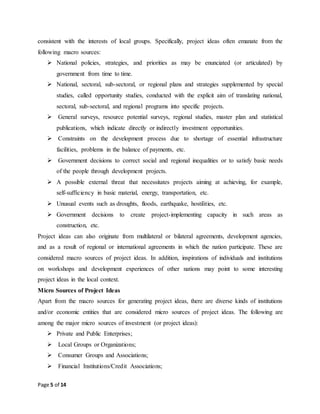
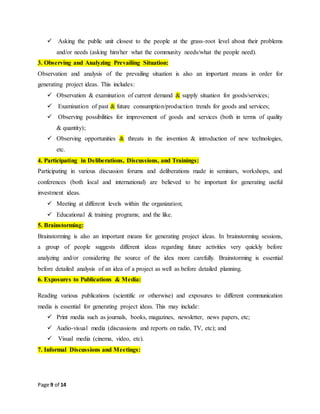
Project Idea Generation Process
The aspects indicated in 1 through 7 below more or less explain the process of generating project
ideas.
1. Survey & Review of Endowments and Facilities (Infrastructures):
Surveying, reviewing, and analyzing existing policies, resource endowments, and socio-
economic variables.
 Natural Resources: review of the natural resource endowments of the country.
 Human Resource: review of educational standards and facilities.
 Socio-Economic Variables: review of various socio-economic factors. This, among
others, includes:
 Housing facilities & standards;
 Utilities services;
 Health and nutrition services; and
 Income distribution.
2. Field Survey and Interview:
This includes asking people regarding what goods or services they want, which helps to identify
if any unsatisfied need exists. It also involves:
 Obtaining information about their existing problems may be through directly asking them
(i.e. people about what their problems are).
Page 9 of 14
 Asking the public unit closest to the people at the grass-root level about their problems
and/or needs (asking him/her what the community needs/what the people need).
3. Observing and Analyzing Prevailing Situation:
Observation and analysis of the prevailing situation is also an important means in order for
generating project ideas. This includes:
 Observation & examination of current demand & supply situation for goods/services;
 Examination of past & future consumption/production trends for goods and services;
 Observing possibilities for improvement of goods and services (both in terms of quality
& quantity);
 Observing opportunities & threats in the invention & introduction of new technologies,
etc.
4. Participating in Deliberations, Discussions, and Trainings:
Participating in various discussion forums and deliberations made in seminars, workshops, and
conferences (both local and international) are believed to be important for generating useful
investment ideas.
 Meeting at different levels within the organization;
 Educational & training programs; and the like.
5. Brainstorming:
Brainstorming is also an important means for generating project ideas. In brainstorming sessions,
a group of people suggests different ideas regarding future activities very quickly before
analyzing and/or considering the source of the idea more carefully. Brainstorming is essential
before detailed analysis of an idea of a project as well as before detailed planning.
6. Exposures to Publications & Media:
Reading various publications (scientific or otherwise) and exposures to different communication
media is essential for generating project ideas. This may include:
 Print media such as journals, books, magazines, newsletter, news papers, etc;
 Audio-visual media (discussions and reports on radio, TV, etc); and
 Visual media (cinema, video, etc).
7. Informal Discussions and Meetings:
Page 10 of 14
In addition to the above aspects, it is also useful to take note of ideas thrown in informal (or non-
formal) discussions and meetings. This also includes exchange of ideas in friendship/fraternal
gatherings and get-togethers.
In a nut shell, all the above aspects and/or procedures might eventually lead to the generation of
project ideas about which we develop feeling of feasibility. The individual(s) or entities
generating the idea(s) develop a kind of feeling that the identified project(s) might be feasible
candidate(s) for further and more detailed analysis, appraisal, and implementation.
Therefore, the feeling of feasibility is a good basis for identification of potentially promising
projects that worth considering. Eventually, the project idea generated becomes an eligible
candidate for further study and preparation. Such ideas need be thoroughly analyzed and
assessed based on tangible facts and data.
Approaches to Project Idea Generation
Broadly speaking, project ideas are said to be generated through one of the following two
approaches: Top –Down (Macro) Approach or Bottom – Up (Micro) Approach. Each of these
approaches is discussed next.
Top – Down Approach
It is an approach whereby individuals at the micro level, or grass root level, are not involved in
the process of project idea generation.
 Projects are identified at higher planning (or macro) level and implemented at the
decision of officials at the top.
 It is based on the national plan and strategies.
The Government need not go down because the problem might be understandable. However,
such projects may not relate to the existing reality in particular vicinity and hence, might
encounter resistance and/or implementation constraints, as the people in the context might lack
interest to cooperate with. The exhibit depicts the general framework of the top – down approach
for project idea generation.
Page 11 of 14
Broader and wider in coverage
Directly derived from the broader Issues at a given local area
Issues at a given area
In general, the top-down approach for project idea generation helps to identify implementation
entities at given local area that may or may not be consistent with the needs in the context. In
other words, such projects have long-term orientations that, perhaps, need not necessarily be
compatible with the existing reality in the locality.
Bottom – Up Approach
A bottom – up idea generation process requires base line surveys, which is based on the realities
existing in different localities.
 Such projects might be easy to implement (or realize) due to their fitness to the realities
in a given context.
 May get community support, successfully implemented, and the potential benefits might
easily be visualized (seen) by the society. This may help to create good will and positive
images towards the institution.
Exhibit 3.3: Bottom – Up Approach
National Plan (A)
� Norms & Values;
� Development Priorities &
Strategies;
� Constraints; and so on.
Draft Plan
Framework of (A)
Local Area
Local Area B
[Development opportunities,
priorities, and strategies;
Key development problems,
constraints, and barriers]
Local Area C
[Views of the people and
their representatives]
Project Ideas
(Implementation entities at a given Local Area that
may not
necessarily reflect the realities in the locality)
Page 12 of 14
Project Identification: Steps and Problems
Steps in Project Identification
Project identification generally involves four major steps. These are:
 Step 1: Generation of project ideas;
 Step 2: Screening of project ideas (giving priorities based on resources, compatibility to
objectives, its potentials to enhance competitiveness, and value adding in the society);
 Step 3: Identification of candidate projects passing the screening criteria; and
 Step 4: Propose for pre-feasibility/feasibility studies.
In this regard, once a list of project ideas has been put forward, the first step is to select one or
more of them as potentially promising.
This calls for a quick preliminary screening by experienced professionals who could also modify
some of the proposals. At this stage, the screening criteria are vague and rough, that become
specific and refined as project planning advances. During the preliminary screening, to eliminate
ideas that prima facie are not promising, it is required to look into aspects pertaining to the
following:
 Compatibility with the promoter,
 Consistency with government priorities,
 Availability of inputs,
 Adequacy of market,
 Reasonableness of costs, and
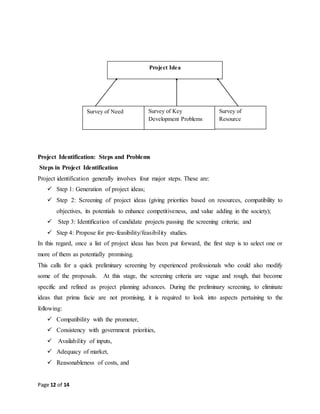
Project Idea
Survey of Need Survey of
Resource
Survey of Key
Development Problems
Page 13 of 14
 Acceptability of risk level.
During preliminary selection, the analyst should eliminate project proposals that:
 Are technically unsound and risky;
 Have no market for the output;
 Have inadequate supply of inputs;
 Are very costly in relation to benefits; and
 Assume an overambitious sales and profitability target.
Obviously, since the criteria tend to be somewhat nebulous (vague, imprecise, and ill defined),
much depends on the experiences and sense of objectivity of the professionals applying them. It
is, however, necessary to conduct this screening, even with indistinct criteria, in order to reduce
the number of project alternatives to a manageable level to which more work and time will be
devoted.
Indeed, project planning can be viewed as a process of elimination, i.e. elimination of inferior
alternatives. As a result of the preliminary screening exercise, a project profile, an opportunity
study report, or an identification study report, as appropriate, is prepared showing which project
alternatives should be rejected and which ones may be advanced to the next stage.
Problems in Project Identification
Ambiguity regarding the Development Goals (Objectives) of the nation:
 People may not clearly identify the national development goals.
 The development goals may not be well communicated, may not be in the best interests
of some groups, or may not get full-hearted acceptance from the public.
Priority Issues in the Existing Development Goals (Objectives):
 Conflict of views regarding the development priorities and goals set (that might entail
lack of interest & commitment).
 Differences in views regarding critical aspects of national priority.
 Differences in prioritizing sectoral goals & objectives.
Limited Data and Obstacles in Information Flow and accessibility:
 Problems in data and information flow;
 Constraint (bottlenecks) for accessing data;
 Limited availability of data & information;
 Data may not be dependable (reliable) for use; and so on.
Page 14 of 14
Conflict of Interest between Local Beneficiary Groups [as some group(s) might bear the
cost while benefits accruing to others].
 What are the costs & benefits of identified projects?
 Who bears the costs & benefits in the society?
 Is benefits accruing to other groups while the cost paid by a given local group (unit)?
 Find mechanisms to compensate those bearing the costs.
 Unless compensated otherwise, the consequences might be unfavorable, severe, and
costly as well.

Project chapter three.doc

  • 1.
    Page 1 of14 CHAPTER 3 PROJECT IDENTIFICATION Introduction Project identification is the process of searching for and subsequently finding potential projects that might be realized to generate benefits in excess of costs that accrue to the society and contribute towards the attainment of development objectives. The generation of promising investment (and/or project) ideas is among the major stages in the project cycle. It is the first stage in the project planning process. Project identification is made in rather general terms with broader scope at the first glance and then, the idea will be progressively developed. According to the UNIDO model, opportunity studies and/or assessments of existing investment opportunities are considered very essential and hence, should precede the task of identification. Opportunity studies generally provide useful insights about possible/potential areas for investments. Generally speaking, a range of alternative project ideas needs to be considered, and even alternative versions of the same project may be conceived. 3.1.1. Who Identifies Projects? There are quite large number of institutions and/or groups that often identify investment opportunities (or generate project ideas) in the society. These entities may be private firms, public enterprises, government units, local or international development agencies, financial institutions, as well as profit seeking or not-for-profit organizations. Listed below are the major groups that are involved, by and large, in the identification of projects in the society:  Small producers’ organizations/producers’ unions;  Large scale individual private sector producers;  Product marketing organizations;  Private sector companies (local/multinational);  State owned enterprises & organizations;  Government ministries, authorities, agencies, and commissions;  Development banks (local as well as foreign);  International development agencies, aid agencies, and self-aid associations;
  • 2.
    Page 2 of14  Local governments and state, regional, and sub-regional authorities  Local political & pressure groups such as opposition parties;  Local and/or international NGOs;  Credit institutions (such as credit unions, savings and loan associations, saving banks, commercial banks) and cooperatives; and so on. How Project Ideas Come About The idea of a project may come to our mind basically from observing existing opportunities and problems in a given context. Such ideas generally emanate from one or a combination of the following:  Polices review & opportunity studies made by central government ministries;  Sectoral strategies & sub-sectoral programs of technical ministries such as ministries for health, agriculture, tourism, education, etc;  Surveys conducted by local governments and regional organizations; Review of past projects;  Private sector, cooperatives, and state enterprise plans;  Investment identification missions by development banks and other donors;  Brainstorming (bright ideas) through unsystematic discussions;  Observation of constraints, problems, and limiting factors/bottlenecks;  Need analysis (existence of unsatisfied demand); and  Need to tackle unexpected or undesirable events such as drought, earthquake, flood, natural catastrophes, and other similar hazards. Pre-Identification and Identification of Projects Pre-Identification “Pre-Identification” is an important prerequisite to the identification of promising investment projects. The pre-identification stage involves surveying, reviewing, inventorying, and analysis of strategies and policies, data about natural resources, and socio-economic variables. This stage is a synonym to opportunity study under the UNIDO cycle, which is a very important phase in project planning. Unfortunately, this aspect of planning is either totally ignored or for which inadequate resources are provided in most developing countries. There are a number of reasons for disregarding this aspect in project planning:
  • 3.
    Page 3 of14  First and, perhaps, most important of all is the sheer ignorance: to learn its importance and to identify ways of carrying out surveys; inventorying of resources; collection, organization, and integrating data; and analyzing the information cost-effectively and generating useful information.  Secondly, such work tends to be regarded as an extensive task resulting in excessive overhead costs. Moreover, funds for such activities often are expended in tight schedules during end of budget period.  Thirdly, much of the work has tended to be time consuming and, thus, people lack the initiatives to start it as well as unable to foresee & measure its benefits. They often do not have the patience to wait for results. Nowadays, modern technology is revolutionizing the survey methods and the means for carrying out synthesis and analysis, speeding up some processes, reducing the costs of surveys, and providing new ways of looking at things. Identifying existing gaps, generating useful information, accomplishing analysis of data, and throwing up ideas for possible projects is a pre- requisite to sound project formulation. In order to come up with sound and/or useful project ideas, we need to carryout project identifications within national, regional, and sectoral development framework and existing policies including pricing, taxation, and subsidy. Otherwise, much time and effort might be wasted in the process of identifying and preparing projects that might be inconsistent with existing policies, strategies, and priorities, which might turnout to be not viable by the end of the day. Thus, those who are responsible for identifying projects need to be aware of accepted strategies and policies as well as be in a position to feedback information to those who are responsible for formulating policies. Project Identification The search for promising project ideas is the first step towards establishing a successful venture. The key to success lays in getting into the right business at the right time. The objective is to identify investment opportunities, which are prima facie feasible and promising and merit further examination and appraisal. Project identification is the process of finding projects that could contribute towards achieving specified development objectives. In principle, project identification should be an integral part of
  • 4.
    Page 4 of14 the macro-planning exercise, with sectoral information and strategies being the main sources of project ideas. In practice, projects often are not derived from national and/or sectoral plans, however. Instead, projects may originate from several sources. Irrespective of their origin, project ideas generally should aim at overcoming constraints on the national development efforts (be it material, human, or institutional constraint) or at meeting unsatisfied needs/ demand for goods and services. The prevailing constraints, needs, and demands should be interpreted broadly to include, for instance, foreign exchange constraints that might indicate the need to undertake projects for export promotion or import substitution. The variety of projects makes it impossible to prepare an exhaustive list of sources from where project ideas emanate; but much depending on the experience and imagination of those entrusted with the task of initiating development project. In general, one can distinguish two levels where project ideas are born: macro-level and the micro-level. Macro – Versus Micro – Sources of Project Ideas Macro Sources of Project Ideas Among the various institutions and sources, the following macro sources are considered the major ones in order to generate project ideas, especially in developing countries:  Federal/Central or Regional Governments;  Bilateral and Multilateral Agreement; and  International Development Agencies. In general, in developing countries, the government remains to be the major source of project ideas. The following are presumed to be the major reasons for governments to be important sources of project ideas in developing and/or underdeveloped nations:  They often have the necessary resources for undertaking opportunity studies;  They do also have unlimited access to data & information;  They do have the required facilities to conduct survey, studies, and reviews; Moreover, such governments are fully familiar with the development objectives, priorities, and strategies. In this regard, the development goals, priorities, and strategies often are not clearly communicated groups (individuals and/or institutions) at micro-level. The development goals in such contexts also seem to be ambiguous to groups at the micro-level and/or may not be
  • 5.
    Page 5 of14 consistent with the interests of local groups. Specifically, project ideas often emanate from the following macro sources:  National policies, strategies, and priorities as may be enunciated (or articulated) by government from time to time.  National, sectoral, sub-sectoral, or regional plans and strategies supplemented by special studies, called opportunity studies, conducted with the explicit aim of translating national, sectoral, sub-sectoral, and regional programs into specific projects.  General surveys, resource potential surveys, regional studies, master plan and statistical publications, which indicate directly or indirectly investment opportunities.  Constraints on the development process due to shortage of essential infrastructure facilities, problems in the balance of payments, etc.  Government decisions to correct social and regional inequalities or to satisfy basic needs of the people through development projects.  A possible external threat that necessitates projects aiming at achieving, for example, self-sufficiency in basic material, energy, transportation, etc.  Unusual events such as droughts, floods, earthquake, hostilities, etc.  Government decisions to create project-implementing capacity in such areas as construction, etc. Project ideas can also originate from multilateral or bilateral agreements, development agencies, and as a result of regional or international agreements in which the nation participate. These are considered macro sources of project ideas. In addition, inspirations of individuals and institutions on workshops and development experiences of other nations may point to some interesting project ideas in the local context. Micro Sources of Project Ideas Apart from the macro sources for generating project ideas, there are diverse kinds of institutions and/or economic entities that are considered micro sources of project ideas. The following are among the major micro sources of investment (or project ideas):  Private and Public Enterprises;  Local Groups or Organizations;  Consumer Groups and Associations;  Financial Institutions/Credit Associations;
  • 6.
    Page 6 of14  Cooperatives, Farmers’ Unions, etc;  New Technology Suppliers and so on. In general, project ideas that emanate from the micro-sources are obtained (and/or generated) based on one or many of the following conditions:  The identification of unsatisfied demand or needs;  The existence of unused or underutilized natural or human resources and the perception of opportunities for their efficient use;  The need to remove shortages in essential materials, services, or facilities that constrain development efforts;  The initiative of private or public enterprises in response to incentives provided by the government;  The necessity to complement or expand investments previously undertaken;  The desire of local groups or organizations to enhance their economic status and improve their welfare; Moreover, the following techniques and/or procedures can be adopted in order to generate project ideas from micro sources:  Analyze the performance of existing industries;  Examine the inputs and outputs of various industries;  Review imports and exports;  Look at the suggestions of financial institutions and development agencies;  Investigate local materials and resources;  Analyze economic and social trends;  Study new technological developments;  Draw clues from consumptions abroad;  Explore the possibility of reviving sick units;  Attend trade-fairs (trade promotions/bazaars); and so on. Project proposals may also come from multinational firms, in response to government investment incentives or else when such firms consider production within the country is a better way to secure a substantial share of the domestic market for their products. Project Identification Studies and Process of Idea Generation
  • 7.
    Page 7 of14 Identification Studies When we are more concerned about project identification, the formal task of conducting identification studies, (opportunity studies), is one of the best available option to project planners, which is critically important to generate and/or come up with useful information. Objective of Identification Studies: The major objective of identification studies is to collect sufficient data and/or generate beneficial information concerning the background, technical, economic, social, and environmental aspect of a potential project. In general, there are four approaches for conducting project identification studies. These are area studies, industrial studies, resource-based studies, and sectoral studies. In this regard, each of the approaches focuses on relatively unique aspects and pay attention to some important variables (or considerations). One may follow any one of these approaches depending on the appropriateness for the type of project being pursued and the significance it has to the concerned. Exhibit 3.1 depicts the main approaches for project identification studies together with the relevant aspects to be assessed and the major considerations therein. Approaches Aspects Considerations Area Studies Identification of opportunities in given area such as localities, regions, states, etc. � The objective is to bring balanced development among areas. Backward areas (less developed and/or marginalized areas). Industry Studies � Identification of opportunities in the industrial sector. � Specific marketable product: � Diversification opportunities; � Import substitution and export possibilities; etc. Development plans & programs; investment policies; economic policies; and industrial policies Resource-Based Opportunities in exploiting natural Resource allocation
  • 8.
    Page 8 of14 Studies resources: � Natural resource analysis; � Import substitution; � Export possibilities; etc. & utilization policies; industrial policies; and other polices & priorities. Sectoral Analysis/ Studies Satisfaction of social needs/removing sectoral problems: � Agriculture sector, � Manufacturing sector, � Health sector, � Education sector, � Service sector, etc. Sectoral strategies; sectoral priorities; existing unsatisfied needs; sectoral development level; etc. Project Idea Generation Process The aspects indicated in 1 through 7 below more or less explain the process of generating project ideas. 1. Survey & Review of Endowments and Facilities (Infrastructures): Surveying, reviewing, and analyzing existing policies, resource endowments, and socio- economic variables.  Natural Resources: review of the natural resource endowments of the country.  Human Resource: review of educational standards and facilities.  Socio-Economic Variables: review of various socio-economic factors. This, among others, includes:  Housing facilities & standards;  Utilities services;  Health and nutrition services; and  Income distribution. 2. Field Survey and Interview: This includes asking people regarding what goods or services they want, which helps to identify if any unsatisfied need exists. It also involves:  Obtaining information about their existing problems may be through directly asking them (i.e. people about what their problems are).
  • 9.
    Page 9 of14  Asking the public unit closest to the people at the grass-root level about their problems and/or needs (asking him/her what the community needs/what the people need). 3. Observing and Analyzing Prevailing Situation: Observation and analysis of the prevailing situation is also an important means in order for generating project ideas. This includes:  Observation & examination of current demand & supply situation for goods/services;  Examination of past & future consumption/production trends for goods and services;  Observing possibilities for improvement of goods and services (both in terms of quality & quantity);  Observing opportunities & threats in the invention & introduction of new technologies, etc. 4. Participating in Deliberations, Discussions, and Trainings: Participating in various discussion forums and deliberations made in seminars, workshops, and conferences (both local and international) are believed to be important for generating useful investment ideas.  Meeting at different levels within the organization;  Educational & training programs; and the like. 5. Brainstorming: Brainstorming is also an important means for generating project ideas. In brainstorming sessions, a group of people suggests different ideas regarding future activities very quickly before analyzing and/or considering the source of the idea more carefully. Brainstorming is essential before detailed analysis of an idea of a project as well as before detailed planning. 6. Exposures to Publications & Media: Reading various publications (scientific or otherwise) and exposures to different communication media is essential for generating project ideas. This may include:  Print media such as journals, books, magazines, newsletter, news papers, etc;  Audio-visual media (discussions and reports on radio, TV, etc); and  Visual media (cinema, video, etc). 7. Informal Discussions and Meetings:
  • 10.
    Page 10 of14 In addition to the above aspects, it is also useful to take note of ideas thrown in informal (or non- formal) discussions and meetings. This also includes exchange of ideas in friendship/fraternal gatherings and get-togethers. In a nut shell, all the above aspects and/or procedures might eventually lead to the generation of project ideas about which we develop feeling of feasibility. The individual(s) or entities generating the idea(s) develop a kind of feeling that the identified project(s) might be feasible candidate(s) for further and more detailed analysis, appraisal, and implementation. Therefore, the feeling of feasibility is a good basis for identification of potentially promising projects that worth considering. Eventually, the project idea generated becomes an eligible candidate for further study and preparation. Such ideas need be thoroughly analyzed and assessed based on tangible facts and data. Approaches to Project Idea Generation Broadly speaking, project ideas are said to be generated through one of the following two approaches: Top –Down (Macro) Approach or Bottom – Up (Micro) Approach. Each of these approaches is discussed next. Top – Down Approach It is an approach whereby individuals at the micro level, or grass root level, are not involved in the process of project idea generation.  Projects are identified at higher planning (or macro) level and implemented at the decision of officials at the top.  It is based on the national plan and strategies. The Government need not go down because the problem might be understandable. However, such projects may not relate to the existing reality in particular vicinity and hence, might encounter resistance and/or implementation constraints, as the people in the context might lack interest to cooperate with. The exhibit depicts the general framework of the top – down approach for project idea generation.
  • 11.
    Page 11 of14 Broader and wider in coverage Directly derived from the broader Issues at a given local area Issues at a given area In general, the top-down approach for project idea generation helps to identify implementation entities at given local area that may or may not be consistent with the needs in the context. In other words, such projects have long-term orientations that, perhaps, need not necessarily be compatible with the existing reality in the locality. Bottom – Up Approach A bottom – up idea generation process requires base line surveys, which is based on the realities existing in different localities.  Such projects might be easy to implement (or realize) due to their fitness to the realities in a given context.  May get community support, successfully implemented, and the potential benefits might easily be visualized (seen) by the society. This may help to create good will and positive images towards the institution. Exhibit 3.3: Bottom – Up Approach National Plan (A) � Norms & Values; � Development Priorities & Strategies; � Constraints; and so on. Draft Plan Framework of (A) Local Area Local Area B [Development opportunities, priorities, and strategies; Key development problems, constraints, and barriers] Local Area C [Views of the people and their representatives] Project Ideas (Implementation entities at a given Local Area that may not necessarily reflect the realities in the locality)
  • 12.
    Page 12 of14 Project Identification: Steps and Problems Steps in Project Identification Project identification generally involves four major steps. These are:  Step 1: Generation of project ideas;  Step 2: Screening of project ideas (giving priorities based on resources, compatibility to objectives, its potentials to enhance competitiveness, and value adding in the society);  Step 3: Identification of candidate projects passing the screening criteria; and  Step 4: Propose for pre-feasibility/feasibility studies. In this regard, once a list of project ideas has been put forward, the first step is to select one or more of them as potentially promising. This calls for a quick preliminary screening by experienced professionals who could also modify some of the proposals. At this stage, the screening criteria are vague and rough, that become specific and refined as project planning advances. During the preliminary screening, to eliminate ideas that prima facie are not promising, it is required to look into aspects pertaining to the following:  Compatibility with the promoter,  Consistency with government priorities,  Availability of inputs,  Adequacy of market,  Reasonableness of costs, and Project Idea Survey of Need Survey of Resource Survey of Key Development Problems
  • 13.
    Page 13 of14  Acceptability of risk level. During preliminary selection, the analyst should eliminate project proposals that:  Are technically unsound and risky;  Have no market for the output;  Have inadequate supply of inputs;  Are very costly in relation to benefits; and  Assume an overambitious sales and profitability target. Obviously, since the criteria tend to be somewhat nebulous (vague, imprecise, and ill defined), much depends on the experiences and sense of objectivity of the professionals applying them. It is, however, necessary to conduct this screening, even with indistinct criteria, in order to reduce the number of project alternatives to a manageable level to which more work and time will be devoted. Indeed, project planning can be viewed as a process of elimination, i.e. elimination of inferior alternatives. As a result of the preliminary screening exercise, a project profile, an opportunity study report, or an identification study report, as appropriate, is prepared showing which project alternatives should be rejected and which ones may be advanced to the next stage. Problems in Project Identification Ambiguity regarding the Development Goals (Objectives) of the nation:  People may not clearly identify the national development goals.  The development goals may not be well communicated, may not be in the best interests of some groups, or may not get full-hearted acceptance from the public. Priority Issues in the Existing Development Goals (Objectives):  Conflict of views regarding the development priorities and goals set (that might entail lack of interest & commitment).  Differences in views regarding critical aspects of national priority.  Differences in prioritizing sectoral goals & objectives. Limited Data and Obstacles in Information Flow and accessibility:  Problems in data and information flow;  Constraint (bottlenecks) for accessing data;  Limited availability of data & information;  Data may not be dependable (reliable) for use; and so on.
  • 14.
    Page 14 of14 Conflict of Interest between Local Beneficiary Groups [as some group(s) might bear the cost while benefits accruing to others].  What are the costs & benefits of identified projects?  Who bears the costs & benefits in the society?  Is benefits accruing to other groups while the cost paid by a given local group (unit)?  Find mechanisms to compensate those bearing the costs.  Unless compensated otherwise, the consequences might be unfavorable, severe, and costly as well.