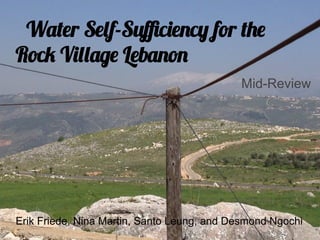
Water Self-Sufficiency for the
Rock Village Lebanon
                                            Mid-Review


Erik Friede, Nina Martin, Santo Leung, and Desmond Ngochi
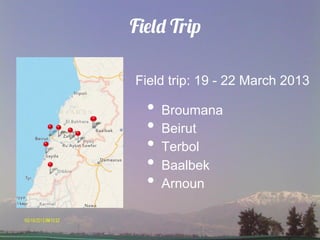
Field Trip

Field trip: 19 - 22 March 2013

  •  Broumana
  •  Beirut
  •  Terbol
  •  Baalbek
  •  Arnoun
Before the trip
•  Reclaimed land since 2000
•  1st year SGT group's focus on renewable
     energy sources
•    Hydrological and geological report on the
     region
•    Established Al-Amal NGO
•    Two years of farming on parts of the land
•    Experience with 5 types of native seeds
     o    Faba beans, chickpeas, wheat, bulgur, lentils
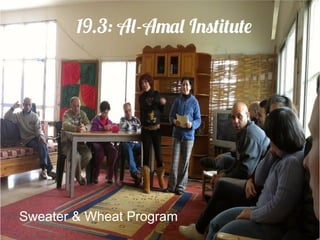
19.3: Al-Amal Institute


Sweater & Wheat Program
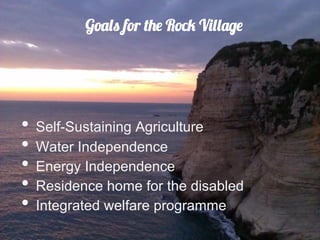
Goals for the Rock Village


•  Self-Sustaining Agriculture
•  Water Independence
•  Energy Independence
•  Residence home for the disabled
•  Integrated welfare programme
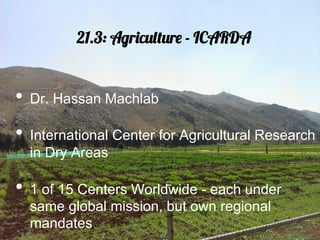
21.3: Agriculture - ICARDA


•  Dr. Hassan Machlab
•  International Center for Agricultural Research
  in Dry Areas

•  1 of 15 Centers Worldwide - each under
  same global mission, but own regional
  mandates
ICARDA
Primary goal in Lebanon:
   o    to provide farmers with technology to increase
        production
   o    to optimise agricultural methods through training


•  Breed appropriate seeds for a specific region
•  Market relevance and value of native seeds
•  access to regions largest gene bank in Syria
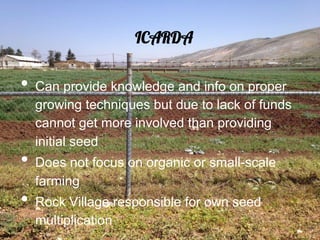
ICARDA

•  Can provide knowledge and info on proper
  growing techniques but due to lack of funds
  cannot get more involved than providing
  initial seed
•  Does not focus on organic or small-scale
  farming
•  Rock Village responsible for own seed
  multiplication
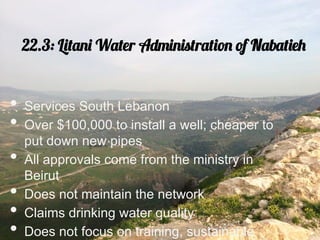
22.3: Litani Water Administration of Nabatieh


•  Services South Lebanon
•  Over $100,000 to install a well; cheaper to
     put down new pipes
•    All approvals come from the ministry in
     Beirut
•    Does not maintain the network
•    Claims drinking water quality
•    Does not focus on training, sustainable
22.3: Confederation of Municipalities Union
               of Shqif Region
Primary problems to address regionally:
1. Water
   - Only 40% of ground water harvested is
   actually distributed
   - Other 60% stolen/wasted due to poor
   maintenance
2. Electricity
  - only 6 hours of electricity from the grid
  - private generators use costly fuel
3. Infrastructure
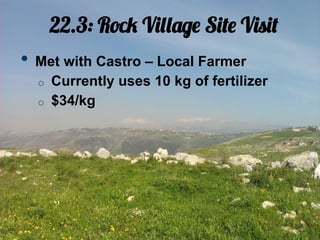
22.3: Rock Village Site Visit
•  Met with Castro – Local Farmer
  o    Currently uses 10 kg of fertilizer
  o    $34/kg
Fawaz Katby - Mayor of Arnoun


•  Village receives water - 400 m3/week
•  Addition of wells --> 90m3/hour
•  Requires 2 pumps, supported by diesel
     generators during eletricity cuts
•    Considers new well as long-term solution
•    Plans to demolish rain water reservoir
•    Tobacco farms use waste water
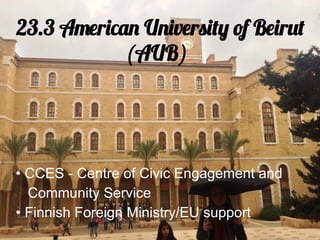
23.3 American University of Beirut
            (AUB)


• CCES - Centre of Civic Engagement and
  Community Service
• Finnish Foreign Ministry/EU support
What We Learned
•  Government is unreliable and ineffective
•  People search for short-term solutions
•  Very little concern for conservation of
     resources
•    Corruption affects foreign financial aid


AUB wants to get involved, but need more data
and hard scientific research before they can
create the program
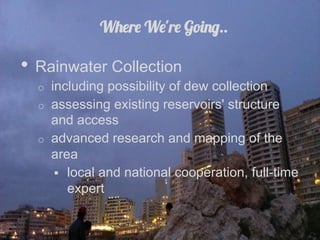
Where We're Going..

•  Rainwater Collection
  o  including possibility of dew collection
  o  assessing existing reservoirs' structure
     and access
  o  advanced research and mapping of the
     area
        local and national cooperation, full-time
         expert
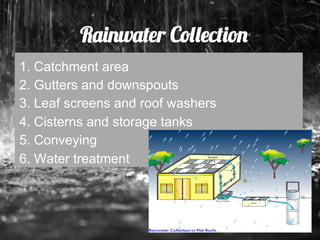
Rainwater Collection
1.  Catchment area
2.  Gutters and downspouts
3.  Leaf screens and roof washers
4.  Cisterns and storage tanks
5.  Conveying
6.  Water treatment
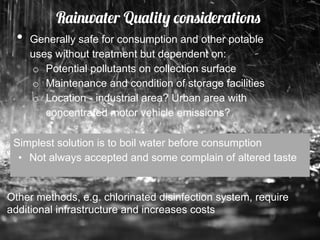
Rainwater Quality considerations
  •  Generally safe for consumption and other potable
    uses without treatment but dependent on:
    o  Potential pollutants on collection surface
    o  Maintenance and condition of storage facilities
    o  Location - industrial area? Urban area with
       concentrated motor vehicle emissions?

 Simplest solution is to boil water before consumption
  •  Not always accepted and some complain of altered taste


Other methods, e.g. chlorinated disinfection system, require
additional infrastructure and increases costs
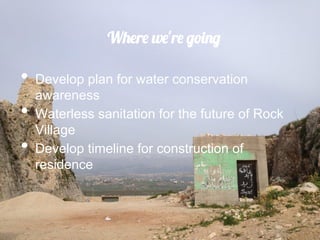
Where we're going

•  Develop plan for water conservation
     awareness
•    Waterless sanitation for the future of Rock
     Village
•    Develop timeline for construction of
     residence
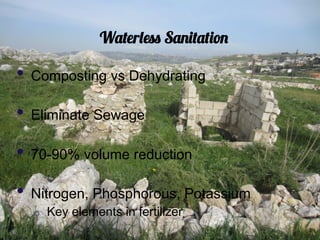
Waterless Sanitation

•  Composting vs Dehydrating
•  Eliminate Sewage
•  70-90% volume reduction
•  Nitrogen, Phosphorous, Potassium
  o  Key elements in fertilizer
Where We're Going..
•  Agriculture implementation plan
  o  seed multiplication
  o  possibility of rock village becoming agricultural
     learning center
  o  sustainable farming methods

Rock Village - SGT course mid-review

  • 1.
    Water Self-Sufficiency forthe Rock Village Lebanon Mid-Review Erik Friede, Nina Martin, Santo Leung, and Desmond Ngochi
  • 2.
    Field Trip Field trip:19 - 22 March 2013 •  Broumana •  Beirut •  Terbol •  Baalbek •  Arnoun
  • 3.
    Before the trip • Reclaimed land since 2000 •  1st year SGT group's focus on renewable energy sources •  Hydrological and geological report on the region •  Established Al-Amal NGO •  Two years of farming on parts of the land •  Experience with 5 types of native seeds o  Faba beans, chickpeas, wheat, bulgur, lentils
  • 4.
  • 5.
    Goals for theRock Village •  Self-Sustaining Agriculture •  Water Independence •  Energy Independence •  Residence home for the disabled •  Integrated welfare programme
  • 6.
    21.3: Agriculture -ICARDA •  Dr. Hassan Machlab •  International Center for Agricultural Research in Dry Areas •  1 of 15 Centers Worldwide - each under same global mission, but own regional mandates
  • 7.
    ICARDA Primary goal inLebanon: o  to provide farmers with technology to increase production o  to optimise agricultural methods through training •  Breed appropriate seeds for a specific region •  Market relevance and value of native seeds •  access to regions largest gene bank in Syria
  • 8.
    ICARDA •  Can provideknowledge and info on proper growing techniques but due to lack of funds cannot get more involved than providing initial seed •  Does not focus on organic or small-scale farming •  Rock Village responsible for own seed multiplication
  • 9.
    22.3: Litani WaterAdministration of Nabatieh •  Services South Lebanon •  Over $100,000 to install a well; cheaper to put down new pipes •  All approvals come from the ministry in Beirut •  Does not maintain the network •  Claims drinking water quality •  Does not focus on training, sustainable
  • 10.
    22.3: Confederation ofMunicipalities Union of Shqif Region Primary problems to address regionally: 1. Water - Only 40% of ground water harvested is actually distributed - Other 60% stolen/wasted due to poor maintenance 2. Electricity - only 6 hours of electricity from the grid - private generators use costly fuel 3. Infrastructure
  • 11.
    22.3: Rock VillageSite Visit •  Met with Castro – Local Farmer o  Currently uses 10 kg of fertilizer o  $34/kg
  • 12.
    Fawaz Katby -Mayor of Arnoun •  Village receives water - 400 m3/week •  Addition of wells --> 90m3/hour •  Requires 2 pumps, supported by diesel generators during eletricity cuts •  Considers new well as long-term solution •  Plans to demolish rain water reservoir •  Tobacco farms use waste water
  • 13.
    23.3 American Universityof Beirut (AUB) • CCES - Centre of Civic Engagement and Community Service • Finnish Foreign Ministry/EU support
  • 14.
    What We Learned • Government is unreliable and ineffective •  People search for short-term solutions •  Very little concern for conservation of resources •  Corruption affects foreign financial aid AUB wants to get involved, but need more data and hard scientific research before they can create the program
  • 15.
    Where We're Going.. • Rainwater Collection o  including possibility of dew collection o  assessing existing reservoirs' structure and access o  advanced research and mapping of the area   local and national cooperation, full-time expert
  • 16.
    Rainwater Collection 1.  Catchmentarea 2.  Gutters and downspouts 3.  Leaf screens and roof washers 4.  Cisterns and storage tanks 5.  Conveying 6.  Water treatment
  • 17.
    Rainwater Quality considerations •  Generally safe for consumption and other potable uses without treatment but dependent on: o  Potential pollutants on collection surface o  Maintenance and condition of storage facilities o  Location - industrial area? Urban area with concentrated motor vehicle emissions? Simplest solution is to boil water before consumption •  Not always accepted and some complain of altered taste Other methods, e.g. chlorinated disinfection system, require additional infrastructure and increases costs
  • 18.
    Where we're going • Develop plan for water conservation awareness •  Waterless sanitation for the future of Rock Village •  Develop timeline for construction of residence
  • 19.
    Waterless Sanitation •  Compostingvs Dehydrating •  Eliminate Sewage •  70-90% volume reduction •  Nitrogen, Phosphorous, Potassium o  Key elements in fertilizer
  • 20.
    Where We're Going.. • Agriculture implementation plan o  seed multiplication o  possibility of rock village becoming agricultural learning center o  sustainable farming methods