INTRODUCTION TO
PROGRAMMING
LANGUAGE - PL101
BY: JOEL A. MANIO
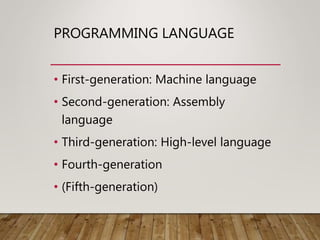
PROGRAMMING LANGUAGE
• First-generation: Machine language
• Second-generation: Assembly
language
• Third-generation: High-level language
• Fourth-generation
• (Fifth-generation)
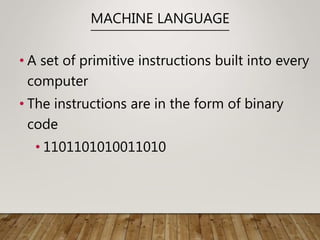
MACHINE LANGUAGE
• A set of primitive instructions built into every
computer
• The instructions are in the form of binary
code
• 1101101010011010
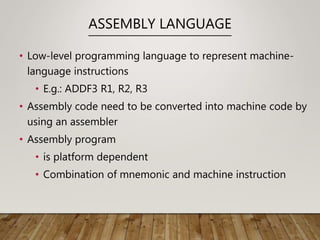
ASSEMBLY LANGUAGE
• Low-level programming language to represent machine-
language instructions
• E.g.: ADDF3 R1, R2, R3
• Assembly code need to be converted into machine code by
using an assembler
• Assembly program
• is platform dependent
• Combination of mnemonic and machine instruction
HIGH-LEVEL LANGUAGE
• English-like and easy to learn and program.
• E.g.:
• Area = 5 * 5 * 3.1415;
• COBOL, FORTRAN, BASIC, Pascal, Ada, C, Visual Basic, Delphi,
C++, C#, Java
• Source program is compiled into machine code by a
compiler and linked to supporting library code by a linker to
form an executable file.
4GL / 5GL
• 3GL offered greater power to the programmer, while
4GL open up the development environment to a wider
population. (Applications Development Without
Programmers)
• Database query languages: SQL…
• Data manipulation, analysis, and reporting languages:
MATLAB, SPSS…
CATEGORY (3GL)
• Windows Application
• C, C++, Java, Visual Basic, C#
• Web Application
• Server Side
• PHP, JSP (Java), ASP.NET (Visual Basic, C#), …
• Client Side
• JaveScript, VBScript
THE BINARY MACHINE
• A modern computer can run programs written in
JavaScript, Pascal, Visual Basic, Visual C++, etc.
• However, computers can only understand one
language: the machine language it is not easy to
use.
• The machine language of a Sun workstation is
different from a PC (or other platform), however,
they can run the same C++ program.
TWO TYPES OF TRANSLATORS
(3GL TO 1GL)
• Interpreter:
• translate and run the source code one line at a time. Easy to
write and easy to find the errors in the program, but
running very slow.
• JavaScript, VBScript, PHP, …
• Compiler:
• translates the source code once and for all, producing a
complete machine language program. Very fast, but when
the program fails, difficult to show the programmer where
are the errors.
• C, C++, Java, C#, and so on.
IMPLEMENT A LANGUAGE
• Generally, the action of any translating program can be divided into
three phases
• Scanning
• Parsing
• Code generation
IMPLEMENT A LANGUAGE - SCANNING
• Scanning process: a long string of characters is broken into tokens.
• Example: sum = a + b is broken into 5 tokens sum, =, a, +, b
• A token is the smallest meaningful unit of information.
IMPLEMENT A LANGUAGE - PARSING
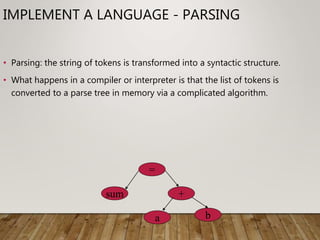
• Parsing: the string of tokens is transformed into a syntactic structure.
• What happens in a compiler or interpreter is that the list of tokens is
converted to a parse tree in memory via a complicated algorithm.
=
sum +
a b
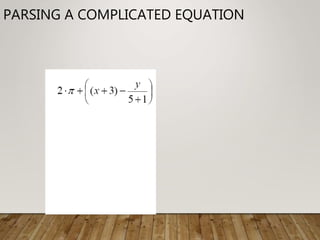
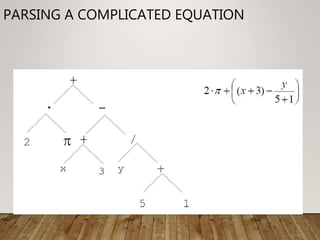
PARSING A COMPLICATED EQUATION

ProgrammingIntroduction.ppt

  • 1.
  • 2.
    PROGRAMMING LANGUAGE • First-generation:Machine language • Second-generation: Assembly language • Third-generation: High-level language • Fourth-generation • (Fifth-generation)
  • 3.
    MACHINE LANGUAGE • Aset of primitive instructions built into every computer • The instructions are in the form of binary code • 1101101010011010
  • 4.
    ASSEMBLY LANGUAGE • Low-levelprogramming language to represent machine- language instructions • E.g.: ADDF3 R1, R2, R3 • Assembly code need to be converted into machine code by using an assembler • Assembly program • is platform dependent • Combination of mnemonic and machine instruction
  • 5.
    HIGH-LEVEL LANGUAGE • English-likeand easy to learn and program. • E.g.: • Area = 5 * 5 * 3.1415; • COBOL, FORTRAN, BASIC, Pascal, Ada, C, Visual Basic, Delphi, C++, C#, Java • Source program is compiled into machine code by a compiler and linked to supporting library code by a linker to form an executable file.
  • 6.
    4GL / 5GL •3GL offered greater power to the programmer, while 4GL open up the development environment to a wider population. (Applications Development Without Programmers) • Database query languages: SQL… • Data manipulation, analysis, and reporting languages: MATLAB, SPSS…
  • 7.
    CATEGORY (3GL) • WindowsApplication • C, C++, Java, Visual Basic, C# • Web Application • Server Side • PHP, JSP (Java), ASP.NET (Visual Basic, C#), … • Client Side • JaveScript, VBScript
  • 8.
    THE BINARY MACHINE •A modern computer can run programs written in JavaScript, Pascal, Visual Basic, Visual C++, etc. • However, computers can only understand one language: the machine language it is not easy to use. • The machine language of a Sun workstation is different from a PC (or other platform), however, they can run the same C++ program.
  • 9.
    TWO TYPES OFTRANSLATORS (3GL TO 1GL) • Interpreter: • translate and run the source code one line at a time. Easy to write and easy to find the errors in the program, but running very slow. • JavaScript, VBScript, PHP, … • Compiler: • translates the source code once and for all, producing a complete machine language program. Very fast, but when the program fails, difficult to show the programmer where are the errors. • C, C++, Java, C#, and so on.
  • 10.
    IMPLEMENT A LANGUAGE •Generally, the action of any translating program can be divided into three phases • Scanning • Parsing • Code generation
  • 11.
    IMPLEMENT A LANGUAGE- SCANNING • Scanning process: a long string of characters is broken into tokens. • Example: sum = a + b is broken into 5 tokens sum, =, a, +, b • A token is the smallest meaningful unit of information.
  • 12.
    IMPLEMENT A LANGUAGE- PARSING • Parsing: the string of tokens is transformed into a syntactic structure. • What happens in a compiler or interpreter is that the list of tokens is converted to a parse tree in memory via a complicated algorithm. = sum + a b
  • 13.
  • 14.