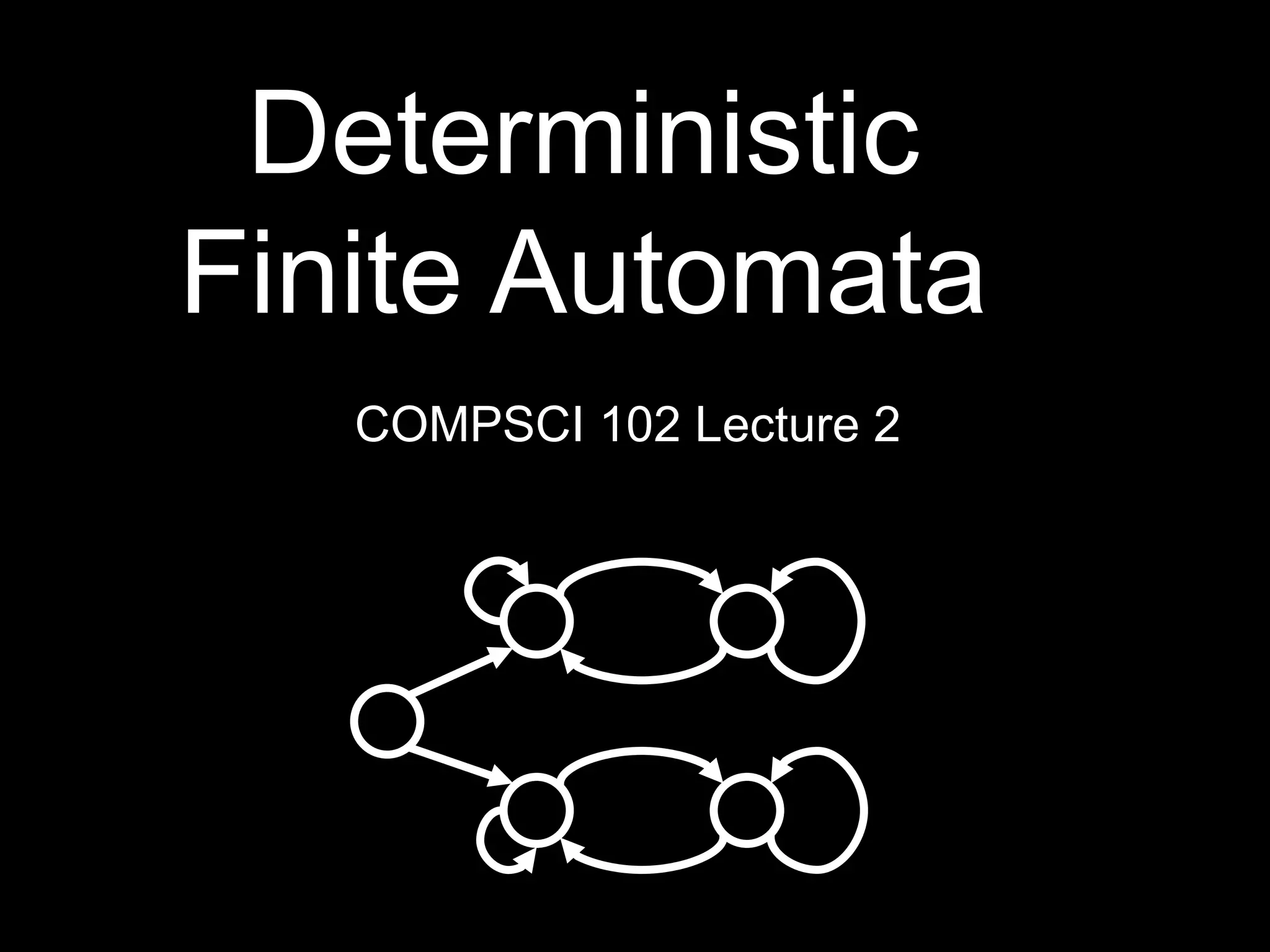
Deterministic
Finite Automata
COMPSCI 102 Lecture 2
Let me show you a
machine so simple
that you can
understand it in less
than two minutes
Steven Rudich:
www.cs.cmu.edu/~rudich
0
0,1
0
0
1
1
1
0111 111
11
1
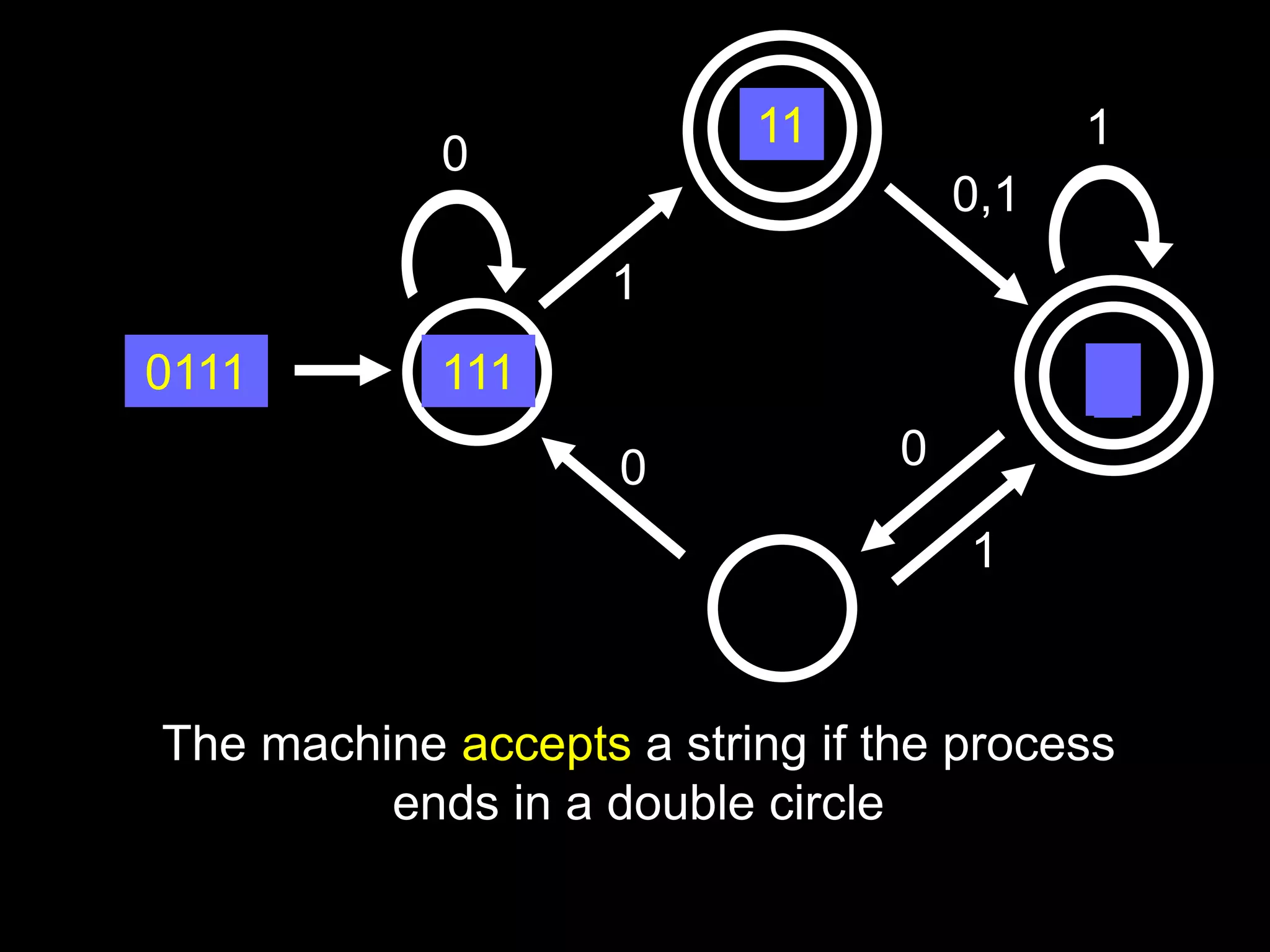
The machine accepts a string if the process
ends in a double circle
Steven Rudich:
www.cs.cmu.edu/~rudich
0
0,1
0
0
1
1
1
The machine accepts a string if the process
ends in a double circle
Anatomy of a Deterministic Finite
Automaton
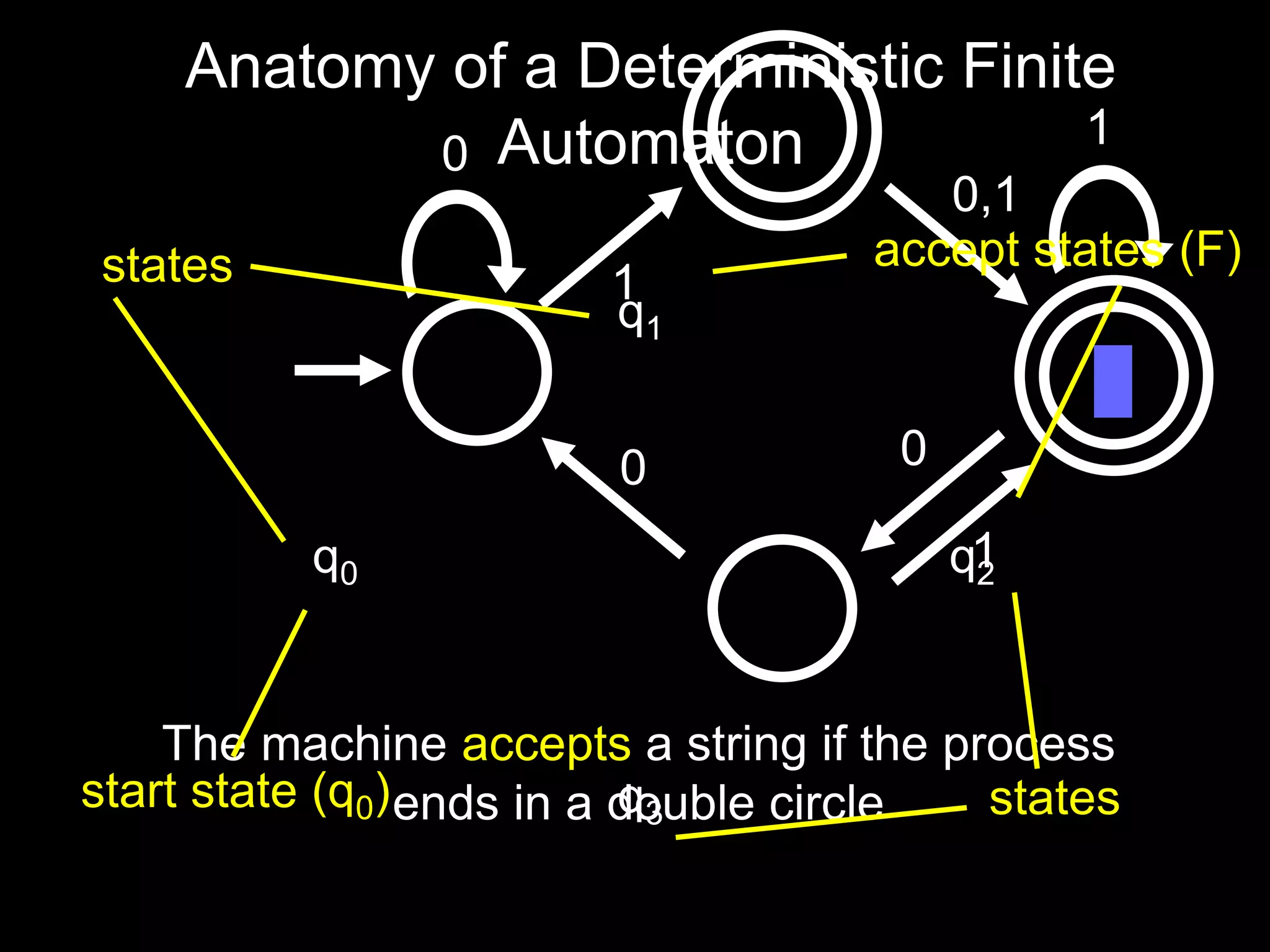
states
states
q0
q1
q2
q3
start state (q0)
accept states (F)
Steven Rudich:
www.cs.cmu.edu/~rudich
Anatomy of a Deterministic Finite
Automaton
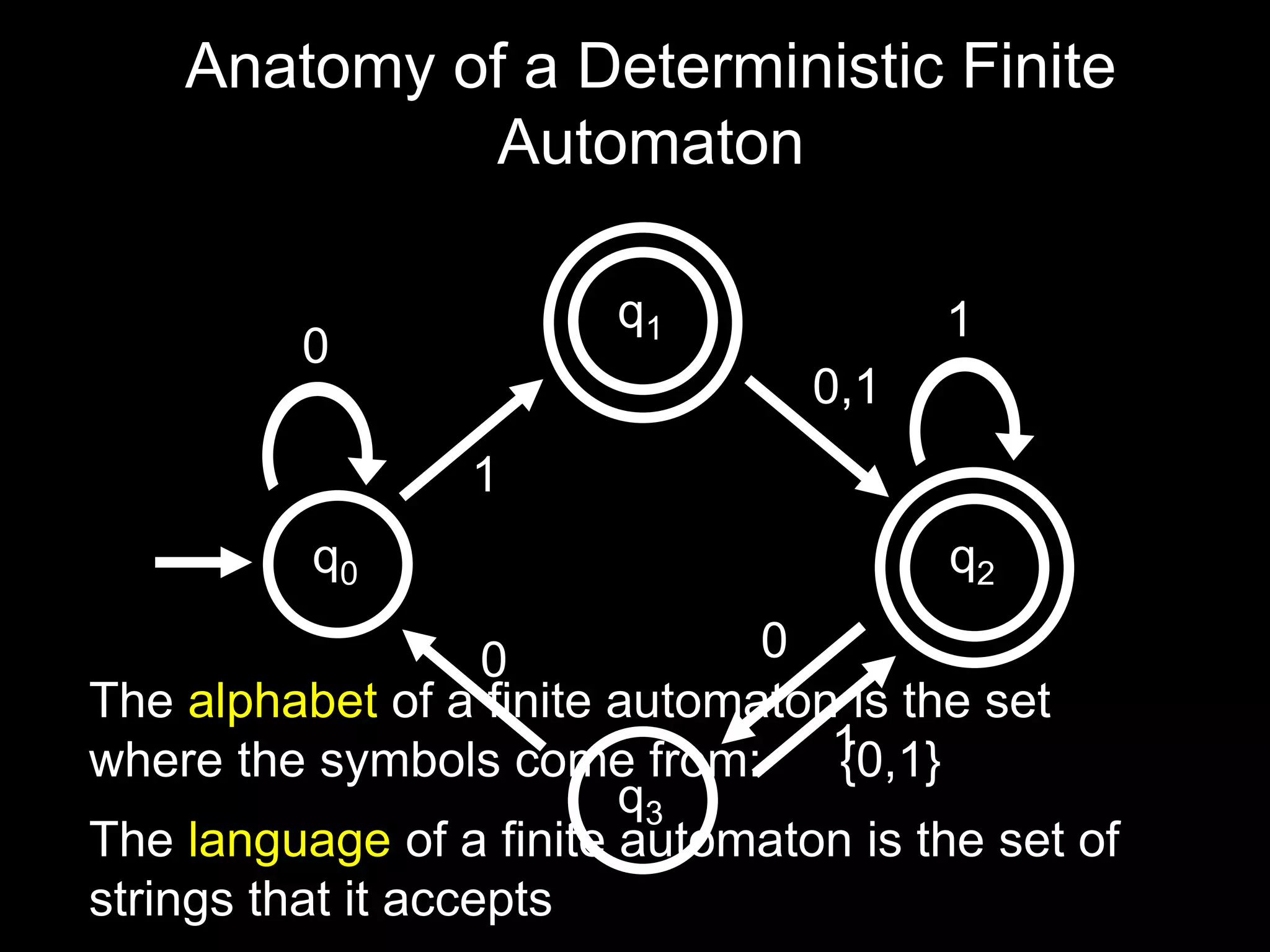
0
0,1
0
0
1
1
1
q0
q1
q2
q3
The alphabet of a finite automaton is the set
where the symbols come from:
The language of a finite automaton is the set of
strings that it accepts
{0,1}
Steven Rudich:
www.cs.cmu.edu/~rudich
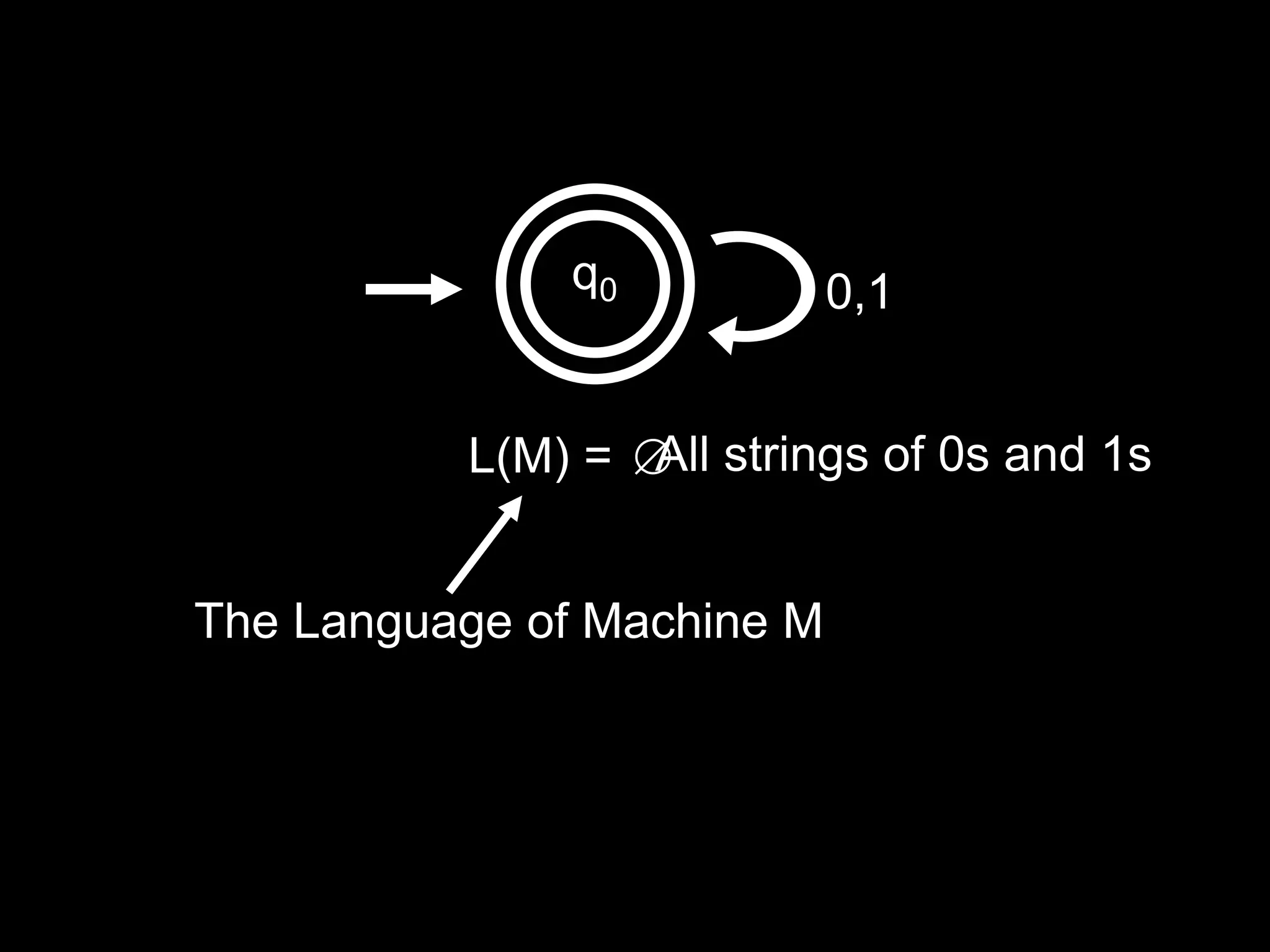
0,1
q0
L(M) = All strings of 0s and 1s

The Language of Machine M
Steven Rudich:
www.cs.cmu.edu/~rudich
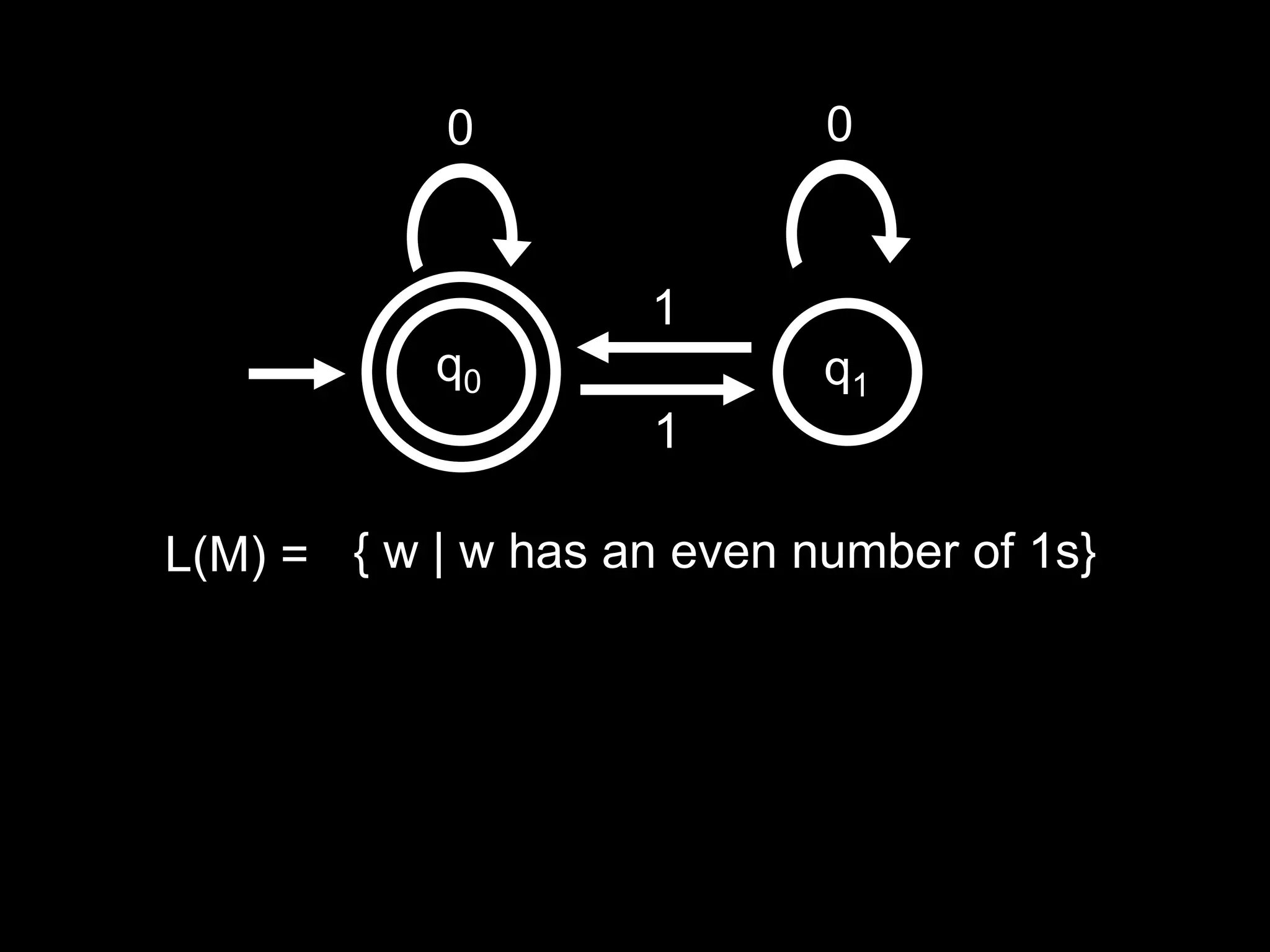
q0 q1
0 0
1
1
L(M) = { w | w has an even number of 1s}
Steven Rudich:
www.cs.cmu.edu/~rudich
An alphabet Σ is a finite set (e.g., Σ = {0,1})
A string over Σ is a finite-length sequence of
elements of Σ
For x a string, |x| is the length of x
The unique string of length 0 will be denoted by ε
and will be called the empty or null string
Notation
A language over Σ is a set of strings over Σ
Steven Rudich:
www.cs.cmu.edu/~rudich
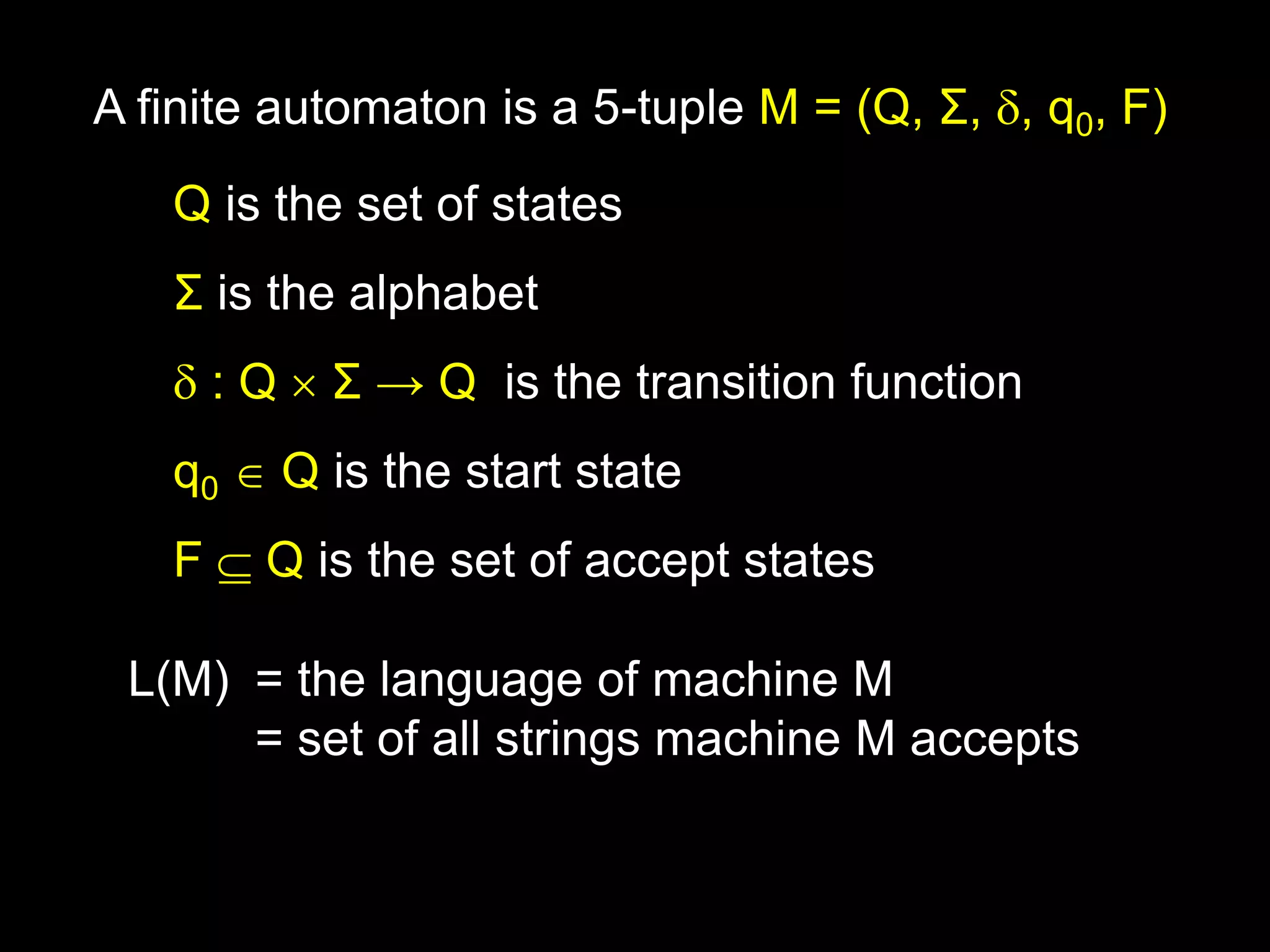
Q is the set of states
Σ is the alphabet
 : Q  Σ → Q is the transition function
q0  Q is the start state
F  Q is the set of accept states
A finite automaton is a 5-tuple M = (Q, Σ, , q0, F)
L(M) = the language of machine M
= set of all strings machine M accepts
Steven Rudich:
www.cs.cmu.edu/~rudich
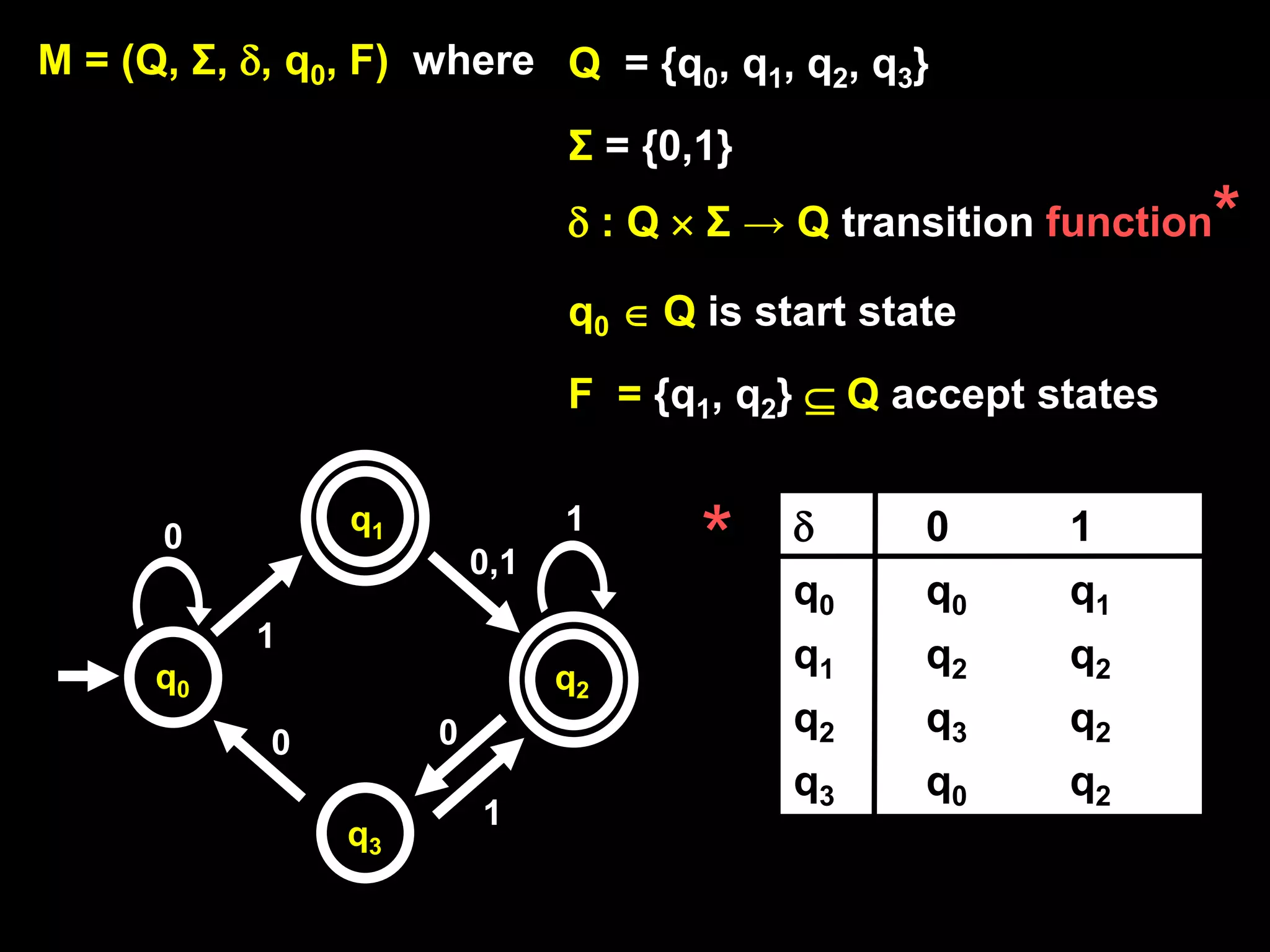
Q = {q0, q1, q2, q3}
Σ = {0,1}
 : Q  Σ → Q transition function*
q0  Q is start state
F = {q1, q2}  Q accept states
M = (Q, Σ, , q0, F) where
 0 1
q0 q0 q1
q1 q2 q2
q2 q3 q2
q3 q0 q2
*
q2
0
0,1
0
0
1
1
1
q0
q1
q3
M
Steven Rudich:
www.cs.cmu.edu/~rudich
q q00
1 0
1
q0 q001
0 0 1
0,1
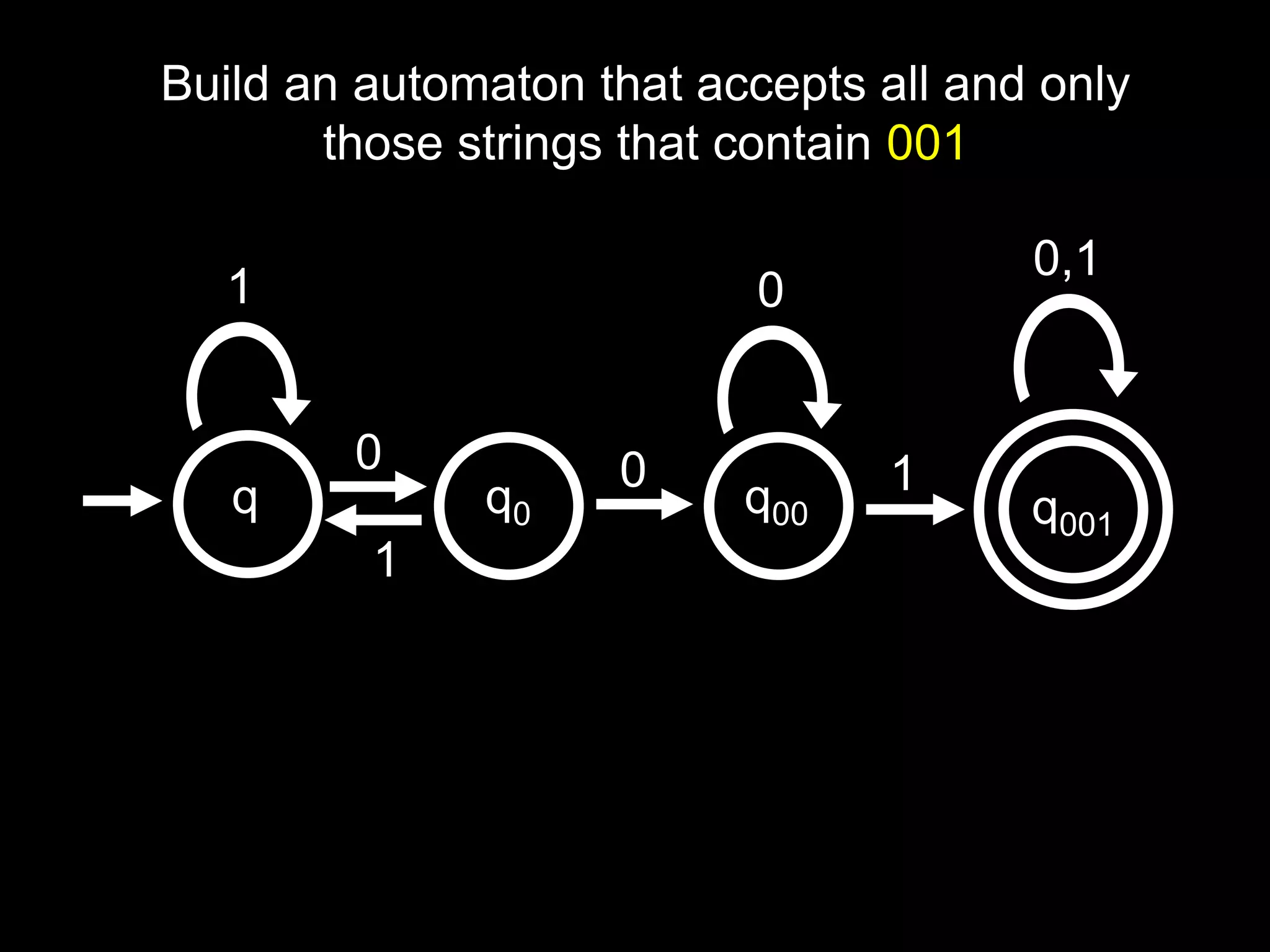
Build an automaton that accepts all and only
those strings that contain 001
Steven Rudich:
www.cs.cmu.edu/~rudich
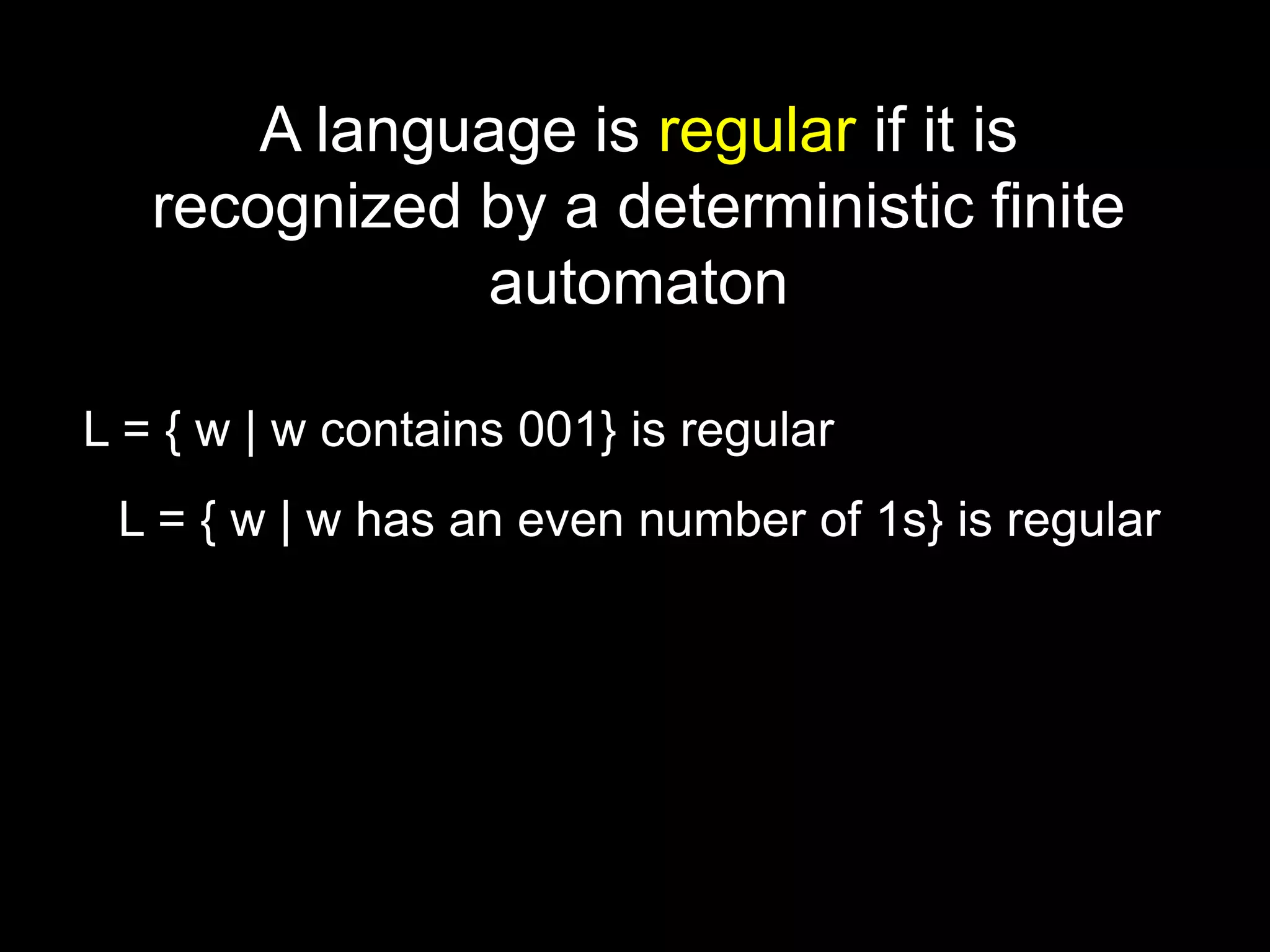
A language is regular if it is
recognized by a deterministic finite
automaton
L = { w | w contains 001} is regular
L = { w | w has an even number of 1s} is regular
Steven Rudich:
www.cs.cmu.edu/~rudich
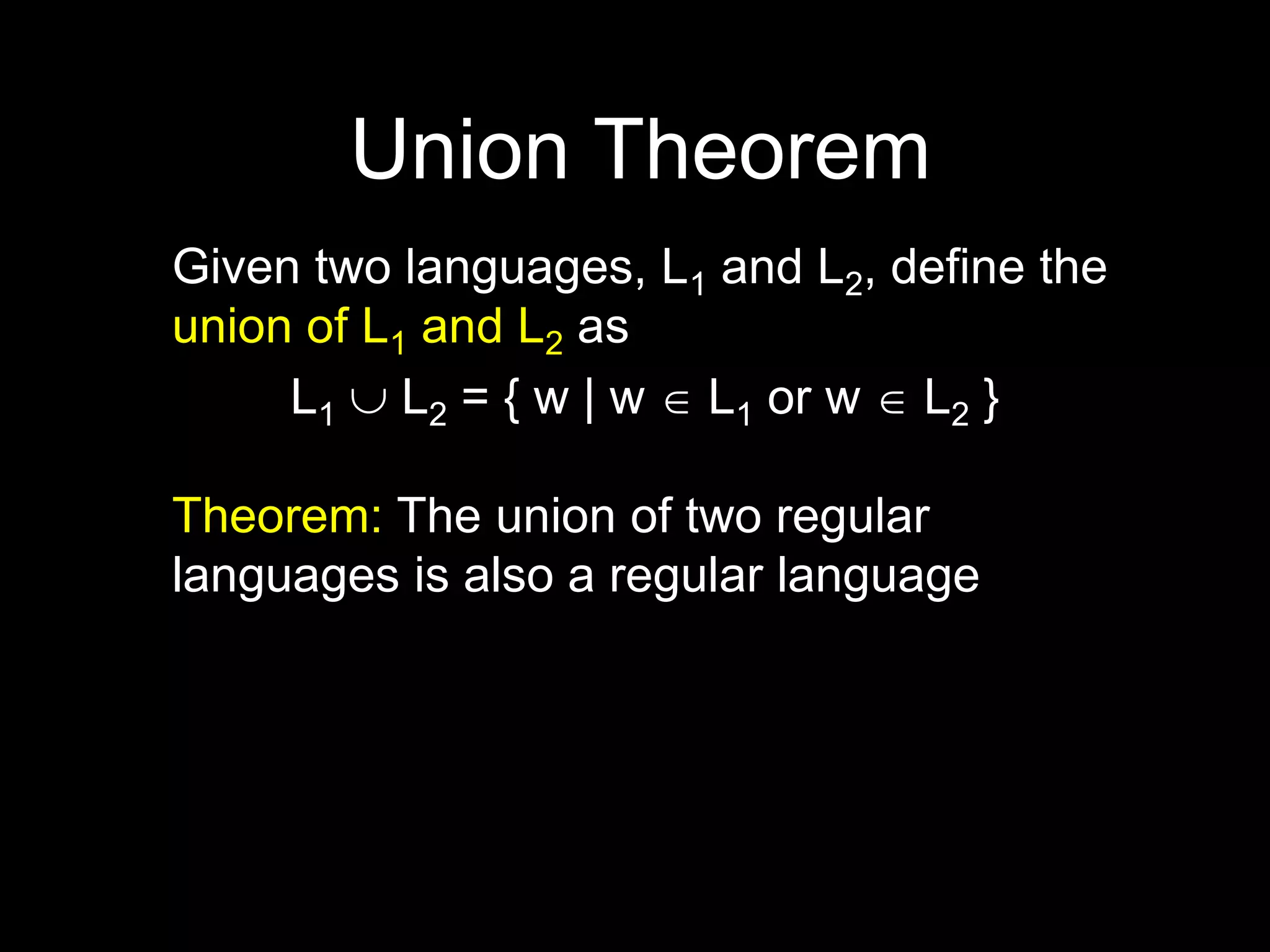
Union Theorem
Given two languages, L1 and L2, define the
union of L1 and L2 as
L1  L2 = { w | w  L1 or w  L2 }
Theorem: The union of two regular
languages is also a regular language
Steven Rudich:
www.cs.cmu.edu/~rudich
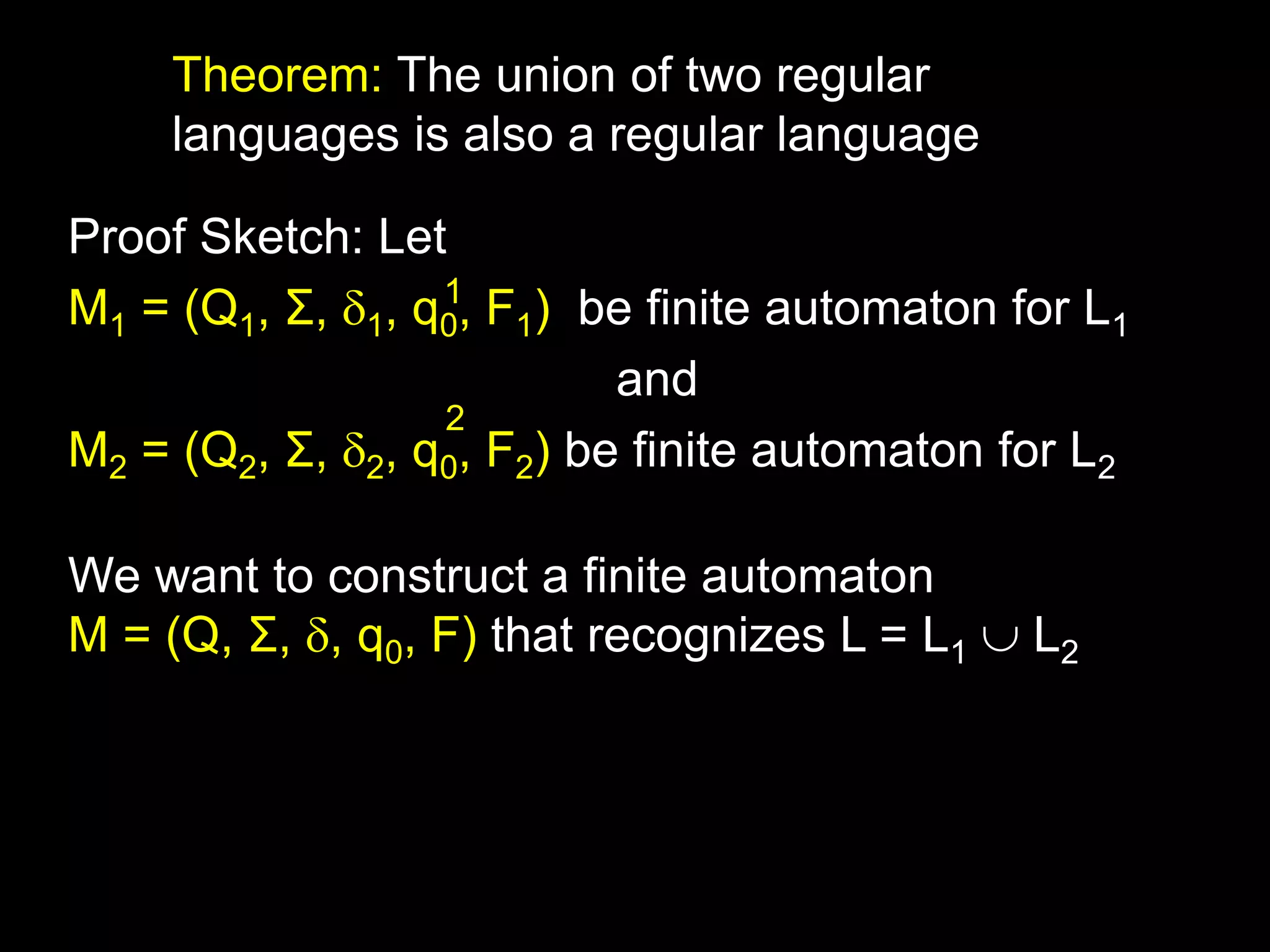
Theorem: The union of two regular
languages is also a regular language
Proof Sketch: Let
M1 = (Q1, Σ, 1, q0, F1) be finite automaton for L1
and
M2 = (Q2, Σ, 2, q0, F2) be finite automaton for L2
We want to construct a finite automaton
M = (Q, Σ, , q0, F) that recognizes L = L1  L2
1
2
Steven Rudich:
www.cs.cmu.edu/~rudich
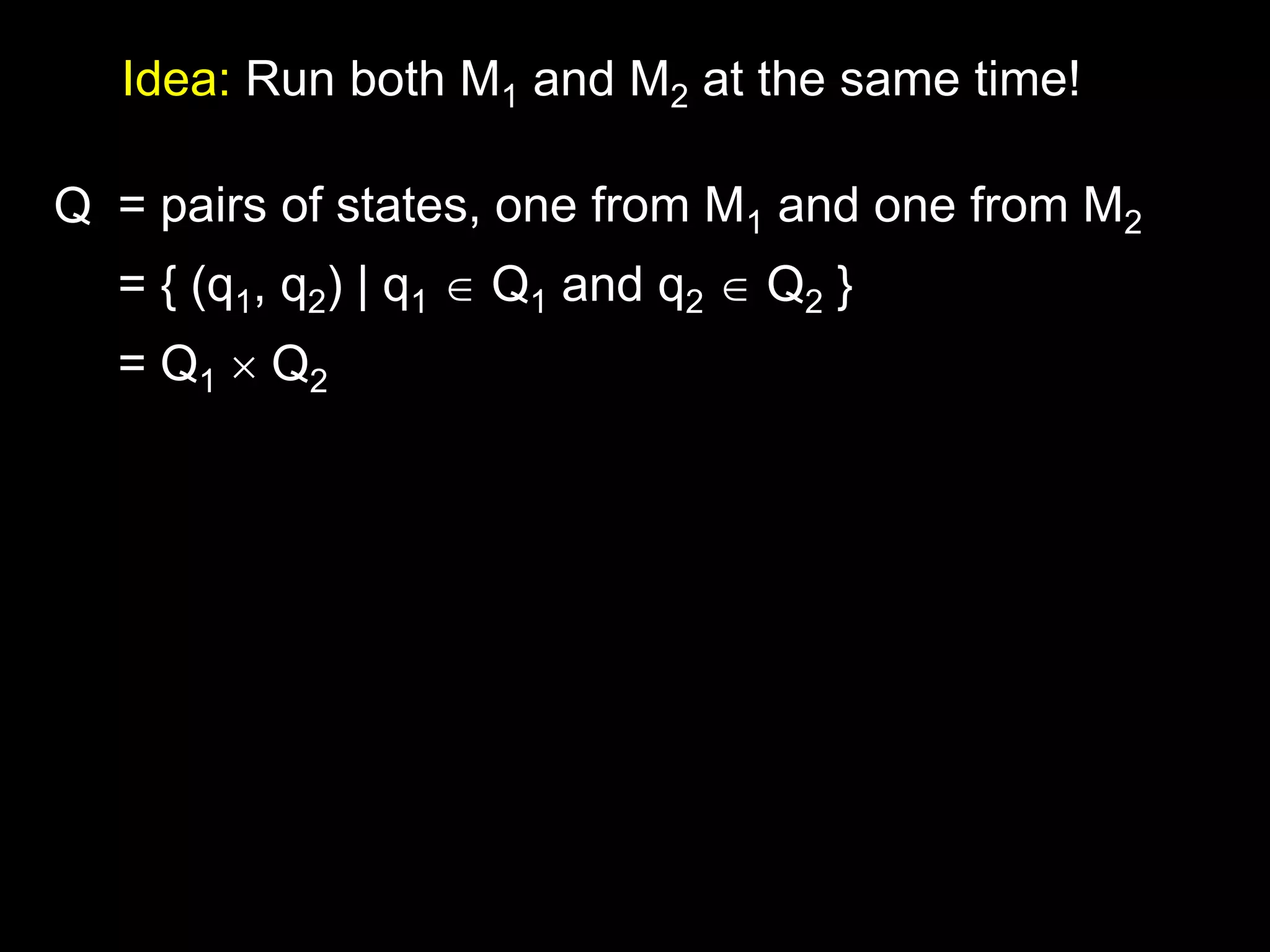
Idea: Run both M1 and M2 at the same time!
Q = pairs of states, one from M1 and one from M2
= { (q1, q2) | q1  Q1 and q2  Q2 }
= Q1  Q2
Steven Rudich:
www.cs.cmu.edu/~rudich
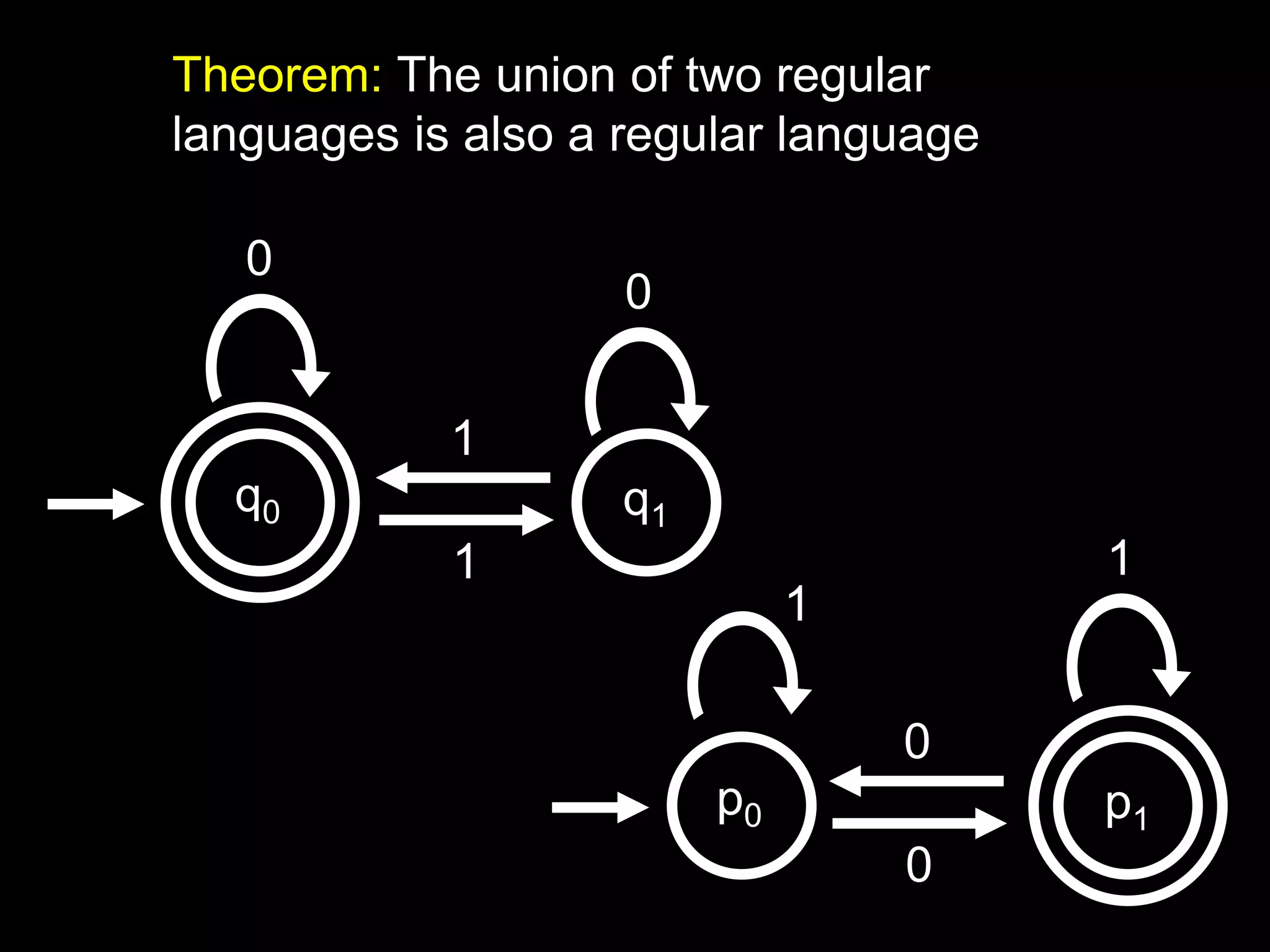
Theorem: The union of two regular
languages is also a regular language
q0 q1
0
0
1
1
p0 p1
1
1
0
0
Steven Rudich:
www.cs.cmu.edu/~rudich
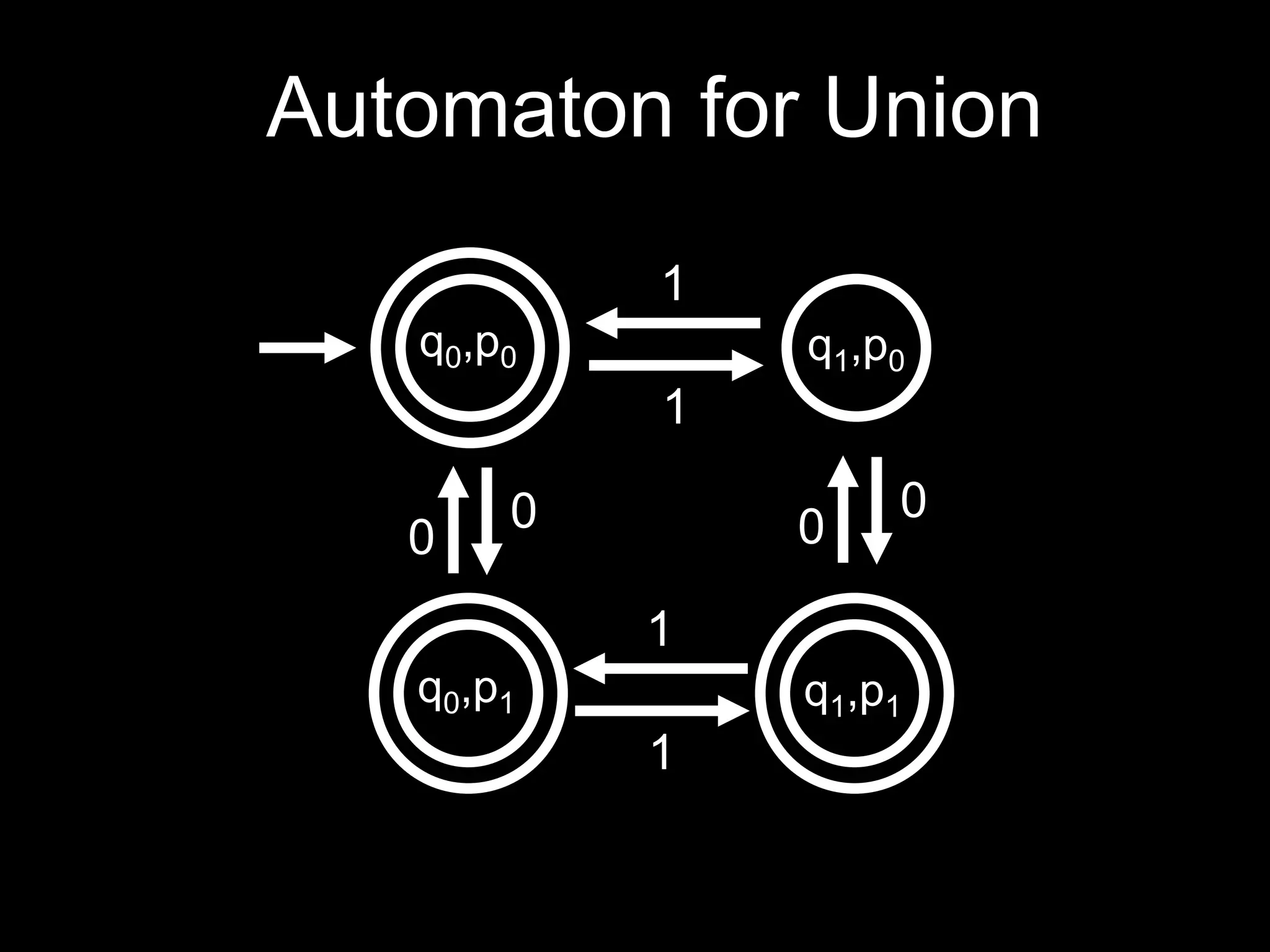
q0,p0 q1,p0
1
1
q0,p1 q1,p1
1
1
0
0
0
0
Automaton for Union
Steven Rudich:
www.cs.cmu.edu/~rudich
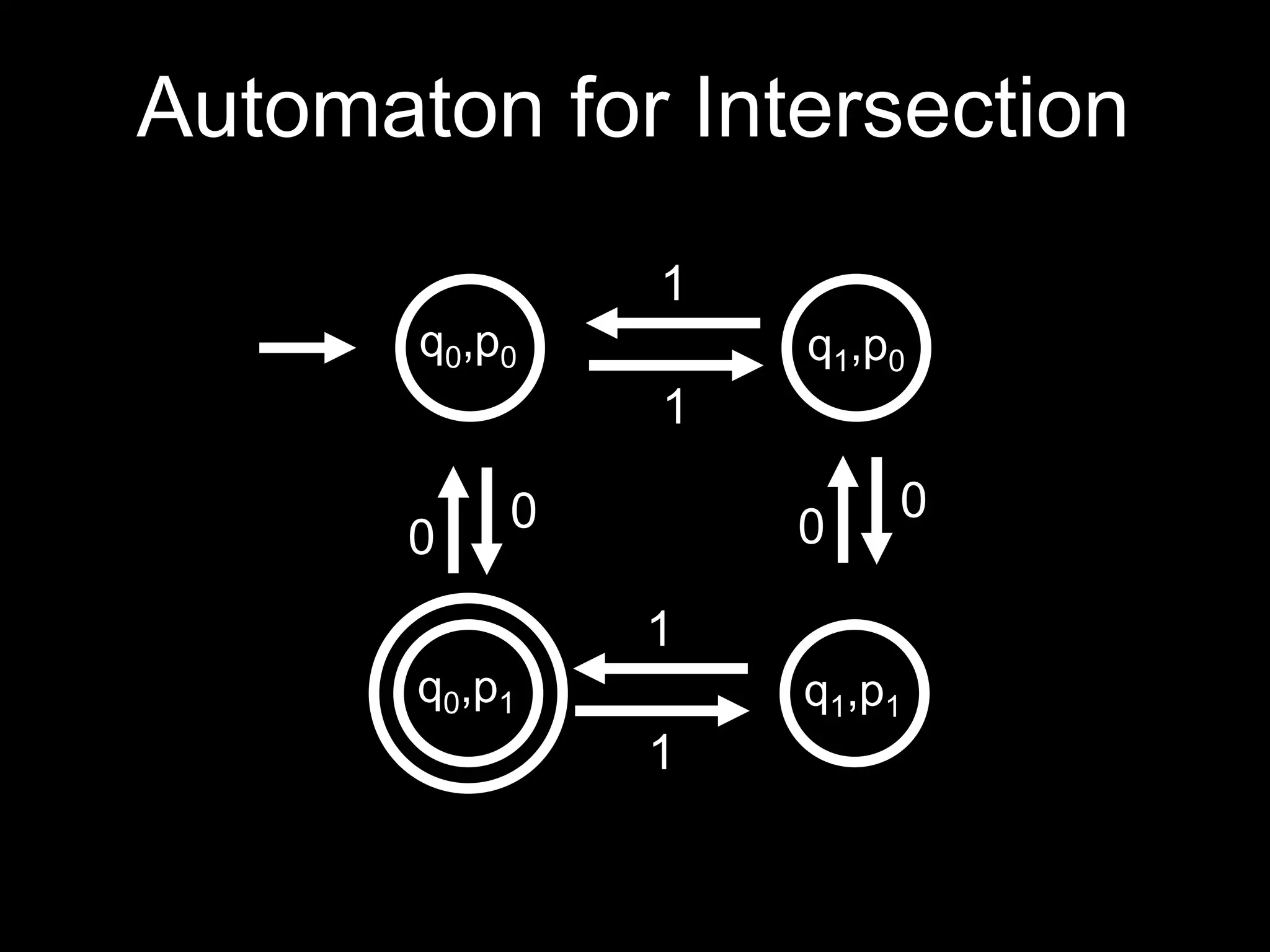
q0,p0 q1,p0
1
1
q0,p1 q1,p1
1
1
0
0
0
0
Automaton for Intersection
Steven Rudich:
www.cs.cmu.edu/~rudich
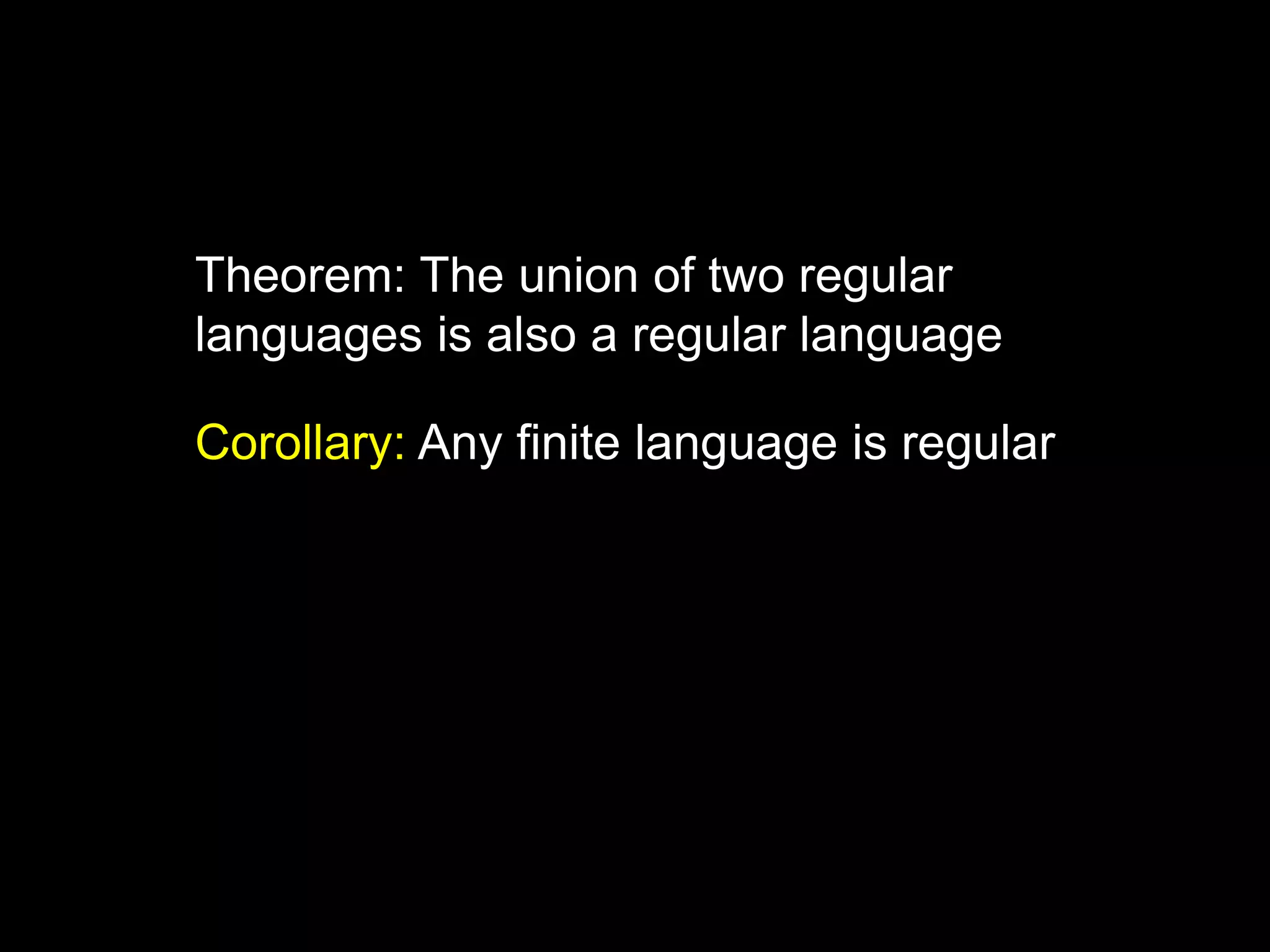
Theorem: The union of two regular
languages is also a regular language
Corollary: Any finite language is regular
Steven Rudich:
www.cs.cmu.edu/~rudich
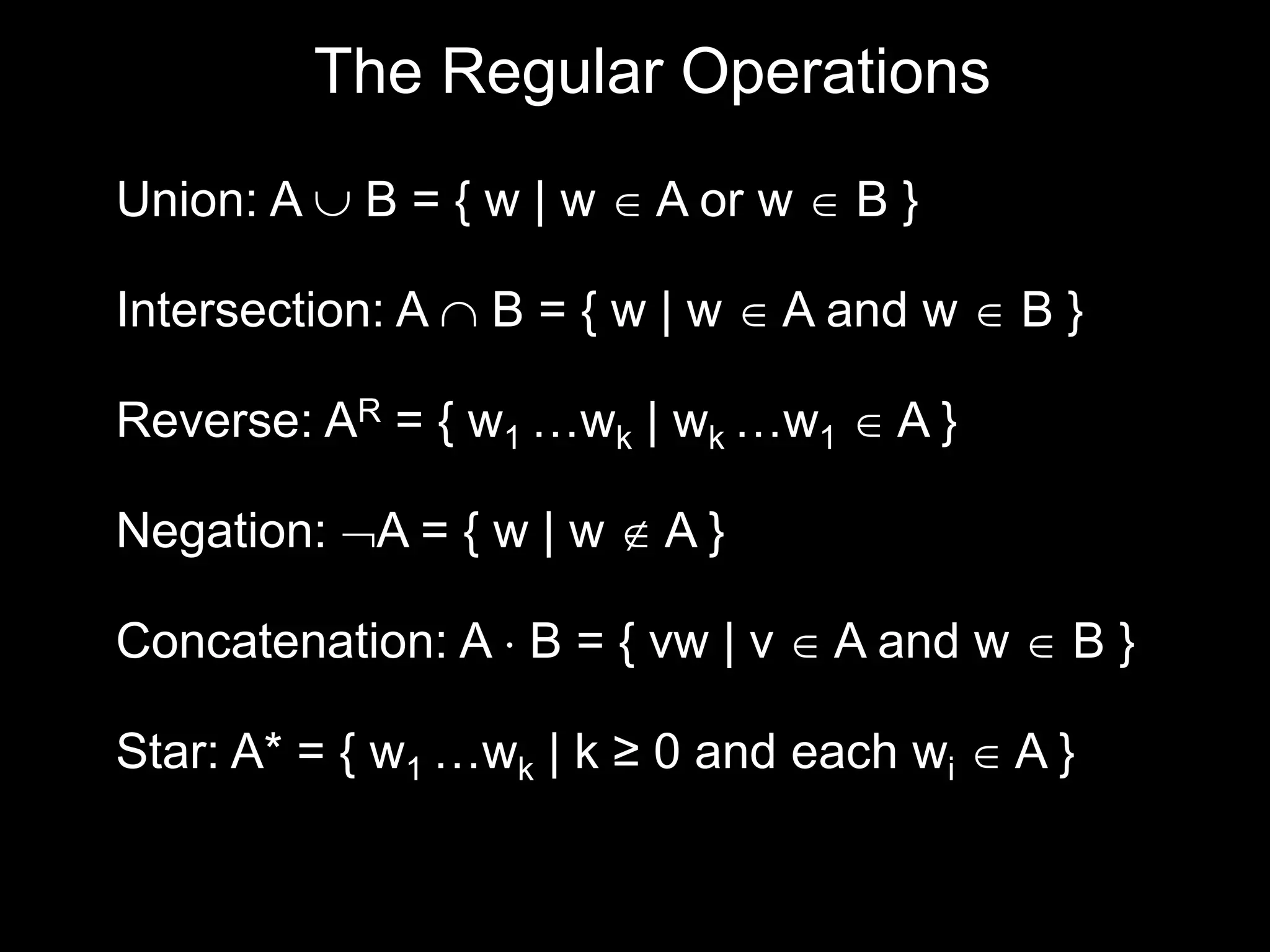
The Regular Operations
Union: A  B = { w | w  A or w  B }
Intersection: A  B = { w | w  A and w  B }
Negation: A = { w | w  A }
Reverse: AR = { w1 …wk | wk …w1  A }
Concatenation: A  B = { vw | v  A and w  B }
Star: A* = { w1 …wk | k ≥ 0 and each wi  A }
Steven Rudich:
www.cs.cmu.edu/~rudich
Regular Languages Are
Closed Under The Regular
Operations
We have seen part of the proof for Union.
The proof for intersection is very similar. The
proof for negation is easy.
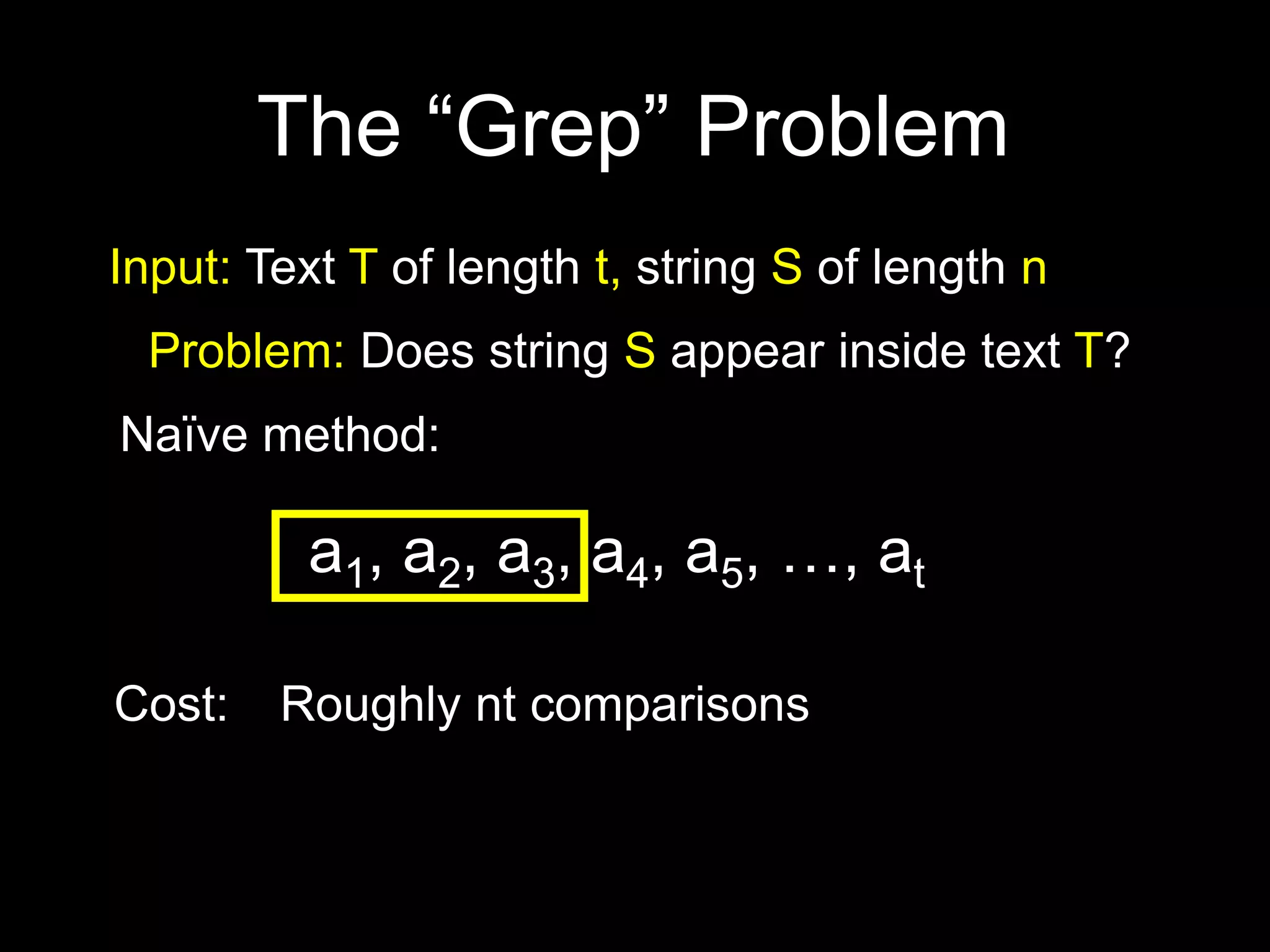
Input: Text T of length t, string S of length n
The “Grep” Problem
Problem: Does string S appear inside text T?
a1, a2, a3, a4, a5, …, at
Naïve method:
Cost: Roughly nt comparisons
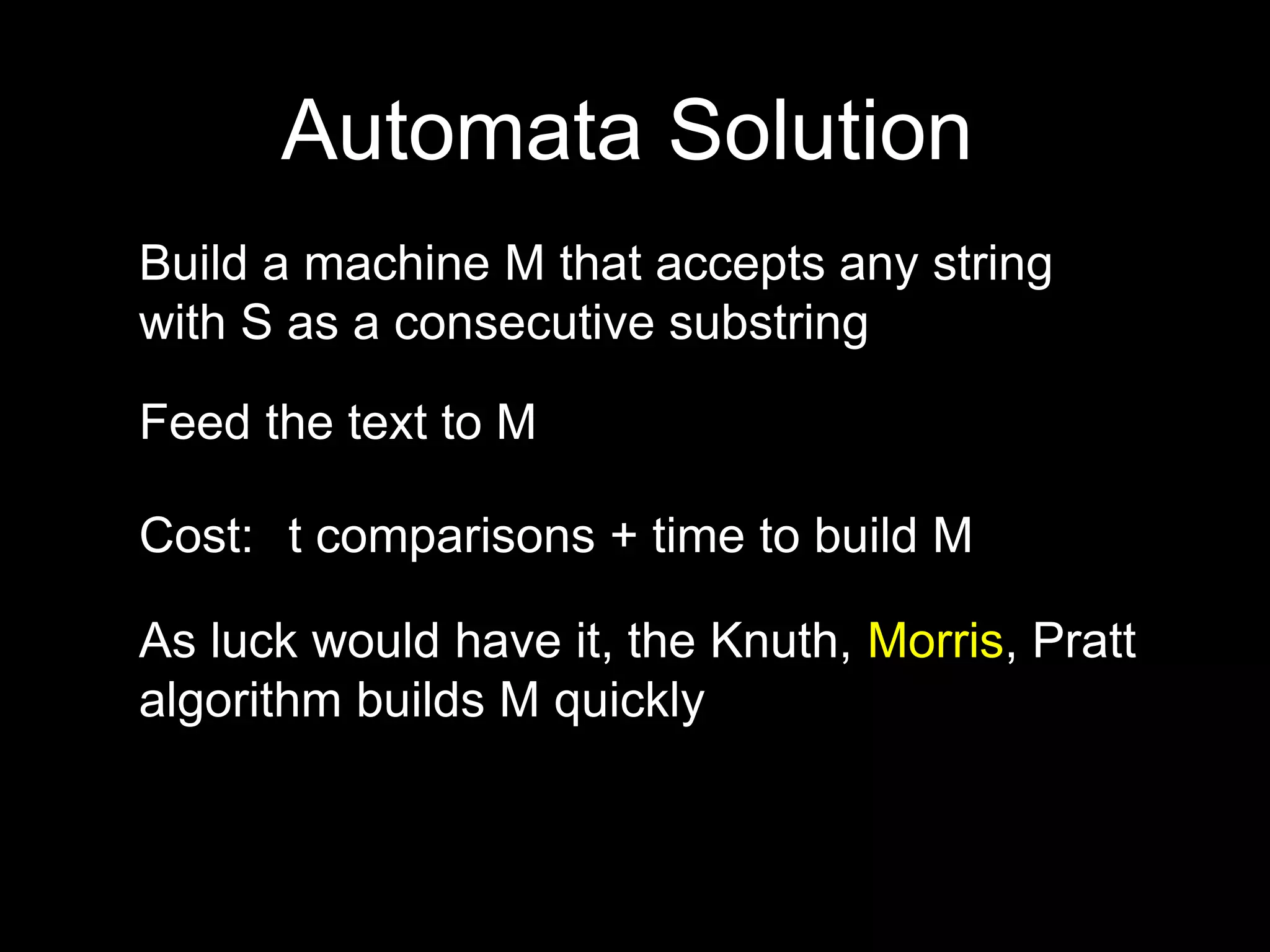
Automata Solution
Build a machine M that accepts any string
with S as a consecutive substring
Feed the text to M
Cost:
As luck would have it, the Knuth, Morris, Pratt
algorithm builds M quickly
t comparisons + time to build M
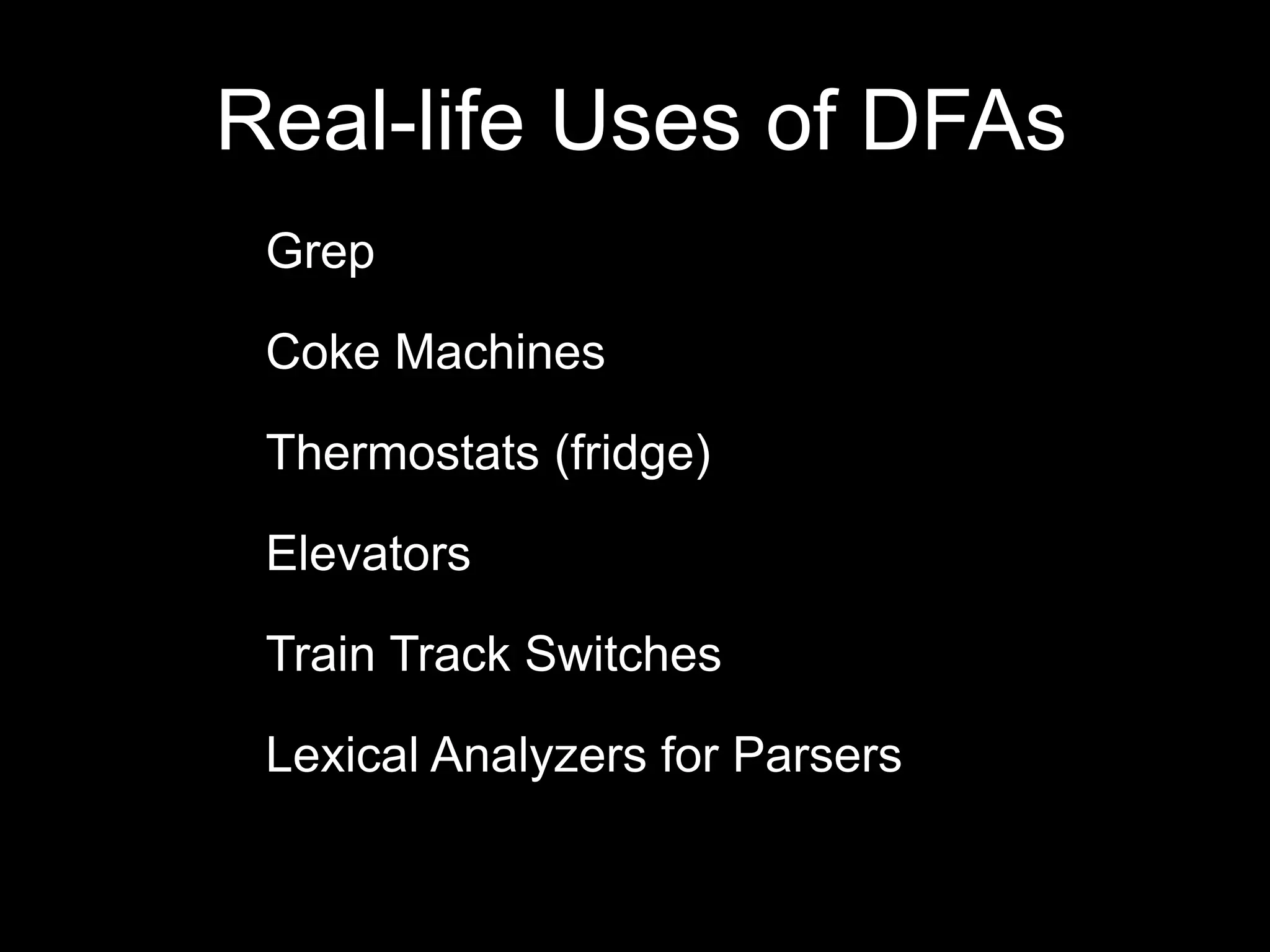
Grep
Coke Machines
Thermostats (fridge)
Elevators
Train Track Switches
Lexical Analyzers for Parsers
Real-life Uses of DFAs
Are all
languages
regular?
i.e., a bunch of a’s followed by an equal
number of b’s
Consider the language L = { anbn | n > 0 }
No finite automaton accepts this language
Can you prove this?
anbn is not regular.
No machine has
enough states to
keep track of the
number of a’s it
might encounter
That is a fairly weak
argument
Consider the following
example…
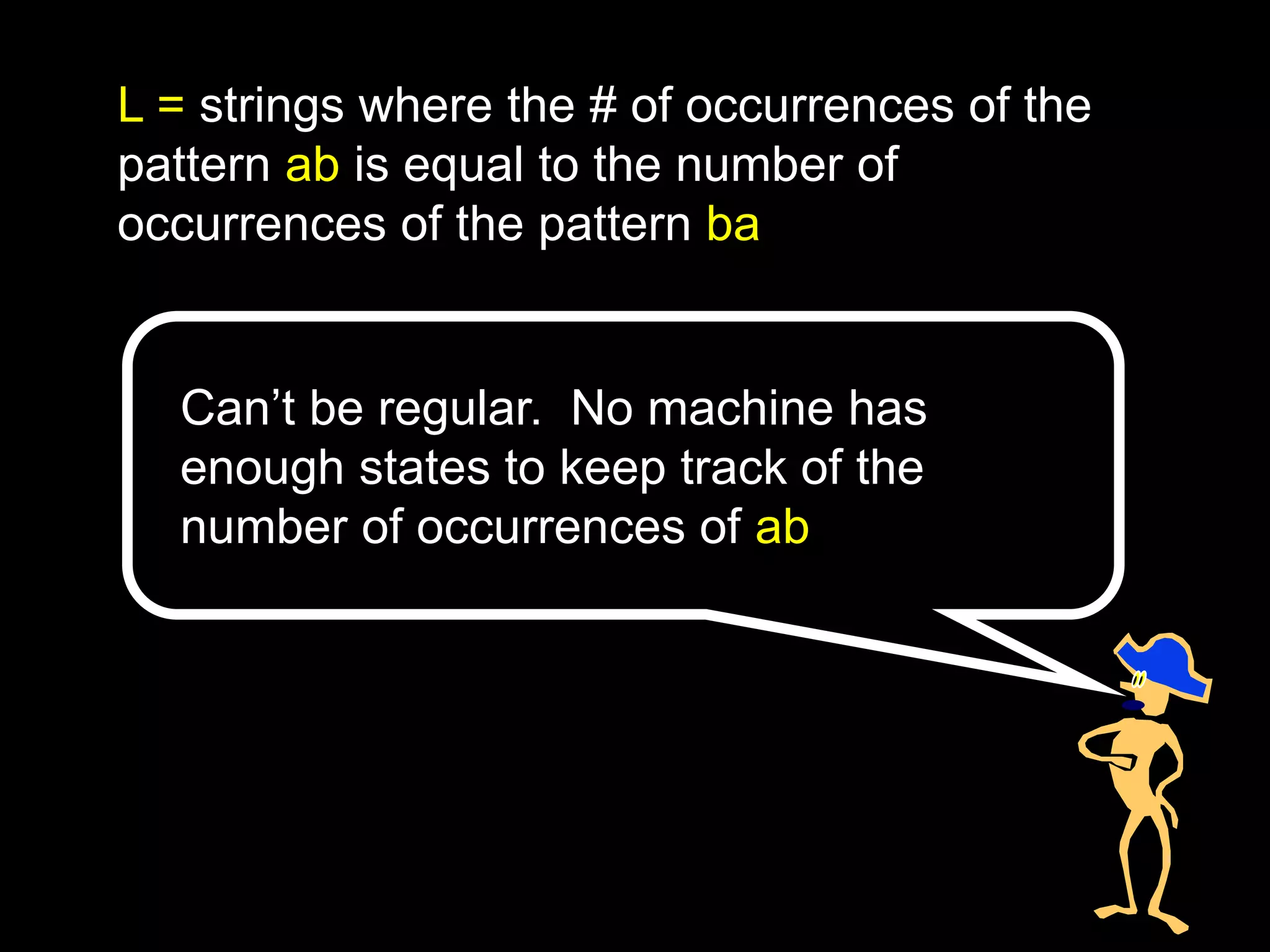
L = strings where the # of occurrences of the
pattern ab is equal to the number of
occurrences of the pattern ba
Can’t be regular. No machine has
enough states to keep track of the
number of occurrences of ab
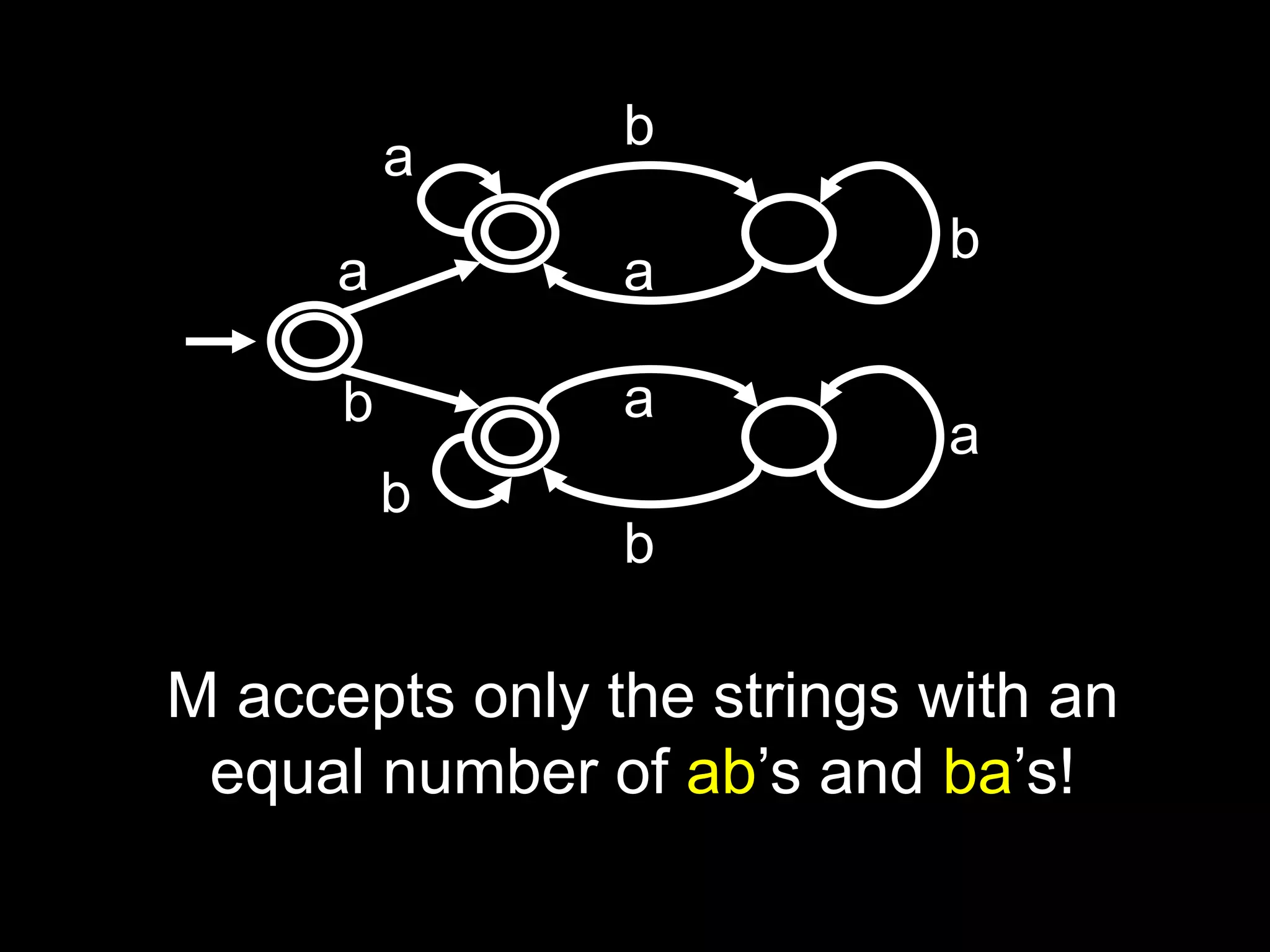
M accepts only the strings with an
equal number of ab’s and ba’s!
b
b
a
b
a
a
a
b
a
b
Let me show you a
professional strength proof
that anbn is not regular…
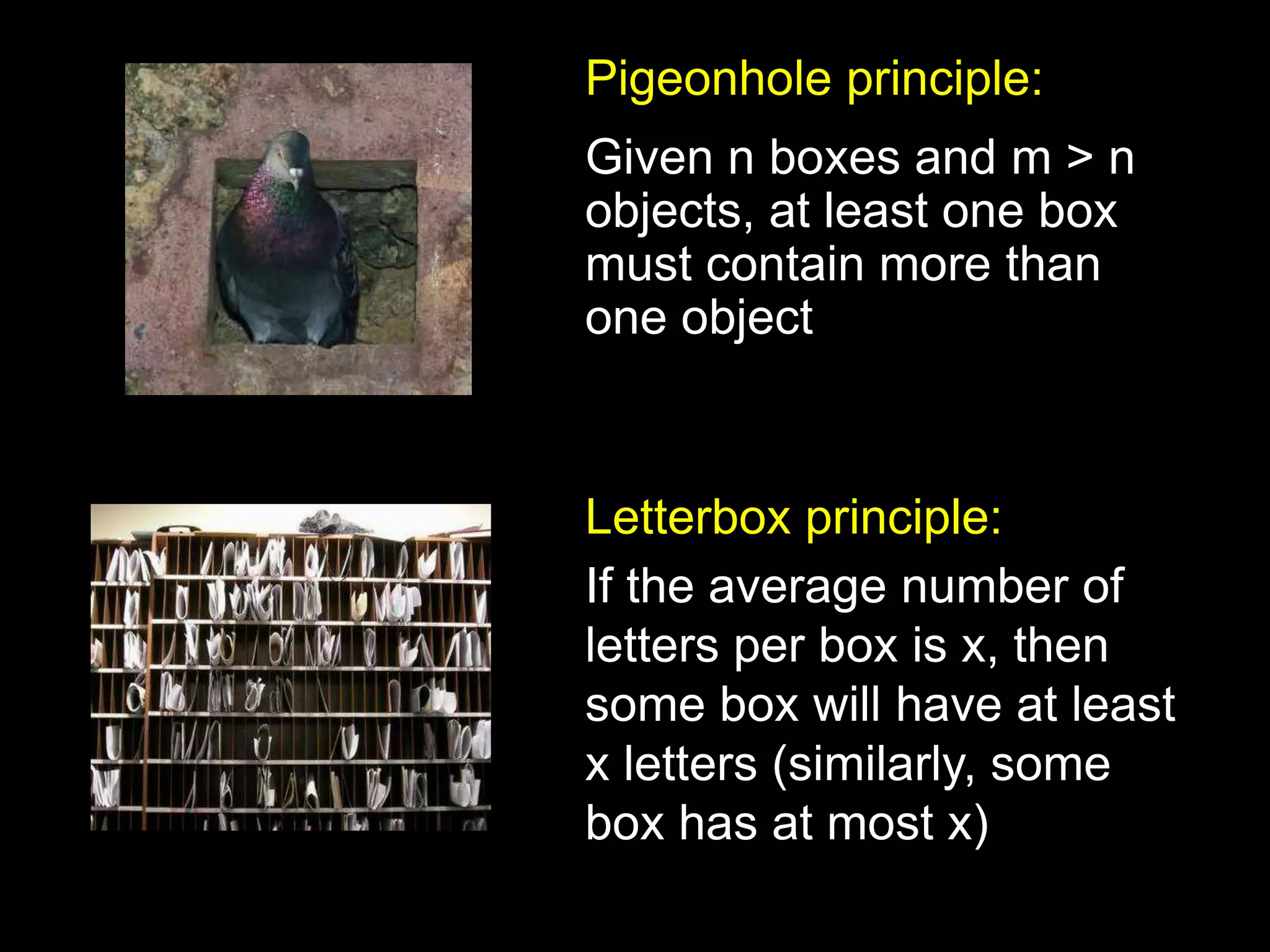
Pigeonhole principle:
Given n boxes and m > n
objects, at least one box
must contain more than
one object
Letterbox principle:
If the average number of
letters per box is x, then
some box will have at least
x letters (similarly, some
box has at most x)
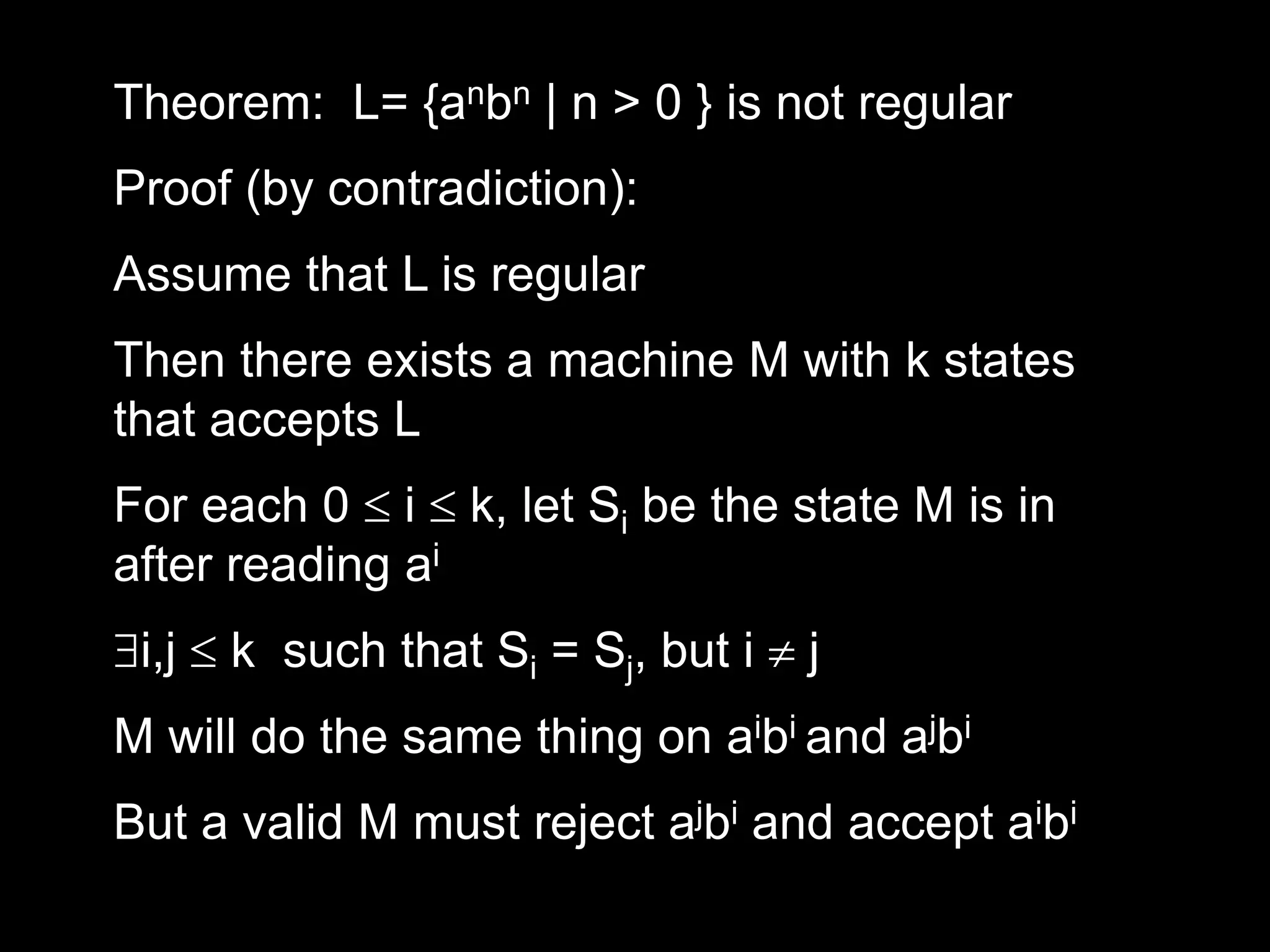
Theorem: L= {anbn | n > 0 } is not regular
Proof (by contradiction):
Assume that L is regular
Then there exists a machine M with k states
that accepts L
For each 0  i  k, let Si be the state M is in
after reading ai
i,j  k such that Si = Sj, but i  j
M will do the same thing on aibi and ajbi
But a valid M must reject ajbi and accept aibi
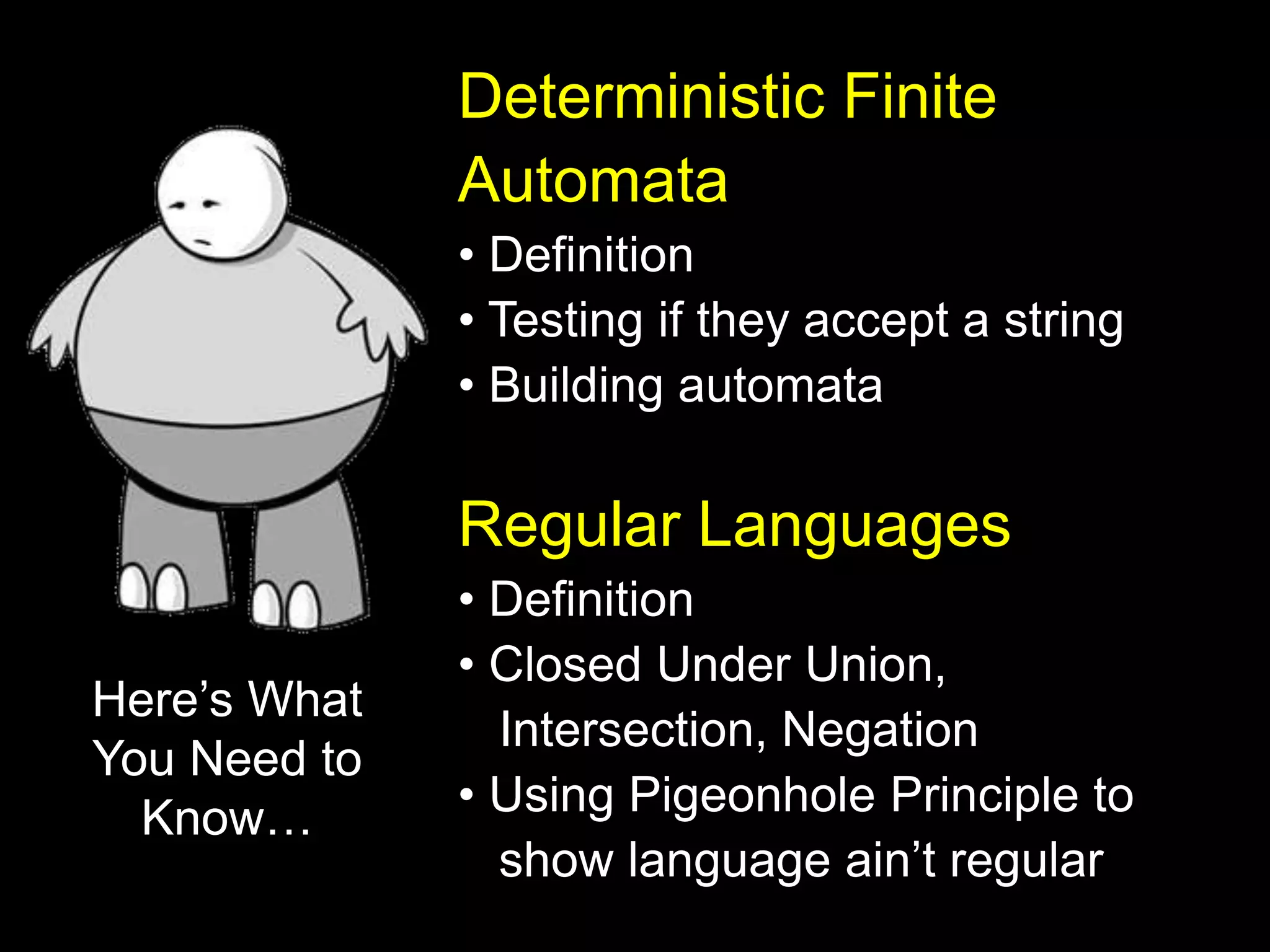
Deterministic Finite
Automata
• Definition
• Testing if they accept a string
• Building automata
Regular Languages
• Definition
• Closed Under Union,
Intersection, Negation
• Using Pigeonhole Principle to
show language ain’t regular
Here’s What
You Need to
Know…

lecture02.ppt