PWCT 1.9 Art Documentation ( http://doublesvsoop.sourceforge.net )
2006-2013, Mahmoud Fayed ( msfclipper@users.sourceforge.net )
_____________________________________________________________________________________
Table of contents
1 - Introduction
2 - Implementation steps
3 - Final Steps Tree
4 - Application during the runtime
1 - Introduction
In this lesson we are going to learn how to use the ActiveSkin ActiveX control.
2 - Implementation Steps
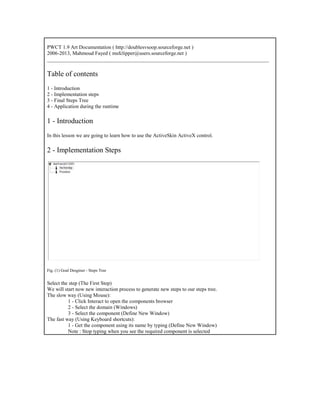
Fig. (1) Goal Desginer - Steps Tree
Select the step (The First Step)
We will start now new interaction process to generate new steps to our steps tree.
The slow way (Using Mouse):
1 - Click Interact to open the components browser
2 - Select the domain (Windows)
3 - Select the component (Define New Window)
The fast way (Using Keyboard shortcuts):
1 - Get the component using its name by typing (Define New Window)
Note : Stop typing when you see the required component is selected
Fig. (2) Component Browser – Select the component (Define New Window)
After selecting the component click Ok or press ENTER
Fig. (3) Interaction page - Set the properties and enter the required data as in the image above
Fig. (4) Form Designer
Fig. (5) Goal Desginer - Steps Tree
Select the step (Window Events)
We will start now new interaction process to generate new steps to our steps tree.
The slow way (Using Mouse):
1 - Click Interact to open the components browser
2 - Select the domain (Windows)
3 - Select the component (Window Events)
The fast way (Using Keyboard shortcuts):
1 - Get the component using its name by typing (Window Events)
Note : Stop typing when you see the required component is selected
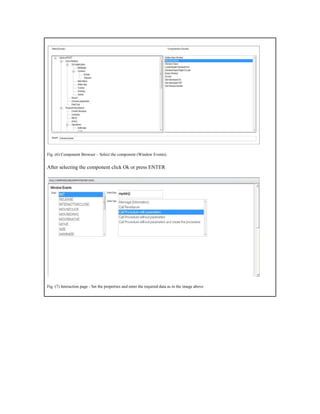
Fig. (6) Component Browser – Select the component (Window Events)
After selecting the component click Ok or press ENTER
Fig. (7) Interaction page - Set the properties and enter the required data as in the image above
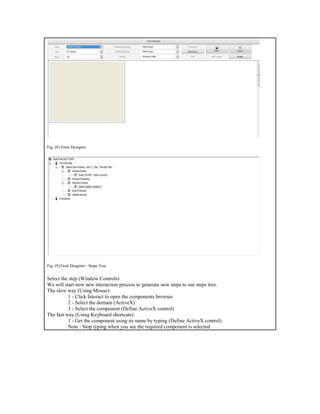
Fig. (8) Form Designer
Fig. (9) Goal Desginer - Steps Tree
Select the step (Window Controls)
We will start now new interaction process to generate new steps to our steps tree.
The slow way (Using Mouse):
1 - Click Interact to open the components browser
2 - Select the domain (ActiveX)
3 - Select the component (Define ActiveX control)
The fast way (Using Keyboard shortcuts):
1 - Get the component using its name by typing (Define ActiveX control)
Note : Stop typing when you see the required component is selected
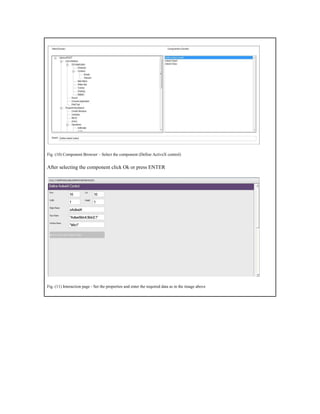
Fig. (10) Component Browser – Select the component (Define ActiveX control)
After selecting the component click Ok or press ENTER
Fig. (11) Interaction page - Set the properties and enter the required data as in the image above
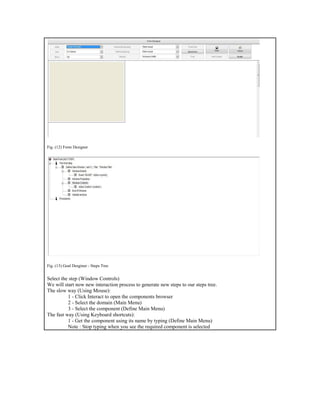
Fig. (12) Form Designer
Fig. (13) Goal Desginer - Steps Tree
Select the step (Window Controls)
We will start now new interaction process to generate new steps to our steps tree.
The slow way (Using Mouse):
1 - Click Interact to open the components browser
2 - Select the domain (Main Menu)
3 - Select the component (Define Main Menu)
The fast way (Using Keyboard shortcuts):
1 - Get the component using its name by typing (Define Main Menu)
Note : Stop typing when you see the required component is selected
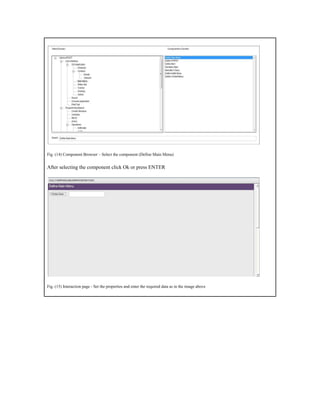
Fig. (14) Component Browser – Select the component (Define Main Menu)
After selecting the component click Ok or press ENTER
Fig. (15) Interaction page - Set the properties and enter the required data as in the image above
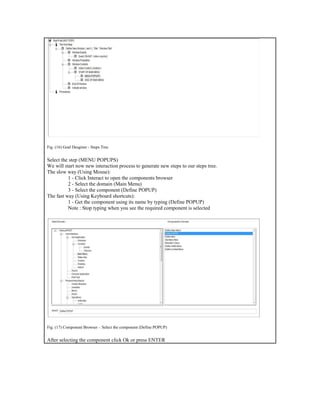
Fig. (16) Goal Desginer - Steps Tree
Select the step (MENU POPUPS)
We will start now new interaction process to generate new steps to our steps tree.
The slow way (Using Mouse):
1 - Click Interact to open the components browser
2 - Select the domain (Main Menu)
3 - Select the component (Define POPUP)
The fast way (Using Keyboard shortcuts):
1 - Get the component using its name by typing (Define POPUP)
Note : Stop typing when you see the required component is selected
Fig. (17) Component Browser – Select the component (Define POPUP)
After selecting the component click Ok or press ENTER
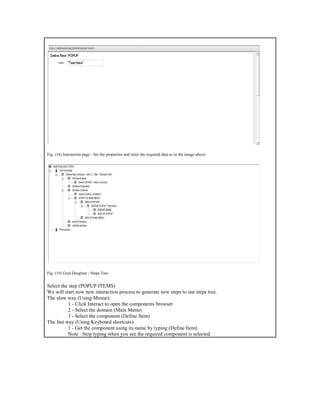
Fig. (18) Interaction page - Set the properties and enter the required data as in the image above
Fig. (19) Goal Desginer - Steps Tree
Select the step (POPUP ITEMS)
We will start now new interaction process to generate new steps to our steps tree.
The slow way (Using Mouse):
1 - Click Interact to open the components browser
2 - Select the domain (Main Menu)
3 - Select the component (Define Item)
The fast way (Using Keyboard shortcuts):
1 - Get the component using its name by typing (Define Item)
Note : Stop typing when you see the required component is selected
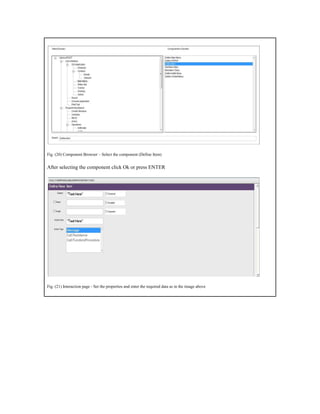
Fig. (20) Component Browser – Select the component (Define Item)
After selecting the component click Ok or press ENTER
Fig. (21) Interaction page - Set the properties and enter the required data as in the image above
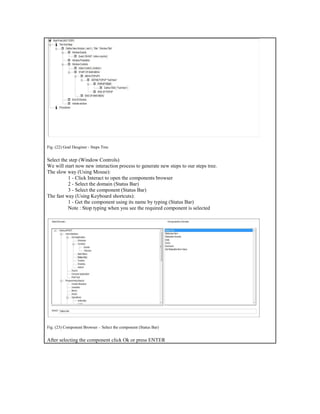
Fig. (22) Goal Desginer - Steps Tree
Select the step (Window Controls)
We will start now new interaction process to generate new steps to our steps tree.
The slow way (Using Mouse):
1 - Click Interact to open the components browser
2 - Select the domain (Status Bar)
3 - Select the component (Status Bar)
The fast way (Using Keyboard shortcuts):
1 - Get the component using its name by typing (Status Bar)
Note : Stop typing when you see the required component is selected
Fig. (23) Component Browser – Select the component (Status Bar)
After selecting the component click Ok or press ENTER
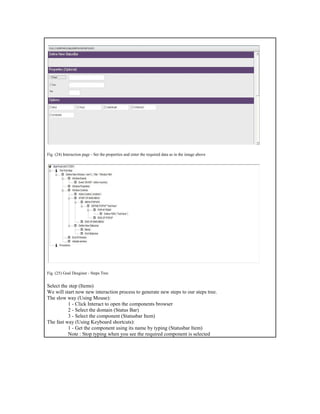
Fig. (24) Interaction page - Set the properties and enter the required data as in the image above
Fig. (25) Goal Desginer - Steps Tree
Select the step (Items)
We will start now new interaction process to generate new steps to our steps tree.
The slow way (Using Mouse):
1 - Click Interact to open the components browser
2 - Select the domain (Status Bar)
3 - Select the component (Statusbar Item)
The fast way (Using Keyboard shortcuts):
1 - Get the component using its name by typing (Statusbar Item)
Note : Stop typing when you see the required component is selected
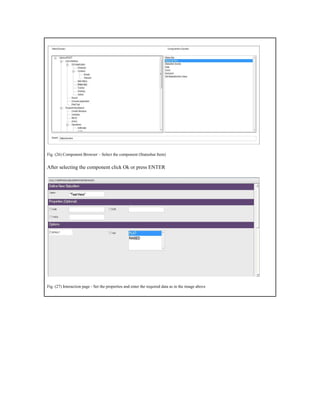
Fig. (26) Component Browser – Select the component (Statusbar Item)
After selecting the component click Ok or press ENTER
Fig. (27) Interaction page - Set the properties and enter the required data as in the image above
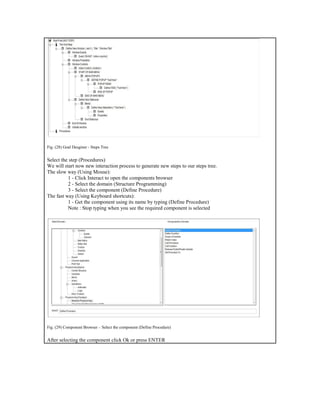
Fig. (28) Goal Desginer - Steps Tree
Select the step (Procedures)
We will start now new interaction process to generate new steps to our steps tree.
The slow way (Using Mouse):
1 - Click Interact to open the components browser
2 - Select the domain (Structure Programming)
3 - Select the component (Define Procedure)
The fast way (Using Keyboard shortcuts):
1 - Get the component using its name by typing (Define Procedure)
Note : Stop typing when you see the required component is selected
Fig. (29) Component Browser – Select the component (Define Procedure)
After selecting the component click Ok or press ENTER
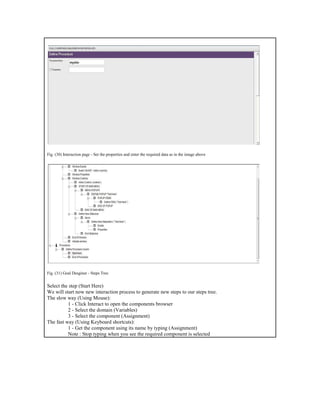
Fig. (30) Interaction page - Set the properties and enter the required data as in the image above
Fig. (31) Goal Desginer - Steps Tree
Select the step (Start Here)
We will start now new interaction process to generate new steps to our steps tree.
The slow way (Using Mouse):
1 - Click Interact to open the components browser
2 - Select the domain (Variables)
3 - Select the component (Assignment)
The fast way (Using Keyboard shortcuts):
1 - Get the component using its name by typing (Assignment)
Note : Stop typing when you see the required component is selected
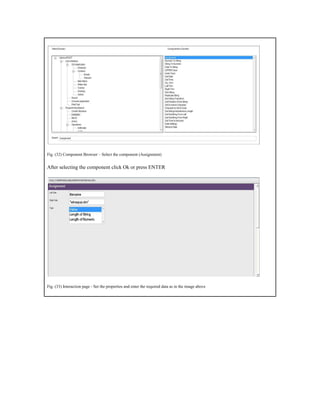
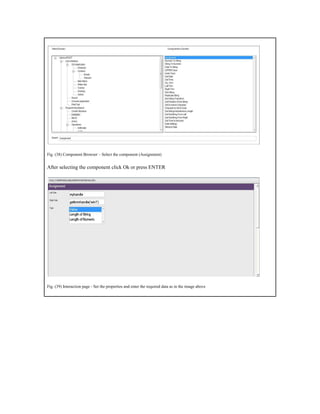
Fig. (32) Component Browser – Select the component (Assignment)
After selecting the component click Ok or press ENTER
Fig. (33) Interaction page - Set the properties and enter the required data as in the image above
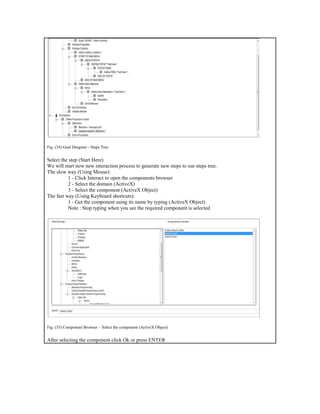
Fig. (34) Goal Desginer - Steps Tree
Select the step (Start Here)
We will start now new interaction process to generate new steps to our steps tree.
The slow way (Using Mouse):
1 - Click Interact to open the components browser
2 - Select the domain (ActiveX)
3 - Select the component (ActiveX Object)
The fast way (Using Keyboard shortcuts):
1 - Get the component using its name by typing (ActiveX Object)
Note : Stop typing when you see the required component is selected
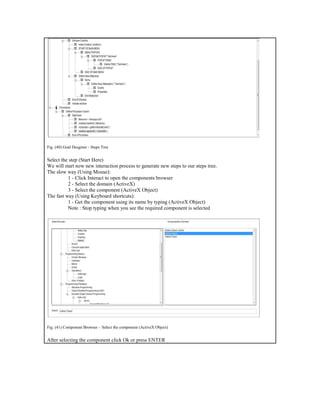
Fig. (35) Component Browser – Select the component (ActiveX Object)
After selecting the component click Ok or press ENTER
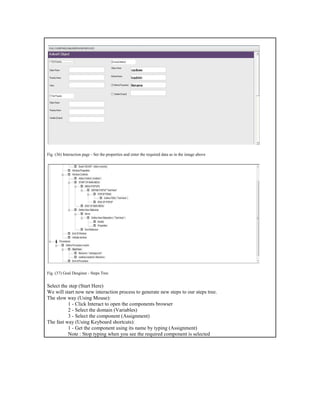
Fig. (36) Interaction page - Set the properties and enter the required data as in the image above
Fig. (37) Goal Desginer - Steps Tree
Select the step (Start Here)
We will start now new interaction process to generate new steps to our steps tree.
The slow way (Using Mouse):
1 - Click Interact to open the components browser
2 - Select the domain (Variables)
3 - Select the component (Assignment)
The fast way (Using Keyboard shortcuts):
1 - Get the component using its name by typing (Assignment)
Note : Stop typing when you see the required component is selected
Fig. (38) Component Browser – Select the component (Assignment)
After selecting the component click Ok or press ENTER
Fig. (39) Interaction page - Set the properties and enter the required data as in the image above
Fig. (40) Goal Desginer - Steps Tree
Select the step (Start Here)
We will start now new interaction process to generate new steps to our steps tree.
The slow way (Using Mouse):
1 - Click Interact to open the components browser
2 - Select the domain (ActiveX)
3 - Select the component (ActiveX Object)
The fast way (Using Keyboard shortcuts):
1 - Get the component using its name by typing (ActiveX Object)
Note : Stop typing when you see the required component is selected
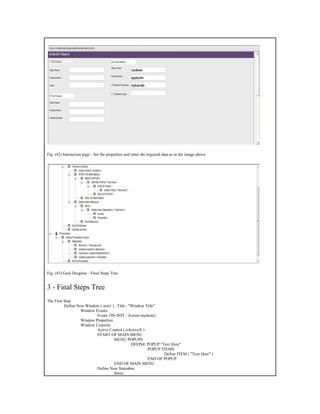
Fig. (41) Component Browser – Select the component (ActiveX Object)
After selecting the component click Ok or press ENTER
Fig. (42) Interaction page - Set the properties and enter the required data as in the image above
Fig. (43) Goal Desginer - Final Steps Tree
3 - Final Steps Tree
The First Step
Define New Window ( win1 ) , Title : "Window Title"
Window Events
Event: ON INIT : Action myskin()
Window Properties
Window Controls
Active Control ( oActiveX )
START OF MAIN MENU
MENU POPUPS
DEFINE POPUP "Text Here"
POPUP ITEMS
Define ITEM ( "Text Here" )
END OF POPUP
END OF MAIN MENU
Define New Statusbar
Items
Define New StatusItem ( "Text Here" )
Events
Properties
End Statusbar
End Of Window
Activate window
Procedures
Define Procedure myskin
Start Here
filename = "winaqua.skn"
oactivex.loadskin ( filename )
myhandle = getformhandle('win1')
oactivex.applyskin ( myhandle )
End of Procedure
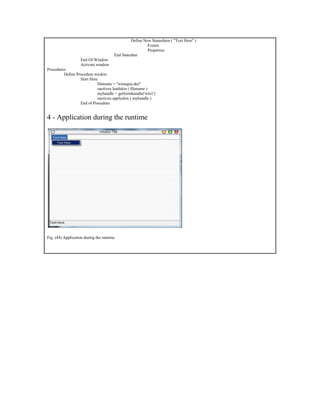
4 - Application during the runtime
Fig. (44) Application during the runtime

Programming Without Coding Technology (PWCT) - ActiveSkin ActiveX Control

  • 1.
    PWCT 1.9 ArtDocumentation ( http://doublesvsoop.sourceforge.net ) 2006-2013, Mahmoud Fayed ( msfclipper@users.sourceforge.net ) _____________________________________________________________________________________ Table of contents 1 - Introduction 2 - Implementation steps 3 - Final Steps Tree 4 - Application during the runtime 1 - Introduction In this lesson we are going to learn how to use the ActiveSkin ActiveX control. 2 - Implementation Steps Fig. (1) Goal Desginer - Steps Tree Select the step (The First Step) We will start now new interaction process to generate new steps to our steps tree. The slow way (Using Mouse): 1 - Click Interact to open the components browser 2 - Select the domain (Windows) 3 - Select the component (Define New Window) The fast way (Using Keyboard shortcuts): 1 - Get the component using its name by typing (Define New Window) Note : Stop typing when you see the required component is selected
  • 2.
    Fig. (2) ComponentBrowser – Select the component (Define New Window) After selecting the component click Ok or press ENTER Fig. (3) Interaction page - Set the properties and enter the required data as in the image above
  • 3.
    Fig. (4) FormDesigner Fig. (5) Goal Desginer - Steps Tree Select the step (Window Events) We will start now new interaction process to generate new steps to our steps tree. The slow way (Using Mouse): 1 - Click Interact to open the components browser 2 - Select the domain (Windows) 3 - Select the component (Window Events) The fast way (Using Keyboard shortcuts): 1 - Get the component using its name by typing (Window Events) Note : Stop typing when you see the required component is selected
  • 4.
    Fig. (6) ComponentBrowser – Select the component (Window Events) After selecting the component click Ok or press ENTER Fig. (7) Interaction page - Set the properties and enter the required data as in the image above
  • 5.
    Fig. (8) FormDesigner Fig. (9) Goal Desginer - Steps Tree Select the step (Window Controls) We will start now new interaction process to generate new steps to our steps tree. The slow way (Using Mouse): 1 - Click Interact to open the components browser 2 - Select the domain (ActiveX) 3 - Select the component (Define ActiveX control) The fast way (Using Keyboard shortcuts): 1 - Get the component using its name by typing (Define ActiveX control) Note : Stop typing when you see the required component is selected
  • 6.
    Fig. (10) ComponentBrowser – Select the component (Define ActiveX control) After selecting the component click Ok or press ENTER Fig. (11) Interaction page - Set the properties and enter the required data as in the image above
  • 7.
    Fig. (12) FormDesigner Fig. (13) Goal Desginer - Steps Tree Select the step (Window Controls) We will start now new interaction process to generate new steps to our steps tree. The slow way (Using Mouse): 1 - Click Interact to open the components browser 2 - Select the domain (Main Menu) 3 - Select the component (Define Main Menu) The fast way (Using Keyboard shortcuts): 1 - Get the component using its name by typing (Define Main Menu) Note : Stop typing when you see the required component is selected
  • 8.
    Fig. (14) ComponentBrowser – Select the component (Define Main Menu) After selecting the component click Ok or press ENTER Fig. (15) Interaction page - Set the properties and enter the required data as in the image above
  • 9.
    Fig. (16) GoalDesginer - Steps Tree Select the step (MENU POPUPS) We will start now new interaction process to generate new steps to our steps tree. The slow way (Using Mouse): 1 - Click Interact to open the components browser 2 - Select the domain (Main Menu) 3 - Select the component (Define POPUP) The fast way (Using Keyboard shortcuts): 1 - Get the component using its name by typing (Define POPUP) Note : Stop typing when you see the required component is selected Fig. (17) Component Browser – Select the component (Define POPUP) After selecting the component click Ok or press ENTER
  • 10.
    Fig. (18) Interactionpage - Set the properties and enter the required data as in the image above Fig. (19) Goal Desginer - Steps Tree Select the step (POPUP ITEMS) We will start now new interaction process to generate new steps to our steps tree. The slow way (Using Mouse): 1 - Click Interact to open the components browser 2 - Select the domain (Main Menu) 3 - Select the component (Define Item) The fast way (Using Keyboard shortcuts): 1 - Get the component using its name by typing (Define Item) Note : Stop typing when you see the required component is selected
  • 11.
    Fig. (20) ComponentBrowser – Select the component (Define Item) After selecting the component click Ok or press ENTER Fig. (21) Interaction page - Set the properties and enter the required data as in the image above
  • 12.
    Fig. (22) GoalDesginer - Steps Tree Select the step (Window Controls) We will start now new interaction process to generate new steps to our steps tree. The slow way (Using Mouse): 1 - Click Interact to open the components browser 2 - Select the domain (Status Bar) 3 - Select the component (Status Bar) The fast way (Using Keyboard shortcuts): 1 - Get the component using its name by typing (Status Bar) Note : Stop typing when you see the required component is selected Fig. (23) Component Browser – Select the component (Status Bar) After selecting the component click Ok or press ENTER
  • 13.
    Fig. (24) Interactionpage - Set the properties and enter the required data as in the image above Fig. (25) Goal Desginer - Steps Tree Select the step (Items) We will start now new interaction process to generate new steps to our steps tree. The slow way (Using Mouse): 1 - Click Interact to open the components browser 2 - Select the domain (Status Bar) 3 - Select the component (Statusbar Item) The fast way (Using Keyboard shortcuts): 1 - Get the component using its name by typing (Statusbar Item) Note : Stop typing when you see the required component is selected
  • 14.
    Fig. (26) ComponentBrowser – Select the component (Statusbar Item) After selecting the component click Ok or press ENTER Fig. (27) Interaction page - Set the properties and enter the required data as in the image above
  • 15.
    Fig. (28) GoalDesginer - Steps Tree Select the step (Procedures) We will start now new interaction process to generate new steps to our steps tree. The slow way (Using Mouse): 1 - Click Interact to open the components browser 2 - Select the domain (Structure Programming) 3 - Select the component (Define Procedure) The fast way (Using Keyboard shortcuts): 1 - Get the component using its name by typing (Define Procedure) Note : Stop typing when you see the required component is selected Fig. (29) Component Browser – Select the component (Define Procedure) After selecting the component click Ok or press ENTER
  • 16.
    Fig. (30) Interactionpage - Set the properties and enter the required data as in the image above Fig. (31) Goal Desginer - Steps Tree Select the step (Start Here) We will start now new interaction process to generate new steps to our steps tree. The slow way (Using Mouse): 1 - Click Interact to open the components browser 2 - Select the domain (Variables) 3 - Select the component (Assignment) The fast way (Using Keyboard shortcuts): 1 - Get the component using its name by typing (Assignment) Note : Stop typing when you see the required component is selected
  • 17.
    Fig. (32) ComponentBrowser – Select the component (Assignment) After selecting the component click Ok or press ENTER Fig. (33) Interaction page - Set the properties and enter the required data as in the image above
  • 18.
    Fig. (34) GoalDesginer - Steps Tree Select the step (Start Here) We will start now new interaction process to generate new steps to our steps tree. The slow way (Using Mouse): 1 - Click Interact to open the components browser 2 - Select the domain (ActiveX) 3 - Select the component (ActiveX Object) The fast way (Using Keyboard shortcuts): 1 - Get the component using its name by typing (ActiveX Object) Note : Stop typing when you see the required component is selected Fig. (35) Component Browser – Select the component (ActiveX Object) After selecting the component click Ok or press ENTER
  • 19.
    Fig. (36) Interactionpage - Set the properties and enter the required data as in the image above Fig. (37) Goal Desginer - Steps Tree Select the step (Start Here) We will start now new interaction process to generate new steps to our steps tree. The slow way (Using Mouse): 1 - Click Interact to open the components browser 2 - Select the domain (Variables) 3 - Select the component (Assignment) The fast way (Using Keyboard shortcuts): 1 - Get the component using its name by typing (Assignment) Note : Stop typing when you see the required component is selected
  • 20.
    Fig. (38) ComponentBrowser – Select the component (Assignment) After selecting the component click Ok or press ENTER Fig. (39) Interaction page - Set the properties and enter the required data as in the image above
  • 21.
    Fig. (40) GoalDesginer - Steps Tree Select the step (Start Here) We will start now new interaction process to generate new steps to our steps tree. The slow way (Using Mouse): 1 - Click Interact to open the components browser 2 - Select the domain (ActiveX) 3 - Select the component (ActiveX Object) The fast way (Using Keyboard shortcuts): 1 - Get the component using its name by typing (ActiveX Object) Note : Stop typing when you see the required component is selected Fig. (41) Component Browser – Select the component (ActiveX Object) After selecting the component click Ok or press ENTER
  • 22.
    Fig. (42) Interactionpage - Set the properties and enter the required data as in the image above Fig. (43) Goal Desginer - Final Steps Tree 3 - Final Steps Tree The First Step Define New Window ( win1 ) , Title : "Window Title" Window Events Event: ON INIT : Action myskin() Window Properties Window Controls Active Control ( oActiveX ) START OF MAIN MENU MENU POPUPS DEFINE POPUP "Text Here" POPUP ITEMS Define ITEM ( "Text Here" ) END OF POPUP END OF MAIN MENU Define New Statusbar Items
  • 23.
    Define New StatusItem( "Text Here" ) Events Properties End Statusbar End Of Window Activate window Procedures Define Procedure myskin Start Here filename = "winaqua.skn" oactivex.loadskin ( filename ) myhandle = getformhandle('win1') oactivex.applyskin ( myhandle ) End of Procedure 4 - Application during the runtime Fig. (44) Application during the runtime