Submitted by
Mrs.N.Kavitha
Head,Department of Computer Science,
E.M.G.Yadava Women’s College
Madurai-14.
PROGRAMMING IN PYTHON
COMPARISONS BETWEEN C AND
PYTHON
INTRODUCTION TO C
 C was developed at Bell Labs by Dennis Ritchie between the
years 1972 and 1973.
 C is one of the oldest general time and it was developed to
construct utilities running on Unix was applied to reimplement
the kernel of the Unix operating system.
 C is also known as a middle level language as it combines the
features of both high level languages and high level languages.
 C is a procedural language that has a lot of features like
structured programming, lexical variable scope, pointers, etc.
INTRODUCTION TO PYTHON
 Python is a general purpose high level language which is
interpreted. Python was first released in 1991 as a successor to
the ABC programming language.
 Python supports a lot of programming paradigms, for instance,
Object Oriented Programming, Functional Programming,
Structured Programming, etc.Python is dynamically-typed and
garbage-collected.
 It is one of the most in demand programming languages
and has its application in a variety of fields like Software
Engineering, Data Science, for instance, in Machine Learning,
Deep Learning, etc.
 Python is being adopted by a lot of developers nowadays as
their primary programming language.
KEY FEATURES OF C
 C is a structured programming language which is extremely
easy to learn.
 It is an efficient programming language, that is, it is fast and has
very good performance as it is a compiled language.
 C is a highly portable and extensible programming language
because it is not tied to any hardware or system. Any code
written in C can be run on any machine which supports C,
without modifying a single line of code.
 C has a rich set of built-in Operators and libraries with functions.
 C is a modular language, that is, it emphasizes on separating
the functionality of a program into independent, interchangeable
modules, such that each contains everything necessary to
execute only one aspect of the desired functionality.
KEY FEATURES OF PYTHON
 Python is a very simple, readable open source programming
language which is extremely easy to learn.
 Python is an interpreted language and not a compiled language.
 Python also supports the Object Oriented Programming Model.
 Python is platform independent and easily extensible and
embeddable.
 It has a huge standard library with lots of modules and
packages which support a lot of common and important
functionalities. Python has one of the largest communities on
StackOverflow and Meetup.
 Python is a high level language as it is easy to use because of
simple syntax, powerful because of its rich libraries and
extremely versatile.
PROS AND CONS OF C
 C is a procedure oriented programming language which offers
high speed of compilation.
 The C language is extremely easy to understand as its syntax is
very simple.
 It has support for a lot of built-in libraries.
 C supports a lot of features like structured programming,
recursion, pointers, structures, etc. which makes it simpler to
solve a lot of problems.
 C codes can be easily extended. A lot of programming
languages like C++, Python, etc. have been created with C
codes as their foundations.
PROS AND CONS OF PYTHON
 Python is portable (computer programming language capable of
developing software for more than one computer system) and
interactive.
 Python is ideal for prototyping as it provides more functionality
with very few lines of code.
 It is very versatile, easy to read, learn and write with a great
community support.
 It has extensive support for libraries, for instance, NumPy for
numerical calculations, Pandas for data analytics, etc.
 Python is free and open source.
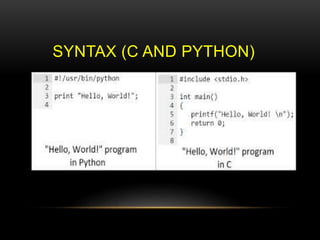
SYNTAX (C AND PYTHON)
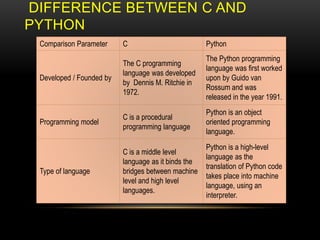
DIFFERENCE BETWEEN C AND
PYTHON
Comparison Parameter C Python
Developed / Founded by
The C programming
language was developed
by Dennis M. Ritchie in
1972.
The Python programming
language was first worked
upon by Guido van
Rossum and was
released in the year 1991.
Programming model
C is a procedural
programming language
Python is an object
oriented programming
language.
Type of language
C is a middle level
language as it binds the
bridges between machine
level and high level
languages.
Python is a high-level
language as the
translation of Python code
takes place into machine
language, using an
interpreter.
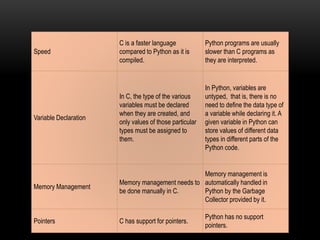
Speed
C is a faster language
compared to Python as it is
compiled.
Python programs are usually
slower than C programs as
they are interpreted.
Variable Declaration
In C, the type of the various
variables must be declared
when they are created, and
only values of those particular
types must be assigned to
them.
In Python, variables are
untyped, that is, there is no
need to define the data type of
a variable while declaring it. A
given variable in Python can
store values of different data
types in different parts of the
Python code.
Memory Management
Memory management needs to
be done manually in C.
Memory management is
automatically handled in
Python by the Garbage
Collector provided by it.
Pointers C has support for pointers.
Python has no support
pointers.
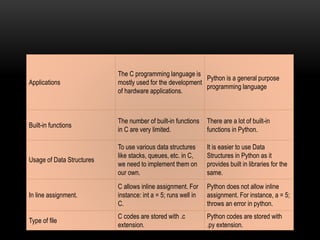
Applications
The C programming language is
mostly used for the development
of hardware applications.
Python is a general purpose
programming language
Built-in functions
The number of built-in functions
in C are very limited.
There are a lot of built-in
functions in Python.
Usage of Data Structures
To use various data structures
like stacks, queues, etc. in C,
we need to implement them on
our own.
It is easier to use Data
Structures in Python as it
provides built in libraries for the
same.
In line assignment.
C allows inline assignment. For
instance: int a = 5; runs well in
C.
Python does not allow inline
assignment. For instance, a = 5;
throws an error in python.
Type of file
C codes are stored with .c
extension.
Python codes are stored with
.py extension.
COMPARISONS BETWEEN JAVA AND PYTHON
INTRODUCTION TO JAVA
 Java is a high-level level, general-purpose, class-based
programming language that is multi-platform, object-oriented
and has a network-centric approach.
 It has a speciality in the WORA (Write Once Run Anywhere)
approach. Used as a computing platform by Sun Microsystem,
Java was later acquired by Oracle Corporation.
 Java is a very popular programming language because it has a
lot of libraries built on top of it, which has made it easy for
programmers to find code that already exists for a specific task
before starting to write their own
INTRODUCTION TO PYTHON
 Python is an interpreted, high-level, object-oriented
programming language that is dynamically typed and able to be
used in a wide range of applications.
 It has properties that are mostly inbuilt and support binding and
type casting dynamically which makes it one of the best
choices.
 The various modules and packages allow modularity and code
reuse.
 It is one of the fastest-growing popular languages as the lines
of code are drastically reduced making it readable and simple to
use.
FEATURES OF JAVA
 Object-Oriented: Java, being an Object-Oriented Programming
Language, offers a lot of important features like Data
Encapsulation, Inheritance, Data Hiding, etc. This makes Java a
suitable language to map real-world entities into objects and
solve real-life problems.
 Platform Independent: The compilation of code in Java is not
specific to any platform but rather it happens as a platform-
independent bytecode. The Java Virtual Machine (JVM) then
interprets it.
 Secure: It helps developers develop secure and tamper-free
code using public-key encryption.
 Multithreaded: It can perform many tasks simultaneously.
 High Performance: Java provides high performance with Just
In Time compilers by compiling bytecode to native machine
codes at run time. This enhances the performance of Java.
 Distributed: Java works really well for a distributed
environment. It helps users to create and manage multiple
distributed applications simultaneously. Hence the code can be
saved on different machines and accessed at the same time.
This helps in the creation of large projects (Using Remote
Method Invocation this can be achieved).
 Dynamic: It is designed to change according to the way the
environment is modified.
FEATURES OF PYTHON
 Easy to learn and use: The syntax is pretty simple and hence easily
adopted by programmers.
 Expressive language: Huge chunks of code can be completed using small
snippets of code.
 Cross-Platform Language: Easily works through all the Operating Systems.
 Free and Open Source: Python is a free and open-source language that
can be accessed by anyone from anywhere in the world.
 Standard Library: The offering of these libraries, for instance, MatPlotLib,
Pandas, Request, NumPy, etc., are extensive and make the work of a
developer really very easy.
 Flexible with other languages and tools: Python is a diverse language that
can be easily integrated with a lot of tools and frameworks to solve a variety
of problems.
DISADVANTAGES OF USING JAVA
 The execution of code can become slow because of the Just In
Time (JIT) Compiler.
 The hardware cost increases as there are high memory and
processing requirements.
 Java requires a significant amount of memory space as
compared to other languages.
DISADVANTAGES OF USING PYTHON
 Python is extremely weak in mobile computing. Therefore, it is
not widely used in application development.
 It is an interpreted language and hence slow.
 Weak in mobile computing and hence it is not used in app
development.
 Python shows errors at run time as it is dynamic. As there is no
error generated during compile time, this might result in a loss of
time for developers running large chunks of code.
 There is no commercial support.
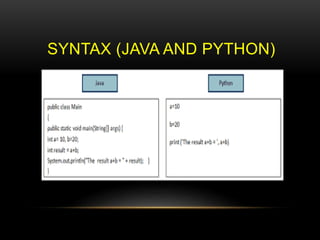
SYNTAX (JAVA AND PYTHON)
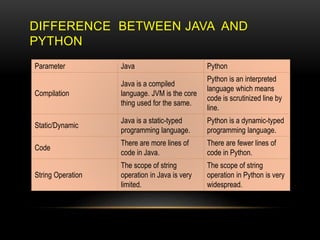
DIFFERENCE BETWEEN JAVA AND
PYTHON
Parameter Java Python
Compilation
Java is a compiled
language. JVM is the core
thing used for the same.
Python is an interpreted
language which means
code is scrutinized line by
line.
Static/Dynamic
Java is a static-typed
programming language.
Python is a dynamic-typed
programming language.
Code
There are more lines of
code in Java.
There are fewer lines of
code in Python.
String Operation
The scope of string
operation in Java is very
limited.
The scope of string
operation in Python is very
widespread.
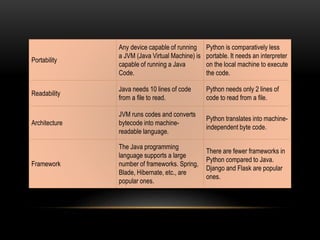
Portability
Any device capable of running
a JVM (Java Virtual Machine) is
capable of running a Java
Code.
Python is comparatively less
portable. It needs an interpreter
on the local machine to execute
the code.
Readability
Java needs 10 lines of code
from a file to read.
Python needs only 2 lines of
code to read from a file.
Architecture
JVM runs codes and converts
bytecode into machine-
readable language.
Python translates into machine-
independent byte code.
Framework
The Java programming
language supports a large
number of frameworks. Spring,
Blade, Hibernate, etc., are
popular ones.
There are fewer frameworks in
Python compared to Java.
Django and Flask are popular
ones.
END

Programming in python in detail concept .pptx

  • 1.
    Submitted by Mrs.N.Kavitha Head,Department ofComputer Science, E.M.G.Yadava Women’s College Madurai-14. PROGRAMMING IN PYTHON
  • 2.
  • 3.
    INTRODUCTION TO C C was developed at Bell Labs by Dennis Ritchie between the years 1972 and 1973.  C is one of the oldest general time and it was developed to construct utilities running on Unix was applied to reimplement the kernel of the Unix operating system.  C is also known as a middle level language as it combines the features of both high level languages and high level languages.  C is a procedural language that has a lot of features like structured programming, lexical variable scope, pointers, etc.
  • 4.
    INTRODUCTION TO PYTHON Python is a general purpose high level language which is interpreted. Python was first released in 1991 as a successor to the ABC programming language.  Python supports a lot of programming paradigms, for instance, Object Oriented Programming, Functional Programming, Structured Programming, etc.Python is dynamically-typed and garbage-collected.  It is one of the most in demand programming languages and has its application in a variety of fields like Software Engineering, Data Science, for instance, in Machine Learning, Deep Learning, etc.  Python is being adopted by a lot of developers nowadays as their primary programming language.
  • 5.
    KEY FEATURES OFC  C is a structured programming language which is extremely easy to learn.  It is an efficient programming language, that is, it is fast and has very good performance as it is a compiled language.  C is a highly portable and extensible programming language because it is not tied to any hardware or system. Any code written in C can be run on any machine which supports C, without modifying a single line of code.  C has a rich set of built-in Operators and libraries with functions.  C is a modular language, that is, it emphasizes on separating the functionality of a program into independent, interchangeable modules, such that each contains everything necessary to execute only one aspect of the desired functionality.
  • 6.
    KEY FEATURES OFPYTHON  Python is a very simple, readable open source programming language which is extremely easy to learn.  Python is an interpreted language and not a compiled language.  Python also supports the Object Oriented Programming Model.  Python is platform independent and easily extensible and embeddable.  It has a huge standard library with lots of modules and packages which support a lot of common and important functionalities. Python has one of the largest communities on StackOverflow and Meetup.  Python is a high level language as it is easy to use because of simple syntax, powerful because of its rich libraries and extremely versatile.
  • 7.
    PROS AND CONSOF C  C is a procedure oriented programming language which offers high speed of compilation.  The C language is extremely easy to understand as its syntax is very simple.  It has support for a lot of built-in libraries.  C supports a lot of features like structured programming, recursion, pointers, structures, etc. which makes it simpler to solve a lot of problems.  C codes can be easily extended. A lot of programming languages like C++, Python, etc. have been created with C codes as their foundations.
  • 8.
    PROS AND CONSOF PYTHON  Python is portable (computer programming language capable of developing software for more than one computer system) and interactive.  Python is ideal for prototyping as it provides more functionality with very few lines of code.  It is very versatile, easy to read, learn and write with a great community support.  It has extensive support for libraries, for instance, NumPy for numerical calculations, Pandas for data analytics, etc.  Python is free and open source.
  • 9.
  • 10.
    DIFFERENCE BETWEEN CAND PYTHON Comparison Parameter C Python Developed / Founded by The C programming language was developed by Dennis M. Ritchie in 1972. The Python programming language was first worked upon by Guido van Rossum and was released in the year 1991. Programming model C is a procedural programming language Python is an object oriented programming language. Type of language C is a middle level language as it binds the bridges between machine level and high level languages. Python is a high-level language as the translation of Python code takes place into machine language, using an interpreter.
  • 11.
    Speed C is afaster language compared to Python as it is compiled. Python programs are usually slower than C programs as they are interpreted. Variable Declaration In C, the type of the various variables must be declared when they are created, and only values of those particular types must be assigned to them. In Python, variables are untyped, that is, there is no need to define the data type of a variable while declaring it. A given variable in Python can store values of different data types in different parts of the Python code. Memory Management Memory management needs to be done manually in C. Memory management is automatically handled in Python by the Garbage Collector provided by it. Pointers C has support for pointers. Python has no support pointers.
  • 12.
    Applications The C programminglanguage is mostly used for the development of hardware applications. Python is a general purpose programming language Built-in functions The number of built-in functions in C are very limited. There are a lot of built-in functions in Python. Usage of Data Structures To use various data structures like stacks, queues, etc. in C, we need to implement them on our own. It is easier to use Data Structures in Python as it provides built in libraries for the same. In line assignment. C allows inline assignment. For instance: int a = 5; runs well in C. Python does not allow inline assignment. For instance, a = 5; throws an error in python. Type of file C codes are stored with .c extension. Python codes are stored with .py extension.
  • 13.
  • 14.
    INTRODUCTION TO JAVA Java is a high-level level, general-purpose, class-based programming language that is multi-platform, object-oriented and has a network-centric approach.  It has a speciality in the WORA (Write Once Run Anywhere) approach. Used as a computing platform by Sun Microsystem, Java was later acquired by Oracle Corporation.  Java is a very popular programming language because it has a lot of libraries built on top of it, which has made it easy for programmers to find code that already exists for a specific task before starting to write their own
  • 15.
    INTRODUCTION TO PYTHON Python is an interpreted, high-level, object-oriented programming language that is dynamically typed and able to be used in a wide range of applications.  It has properties that are mostly inbuilt and support binding and type casting dynamically which makes it one of the best choices.  The various modules and packages allow modularity and code reuse.  It is one of the fastest-growing popular languages as the lines of code are drastically reduced making it readable and simple to use.
  • 16.
    FEATURES OF JAVA Object-Oriented: Java, being an Object-Oriented Programming Language, offers a lot of important features like Data Encapsulation, Inheritance, Data Hiding, etc. This makes Java a suitable language to map real-world entities into objects and solve real-life problems.  Platform Independent: The compilation of code in Java is not specific to any platform but rather it happens as a platform- independent bytecode. The Java Virtual Machine (JVM) then interprets it.  Secure: It helps developers develop secure and tamper-free code using public-key encryption.  Multithreaded: It can perform many tasks simultaneously.
  • 17.
     High Performance:Java provides high performance with Just In Time compilers by compiling bytecode to native machine codes at run time. This enhances the performance of Java.  Distributed: Java works really well for a distributed environment. It helps users to create and manage multiple distributed applications simultaneously. Hence the code can be saved on different machines and accessed at the same time. This helps in the creation of large projects (Using Remote Method Invocation this can be achieved).  Dynamic: It is designed to change according to the way the environment is modified.
  • 18.
    FEATURES OF PYTHON Easy to learn and use: The syntax is pretty simple and hence easily adopted by programmers.  Expressive language: Huge chunks of code can be completed using small snippets of code.  Cross-Platform Language: Easily works through all the Operating Systems.  Free and Open Source: Python is a free and open-source language that can be accessed by anyone from anywhere in the world.  Standard Library: The offering of these libraries, for instance, MatPlotLib, Pandas, Request, NumPy, etc., are extensive and make the work of a developer really very easy.  Flexible with other languages and tools: Python is a diverse language that can be easily integrated with a lot of tools and frameworks to solve a variety of problems.
  • 19.
    DISADVANTAGES OF USINGJAVA  The execution of code can become slow because of the Just In Time (JIT) Compiler.  The hardware cost increases as there are high memory and processing requirements.  Java requires a significant amount of memory space as compared to other languages.
  • 20.
    DISADVANTAGES OF USINGPYTHON  Python is extremely weak in mobile computing. Therefore, it is not widely used in application development.  It is an interpreted language and hence slow.  Weak in mobile computing and hence it is not used in app development.  Python shows errors at run time as it is dynamic. As there is no error generated during compile time, this might result in a loss of time for developers running large chunks of code.  There is no commercial support.
  • 21.
  • 22.
    DIFFERENCE BETWEEN JAVAAND PYTHON Parameter Java Python Compilation Java is a compiled language. JVM is the core thing used for the same. Python is an interpreted language which means code is scrutinized line by line. Static/Dynamic Java is a static-typed programming language. Python is a dynamic-typed programming language. Code There are more lines of code in Java. There are fewer lines of code in Python. String Operation The scope of string operation in Java is very limited. The scope of string operation in Python is very widespread.
  • 23.
    Portability Any device capableof running a JVM (Java Virtual Machine) is capable of running a Java Code. Python is comparatively less portable. It needs an interpreter on the local machine to execute the code. Readability Java needs 10 lines of code from a file to read. Python needs only 2 lines of code to read from a file. Architecture JVM runs codes and converts bytecode into machine- readable language. Python translates into machine- independent byte code. Framework The Java programming language supports a large number of frameworks. Spring, Blade, Hibernate, etc., are popular ones. There are fewer frameworks in Python compared to Java. Django and Flask are popular ones.
  • 24.