Sped 510
Program Modification
Sped 510
Program Modification
The Whysand Wherefores: A Repertoire
Christopher G. Aguilar, Ph.D.
Presenter
Dorothy S. Tarol, Ph. D.
Professor
2019 Pambansang Ulirang Guro
M.A.Ed. SpEd.
University of San Agustin
Graduate School
The Jump
To be Fair is not Always Equal
The Case of ZEK
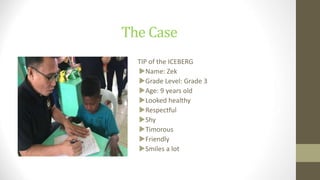
The Case
TIP of the ICEBERG
Name: Zek
Grade Level: Grade 3
Age: 9 years old
Looked healthy
Respectful
Shy
Timorous
Friendly
Smiles a lot
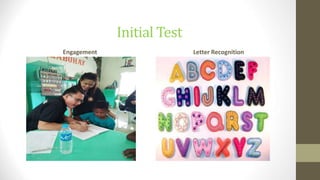
Initial Test
Engagement Letter Recognition
Measurement
Justification
Early identification is crucial
when it comes to helping
Zek who is having trouble
learning to read.
Focus
..early identification of
children at risk for problems
in learning to read
the goal is to describe the
procedures that will allow
me to identify Zek’s need in
reading before he
experience serious failure
The Deep Down Gaps
•Phonemic awareness - identify, and
manipulate individual sounds
•Letter identification is a skill that involves being
able to say the names of both upper and lower case
letters of the alphabet quickly, without having to
think very long about each letter
Descending Assumption
 Zek is destined to be a poor reader at the end of his elementary
school as evidenced of his difficulties in understanding and applying
the alphabetic principle in deciphering unfamiliar words.
 Zek is characterized by slower than normal development of a "sight
vocabulary" of words he can read fluently and automatically.
 Zek’s general intelligence and verbal ability are associated with
weaknesses in phonological processing.
 Zek entered school significantly delayed in a much broader range of
pre-reading skills.
 Zek as an IP belongs to the minority status or lower socioeconomic
status which limits his access to nutritional food and school exposure that caused
the deficiency in both of the critical kinds of knowledge and skill required for his
good reading comprehension.
Breaking the Grounds
TheLearningStrandOneoftheIPcurriculumisCommunicationSkills
This strand aims to develop the ability of the IP learners to access, critically process
and effectively make use of available information in a variety of media to be able to:
a.) function effectively as a member of the family, community, nation and the world;
and b.) actively participate in community and economic development.
Reality Check
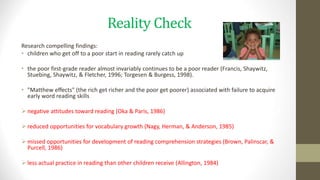
Research compelling findings:
• children who get off to a poor start in reading rarely catch up
• the poor first-grade reader almost invariably continues to be a poor reader (Francis, Shaywitz,
Stuebing, Shaywitz, & Fletcher, 1996; Torgesen & Burgess, 1998).
• "Matthew effects" (the rich get richer and the poor get poorer) associated with failure to acquire
early word reading skills
 negative attitudes toward reading (Oka & Paris, 1986)
 reduced opportunities for vocabulary growth (Nagy, Herman, & Anderson, 1985)
 missed opportunities for development of reading comprehension strategies (Brown, Palinscar, &
Purcell, 1986)
 less actual practice in reading than other children receive (Allington, 1984)
Damage Reduction
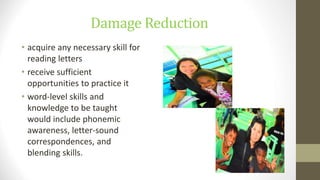
• acquire any necessary skill for
reading letters
• receive sufficient
opportunities to practice it
• word-level skills and
knowledge to be taught
would include phonemic
awareness, letter-sound
correspondences, and
blending skills.
Bridging Modification
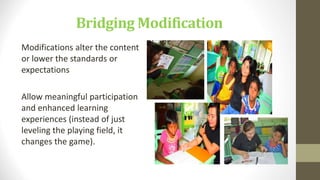
Modifications alter the content
or lower the standards or
expectations
Allow meaningful participation
and enhanced learning
experiences (instead of just
leveling the playing field, it
changes the game).
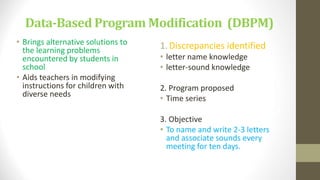
Data-Based Program Modification (DBPM)
• Brings alternative solutions to
the learning problems
encountered by students in
school
• Aids teachers in modifying
instructions for children with
diverse needs
1.Discrepancies identified
• letter name knowledge
• letter-sound knowledge
2. Program proposed
• Time series
3. Objective
• To name and write 2-3 letters
and associate sounds every
meeting for ten days.
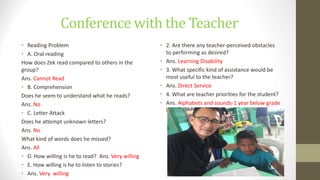
Conference with the Teacher
• Reading Problem
• A. Oral reading
How does Zek read compared to others in the
group?
Ans. Cannot Read
• B. Comprehension
Does he seem to understand what he reads?
Ans. No
• C. Letter Attack
Does he attempt unknown letters?
Ans. No
What kind of words does he missed?
Ans. All
• D. How willing is he to read? Ans. Very willing
• E. How willing is he to listen to stories?
• Ans. Very willing
• 2. Are there any teacher-perceived obstacles
to performing as desired?
• Ans. Learning Disability
• 3. What specific kind of assistance would be
most useful to the teacher?
• Ans. Direct Service
• 4. What are teacher priorities for the student?
• Ans. Alphabets and sounds-1 year below grade
level
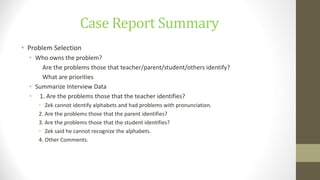
Case Report Summary
• Problem Selection
• Who owns the problem?
Are the problems those that teacher/parent/student/others identify?
What are priorities
• Summarize Interview Data
• 1. Are the problems those that the teacher identifies?
• Zek cannot identify alphabets and had problems with pronunciation.
2. Are the problems those that the parent identifies?
3. Are the problems those that the student identifies?
• Zek said he cannot recognize the alphabets.
4. Other Comments.
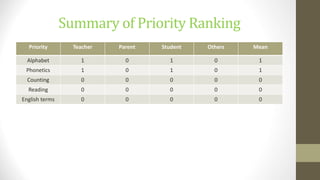
Summary of Priority Ranking
Priority Teacher Parent Student Others Mean
Alphabet 1 0 1 0 1
Phonetics 1 0 1 0 1
Counting 0 0 0 0 0
Reading 0 0 0 0 0
English terms 0 0 0 0 0
DeterminingZeks’ActualProgressintheLetterSkillSequence
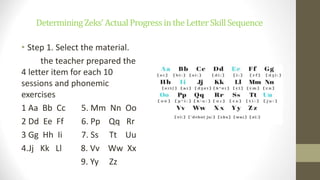
• Step 1. Select the material.
the teacher prepared the
4 letter item for each 10
sessions and phonemic
exercises
1 Aa Bb Cc 5. Mm Nn Oo
2 Dd Ee Ff 6. Pp Qq Rr
3 Gg Hh Ii 7. Ss Tt Uu
4.Jj Kk Ll 8. Vv Ww Xx
9. Yy Zz
DeterminingZeks’ActualProgressintheLetterSkillSequence
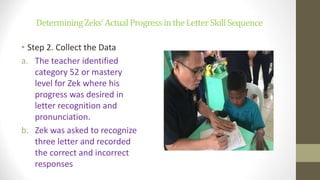
• Step 2. Collect the Data
a. The teacher identified
category 52 or mastery
level for Zek where his
progress was desired in
letter recognition and
pronunciation.
b. Zek was asked to recognize
three letter and recorded
the correct and incorrect
responses
DeterminingZeks’ActualProgressintheLetterSkillSequence
• Step 3. Summarize the data
a. The teacher totaled the
number of correct and
incorrect words decoded
and pronounced.
b. The data each batch of
letters were ordered from
high to low and the
medians were selected.
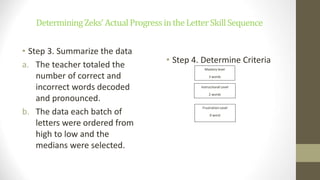
• Step 4. Determine Criteria
Instructional Level
2 words
Mastery level
3 words
Frustration Level
0 word
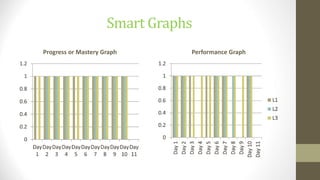
Smart Graphs
Progress or Mastery Graph Performance Graph
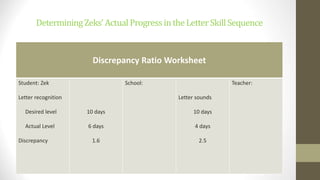
DeterminingZeks’ActualProgressintheLetterSkillSequence
Discrepancy Ratio Worksheet
Student: Zek
Letter recognition
Desired level
Actual Level
Discrepancy
10 days
6 days
1.6
School:
Letter sounds
10 days
4 days
2.5
Teacher:
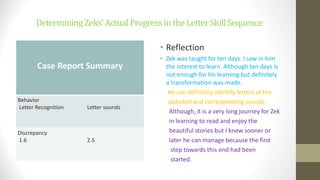
DeterminingZeks’ActualProgressintheLetterSkillSequence
Case Report Summary
Behavior
Letter Recognition Letter sounds
Discrepancy
1.6 2.5
• Reflection
• Zek was taught for ten days. I saw in him
the interest to learn. Although ten days is
not enough for his learning but definitely
a transformation was made.
He can definitely identify letters of the
alphabet and corresponding sounds.
Although, it is a very long journey for Zek
in learning to read and enjoy the
beautiful stories but I knew sooner or
later he can manage because the first
step towards this end had been
started.
TheJUMP
We all love to jump. We jump for a lot of reasons. We jump for our winnings. We jump for our success. We jump for our excitements. We jump because we want to
celebrate. We jump because we just love to jump or simply we jump because Dr. Tarol said so. For whatever reason that we jump we are pretty sure that it comes
with gladness. And we just had our jumps either high or low it came with gladness… because we have served the likes of ZEKs in an IP community.
Program Modification-Time Study on IP

Program Modification-Time Study on IP

  • 1.
    Sped 510 Program Modification Sped510 Program Modification The Whysand Wherefores: A Repertoire Christopher G. Aguilar, Ph.D. Presenter Dorothy S. Tarol, Ph. D. Professor 2019 Pambansang Ulirang Guro M.A.Ed. SpEd. University of San Agustin Graduate School
  • 2.
    The Jump To beFair is not Always Equal The Case of ZEK
  • 3.
    The Case TIP ofthe ICEBERG Name: Zek Grade Level: Grade 3 Age: 9 years old Looked healthy Respectful Shy Timorous Friendly Smiles a lot
  • 4.
  • 5.
    Measurement Justification Early identification iscrucial when it comes to helping Zek who is having trouble learning to read. Focus ..early identification of children at risk for problems in learning to read the goal is to describe the procedures that will allow me to identify Zek’s need in reading before he experience serious failure
  • 6.
    The Deep DownGaps •Phonemic awareness - identify, and manipulate individual sounds •Letter identification is a skill that involves being able to say the names of both upper and lower case letters of the alphabet quickly, without having to think very long about each letter
  • 7.
    Descending Assumption  Zekis destined to be a poor reader at the end of his elementary school as evidenced of his difficulties in understanding and applying the alphabetic principle in deciphering unfamiliar words.  Zek is characterized by slower than normal development of a "sight vocabulary" of words he can read fluently and automatically.  Zek’s general intelligence and verbal ability are associated with weaknesses in phonological processing.  Zek entered school significantly delayed in a much broader range of pre-reading skills.  Zek as an IP belongs to the minority status or lower socioeconomic status which limits his access to nutritional food and school exposure that caused the deficiency in both of the critical kinds of knowledge and skill required for his good reading comprehension.
  • 8.
  • 9.
    TheLearningStrandOneoftheIPcurriculumisCommunicationSkills This strand aimsto develop the ability of the IP learners to access, critically process and effectively make use of available information in a variety of media to be able to: a.) function effectively as a member of the family, community, nation and the world; and b.) actively participate in community and economic development.
  • 10.
    Reality Check Research compellingfindings: • children who get off to a poor start in reading rarely catch up • the poor first-grade reader almost invariably continues to be a poor reader (Francis, Shaywitz, Stuebing, Shaywitz, & Fletcher, 1996; Torgesen & Burgess, 1998). • "Matthew effects" (the rich get richer and the poor get poorer) associated with failure to acquire early word reading skills  negative attitudes toward reading (Oka & Paris, 1986)  reduced opportunities for vocabulary growth (Nagy, Herman, & Anderson, 1985)  missed opportunities for development of reading comprehension strategies (Brown, Palinscar, & Purcell, 1986)  less actual practice in reading than other children receive (Allington, 1984)
  • 11.
    Damage Reduction • acquireany necessary skill for reading letters • receive sufficient opportunities to practice it • word-level skills and knowledge to be taught would include phonemic awareness, letter-sound correspondences, and blending skills.
  • 12.
    Bridging Modification Modifications alterthe content or lower the standards or expectations Allow meaningful participation and enhanced learning experiences (instead of just leveling the playing field, it changes the game).
  • 13.
    Data-Based Program Modification(DBPM) • Brings alternative solutions to the learning problems encountered by students in school • Aids teachers in modifying instructions for children with diverse needs 1.Discrepancies identified • letter name knowledge • letter-sound knowledge 2. Program proposed • Time series 3. Objective • To name and write 2-3 letters and associate sounds every meeting for ten days.
  • 14.
    Conference with theTeacher • Reading Problem • A. Oral reading How does Zek read compared to others in the group? Ans. Cannot Read • B. Comprehension Does he seem to understand what he reads? Ans. No • C. Letter Attack Does he attempt unknown letters? Ans. No What kind of words does he missed? Ans. All • D. How willing is he to read? Ans. Very willing • E. How willing is he to listen to stories? • Ans. Very willing • 2. Are there any teacher-perceived obstacles to performing as desired? • Ans. Learning Disability • 3. What specific kind of assistance would be most useful to the teacher? • Ans. Direct Service • 4. What are teacher priorities for the student? • Ans. Alphabets and sounds-1 year below grade level
  • 15.
    Case Report Summary •Problem Selection • Who owns the problem? Are the problems those that teacher/parent/student/others identify? What are priorities • Summarize Interview Data • 1. Are the problems those that the teacher identifies? • Zek cannot identify alphabets and had problems with pronunciation. 2. Are the problems those that the parent identifies? 3. Are the problems those that the student identifies? • Zek said he cannot recognize the alphabets. 4. Other Comments.
  • 16.
    Summary of PriorityRanking Priority Teacher Parent Student Others Mean Alphabet 1 0 1 0 1 Phonetics 1 0 1 0 1 Counting 0 0 0 0 0 Reading 0 0 0 0 0 English terms 0 0 0 0 0
  • 17.
    DeterminingZeks’ActualProgressintheLetterSkillSequence • Step 1.Select the material. the teacher prepared the 4 letter item for each 10 sessions and phonemic exercises 1 Aa Bb Cc 5. Mm Nn Oo 2 Dd Ee Ff 6. Pp Qq Rr 3 Gg Hh Ii 7. Ss Tt Uu 4.Jj Kk Ll 8. Vv Ww Xx 9. Yy Zz
  • 18.
    DeterminingZeks’ActualProgressintheLetterSkillSequence • Step 2.Collect the Data a. The teacher identified category 52 or mastery level for Zek where his progress was desired in letter recognition and pronunciation. b. Zek was asked to recognize three letter and recorded the correct and incorrect responses
  • 19.
    DeterminingZeks’ActualProgressintheLetterSkillSequence • Step 3.Summarize the data a. The teacher totaled the number of correct and incorrect words decoded and pronounced. b. The data each batch of letters were ordered from high to low and the medians were selected. • Step 4. Determine Criteria Instructional Level 2 words Mastery level 3 words Frustration Level 0 word
  • 20.
    Smart Graphs Progress orMastery Graph Performance Graph
  • 21.
    DeterminingZeks’ActualProgressintheLetterSkillSequence Discrepancy Ratio Worksheet Student:Zek Letter recognition Desired level Actual Level Discrepancy 10 days 6 days 1.6 School: Letter sounds 10 days 4 days 2.5 Teacher:
  • 22.
    DeterminingZeks’ActualProgressintheLetterSkillSequence Case Report Summary Behavior LetterRecognition Letter sounds Discrepancy 1.6 2.5 • Reflection • Zek was taught for ten days. I saw in him the interest to learn. Although ten days is not enough for his learning but definitely a transformation was made. He can definitely identify letters of the alphabet and corresponding sounds. Although, it is a very long journey for Zek in learning to read and enjoy the beautiful stories but I knew sooner or later he can manage because the first step towards this end had been started.
  • 23.
    TheJUMP We all loveto jump. We jump for a lot of reasons. We jump for our winnings. We jump for our success. We jump for our excitements. We jump because we want to celebrate. We jump because we just love to jump or simply we jump because Dr. Tarol said so. For whatever reason that we jump we are pretty sure that it comes with gladness. And we just had our jumps either high or low it came with gladness… because we have served the likes of ZEKs in an IP community.