The Program Assessment Guide
Structuring Contextual Knowledge and Experience to
 Improve the Design, Delivery and Effectiveness of
               Nutrition Interventions


                    David Pelletier
           Division of Nutritional Sciences
                  Cornell University

               CORE Spring Meeting
                  May 1, 2012
                 Wilmington, DE
Acknowledgments
Collaborators on the MN Tool Project
   Allison Corsi, Lesli Hoey, Suzanne Gervais,
    Cornell University


Funders and Facilitators of the MN Tool Project
   The World Bank
   Micronutrient Initiative
   Centers for Disease Control
   UNICEF
   GAIN
   A2Z (USAID and Gates Foundation)
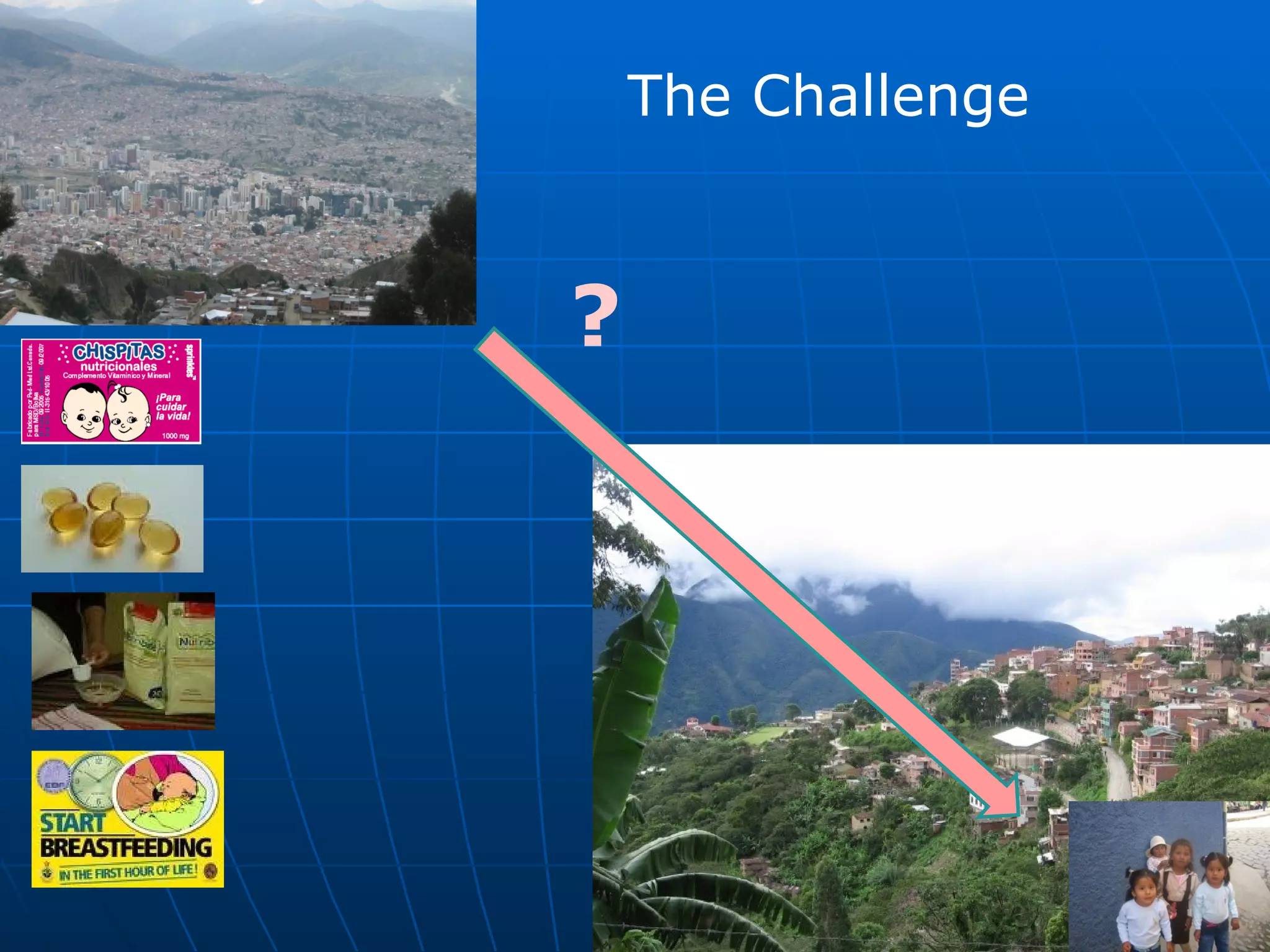
The Challenge


?
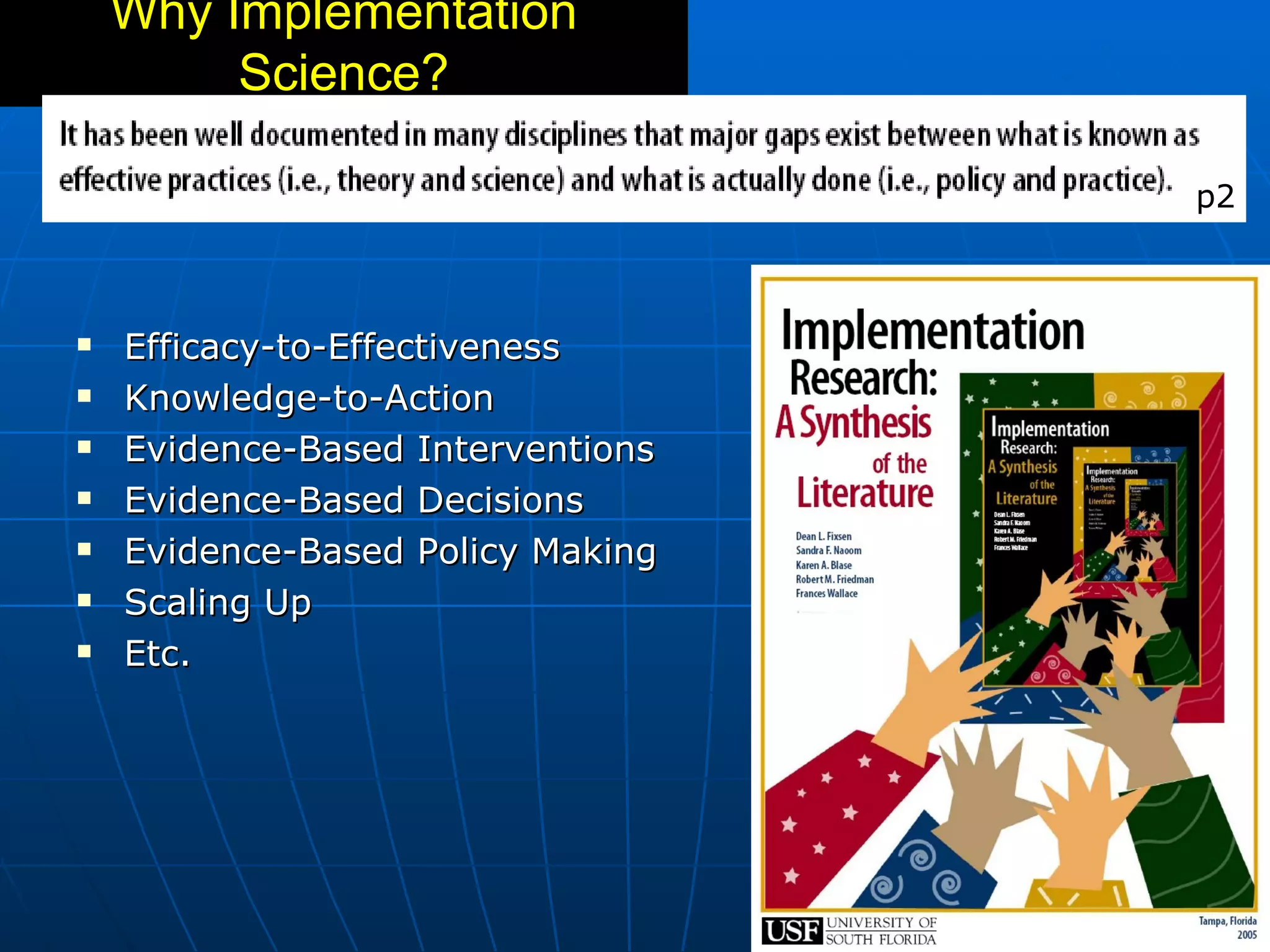
Why Implementation
         Science?

                                   p2


   Efficacy-to-Effectiveness
   Knowledge-to-Action
   Evidence-Based Interventions
   Evidence-Based Decisions
   Evidence-Based Policy Making
   Scaling Up
   Etc.
Outline
1.   Genesis of the project
2.   Overview of the PAG
3.   Adaptations and next steps for the PAG
4.   Q&A
Genesis of This Project

   Micronutrient Forum (May 2009)
    • From Evidence to Large Scale Programs
   The Innocenti Process (Sept 2008)
    •   Country implementers, donors, researchers
    •   Review of evidence for effectiveness at scale
    •   Identification of overarching issues needing attention
   Country implementers requested stronger
    guidance on identifying and resolving
    implementation bottlenecks
The Micronutrient Program Tools
   Program Assessment Guide (PAG)
   Program Documentation Guide (PDG)
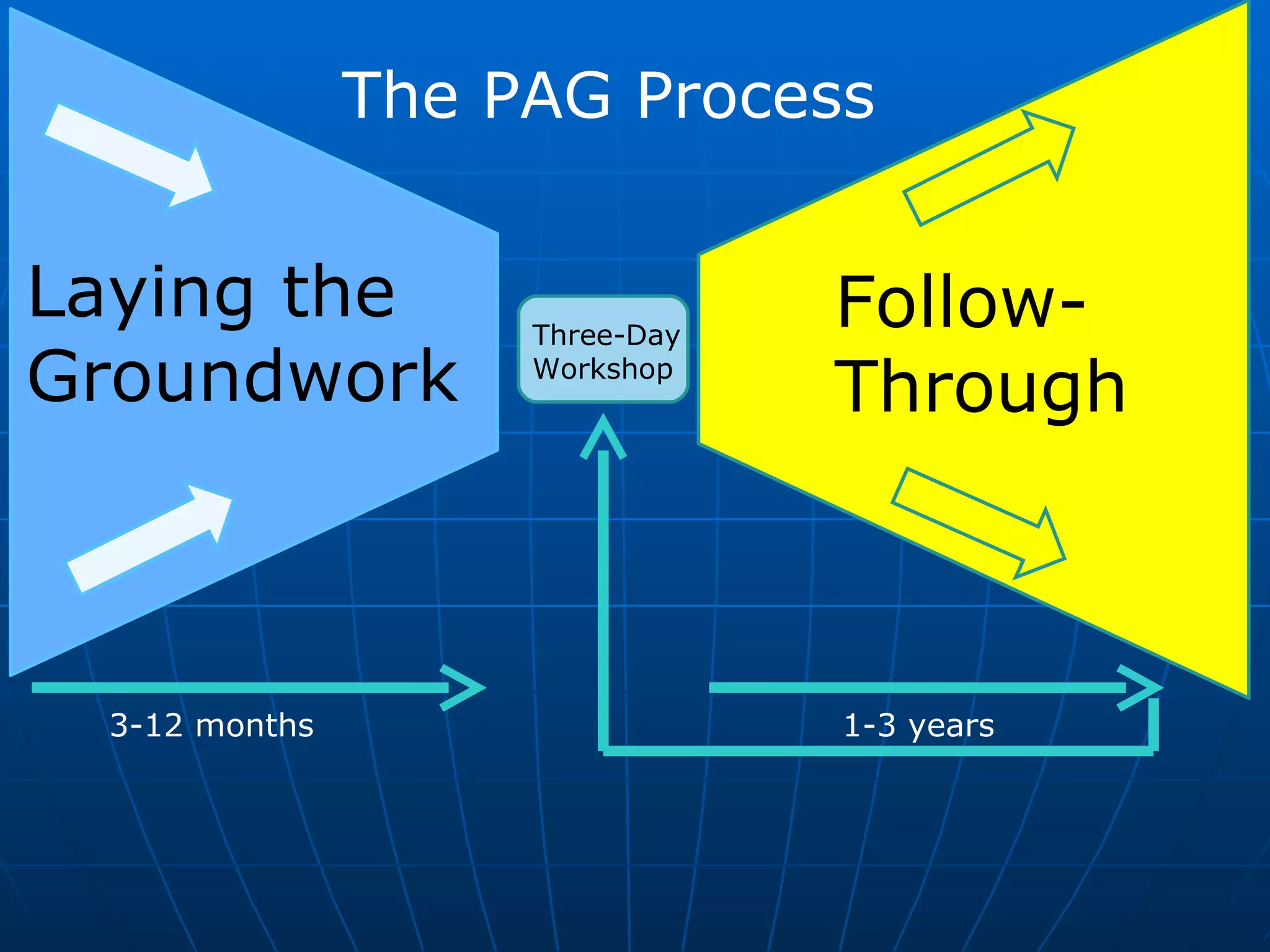
The PAG Process


Laying the          Three-Day
                                Follow-
Groundwork          Workshop
                                Through


 3-12 months                    1-3 years
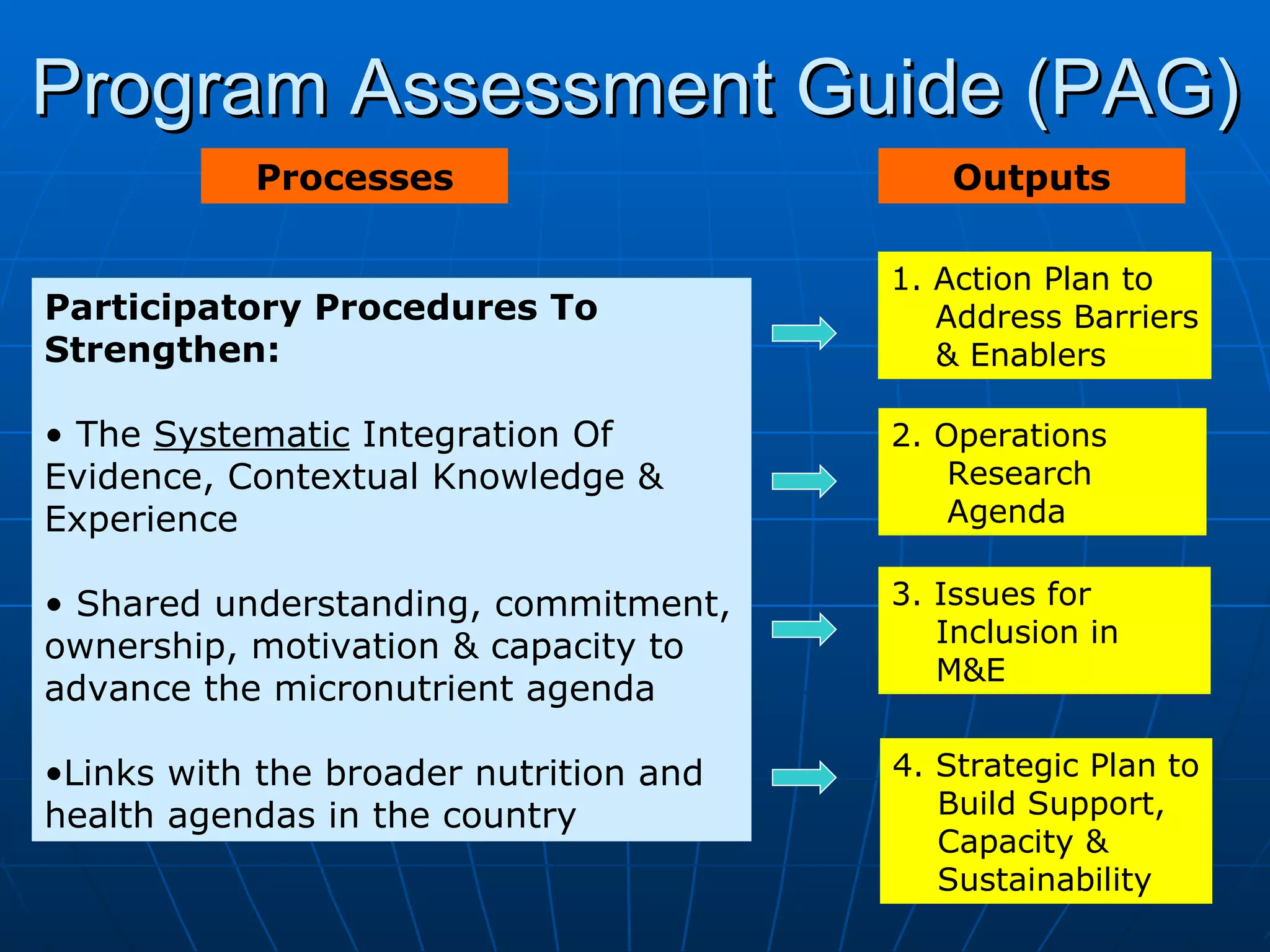
Program Assessment Guide (PAG)
           Processes                        Outputs

                                        1. Action Plan to
Participatory Procedures To                Address Barriers
Strengthen:                                & Enablers

• The Systematic Integration Of         2. Operations
Evidence, Contextual Knowledge &            Research
Experience                                  Agenda

• Shared understanding, commitment,     3. Issues for
ownership, motivation & capacity to        Inclusion in
                                           M&E
advance the micronutrient agenda

•Links with the broader nutrition and   4. Strategic Plan to
health agendas in the country              Build Support,
                                           Capacity &
                                           Sustainability
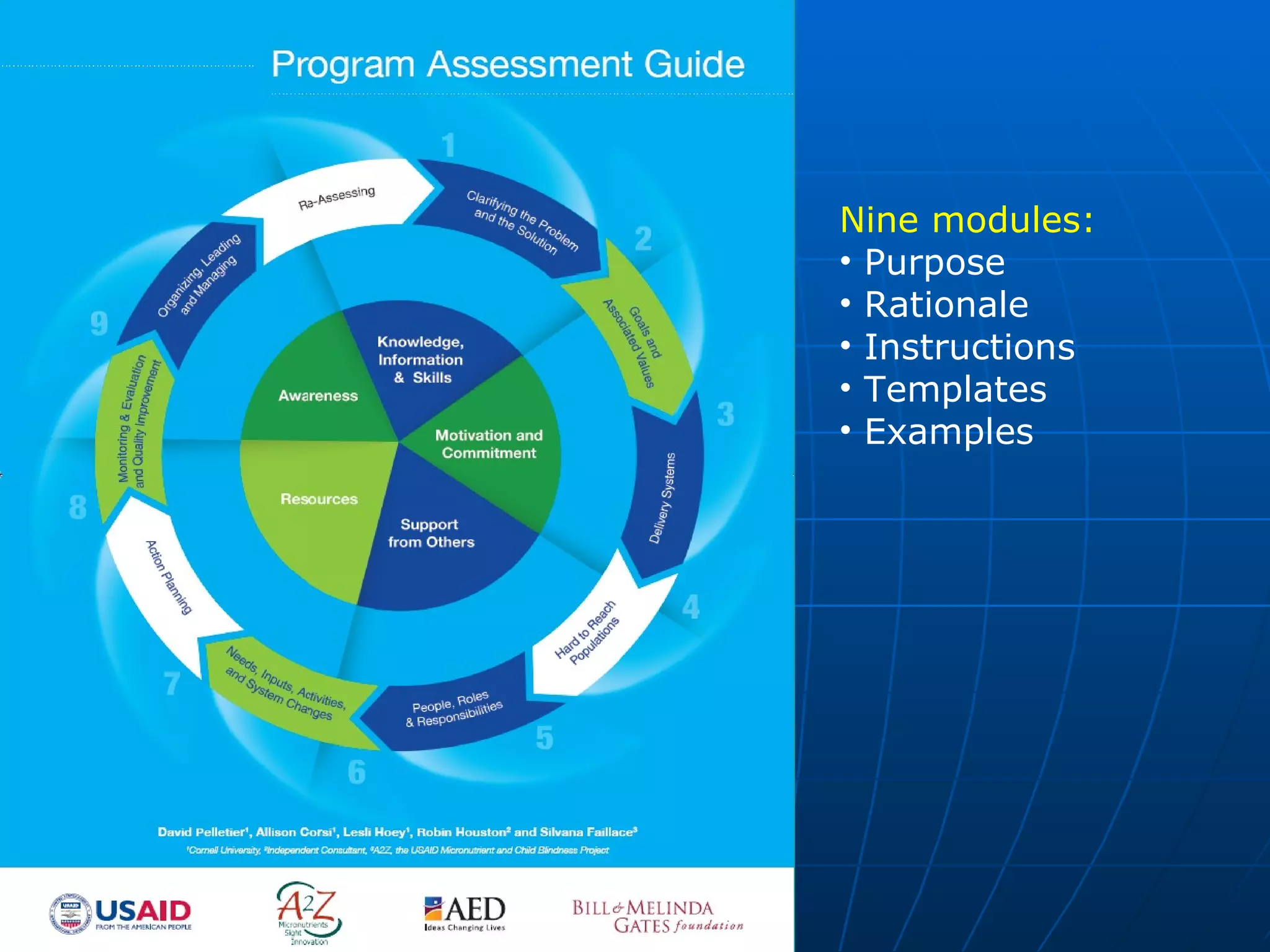
Nine modules:
• Purpose
• Rationale
• Instructions
• Templates
• Examples
Program Assessment Guide

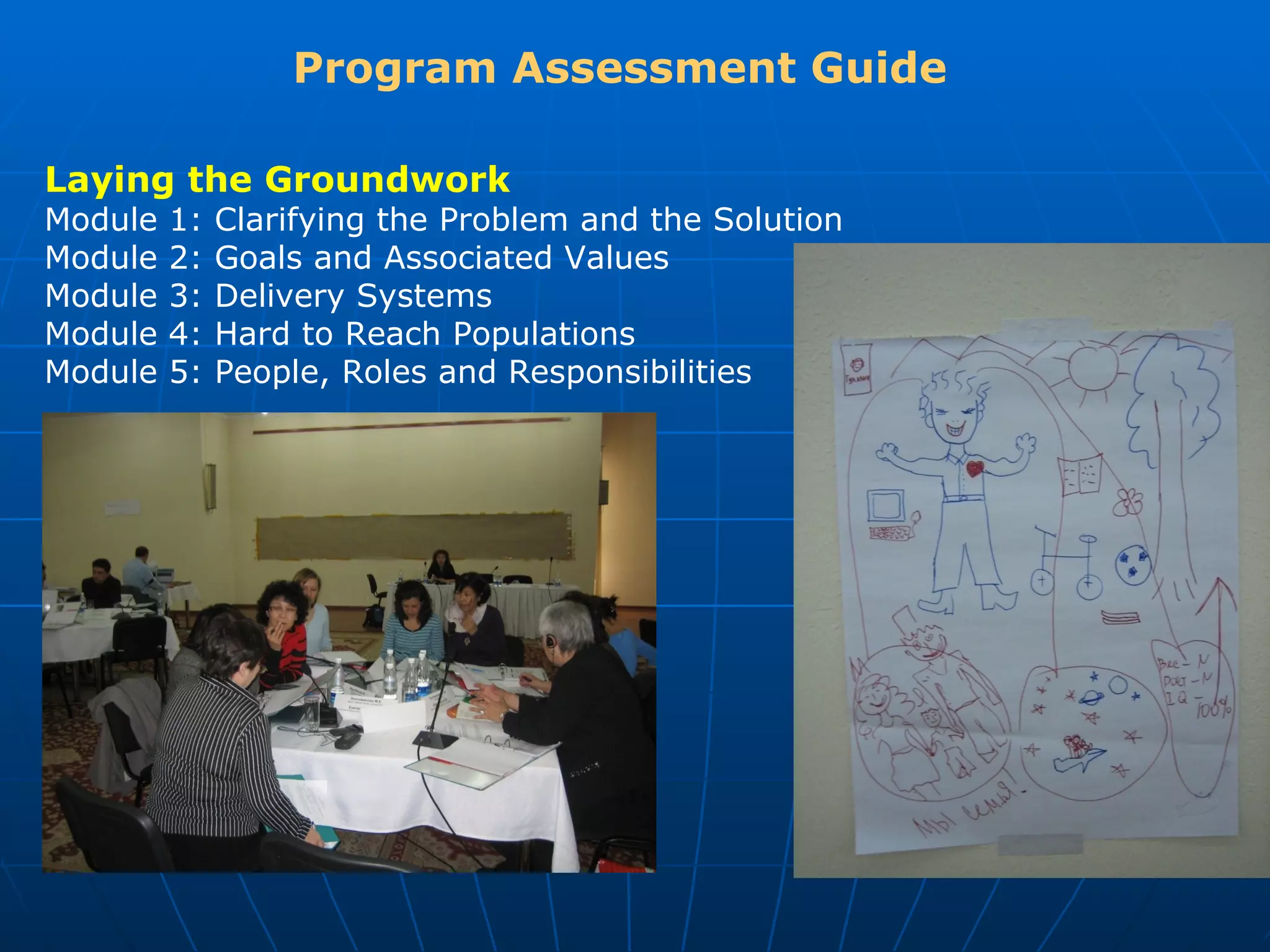
Laying the Groundwork
Module   1:   Clarifying the Problem and the Solution
Module   2:   Goals and Associated Values
Module   3:   Delivery Systems
Module   4:   Hard to Reach Populations
Module   5:   People, Roles and Responsibilities
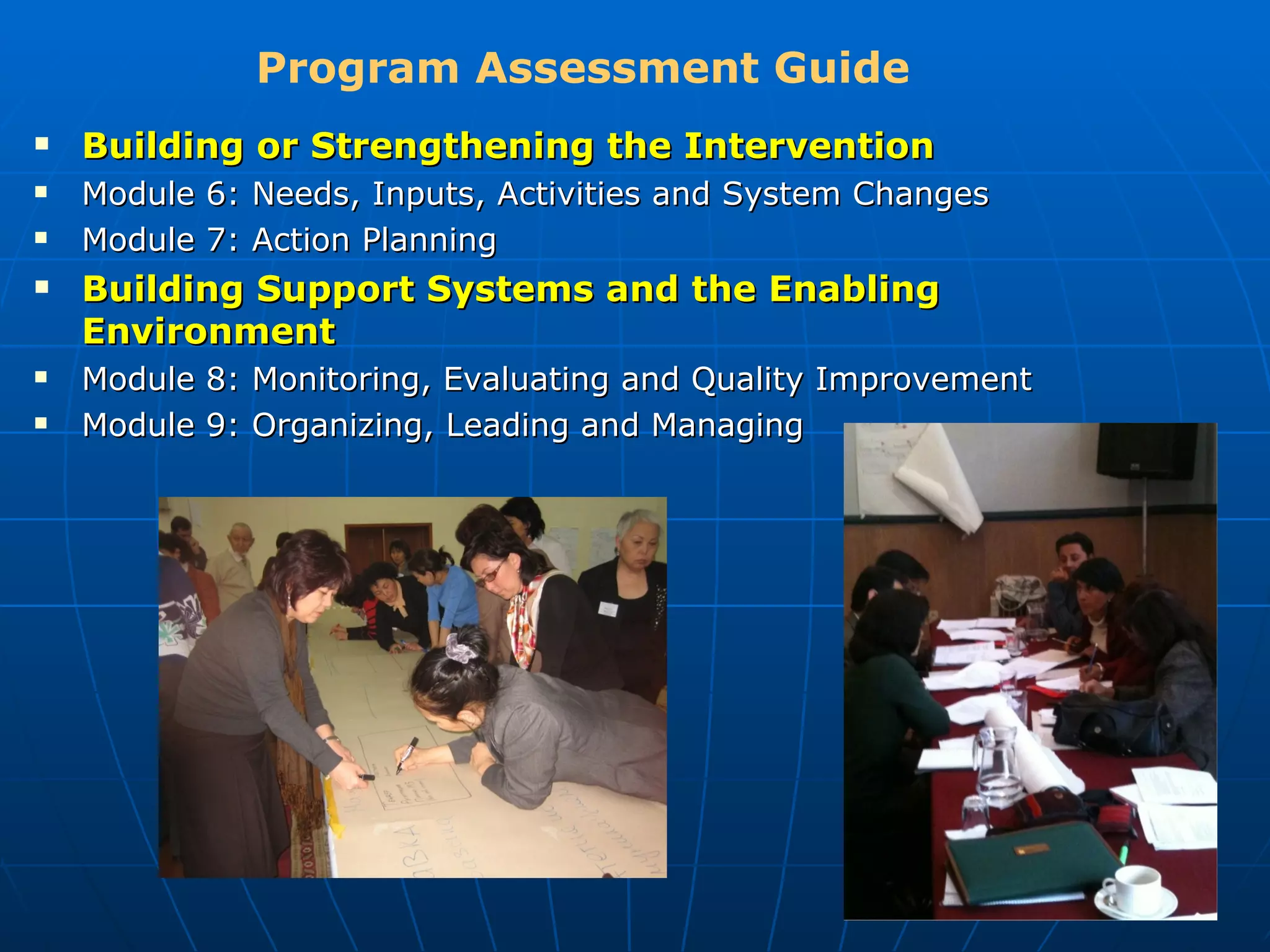
Program Assessment Guide
   Building or Strengthening the Intervention
   Module 6: Needs, Inputs, Activities and System Changes
   Module 7: Action Planning
   Building Support Systems and the Enabling
    Environment
   Module 8: Monitoring, Evaluating and Quality Improvement
   Module 9: Organizing, Leading and Managing
Some Distinctive Features of the PAG


1. Delivery Systems as Social Systems (Module 3)


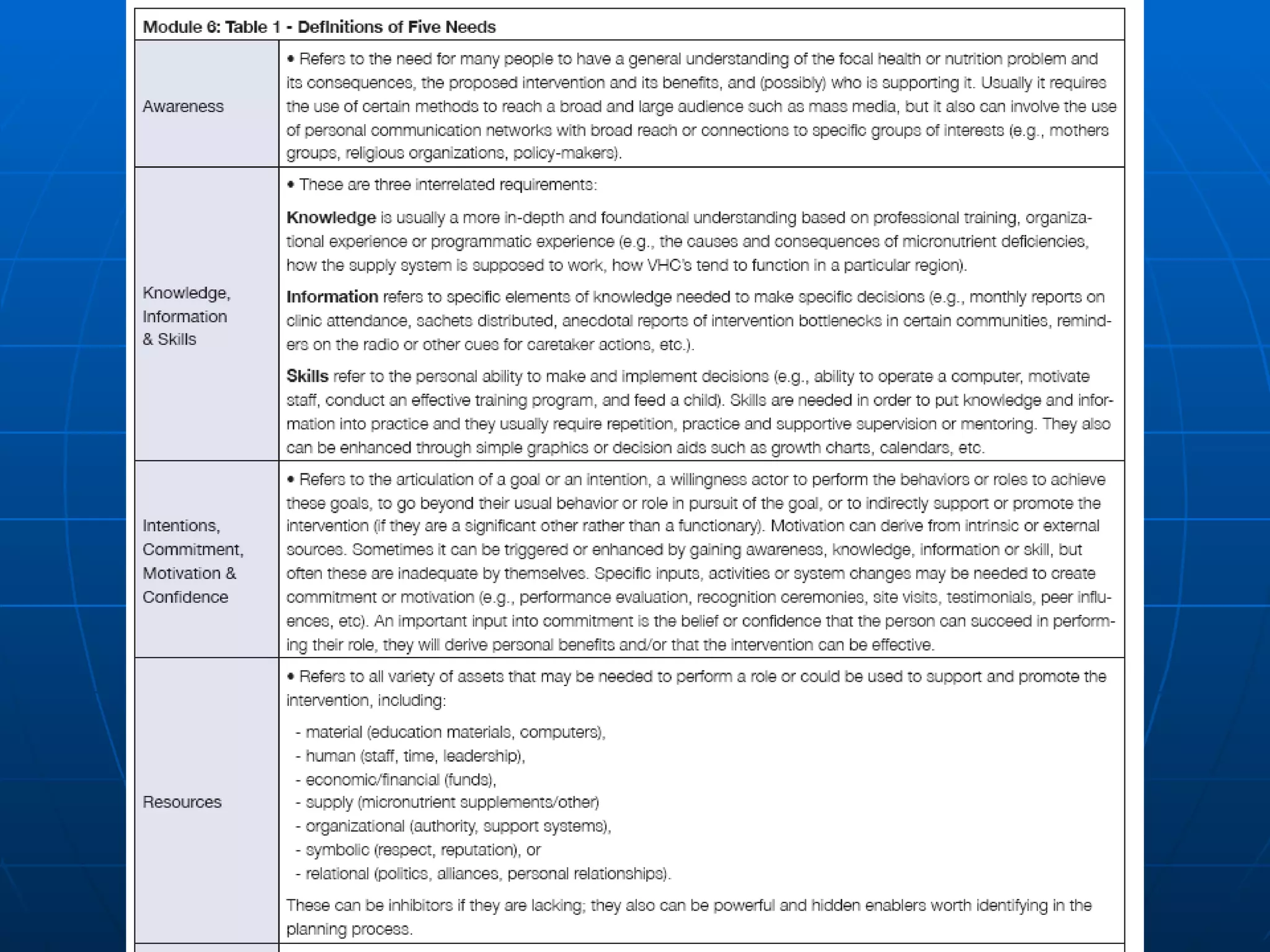
2. The Five Needs Tool (Module 6)

3. The Stress-Testing Tool (Module 6)

4. Clear definition of roles and responsibilities (Modules 5,7) and
    responsibility for follow-up (Module 9)
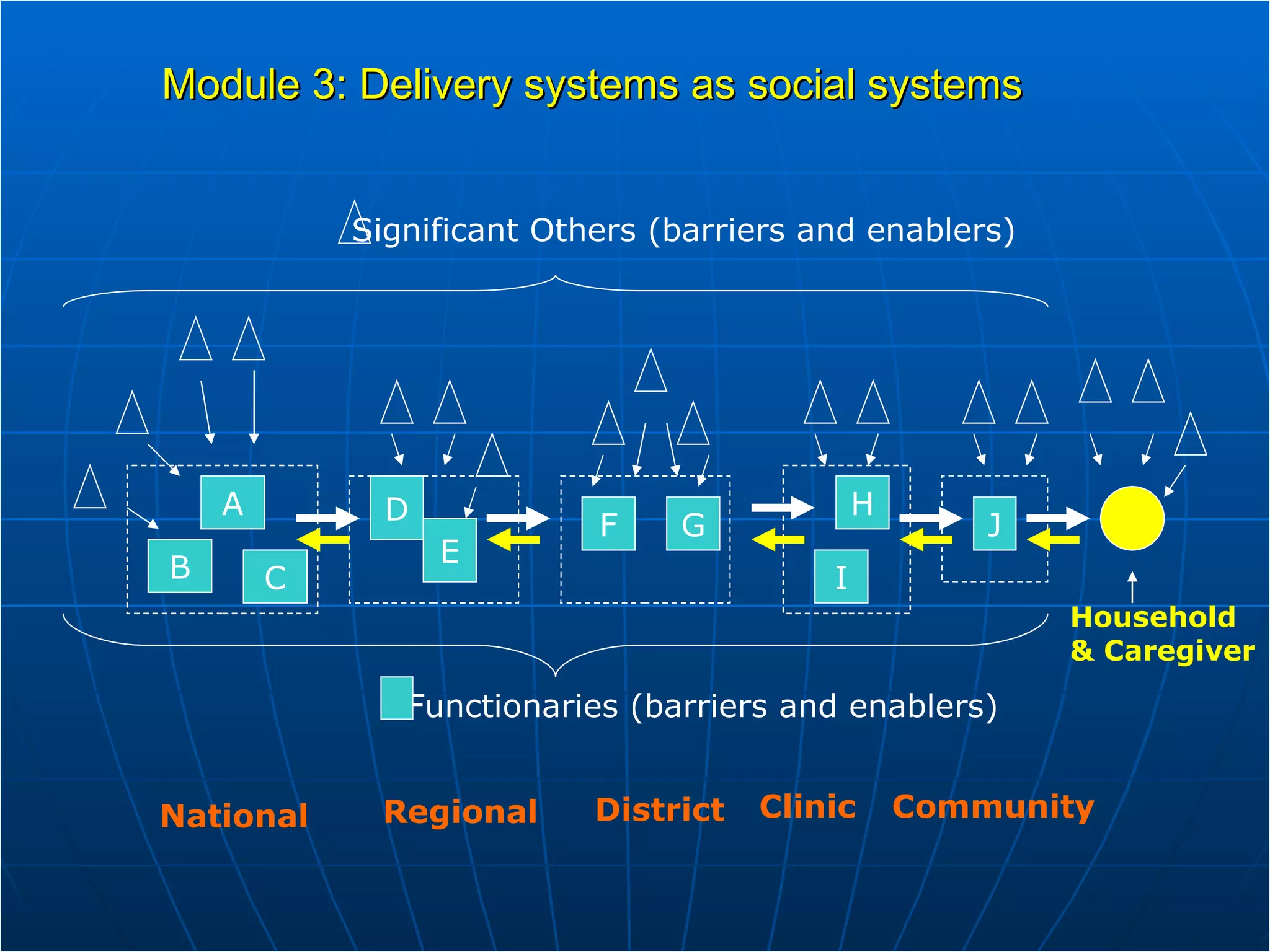
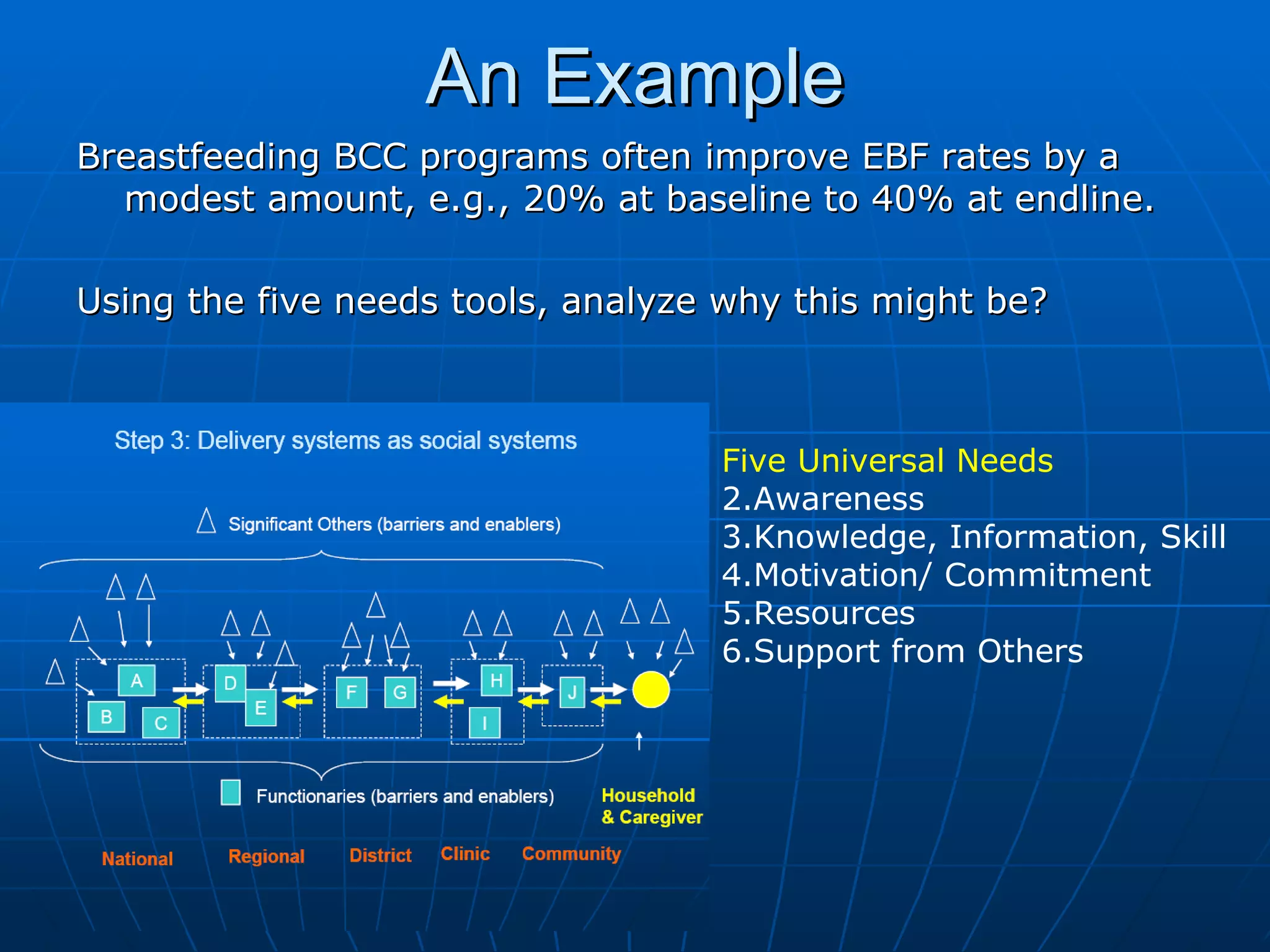
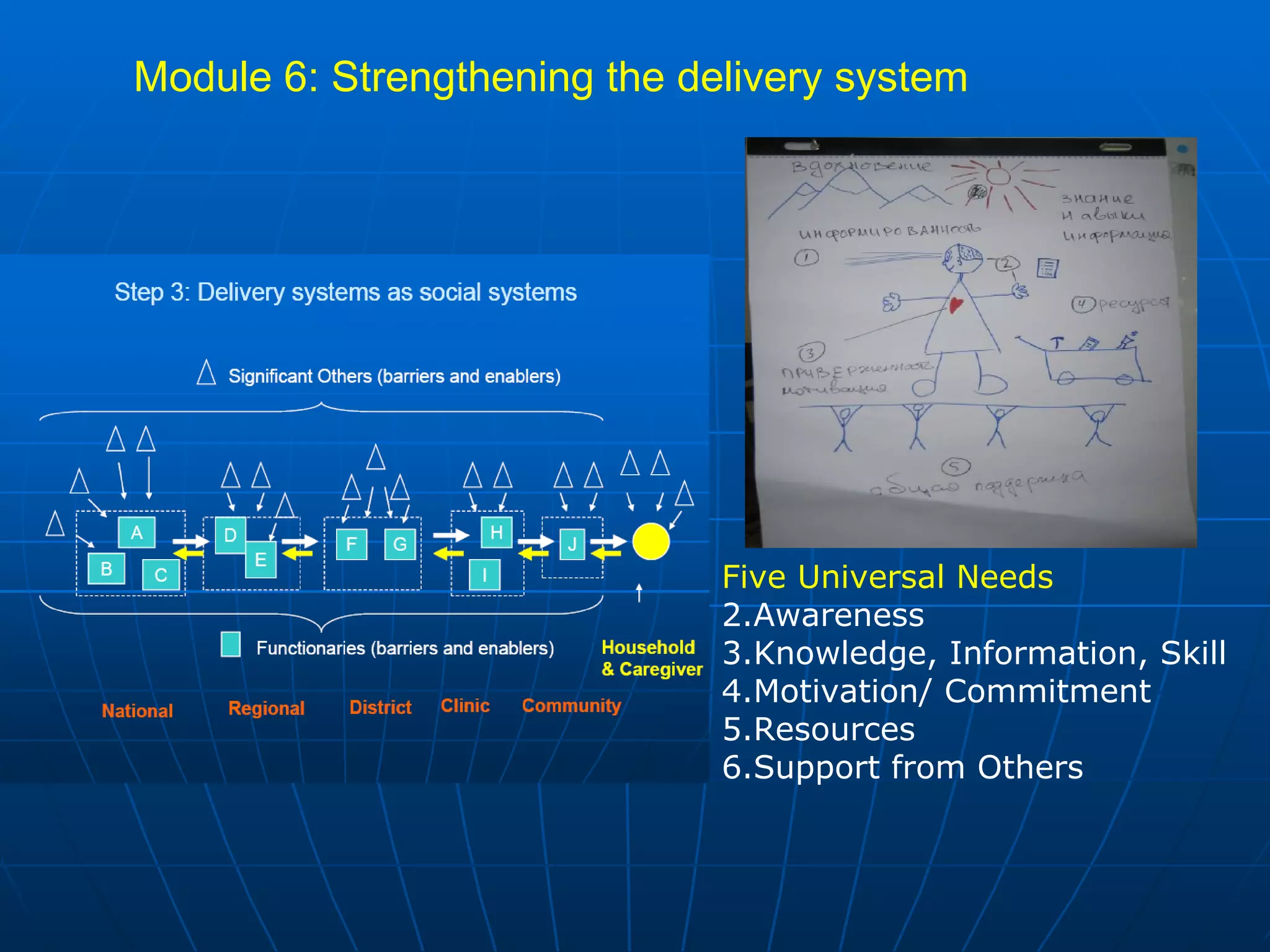
Module 3: Delivery systems as social systems


            Significant Others (barriers and enablers)


    A         D                               H
                           F    G                     J
                  E
B       C                                 I
                                                          Household
                                                          & Caregiver

               Functionaries (barriers and enablers)


National     Regional      District   Clinic      Community
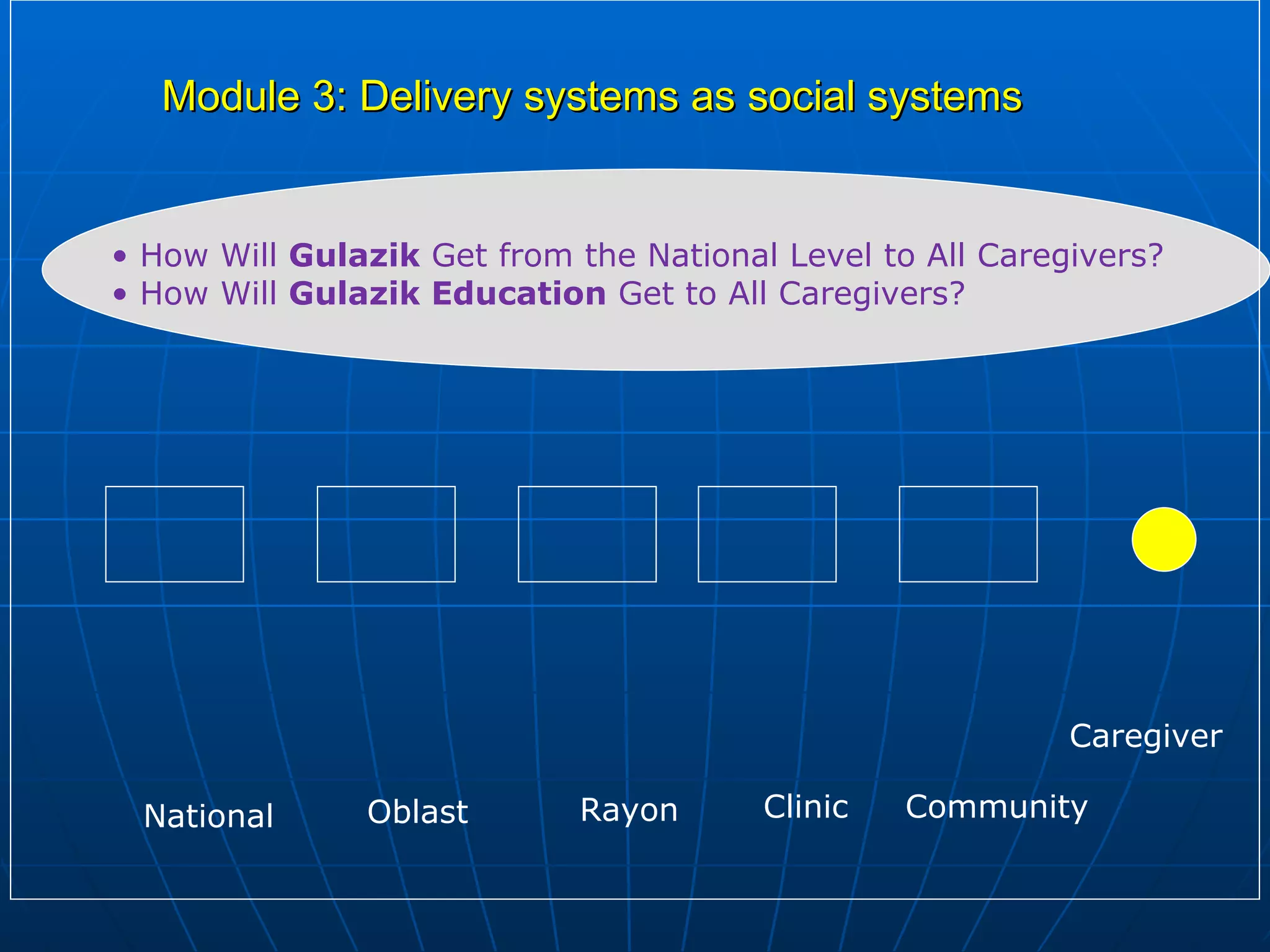
Module 3: Delivery systems as social systems


• How Will Gulazik Get from the National Level to All Caregivers?
• How Will Gulazik Education Get to All Caregivers?


                                                           Caregiver

 National      Oblast       Rayon       Clinic   Community
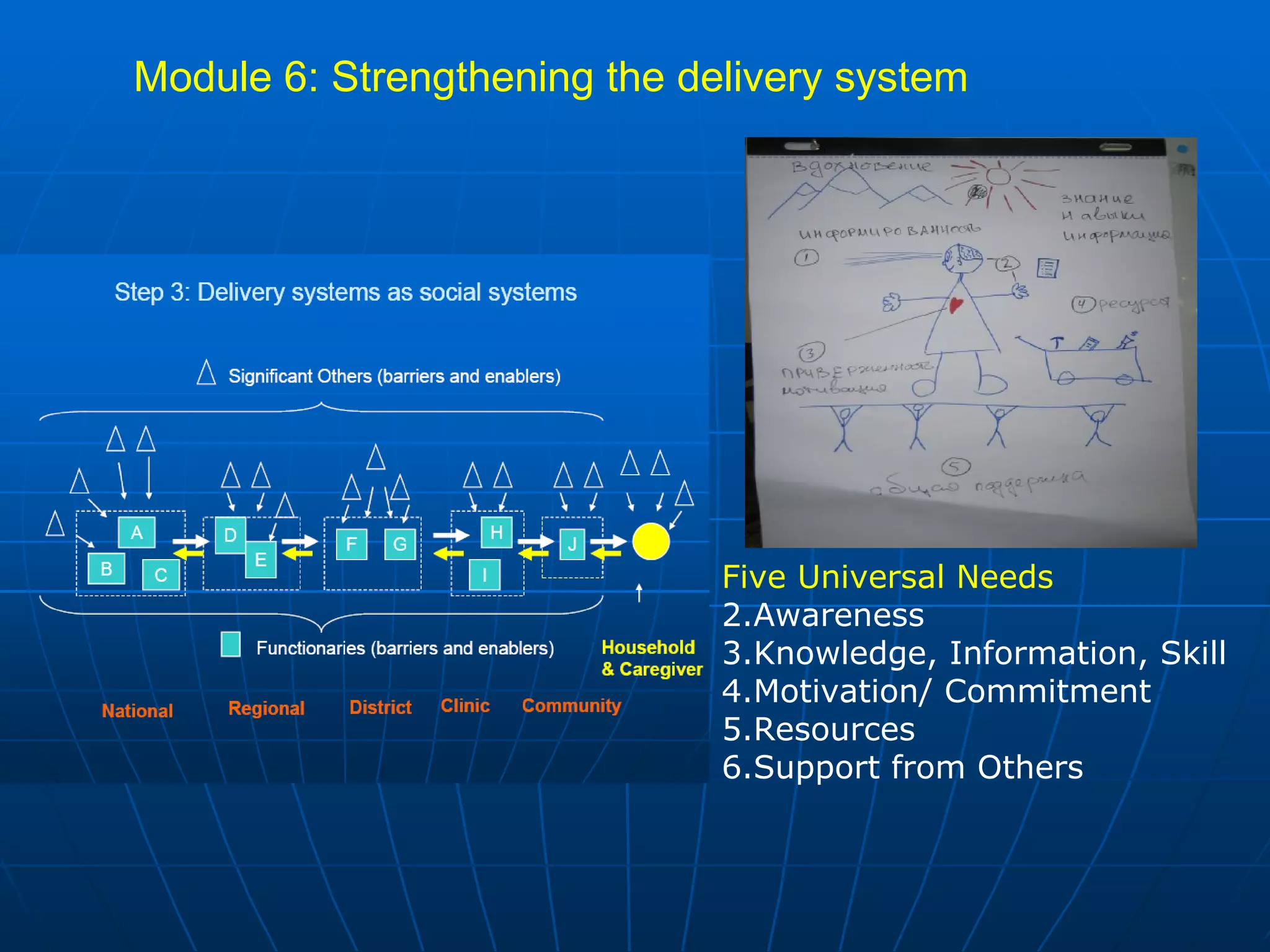
Module 6: Strengthening the delivery system


                              Five Universal Needs
                              2.Awareness
                              3.Knowledge, Information, Skill
                              4.Motivation/ Commitment
                              5.Resources
                              6.Support from Others
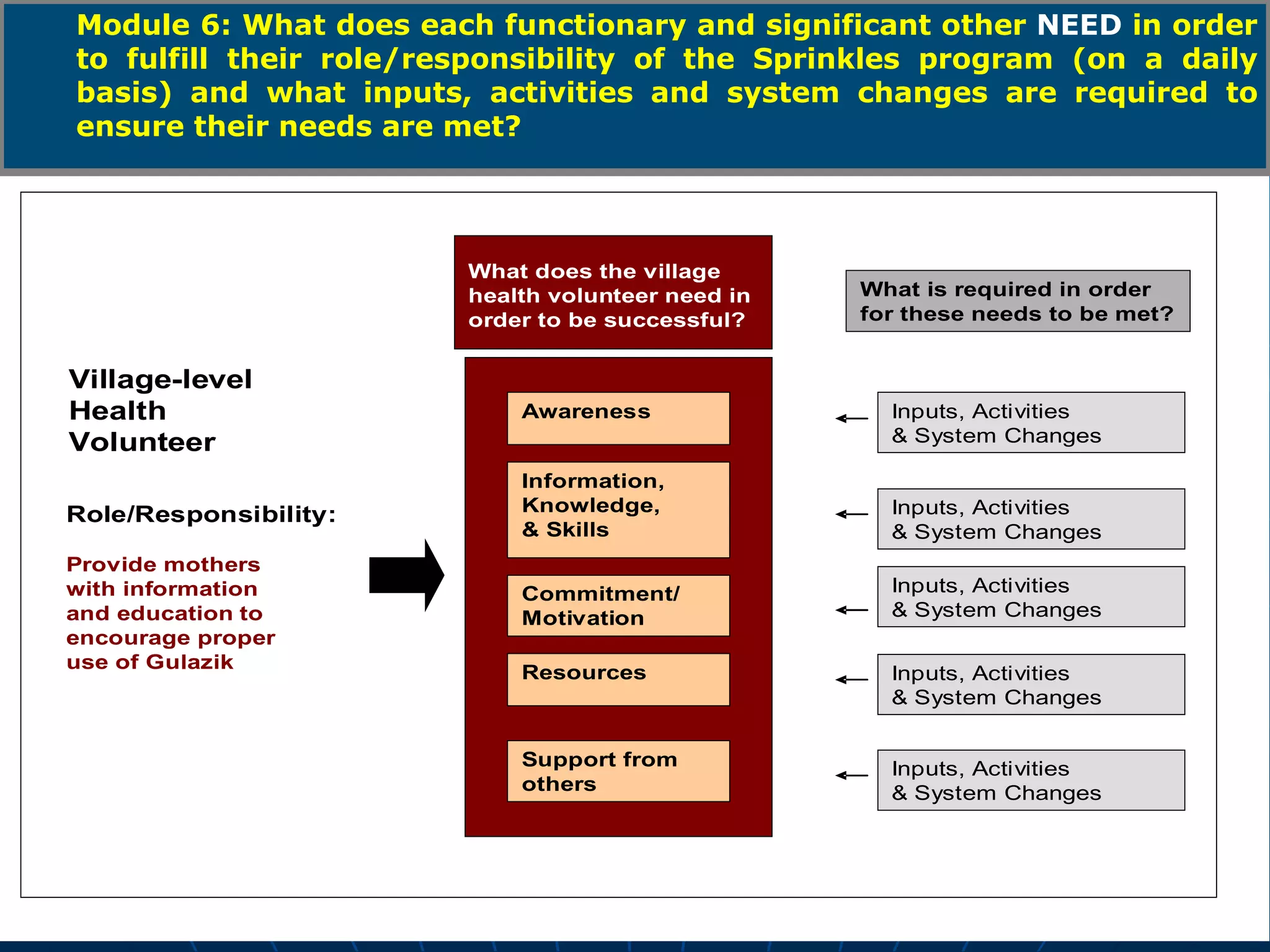
Module 6: What does each functionary and significant other NEED in order
to fulfill their role/responsibility of the Sprinkles program (on a daily
basis) and what inputs, activities and system changes are required to
ensure their needs are met?


                        What does the village
                        health volunteer need in   What is required in order
                        order to be successful?    for these needs to be met?


Village-level
Health                      Awareness                Inputs, Activities
Volunteer                                            & System Changes

                            Information,
Role/Responsibility:        Knowledge,               Inputs, Activities
                            & Skills                 & System Changes
Provide mothers
with information            Commitment/              Inputs, Activities
and education to            Motivation               & System Changes
encourage proper
use of Gulazik
                            Resources                Inputs, Activities
                                                     & System Changes


                            Support from             Inputs, Activities
                            others                   & System Changes
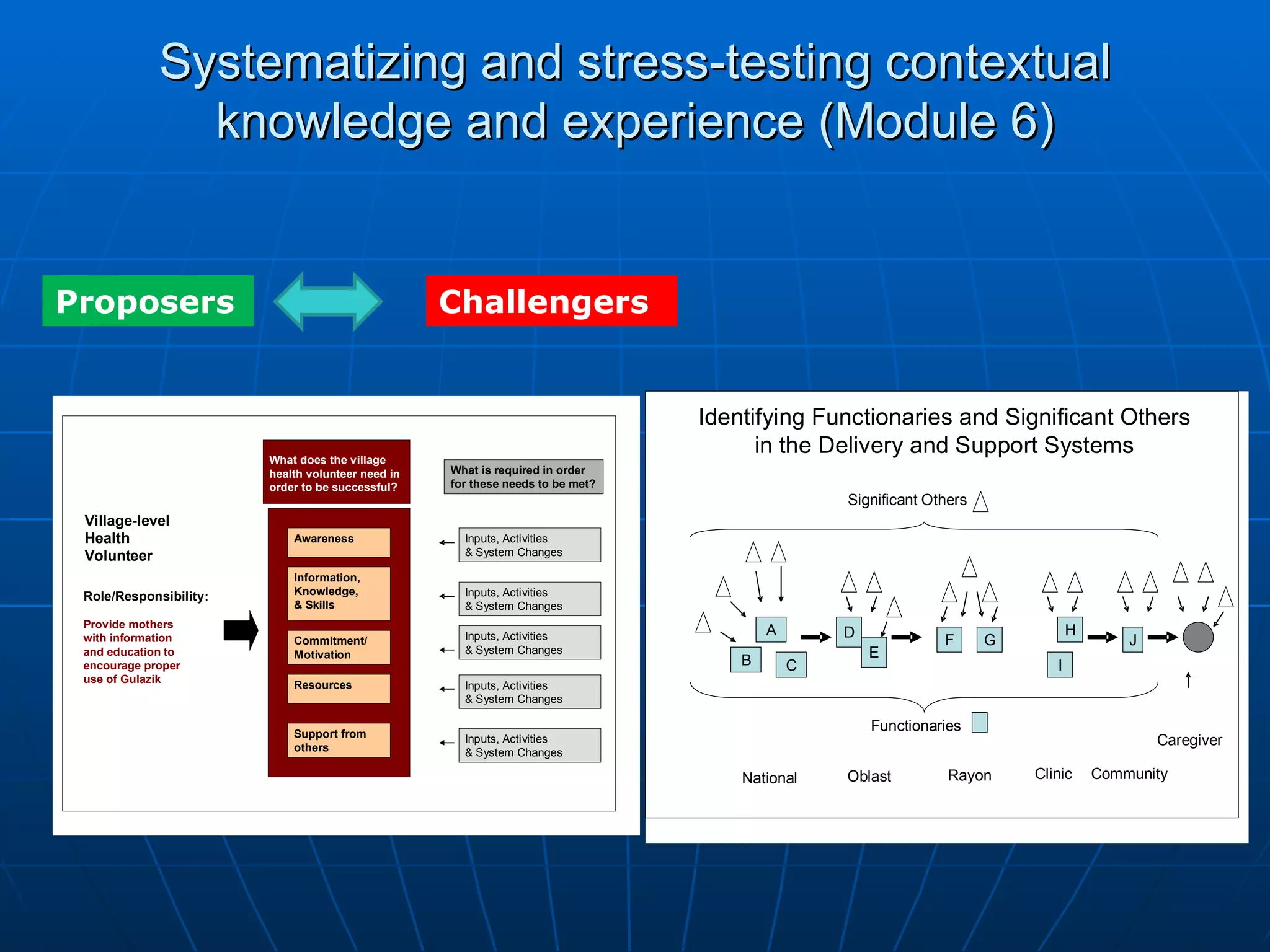
Systematizing and stress-testing contextual
               knowledge and experience (Module 6)


Proposers                                          Challengers


                                                                                Identifying Functionaries and Significant Others
                        What does the village
                                                                                      in the Delivery and Support Systems
                        health volunteer need in   What is required in order
                        order to be successful?    for these needs to be met?
                                                                                                Significant Others
 Village-level
 Health                     Awareness                Inputs, Activities
 Volunteer                                           & System Changes

                            Information,
 Role/Responsibility:       Knowledge,               Inputs, Activities
                            & Skills                 & System Changes
 Provide mothers
                                                     Inputs, Activities                 A       D                               H
 with information           Commitment/                                                                       F      G                  J
 and education to           Motivation               & System Changes                               E
 encourage proper                                                                   B       C                               I
 use of Gulazik
                            Resources                Inputs, Activities
                                                     & System Changes


                            Support from
                                                                                                    Functionaries
                            others
                                                     Inputs, Activities                                                                     Caregiver
                                                     & System Changes

                                                                                    National    Oblast         Rayon     Clinic     Community
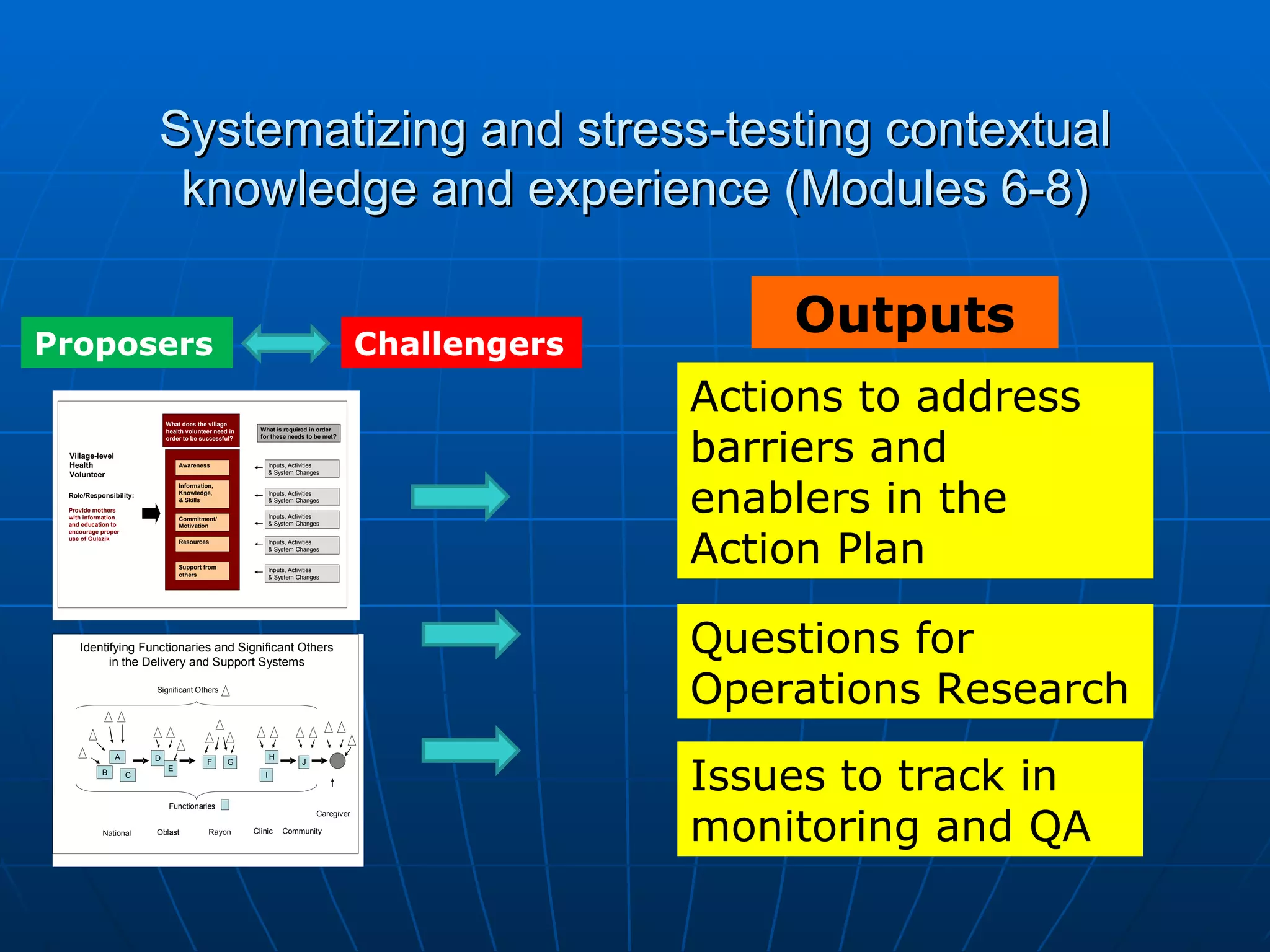
Systematizing and stress-testing contextual
                          knowledge and experience (Modules 6-8)


Proposers                                                                                   Challengers
                                                                                                              Outputs
                                                                                                          Actions to address
                                                                                                          barriers and
                             What does the village
                             health volunteer need in     What is required in order
                             order to be successful?      for these needs to be met?


 Village-level
 Health                          Awareness                     Inputs, Activities
 Volunteer                                                     & System Changes


                                                                                                          enablers in the
                                 Information,
 Role/Responsibility:            Knowledge,                    Inputs, Activities
                                 & Skills                      & System Changes
 Provide mothers
 with information                Commitment/                   Inputs, Activities
                                                               & System Changes


                                                                                                          Action Plan
 and education to                Motivation
 encourage proper
 use of Gulazik                  Resources                     Inputs, Activities
                                                               & System Changes


                                 Support from                  Inputs, Activities
                                 others                        & System Changes


    Identifying Functionaries and Significant Others
          in the Delivery and Support Systems
                                                                                                          Questions for
                         Significant Others
                                                                                                          Operations Research

                                                                                                          Issues to track in
                 A       D                                     H
                                           F      G                       J
           B                 E
                     C                                     I


                                                                                                          monitoring and QA
                              Functionaries
                                                                                Caregiver

           National      Oblast            Rayon        Clinic     Community
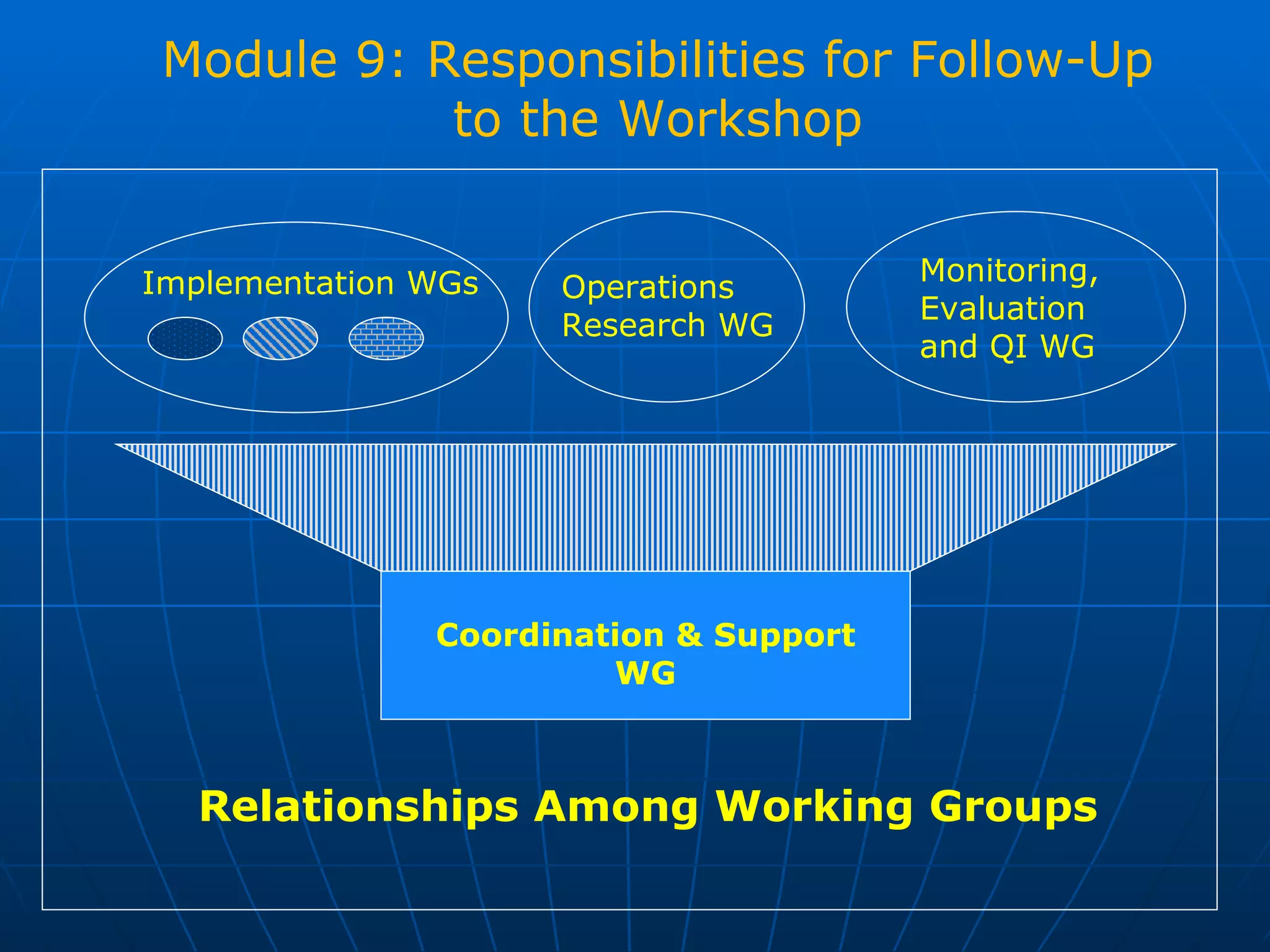
Module 9: Responsibilities for Follow-Up
            to the Workshop


Implementation WGs                      Monitoring,
                     Operations
                                        Evaluation
                     Research WG
                                        and QI WG


               Coordination & Support
                        WG


  Relationships Among Working Groups
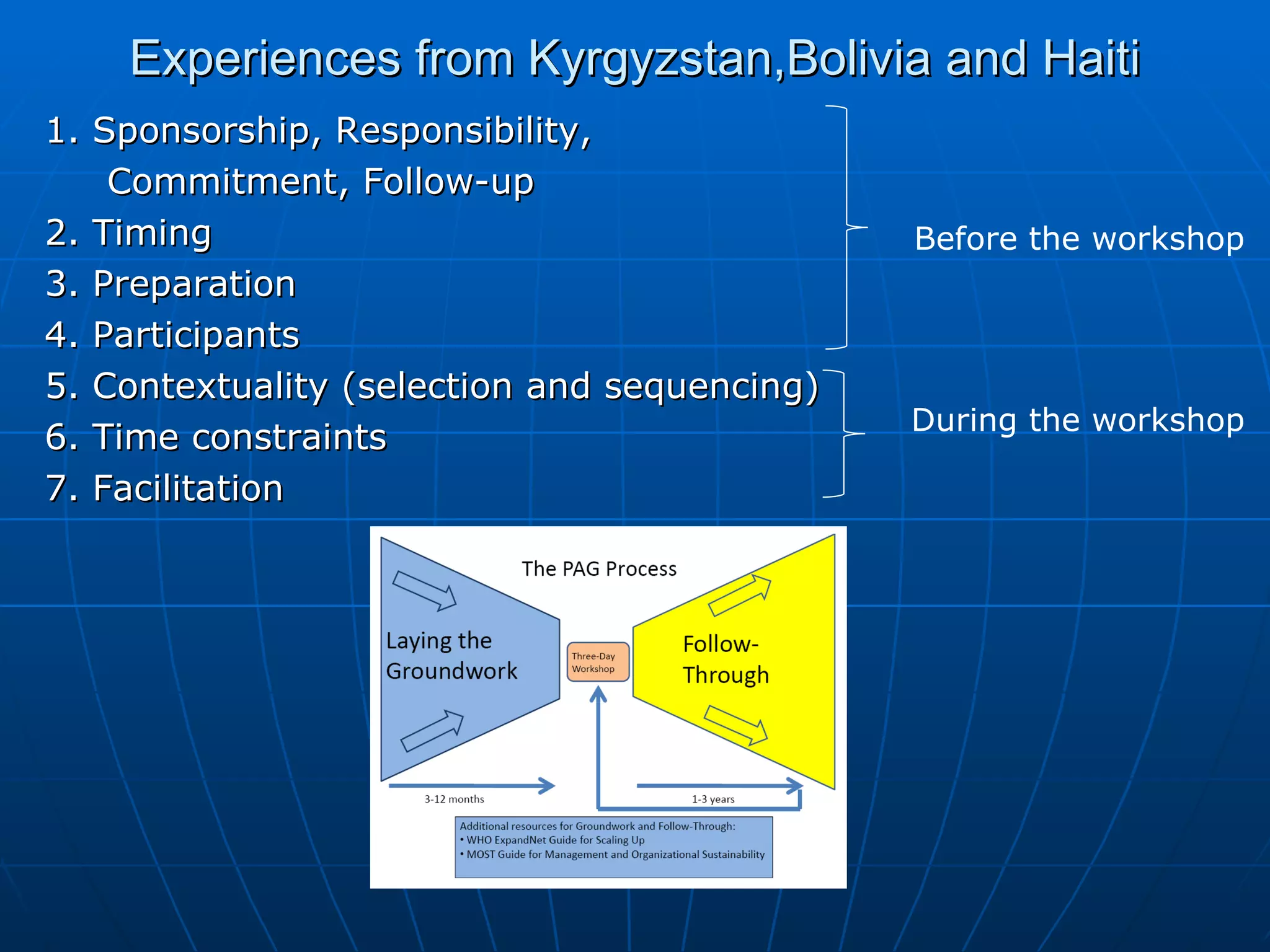
Experiences from Kyrgyzstan,Bolivia and Haiti
1. Sponsorship, Responsibility,
    Commitment, Follow-up
2. Timing                                     Before the workshop
3. Preparation
4. Participants
5. Contextuality (selection and sequencing)
                                              During the workshop
6. Time constraints
7. Facilitation
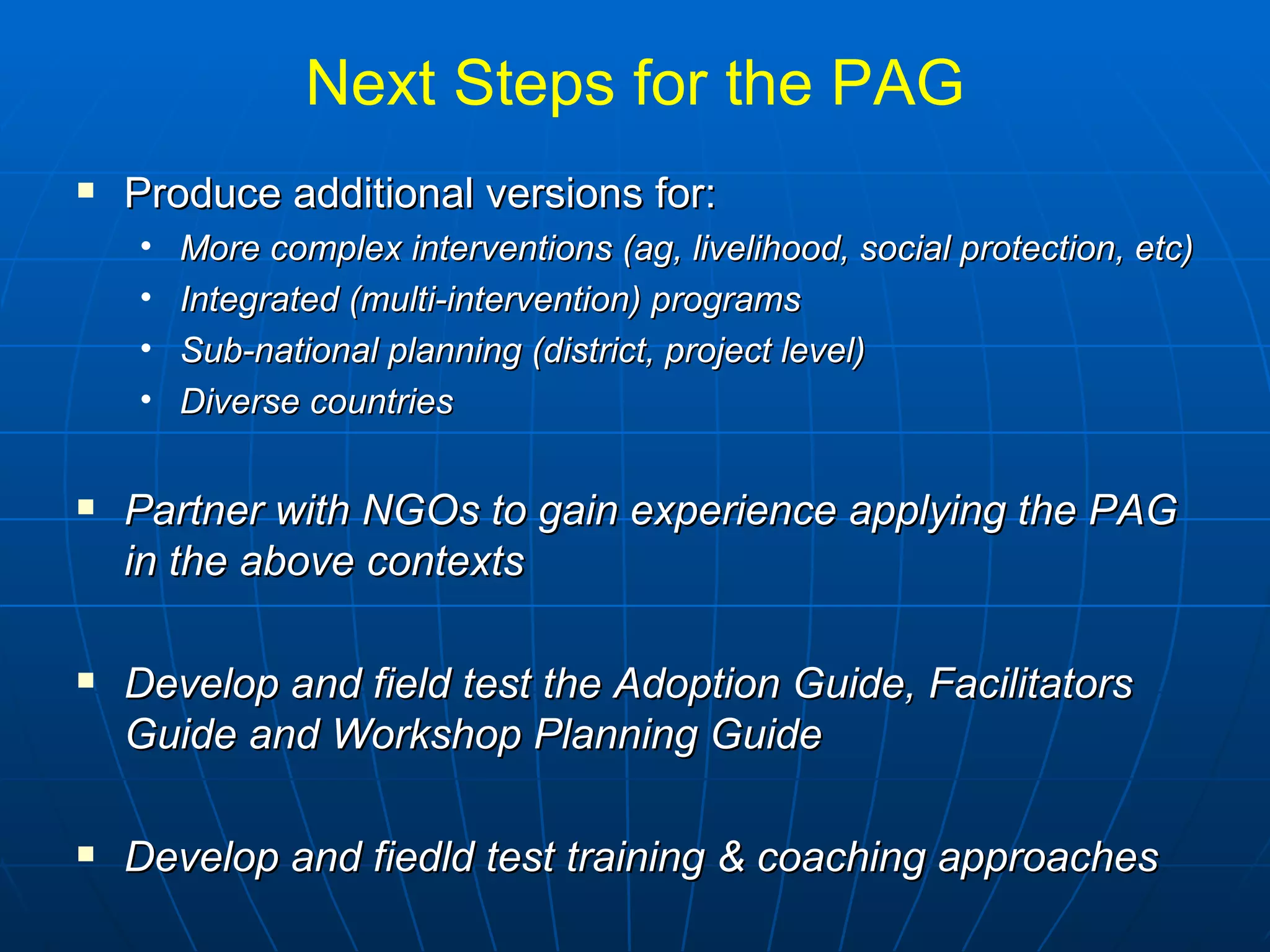
Next Steps for the PAG
   Produce additional versions for:
    •   More complex interventions (ag, livelihood, social protection, etc)
    •   Integrated (multi-intervention) programs
    •   Sub-national planning (district, project level)
    •   Diverse countries

   Partner with NGOs to gain experience applying the PAG
    in the above contexts

   Develop and field test the Adoption Guide, Facilitators
    Guide and Workshop Planning Guide

   Develop and fiedld test training & coaching approaches
Q&A
An Example
Breastfeeding BCC programs often improve EBF rates by a
  modest amount, e.g., 20% at baseline to 40% at endline.

Using the five needs tools, analyze why this might be?


                                   Five Universal Needs
                                   2.Awareness
                                   3.Knowledge, Information, Skill
                                   4.Motivation/ Commitment
                                   5.Resources
                                   6.Support from Others
Module 6: Strengthening the delivery system


                              Five Universal Needs
                              2.Awareness
                              3.Knowledge, Information, Skill
                              4.Motivation/ Commitment
                              5.Resources
                              6.Support from Others
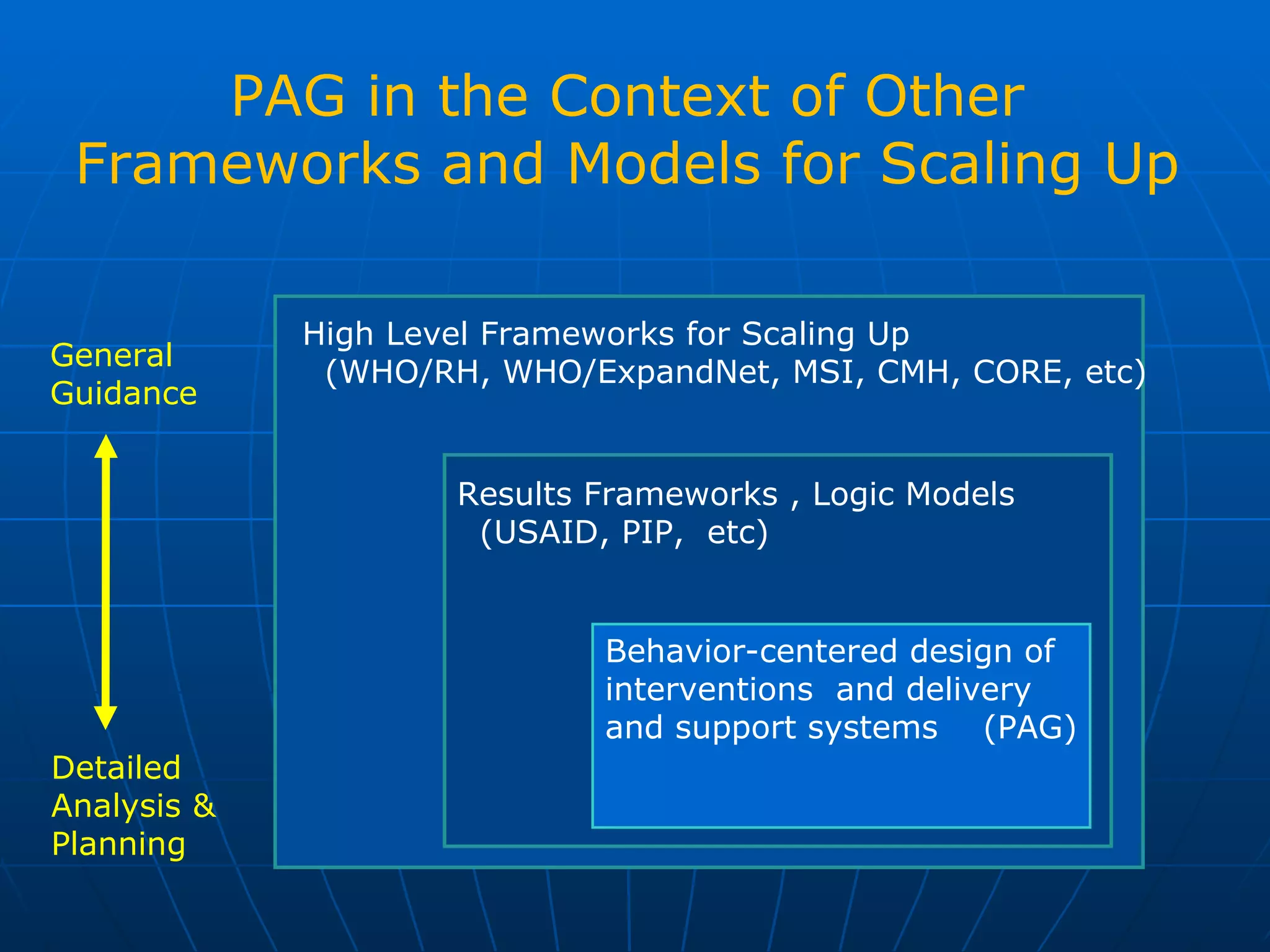
PAG in the Context of Other
 Frameworks and Models for Scaling Up

             High Level Frameworks for Scaling Up
General
              (WHO/RH, WHO/ExpandNet, MSI, CMH, CORE, etc)
Guidance


                     Results Frameworks , Logic Models
                      (USAID, PIP, etc)


                             Behavior-centered design of
                             interventions and delivery
                             and support systems (PAG)
Detailed
Analysis &
Planning

Program assessment guide_Pelletier_5.1.12

  • 1.
    The Program AssessmentGuide Structuring Contextual Knowledge and Experience to Improve the Design, Delivery and Effectiveness of Nutrition Interventions David Pelletier Division of Nutritional Sciences Cornell University CORE Spring Meeting May 1, 2012 Wilmington, DE
  • 2.
    Acknowledgments Collaborators on theMN Tool Project  Allison Corsi, Lesli Hoey, Suzanne Gervais, Cornell University Funders and Facilitators of the MN Tool Project  The World Bank  Micronutrient Initiative  Centers for Disease Control  UNICEF  GAIN  A2Z (USAID and Gates Foundation)
  • 3.
  • 4.
    Why Implementation Science? p2  Efficacy-to-Effectiveness  Knowledge-to-Action  Evidence-Based Interventions  Evidence-Based Decisions  Evidence-Based Policy Making  Scaling Up  Etc.
  • 5.
    Outline 1. Genesis of the project 2. Overview of the PAG 3. Adaptations and next steps for the PAG 4. Q&A
  • 6.
    Genesis of ThisProject  Micronutrient Forum (May 2009) • From Evidence to Large Scale Programs  The Innocenti Process (Sept 2008) • Country implementers, donors, researchers • Review of evidence for effectiveness at scale • Identification of overarching issues needing attention  Country implementers requested stronger guidance on identifying and resolving implementation bottlenecks
  • 7.
    The Micronutrient ProgramTools  Program Assessment Guide (PAG)  Program Documentation Guide (PDG)
  • 8.
    The PAG Process Layingthe Three-Day Follow- Groundwork Workshop Through 3-12 months 1-3 years
  • 9.
    Program Assessment Guide(PAG) Processes Outputs 1. Action Plan to Participatory Procedures To Address Barriers Strengthen: & Enablers • The Systematic Integration Of 2. Operations Evidence, Contextual Knowledge & Research Experience Agenda • Shared understanding, commitment, 3. Issues for ownership, motivation & capacity to Inclusion in M&E advance the micronutrient agenda •Links with the broader nutrition and 4. Strategic Plan to health agendas in the country Build Support, Capacity & Sustainability
  • 10.
    Nine modules: • Purpose •Rationale • Instructions • Templates • Examples
  • 11.
    Program Assessment Guide Layingthe Groundwork Module 1: Clarifying the Problem and the Solution Module 2: Goals and Associated Values Module 3: Delivery Systems Module 4: Hard to Reach Populations Module 5: People, Roles and Responsibilities
  • 12.
    Program Assessment Guide  Building or Strengthening the Intervention  Module 6: Needs, Inputs, Activities and System Changes  Module 7: Action Planning  Building Support Systems and the Enabling Environment  Module 8: Monitoring, Evaluating and Quality Improvement  Module 9: Organizing, Leading and Managing
  • 13.
    Some Distinctive Featuresof the PAG 1. Delivery Systems as Social Systems (Module 3) 2. The Five Needs Tool (Module 6) 3. The Stress-Testing Tool (Module 6) 4. Clear definition of roles and responsibilities (Modules 5,7) and responsibility for follow-up (Module 9)
  • 14.
    Module 3: Deliverysystems as social systems Significant Others (barriers and enablers) A D H F G J E B C I Household & Caregiver Functionaries (barriers and enablers) National Regional District Clinic Community
  • 15.
    Module 3: Deliverysystems as social systems • How Will Gulazik Get from the National Level to All Caregivers? • How Will Gulazik Education Get to All Caregivers? Caregiver National Oblast Rayon Clinic Community
  • 16.
    Module 6: Strengtheningthe delivery system Five Universal Needs 2.Awareness 3.Knowledge, Information, Skill 4.Motivation/ Commitment 5.Resources 6.Support from Others
  • 17.
    Module 6: Whatdoes each functionary and significant other NEED in order to fulfill their role/responsibility of the Sprinkles program (on a daily basis) and what inputs, activities and system changes are required to ensure their needs are met? What does the village health volunteer need in What is required in order order to be successful? for these needs to be met? Village-level Health Awareness Inputs, Activities Volunteer & System Changes Information, Role/Responsibility: Knowledge, Inputs, Activities & Skills & System Changes Provide mothers with information Commitment/ Inputs, Activities and education to Motivation & System Changes encourage proper use of Gulazik Resources Inputs, Activities & System Changes Support from Inputs, Activities others & System Changes
  • 18.
    Systematizing and stress-testingcontextual knowledge and experience (Module 6) Proposers Challengers Identifying Functionaries and Significant Others What does the village in the Delivery and Support Systems health volunteer need in What is required in order order to be successful? for these needs to be met? Significant Others Village-level Health Awareness Inputs, Activities Volunteer & System Changes Information, Role/Responsibility: Knowledge, Inputs, Activities & Skills & System Changes Provide mothers Inputs, Activities A D H with information Commitment/ F G J and education to Motivation & System Changes E encourage proper B C I use of Gulazik Resources Inputs, Activities & System Changes Support from Functionaries others Inputs, Activities Caregiver & System Changes National Oblast Rayon Clinic Community
  • 19.
    Systematizing and stress-testingcontextual knowledge and experience (Modules 6-8) Proposers Challengers Outputs Actions to address barriers and What does the village health volunteer need in What is required in order order to be successful? for these needs to be met? Village-level Health Awareness Inputs, Activities Volunteer & System Changes enablers in the Information, Role/Responsibility: Knowledge, Inputs, Activities & Skills & System Changes Provide mothers with information Commitment/ Inputs, Activities & System Changes Action Plan and education to Motivation encourage proper use of Gulazik Resources Inputs, Activities & System Changes Support from Inputs, Activities others & System Changes Identifying Functionaries and Significant Others in the Delivery and Support Systems Questions for Significant Others Operations Research Issues to track in A D H F G J B E C I monitoring and QA Functionaries Caregiver National Oblast Rayon Clinic Community
  • 20.
    Module 9: Responsibilitiesfor Follow-Up to the Workshop Implementation WGs Monitoring, Operations Evaluation Research WG and QI WG Coordination & Support WG Relationships Among Working Groups
  • 21.
    Experiences from Kyrgyzstan,Boliviaand Haiti 1. Sponsorship, Responsibility, Commitment, Follow-up 2. Timing Before the workshop 3. Preparation 4. Participants 5. Contextuality (selection and sequencing) During the workshop 6. Time constraints 7. Facilitation
  • 22.
    Next Steps forthe PAG  Produce additional versions for: • More complex interventions (ag, livelihood, social protection, etc) • Integrated (multi-intervention) programs • Sub-national planning (district, project level) • Diverse countries  Partner with NGOs to gain experience applying the PAG in the above contexts  Develop and field test the Adoption Guide, Facilitators Guide and Workshop Planning Guide  Develop and fiedld test training & coaching approaches
  • 23.
  • 24.
    An Example Breastfeeding BCCprograms often improve EBF rates by a modest amount, e.g., 20% at baseline to 40% at endline. Using the five needs tools, analyze why this might be? Five Universal Needs 2.Awareness 3.Knowledge, Information, Skill 4.Motivation/ Commitment 5.Resources 6.Support from Others
  • 25.
    Module 6: Strengtheningthe delivery system Five Universal Needs 2.Awareness 3.Knowledge, Information, Skill 4.Motivation/ Commitment 5.Resources 6.Support from Others
  • 27.
    PAG in theContext of Other Frameworks and Models for Scaling Up High Level Frameworks for Scaling Up General (WHO/RH, WHO/ExpandNet, MSI, CMH, CORE, etc) Guidance Results Frameworks , Logic Models (USAID, PIP, etc) Behavior-centered design of interventions and delivery and support systems (PAG) Detailed Analysis & Planning

Editor's Notes

  • #2 Pelletier AED PAG Training Jan 5-7, 2011