A Better Path:
Open Standards
A Strategic Guide to
extracting complete data
Tp Ca««pµ‰p: Fäa‰³pµøpj EHR
Ec¾ìĞìøp³ì aµj Iµc¾³á«pøp Daøa
Healthcare organizations today face a significant data fragmentation challenge. The average hospital
operates with 16 disparate electronic systems, creating a complex ecosystem where information exists in
various states of accessibility and standardization. This fragmentation creates substantial barriers to
comprehensive data utilization, with approximately 80% of hospitals reporting difficulties extracting
meaningful information from their EHRs according to research published in JAMIA Open.
Perhaps most concerning is that over half of clinically relevant data resides in unstructured formats -
clinical notes, PDFs, scanned documents, and other non-standardized content that standard interoperability
protocols struggle to access. This "dark data" represents a massive untapped resource for healthcare
organizations seeking to optimize care delivery and operational efficiency.
Waø Søaµjaäj Aááä¾acpì M•ìì
Custom EHR fields created during
implementation to address specific
organizational needs
Non-standardized data types and local
vocabularies developed for specialized
workflows
Unstructured text within physician notes
containing valuable clinical narratives and
insights
Historical records stored in legacy or
decommissioned systems predating current
standards
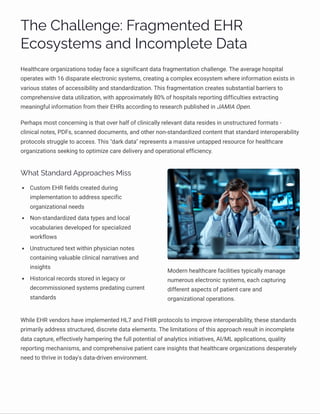
Modern healthcare facilities typically manage
numerous electronic systems, each capturing
different aspects of patient care and
organizational operations.
While EHR vendors have implemented HL7 and FHIR protocols to improve interoperability, these standards
primarily address structured, discrete data elements. The limitations of this approach result in incomplete
data capture, effectively hampering the full potential of analytics initiatives, AI/ML applications, quality
reporting mechanisms, and comprehensive patient care insights that healthcare organizations desperately
need to thrive in today's data-driven environment.
Tp L•³•øaø•¾µì ¾ˆ FHIR aµj HL7 A«¾µp
FHIR (Fast Healthcare Interoperability Resources) represents a significant advancement in healthcare data
exchange, designed to standardize how information moves between systems. However, despite its
sophisticated design and growing adoption, FHIR implementations vary considerably across vendors. This
inconsistency creates a paradoxical situation where a standard meant to unify data instead introduces new
forms of fragmentation when organizations attempt to integrate multiple systems.
While FHIR is technically extensible, this flexibility can become a double-edged sword. Many EHR vendors
selectively implement only portions of the FHIR specification or create non-standard extensions that limit
true interoperability. Similarly, HL7 v2 messages remain deeply embedded in healthcare workflows but were
originally designed for messaging rather than comprehensive data exchange, creating additional limitations
when organizations need to extract complete datasets for analytics or research.
FHIR C¾ėpäa‰p
L•³•øaø•¾µì
FHIR APIs typically provide
access to only 20-30% of all
clinical data within an EHR
system, leaving the majority
inaccessible through
standard interfaces.
M•ì앵‰ C«•µ•ca«
C¾µøpĝø
Critical information including
social determinants of
health, detailed care team
notes, and nuanced clinical
impressions often remain
outside FHIR's scope.
Lp‰acĞ Daøa Gaáì
FHIR is not retroactive;
historical data predating
FHIR adoption may not be
available via API at all,
creating blind spots in
longitudinal analysis.
"While FHIR has moved the industry forward, it doesn't cover the entire spectrum of patient data. We
must think beyond FHIR for a complete picture." 4 HealthIT Analytics, 2023
The reality is that healthcare organizations making critical decisions based solely on FHIR-accessible data
are working with an incomplete picture. This partial view can lead to missed care opportunities, incomplete
quality measures, and an inability to fully leverage advanced analytics capabilities that depend on
comprehensive datasets. As the industry moves toward value-based care models that require holistic
understanding of patient journeys, these gaps become increasingly problematic.
A Bpøøpä Paø: Oápµ Søaµjaäj-Baìpj
Daøa Eĝøäacø•¾µ
An open standard approach to healthcare data management fundamentally changes what's possible with
EHR information. Rather than being limited by the constraints of any single standard like FHIR or HL7, this
approach embraces vendor-neutral tools and standardized data pipelines designed to extract and
normalize all EHR data4regardless of whether it's structured or unstructured, standard or custom. This
comprehensive methodology creates a foundation for truly data-driven healthcare operations.
By implementing an open standard-based extraction strategy, healthcare organizations gain several critical
capabilities that conventional approaches simply cannot deliver:
FĀ««-ìápcøä³ jaøa accpìì
Retrieve and integrate data across EHRs, legacy systems, and third-party applications
without being limited by vendor-specific constraints or API limitations.
H•‰-ˆ•jp«•øĞ aµa«Ğø•cì
Generate clinical and operational insights based on complete datasets rather than just the
portion accessible through standard interfaces.
I³áä¾ėpj c¾³á«•aµcp
Enhance regulatory reporting with comprehensive auditability across all data sources and
types, including previously inaccessible information.
Ajėaµcpj AI caáab•«•ø•pì
Provide AI/ML and population health tools with the complete datasets they need to deliver
accurate, actionable insights.
Enabling technologies like natural language processing (NLP), health data lakes, and clinical archival
platforms work together to extract and enrich data that FHIR alone cannot access. These technologies can
parse physician notes, interpret custom fields, and standardize information from legacy systems to create
a unified view of all available healthcare data.
In a case study from the Office of the National Coordinator for Health IT (ONC), a large health system
was able to identify 25% more relevant patient insights by combining NLP with structured data
extraction, revealing critical information hidden in notes and custom fields.
This substantial improvement in insight generation demonstrates the tangible benefits of moving beyond
standard-only approaches to embrace comprehensive data extraction methodologies that leave no valuable
information untapped.
Tp Ca«« ø¾ Acø•¾µ: Paäøµpä Ę•ø aµ
Iµøpä¾ápäab•«•øĞ-F•äìø Vpµj¾ä
As healthcare organizations navigate the complex landscape of digital transformation, selecting the right
technology partners becomes increasingly crucial. Not all vendors approach interoperability with the same
commitment to comprehensive data access. To truly unlock the full potential of healthcare data,
organizations should prioritize vendors that demonstrate specific capabilities and approaches that go
beyond basic standard compliance.
Eììpµø•a« Vpµj¾ä Caáab•«•ø•pì
The right vendor partnership can dramatically
accelerate your organization's data strategy
implementation and provide access to previously
untapped insights.
Uµ•ėpäìa« Daøa Iµ‰pìø•¾µ
Support for data ingestion from all EHR
systems, not just those that are FHIR-
compliant, including legacy and custom
platforms
Ajėaµcpj Paä앵‰ Caáab•«•ø•pì
Ability to parse and standardize custom
fields and extract meaningful information
from unstructured clinical notes
M¾jpäµ Aäc•øpcøĀäp
Cloud-native, secure, and scalable data
solutions designed for healthcare's unique
compliance requirements
Oápµ Fäa³pĘ¾ä¨ P•«¾ì¾áĞ
Commitment to open APIs and
interoperable frameworks that prevent
future vendor lock-in
By selecting vendors that embrace these interoperability-first principles, healthcare organizations position
themselves to achieve several strategic advantages in today's data-intensive healthcare environment:
Benefit Impact
Rapid insights from comprehensive data Faster decision-making based on complete
rather than partial information, incorporating
both real-time and historical data
Simplified regulatory compliance Streamlined processes for meeting reporting
mandates across quality initiatives, government
programs, and payer requirements
Enhanced data governance Stronger control over data lineage, quality, and
utilization throughout the organization
Future-ready infrastructure Capability to adapt to emerging standards and
requirements without major system overhauls
"You can't drive innovation without access to the full dataset. Partnering with a vendor that understands
how to extract and normalize the complete EHR is no longer optional4it's strategic." 4 HIMSS, 2024
This strategic perspective recognizes that in today's healthcare landscape, data accessibility isn't merely a
technical consideration4it's a fundamental business imperative that directly impacts clinical outcomes,
operational efficiency, and organizational agility in responding to industry changes.
C¾µc«Ā앾µ
FHIR and HL7 have undoubtedly advanced healthcare interoperability, creating standardized pathways for
data exchange that were previously impossible. They represent important building blocks in the healthcare
data ecosystem and have enabled significant progress toward more connected care delivery. However, as
this document has illustrated, these standards alone cannot provide the complete view of EHR data that
modern healthcare organizations require to fully optimize patient care and operational performance.
A comprehensive healthcare data strategy demands a broader, open standard-based approach that
accounts for the full complexity and variability of information across the care continuum. This means
implementing solutions capable of accessing, normalizing, and analyzing data regardless of where it
resides4in standard FHIR resources, custom EHR fields, unstructured clinical notes, or legacy systems.
As healthcare organizations continue their digital transformation journeys and increasingly invest in
analytics, artificial intelligence, and machine learning technologies, ensuring access to all relevant data
becomes not just beneficial but essential. The success of these advanced technologies directly correlates
with the completeness and quality of the data they can access4making a beyond-FHIR strategy critical for
organizations with ambitious goals.
The path forward is clear: healthcare leaders must prioritize partnerships with technology vendors who
understand how to overcome the limitations of standard-only approaches and can deliver truly
comprehensive data extraction, normalization, and analysis capabilities. By embracing this expanded vision
of healthcare interoperability, organizations position themselves to:
Reveal previously hidden clinical insights that can improve patient outcomes
Enhance operational efficiency through complete rather than partial performance metrics
Support more accurate quality reporting and regulatory compliance
Future-proof their data infrastructure against evolving standards and requirements
Maximize the return on investment for analytics and AI initiatives
Connect with a vendor who can take you beyond FHIR, and unlock the complete value of your EHR data to
drive meaningful improvements in care delivery and organizational performance.
© 2025 Hart, Inc. All Rights Reserved. 116 W 3rd Street, Suite 200
Kansas City, MO 64105

A Strategic Guide to extracting complete data

  • 1.
    A Better Path: OpenStandards A Strategic Guide to extracting complete data
  • 2.
    Tp Ca««pµ‰p: Fäa‰³pµøpjEHR Ec¾ìĞìøp³ì aµj Iµc¾³á«pøp Daøa Healthcare organizations today face a significant data fragmentation challenge. The average hospital operates with 16 disparate electronic systems, creating a complex ecosystem where information exists in various states of accessibility and standardization. This fragmentation creates substantial barriers to comprehensive data utilization, with approximately 80% of hospitals reporting difficulties extracting meaningful information from their EHRs according to research published in JAMIA Open. Perhaps most concerning is that over half of clinically relevant data resides in unstructured formats - clinical notes, PDFs, scanned documents, and other non-standardized content that standard interoperability protocols struggle to access. This "dark data" represents a massive untapped resource for healthcare organizations seeking to optimize care delivery and operational efficiency. Waø Søaµjaäj Aááä¾acpì M•ìì Custom EHR fields created during implementation to address specific organizational needs Non-standardized data types and local vocabularies developed for specialized workflows Unstructured text within physician notes containing valuable clinical narratives and insights Historical records stored in legacy or decommissioned systems predating current standards Modern healthcare facilities typically manage numerous electronic systems, each capturing different aspects of patient care and organizational operations. While EHR vendors have implemented HL7 and FHIR protocols to improve interoperability, these standards primarily address structured, discrete data elements. The limitations of this approach result in incomplete data capture, effectively hampering the full potential of analytics initiatives, AI/ML applications, quality reporting mechanisms, and comprehensive patient care insights that healthcare organizations desperately need to thrive in today's data-driven environment.
  • 3.
    Tp L•³•øaø•¾µì ¾ˆFHIR aµj HL7 A«¾µp FHIR (Fast Healthcare Interoperability Resources) represents a significant advancement in healthcare data exchange, designed to standardize how information moves between systems. However, despite its sophisticated design and growing adoption, FHIR implementations vary considerably across vendors. This inconsistency creates a paradoxical situation where a standard meant to unify data instead introduces new forms of fragmentation when organizations attempt to integrate multiple systems. While FHIR is technically extensible, this flexibility can become a double-edged sword. Many EHR vendors selectively implement only portions of the FHIR specification or create non-standard extensions that limit true interoperability. Similarly, HL7 v2 messages remain deeply embedded in healthcare workflows but were originally designed for messaging rather than comprehensive data exchange, creating additional limitations when organizations need to extract complete datasets for analytics or research. FHIR C¾ėpäa‰p L•³•øaø•¾µì FHIR APIs typically provide access to only 20-30% of all clinical data within an EHR system, leaving the majority inaccessible through standard interfaces. M•ì앵‰ C«•µ•ca« C¾µøpĝø Critical information including social determinants of health, detailed care team notes, and nuanced clinical impressions often remain outside FHIR's scope. Lp‰acĞ Daøa Gaáì FHIR is not retroactive; historical data predating FHIR adoption may not be available via API at all, creating blind spots in longitudinal analysis. "While FHIR has moved the industry forward, it doesn't cover the entire spectrum of patient data. We must think beyond FHIR for a complete picture." 4 HealthIT Analytics, 2023 The reality is that healthcare organizations making critical decisions based solely on FHIR-accessible data are working with an incomplete picture. This partial view can lead to missed care opportunities, incomplete quality measures, and an inability to fully leverage advanced analytics capabilities that depend on comprehensive datasets. As the industry moves toward value-based care models that require holistic understanding of patient journeys, these gaps become increasingly problematic.
  • 4.
    A Bpøøpä Paø:Oápµ Søaµjaäj-Baìpj Daøa Eĝøäacø•¾µ An open standard approach to healthcare data management fundamentally changes what's possible with EHR information. Rather than being limited by the constraints of any single standard like FHIR or HL7, this approach embraces vendor-neutral tools and standardized data pipelines designed to extract and normalize all EHR data4regardless of whether it's structured or unstructured, standard or custom. This comprehensive methodology creates a foundation for truly data-driven healthcare operations. By implementing an open standard-based extraction strategy, healthcare organizations gain several critical capabilities that conventional approaches simply cannot deliver: FĀ««-ìápcøä³ jaøa accpìì Retrieve and integrate data across EHRs, legacy systems, and third-party applications without being limited by vendor-specific constraints or API limitations. H•‰-ˆ•jp«•øĞ aµa«Ğø•cì Generate clinical and operational insights based on complete datasets rather than just the portion accessible through standard interfaces. I³áä¾ėpj c¾³á«•aµcp Enhance regulatory reporting with comprehensive auditability across all data sources and types, including previously inaccessible information. Ajėaµcpj AI caáab•«•ø•pì Provide AI/ML and population health tools with the complete datasets they need to deliver accurate, actionable insights. Enabling technologies like natural language processing (NLP), health data lakes, and clinical archival platforms work together to extract and enrich data that FHIR alone cannot access. These technologies can parse physician notes, interpret custom fields, and standardize information from legacy systems to create a unified view of all available healthcare data. In a case study from the Office of the National Coordinator for Health IT (ONC), a large health system was able to identify 25% more relevant patient insights by combining NLP with structured data extraction, revealing critical information hidden in notes and custom fields. This substantial improvement in insight generation demonstrates the tangible benefits of moving beyond standard-only approaches to embrace comprehensive data extraction methodologies that leave no valuable information untapped.
  • 5.
    Tp Ca«« ø¾Acø•¾µ: Paäøµpä Ę•ø aµ Iµøpä¾ápäab•«•øĞ-F•äìø Vpµj¾ä As healthcare organizations navigate the complex landscape of digital transformation, selecting the right technology partners becomes increasingly crucial. Not all vendors approach interoperability with the same commitment to comprehensive data access. To truly unlock the full potential of healthcare data, organizations should prioritize vendors that demonstrate specific capabilities and approaches that go beyond basic standard compliance. Eììpµø•a« Vpµj¾ä Caáab•«•ø•pì The right vendor partnership can dramatically accelerate your organization's data strategy implementation and provide access to previously untapped insights. Uµ•ėpäìa« Daøa Iµ‰pìø•¾µ Support for data ingestion from all EHR systems, not just those that are FHIR- compliant, including legacy and custom platforms Ajėaµcpj Paä앵‰ Caáab•«•ø•pì Ability to parse and standardize custom fields and extract meaningful information from unstructured clinical notes M¾jpäµ Aäc•øpcøĀäp Cloud-native, secure, and scalable data solutions designed for healthcare's unique compliance requirements Oápµ Fäa³pĘ¾ä¨ P•«¾ì¾áĞ Commitment to open APIs and interoperable frameworks that prevent future vendor lock-in By selecting vendors that embrace these interoperability-first principles, healthcare organizations position themselves to achieve several strategic advantages in today's data-intensive healthcare environment: Benefit Impact Rapid insights from comprehensive data Faster decision-making based on complete rather than partial information, incorporating both real-time and historical data Simplified regulatory compliance Streamlined processes for meeting reporting mandates across quality initiatives, government programs, and payer requirements Enhanced data governance Stronger control over data lineage, quality, and utilization throughout the organization Future-ready infrastructure Capability to adapt to emerging standards and requirements without major system overhauls "You can't drive innovation without access to the full dataset. Partnering with a vendor that understands how to extract and normalize the complete EHR is no longer optional4it's strategic." 4 HIMSS, 2024 This strategic perspective recognizes that in today's healthcare landscape, data accessibility isn't merely a technical consideration4it's a fundamental business imperative that directly impacts clinical outcomes, operational efficiency, and organizational agility in responding to industry changes.
  • 6.
    C¾µc«Ā앾µ FHIR and HL7have undoubtedly advanced healthcare interoperability, creating standardized pathways for data exchange that were previously impossible. They represent important building blocks in the healthcare data ecosystem and have enabled significant progress toward more connected care delivery. However, as this document has illustrated, these standards alone cannot provide the complete view of EHR data that modern healthcare organizations require to fully optimize patient care and operational performance. A comprehensive healthcare data strategy demands a broader, open standard-based approach that accounts for the full complexity and variability of information across the care continuum. This means implementing solutions capable of accessing, normalizing, and analyzing data regardless of where it resides4in standard FHIR resources, custom EHR fields, unstructured clinical notes, or legacy systems. As healthcare organizations continue their digital transformation journeys and increasingly invest in analytics, artificial intelligence, and machine learning technologies, ensuring access to all relevant data becomes not just beneficial but essential. The success of these advanced technologies directly correlates with the completeness and quality of the data they can access4making a beyond-FHIR strategy critical for organizations with ambitious goals. The path forward is clear: healthcare leaders must prioritize partnerships with technology vendors who understand how to overcome the limitations of standard-only approaches and can deliver truly comprehensive data extraction, normalization, and analysis capabilities. By embracing this expanded vision of healthcare interoperability, organizations position themselves to: Reveal previously hidden clinical insights that can improve patient outcomes Enhance operational efficiency through complete rather than partial performance metrics Support more accurate quality reporting and regulatory compliance Future-proof their data infrastructure against evolving standards and requirements Maximize the return on investment for analytics and AI initiatives Connect with a vendor who can take you beyond FHIR, and unlock the complete value of your EHR data to drive meaningful improvements in care delivery and organizational performance.
  • 7.
    © 2025 Hart,Inc. All Rights Reserved. 116 W 3rd Street, Suite 200 Kansas City, MO 64105