
ASSALAM-O-ALIKUM
FAYYAZ AHMED QURESHI
PRESENTED TO; MISS ANILA
QURESHI
CREATING
PROFESSIONAL
REPORT
TABLE OF CONTENT
 >DEFINATION
>WRITING A REPORT
>Decide the Purpose
>Identify Your Audience
>Know Your Topic
>Outline the Report
> Write, Edit, Proofread, and Finish
DEFINATION
 Professional Report Writing is
aimed at business professionals at all
levels who need to fine-tune and
improve their report writing skills.
> Professional Report Writing will
enable learners to develop and
enhance their report writing skills.
Writing a Report
Research and then publishing the
outcome of that analysis.
> In the professional world, the “look” or
appearance of what you publish is
paramount.
> The eye-pleasing final result could
burnish your reputation and enhance
your personal brand.
Decide the Purpose
 Before you begin the report;
> You must first know why you are
writing it in the first place.
>Reports are of many kinds but they are
either meant to inform or persuade.
>It can be meant for describing a
technical process, sharing background
information, or demonstrate progress on
a project.
Ask yourself
What and Why. This will help you distill
the purpose to the one main point and
stick to it.
Identify Your Audience
 EVALUATE YOUR AUDIENCE
> Will they be able to understand what
you are talking about?
>Are there different levels of readers
who will read the report?
>The reader’s knowledge of the subject
will greatly influence the information that
you need to include.
Identify Your Audience
 >Script the report by keep in mind
Primary audience.
>The secondary audience can be
supported with supplemental
information at the end of the report.
Know Your Topic
> Research the topic
>Include all the relevant information to
prove your point.
>Make sure that you come to a
conclusion based on facts and not
personal opinion.
> The information must be correct,
current, and well-referenced.
Know Your Topic
> Use variety of resources(help to
support your point).
> Don’t stick to Wikipedia.
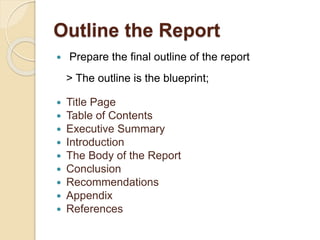
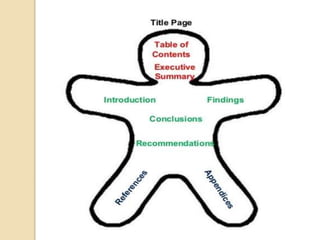
Outline the Report
 Prepare the final outline of the report
> The outline is the blueprint;
 Title Page
 Table of Contents
 Executive Summary
 Introduction
 The Body of the Report
 Conclusion
 Recommendations
 Appendix
 References
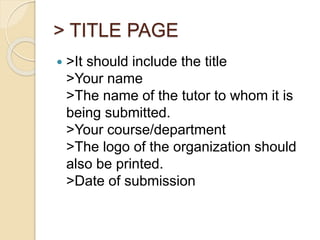
> TITLE PAGE
 >It should include the title
>Your name
>The name of the tutor to whom it is
being submitted.
>Your course/department
>The logo of the organization should
also be printed.
>Date of submission
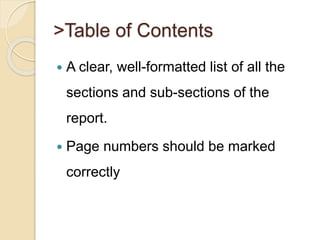
>Table of Contents
 A clear, well-formatted list of all the
sections and sub-sections of the
report.
 Page numbers should be marked
correctly
> Executive Summary
 An executive summary is a short
document or section of a
document that summarizes a longer
report.
>Readers can rapidly become
acquainted with a large body of
material without having to read it all.
> Introduction
 You will explain the problem in general
 Show the reader why the report is
being made.
> The Body of the Report
 This is the main section of the report.
> It answers the questions —
 Who? Why? Where? When? What?
How?
> The various sections include;
> Review of Literature
> Materials and Methods
> Results
> Significance.
> Conclusion
 Result of your findings
>Facts describing your main body.
> Recommendations
 A solution to a problem
> Evaluates possible solutions and
recommends one.
>Appendix
 An appendix is a collection of
supplementary materials.
>References
 This is a list giving the full details of all
the
sources to which you have made
reference within your text.
Write, Edit, Proofread, and
Finish
 Write and Edit according to the
structure.
>Read, your data meet with your topic
point.
>Proofread , correction of mistakes
like spelling and grammar.
Professional report writing

Professional report writing

  • 1.
  • 2.
  • 3.
    TABLE OF CONTENT >DEFINATION >WRITING A REPORT >Decide the Purpose >Identify Your Audience >Know Your Topic >Outline the Report > Write, Edit, Proofread, and Finish
  • 4.
    DEFINATION  Professional ReportWriting is aimed at business professionals at all levels who need to fine-tune and improve their report writing skills. > Professional Report Writing will enable learners to develop and enhance their report writing skills.
  • 5.
    Writing a Report Researchand then publishing the outcome of that analysis. > In the professional world, the “look” or appearance of what you publish is paramount. > The eye-pleasing final result could burnish your reputation and enhance your personal brand.
  • 6.
    Decide the Purpose Before you begin the report; > You must first know why you are writing it in the first place. >Reports are of many kinds but they are either meant to inform or persuade. >It can be meant for describing a technical process, sharing background information, or demonstrate progress on a project. Ask yourself What and Why. This will help you distill the purpose to the one main point and stick to it.
  • 7.
    Identify Your Audience EVALUATE YOUR AUDIENCE > Will they be able to understand what you are talking about? >Are there different levels of readers who will read the report? >The reader’s knowledge of the subject will greatly influence the information that you need to include.
  • 8.
    Identify Your Audience >Script the report by keep in mind Primary audience. >The secondary audience can be supported with supplemental information at the end of the report.
  • 9.
    Know Your Topic >Research the topic >Include all the relevant information to prove your point. >Make sure that you come to a conclusion based on facts and not personal opinion. > The information must be correct, current, and well-referenced.
  • 10.
    Know Your Topic >Use variety of resources(help to support your point). > Don’t stick to Wikipedia.
  • 11.
    Outline the Report Prepare the final outline of the report > The outline is the blueprint;  Title Page  Table of Contents  Executive Summary  Introduction  The Body of the Report  Conclusion  Recommendations  Appendix  References
  • 13.
    > TITLE PAGE >It should include the title >Your name >The name of the tutor to whom it is being submitted. >Your course/department >The logo of the organization should also be printed. >Date of submission
  • 14.
    >Table of Contents A clear, well-formatted list of all the sections and sub-sections of the report.  Page numbers should be marked correctly
  • 15.
    > Executive Summary An executive summary is a short document or section of a document that summarizes a longer report. >Readers can rapidly become acquainted with a large body of material without having to read it all.
  • 16.
    > Introduction  Youwill explain the problem in general  Show the reader why the report is being made.
  • 17.
    > The Bodyof the Report  This is the main section of the report. > It answers the questions —  Who? Why? Where? When? What? How? > The various sections include; > Review of Literature > Materials and Methods > Results > Significance.
  • 18.
    > Conclusion  Resultof your findings >Facts describing your main body.
  • 19.
    > Recommendations  Asolution to a problem > Evaluates possible solutions and recommends one.
  • 20.
    >Appendix  An appendixis a collection of supplementary materials.
  • 21.
    >References  This isa list giving the full details of all the sources to which you have made reference within your text.
  • 22.
    Write, Edit, Proofread,and Finish  Write and Edit according to the structure. >Read, your data meet with your topic point. >Proofread , correction of mistakes like spelling and grammar.