PROFESSIONAL Nursing Etiqutte
Dr Uma Devi T.,
M.Sc (N)., PG Diploma (Biostatistics)., Ph.D (Women’s Studies)., PhD Scholar (Nursing),
Associate Professor & Head,
Department of Obstetrics and Gynaecological Nursing,
Shri Sathya Sai College of Nursing,
SBV Chennai Campus.
"Nursing is not just an art,
it has a heart.
Nursing is not just a science,
it has a conscience."
– Donna Wilk Cardillo
•Manners refer to the polite behaviors and customs
that are considered socially acceptable in different
situations. For example, saying "please" and "thank
you" or holding the door for someone.
•Etiquette is a broader concept that includes manners
but also covers rules and guidelines for professional
and social conduct in specific settings, like workplace
etiquette, dining etiquette, or nursing etiquette.
Nursing Etiquette
• Nursing etiquette refers to the set of professional behaviors,
ethical standards, and courteous interactions that guide nurses
in their clinical practice.
•Proper nursing etiquette ensures a positive healthcare
environment, enhances patient trust, and promotes
collaboration within the healthcare team.
Situation
•A nurse working in a medical-surgical ward has six
patients under her care. She/he starts her/his shift at
7:00 AM and knows that timely medication
administration, wound care, patient assessments,
and documentation are crucial.
Challenge
•At 8:00 AM, Suddenly, one of her/his patients
develops breathing difficulty, requiring immediate
attention.
Action:
•Prioritization
•Delegation
•Efficiency
Effective time management in nursing is about
prioritizing tasks, handling unexpected situations
calmly, and using teamwork to ensure patient safety.
TIME MANAGEMENT
1
Situation
•A busy emergency department (ED) receives multiple
trauma patients from a road accident.
Challenge
•The unit is understaffed, and the available nurses are
overwhelmed with triaging, administering first aid,
and stabilizing patients.
Action:
•Assess the situation Quickly.
•Assign the roles based on the skills and experience of the
available staff.
•Guide the junior nurses on prioritizing critical cases using the
triage system.
•Communicate effectively with the doctors and paramedics,
ensuring a smooth flow of patient care.
•Remain calm under pressure, motivate the team and making
sure every patient receives timely intervention.

A good nurse leader doesn’t just give orders—they
guide, support, and empower their team to provide
the best patient care, even in high-pressure situations.
LEADERSHIP
2
Situation
•A student nurse is on her clinical rotation in the Burns
unit when she is assigned to a 35-year-old patient with
second-degree burns on the chest and arms.
Challenge
•The patient's vital signs appear stable, but the student
notices that the patient is becoming increasingly
restless and has difficulty breathing.
Action:
•Remember that burns on the chest can lead to swelling
and restrict breathing.
•Assess the patient’s oxygen saturation, and notice the
skin around the burn.
•Recognize a possible compartment syndrome or
impending respiratory distress
•Inform inform the instructor and the attending nurse.
Critical thinking is not just about following instructions—it’s
about observing, analyzing, and acting swiftly to prevent harm
to patients.
CRITICAL THINKING
3
Situation
•A student nurse is on her clinical rotation in the ICU and is
assigned to a post-operative patient who is unable to speak
due to being on a ventilator.
Challenge
•The patient appears restless and uncomfortable, the
patient is grimacing and clutching his abdomen but when
the student asks the assigned nurse, she is told the patient
is just “agitated” and should be left alone.
Action:
•Dont dismiss the patient’s discomfort
•Decide to assess further.
•Report to the senior nurse and insists on a proper
pain assessment.
Patient advocacy is about not ignoring signs of distress,
speaking up for patient needs, and ensuring they receive
appropriate care—even if others overlook it.
PATIENT ADVOCACY
4
Situation
•A student nurse is assisting in the preoperative unit
Challenge
• when she/he notices that an elderly patient
scheduled for surgery seems confused and unsure
about the procedure. When she/he asks the patient
what surgery they are undergoing, the patient
struggles to recall the details. The patient also
appears hesitant and anxious.
Action:
•Notify the clinical instructor, recognizing that the patient
may not have fully understood the consent process.
•Make sure that the surgeon is called to re-explain the
procedure to the patient.
•Obtaine a proper informed consent.
•Ensure that the patient, now fully informed, is able to
make a confident decision about proceeding with surgery.
Always assess patient understanding, especially in critical
decisions like surgery, and advocate for their rights if they
seem unsure or uninformed
Ethical Principles
✅ Autonomy: Ensuring the patient understands their
treatment and can make an informed decision.
✅ Beneficence: Acting in the best interest of the patient’s well-
being.
✅ Non-maleficence: Preventing potential harm by ensuring
informed consent is valid.
✅ Veracity: Upholding truthfulness in communication between
healthcare professionals and patients.
ETHICAL NURSING
PRACTICE
5
Situation
•A nursing student is assisting in the labor ward during a
busy night shift. Three women are in active labor, and the
team is managing multiple deliveries.
Challenges
•One patient has prolonged labor, requiring continuous
monitoring and emotional support.
•Another patient is experiencing complications, and the
nurse must assist the obstetrician with emergency
procedures.
•The nurse must chart vital signs, fetal heart rate, and
contraction patterns without missing critical details.
•After one delivery, she must quickly assist with the next
while ensuring postnatal care for the mother and baby.
Action
• Despite exhaustion, the stay alert and active throughout the shift,
ensuring safe deliveries.
• Pays attention to hydration and short breaks whenever possible to
maintain her energy.
• Provide continuous emotional support to mothers, easing their
anxiety and pain.
• Handle this multiple high-pressure situations without losing focus.
Working in nursing unit requires immense physical and
mental stamina. Nurses must stay resilient and
energized to handle long hours, unexpected
complications, and emotionally intense situations.
STAMINA
6
Situation
• A nursing student is on a hospital rotation in the general medical
ward, preparing to administer medications during the morning
rounds.
Challenges
• The patient, a 65-year-old male with hypertension and diabetes, is
scheduled to receive metoprolol (a beta-blocker) and insulin.
• While reviewing the medication chart, the student notices that the
doctor accidentally prescribed double the usual dose of metoprolol.
• The student checks the patient’s blood pressure (BP) and heart
rate, which are already on the lower side.
• If administered, the medication could cause severe bradycardia
(low heart rate) and hypotension, leading to dizziness, fainting, or
even cardiac arrest.
Action
•Inform the senior nurse about the discrepancy.
•Verify the chart, consult the physician, and confirm that
the order was incorrect.
•Ensure that the correct dose is prescribed, preventing a
potential medical emergency.
Always cross-check prescriptions, especially for high-risk
medications. Never ignore a gut feeling—verify when in doubt.
Attention to detail in nursing prevents errors and ensures
patient safety.
ATTENTION IN DETAIL
7
Situation
•A young first-time mother brings her newborn to the
pediatric outpatient department (OPD) for a routine
vaccination.
Challenges
•The mother is visibly anxious and hesitant about the
vaccination.
•She looks nervous and overwhelmed, asking multiple
questions about the vaccine’s safety, side effects, and
potential pain for the baby.
•She has heard conflicting information from relatives and
social media, making her doubtful.
•The baby is crying, adding to her stress.
Action
• Listen calmly to the mother’s concerns without dismissing her fears.
• Explain the benefits of vaccination in simple, reassuring language,
addressing myths with evidence-based facts.
• Demonstrate gentle techniques to help soothe the baby before and after
the shot.
• Encourage the mother by saying, "I understand it’s scary, but you’re doing a
great job protecting your baby."
• After the vaccination, ensure she is at ease before leaving.
Empathy is not just about listening but also about
responding with patience and reassurance.
EMPATHY
8
Situation
•A nursing student is assisting in the emergency
department (ED) when an elderly patient with chest pain
and breathlessness arrives. The patient speaks only a
regional dialect and is visibly distressed.
Challenges
•The language barrier makes it difficult to obtain a clear
history.
•The patient's family is also anxious and asking multiple
questions.
•The doctor needs a quick and precise update on the
patient's condition.
Action
• Remain calm and use non-verbal cues like maintaining eye
contact and using simple gestures to reassure the patient.
• Call a staff member who speaks the patient's dialect to help
translate.
• Clearly and concisely communicate the symptoms, vital signs, and
patient history to the doctor.
• Explains the next steps to the family in a simple and
understandable way, reducing their anxiety.
Effective communication ensures faster and safer
patient care.
EFFECTIVE
COMMUNICATION
9
Situation
•An elderly patient arrives at the outpatient department
(OPD) for a routine diabetes check-up. He is visibly weak,
struggling to walk, and confused about where to go. He also
appears dehydrated and fatigued from waiting.
Challenges
•The patient is alone with no family to assist him.
•He is unsure about his next steps, looking disoriented.
•The waiting area is crowded, and he is at risk of falling due to
weakness.
Action
• Notice his discomfort and immediately guide him to a nearby chair.
• Offer him water and ask if he needs any immediate assistance.
• Explain him gently the OPD process and personally escort him to the
doctor’s room instead of leaving him to navigate alone.
• After her/his consultation, ensure he understands his medication
and the follow-up plan before he leaves.
Caring goes beyond treatment—it’s about ensuring
patient comfort and dignity.
CARING
10
Situation
•A nursing student is assigned to the outpatient
department (OPD) during her clinical rotation. She/he
arrives in a wrinkled uniform, untied hair, and wearing
strong perfume. She/he slouches while talking to patients
and does not make eye contact.
Challenges
•Patients feel less confident about her professionalism.
•A senior nurse advises her/him to improve her/his
appearance to reflect professionalism.
•She/he struggles to gain respect from both patients and
staff.
Action
•Correct the, ensure it is clean and neatly pressed, and
keep the hair tied back.
•Maintain a confident posture, makes eye contact, and use
a calm, polite tone when speaking to patients.
•Greet each patient with a smile and respectful gestures,
making them feel at ease.
Professional attire and body language enhance trust
and confidence in patient care.
PROFESSIONAL ATTIRE
11
1
10
9
2
3
4
5
6
7
8
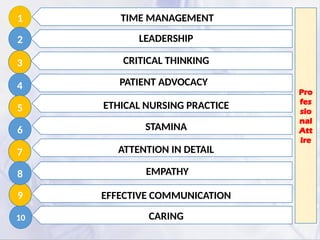
TIME MANAGEMENT
LEADERSHIP
CRITICAL THINKING
PATIENT ADVOCACY
ETHICAL NURSING PRACTICE
STAMINA
ATTENTION IN DETAIL
EMPATHY
EFFECTIVE COMMUNICATION
CARING
Pro
fes
sio
nal
Att
ire
Assess yourself
What is the most professional way to
handle a disagreement with a colleague?
•A) Argue in front of patients to prove your
point
•B) Complain about them to other nurses
•C) Discuss privately and professionally to
resolve the issue
•D) Ignore them completely and avoid further
interaction
✅ Correct Answer:
C) Discuss privately and
professionally to resolve the issue
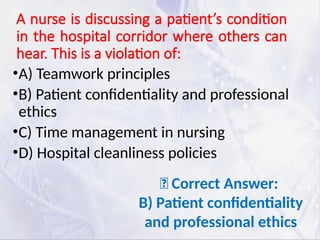
A nurse is discussing a patient’s condition
in the hospital corridor where others can
hear. This is a violation of:
•A) Teamwork principles
•B) Patient confidentiality and professional
ethics
•C) Time management in nursing
•D) Hospital cleanliness policies
✅ Correct Answer:
B) Patient confidentiality
and professional ethics
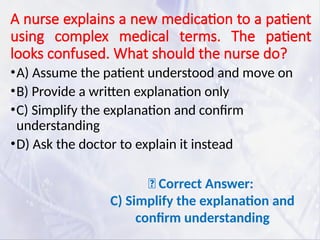
A nurse explains a new medication to a patient
using complex medical terms. The patient
looks confused. What should the nurse do?
•A) Assume the patient understood and move on
•B) Provide a written explanation only
•C) Simplify the explanation and confirm
understanding
•D) Ask the doctor to explain it instead
✅ Correct Answer:
C) Simplify the explanation and
confirm understanding
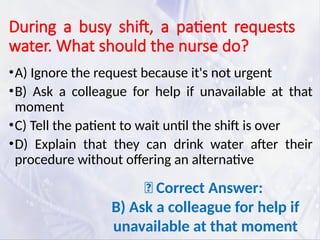
During a busy shift, a patient requests
water. What should the nurse do?
•A) Ignore the request because it's not urgent
•B) Ask a colleague for help if unavailable at that
moment
•C) Tell the patient to wait until the shift is over
•D) Explain that they can drink water after their
procedure without offering an alternative
✅ Correct Answer:
B) Ask a colleague for help if
unavailable at that moment
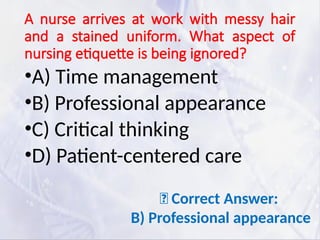
A nurse arrives at work with messy hair
and a stained uniform. What aspect of
nursing etiquette is being ignored?
•A) Time management
•B) Professional appearance
•C) Critical thinking
•D) Patient-centered care
✅ Correct Answer:
B) Professional appearance
Exercising professional etiquette doesn't
take a lot of time or effort,
so
make it a part of your everyday practice.

Key Professional Nursing Etiquette .pptx

  • 1.
    PROFESSIONAL Nursing Etiqutte DrUma Devi T., M.Sc (N)., PG Diploma (Biostatistics)., Ph.D (Women’s Studies)., PhD Scholar (Nursing), Associate Professor & Head, Department of Obstetrics and Gynaecological Nursing, Shri Sathya Sai College of Nursing, SBV Chennai Campus.
  • 2.
    "Nursing is notjust an art, it has a heart. Nursing is not just a science, it has a conscience." – Donna Wilk Cardillo
  • 3.
    •Manners refer tothe polite behaviors and customs that are considered socially acceptable in different situations. For example, saying "please" and "thank you" or holding the door for someone. •Etiquette is a broader concept that includes manners but also covers rules and guidelines for professional and social conduct in specific settings, like workplace etiquette, dining etiquette, or nursing etiquette.
  • 4.
    Nursing Etiquette • Nursingetiquette refers to the set of professional behaviors, ethical standards, and courteous interactions that guide nurses in their clinical practice. •Proper nursing etiquette ensures a positive healthcare environment, enhances patient trust, and promotes collaboration within the healthcare team.
  • 5.
    Situation •A nurse workingin a medical-surgical ward has six patients under her care. She/he starts her/his shift at 7:00 AM and knows that timely medication administration, wound care, patient assessments, and documentation are crucial. Challenge •At 8:00 AM, Suddenly, one of her/his patients develops breathing difficulty, requiring immediate attention.
  • 6.
    Action: •Prioritization •Delegation •Efficiency Effective time managementin nursing is about prioritizing tasks, handling unexpected situations calmly, and using teamwork to ensure patient safety.
  • 7.
  • 8.
    Situation •A busy emergencydepartment (ED) receives multiple trauma patients from a road accident. Challenge •The unit is understaffed, and the available nurses are overwhelmed with triaging, administering first aid, and stabilizing patients.
  • 9.
    Action: •Assess the situationQuickly. •Assign the roles based on the skills and experience of the available staff. •Guide the junior nurses on prioritizing critical cases using the triage system. •Communicate effectively with the doctors and paramedics, ensuring a smooth flow of patient care. •Remain calm under pressure, motivate the team and making sure every patient receives timely intervention. A good nurse leader doesn’t just give orders—they guide, support, and empower their team to provide the best patient care, even in high-pressure situations.
  • 10.
  • 11.
    Situation •A student nurseis on her clinical rotation in the Burns unit when she is assigned to a 35-year-old patient with second-degree burns on the chest and arms. Challenge •The patient's vital signs appear stable, but the student notices that the patient is becoming increasingly restless and has difficulty breathing.
  • 12.
    Action: •Remember that burnson the chest can lead to swelling and restrict breathing. •Assess the patient’s oxygen saturation, and notice the skin around the burn. •Recognize a possible compartment syndrome or impending respiratory distress •Inform inform the instructor and the attending nurse. Critical thinking is not just about following instructions—it’s about observing, analyzing, and acting swiftly to prevent harm to patients.
  • 13.
  • 14.
    Situation •A student nurseis on her clinical rotation in the ICU and is assigned to a post-operative patient who is unable to speak due to being on a ventilator. Challenge •The patient appears restless and uncomfortable, the patient is grimacing and clutching his abdomen but when the student asks the assigned nurse, she is told the patient is just “agitated” and should be left alone.
  • 15.
    Action: •Dont dismiss thepatient’s discomfort •Decide to assess further. •Report to the senior nurse and insists on a proper pain assessment. Patient advocacy is about not ignoring signs of distress, speaking up for patient needs, and ensuring they receive appropriate care—even if others overlook it.
  • 16.
  • 17.
    Situation •A student nurseis assisting in the preoperative unit Challenge • when she/he notices that an elderly patient scheduled for surgery seems confused and unsure about the procedure. When she/he asks the patient what surgery they are undergoing, the patient struggles to recall the details. The patient also appears hesitant and anxious.
  • 18.
    Action: •Notify the clinicalinstructor, recognizing that the patient may not have fully understood the consent process. •Make sure that the surgeon is called to re-explain the procedure to the patient. •Obtaine a proper informed consent. •Ensure that the patient, now fully informed, is able to make a confident decision about proceeding with surgery. Always assess patient understanding, especially in critical decisions like surgery, and advocate for their rights if they seem unsure or uninformed
  • 19.
    Ethical Principles ✅ Autonomy:Ensuring the patient understands their treatment and can make an informed decision. ✅ Beneficence: Acting in the best interest of the patient’s well- being. ✅ Non-maleficence: Preventing potential harm by ensuring informed consent is valid. ✅ Veracity: Upholding truthfulness in communication between healthcare professionals and patients.
  • 20.
  • 21.
    Situation •A nursing studentis assisting in the labor ward during a busy night shift. Three women are in active labor, and the team is managing multiple deliveries. Challenges •One patient has prolonged labor, requiring continuous monitoring and emotional support. •Another patient is experiencing complications, and the nurse must assist the obstetrician with emergency procedures. •The nurse must chart vital signs, fetal heart rate, and contraction patterns without missing critical details. •After one delivery, she must quickly assist with the next while ensuring postnatal care for the mother and baby.
  • 22.
    Action • Despite exhaustion,the stay alert and active throughout the shift, ensuring safe deliveries. • Pays attention to hydration and short breaks whenever possible to maintain her energy. • Provide continuous emotional support to mothers, easing their anxiety and pain. • Handle this multiple high-pressure situations without losing focus. Working in nursing unit requires immense physical and mental stamina. Nurses must stay resilient and energized to handle long hours, unexpected complications, and emotionally intense situations.
  • 23.
  • 24.
    Situation • A nursingstudent is on a hospital rotation in the general medical ward, preparing to administer medications during the morning rounds. Challenges • The patient, a 65-year-old male with hypertension and diabetes, is scheduled to receive metoprolol (a beta-blocker) and insulin. • While reviewing the medication chart, the student notices that the doctor accidentally prescribed double the usual dose of metoprolol. • The student checks the patient’s blood pressure (BP) and heart rate, which are already on the lower side. • If administered, the medication could cause severe bradycardia (low heart rate) and hypotension, leading to dizziness, fainting, or even cardiac arrest.
  • 25.
    Action •Inform the seniornurse about the discrepancy. •Verify the chart, consult the physician, and confirm that the order was incorrect. •Ensure that the correct dose is prescribed, preventing a potential medical emergency. Always cross-check prescriptions, especially for high-risk medications. Never ignore a gut feeling—verify when in doubt. Attention to detail in nursing prevents errors and ensures patient safety.
  • 26.
  • 27.
    Situation •A young first-timemother brings her newborn to the pediatric outpatient department (OPD) for a routine vaccination. Challenges •The mother is visibly anxious and hesitant about the vaccination. •She looks nervous and overwhelmed, asking multiple questions about the vaccine’s safety, side effects, and potential pain for the baby. •She has heard conflicting information from relatives and social media, making her doubtful. •The baby is crying, adding to her stress.
  • 28.
    Action • Listen calmlyto the mother’s concerns without dismissing her fears. • Explain the benefits of vaccination in simple, reassuring language, addressing myths with evidence-based facts. • Demonstrate gentle techniques to help soothe the baby before and after the shot. • Encourage the mother by saying, "I understand it’s scary, but you’re doing a great job protecting your baby." • After the vaccination, ensure she is at ease before leaving. Empathy is not just about listening but also about responding with patience and reassurance.
  • 29.
  • 30.
    Situation •A nursing studentis assisting in the emergency department (ED) when an elderly patient with chest pain and breathlessness arrives. The patient speaks only a regional dialect and is visibly distressed. Challenges •The language barrier makes it difficult to obtain a clear history. •The patient's family is also anxious and asking multiple questions. •The doctor needs a quick and precise update on the patient's condition.
  • 31.
    Action • Remain calmand use non-verbal cues like maintaining eye contact and using simple gestures to reassure the patient. • Call a staff member who speaks the patient's dialect to help translate. • Clearly and concisely communicate the symptoms, vital signs, and patient history to the doctor. • Explains the next steps to the family in a simple and understandable way, reducing their anxiety. Effective communication ensures faster and safer patient care.
  • 32.
  • 33.
    Situation •An elderly patientarrives at the outpatient department (OPD) for a routine diabetes check-up. He is visibly weak, struggling to walk, and confused about where to go. He also appears dehydrated and fatigued from waiting. Challenges •The patient is alone with no family to assist him. •He is unsure about his next steps, looking disoriented. •The waiting area is crowded, and he is at risk of falling due to weakness.
  • 34.
    Action • Notice hisdiscomfort and immediately guide him to a nearby chair. • Offer him water and ask if he needs any immediate assistance. • Explain him gently the OPD process and personally escort him to the doctor’s room instead of leaving him to navigate alone. • After her/his consultation, ensure he understands his medication and the follow-up plan before he leaves. Caring goes beyond treatment—it’s about ensuring patient comfort and dignity.
  • 35.
  • 36.
    Situation •A nursing studentis assigned to the outpatient department (OPD) during her clinical rotation. She/he arrives in a wrinkled uniform, untied hair, and wearing strong perfume. She/he slouches while talking to patients and does not make eye contact. Challenges •Patients feel less confident about her professionalism. •A senior nurse advises her/him to improve her/his appearance to reflect professionalism. •She/he struggles to gain respect from both patients and staff.
  • 37.
    Action •Correct the, ensureit is clean and neatly pressed, and keep the hair tied back. •Maintain a confident posture, makes eye contact, and use a calm, polite tone when speaking to patients. •Greet each patient with a smile and respectful gestures, making them feel at ease. Professional attire and body language enhance trust and confidence in patient care.
  • 38.
  • 39.
    1 10 9 2 3 4 5 6 7 8 TIME MANAGEMENT LEADERSHIP CRITICAL THINKING PATIENTADVOCACY ETHICAL NURSING PRACTICE STAMINA ATTENTION IN DETAIL EMPATHY EFFECTIVE COMMUNICATION CARING Pro fes sio nal Att ire
  • 40.
  • 41.
    What is themost professional way to handle a disagreement with a colleague? •A) Argue in front of patients to prove your point •B) Complain about them to other nurses •C) Discuss privately and professionally to resolve the issue •D) Ignore them completely and avoid further interaction ✅ Correct Answer: C) Discuss privately and professionally to resolve the issue
  • 42.
    A nurse isdiscussing a patient’s condition in the hospital corridor where others can hear. This is a violation of: •A) Teamwork principles •B) Patient confidentiality and professional ethics •C) Time management in nursing •D) Hospital cleanliness policies ✅ Correct Answer: B) Patient confidentiality and professional ethics
  • 43.
    A nurse explainsa new medication to a patient using complex medical terms. The patient looks confused. What should the nurse do? •A) Assume the patient understood and move on •B) Provide a written explanation only •C) Simplify the explanation and confirm understanding •D) Ask the doctor to explain it instead ✅ Correct Answer: C) Simplify the explanation and confirm understanding
  • 44.
    During a busyshift, a patient requests water. What should the nurse do? •A) Ignore the request because it's not urgent •B) Ask a colleague for help if unavailable at that moment •C) Tell the patient to wait until the shift is over •D) Explain that they can drink water after their procedure without offering an alternative ✅ Correct Answer: B) Ask a colleague for help if unavailable at that moment
  • 45.
    A nurse arrivesat work with messy hair and a stained uniform. What aspect of nursing etiquette is being ignored? •A) Time management •B) Professional appearance •C) Critical thinking •D) Patient-centered care ✅ Correct Answer: B) Professional appearance
  • 46.
    Exercising professional etiquettedoesn't take a lot of time or effort, so make it a part of your everyday practice.