Improving Productivity
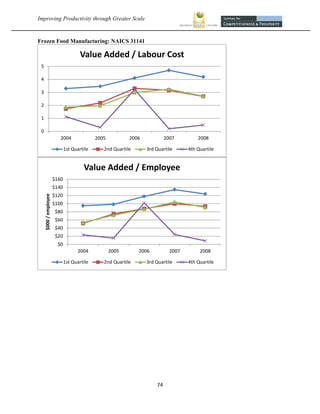
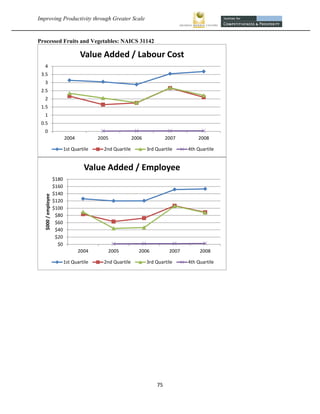
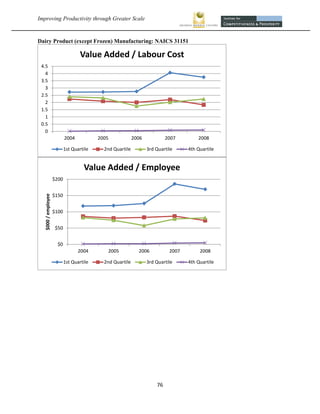
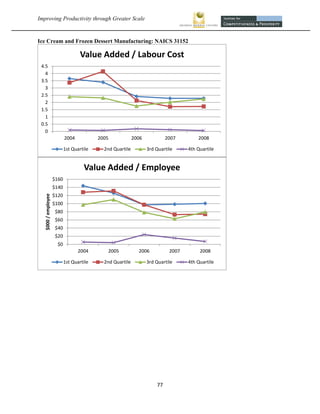
in Canada’s Food Processing Sector
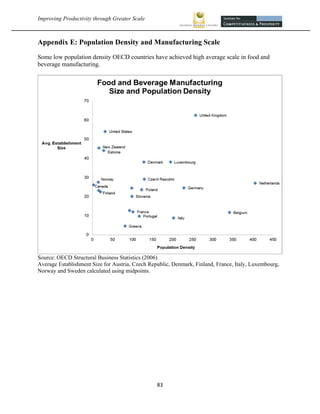
       through Greater Scale

           February 2012
Improving Productivity through Greater Scale                                                           


                                       Executive Summary

The purpose of this study was to provide an economic analysis of the relationship between scale
and productivity in Canada’s food processing and its significance for Canadian public policy and
management purposes. With the changing global agri-food environment and future demand
opportunities, scale in food processing is one factor that allows participating Canadian firms to
compete successfully in this environment. Large scale processing drives large scale demand for
agricultural products, leads to growth of markets along the whole value chain and allows firms to
satisfy both the domestic and export markets.

In this analysis, elements of the economic literature relevant to economies of scale and
productivity were reviewed, with an emphasis on Canadian food processing. Industry data from
Canada and the United States were collected and analyzed, and interviews were completed with
Canadian food processors. Based on the above, hypotheses regarding scale and productivity in
Canadian food processing were formulated and assessed. This analysis formed the basis for our
conclusions.

The results showed the following:
    Canadian food processors are significantly smaller in scale than their US counterparts.
       On average, Canadian food processing facilities have half the number of employees and
       less than half the sales revenue of US facilities. Major scale differences are found in all
       sectors of the food processing industry.
    Larger facilities are more productive – value added per employee for establishments at
       the 75th percentile is twice the level for the median establishment. To the extent Canadian
       establishments have not achieved scale, this hurts the industry’s overall productivity.
    Investment in machinery and equipment in Canadian food processing facilities trails the
       US; for every dollar invested per worker in the US, Canadian facilities invest only 62
       cents.
    Canadian food processing firms noted the following regarding scale and productivity:
                    Operating plants at a competitive/efficient scale is fundamental, especially
                       in specialized facilities
                    Firm scale allows for the overhead of enhanced marketing, human
                       resource, and research and development functions
                    The more dependent firms are on the raw farm product as a share of
                       product value, the greater the extent to which competition drives scale
                    In other cases, the perishable nature of the product and transportation cost
                       relative to the size/concentration of the local market limits plant scale.
                    A number of marketing regulations and firms that experience downtime in
                       multiproduct plants were also found to limit scale of Canadian firms.
    Even within free trade agreements, border effects are perceived as significant. This has
       the effect of broadly limiting the future scale of Canadian firms, particularly in competing
       in global markets.
    The scale of food retailing in Canada is a significant factor for many food processors.
       Given that food retailing is more concentrated in Canada than in the US, this suggests the
       potential for increased scale in food processing in the future.


                                                2 
 
Improving Productivity through Greater Scale                                                            


       Marketing regulations that impact the available supply of farm product, flexibility of
        procurement arrangements, ability to export and the ability to for firms to compete with
        rivals in raw product procurement are a limit to scale. In effect, some of these regulations
        create sub-national markets which limit scale by their very nature.

Thus, firm scale is an important part of the productivity challenge. The analysis here finds that
manufacturing productivity increases with scale, as does capacity utilization. Although scale is
not the only challenge to improving productivity, it is a factor that has helped to maintain or
improve productivity in the US sector while Canada’s lags. As new labour-saving technologies
emerge, the gap in scale will only be exacerbated.

To the extent that policy creates barriers to firm scale and/or could better promote scale as a
means of narrowing the productivity gap, this should be engaged. Policy by governments has
tended to contain scale biases- either implicitly favoring scale or opposing scale. The current
emphasis on “local” appears to fall toward the latter. Instead, policy should be even-handed
regarding scale, and transparent that policy initiatives are scale-neutral.

On the domestic side, any policy that constrains national markets (e.g. provincial waste and
packaging standards) can have an effect on scale efficiencies of a firm servicing the entire
country.

This leads to the following recommendations:

       Governments (AAFC, Industry Canada, provinces) should continue and intensify efforts
        to minimize border friction. This ranges from increased trade advocacy activity, to
        ongoing diplomatic engagement regarding border interruptions and costs. The results of
        these efforts should be communicated to industry, so that more transparent assessment
        can be made of export market prospects, with the goal of greater certainty in market
        access.
       The system of farm product allocation among processing plants in supply management
        should be reformed. Administratively-derived allocation is inflexible and creates
        unproductive entitlements to supply. It is unclear that these contribute anything to the
        market power protection of farmers. Administrative allocation mechanisms should be
        reformed to a more freely competitive system of allocation among plants
       Regulated marketing is largely fragmented at the provincial level. This creates
        unnecessary friction among provinces and additional costs in the system. Acknowledging
        that some of this orientation has a statutory basis, especially in supply management, the
        system should be reformed to be national in structure. Dairy marketing agencies have
        attempted to move in this direction; this should be supported and continue for all
        provincial marketing boards in supply management with the goal of having a single
        national marketing agency for the national allocation of each of the supply managed
        commodities.
       Regulated marketing, including the Canadian Wheat Board (the most recent federal
        legislative proposal on the CWB would accomplish this) and supply management should
        be reformed to better meet the needs of differentiated markets and facilitate cooperation
        between processors and their suppliers where there is a willingness on behalf of both

                                                 3 
 
Improving Productivity through Greater Scale                                                                  


         parties to do so. This would allow improved access to specified farm products on behalf
         of processors, and allow farmers an alternative to imposed product standards.
        The objectives and instruments of regulated marketing should be reviewed to determine
         whether overreach is occurring.
        When Government assesses new policies (waste, packaging), it should consider the effect
         a provincial policy vs. federal policy will have on the ability of firms to scale up and
         service the country.
        New technology will be a driver for food processing scale. Currently, government
         announcements focus on the number of jobs that grants and investments will bring to a
         community. As new labour and energy saving technologies are adopted, fewer jobs may
         be created but the focus should be on the fact that higher skilled jobs will be created as a
         result.
        An opportunity exists to create awareness regarding productivity and the role of scale in
         educational activities. Public resources or incentives should be provided to firms to
         examine and upgrade processes and technology related to scale that can improve
         competitiveness.
        The data associated with scale and productivity are imperfect. If competitiveness in food
         processing is important to the Canadian economy (as we believe it is) then the nature of
         the data should be reviewed and formatted appropriately for more precise comparisons,
         and government should be “minding the store” and regularly monitoring the situation.

It must be made clear that this report and its conclusions are not based on a ‘big versus small’
argument. There is room for all sizes of food processing targeting various markets in Canada.
However, if Canada wants to compete effectively against foreign food processors, both in the
domestic market and export markets, then more focus is required on improved scale and
productivity in those firms that do want to compete in this arena. Innovation, technology and
effective management will be the key to moving the sector forward and using resources
efficiently. There is an opportunity for good public policy to play an important role in creating a
business climate that will facilitate this growth and investment for the betterment of the entire
agri-food value chain.


    Funding for this project was provided by Maple Leaf Foods, Cargill Ltd., Viterra Inc., the Conference 
                     Board of Canada and Alberta Agriculture and Rural Development. 

                       The analysis and recommendations are those of the authors. 


                                                     4 
 
Improving Productivity through Greater Scale                                                                                                                       


                                                                  Table of Contents

1.      Introduction ........................................................................................................................................... 6 
      1.1        Purpose and Objectives ................................................................................................................ 6 
      1.2        Report Outline ............................................................................................................................... 6 
2.      Defining Productivity and Scale, and their Relationship ...................................................................... 7 
      2.1        Defining Productivity and Scale ................................................................................................... 7 
      2.2        Measurement of Productivity and Scale ..................................................................................... 10 
      2.3        Data and Limitations .................................................................................................................. 11 
      2.4        Observations ............................................................................................................................... 12 
3.      Scale and Productivity in Canada’s Food Processing Sector .............................................................. 13 
      3.1        Description of Canada’s Food Processing Sector ...................................................................... 13 
      3.2        Canada / US Food Processing Comparison ............................................................................... 20 
      3.3        Observations ............................................................................................................................... 30 
4.      Firm-level Analysis of the Importance of Scale in Achieving Productivity ....................................... 31 
      4.1        Plant Size/Scale and Efficiencies ................................................................................................ 31 
      4.2        Firm Size/Scale and Efficiencies ................................................................................................. 32 
      4.3        Observations ............................................................................................................................... 34 
5.      What is affecting Scale in Canadian Food Processing? ...................................................................... 36 
      5.1        Factor Conditions ....................................................................................................................... 36 
      5.2        Industrial Policy  ......................................................................................................................... 42 
                                  .
      5.3         Investment Conditions ................................................................................................................ 49 
      5.4        Tax and Regulatory Environment ............................................................................................... 52 
      5.5        Observations ............................................................................................................................... 53 
6.            Conclusions and Recommendations ............................................................................................... 54 
      6.1        Conclusions ................................................................................................................................. 54 
      6.2        Recommendations ....................................................................................................................... 56 


                                                                                5 
 
Improving Productivity through Greater Scale                                                           


1.     Introduction
“To remain competitive and profitable, Canadian food processors will increasingly need to
identify growth markets that will allow them to leverage their production capacity and increase
their scale.” Stephen Rannekliev, Vice-President, Food and Agribusiness Research and
Advisory Services, Rabobank, April 2008.

Bank of Canada research indicates that “a smaller average size is one of the most distinctive
structural features of Canadian firms relative to those in the United States, which in the past has
registered a systematically higher productivity level than Canada” and Intel founder Andy Grove
argues that “losing the ability to scale will ultimately damage our capacity to innovate”.

The productivity gap in Canada has been well documented as a competitive challenge to the
economy in many sectors including in food processing (Hodgson and Triplett, 2007; Conference
Board of Canada, 2010). This research project intends to examine scale as a factor that could be
affecting the gap.

1.1    Purpose and Objectives

The purpose of this study was to evaluate and assess the relationship between scale and
productivity in Canada’s food processing sector, and to put it in context.

The specific objectives of this study were to:
    Determine the impact of scale in Canada’s food processing sector overall and its
       important sub-sectors
    Identify the key contributors to Canada’s sub-scale challenges where they exist
    Develop public policy recommendations to deal with opportunities for improvement

1.2    Report Outline

Section 2 begins by putting scale and productivity into context. Section 3 describes the effects of
scale on productivity based on a comprehensive literature review. Section 4 describes the food
processing sector in Canada, compares it to the United States and shows the effects of scale on
productivity. Section 5 assesses a set of hypotheses formulated based on potential contributors to
Canada’s sub-scale challenges. Lastly, Section 6 provides recommendations to improve scale
challenges in Canada’s food processing sector.


                                                 6 
 
Improving Productivity through Greater Scale                                                               


2.     Defining Productivity and Scale, and their Relationship
2.1    Defining Productivity and Scale

“Productivity isn’t everything, but in the long run it is almost everything. A country’s ability to
improve its standard of living over time depends almost entirely on its ability to raise its output
per worker”.
                   Paul Krugman, The Age of Diminishing Expectations (1992)

‘Over long periods of time, small differences in rates of productivity growth compound, like
interest in a bank account, and can make an enormous difference to a society's prosperity.
Nothing contributes more to reduction of poverty, to increases in leisure, and to the country's
ability to finance education, public health, environment and the arts.’

                  Blinder and Baumol, Economics: Principles and Policy (1993)

The purpose of this section is to provide background and understand what is known about the
relationship between the size of firms and firm productivity, with particular application to food
processing. Specifically, the section seeks to determine the following:
     What are the economies associated with larger firms?
     What has been observed regarding the relationship between firm size/scale and
        productivity, particularly in reference to Canada’s food processing sector?
     What measures are employed to relate size/scale and productivity?
     What is the significance of size/scale in food processing?

Productivity

Most commonly, and basically, productivity is defined as a ratio of output volume over volume
of inputs (OECD). This ratio measures the efficiency at which inputs are used to produce a given
level of output (OECD). Therefore, depending on the type of competing entity, productivity can
be distinguished with respect to products, industries or nations as a whole. And depending on the
space where entities operate, productivity can be compared on a regional, national or
international basis. It is also possible the extend this definition outside of a commodity
orientation by measuring the value of inputs and outputs in transformation- this allows for
differentiated products in which, compared with a commodity variant of the product, the value of
inputs is high but with a concomitantly high value of output.

Economies of Size and Scale

Firm costs and returns vary as a function of its level of inputs and outputs; this is the basis for the
related concepts of economies of size and scale. Economies of size relates unit cost to level of
output; if unit costs decrease as output is increased, economies of size exist- conversely, if unit
costs increase as output is increased, diseconomies of size are observed (Beattie and Taylor,
Debertin) . Economies of scale is a concept that focuses on the scaling of inputs relative to
corresponding output observed (Beattie and Taylor, Debertin). For example, when all inputs are
increased by the same proportion (say double), if the value of output more than doubles we

                                                  7 
 
Improving Productivity through Greater Scale                                                                


observe increasing returns to scale; if output less than doubles we have decreasing returns to
scale. In fact, economies of scale formally involve technical qualification around all inputs being
increased proportionally; as a consequence, economies to scale tends to be more of academic
significance, even if it is a much more commonly used term (Beattie and Taylor).

Besanko, Dranove, and Shanley provide a discussion of how economies relating to firm size
arise. The first factor identified is indivisibilities in fixed costs. If some inputs are fixed in size,
then unit costs can be decreased until the capacity of these fixed inputs are fully utilized. For
example, a train runs on rails regardless of the load being transported; the longer and more fully
loaded the train, the lower the unit cost. Secondly, there are economies related to size arising
from inventory. Firms operating at a larger size can maintain lower ratios of inventory to sales
than smaller ones, based on observations from operations theory. Conversely, larger firms may
be able to secure volume discounts in purchasing inputs that smaller firms cannot. Finally, the
costs of firm capacity itself induce economies relating to size- the incremental cost of increasing
capacity is decreasing. Tirole also refers to economies of “massed reserves”. These arise
because a plant with a larger number of machines can sustain a flow of output proportionally
higher than one with a smaller number; this is true because the random effect of a single machine
breaking down is much smaller in a larger plant.

Leung et al summarized recent research relating productivity and the size of firms in the
Canadian economy. The results showed the following. First, labour productivity (measured as
sales/employee) is higher for larger firms than smaller ones, due to improved use of technology
and training, the fixed costs of which can be amortized over a larger sales volume and thus lower
on a unit cost basis. Secondly, larger firms are more capital intensive due lower costs of capital
and greater specialization. The authors cite empirical evidence that for the period 1984-1997,
Canadian firms with greater than 100 employees had sales/employee levels 27% higher than
firms with fewer than 100 employees. Over the same period, Canadian firms had sales/employee
levels 82% that of the US. The authors note that this productivity gap is almost entirely
explained by productivity lags in small firms (<20 employees) and large firms (>500
employees); for firms between 20 and 500 employees, Canadian firms had similar or better
sales/employee (productivity) compared with the US.

There can also be diseconomies associated with firm size. One is that there are decreasing
returns to management. This is described in the transactions cost literature by Williamson- the
boundaries of a firm, including its size, are limited by the opportunity costs associated with
internal management. A related concept discussed by Liebenstein is that of “X-efficiency” in
firms- the difference between theoretical allocative efficiency and actual efficiency. The gap
represented by X-efficiency was observed as relating to problems in motivating workers, and
waste resulting from not fully understanding or implementing technology.

Empirical Research

There have been a range of empirical studies of food processing that relate to economies of
size/scale. McPhee and Peterson lay out three types of empirical approaches used to study
economies of size; (1) average costs estimated from accounting data on existing plants/firms, (2)
engineering cost estimates, where the technology and costs of alternative sized plants are

                                                   8 
 
Improving Productivity through Greater Scale                                                             


explicitly modeled and average costs observed, and (3) the “survivor firm” approach, in which
firms are sorted into size categories, and the share of industry output of each size category
tracked. Based on changes in size category shares over time, efficient firm sizes are inferred.

For example, Chang-Kang et al (1999) looked at productivity growth in food manufacturing in
Canada and the US over the period 1962-1993 and found that Canadian food manufacturers had
operated below capacity to a much greater extent than in the US, and that this affected
productivity. Canadian food processors were found to have lower productivity growth and lower
returns to research and development. The study concluded that the observed differences were
explained by Canadian firms’ unwillingness to engage in mergers and cost-cutting measures, and
due to extensive regulation in Canada. Gervais et al (2008) studied productivity in the Canadian
meat, bakery, and dairy segments based on 1990-1999 data from the Annual Survey of
Manufacturers (Statistics Canada). The results showed increasing returns to scale in the meat
segment, a range of increasing and decreasing returns by province in bakeries- with increasing
returns in small provinces and decreasing returns in large provinces, and essentially constant
returns to scale in dairy processing, with some provincial variation- similar to that observed in
bakeries.

In the US, Buccola et al (2000) analyzed productivity growth in the US baking and grain milling
industries for the period 1958-1994 and found that productivity growth was positively related to
capacity utilization and the capital stock. Xia and Buccola (2002) considered the relationship
among firm size, unit cost, and productivity in US meat processing from 1973-1994 and found
rates of productivity growth to be declining, and that technical change and economies of size
have a type of synergistic effect in enhancing productivity. MacDonald and Ollinger
investigated the nature and extent of scale economies in the US hog slaughter segment for 1963,
1967, 1972, 1977, 1982, 1987, and 1992. The results showed modest economies of scale in
primary hog processing, and that technology improvements had increased the effective scale of
plants over time.

In Europe, Wijnands et al conducted an in-depth study of food processing competitiveness in the
EU. As part of the analysis, the following measures were estimated- growth in gross value-
added, growth in the Balassa index (revealed comparative advantage), world market share
growth, and growth in gross value-added per worker; these were benchmarked against competing
nations. The results showed that the EU food industry is relatively weak in labour productivity
and economies of scale. Cultural diversity across member countries was observed as allowing
some economies of scope and specialization of small and medium-sized firms. Key threats to
competitiveness were seen as limitations on farm production practices, restrictive regulatory
approval policy for new products, and food retailer concentration.

A range of other empirical studies test for increasing returns to scale in industries, and infer from
this the potential for market power. For example, Bhuyan and Lopez studied market power and
elasticities of scale in 40 food and tobacco processing industries in the US. They found that for
20 of the industries, increasing returns to scale were observed, and that 37 of the 40 industries
exercised market power in output price setting. Morrison Paul (2001) investigated monopoly
and monopsony power in US meat packing and the role of scale economies in industry


                                                  9 
 
Improving Productivity through Greater Scale                                                             


concentration and found substantial economies of scale in US meat packing, as well as
significant market power, particularly in output markets.

Cohen and Paul (2005) considered the spatial concentration of food processing in several regions
within the US based on the period 1986-1996. Their results showed significant economies
relating scale and localization effects associated with farm product procurement and labour
supply. Some of the effects were offsetting; for example, plants located near agriculturally
intensive states were observed as having lower production costs, yet being located in a more
rural state was cost increasing- perhaps due to smaller workforce, distance from markets, etc.

Baldwin and Gu considered the impact of liberalized trade and plant size in Canadian
manufacturing for the period 1973 to 1997. The results of their analysis showed that the average
size of plants that export was significantly larger than those not exporting, but that there was
little difference in specialization. However, production runs in exporting plants were
significantly longer than non-exporting plants. Reduction in tariff barriers was found to reduce
the size of non-exporting plants, with an ambiguous effect on the scale of exporting plants.

Barkema et al, in reviewing observed increases in scale, economies of scale, and increased
concentration in US livestock and meat processing, consider the policy implications of scale.
They pose the question of whether increased concentration (due to increased scale) is good or
bad, and make the following observations. While the natural concern relative to fewer larger
firms is market power, the true extent of this issue is unknown- academic literature provides no
clear evidence of concentration in livestock and meats influencing prices, but the prospect still
exists of market power. At the same time, scale is linked to productivity and efficiency, and the
best evidence of this is a lower proportion of income spent on food. Thus, there is a tradeoff in
scale that presents the prospect of market power abuses, but with the benefit of increased
efficiency. In consideration of the above, Barkema et al suggest renewed and refined anti-trust
enforcement that addresses the prospect of market power abuse, the development of new
marketing institutions that allow processors and their suppliers to work together better and
differently, and programs that orient processors and rural communities/services better.

2.2    Measurement of Productivity and Scale

As the OECD notes ‘there are different measures of productivity; the choice between them
depends on the entity being measured, the purpose of measurement and/or data availability’. For
example, macro measures of productivity commonly use GDP relative to a measure of input,
such as employment, labour hours, or labour cost. Therefore, at an industry level, a measure of
value-added is ideal. Value-added is the difference between an industry’s total revenue and its
cost of purchased inputs. So, for food manufacturing industries, value added is the difference
between their selling prices (i.e. ‘wholesale’ prices) multiplied by the units sold, less the cost of
raw farm products, packaging and energy.

There are different denominators that could be used in measuring productivity. This study uses
two different methods:


                                                 10 
 
Improving Productivity through Greater Scale                                                           


         Value added per employee
             o Measures the ability of an industry to generate gross earnings relative to the
                 number of employees engaged in the process
         Value added per labour cost
             o Measures the ability of an industry to generate gross earnings relative to the cost
                 of labour consumed

There are also several ways to define scale/size. This study uses two definitions:

         Number of employees
         Throughput or sales

The principal difference between these two measures of scale relates to labour-saving
technology. The notion of scale across industries in which the labour input is proportionally
similar and constant over time is such that the two definitions of scale should be equivalent.
Conversely, if an industry has invested in labour-saving technology where others have not, the
notion of scale will differ according to employees or output.

2.3       Data and Limitations

The most comprehensive data sets in Canada and the United States are the Annual Survey of
Manufactures (and Logging in Canada) conducted by Statistics Canada and the US Census
Bureau. For the most part these surveys are consistent and comparable and based on
establishment/plant data.

However there are differences in the data that should be acknowledged and observed in
interpretation:
     The US Census Bureau conducts a census every five years – for the intervening years it
        generates annual data based on a survey that is less comprehensive. Baldwin et al. 2002
        suggest that in these years some smaller firms and new firms can be left out of the survey.
        Conversely, the Canadian ASM is an annual survey.
     Value added measures between Canada and the United States differ slightly: Baldwin et
        al (2002) note that Canada includes head offices attached to plant establishments in its
        value added measurements, whereas the United States does not; however they estimate
        that this only had a 2% effect on the data. Baldwin et al (2002) also note that between
        years there are subtle differences in the definition of value added between the countries.


                                                  11 
 
Improving Productivity through Greater Scale                                                         


2.4    Observations

The above suggests the following. Productivity is a relatively simple concept that compares the
volume or value of output and inputs; the greater the output relative to input, the more
productive. The general notions of economies of size and scale are ultimately predicated on the
spreading of fixed costs across larger volumes- thus reducing unit cost, and on increased market
leverage, especially in procurement.

The more applicable concept in understanding how a firm’s productivity and profitability
changes as it gets larger or smaller is economies of size, measured in terms of output. However,
the much more commonly used term is economies of scale (measurement of inputs), which, if
interpreted precisely, is unwieldy. In this study, we will attempt to bridge this gap by using
measures of firms based on both output and input; this will be identified for the purposes of
clarity. And the term “scale” will be retained due to its ubiquitous use, with its technical
qualifications noted.

Applied research work has tended to deal with the use of aggregate data to estimate industry-
level production relationships among inputs and outputs to derive returns to scale parameters and
productivity measures. One use of this information is to infer measures of processor market
power; here the findings appear to have been mixed with no clear sense that processors increase
in scale in order to suppress farm product prices or increase selling prices. Another application
is in measuring productivity and production efficiency. The literature reviewed here finds
productivity generally increasing with scale, and with effective capacity utilization.

Other studies have considered whether productivity and scale are related to local effects-
availability of a specialized workforce and infrastructure, and location close to farm product
supplies and consumer markets. These appear to be validated, although the factors are complex,
with some having offsetting effects- such as proximity to farm product supplies, which can raise
labour costs. There is also some discussion that the size of markets can limit scale and
specialization. Regulatory factors- approvals for new products or policies limiting farm product
availability- were observed as playing a role in European food processing performance. There is
also Canadian evidence that trade influences the scale of Canadian manufacturing plants, which
in turn influences productivity.

Finally, a range of measures exist in examining productivity and scale; among the important
considerations are the intended use of measures and the availability and quality of data. For
example, in industries in which technology is mature and little difference exists in technology
across plants, there will be a high correlation between scale measured as plant output
volume/sales value and scale measured as employment; conversely, if a subset of plants apply
sharply different labour-saving technologies, there is apt to be a difference between scale
measured as sales vs. employment. The data available to measure productivity and scale in
Canada versus the US each come from a survey, and there are differences that exist in the
between the two that should be observed, and limit the precision with which inferences can be
made. Conversely, the data are broadly representative of trends and observations that are not
based on minute differences.


                                                12 
 
Improving Productivity through Greater Scale                                                           


3.     Scale and Productivity in Canada’s Food Processing Sector

This section of the report describes the current and historical food processing situation in Canada
and show that scale and productivity are lagging. This is done by examining the size of the
sector, the scale of plants, investments made, the retail environment that the sector operates in
and its productivity. This section also compares Canadian food processing with its largest trading
counterpart and closest competitor – the United States.

3.1    Description of Canada’s Food Processing Sector

“The food and beverage processing industry is the largest manufacturing industry in Canada in
terms of shipments, accounting for 17% of total manufacturing shipments. It provides
employment for 296,000 Canadians (about 1.7% of the Canadian workforce) and produces
shipments worth $89 billion which account for 2% of the national GDP. It supplies
approximately 77% of processed food and beverage products available in Canada. It is also the
single largest market for Canadian agricultural products” (AAFC, 2010).

In this report we examine eleven sub-sectors of the Canadian food processing sector including
the following:
     Grain and Oilseed Processing
     Breakfast Cereal Manufacturing
     Sugar and Confectionery
     Processed Fruits and Vegetables – Canning, Pickling and Drying
     Frozen Food
     Dairy Products (except Frozen)
     Ice Cream and Frozen Dessert
     Poultry Processing
     Red Meat Manufacturing
     Bread and Bakery Product Manufacturing
     Seafood Preparation and Packaging

The following section provides a snapshot of each sub-sector.


                                                13 
 
Improving Productivity through Greater Scale                                                         


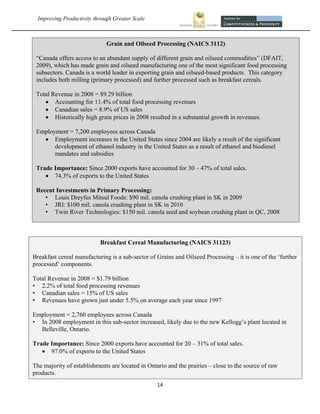
                              Grain and Oilseed Processing (NAICS 3112)

 “Canada offers access to an abundant supply of different grain and oilseed commodities” (DFAIT,
 2009), which has made grain and oilseed manufacturing one of the most significant food processing
 subsectors. Canada is a world leader in exporting grain and oilseed-based products. This category
 includes both milling (primary processed) and further processed such as breakfast cereals.

 Total Revenue in 2008 = $9.29 billion
     Accounting for 11.4% of total food processing revenues
     Canadian sales = 8.9% of US sales
     Historically high grain prices in 2008 resulted in a substantial growth in revenues.

 Employment = 7,200 employees across Canada
    Employment increases in the United States since 2004 are likely a result of the significant
       development of ethanol industry in the United States as a result of ethanol and biodiesel
       mandates and subsidies

 Trade Importance: Since 2000 exports have accounted for 30 – 47% of total sales.
     74.3% of exports to the United States

 Recent Investments in Primary Processing:
    • Louis Dreyfus Mitsul Foods: $90 mil. canola crushing plant in SK in 2009
    • JRI: $100 mil. canola crushing plant in SK in 2010
    • Twin River Technologies: $150 mil. canola seed and soybean crushing plant in QC, 2008


                           Breakfast Cereal Manufacturing (NAICS 31123)

Breakfast cereal manufacturing is a sub-sector of Grains and Oilseed Processing – it is one of the ‘further
processed’ components.

Total Revenue in 2008 = $1.79 billion
• 2.2% of total food processing revenues
• Canadian sales = 15% of US sales
• Revenues have grown just under 5.5% on average each year since 1997

Employment = 2,760 employees across Canada
• In 2008 employment in this sub-sector increased, likely due to the new Kellogg’s plant located in
  Belleville, Ontario.

Trade Importance: Since 2000 exports have accounted for 20 – 31% of total sales.
    97.0% of exports to the United States

The majority of establishments are located in Ontario and the prairies – close to the source of raw
products.
                                                  14 
   
Improving Productivity through Greater Scale                                                         


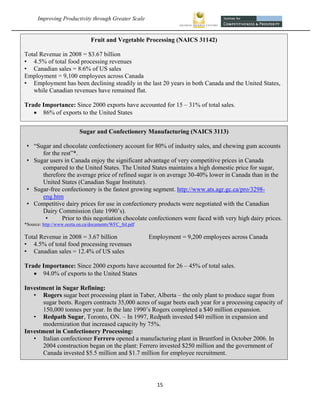
                                Fruit and Vegetable Processing (NAICS 31142)

Total Revenue in 2008 = $3.67 billion
• 4.5% of total food processing revenues
• Canadian sales = 8.6% of US sales
Employment = 9,100 employees across Canada
• Employment has been declining steadily in the last 20 years in both Canada and the United States,
   while Canadian revenues have remained flat.

Trade Importance: Since 2000 exports have accounted for 15 – 31% of total sales.
    86% of exports to the United States


                          Sugar and Confectionery Manufacturing (NAICS 3113)

 • “Sugar and chocolate confectionery account for 80% of industry sales, and chewing gum accounts
      for the rest”*.
 • Sugar users in Canada enjoy the significant advantage of very competitive prices in Canada
      compared to the United States. The United States maintains a high domestic price for sugar,
      therefore the average price of refined sugar is on average 30-40% lower in Canada than in the
      United States (Canadian Sugar Institute).
 • Sugar-free confectionery is the fastest growing segment. http://www.ats.agr.gc.ca/pro/3298-
      eng.htm
 • Competitive dairy prices for use in confectionery products were negotiated with the Canadian
      Dairy Commission (late 1990’s).
       •      Prior to this negotiation chocolate confectioners were faced with very high dairy prices.
*Source: http://www.oceta.on.ca/documents/WFC_fnl.pdf

Total Revenue in 2008 = 3.67 billion                    Employment = 9,200 employees across Canada
• 4.5% of total food processing revenues
• Canadian sales = 12.4% of US sales

Trade Importance: Since 2000 exports have accounted for 26 – 45% of total sales.
    94.0% of exports to the United States

Investment in Sugar Refining:
   • Rogers sugar beet processing plant in Taber, Alberta – the only plant to produce sugar from
      sugar beets. Rogers contracts 35,000 acres of sugar beets each year for a processing capacity of
      150,000 tonnes per year. In the late 1990’s Rogers completed a $40 million expansion.
   • Redpath Sugar, Toronto, ON. – In 1997, Redpath invested $40 million in expansion and
      modernization that increased capacity by 75%.
Investment in Confectionery Processing:
   • Italian confectioner Ferrero opened a manufacturing plant in Brantford in October 2006. In
      2004 construction began on the plant: Ferrero invested $250 million and the government of
      Canada invested $5.5 million and $1.7 million for employee recruitment.


                                                          15 
       
Improving Productivity through Greater Scale                                                       


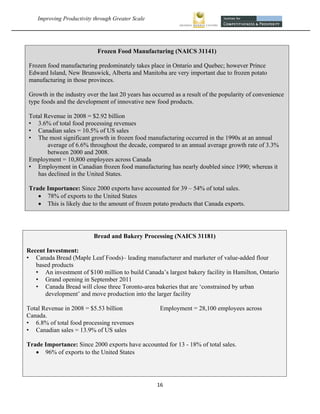
                            Frozen Food Manufacturing (NAICS 31141)

Frozen food manufacturing predominately takes place in Ontario and Quebec; however Prince
Edward Island, New Brunswick, Alberta and Manitoba are very important due to frozen potato
manufacturing in those provinces.

Growth in the industry over the last 20 years has occurred as a result of the popularity of convenience
type foods and the development of innovative new food products.

Total Revenue in 2008 = $2.92 billion
• 3.6% of total food processing revenues
• Canadian sales = 10.5% of US sales
• The most significant growth in frozen food manufacturing occurred in the 1990s at an annual
       average of 6.6% throughout the decade, compared to an annual average growth rate of 3.3%
       between 2000 and 2008.
Employment = 10,800 employees across Canada
• Employment in Canadian frozen food manufacturing has nearly doubled since 1990; whereas it
   has declined in the United States.

Trade Importance: Since 2000 exports have accounted for 39 – 54% of total sales.
    78% of exports to the United States
    This is likely due to the amount of frozen potato products that Canada exports.


                           Bread and Bakery Processing (NAICS 31181)

Recent Investment:
• Canada Bread (Maple Leaf Foods)– leading manufacturer and marketer of value-added flour
   based products
   • An investment of $100 million to build Canada’s largest bakery facility in Hamilton, Ontario
   • Grand opening in September 2011
   • Canada Bread will close three Toronto-area bakeries that are ‘constrained by urban
      development’ and move production into the larger facility

Total Revenue in 2008 = $5.53 billion                Employment = 28,100 employees across
Canada.
• 6.8% of total food processing revenues
• Canadian sales = 13.9% of US sales

Trade Importance: Since 2000 exports have accounted for 13 - 18% of total sales.
    96% of exports to the United States


                                                    16 
     
Improving Productivity through Greater Scale                                                                  


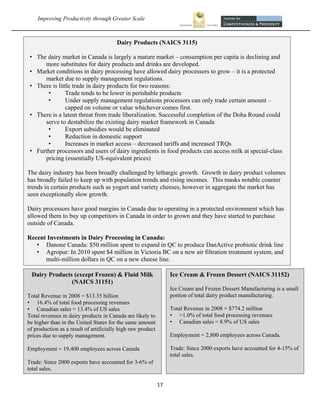
                                        Dairy Products (NAICS 3115)

 • The dairy market in Canada is largely a mature market – consumption per capita is declining and
      more substitutes for dairy products and drinks are developed.
 • Market conditions in dairy processing have allowed dairy processors to grow – it is a protected
      market due to supply management regulations.
 • There is little trade in dairy products for two reasons:
       •        Trade tends to be lower in perishable products
       •        Under supply management regulations processors can only trade certain amount –
                capped on volume or value whichever comes first.
 • There is a latent threat from trade liberalization. Successful completion of the Doha Round could
      serve to destabilize the existing dairy market framework in Canada
       •        Export subsidies would be eliminated
       •        Reduction in domestic support
       •        Increases in market access – decreased tariffs and increased TRQs
 • Further processors and users of dairy ingredients in food products can access milk at special-class
      pricing (essentially US-equivalent prices)

The dairy industry has been broadly challenged by lethargic growth. Growth in dairy product volumes
has broadly failed to keep up with population trends and rising incomes. This masks notable counter
trends in certain products such as yogurt and variety cheeses, however in aggregate the market has
seen exceptionally slow growth.

Dairy processors have good margins in Canada due to operating in a protected environment which has
allowed them to buy up competitors in Canada in order to grown and they have started to purchase
outside of Canada.

Recent Investments in Dairy Processing in Canada:
   • Danone Canada: $50 million spent to expand in QC to produce DanActive probiotic drink line
   • Agropur: In 2010 spent $4 million in Victoria BC on a new air filtration treatment system, and
      multi-million dollars in QC on a new cheese line.

 Dairy Products (except Frozen) & Fluid Milk                       Ice Cream & Frozen Dessert (NAICS 31152)
               (NAICS 31151)
                                                                   Ice Cream and Frozen Dessert Manufacturing is a small
Total Revenue in 2008 = $13.35 billion                             portion of total dairy product manufacturing.
• 16.4% of total food processing revenues
• Canadian sales = 13.4% of US sales                               Total Revenue in 2008 = $774.2 million
Total revenues in dairy products in Canada are likely to           • >1.0% of total food processing revenues
be higher than in the United States for the same amount            • Canadian sales = 8.9% of US sales
of production as a result of artificially high raw product
prices due to supply management.                                   Employment = 2,800 employees across Canada.

Employment = 19,400 employees across Canada                        Trade: Since 2000 exports have accounted for 4-15% of
                                                                   total sales.
Trade: Since 2000 exports have accounted for 3-6% of
total sales.

                                                             17 
     
Improving Productivity through Greater Scale                                                         


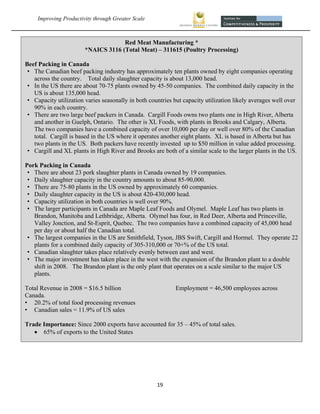
                                     Poultry Processing (NAICS 311615)

•   Ontario and Quebec dominate chicken and turkey production
•   There are over 50 federally inspected chicken and turkey plants of which over 30 are in Ontario and
    Quebec. Those 50 plants are operated by about 40 individual companies.
•   The largest companies in Canada are Maple Leaf, Olymel, Maple Lodge, Lilydale and Exceldor. These
    companies have approximately 60% of the broiler market in Canada.
•   Canada slaughters about 12 million chickens per week. The average slaughter per plant is about 450,000
    per week. The largest plants might slaughter up to 800,000 head.

•   In the US the industry is located primarily in the Southeast.
•   There are approximately 40 major broiler processing companies in the US. These companies slaughter
    about 160 million birds per week.
•   The largest broiler processors in the US are Pilgrim’s Pride (JBS), Tyson, Perdue, Sanderson and Wayne.
    These five largest firms have about 60% of the market share. Tyson and Pilgrim’s have about 40%. The
    two largest companies slaughter about 32 million birds per week. A typical plant of these larger firms
    might slaughter approximately 1 million birds per week.
•   The industry in Canada has been challenged by over capacity.
•   The plant sizes in Canada are relatively small compared to those in the US.

Total Revenue in 2008 = $6.1 billion                        Employment = 21,500 employees across Canada.
• 7.5% of total food processing revenues
• Canadian sales = 10.4% of US sales

Trade: Since 2000 exports have accounted for 3 – 6% of total sales.
    Exports to the US account for only 58% of total export – likely because exports in poultry are cuts that
       Canadians do not want or eat, cuts that the US likely does not eat also.


                             Seafood Packaging and Processing (NAICS 3117)

The Canadian seafood processing industry is a significant global player – with over 70% of total revenues
being exported to over 80 countries world-wide – mainly to the United States, followed by China and Japan.

Total Revenue in 2008 = $3.93 billion: sales have been relatively flat since 1990.
• 4.8% of total food processing revenues
• Canadian sales = 35.2% of US sales: Seafood processing is a proportionately large sector compared to its US
          counterpart.
•      Employment = 27,600 employees across Canada.


Trade Importance: Since 2000 exports have accounted for 69-78% of total sales.
    55% of exports to the United States


                                                       18 
       
Improving Productivity through Greater Scale                                                        


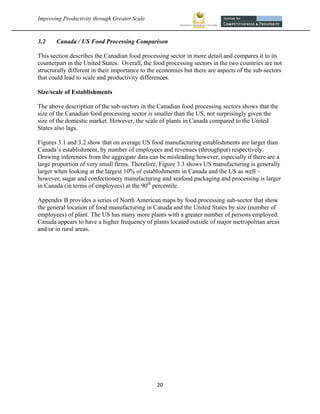
                                     Red Meat Manufacturing *
                        *NAICS 3116 (Total Meat) – 311615 (Poultry Processing)

Beef Packing in Canada
 • The Canadian beef packing industry has approximately ten plants owned by eight companies operating
   across the country. Total daily slaughter capacity is about 13,000 head.
 • In the US there are about 70-75 plants owned by 45-50 companies. The combined daily capacity in the
   US is about 135,000 head.
 • Capacity utilization varies seasonally in both countries but capacity utilization likely averages well over
   90% in each country.
 • There are two large beef packers in Canada. Cargill Foods owns two plants one in High River, Alberta
   and another in Guelph, Ontario. The other is XL Foods, with plants in Brooks and Calgary, Alberta.
   The two companies have a combined capacity of over 10,000 per day or well over 80% of the Canadian
   total. Cargill is based in the US where it operates another eight plants. XL is based in Alberta but has
   two plants in the US. Both packers have recently invested up to $50 million in value added processing.
 • Cargill and XL plants in High River and Brooks are both of a similar scale to the larger plants in the US.

Pork Packing in Canada
 • There are about 23 pork slaughter plants in Canada owned by 19 companies.
 • Daily slaughter capacity in the country amounts to about 85-90,000.
 • There are 75-80 plants in the US owned by approximately 60 companies.
 • Daily slaughter capacity in the US is about 420-430,000 head.
 • Capacity utilization in both countries is well over 90%.
 • The larger participants in Canada are Maple Leaf Foods and Olymel. Maple Leaf has two plants in
   Brandon, Manitoba and Lethbridge, Alberta. Olymel has four, in Red Deer, Alberta and Princeville,
   Valley Jonction, and St-Esprit, Quebec. The two companies have a combined capacity of 45,000 head
   per day or about half the Canadian total.
 • The largest companies in the US are Smithfield, Tyson, JBS Swift, Cargill and Hormel. They operate 22
   plants for a combined daily capacity of 305-310,000 or 70+% of the US total.
 • Canadian slaughter takes place relatively evenly between east and west.
 • The major investment has taken place in the west with the expansion of the Brandon plant to a double
   shift in 2008. The Brandon plant is the only plant that operates on a scale similar to the major US
   plants.

Total Revenue in 2008 = $16.5 billion                       Employment = 46,500 employees across
Canada.
• 20.2% of total food processing revenues
• Canadian sales = 11.9% of US sales

Trade Importance: Since 2000 exports have accounted for 35 – 45% of total sales.
    65% of exports to the United States


                                                     19 
      
Improving Productivity through Greater Scale                                                            


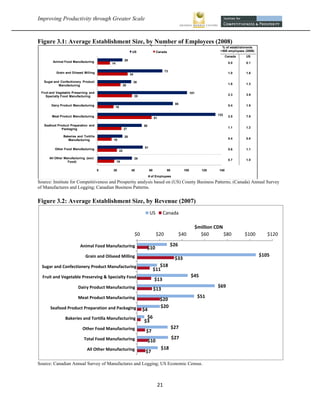
3.2    Canada / US Food Processing Comparison

This section describes the Canadian food processing sector in more detail and compares it to its
counterpart in the United States. Overall, the food processing sectors in the two countries are not
structurally different in their importance to the economies but there are aspects of the sub-sectors
that could lead to scale and productivity differences.

Size/scale of Establishments

The above description of the sub-sectors in the Canadian food processing sectors shows that the
size of the Canadian food processing sector is smaller than the US, not surprisingly given the
size of the domestic market. However, the scale of plants in Canada compared to the United
States also lags.

Figures 3.1 and 3.2 show that on average US food manufacturing establishments are larger than
Canada’s establishment, by number of employees and revenues (throughput) respectively.
Drawing inferences from the aggregate data can be misleading however, especially if there are a
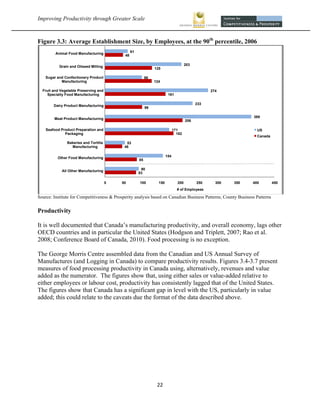
large proportion of very small firms. Therefore, Figure 3.3 shows US manufacturing is generally
larger when looking at the largest 10% of establishments in Canada and the US as well –
however, sugar and confectionery manufacturing and seafood packaging and processing is larger
in Canada (in terms of employees) at the 90th percentile.

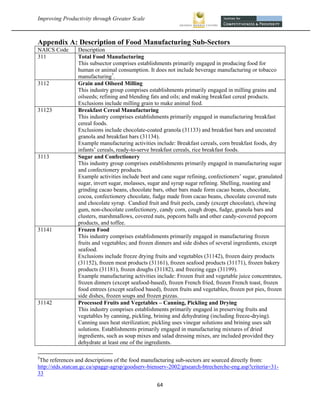
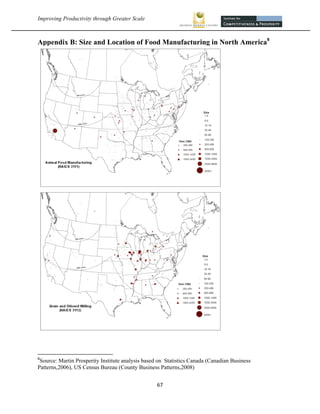
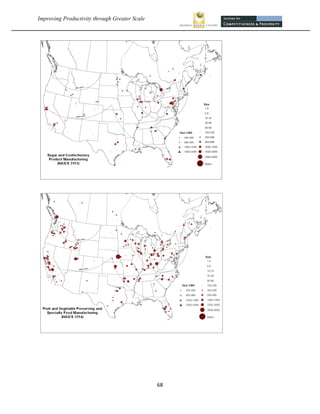
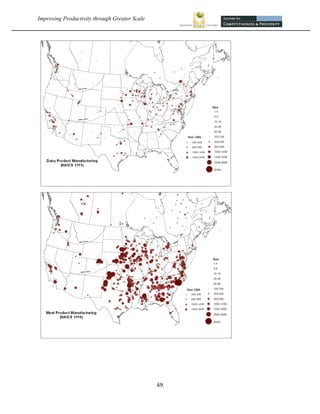
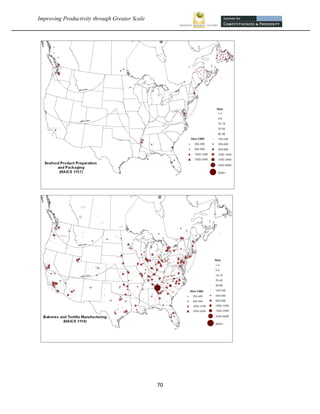
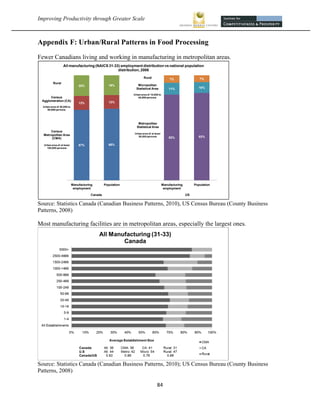
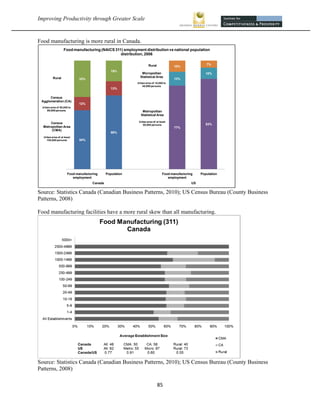
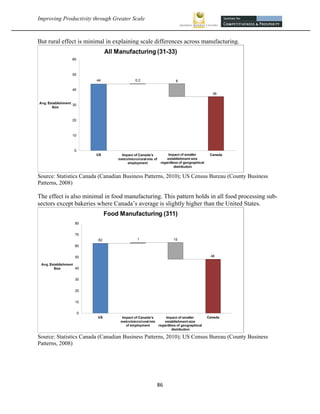
Appendix B provides a series of North American maps by food processing sub-sector that show
the general location of food manufacturing in Canada and the United States by size (number of
employees) of plant. The US has many more plants with a greater number of persons employed.
Canada appears to have a higher frequency of plants located outside of major metropolitan areas
and/or in rural areas.


                                                20 
 
Improving Productivity through Greater Scale                                                                                                                         


Figure 3.1: Average Establishment Size, by Number of Employees (2008)
                                         (   )
                                                                                                                                   % of establishments
                                                                    US                   Canada                                   >500 employees (2006)
                                                                                                                                       Canada    US
           Animal Food Manufacturing                          28
                                              14                                                                                        0.0       0.1


             Grain and Oilseed Milling                                                           73
                                                                   34                                                                   1.0       1.6

     Sugar and Confectionery Product                                    38
              Manufacturing                                  26                                                                         1.8       1.3

    Fruit and Vegetable Preserving and                                                                              101
       Specialty Food Manufacturing                                     39                                                              2.3       3.9


          Dairy Product Manufacturing                                                                   85
                                                   18                                                                                   0.4       1.9


          Meat Product Manufacturing                                                                                             133
                                                                                        61                                              2.5       7.9

     Seafood Product Preparation and                                         50
                Packaging                                    27                                                                         1.1       1.2

                  Bakeries and Tortilla                       28
                     Manufacturing             16                                                                                       0.4       0.8


            Other Food Manufacturing                                          51
                                                        22                                                                              0.6       1.1

         All Other Manufacturing (excl.                                 39                                                              0.7       1.0
                     Food)                         19

                                          0   20                   40              60             80          100          120   140
                                                                                  # of Employees
Source: Institute for Competitiveness and Prosperity analysis based on (US) County Business Patterns; (Canada) Annual Survey
of Manufactures and Logging; Canadian Business Patterns.


Figure 3.2: Average Establishment Size, by Revenue (2007)
                                                                                   US            Canada

                                                                                                                      $million CDN
                                                                        $0               $20                $40         $60        $80           $100        $120

                             Animal Food Manufacturing                                                $26
                                                                               $10
                                Grain and Oilseed Milling                                                                                                 $105
                                                                                                        $33
    Sugar and Confectionery Product Manufacturing                                          $18
                                                                                        $11
    Fruit and Vegetable Preserving & Specialty Food…                                                                $45
                                                                                        $13
                            Dairy Product Manufacturing                                                                          $69 
                                                                                        $13
                            Meat Product Manufacturing                                                                    $51
                                                                                             $20
         Seafood Product Preparation and Packaging                                           $20
                                                                             $4
                   Bakeries and Tortilla Manufacturing                         $6
                                                                              $3
                               Other Food Manufacturing                                                $27
                                                                              $7
                                Total Food Manufacturing                                               $27
                                                                                  $10
                                  All Other Manufacturing                                    $18
                                                                              $7

Source: Canadian Annual Survey of Manufactures and Logging; US Economic Census.


                                                                                         21 
 
Improving Productivity through Greater Scale                                                                                         


Figure 3.3: Average Establishment Size, by Employees, at the 90th percentile, 2006
                                                    61
           Animal Food Manufacturing
                                               48


             Grain and Oilseed Milling                                                   203
                                                                   125

     Sugar and Confectionery Product                          98
             Manufacturing                                         124

    Fruit and Vegetable Preserving and                                                               274
       Specialty Food Manufacturing                                         161


          Dairy Product Manufacturing                                                          233
                                                              99


          Meat Product Manufacturing                                                                               389
                                                                                         206

     Seafood Product Preparation and                                             171                                 US
               Packaging                                                           182
                                                                                                                     Canada
                 Bakeries and Tortilla          53
                   Manufacturing               46


            Other Food Manufacturing                                       154
                                                         85


              All Other Manufacturing                     90
                                                         83

                                          0   50         100         150           200         250     300   350   400        450
                                                                                   # of Employees

Source: Institute for Competitiveness & Prosperity analysis based on Canadian Business Patterns; County Business Patterns


Productivity

It is well documented that Canada’s manufacturing productivity, and overall economy, lags other
OECD countries and in particular the United States (Hodgson and Triplett, 2007; Rao et al.
2008; Conference Board of Canada, 2010). Food processing is no exception.

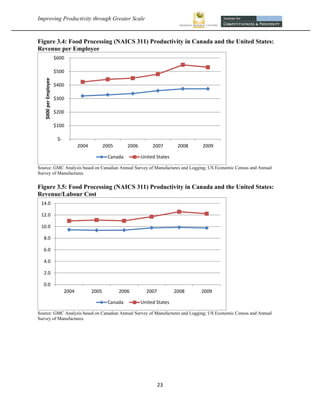
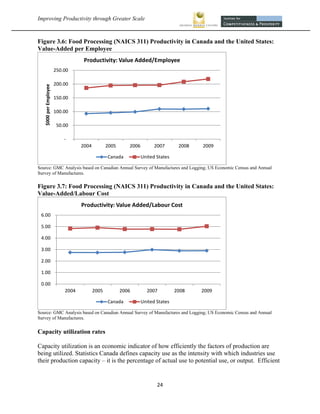
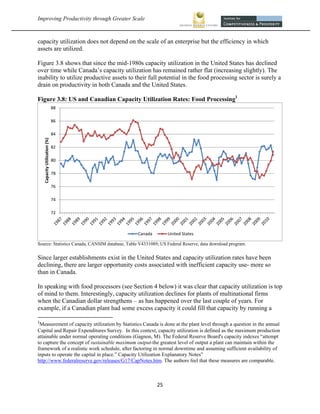
The George Morris Centre assembled data from the Canadian and US Annual Survey of
Manufactures (and Logging in Canada) to compare productivity results. Figures 3.4-3.7 present
measures of food processing productivity in Canada using, alternatively, revenues and value
added as the numerator. The figures show that, using either sales or value-added relative to
either employees or labour cost, productivity has consistently lagged that of the United States.
The figures show that Canada has a significant gap in level with the US, particularly in value
added; this could relate to the caveats due the format of the data described above.


                                                                    22 
 
Improving Productivity through Greater Scale                                                                       


Figure 3.4: Food Processing (NAICS 311) Productivity in Canada and the United States:
Revenue per Employee
                          $600

                          $500
     $000 per Employee


                          $400

                          $300

                          $200

                          $100

                           $‐
                                       2004          2005      2006        2007        2008   2009

                                                      Canada          United States

Source: GMC Analysis based on Canadian Annual Survey of Manufactures and Logging; US Economic Census and Annual
Survey of Manufactures.


Figure 3.5: Food Processing (NAICS 311) Productivity in Canada and the United States:
Revenue/Labour Cost
    14.0

    12.0

    10.0

     8.0

     6.0

     4.0

     2.0

     0.0
                                2004          2005          2006        2007          2008    2009

                                                      Canada          United States

Source: GMC Analysis based on Canadian Annual Survey of Manufactures and Logging; US Economic Census and Annual
Survey of Manufactures.


                                                                               23 
 
Improving Productivity through Greater Scale                                                                       


Figure 3.6: Food Processing (NAICS 311) Productivity in Canada and the United States:
Value-Added per Employee
                                      Productivity: Value Added/Employee
                          250.00

                          200.00
     $000 per Employee


                          150.00

                          100.00

                           50.00

                              ‐
                                     2004          2005      2006         2007       2008   2009

                                                   Canada           United States

Source: GMC Analysis based on Canadian Annual Survey of Manufactures and Logging; US Economic Census and Annual
Survey of Manufactures.

Figure 3.7: Food Processing (NAICS 311) Productivity in Canada and the United States:
Value-Added/Labour Cost
                                     Productivity: Value Added/Labour Cost
    6.00

    5.00

    4.00

    3.00

    2.00

    1.00

    0.00
                              2004          2005          2006        2007          2008    2009

                                                   Canada           United States

Source: GMC Analysis based on Canadian Annual Survey of Manufactures and Logging; US Economic Census and Annual
Survey of Manufactures.


Capacity utilization rates

Capacity utilization is an economic indicator of how efficiently the factors of production are
being utilized. Statistics Canada defines capacity use as the intensity with which industries use
their production capacity – it is the percentage of actual use to potential use, or output. Efficient


                                                                           24 
 
Improving Productivity through Greater Scale                                                                             


capacity utilization does not depend on the scale of an enterprise but the efficiency in which
assets are utilized.

Figure 3.8 shows that since the mid-1980s capacity utilization in the United States has declined
over time while Canada’s capacity utilization has remained rather flat (increasing slightly). The
inability to utilize productive assets to their full potential in the food processing sector is surely a
drain on productivity in both Canada and the United States.

Figure 3.8: US and Canadian Capacity Utilization Rates: Food Processing1
                                88

                                86

                                84
     Capacity Utilization (%)


                                82

                                80

                                78

                                76

                                74

                                72


                                                               Canada         United States

Source: Statistics Canada, CANSIM database, Table V4331089; US Federal Reserve, data download program.


Since larger establishments exist in the United States and capacity utilization rates have been
declining, there are larger opportunity costs associated with inefficient capacity use- more so
than in Canada.

In speaking with food processors (see Section 4 below) it was clear that capacity utilization is top
of mind to them. Interestingly, capacity utilization declines for plants of multinational firms
when the Canadian dollar strengthens – as has happened over the last couple of years. For
example, if a Canadian plant had some excess capacity it could fill that capacity by running a
                                                            
1
 Measurement of capacity utilization by Statistics Canada is done at the plant level through a question in the annual
Capital and Repair Expenditures Survey. In this context, capacity utilization is defined as the maximum production
attainable under normal operating conditions (Gagnon, M). The Federal Reserve Board's capacity indexes “attempt
to capture the concept of sustainable maximum output-the greatest level of output a plant can maintain within the
framework of a realistic work schedule, after factoring in normal downtime and assuming sufficient availability of
inputs to operate the capital in place.” Capacity Utilization Explanatory Notes”
http://www.federalreserve.gov/releases/G17/CapNotes.htm. The authors feel that these measures are comparable.


                                                                        25 
 
Improving Productivity through Greater Scale                                                           


short-line (niche product) for the US market. However, when the dollar strengthened, that
production becomes uneconomical resulting in that production moving to a plant in the US.

The Effect of Scale on Productivity

The above suggests that Canadian food manufacturing establishments lack scale compared to
their US counterparts and are lagging in terms of productivity, but not capacity utilization. Our
findings from the literature review in Section 2 would suggest that they are related and that
productivity generally increases with scale, and with effective capacity utilization.

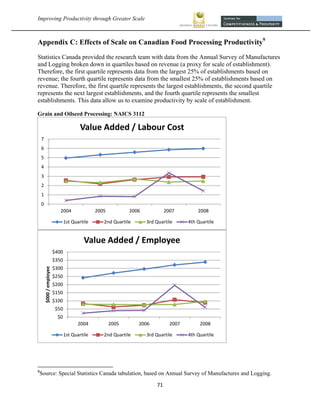
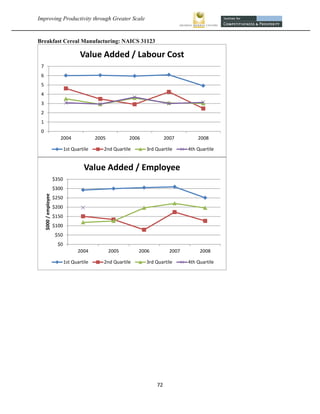
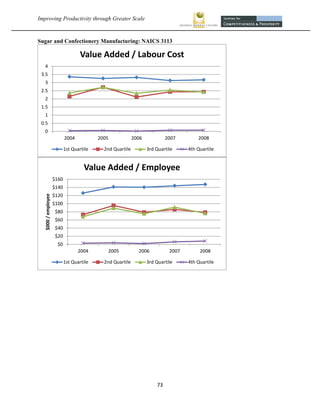
The following two figures show that productivity does indeed improve with scale in Canadian
food processing. Statistics Canada conducted a special tabulation using the Annual Survey of
Manufactures and Logging data to breakdown the aggregate data into quartiles, based on
revenue, so that we could examine whether productivity improved with scale, as indicated by
sales.

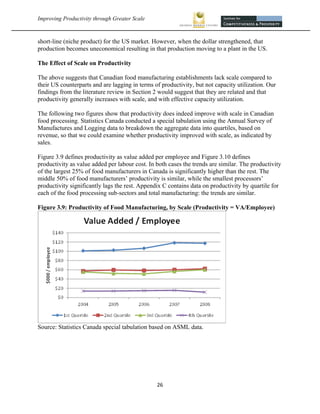
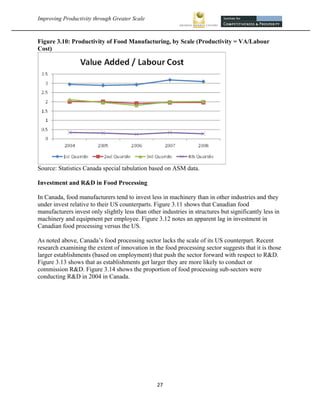
Figure 3.9 defines productivity as value added per employee and Figure 3.10 defines
productivity as value added per labour cost. In both cases the trends are similar. The productivity
of the largest 25% of food manufacturers in Canada is significantly higher than the rest. The
middle 50% of food manufacturers’ productivity is similar, while the smallest processors’
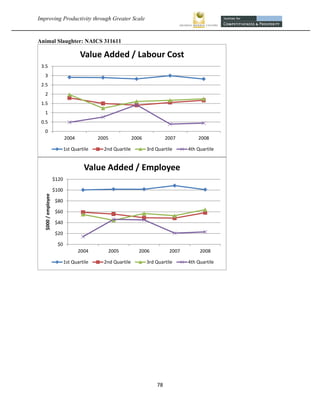
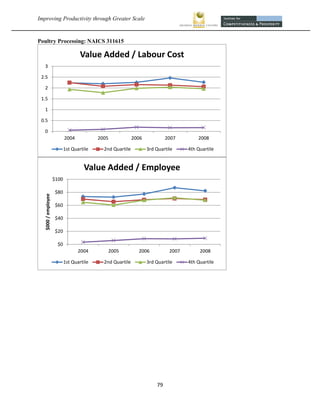
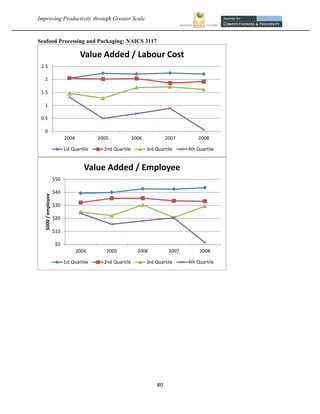
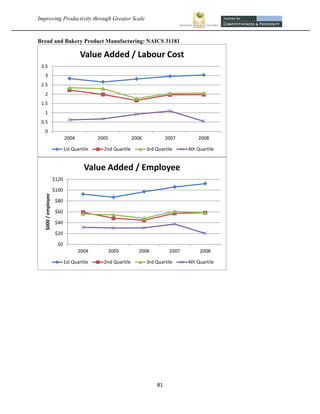
productivity significantly lags the rest. Appendix C contains data on productivity by quartile for
each of the food processing sub-sectors and total manufacturing: the trends are similar.

Figure 3.9: Productivity of Food Manufacturing, by Scale (Productivity = VA/Employee)


Source: Statistics Canada special tabulation based on ASML data.


                                                26 
 
Improving Productivity through Greater Scale                                                             


Figure 3.10: Productivity of Food Manufacturing, by Scale (Productivity = VA/Labour
Cost)


Source: Statistics Canada special tabulation based on ASM data.

Investment and R&D in Food Processing

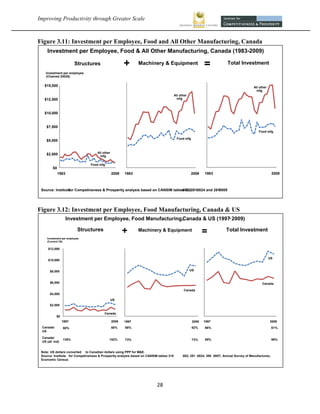
In Canada, food manufacturers tend to invest less in machinery than in other industries and they
under invest relative to their US counterparts. Figure 3.11 shows that Canadian food
manufacturers invest only slightly less than other industries in structures but significantly less in
machinery and equipment per employee. Figure 3.12 notes an apparent lag in investment in
Canadian food processing versus the US.

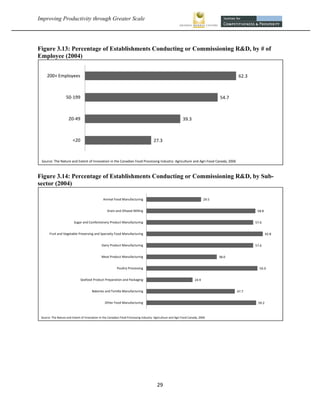
As noted above, Canada’s food processing sector lacks the scale of its US counterpart. Recent
research examining the extent of innovation in the food processing sector suggests that it is those
larger establishments (based on employment) that push the sector forward with respect to R&D.
Figure 3.13 shows that as establishments get larger they are more likely to conduct or
commission R&D. Figure 3.14 shows the proportion of food processing sub-sectors were
conducting R&D in 2004 in Canada.


                                                 27 
 
Improving Productivity through Greater Scale                                                                                                                             


Figure 3.11: Investment per Employee, Food and All Other Manufacturing, Canada
       Investment per Employee, Food & All Other Manufacturing, Canada (1983  2009)
                                                                            -

                                 Structures                                +      Machinery & Equipment            =             Total Investment
       Investment per employee             
       (Chained 2002$)


      $15,000                                                                                                                                      All other
                                                                                                                                                     mfg
                                                                                               All other
      $12,500                                                                                    mfg


      $10,000


       $7,500 
                                                                                                                                                      Food mfg

       $5,000 
                                                                                                 Food mfg


       $2,500                                    All other
                                                   mfg

                                              Food mfg
           $0
                1983                                         2009          1983                            2009    1983                                          2009


    Source: Institute  Competiveness & Prosperity analysis based on CANSIM tables 310281
                    for                                                         -002,  -0024 and 281
                                                                                                   -0005


Figure 3.12: Investment per Employee, Food Manufacturing, Canada & US
                           Investment per Employee, Food Manufacturing,Canada & US (1997  2009)
                                                                                        -

                                  Structures                               +      Machinery & Equipment
                                                                                                                   =            Total Investment
       Investment per employee     
       (Current C$)     
        $12,000


                                                                                                                                                               US
        $10,000


         $8,000                                                                                            US


         $6,000                                                                                                                                         Canada

                                                                                                      Canada
         $4,000
                                                             US
         $2,000

                                                      Canada       
              $0    
                       1997                                  2009          1997                             2009   1997                                        2009
    Canada/            60%                                   60%           68%                              62%    66%                                           61%
    US

    Canada/
           
    US (all ind)
                       135%                              152%              73%                              73%    89%                                           99%


    Note: US dollars converted to Canadian dollars using PPP for M&E.
    Source: Institute for Competiveness & Prosperity analysis based on CANSIM tables 310            -002, 281 -0024, 380 -0057; Annual Survey of Manufactures;
    Economic Census


                                                                                         28 
 
Improving Productivity through Greater Scale                                                                                                                         


Figure 3.13: Percentage of Establishments Conducting or Commissioning R&D, by # of
Employee (2004)


        200+ Employees                                                                                                                        62.3


                      50‐199                                                                                                          54.7


                        20‐49                                                                                  39.3


                           <20                                                           27.3


    Source: The Nature and Extent of Innovation in the Canadian Food Processing Industry: Agriculture and Agri‐Food Canada, 2006


Figure 3.14: Percentage of Establishments Conducting or Commissioning R&D, by Sub-
sector (2004)

                                                   Animal Food Manufacturing                                                   29.5


                                                      Grain and Oilseed Milling                                                                       58.8


                            Sugar and Confectionery Product Manufacturing                                                                            57.6


          Fruit and Vegetable Preserving and Specialty Food Manufacturing                                                                                    62.8


                                                 Dairy Product Manufacturing                                                                         57.6


                                                 Meat Product Manufacturing                                                           38.0


                                                             Poultry Processing                                                                        59.9


                                 Seafood Product Preparation and Packaging                                              24.9


                                          Bakeries and Tortilla Manufacturing                                                                47.7


                                                    Other Food Manufacturing                                                                          59.2


    Source: The Nature and Extent of Innovation in the Canadian Food Processing Industry: Agriculture and Agri‐Food Canada, 2006


                                                                                           29 
 
Improving Productivity through Greater Scale                                                         


3.3    Observations

The above puts some metrics on the previous findings and observations from Section 2. It also
presents some challenges to Canadian food manufacturing that relate to scale. Canada has
smaller food processing firms than the US, even when comparing the largest establishments in
both countries. Productivity in Canadian food processing lags that in the US; acknowledging the
caveats with the ASM data noted in Section 2, this was a robust finding in the sense that it was
consistent using alternative data (revenue vs. value-added) and alternative measures (relative to
employees or relative to labour costs). Canada also lags the US in capacity utilization in food
manufacturing. Finally, Canadian food manufacturers appear to have lower investment rates
compared with other manufacturers in Canada, and compared with US food processors.

The Centre for the Study of Living Standards recently conducted a study that considered
productivity in Canadian food manufacturing (Ross, 2011). The study estimated labour
productivity and multifactor productivity in Canadian food manufacturing and food
manufacturing subsectors. The data were drawn from Canadian Productivity Accounts. The
results showed that labour productivity, based on real GDP, in Canadian food manufacturing
grew at a compound rate of about 2.8% per year between 2000 and 2009. Food manufacturing
labour productivity in 2009 (expressed in 2002 dollars) was $48.75/hour worked. Extending this
to an annual per worker measure, based on a 40 hour week and 52 weeks per year, GDP per
worker (in 2002 dollars) is about $101,400. This compares favorably with the labour
productivity results estimated in this study which ranged just over $100,000/worker,
acknowledging the differences due to nominal versus deflated data. The study also compared
estimated productivity growth in Canada versus the US, based on indices from the US Bureau of
Labor Statistics. The comparison showed that Canada had a higher productivity growth rate than
the US, but that this mostly occurred between 1987 and 2000. Comparisons of labour
productivity levels were not made, but the study acknowledged that Canadian food
manufacturing generally has a lower output per worker than its US counterpart.

The following sections attempt to uncover what may be occurring to drive these results.


                                                30 
 
Improving Productivity through Greater Scale                                                            


4.     Firm-level Analysis of the Importance of Scale in Achieving Productivity

To understand better the effects and implication of scale on productivity, a range of food
processing firms were interviewed. In the interviews, questions were posed relating to the scale
of processing plants and the overall scale of firms, and how this influenced firm operations and
returns, and what factors limited scale. The interview guide that was sent to participants in
advance is presented in Appendix D.

In all, 15 interviews with food processors occurred, across a broad range of products including
red meats, poultry, dairy, grain and oilseed processing, vegetable processing, and
prepared/packaged foods. In all cases, the interviews were conducted with firm CEOs or
members of the senior management team, mostly by telephone. The sections below summarize
the discussions and put them in context.

4.1    Plant Size/Scale and Efficiencies

Nature and Rationale for Plant Size

Discussions with processors revealed a range of rationales for a given plant size and
determinants of efficiency relative to a given plant size. The most significant determinants of
plant size tended to be the availability of local supply of farm product procured by a plant, and
the market size that the plant serves. The availability of local supply was perceived as very
important in establishing the scale of plants in which the value of the farm product was a high
proportion of the ultimate food product. In such contexts (primary grain handling, livestock
slaughter, etc.) full use of plant capacity was seen as especially significant in a firm being
competitive in procurement of the raw farm product.

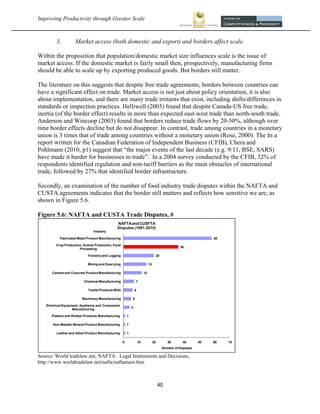
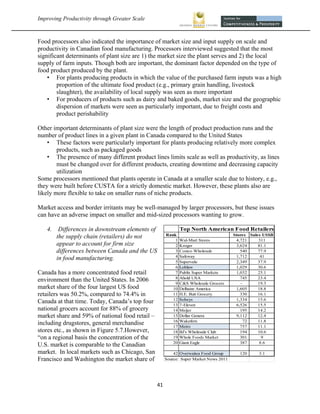
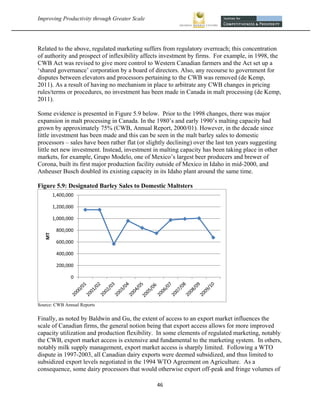
In other products, the size of the market being served was seen as the critical determinant of size.
Individual plants did not significantly exceed the size of the market they served for reasons such
as freight cost and product perishability. Dairy and bakery products were examples of these
cases. Thus, in these product categories, market size and geographic dispersion of markets is the
critical determinant of plant size.

In a final category of products typified by packaged foods, plant size and efficiency were limited
by the length of product production runs. The more specialized a plant is, the greater the
economies associated with scale. In plants that manufacture many different products, the same
economies associated with scale are not attainable as production lines must frequently be
changed over for different products, creating downtime and decreasing capacity utilization.
In understanding the advantages of size/scale, some disadvantages with very large plants were
identified. First, compared with a portfolio of smaller plants, there is additional risk from
breakdowns and other contingencies in a single very large plant. There can also be greater risks
associated with interruptions in services or logistical links to large plants versus a comparable
network of smaller plants. Finally, some plants operate at a relatively small scale due to history
(for example, because they were built before CUSTA for a strictly domestic market), or because
increasing their scale would imply shifting of volume away from a large plant somewhere else-


                                                31 
 
Improving Productivity through Greater Scale                                                             


with the efficiency gain in the small plant more than offset by the corresponding loss in
efficiency in the other plant.

Differences in Performance Attributable to Plant Size

In many cases, clear differences in plant performance could be attributed to size. One
respondent made reference to a plant that was double the capacity of another, and operated at a
25% lower unit cost as a result. The major source of this unit cost advantage was spreading of
overhead costs- especially management and labour cost. There can also be important advantages
in facilitating use of faster production lines, greater specialization in staff and on-site services,
and improved energy efficiency. These appeared to be more significant the more specialized the
plant was. In other cases, investment in technology could overcome many of the disadvantages
in scale associated with smaller plants.

Capital Access, Technology, and Plant Size

Access to capital was not broadly seen as a determinant of plant size; for most firms interviewed
limits to capital access did not influence plant size. Rather, the capital access issues existed
within the companies themselves in the form of rate of return targets that a plant investment
would be held to. In this regard, proponents of plant investments must compete with other
projects within a company for capital. Related to this there was a sense that government capital
grants could be quite influential in stimulating investment and attaining more efficient scale.

Technology was not seen as limiting scale developments in Canada as plant technologies were
observed as being widely available, and even ubiquitous. Some interviewees felt that
technologies in Canada were priced higher than elsewhere, but this was not a consistently held
view. The most significant advances in technology recently observed have been in energy
efficiency in plants.

4.2    Firm Size/Scale and Efficiencies

Marketing Functions

There was a connection observed between large processing firms and large customers (retailers,
distributors) such that large processors are better positioned to supply large customers. This
relates to the consolidated nature of the processed food distribution network; for example, in
grocery retailing the top three firms account for about 70% of the volume. Firms need to be
capable of supplying a threshold volume in order to penetrate this network. In addition, the fees
associated with product listing are relatively high in Canada. In this respect, large firms can
supply large customers as well as smaller firm but the opposite is not true- small processing
firms struggle in attempting to supply large customers. As such, the size/scale of a processor
provides market access.

A range of advantages were observed for large firms in marketing. Larger firms were observed
as being better positioned to marshal an in-house dedicated sales force to promote and market its
products. This is essentially driven by the ability to spread selling costs over a larger volume of

                                                 32 
 
Improving Productivity through Greater Scale                                                             


product. Similarly, larger firms are better able to support logistics support and export promotion
activities. Larger firms were seen as better able to accommodate in-house research and
development, and support the development of brands. Finally, large firms with multi-plant
locations have advantages in unit cost and reduced risk from being able to serve customers from
multiple locations.

Firm Scale and Human Resources

There were advantages seen in working with a workforce in larger firms. Larger firms were seen
as having an advantage in recruitment and retention of employees due to the upward mobility
they could offer and the ability to train in-house. Greater ability to specialize was also seen as an
advantage, as well as greater flexibility in work hours and work absence for employees. The
above are all elements of the ability to spread human resource costs over larger volumes. Some
interviewees felt that obtaining advantages in human resources (along with improved scale) in
Canada was quite critical, as labour rates in Canada were much higher than what was observed in
the US. There was also an admission that large firms can be slow to adapt and that a proactive
corporate culture in larger firms was needed to mitigate this.

Firm Scale Relative to Distribution Chain

The scale of processing firms was observed to relate to the scale of the distribution change in
several elements. Regulatory requirements, some of which occur downstream, tend to drive
scale in processing in order to reduce unit costs. Processing firm scale cannot be out of scope
versus the scale of customer/downstream segments, particularly in packaged food products.
However, particularly in commodity products, the scale of downstream segments was not seen as
a binding constraint.

Larger scale was also seen as being demanding in managing logistics through the distribution
chain, as there is more scope for errors, etc. This can create additional costs. Particularly in
packaged food products, Canadian plants were seen as being built on a model in which
individual plants produce a range of products and move them through the distribution chain- this
carries the implication of greater flexibility in manufacturing, but with corresponding loss in
scale and higher unit costs compared with more specialized plants.

Firm Scale and Supply/Service Procurement

Firms operating at a large scale were seen as being better able to leverage terms with suppliers of
inputs and with input suppliers. This in turn could be leveraged into partnerships and more
intimate relationships with suppliers. Conversely, there were some observations that suppliers
had themselves consolidated and that scale in processing was important in managing
procurement relationships in bargaining with suppliers. At the same time, it was observed that
with scale the need to operate effectively at capacity was increased, necessitating reliable
relationships with suppliers.

Firm Scale and Regulatory Requirements


                                                 33 
 
Improving Productivity through Greater Scale                                                             


Firms that purchased farm products covered by marketing regulations, especially supply
management, tended to see them as a limit on firm scale, and a disincentive to investment.
Several firms mentioned the mechanisms of allocation of farm products across processing plants
in a province as a strong limit on scale, and felt that the means of relating national quotas to the
provincial level had a contributing effect in limiting scale. Another firm saw the international
rules on Canadian supply management as sharply limiting on product exports. With regard to
western grains, regulatory limits on the availability of rail cars across facilities was seen as
limiting to scale. There was also a sense among some of the processors interviewed that
regulated marketing focused excessively on farm product pricing, to the detriment of other
elements of procurement such as product quality and delivery, and generally removed
transparency in the procurement process.

With regard to product/processing regulatory standards, larger firms were seen as better
positioned to cover the costs of regulatory compliance compared with smaller firms. There was
also a sense that Canada was lagging the US in terms of the ability to get regulatory approval for
product claims.

Firm Scale in Canada vs. US

Firms that were more oriented toward commodity businesses generally felt that their scale of
operation would not change if the firm moved to the US. The more consumer-oriented and
packaged foods firms did perceive that they would operate a larger scale if they were based in
the US. This was because the size and density of customers in the US would increase the
investment opportunity and allow greater specialization in plants versus Canadian plants which
are multi-product in nature. Some other firms observed that there was an opportunity for much
greater growth in a less regulated environment in the US, and that governments in Canada tend
to support development of smaller firms at the expense of larger firms.

4.3    Observations

The above suggests the following. The scale of plants and resulting unit costs were viewed as
being among the most important factors in firm competitiveness, especially in plants that
specialized in a narrow set of products. Related to this, effective utilization of capacity in plants
was viewed as critical in realizing the benefits of scale. Lack of efficient plant scale was
observed as placing pressure on a company’s human resources, technology, and marketing
elements. Overall, the main sources of advantage with size/scale were viewed as:
      Spreading of plant overhead costs over increasing volume
      Procurement of supplies
      Improved labour efficiency
      Exploiting non-linear relationship between plant output, labour cost, and transportation
         cost

Large firms have advantages in better being able to carry the costs of a dedicated sales force,
human resource management, research and development, and brand development. They also
appear to have distinct advantages in developing human resources within the firm, although large
firms can also be slow and resistant to change. Large firms both shape and are shaped by their

                                                 34 
 
Improving Productivity through Greater Scale                                                            


distribution supplier and distribution chains. While larger firms are better able to handle the
costs of regulatory requirements, marketing regulations can limit the extent to which they
achieve size economies.

While limited in scope, the survey suggests the following view of Canadian food processing.
For firms specialized in more commodity-oriented products for which the farm product value is a
significant proportion of the final product, there was greater evidence of size/scale economies,
and that these were being attained (example sub-sectors that fit this include red meat, frozen
potato products and canola crushing). In other products, the size of the market was limiting
scale- either because the size/density of the market vs. product perishability and transport cost of
the product implied it, or because Canadian plants were multi-product in nature, and the resulting
changeover and downtime effectively limited scale. There was also a sense that the elements of
marketing regulations impacted efficiency of scale.


                                                35 
 
Improving Productivity through Greater Scale                                                           


5.       What is affecting Scale in Canadian Food Processing?

This section examines whether a range of plausible factors might help explain the observed scale
of the sector (or in other words investment into the sector that would lead to scale) and therefore
impact productivity. The following propositions were considered as prospective influencers of
Canadian food processing scale and productivity:
     Factor conditions
     Industrial Policy
     Investment conditions
     Tax and regulatory environment

The following sections articulate propositions regarding these in detail, and then provide analysis
and context around them.

5.1      Factor Conditions

      1. The data show that Canadian manufacturers are generally sub-scale compared to their
         US counterparts; food processing in no exception.

Figures 5.1 and 5.2 show that Canadian manufacturers have smaller scale facilities compared to
their US counterparts – whether scale is measured, by number of employees or throughput
(revenue). Figures 5.3 and 5.4 show that since the 1950’s Canadian manufacturing, and food in
particular, has lagged the scale of US processing plants (by employee and revenue respectively).
It is interesting to note that, as shown in Figures 5.3 and 5.4, although the number of employees
has declined in Canadian food processing, the value of output has increased- which means that
fewer employees are generating higher sales, likely due to technology and investment
improvements in the sector. However, this has lagged the US- comparing Figures 5.3 and 5.4, in
food Canada has 47% of the labour complement per establishment compared to the US, but only
34% of the revenue per establishment.


                                                36 
 
Improving Productivity through Greater Scale                                                                                                                               


Figure 5.1: Scale of Manufacturing in Canada and the United States, by employee
                        Avg. establishment size in manufacturing, US & Canada (2008)
    Canada (employees per
        establishment)

      120
                                                                                                                           Canada
                                                                                                                           establishment size
                                                                                                                           greater than US

      100                                                                                                                                       US establishment
                                                                                                                                                size greater than
                                                                                                                                                Canada

       80                                                                                                                    Primary metal manuf acturing


                                                                                                                             Paper manuf acturing

       60
                                                                                                                                           Transportation equipment
                                                  Beverage and tobacco
                                                                                            Plastics and rubber                                 manuf acturing
                                          Wood product                                           products
                                Non-metallic
       40                                                              Petroleum and coal              Chemical manf acturing
                               mineral product
                                                                         manuf acturing
                     Clothing manuf acturing                                                                         Computer and electronic
                   Printing and related                                                                               product manuf acturing
                    support activities                                   Food manufacturing
       20         Textile product                                        Machinery manuf acturing                  Electrical equipment,
                        mills                                                                                    appliance and component
                                               Furniture       Frabricated         Textile mills                       manuf acturing
                                                             metal product
                                Misc. manuf acturing       Leather and allied product
         0
              0                        20                         40                      60                         80                   100                   120
                                                                        US (employees per establishment)

     Source: Institute for Competitiveness & Prosperity analysis based on (US) County Business Patterns, (Canada) Annual Survey of
     Manufactures and Logging


Figure 5.2: Scale of Manufacturing in Canada and the United States, by revenue
                          Revenues per establishment in manufacturing, US & Canada
     Canada (revenues per                          (2007)
      establishment, 000s)
    $80,000
                                                                                                                             Canada revenues
                                                                                                                             per establishment
                                                                                                                             exceeds US
    $70,000
                                                                                                                                                    US revenues per
                                                                                                                                                    establishment
    $60,000                                                                                                                                         exceeds Canada

                                                                                                                                     Primary metal
    $50,000


    $40,000             Plastics and rubber products
                                                                                                                                   Transportation equipment
                                                   Electrical equipment,
                       Non-metallic mineral      appliance and component
    $30,000            Wood product                                                                   Paper
                       Miscellaneous
                       Furniture
                       Leather                                                                                                    Chemical
    $20,000            Fabric. metal
                       Clothing
                       Printing                                                                    Beverage and tobacco                  Petroleum and coal product
                                                                       Food
                       Textile prod.                                                                     product                         Canada: $179,178
    $10,000
                                                                                  Computer and electronic                                US: $321,492
                                                  Machinery                             product
                                                Textile mills
         $-
                  $-             $10,000            $20,000             $30,000          $40,000              $50,000          $60,000           $70,000        $80,000
                                                                        US (revenues per establishment, 000s)

    Note: US figures converted into Canadian dollars using PPP=1.1925
    Source: Institute for Competitiveness & Prosperity analysis based on data from Annual Survey of Manufacturers and Logging (CAN)
    and Economic Census (US).


                                                                                                               37 
 
Improving Productivity through Greater Scale                                                                                                     


Figure 5.3: Historic Scale of Manufacturing in Canada and the United States, by employee
                          Avg. establishment size, all manufacturing and food
                          manufacturing, US & Canada (1958, 1963, 1967, 2008)
    Employees per
    establishment
     70


      60
                                                                                                                               US food

      50


      40
                                                                                                                          US manufacturing

      30
                                                                                                                               Canada food

      20
                                                                                                                    Canada manufacturing

      10


       0
                        1958                             1963                             1967                            2008
     Canada/US
     All:                74%                             80%                              81%                              48%
     Food:               66%                             53%                              56%                              47%

    Source: Institute for Competitiveness & Prosperity analysis based on (US) County Business Patterns; (Canada) Annual Survey of
    Manufacturers and Logging; data provided by John Baldwin, Statistics Canada


Figure 5.4: Historic Scale of Manufacturing in Canada and the United States, by revenue
                    Revenues per establishment, all manufacturing and food
                  manufacturing, US & Canada, C$ 2010 (1958, 1963, 1967, 2007)
         Revenues per
      establishment (000s)
    $35,000


    $30,000                                                                                                                   US food


    $25,000

                                                                                                                          US manufacturing
    $20,000


    $15,000


                                                                                                                              Canada food
    $10,000


                                                                                                                     Canada manufacturing
     $5,000


           $-
                             1958                           1963                            1967                           2007
     Canada/US
     All:                    48%                             44%                               42%                          38%
     Food:                   34%                             25%                               23%                          34%
    Note: due to data availability, poultry, dairy and bakeries are excluded from 1958 food industry data; US values converted using 2010 PPP
    Source: Institute for Competitiveness & Prosperity analysis based on (US) Economic Census; (Canada) Annual Survey of Manufacturers
    and Logging; data provided by John Baldwin, Statistics Canada


The fact that Canadian manufacturers lack scale compared to US manufacturers should be no
surprise. The sizes of the domestic markets that are serviced differ drastically. Despite the fact
that ‘free trade’ exists, borders remain important (see below) and many food processing facilities

                                                                                         38 
 
Improving Productivity through Greater Scale                                                                   


were likely built prior to free trade to focus on the domestic market. It can be said that market
access and domestic market size play an integral role in the scale of food processing.

    2. Differences in demographic factors do not account for establishment size differences
       between Canada and the United States.

Several OECD economies have above-average establishment size regardless of their smaller
populations, as shown in Figure 5.52. Therefore, Canada market size is unlikely to be the only
reason for its smaller scale in food processing.

As shown in Appendix F, Canada has a more rural orientation than the United States both in the
proportion of the population that live in rural areas and the amount of food processing located in
rural areas. However it is likely not the primary factor in Canada’s food processors having lower
scale since the majority of food processing in Canada (just over half) takes place in urban areas.
Also, overall, the geographic concentration of food manufacturing is similar in Canada and the
United States.

As Appendix F shows, while the food processing industry in Canada is more rurally oriented
than in the US. However, it is also the case that Canadian facilities are smaller than those in the
US regardless of whether they are located in urban or rural areas.

Figure 5.5: Food and Beverage Manufacturing, Size and Population


Source: OECD Structural Business Statistics (2006): Average Establishment Size for Austria, Czech Republic,
Denmark, Finland, France, Italy, Luxembourg, Norway and Sweden calculated using midpoints.


2
   The same was found looking at population density, shown in Appendix E.

                                                       39 
 
Improving Productivity through Greater Scale                                                                                             


          3.         Market access (both domestic and export) and borders affect scale.

Within the proposition that population/domestic market size influences scale is the issue of
market access. If the domestic market is fairly small then, prospectively, manufacturing firms
should be able to scale up by exporting produced goods. But borders still matter.

The literature on this suggests that despite free trade agreements, borders between countries can
have a significant effect on trade. Market access is not just about policy orientation, it is also
about implementation, and there are many trade irritants that exist, including shifts/differences in
standards or inspection practices. Helliwell (2003) found that despite Canada-US free trade,
inertia (of the border effect) results in more than expected east-west trade than north-south trade.
Anderson and Wincoop (2003) found that borders reduce trade flows by 20-50%, although over
time border effects decline but do not disappear. In contrast, trade among countries in a monetary
union is 3 times that of trade among countries without a monetary union (Rose, 2000). The In a
report written for the Canadian Federation of Independent Business (CFIB), Chera and
Pohlmann (2010, p1) suggest that “the major events of the last decade (e.g. 9/11, BSE, SARS)
have made it harder for businesses to trade”. In a 2004 survey conducted by the CFIB, 32% of
respondents identified regulation and non-tariff barriers as the main obstacles of international
trade, followed by 27% that identified border infrastructure.

Secondly, an examination of the number of food industry trade disputes within the NAFTA and
CUSTA agreements indicates that the border still matters and reflects how sensitive we are; as
shown in Figure 5.6.

Figure 5.6: NAFTA and CUSTA Trade Disputes, #
                                                 NAFTA and CUSFTA
                                                 Disputes (1991-2010)
                                 Industry

            Fabricated Metal Product Manufacturing                                                                            58

          Crop Production, Animal Production, Food
                                                                                                              36
                        Processing

                              Forestry and Logging                                         20

                             Mining and Quarrying                                15

       Cement and Concrete Product Manufacturing                            12

                           Chemical Manufacturing                  7

                              Textile Products Mills               6

                          Machinery Manufacturing              5

    Electrical Equipment, Appliance and Component
                                                               4
                     Manufacturing

       Plastics and Rubber Products Manufacturing          1

        Non-Metallic Mineral Product Manufacturing         1

          Leather and Allied Product Manufacturing         1

                                                       0               10             20               30       40       50   60   70
                                                                                                    Number of Disputes

Source: World tradelaw.net, NAFTA: Legal Instruments and Decisions,
http://www.worldtradelaw.net/nafta/naftamain.htm


                                                                                           40 
 
Improving Productivity through Greater Scale                                                                 


Food processors also indicated the importance of market size and input supply on scale and
productivity in Canadian food manufacturing. Processors interviewed suggested that the most
significant determinants of plant size are 1) the market size the plant serves and 2) the local
supply of farm inputs. Though both are important, the dominant factor depended on the type of
food product produced by the plant.
    • For plants producing products in which the value of the purchased farm inputs was a high
        proportion of the ultimate food product (e.g., primary grain handling, livestock
        slaughter), the availability of local supply was seen as more important
    • For producers of products such as dairy and baked goods, market size and the geographic
        dispersion of markets were seen as particularly important, due to freight costs and
        product perishability

Other important determinants of plant size were the length of product production runs and the
number of product lines in a given plant in Canada compared to the United States
    • These factors were particularly important for plants producing relatively more complex
        products, such as packaged goods
    • The presence of many different product lines limits scale as well as productivity, as lines
        must be changed over for different products, creating downtime and decreasing capacity
        utilization
Some processors mentioned that plants operate in Canada at a smaller scale due to history, e.g.,
they were built before CUSTA for a strictly domestic market. However, these plants also are
likely more flexible to take on smaller runs of niche products.

Market access and border irritants may be well-managed by larger processors, but these issues
can have an adverse impact on smaller and mid-sized processors wanting to grow.

    4. Differences in downstream elements of                   Top North American Food Retailers
                                                       Rank                             Stores Sales US$B
       the supply chain (retailers) do not
                                                           1   Wal-Mart Stores           4,721     311
       appear to account for firm size                     2   Kroger                    3,624     81.1
       differences between Canada and the US               3   Costco Wholesale            540     77.9
                                                           4   Safeway                   1,712      41
       in food manufacturing.
                                                           5   Supervalu                 2,349     37.9
                                                           6   Loblaw                    1,029     30.6
Canada has a more concentrated food retail                 7   Publix Super Markets      1,032     25.1
                                                           8   Ahold USA                   745     23.4
environment than the United States. In 2006                9   C&S Wholesale Grocers        -      19.3
market share of the four largest US food                  10   Delhaize America          1,605     18.8
retailers was 50.2%, compared to 74.4% in                 11   H.E. Butt Grocery           330     16.1
                                                          12   Sobeys                    1,334     15.6
Canada at that time. Today, Canada’s top four             13   7-Eleven                  6,526     15.5
national grocers account for 88% of grocery               14   Meijer                      195     14.2
market share and 59% of national food retail –            15   Dollar Genera             9,112     12.4
                                                          16   Wakefern                       72   11.8
including drugstores, general merchandise                 17   Metro                       757     11.1
stores etc., as shown in Figure 5.7.However,              18   BJ's Wholesale Club         194     10.6
“on a regional basis the concentration of the             19   Whole Foods Market          301      9
                                                          20   Giant Eagle                 387     8.6
U.S. market is comparable to the Canadian
market. In local markets such as Chicago, San              42 Overwaitea Food Group       120     3.1
Francisco and Washington the market share of           Source: Super Market News 2011


                                                 41 
 
Improving Productivity through Greater Scale                                                          


the largest firm is estimated at 42.8 percent, 37.2 percent and 33.4 percent, which is relatively
similar to Loblaw’s Canadian national market share” (Dessureault and Grier, 2006).

Food sales in general merchandise stores are not as mature in Canada as they are in the United
States, but food sales by retailers such as Wal-Mart and Costco are growing significantly in
Canada.

Figure 5.7: National Grocery Market Shares
                  Other Grocery
                                                 
                                                National Grocery
                      12%

        Safeway
          7%


                                                                Loblaw
                                                                 44%
        Metro
        16%


                    Sobey
                     21%

Nielsen Homescan, Spring 2010


This concentration means that the major food buyers in both the US and Canada have market
power and that any change in demand of one or two of the major customers can cause a
significant shift in a processor’s demand. Naturally, this concentration ratio would encourage
growth of food processors along with the retailers. At the same time retailers are moving towards
smaller orders, higher frequencies and shorter lead times. This results in the need for advanced
technologies and logistics, and advanced inventory systems and controls. There is a need for
scale in order to meet market demand but also in order to make these investments economical,
but at the same time there is a need for flexibility on behalf of the processors as well.

Thus, based solely on the scale of major retailers, one would expect the scale of Canadian food
processors to be comparable or even larger than food processors in the United States. This has
not been the case, but it could be a driver of increased scale in Canadian food processing in the
future.

5.2      Industrial Policy

      5. There is little evidence that competition policies have kept the Canadian food industry
         small.

An alternative proposition is that the policy of governments in Canada has been to limit the scale
of food processing firms. One element of this is Anti-combines and competition policy.

                                                 42 
 
Improving Productivity through Greater Scale                                                                                     


However, Figure 5.8 shows that Canada’s Competition Bureau has not disproportionately
targeted the food manufacturing industry and has not been particularly obstructive of mergers in
Canadian food processing. Therefore, there is no indication that competition policy has had an
effect on the scale of food processing in Canada.

Figure 5.8: Percentage of Total Mergers Contested by the Canadian Competition Bureau
(1980 – 2011)
                                     Industry
                    Agriculture, Forestry, and Hunting
                                             Retail Trade
       Waste Management and Remediation Services
                                   Other Manufacturing
                   Accommodation and Food Services
                      Transportation and Warehousing
                                    Food Manufacturing
                    Health Care and Social Assistance
                     Information and Cultural Services
                  Arts, Entertainment, and Recreation
                                          Other Services
                                 Finance and Insurance
                                        Wholesale Trade
                       Real Estate, Rental and Leasing
            Mining, Quarrying, Oil and Gas Extraction

                                                            0        0.5         1       1.5        2         2.5           3
                                                                           Percentage of Mergers Contested

Source: Canadian Competition Tribunal, (2011, May 27). Case Directory: http://www.ct-tc.gc.ca/CasesAffaires/Cases-eng.asp
FPInfomart.ca, (2011, May 27). Mergers and Acquisitions. Retrieved from FP Advisor database.


    6.   Regulations in marketing farm products in Canada contribute to smaller firm sizes in
         Canada’s food manufacturing industry.

As discussed in Section 2.3 above, one of the key influencers observed in European food
processing productivity and competitiveness identified in Wijnands et al is limitations on farm
practices. The impact of regulations around farm products, particularly marketing/procurement
of farm products, was raised extensively in consultations with processors. Thus there is rationale
to consider whether, and how, regulations influencing farm product marketing transactions can
be expected to influence scale and productivity in Canadian food processing.

Canadian agricultural policy contains a variety of measures that influence the transaction
between farmers and processors. These were largely developed to protect market access for farm
products, and to protect farmers against the market power of processors and first handlers. A
range of regulations are applied in different farm commodities:
    Uniform product standards and quality standards
    Delivery terms
    Minimum price setting
    Mandatory pooling of physical farm product within grade

                                                            43 
 
Improving Productivity through Greater Scale                                                                             


             Classified end-use pricing and pooling of revenues
             Supply control
             Allocation of farm products across processors

The application of these occurs through provincial regulations on farm product marketing (most
commonly on horticultural products today; but also on some other products), the Canadian
Wheat Board (CWB) on wheat and barley for human consumption in western Canada, and in the
supply managed commodities- dairy, eggs, chicken, turkey, and broiler hatching eggs.

Generally, the lowest intensity of regulation applies in provincial regulated marketing, where
marketing boards have the power to negotiate terms of sale (pricing, delivery specifications) with
processors on behalf of farmers. At present, the CWB exercises more authority as a single desk
seller3, with power to set grades and quality standards, pool product and prices, and influence the
allocation of railcars to elevators. Finally, the largest extent of authority is delegated to
marketing boards in supply management. They set minimum prices, control product quantity
through quotas, set product standards, allocate product to processors, and in some cases pool
product and price.

In the main, marketing regulations are exercised at the provincial level through marketing
boards. The clear exception to this is the CWB, and elements of supply management are
implemented at the national level. But in all cases outside of the CWB, implementation of
marketing regulations occurs at the provincial level; this creates certain rigidities that influence
scale.

Anticipated Impacts of Regulated Marketing on Scale

Given the above overview, the most obvious impact of regulated marketing, especially supply
management, is to impact the quantity available that processors can purchase. This is because
the volume available in the marketplace is set administratively, not the result of supply demand
interaction. Moreover, in a supply-managed system, the intrinsic relationship between price and
quantity under a free market system is severed, so higher prices offered need not result in
increased supply. Thus, limitations in the available supply of farm product in supply
management limit the overall scale of processing in affected industries, and can be expected to
limit the extent of scale in plants. In provincial regulated marketing arrangements, some
elements of this also apply in the sense that marketing boards commonly negotiate with
processors for a set tonnage of product; there can be constraints on processors wishing to
purchase product above this level, as all bids (regardless of volume) are bound by the minimum
price.


3
 The federal government has announced that, effective August 1, 2012, it will change the marketing system for
wheat and barley in western Canada. Under its announced decision, the government plans to allow open marketing
of wheat and barley; this differs from the current system in which the Canadian Wheat Board (CWB) is the single
desk seller of all exports of western wheat and barley and all domestic sales of western wheat and barley for human
consumption. The discussion in this report reflects the current marketing structure and the past impacts. This report
does not comment on the prospective market changes as a result of changes in the Canadian Wheat Board Act. 


                                                               44 
 
Improving Productivity through Greater Scale                                                                 


Regulated marketing systems also affect the allocation of farm product to processors. For
example, the CWB has had a role in allocating rail cars among grain elevators; this is essentially
done based on history. An elevator requires access to railcars to effectively market grain
deliveries from the farm, so administratively determined car allocation effectively controls an
elevator’s ability to access to raw product. In supply management, it is common that farm
product is allocated among processors based on historic shares of production, rather than on open
competition among processors. This has two impacts. First, a given processor is bound by
historical market share, and cannot grow relative to rival firms without acquiring a rival’s
entitlement to product at considerable capital expense (either through acquiring a rival’s plant
supply quota, or by acquiring actual facilities where supply entitlement is tied to plants).
Secondly, growth in the marketplace is distributed pro rata among processors; a processor
experiencing growth at a more rapid rate than the market as a whole must either purchase supply
entitlement from a rival firm, or acquire additional raw product from another province (which
creates supply instability in that province). Thus, administrative allocation among plants within
the regulated system creates inflexibilities and barriers to growth that influence investment and
scale.

Administrative allocation of farm product among plants within the supply managed system can
create significant friction between provinces, and thus policy uncertainty borne by processors
investing in facilities. This has been most prominent in poultry and eggs. Processors
experiencing rapid growth and attempting to more effectively utilize plant capacity can, in lieu of
purchasing volume entitlement from rival firms, purchase farm product from other provinces.
This shifts volumes across provinces, which is a problem because the national quota is
fragmented provincially on essentially fixed weights. The observed result has been reciprocal
trade in raw farm products across provinces to fill local supply deficits and get around regulatory
boundaries, rather than trade based on comparative advantage. The impact on investment in
facilities is most evident from a recent federal appeal court ruling in the chicken industry, in
which it was ruled that a provincial marketing board (and government delegating authority to it)
is not obligated to provide a supply of raw farm product to plants in that province4. Authority on
these matters falls to provinces, which can act to resolve the friction through revised regulations
to control interprovincial movement, such as recently occurred between Ontario and Quebec in
chicken5. The ultimate result is restricted availability of raw product to processors and a degree
of uncertainty regarding future supply.

Elements of marketing regulation also impose product and revenue pooling. For example, the
CWB sells wheat and barley according to a grade; it does not facilitate transactions between
processors and individual farmers. This is significant, because there has been an interest among
some processors in direct relationships with farmers in developing specialty food products.
Moreover, the CWB pools returns within a grade, so farmers are paid the average price for the
grade of grain they market, which reduces farmers’ incentive to work directly with processors in
sourcing product. In supply management, a similar situation exists in the dairy industry. The
sole purchaser and seller of farmers’ milk is a provincial marketing board, and farmers are paid
according to the pooled revenue across end uses for milk. The prospect of a processor working
directly with dairy farmers on sourcing is thus sharply limited.
                                                            
4
    Nadeau Poultry Farm vs. GroupeWestcohttp://decisions.fca-caf.gc.ca/en/2011/2011fca188/2011fca188.html
5
    http://www.cfo.on.ca/_pdfs/UpdateIPMJanuary27.pdf

                                                               45 
 
Improving Productivity through Greater Scale                                                           


Related to the above, regulated marketing suffers from regulatory overreach; this concentration
of authority and prospect of inflexibility affects investment by firms. For example, in 1998, the
CWB Act was revised to give more control to Western Canadian farmers and the Act set up a
‘shared governance’ corporation by a board of directors. Also, any recourse to government for
disputes between elevators and processors pertaining to the CWB was removed (de Kemp,
2011). As a result of having no mechanism in place to arbitrate any CWB changes in pricing
rules/terms or procedures, no investment has been made in Canada in malt processing (de Kemp,
2011).

Some evidence is presented in Figure 5.9 below. Prior to the 1998 changes, there was major
expansion in malt processing in Canada. In the 1980’s and early 1990’s malting capacity had
grown by approximately 75% (CWB, Annual Report, 2000/01). However, in the decade since
little investment has been made and this can be seen in the malt barley sales to domestic
processors – sales have been rather flat (or slightly declining) over the last ten years suggesting
little net new investment. Instead, investment in malting capacity has been taking place in other
markets, for example, Grupo Modelo, one of Mexico’s largest beer producers and brewer of
Corona, built its first major production facility outside of Mexico in Idaho in mid-2000, and
Anheuser Busch doubled its existing capacity in its Idaho plant around the same time.

Figure 5.9: Designated Barley Sales to Domestic Maltsters
         1,400,000

         1,200,000

         1,000,000

          800,000
    MT


          600,000

          400,000

          200,000

                0


Source: CWB Annual Reports


Finally, as noted by Baldwin and Gu, the extent of access to an export market influences the
scale of Canadian firms, the general notion being that export access allows for more improved
capacity utilization and production flexibility. In some elements of regulated marketing, notably
the CWB, export market access is extensive and fundamental to the marketing system. In others,
notably milk supply management, export market access is sharply limited. Following a WTO
dispute in 1997-2003, all Canadian dairy exports were deemed subsidized, and thus limited to
subsidized export levels negotiated in the 1994 WTO Agreement on Agriculture. As a
consequence, some dairy processors that would otherwise export off-peak and fringe volumes of

                                                 46 
 
Improving Productivity through Greater Scale                                                                                 


product, or perhaps in some cases attempt to focus on exports, are unable to do so or only to a
limited extent.

    7.    There is evidence that sugar policy in the United States accounts for larger
         confectionery plants in Canada than many of the other food processing sub-sectors.

In 1981 the US implemented a sugar policy with the goal of maintaining high domestic sugar
prices by limiting imports. “Through preferential loan agreements and tariff-rate quotas, the U.S.
government thwarts price competition to maintain an artificially high domestic price for sugar—
a price that can be twice the world market price or higher” (Groombridge, 2001). In effect the
high price of sugar benefits sugar manufacturers/refiners but has a negative consequence on US
confectioners and any other processor that utilizes sugar as a input. As a result, the US sugar
policy incents confectioners to move elsewhere ad export product to the US instead of
manufacturing it there. Canada, being so close to the United States, has benefited from this
policy as Figure 5.10 shows that there are larger (by number of employees) confectioners in
Canada than in the United States.

The US sugar policy has also been identified in the United States as leading to lost employment
in the confectionery industry. The US Department of Commerce (2006) found that “for each
sugar growing and harvesting job that has been saved through the US sugar policy, nearly three
confectionery manufacturing jobs are lost”. The US Department of Commerce (2006) is also
aware that confectionery manufacturers have closed or relocated to Canada and Mexico where
the prices are more competitive.

As noted in Section 2, foreign ownership in confectionery processing is high in Canada as most
major manufacturers have a plant in Canada. Sugar users in Canada enjoy the significant
advantage of competitive prices in Canada compared to the United States – sugar prices in
Canada are on average 30-40% lower in Canada than in the United States (Canadian Sugar
Institute) and this has helped them to compete internationally (Canadian Sugar Institute).

Figure 5.10: Average Establishment Size, Food Manufacturing, Sugar and Confectionary


Source: US Census Bureau (County Business Patterns, 2009), Statistics Canada (Annual Survey of Manufactures and Logging,
2009). Canadian Sugar and Confectionery Manufacturing numbers calculated using midpoints from Statistics Canada (Canadian
Business Patterns, 2010)


                                                           47 
 
Improving Productivity through Greater Scale                                                            


    8.   Internal trade and regulatory barriers affect scale and new investments.

The effect of interprovincial trade barriers on scale in food processing is mixed and in effect
there are many, small barriers whose existence compound to affect investment.

Barriers to internal trade do exist in Canada, but their scale and impacts are difficult to verify.
The 1990s Agreement on Internal Trade (AIT) has not been effective at breaking down barriers
to trade in affected industries. Macmillan and Grady (2007) found that there are a large number
of remaining barriers in the agriculture sector including supply management, technical standards,
labelling requirements, provincially regulated meat packing plants and more. Similarly,
Coulibaly (2010) notes that non-tariff barriers in the form of differing legislation, regulation and
standards in various provinces affect interprovincial trade. Macmillan and Grady (2007) also
note that there are frequent AIT disputes in the agriculture sector and they do not envision much
progress in removing the barriers in the near term. However, much of the wider Canadian agri-
food sector seems to enjoy a relatively free movement across provincial boundaries.

Coulibaly (2010) references the Canadian Centre for Policy Alternatives indicating that there is
no credible evidence of an internal trade crisis in Canada. However, any federal, provincial or
territorial policies that fragment markets can make it more difficult for companies to scale up in
one region and service the rest of Canada, thereby affecting scale and productivity.

While internal trade policy barriers can have some impact on food product trade flows, different
regulatory barriers between the provinces can also affect scale and future investments in scale for
Canadian food processors. Canada’s AIT does not focus on those regulatory barriers well within
the constitutional responsibility of the provinces- planning legislation/regulation; workplace
safety/labour regulation; environmental/waste management regulation, etc... These areas of
provincial regulation are often not formally considered “trade barriers” as product flows are not
directly affected, but these can/do affect both investment decisions on location/expansions and
on future scale investments. Major differences in such internal regulatory rules in these
provincial areas of responsibility can adversely affect decisions to expand and locate new
facilities in other Canadian jurisdictions- costs of doing business/approvals/paper burden-can be
sufficient to alter decisions to undertake risky investments and find second best alternatives to
expanding scale. Those food processors with sufficient national/global scale may have the
necessary resources/skills to accommodate differing provincial rules/regulations, whereas
expanding firms/new firms may not have sufficient resources to invest to meet these differing
provincial standards/rules.

In many cases, there are existing constitutional boundaries where the Provinces have the full
authority to make rules to meet the needs of their own jurisdiction. However, in keeping with the
broader goal of achieving a larger national market, with reduced barriers to smooth flow of
product, services, and now investments across provincial jurisdictions, it may be appropriate to
fully examine how best to reach “national” standards, or to at least have greater harmonization
among the differing provincial regulatory agencies and implementation of differing provincial
regulations. This is not a call, for example, that all planning approval processes must be identical
across Canada, but different provinces should not have extremely different processes for similar
projects. It is recognized that reforming areas of primary provincial jurisdiction are not easy to

                                                 48 
 
Improving Productivity through Greater Scale                                                             


obtain. But those provincial regulations which unnecessarily segment national food markets do
decrease the capacity of Canadian food processors to obtain sufficient scale, or make needed
investments in new facilities in other Canadian jurisdictions.

    5.3          Investment Conditions

    9. Canadian manufacturers do not invest in technology to the same extent as their US
       counterparts and this reduces the quest for scale which in turn reduces the benefits from
       scale and so on in a vicious circle.

Scale in manufacturing is important for technology adoption and plant size has been positively
and significantly linked with investment and innovation capacity. Academic research indicates
the importance of scale in manufacturing for technology adoption, as described below.

The research indicates that the Canadian industry operates at a lower level of sophistication and
that this is the cause and effect of lower scale. Our firms invest less in technology (as shown in
Figure 3.12 above) and hence do not seek out the benefits of scale; our firms are lower in scale
and therefore have less incentive to invest in technology.

         The number of technologies used in a plant is positively and significantly correlated with
          plant size (p. 21-22 Baldwin, Sabourin & Smith, 2003)
         Where plant size is between 100 and 499 employees, there is a greater likelihood to use at
          least one advanced technology (versus plants with fewer than 100 employees); Plants
          employing more than 500 employees have a stronger propensity toward technology in
          nearly all cases (Table 2, Baldwin & Diverty, 1995)
         Plant size is positively and significantly correlated with innovation activity; much of the
          size differential in innovation rates is attributable to differences in the product and
          process development techniques being used by firms of differing sizes (p. 10-11, Baldwin
          & Sabourin, 1999)
         Reasons for the technology gap between the U.S. and Canada “can be ascribed primarily
          to differences in the size of plants and in the size of markets. ( p. ix, Baldwin &
          Sabourin, 1998)
         U.S. plant managers rank the need for market expansion almost at the bottom of the list
          of impediments while, in Canada, it is ranked at the top of the list.” (p. x, Baldwin &
          Sabourin, 1998)
         “The only cost category where there were significant differences across technology users
          is the area of market size (p. 15, Sabourin, 2001)

It has also been widely analyzed and discussed that investment in Canadian manufacturing lags
many OECD countries, including the United States (Myers, 2010; Science, Technology and
Innovation Council, 2009; Council of Canadian Academies, 2009; World Economic Forum,
2009).

Secondly, unionization, although higher in Canada, as shown in Figure 5.11 below, is a relatively
minor impediment to technology adoption. As Baldwin & Lin (p. 13, 2001) note, “the
importance of unionization in a plant is also posited to be related to impediments—though not

                                                  49 
 
Improving Productivity through Greater Scale                                                         


necessarily because of any connection to technological sophistication. Rather it is included
because it is sometimes seen as a factor that would make technology adoption more difficult
because it increases the costs to management of changing work patterns during the introduction
of new technological processes.”

Figure 5.11: Unionization Rates, 2010
                             % of employees who are union members or represented by a
                                                      union
                                      Canada                     United States
All Manufacturing
                  Durables             25.2%                         11.0%
             Non-Durables              27.1%                         12.6%
Food, Beverage & Tobacco               34.2%                         17.5%
                     Food               n/a                       17.0% (2008)
      Beverage & Tobacco                n/a                            n/a
Source: Statistics Canada, Labour Force Survey; US Bureau of Labor Statistics


    10. Variability/strength of Canadian dollar does not explain firm size differences between
        Canada and the United States

The academic literature does not support the theory that exchange rate volatility hampers
business investment in Canada – and exchange rate risk is not seen as a major contributing factor
to Canada’s size deficit. Both Campa and Goldberg (1999) and Lafrance and Tessier (2000)
found that the real exchange rate had little significant impact on investment for Canadian
manufacturing sectors.

But the data in Figures 5.12 and 5.13 below suggest that there is a (somewhat weak) relationship.
Figure 5.12 shows that there has been less investment in buildings since 2003 with an
appreciating dollar. In contrast, Figure 5.13 suggests a positive relationship between investment
in machinery and equipment and the exchange rate.


                                                             50 
 
Improving Productivity through Greater Scale                                                                                                                   


Figure 5.12: Investment in Buildings vs. Canada/US exchange rate
                              Capital investment in food manufacturing and Canada/US
                                             exchange rate, 1986-2010
    Index (1986 = 100)
         180

                                                                                                                                   r = -0.406
                                                                                                                                   (one year lag)
         160


         140


         120
                                                                                                                                       Canada/US exchange
                                                                                                                                              rate
         100


         80     
         60     
         40                                                                                                                                Investment in
                                                                                                                                         buildings, chained
         20                                                                                                                                   2002 C$

           0
                   1986 1987 1988 1989 1990 1991 1992 1993 1994 1995 1996 1997 1998 1999 2000 2001 2002 2003 2004 2005 2006 2007 2008 2009 2010

                                                                                   Year
     Source: Institute for Competitiveness & Prosperity analysis based on CANSIM Table 387               -0006; Fixed Capital Stocks and
     Flows      


Figure 5.13: Investment in Machinery and Equipment vs. Canada/US exchange rate
                             Capital investment in food manufacturing and Canada/US
                                            exchange rate, 1986-2010
    Index (1986 = 100)
         250

                                                                                                                 Investment in M&E,
                                                                                                                   chained 2002 C$

         200


         150


                                                                                                                         Canada/US exchange
         100                                                                                                                    rate


         50
                                                                                                                         r = 0.203
                                                                                                                         (one year lag)


           0    
                                                                 
                   1986 1987 1988 1989 1990 1991 1992 1993 1994 1995 1996 1997 1998 1999 2000 2001 2002 2003 2004 2005 2006 2007 2008 2009 2010

                                                                              Year
     Source: Institute for Competitiveness & Prosperity analysis based on CANSIM Table 387           -0006; Fixed Capital Stocks and
     Flows      


                                                                                                  51 
 
Improving Productivity through Greater Scale                                                           


Thus, the relationship the exchange rate and investment, if there is one, is ambiguous. From the
stakeholder interviews it was clear that the strengthening Canadian dollar had a significant
impact on capacity utilization. Industry stakeholders explained that Canadian food
manufacturing firms attempt to maximize capacity utilization by producing product for export
round out the last 10-20% capacity available. However, under a strengthening Canadian dollar
export demand softens, and export production in multinational firms tends to be shifted to the
US, and capacity utilization therefore declines. As shown in Section 3.2 capacity utilization rates
in Canada have been stagnant at about 80% over the last number of years.

5.4 Tax and Regulatory Environment

    11. Different tax codes and costs of financing (equity/debt) do not account for firm size
        differences between Canada and the United States.

Research indicates Canada’s cost of equity is higher than in the US, but user cost of capital
differences, including tax differences, have had a negligible effect on investment – and thus scale
of processing, and that user cost of capital has historically been similar between Canada and the
United States. For example, in a study of differences of user cost of capital (incorporating cost
of equity, debt and taxation) between Canada and the US for the period 1976-1996, McKenzie
and Thompson (1997) found that the cost of capital has generally been higher than in the United
States. McKenzie and Mintz (1992) reached a similar conclusion. Both studies found that this
was primarily due to higher real interest rates in Canada, although the tax system also
contributed. McKenzie and Thompson (1997) also found that changes in the relative cost of
capital have had a small, but statistically significant impact on relative investment levels in the
two countries for equipment investment, although not for structures investment. However, in the
manufacturing sector, the difference in the average user cost of capital from 1976-1996 between
the two countries was negligible, due to the relatively more favourable tax treatment of this
sector in Canada. These findings suggest that under-investment in Canadian manufacturing
relative to the United States is not primarily due to the differing tax regimes.

Conversely, the analysis of tax treatment of small businesses in Canada suggests that small
business tax relief could create a ‘taxation wall’ that reduces the incentive to grow. Chen and
Mintz (2011) have suggested three ways in which tax treatment could incent a company to
remain small:
    Companies may split into smaller units to take advantage of tax benefits
    Individuals may create small corporations to reduce their personal tax liabilities rather
       than grow companies
    Tax treatment can lead to a “threshold effect” that holds back small business from
       growing beyond the official definition of “smallness”

Chen &Mintz (2011) found that as a business in Canada grows, effective tax rates on capital
investments virtually double when the business grows from as little as $1 million to over $30
million in asset size.

The results of the food processor interviews suggest that capital constraints do not influence
investments in scale by large firms. The food processing interviews were conducted primarily

                                                52 
 
Improving Productivity through Greater Scale                                                          


with larger food processors, and among those interviewed, access to capital was not broadly seen
as a constraint on plant expansion. Rather, capital access issues exist within the companies
themselves, where plant managers compete for investment capital with other plant managers
within the same company and the business case for investment must be made. Overall, capital is
not a key constraint to achieving scale – but competition for investment funds within a company
could be, if other factors such as a strong Canadian dollar are at play.

5.5    Observations

The discussion above suggests the following. First, while NAFTA has been a boon to trade in
food products with the US and Mexico, it is evident that border effects remain in terms of trade
disputes, product standard differentials, etc. The observation that Canadian manufacturing firms
generally are smaller than US firms (not just food processors) is some evidence of this. The
broad structure of food processors (rural/urban, geographic concentration) in Canada and the US
is similar; in the absence or real or perceived border effects the expectation is that Canadian
firms would scale up to export; this appears not to have occurred at a broad level.

The scale at which downstream customers operate is an influencer of processing firm scale,
especially in more perishable products. This factor, taken in isolation, would suggest that
Canadian food processing firms should be at or above the scale of US firms, as food retailing in
Canada is generally more concentrated than in the US. This may provide a motivation for
restructuring in Canadian food processing yet to come.

Regulations that influence farm product procurement by food processors appear to have material
impact on scale in Canada. These relate to constraints on the volume of farm product available
for processing, reduced flexibility that processors have in pricing and procurement relations with
raw product suppliers, the procurement environment in which administrative allocation supplants
competition for raw product among processors, and limited export market access. Conversely,
the regulated sugar market in the US is associated with a scale advantage to Canada in the
confectionery area.

There is no evident effect on scale effect observed due to other candidate factors. Competition
policy appears not to have constrained mergers and acquisitions in food processing
disproportionately compared with other manufacturing sectors. Interprovincial trade barriers do
not appear to have had a material effect on scale. Differences between the US and Canada in
either technology adoption, cost of capital, or taxation policy do not appear to have material
effects on scale in food processing in Canada vs. the US.


                                                53 
 
Improving Productivity through Greater Scale                                                             


6.        Conclusions and Recommendations

The purpose of this study was to provide an economic analysis of the relationship between scale
and productivity in Canada’s food processing sector and its significance for Canadian public
policy and management purposes. To do so, we reviewed elements of the economic literature
relevant to economies of scale and productivity, with an emphasis on Canadian food processing.
We collected, analyzed, and synthesized industry data from Canada and the United States.
Finally, we conducted a series of interviews with key Canadian food processors. Based on the
above, we arrived at the following conclusions regarding scale and productivity in Canadian food
processing.

6.1       Conclusions

Our key findings are:

         Productivity and scale are relatively straightforward economic concepts. Productivity
          relates to the efficiency in transformation of raw inputs into output, accounting for the
          value of each. Scale (or size) economies relate to the ability of larger firms to spread
          fixed costs and use market leverage to decrease unit costs compared with smaller firms.
         Canadian food processors are significantly smaller in scale than their US counterparts.
          On average, Canadian food processing facilities have half the number of employees and
          less than half the sales revenue of US facilities. Major scale differences are found in all
          sectors of the food processing industry.
         Larger facilities are more productive – value added per employee for establishments at
          the 75th percentile is twice the level for the median establishment. To the extent Canadian
          establishments have not achieved scale, this hurts the industry’s overall productivity.
         Investment in machinery and equipment in Canadian food processing facilities trails the
          US; for every dollar invested per worker in the US, Canadian facilities invest only 62
          cents.

Firm scale is an important part of the productivity challenge. The analysis here finds that
manufacturing productivity increases with scale, as does capacity utilization. Food processing in
Canada is not structurally different than its US counterpart in terms of its importance to the
economy and the various sub-sectors that comprise it, but as a whole, US food processors have
greater productivity and significantly greater plant scale compared with Canada’s processors.
Although scale is not the only challenge to improving productivity, it is a factor that has helped
to maintain or improve productivity in the US sector while Canada’s lags. As new labour-saving
technologies emerge across various sub-sectors of North American food processing, the gap in
scale will only be exacerbated.

         In interviews with a group of large Canadian food processing firms, they noted the
          following:
                      Operating plants at a competitive/efficient scale is fundamental, especially
                         in specialized facilities
                      Firm scale allows for the overhead of enhanced marketing, human
                         resource, and research and development functions

                                                  54 
 
Improving Productivity through Greater Scale                                                            


                        Among the firms consulted, the more dependent the firms were on the raw
                         farm product as a share of product value, the greater the extent to which
                         they were currently operating at competitive scale
                      In other cases, the perishable nature of the product and transportation cost
                         relative to the size/concentration of the local market limited scale.
                         Marketing regulations and firms that experienced downtime in
                         multiproduct plants were also found to limit scale of Canadian firms.
       Even with free trade agreements, border effects can be significant. This ongoing friction
        has the effect of broadly limiting the scale of Canadian firms, particularly those looking
        to expand into global markets.
       We found no single external or public policy factor that limits Canadian processors in the
        pursuit of greater scale. Instead we see a system based on inertia. Our firms generally do
        not drive for greater scale and hence do not achieve the sophistication that is necessary to
        gain the productivity and innovation advantage that can result from scale. Without world
        class sophistication, Canadian firms can operate successfully in smaller facilities. This is
        a vicious circle that can only be broken with concerted government and industry effort.
       The scale of downstream market in Canada is a significant factor for many food
        processors. Given that food retailing is more concentrated in Canada than in the US, this
        suggests the potential for consolidation in food processing in the future.
       Marketing regulations that affect the available supply of farm product, flexibility of
        procurement arrangements, ability to export and the ability to for firms to compete with
        rivals in raw product procurement are a limit to scale. In effect, some of these regulations
        create sub-national markets which limit scale by their very nature.
       To the extent that public policy creates barriers to firm scale and/or could better promote
        scale as a means of narrowing the productivity gap, this should be engaged. Policy by
        governments has tended to contain scale biases- either implicitly favoring scale or
        opposing scale. The current emphasis on “local” (even regional) appears to fall toward
        the latter, including public incentives (taxation, direct assistance) that targets
        small/medium size food processors. Federal and provincial public policy should be even-
        handed regarding scale, and transparent that policy initiatives are scale-neutral.

The productivity gap in food processing is a significant issue. Increased food prices heighten the
awareness that food processing productivity is a crucial element in stabilizing food price
inflation- which is inherently the equivalent of a regressive tax- and which ultimately lowers the
Canadian standard of living. As a structural exporter of a broad range of food products, lagging
food processing productivity will compromise Canada’s cost competitiveness in both the
domestic and export markets. It is also evident that access to some markets- both domestic and
export- require scale, as increasingly concentrated retailers find it difficult and expensive to
purchase from suppliers lacking in scale.

Past successes in food manufacturing have demonstrated that Canada is more than the proverbial
hewer of wood and drawer of water; but clearly this must be nurtured to be sustainable lest we
become the exporters of raw farm products and the importers of processed and ready to eat
foods. This is both critical to economic development and to future food security.


                                                55 
 
Improving Productivity through Greater Scale                                                          


Moreover, there is little point in moralistic discussions of “big” versus “small” firms. Some
small firms are very successful at a small size, and some customers/consumers prefer to purchase
from small firms. Conversely, there are other, different advantages associated with scale, and
some small firms aspire to scale to obtain these advantages. Thus, within the observation that
Canada is lagging in scale in food processing which influences our productivity, it must be
acknowledged that there is also a role for smaller firms.

Many observers argue correctly that an important element of our economic progress is the
success of our small and medium enterprises. We hear observations that these smaller businesses
are the back bone of our economy, that they are the engine of job growth, and that our innovation
performance is highly dependent on their success. Small- and medium-sized suppliers are critical
to the success of our globally competitive firms and exporters. Ambitious entrepreneurs
challenge the current business environment, making the status quo uncomfortable and sometimes
providing the spark for creative destruction as described by the famed economist, Joseph
Schumpeter. Small businesses are indeed the back bone of our economy.

All of this is true, but much of our public policy is based on an exaggerated sense of the extreme
importance of small businesses to our economy and on the need for special support for that
sector of the economy. We should avoid over emphasizing their importance and the impulse to
favour them in our public policy.

Businesses with fewer than 500 employees make up more than 99 percent of our enterprises in
Canada. Yet larger businesses account for about 40 percent of our employment. Larger
businesses also account for 46 percent, or nearly half, of our economic output as defined by
Gross Domestic Product (GDP). Larger businesses have a stronger productivity and innovation
record. Consequently they pay higher wages.

No doubt, the large globally successful firms of today were once small businesses. But the odds
of a specific small firm becoming a global leader in the future are infinitesimally small – like
lightning striking the same place twice or winning the lottery.

Our tax system has a preferential inclination for all small businesses – from the lower tax rates
on smaller firms to the greater tax credits supporting R&D. Yet, larger firms conduct most of
Canada’s business R&D. Other examples of the imbalance in public policy exist. We are not
arguing that the balance should be tipped in favour of larger firms and establishments – rather
public policy should be more even handed.

6.2    Recommendations

The findings and conclusions lead logically to the following three sets of recommendations:

Reduce border frictions to enhance market access and scale


                                                56 
 
Improving Productivity through Greater Scale                                                            


Despite reduced North American trade barriers across our economy, the border is still a barrier
for our food processors to gain full market access to the rest of North America. The prospect
(and realization) of interrupted market access appears to limit those food processors’ willingness
to invest in scale and to fully use available capacity. Those Canadian food processors with
existing market access made necessary border investments which should limit adverse impacts.
As such, government and industry have roles to work with trading partners to improve trade
flows:
     Government should continue and intensify efforts to minimize border friction. This
        includes increased trade advocacy activity, fast tracking of border infrastructure
        investments, and ongoing diplomatic engagement regarding border interruptions and
        costs. The results of these efforts should be communicated to industry, so that more
        transparent assessment can be made of export market prospects, with the goal of greater
        certainty in securing improved market access.
     For its part, industry stakeholders should bring forward recommendations on how food
        safety and other regulation can be harmonized between Canada and the US. It should also
        embark on an initiative to assess reasons for trade disputes and identify ways of reducing
        them.

Rationalize Marketing Regulations

Marketing regulations are engrained in our food industry and it is unrealistic to see their
elimination in the short term. However, there are elements of regulated marketing that could be
reformed now:
     Reform the system of farm product allocation among plants in supply management.
       Administratively-derived allocation is inflexible and creates unproductive entitlements to
       supply. It is unclear that these contribute to income stabilization for farmers.
       Administrative allocation mechanisms should be reformed to a more freely competitive
       system of allocation among food plants.
     Move regulated marketing to a national basis where possible. Regulated marketing is
       largely fragmented at the provincial level. This creates unnecessary friction among
       provinces and additional costs in the system. We cannot afford to manage sub-national
       markets. Acknowledging that some of this orientation has a statutory basis, especially in
       supply management, the system should be reformed to be national in structure. Dairy
       marketing agencies have attempted to move in this direction; this should be supported
       and continue for all provincial marketing boards in supply management with the goal of
       having a single national marketing board for each of the supply managed commodities.
     Reform regulated marketing, including the Canadian Wheat Board and supply
       management, to better meet the needs of differentiated markets and facilitate cooperation
       between processors and their suppliers where there is a willingness on behalf of both
       parties to do so. This would allow improved access to specified farm products on behalf
       of processors, and allow farmers an alternative to imposed product standards6.


6
 As this report is being completed, the Canadian government is moving to change the Canadian Wheat
Board Act such that the Canadian Wheat Board will no longer be a single desk marketer in Canada. The
specific nature of changes that follow this are yet to be determined.

                                                 57 
 
Improving Productivity through Greater Scale                                                           


       Review the objectives and instruments of regulated marketing to determine whether
        overreach is occurring. For example, the Canadian Wheat Board has had single desk
        marketing authority, and has also been involved in allocating rail cars to elevators, which
        by nature limits the volume at which facilities can operate; but is the involvement in
        railcar allocation a necessary element of its marketing authority, or is it an example of
        regulatory overreach?
       Ensure the effect on firm and industry scale is considered by governments when they
        develop new regulatory and support policies for the food processing industry.

Expand awareness and Education on the benefits of scale

Productivity is a conceptually straightforward concept, but it appears not to be well understood,
despite the fact that it is regularly discussed. Nuances associated with data format and
alternative definitions and metrics also make it difficult to measure. The link between firm scale
and productivity is somewhat direct, but apparently not well understood.
     Industry and government can and should do more to raise the profile of scale as an
        important issue in food processing. Industry associations should encourage discussion
        and debate among their members on the importance of scale for productivity and
        innovation. Industry needs to bring forward policy and challenges and opportunities to its
        government partners on a continuous basis. To the extent government funds are deemed
        necessary to help the industry, public resources or incentives should be provided to firms
        to examine and upgrade processes and technology related to scale that can improve
        competitiveness.
     The data associated with scale and productivity are imperfect. If competitiveness in food
        processing is important to the Canadian economy (as we believe it is) then the nature of
        the data should be reviewed and formatted appropriately for more precise comparisons,
        and government should be “minding the store” and regularly monitoring the situation.

New technologies and innovation will be a driver for food processing scale. Currently,
government announcements focus on the number of jobs that grants and investments will bring
to a community. As new labour and energy saving technologies are adopted, fewer jobs may be
created but the focus should be on the fact that more skilled jobs will be created as a result.

It must be made clear that this report and its conclusions are not based on a ‘big versus small’
argument. There is room for all sizes of food processing firms that target various markets
segments and niches in Canada; indeed, some consumers are adamant in their preferences
relative to small firms supplying their food. However, Canada has a structural export orientation
in agri-food, based solely on its natural resource base and population; thus, it must effectively
compete against foreign food processors, both in the domestic market and export markets. More
focus is required on improved scale and productivity so that we have firms that can compete
internationally because our farm and food products outstrip domestic need. Innovation,
technology and effective management will be the key to moving the sector forward and using
resources efficiently. There is an opportunity for good public policy to play an important role in
creating a business climate that will facilitate this growth and investment for the betterment of
the entire agri-food value chain.


                                                58 
 
Improving Productivity through Greater Scale                                                     


References
Agriculture and Agri-Food Canada. Growing the Canadian Food Processing Sector, An
Industry/Government Action Plan. December 2010. Retrieved on July 20, 2011 from
http://www.ats-sea.agr.gc.ca/rt-tr/5708-eng.htm

Baldwin, J.R. and B. Diverty. Advanced Technology Use in Canadian Manufacturing
Establishments. Analytical Studies Research Paper Series 11F0019MIE No.85. Analytical
Studies Branch. Ottawa: Statistics Canada . 1995.

Baldwin, J.R. and W.Gu.The Impact of Trade on Plant Scale, Production-Run Length and
Diversification. Ottawa: Statistics Canada, Microeconomic Analysis Division. 2006.

Baldwin, J.R., R. Jarmin and J. Tang. The Trend to Smaller Producers in Manufacturing: A
Canada/US Comparison. Economic Analysis Research Paper Series. Ottawa: Statistics Canada.
2002.

Baldwin, J. R. and Z. Lin, Impediments to Advanced Technology Adoption for Canadian
Manufacturers. Research Paper Series No. 11F0019MPE No. 173 Analytical Studies Branch.
Ottawa: Statistics Canada. 2001

Baldwin, J.R. and D. Sabourin. Technology Adoption: A Comparison Between Canada and the
United States. Analytical Studies Branch Research Paper Series 11F0019MPE No. 119. Ottawa:
Statistics Canada, Analytical Studies Branch. 1998.

Baldwin, J.R. and D.Sabourin. Innovative Activity in Canadian Food Processing Establishments:
The Importance of Engineering Practices. Research Paper Series Analytical Studies Branch No.
11F0019MPE No. 101. Ottawa: Statistics Canada, 1999

Baldwin, J.R., D. Sabourin and D. Smith. Impact of Advanced Technology Use on Firm
Performance in the Canadian Food Processing Sector. Economic Analysis Research Paper
Series. Ottawa: Statistics Canada. 2003.

Barkema, A., M. Drabenstott, and N. Novak. “The New US Meat Industry”, Federal Reserve
Bank of Kansas City Economic Review, Second Quarter 2001, 33-56

Beattie, B.R. and C.R. Taylor.The Economics of Production. Malabar, Florida: Kreiger
Publishing. 1993.

Besanko, D., D. Dranove, and M.Shanley.Economics of Strategy, Second Edition. New York:
John Wiley and Sons. 2000.

Bhuyan, S. and R.A. Lopez. “Oligopoly Power in the Food and Tobacco Industries” American
Journal of Agricultural Economics, 79 (3)1035-1043. 1997.


                                                59 
 
Improving Productivity through Greater Scale                                                      


Blinder, A. and W. Baumol. Economics: Principles and Policy. Harcourt Brace Jovanovich, San
Diego. 1993

Buccola, S., Y. Fuji, and Y. Xia. “Size and Productivity in the US Milling and Baking
Industries”, American Journal of Agricultural Economics, 82 (4) 865-880. 2000.

Campa, J., and L. Goldberg. “Investment, Pass-Through and Exchange Rates: A Cross-
Country Comparison.”International Economic Review, vol. 40 no. 2 (May): 287-314. 1999.

Canadian Federation of Independent Business. Report on Trade. October, 2004.

Canadian Wheat Board.Annual Report.2000/2001.

Chan-Kang, C., S.Buccola, and J.Kerkvliet. “Investment and Productivity in Canadian and US
Food Manufacturing”, Canadian Journal of Agricultural Economics 47(2) 105-118. 1999.

Chen, D. and J. Mintz. “Small Business Taxation: Revamping Incentives to Encourage Growth”.
The School of Public Policy, University of Calgary.SPP Research Papers.4(7). May 2011.
http://policyschool.ucalgary.ca/files/publicpolicy/mintzchen%20small%20business%20tax%20c.
pdf

Chera, S. and C. Pohlmann. Trade without Borders.A Canadian Federation of Independent
Business Report. 2010. http://www.cfib-fcei.ca/cfib-documents/rr3112.pdf

Cohen, J. P. and C. J. Morrison Paul.“Agglomeration economies and industry location decisions:
the impacts of spatial and industrial spillovers”, Regional Science and Urban Economics 35
(215-237). 2005.

Conference Board of Canada.Canada’s lagging Productivity: The Case of a Well-Educated
Workforce Lacking the Much-Needed Physical Capital. 2010.

Coulibaly, A.L. Does the Agreement on Internal Trade Do Enough to Liberalize Canada’s
Domestic Trade in Agri-Food Products? A Library of Parliament Background Paper. Ottawa,
Canada. 2010. http://www.parl.gc.ca/Content/LOP/ResearchPublications/2010-25-e.pdf

Council of Canadian Academies. Innovation and Business Strategy: Why Canada Falls Short.
2009.

De Kemp, P. In conversation.Malting Industry Association of Canada, President. 2011.

Debertin, D. L. Agricultural Production Economics. New York: MacMillan Publishers. 1986.

Department of Foreign Affairs and International Trade.Invest in Canada: Grain Processing.
2009. http://investincanada.gc.ca/download/841.pdf


                                                60 
 
Improving Productivity through Greater Scale                                                       


Dessureault, S. and K. Grier.Food and Agribusiness Canada. Food Retail: A Strong,
Consolidated Sector. A George Morris Centre publication prepared for Rabobank International,
Food and Agribusiness Research. NY. 2006.

Gagnon, M. Canadian Industrial Capacity Utilization Rates: a Brief Summary of Methodology.”
Investment and Capital Stock Division, Statistics Canada. Retrieved on Nov 2, 2011
fromhttp://www.statcan.gc.ca/imdb-bmdi/document/2821_D1_T2_V1-eng.pdf

Gervais, Jean-Phillipe, Olivier Bonroy, and Steve Couture.“A Province-level Analysis of
Economies of Scale in Food Processing”, Agribusiness 24(4) 538-556. 2008.

Government of Canada (Science, Technology and Innovation Council). Canada’s Science,
Technology and Innovation System: State of the Nation 2008. Ottawa. http://www.stic-
csti.ca/eic/site/stic-csti.nsf/vwapj/08-141_IC_SOTN_EN_Final_no_trans2.pdf/$FILE/08-
141_IC_SOTN_EN_Final_no_trans2.pdf

Groombridge, M.A. America’s Bittersweet Sugar Policy.Trade Briefing Paper of the CATO
Institute’s Center for Trade Policy Studies. 13. 2001. http://www.cato.org/pubs/tbp/tbp-013.pdf

Hodgson, G. and J. Triplett.“One Issue, Two Voices: Canada-US Competitiveness: The
Productivity Gap”. Woodrow Wilson International Center for Scholars: The Canada Institute.
2007

Krugman, P.The Age of Diminished Expectations: US Economic Policy in the 1980s. Cambridge,
MA. The MIT Press. 1992.

Lafrance, R. and David Tessier."Exchange Rate Variability and Investment in Canada."In
Revisiting the Case for Flexible Exchange Rates.2000.

Leung, D., C. Meh, and Y.Terajima. “Productivity in Canada: Does Firm Size Matter?”,Bank of
Canada Review Autumn, 2008. 5-14.

Liebenstein, H. “Allocative Efficiency vs. X-Efficiency”, American Economic Review (June
1966) 392-413.

MacDonald, J.M. and M.E. Ollinger. “Scale Economies and Consolidation in Hog
Slaughter”,American Journal of Agricultural Economics82(2) 334-346. 2000.

Macmillan, K. and P. Grady. Interprovincial Barriers to Internal Trade in Goods, Services and
Flow of Capital: Policy Knowledge Gaps and Research Issues. Industry Canada Working Paper
Series.2007-11. 2007.http://global-economics.ca/report_internal_trade.pdf

MacPhee, C.R. and R.D. Peterson. “The Economies of Scale Revisited: Comparing Census
Costs, Engineering Estimates, and the Survivor Technique”, Quarterly Journal of Business and
Economics, (29): 43-67. 1990


                                                61 
 
Improving Productivity through Greater Scale                                                   


Martin, L. H. Mayer and J. Bouma.Benefits and Costs of a Voluntary Wheat Board for the
Province of Alberta.A George Morris Centre and Toma and Bouma publication. 2002.

McKenzie, K.J. and J.M. Mintz.“Tax Effects on the Cost of Capital: A Canada-United States
Comparison” in Canada- US Tax Comparisons, J. Whalley and J. Shoveneds.NBER Research
Volume, University of Chicago.189-216. 1992.

McKenzie, K.J. and A. J. Thompson. “Taxes, the Cost of Capital and Investment: A Comparison
of Canada and the United States”. Technical Committee on Business Taxation.Working Paper
97-3, Department of Finance, Ottawa, Ontario. 1997.

Morrison Paul, C.J. “Cost Economies and Market Power: The Case of the U.S. Meat Packing
Industry”, The Review of Economics and Statistics 83 (3) 531-540. 2001.

Myers, J. Invest to Grow: Technology, Innovation and Canada’s Productivity Challenge. A
Canadian Manufacturers and Exporters Publication. 2010. http://www.cpia-aci.ca/government-
affairs/docs/invest2grow_e.pdf

OECD. “Defining and Measuring Productivity”. Retrieved on July 20, 2011 from
http://www.oecd.org/dataoecd/4/57/40526851.pdf

Rao, S. T. Tang and W. Wang. “What explains the Canada-US productivity gap?”Canadian
Public Policy.34(2).163-192. 2008.

Sabourin, D. Skill Shortages and Advanced Technology Adoption. Research Paper Series,
Analytical Studies Branch No. 11F0019MPE No. 175. Ottawa: Statistics Canada. 2001

Sosland, M. 1997. The State of the North American Cereal Processing Sector. Speech given at
the Moving Up Market Conference, Calgary, AB. November 4.

Tirole, J..The Theory of Industrial Organization. Cambridge, MA: The MIT Press. 1988.

United States Department of Commerce (International Trade Administration).Employment
Changes in US Food Manufacturing: The Impact of Sugar Prices. 2006.
http://trade.gov/media/Publications/pdf/sugar06.pdf

Western Canadian Wheat Growers’ Association. 2010. Submission to the Rail Freight Service
Review Panel. April 30, 2010.

Williamson, O.E. The Economic Institutions of Capitalism. New York: The Free Press. 1985.

Wijnands, J.H.M, B.M.J. van der Meulen, and K.J. Poppe [eds]. Competitiveness
of the European Food Industry:An economic and legal assessment-2007. Luxembourg: Office
for Official European Union Publications. 2007.

World Economic Forum. The Global Competitiveness Report 2008-2009. 2009.

                                                62 
 
Improving Productivity through Greater Scale                                                


Xia, Y. and S.Buccola. “Size, Cost, and Productivity in the Meat Processing Industries”,
Agribusiness,18 (3) 283–299. 2002.


                                                63 
 
Improving Productivity through Greater Scale                                                                   


Appendix A: Description of Food Manufacturing Sub-Sectors
NAICS Code       Description
311              Total Food Manufacturing
                 This subsector comprises establishments primarily engaged in producing food for
                 human or animal consumption. It does not include beverage manufacturing or tobacco
                 manufacturing7.
3112             Grain and Oilseed Milling
                 This industry group comprises establishments primarily engaged in milling grains and
                 oilseeds; refining and blending fats and oils; and making breakfast cereal products.
                 Exclusions include milling grain to make animal feed.
31123            Breakfast Cereal Manufacturing
                 This industry comprises establishments primarily engaged in manufacturing breakfast
                 cereal foods.
                 Exclusions include chocolate-coated granola (31133) and breakfast bars and uncoated
                 granola and breakfast bars (31134).
                 Example manufacturing activities include: Breakfast cereals, corn breakfast foods, dry
                 infants’ cereals, ready-to-serve breakfast cereals, rice breakfast foods.
3113             Sugar and Confectionery
                 This industry group comprises establishments primarily engaged in manufacturing sugar
                 and confectionery products.
                 Example activities include beet and cane sugar refining, confectioners’ sugar, granulated
                 sugar, invert sugar, molasses, sugar and syrup sugar refining. Shelling, roasting and
                 grinding cacao beans, chocolate bars, other bars made form cacao beans, chocolate,
                 cocoa, confectionery chocolate, fudge made from cacao beans, chocolate covered nuts
                 and chocolate syrup. Candied fruit and fruit peels, candy (except chocolate), chewing
                 gum, non-chocolate confectionery, candy corn, cough drops, fudge, granola bars and
                 clusters, marshmallows, covered nuts, popcorn balls and other candy-covered popcorn
                 products, and toffee.
31141            Frozen Food
                 This industry comprises establishments primarily engaged in manufacturing frozen
                 fruits and vegetables; and frozen dinners and side dishes of several ingredients, except
                 seafood.
                 Exclusions include freeze drying fruits and vegetables (31142), frozen dairy products
                 (31152), frozen meat products (31161), frozen seafood products (31171), frozen bakery
                 products (31181), frozen doughs (31182), and freezing eggs (31199).
                 Example manufacturing activities include: Frozen fruit and vegetable juice concentrates,
                 frozen dinners (except seafood-based), frozen French fried, frozen French toast, frozen
                 food entrees (except seafood based), frozen fruits and vegetables, frozen pot pies, frozen
                 side dishes, frozen soups and frozen pizzas.
31142            Processed Fruits and Vegetables – Canning, Pickling and Drying
                 This industry comprises establishments primarily engaged in preserving fruits and
                 vegetables by canning, pickling, brining and dehydrating (including freeze-drying).
                 Canning uses heat sterilization; pickling uses vinegar solutions and brining uses salt
                 solutions. Establishments primarily engaged in manufacturing mixtures of dried
                 ingredients, such as soup mixes and salad dressing mixes, are included provided they
                 dehydrate at least one of the ingredients.
                                                            
7
 The references and descriptions of the food manufacturing sub-sectors are sourced directly from:
http://stds.statcan.gc.ca/spaggr-agrsp/goodserv-bienserv-2002/gtsearch-btrecherche-eng.asp?criteria=31-
33

                                                   64 
 
Improving Productivity through Greater Scale                                                                  


                Exclusions include canned dairy products (31151), canned meat products (31161),
                canned seafood products, including soups (31171), mixing purchased dehydrated
                potatoes, rice, pasta and other ingredients, canning or dehydrating eggs or canned
                puddings (31199) and canned fruit-flavoured drinks (31211).
                Example manufacturing activities include: Baby foods, baked beans, boullion, brined
                fruits and vegetables, canned fruits and vegetables, canned soups (except seafood),
                dehydrated fruits and vegetables, dried fruits and vegetables, freeze-dried fruits and
                vegetables, canned fruit and vegetable juices, fresh fruit and vegetable juices, pickled
                fruits and vegetables, jellies and jams, ketchup, marmalade, canned pasta-based
                products, pickles, pork and beans, dehydrated potato products, canned potatoes, raisins,
                relishes, dry salad dressing mixes, salsa, tomato-based sauces, sauerkraut, soup mixes,
                and spaghetti sauce.
31151           Dairy Products (except Frozen)

                This industry comprises establishments primarily engaged in manufacturing dairy
                products, except frozen. Establishments primarily engaged in manufacturing substitute
                products are included. Exclusions include margarine or margarine-butter blends
                (31122), ice cream, frozen yogurt or other frozen desserts (31152) and cheese-based
                salad dressings (31194).
                Example Processing Products include: Fluid Milk Manufacturing: acidophilus milk,
                buttermilk, cottage cheese, chocolate milk, cream, sour cream, sour cream-based dips,
                chocolate milk drinks, eggnog, fluid milk substitutes, fluid milk, milk-based drinks,
                non-dairy creamers, sour cream, whipped toppings, whipping cream and yogurt (not
                frozen).
31152           Ice Cream and Frozen Dessert
                This industry comprises establishments primarily engaged in manufacturing frozen
                custard, frozen desserts (except bakery), frozen fruit pops, ice cream specialties, ice
                cream, ice milk specialties, flavoured ices, sherberts, frozen juice pops, tofu frozen
                desserts, and frozen yogurt.
311611          Animal (except Poultry) Slaughtering
                This industry comprises establishments primarily engaged in slaughtering animals,
                except poultry and small game. Establishments that slaughter animals and then prepare
                meat products are included.
                Exclusions include rendering animal fat, bones and meat scraps, or processing
                purchased meat carcasses (311614), and slaughtering poultry and small game (311615).
                Example manufacturing activities include: Abattoirs, animal feed, bacon, beef carcasses
                and cuts, animal fats, fresh, frozen and chilled meats, hams, hides and skins, horse meat,
                lamb carcasses and cuts, lard, luncheon meat, cured or smoked meat, fresh, chilled or
                frozen meat, pork carcasses and cuts, sausages and similar products, tallow, variety
                meats (edible organs), veal carcasses and cuts, wieners – all made in slaughtering plants.
311615          Poultry Processing
                This Canadian industry comprises establishments primarily engaged in slaughtering
                poultry and small game or preparing processed poultry and small game meat and meat
                by-products.
                Exclusions include cat and dog food made from poultry products, frozen preparations of
                poultry such as frozen dinners (31141), preparations of non-frozen poultry for
                manufactured foods such as baby food (31142), fresh preparations of poultry, such as
                fresh pot pies (311990).
                Example manufacturing activities include: Canned poultry, fresh, frozen, canned or
                cooked processed chicken, slaughtering and dressing of chicken, duck small game,


                                                  65 
 
Improving Productivity through Greater Scale                                                                  


                rabbits, turkey and geese, meat products (hot dogs, hams, luncheon meats, sausages)
                made from a combination of poultry and other meats.
3117            Seafood Preparation and Packaging
                This industry group comprises establishments primarily engaged in canning seafood,
                including soup; smoking, salting and drying seafood; preparing fresh fish by removing
                heads, fins, scales, bones and entrails; shucking and packing fresh shellfish; processing
                marine fats and oils; and freezing seafood. Establishments known as "floating factory
                ships", that are engaged in shipboard processing of seafood, are included.
                Example activities include: canned, cured, dried, curing, pickling, salting, frozen, fish,
                crustaceans and molluscs, canned, fresh and frozen chowders, cod liver oil extraction,
                frozen seafood dinners, fish oil manufacturing, fish meal, floating factory ships
                processing seafood, frozen seafood products, canned lobster, fish roe, canned salmon,
                dulse processing, shucking and packing fresh shellfish, and fish and seafood soups.
311814          Commercial Bakery and Frozen Bakery Products
                This industry comprises establishments primarily engaged in manufacturing bakery
                products, other than for retail sale. Establishments primarily engaged in manufacturing
                frozen baked products are included.
                Example activities include frozen bakery products, partially cooked bakery products,
                bread and bread-type rolls, buns, croissants, croutons, bread crumbs, doughnuts, frozen
                bread products, pastries, pies, unleavened bread,


                                                   66 
 
Improving Productivity through Greater Scale                                                    


Appendix B: Size and Location of Food Manufacturing in North America8


8
  Source: Martin Prosperity Institute analysis based on Statistics Canada (Canadian Business
Patterns,2006), US Census Bureau (County Business Patterns,2008)


                                                   67 
 
Improving Productivity through Greater Scale           


                                                68 
 
Improving Productivity through Greater Scale           


                                                69 
 
Improving Productivity through Greater Scale           


                                                70 
 
Improving Productivity through Greater Scale                                                            


Appendix C: Effects of Scale on Canadian Food Processing Productivity9
Statistics Canada provided the research team with data from the Annual Survey of Manufactures
and Logging broken down in quartiles based on revenue (a proxy for scale of establishment).
Therefore, the first quartile represents data from the largest 25% of establishments based on
revenue; the fourth quartile represents data from the smallest 25% of establishments based on
revenue. Therefore, the first quartile represents the largest establishments, the second quartile
represents the next largest establishments, and the fourth quartile represents the smallest
establishments. This data allow us to examine productivity by scale of establishment.

Grain and Oilseed Processing: NAICS 3112

                                         Value Added / Labour Cost
    7
    6
    5
    4
    3
    2
    1
    0
                             2004               2005          2006             2007         2008

                                 1st Quartile      2nd Quartile      3rd Quartile       4th Quartile


                                          Value Added / Employee
                          $400
                          $350
                          $300
        $000 / employee


                          $250
                          $200
                          $150
                          $100
                           $50
                           $0
                                       2004            2005       2006           2007        2008

                                 1st Quartile      2nd Quartile      3rd Quartile       4th Quartile


9
 Source: Special Statistics Canada tabulation, based on Annual Survey of Manufactures and Logging.

                                                                         71 
 
Improving Productivity through Greater Scale                                                            


Breakfast Cereal Manufacturing: NAICS 31123

                                         Value Added / Labour Cost
    7
    6
    5
    4
    3
    2
    1
    0
                             2004               2005          2006             2007         2008

                                 1st Quartile      2nd Quartile      3rd Quartile       4th Quartile


                                          Value Added / Employee
                          $350
                          $300
        $000 / employee


                          $250
                          $200
                          $150
                          $100
                          $50
                           $0
                                       2004            2005       2006           2007        2008

                                 1st Quartile      2nd Quartile      3rd Quartile       4th Quartile


                                                                         72 
 
Improving Productivity through Greater Scale                                                           


Sugar and Confectionery Manufacturing: NAICS 3113

                                      Value Added / Labour Cost
     4
    3.5
     3
    2.5
     2
    1.5
     1
    0.5
     0
                              2004           2005             2006             2007        2008

                              1st Quartile     2nd Quartile          3rd Quartile      4th Quartile


                                       Value Added / Employee
                       $160
                       $140
                       $120
     $000 / employee


                       $100
                        $80
                        $60
                        $40
                        $20
                        $0
                                     2004       2005            2006            2007        2008

                              1st Quartile     2nd Quartile          3rd Quartile      4th Quartile


                                                                         73 
 
Improving Productivity through Greater Scale                                                            


Frozen Food Manufacturing: NAICS 31141

                                         Value Added / Labour Cost
    5

    4

    3

    2

    1

    0
                             2004               2005          2006             2007         2008

                                 1st Quartile      2nd Quartile      3rd Quartile       4th Quartile


                                          Value Added / Employee
                          $160
                          $140
                          $120
        $000 / employee


                          $100
                           $80
                           $60
                           $40
                           $20
                            $0
                                       2004            2005       2006           2007        2008

                                 1st Quartile      2nd Quartile      3rd Quartile       4th Quartile


                                                                         74 
 
Improving Productivity through Greater Scale                                                           


Processed Fruits and Vegetables: NAICS 31142

                                      Value Added / Labour Cost
     4
    3.5
     3
    2.5
     2
    1.5
     1
    0.5
     0
                              2004           2005             2006             2007        2008

                              1st Quartile     2nd Quartile          3rd Quartile      4th Quartile


                                       Value Added / Employee
                       $180
                       $160
                       $140
     $000 / employee


                       $120
                       $100
                        $80
                        $60
                        $40
                        $20
                         $0
                                     2004       2005            2006            2007        2008

                              1st Quartile     2nd Quartile          3rd Quartile      4th Quartile


                                                                         75 
 
Improving Productivity through Greater Scale                                                           


Dairy Product (except Frozen) Manufacturing: NAICS 31151

                                      Value Added / Labour Cost
    4.5
      4
    3.5
      3
    2.5
      2
    1.5
      1
    0.5
      0
                              2004           2005             2006             2007        2008

                              1st Quartile     2nd Quartile          3rd Quartile      4th Quartile


                                       Value Added / Employee
                       $200


                       $150
     $000 / employee


                       $100


                        $50


                        $0
                                     2004       2005            2006            2007        2008

                              1st Quartile     2nd Quartile          3rd Quartile      4th Quartile


                                                                         76 
 
Improving Productivity through Greater Scale                                                           


Ice Cream and Frozen Dessert Manufacturing: NAICS 31152

                                      Value Added / Labour Cost
    4.5
      4
    3.5
      3
    2.5
      2
    1.5
      1
    0.5
      0
                              2004           2005             2006             2007        2008

                              1st Quartile     2nd Quartile          3rd Quartile      4th Quartile


                                       Value Added / Employee
                       $160
                       $140
                       $120
     $000 / employee


                       $100
                        $80
                        $60
                        $40
                        $20
                        $0
                                     2004       2005            2006            2007        2008

                              1st Quartile     2nd Quartile          3rd Quartile      4th Quartile


                                                                         77 
 
Improving Productivity through Greater Scale                                                           


Animal Slaughter: NAICS 311611

                                      Value Added / Labour Cost
    3.5
     3
    2.5
     2
    1.5
     1
    0.5
     0
                              2004           2005             2006             2007        2008

                              1st Quartile     2nd Quartile          3rd Quartile      4th Quartile


                                       Value Added / Employee
                       $120

                       $100
     $000 / employee


                       $80

                       $60

                       $40

                       $20

                        $0
                                     2004       2005            2006            2007        2008

                              1st Quartile     2nd Quartile          3rd Quartile      4th Quartile


                                                                         78 
 
Improving Productivity through Greater Scale                                                           


Poultry Processing: NAICS 311615

                                      Value Added / Labour Cost
     3

    2.5

     2

    1.5

     1

    0.5

     0
                              2004           2005             2006             2007        2008

                              1st Quartile     2nd Quartile          3rd Quartile      4th Quartile


                                       Value Added / Employee
                       $100

                       $80
     $000 / employee


                       $60

                       $40

                       $20

                        $0
                                     2004       2005            2006            2007        2008

                              1st Quartile     2nd Quartile          3rd Quartile      4th Quartile


                                                                         79 
 
Improving Productivity through Greater Scale                                                          


Seafood Processing and Packaging: NAICS 3117

                                     Value Added / Labour Cost
    2.5

     2

    1.5

     1

    0.5

     0
                             2004           2005             2006             2007        2008

                             1st Quartile     2nd Quartile          3rd Quartile      4th Quartile


                                       Value Added / Employee
                       $50

                       $40
     $000 / employee


                       $30

                       $20

                       $10

                        $0
                                    2004       2005            2006            2007        2008

                             1st Quartile     2nd Quartile          3rd Quartile      4th Quartile


                                                                        80 
 
Improving Productivity through Greater Scale                                                           


Bread and Bakery Product Manufacturing: NAICS 31181

                                      Value Added / Labour Cost
    3.5
     3
    2.5
     2
    1.5
     1
    0.5
     0
                              2004           2005             2006             2007        2008

                              1st Quartile     2nd Quartile          3rd Quartile      4th Quartile


                                       Value Added / Employee
                       $120

                       $100
     $000 / employee


                        $80

                        $60

                        $40

                        $20

                        $0
                                     2004       2005            2006            2007        2008

                              1st Quartile     2nd Quartile          3rd Quartile      4th Quartile


                                                                         81 
 
Improving Productivity through Greater Scale                                                      


Appendix D: Food Processor Interview Template
Plants
   1. What do you view as the critical considerations in determining the scale of a plant?
   2. What differences in performance, costs, and returns have you observed across plants that
       can be attributed to scale?
   3. Is access to capital an important issue influencing the scale of a plant?
   4. How significant is scale in determining plant performance?
   5. How would you rank scale as to contribution to productivity relative to other factors?
   6. Are there limitations on use/availability of technology that limit scale? What barriers
       exist in obtaining plants of greater scale?

Firms
   1. How does your company’s scale influence its ability to market? Could you/would you
      market differently if you operated at a sharply different scale? How?
   2. To what extent is your ability to maintain HR functions and access a workforce
      dependent upon scale? How would it change if your scale was markedly different (would
      it?)
   3. Does the distribution chain for your products and the scale of your customers markedly
      influence the scale at which you operate? Conversely, does your scale influence your
      efficiency in distribution?
   4. Are there advantages associated with your scale in relation to procurement? Is the scale
      of your suppliers an influence? Are these an important determinant of scale?
   5. Do marketing regulations (supply management, Canadian Wheat Board, provincially
      regulated marketing) influence the scale at which your firm operates?
   6. If your firm were to relocate to the United States, would it allow you to operate at a
      different scale? Why?


                                                82 
 
Improving Productivity through Greater Scale                                                            


Appendix E: Population Density and Manufacturing Scale
Some low population density OECD countries have achieved high average scale in food and
beverage manufacturing.


Source: OECD Structural Business Statistics (2006)
Average Establishment Size for Austria, Czech Republic, Denmark, Finland, France, Italy, Luxembourg,
Norway and Sweden calculated using midpoints.


                                                 83 
 
Improving Productivity through Greater Scale                                                                                 


Appendix F: Urban/Rural Patterns in Food Processing
Fewer Canadians living and working in manufacturing in metropolitan areas.
                     All manufacturing (NAICS 31-33) employment distribution vs national population
                                                   distribution, 2006

                                                                        Rural                  7%                 7%
            Rural
                                  20%                 19%          Micropolitan
                                                                  Statistical Area            11%                 10%

                                                                Urban area of 10,000 to
         Census                                                    49,999 persons
    Agglomeration (CA)                                13%
                                  13%
    Urban area of 50,000 to
       99,999 persons


                                                                   Metropolitan
                                                                  Statistical Area
        Census
                                                                 Urban area of at least
    Metropolitan Area
         (CMA)
                                                                    50,000 persons
                                                                                              82%                 83%

     Urban area of at least       67%                 68%
       100,000 persons


                              Manufacturing        Population                             Manufacturing        Population
                               employment                                                  employment

                                          Canada                                                          US


Source: Statistics Canada (Canadian Business Patterns, 2010), US Census Bureau (County Business
Patterns, 2008)

Most manufacturing facilities are in metropolitan areas, especially the largest ones.


Source: Statistics Canada (Canadian Business Patterns, 2010); US Census Bureau (County Business
Patterns, 2008)

                                                                                    84 
 
Improving Productivity through Greater Scale                                                                          


Food manufacturing is more rural in Canada.
                     Food manufacturing (NAICS 311) employment distribution vs national population
                                                  distribution, 2006

                                                                    Rural                                  7%
                                                                                         10%
                                                  19%
                                                               Micropolitan                                10%
            Rural                                             Statistical Area
                               33%                                                       13%
                                                            Urban area of 10,000 to
                                                               49,999 persons
                                                  13%

         Census
    Agglomeration (CA)
                               12%
    Urban area of 50,000 to
       99,999 persons                                          Metropolitan
                                                              Statistical Area

                                                             Urban area of at least
         Census                                                                                            83%
                                                                50,000 persons
     Metropolitan Area                                                                   77%
          (CMA)
                                                  68%
     Urban area of at least
       100,000 persons         54%


                        Food manufacturing     Population                         Food manufacturing    Population
                           employment                                                employment
                                      Canada                                                       US

Source: Statistics Canada (Canadian Business Patterns, 2010); US Census Bureau (County Business
Patterns, 2008)

Food manufacturing facilities have a more rural skew than all manufacturing.


Source: Statistics Canada (Canadian Business Patterns, 2010); US Census Bureau (County Business
Patterns, 2008)

                                                                            85 
 
Improving Productivity through Greater Scale                                                        


But rural effect is minimal in explaining scale differences across manufacturing.


Source: Statistics Canada (Canadian Business Patterns, 2010); US Census Bureau (County Business
Patterns, 2008)

The effect is also minimal in food manufacturing. This pattern holds in all food processing sub-
sectors except bakeries where Canada’s average is slightly higher than the United States.


Source: Statistics Canada (Canadian Business Patterns, 2010); US Census Bureau (County Business
Patterns, 2008)


                                                 86 
 

Productivity

  • 1.
    Improving Productivity in Canada’sFood Processing Sector through Greater Scale February 2012
  • 2.
    Improving Productivity throughGreater Scale      Executive Summary The purpose of this study was to provide an economic analysis of the relationship between scale and productivity in Canada’s food processing and its significance for Canadian public policy and management purposes. With the changing global agri-food environment and future demand opportunities, scale in food processing is one factor that allows participating Canadian firms to compete successfully in this environment. Large scale processing drives large scale demand for agricultural products, leads to growth of markets along the whole value chain and allows firms to satisfy both the domestic and export markets. In this analysis, elements of the economic literature relevant to economies of scale and productivity were reviewed, with an emphasis on Canadian food processing. Industry data from Canada and the United States were collected and analyzed, and interviews were completed with Canadian food processors. Based on the above, hypotheses regarding scale and productivity in Canadian food processing were formulated and assessed. This analysis formed the basis for our conclusions. The results showed the following:  Canadian food processors are significantly smaller in scale than their US counterparts. On average, Canadian food processing facilities have half the number of employees and less than half the sales revenue of US facilities. Major scale differences are found in all sectors of the food processing industry.  Larger facilities are more productive – value added per employee for establishments at the 75th percentile is twice the level for the median establishment. To the extent Canadian establishments have not achieved scale, this hurts the industry’s overall productivity.  Investment in machinery and equipment in Canadian food processing facilities trails the US; for every dollar invested per worker in the US, Canadian facilities invest only 62 cents.  Canadian food processing firms noted the following regarding scale and productivity:  Operating plants at a competitive/efficient scale is fundamental, especially in specialized facilities  Firm scale allows for the overhead of enhanced marketing, human resource, and research and development functions  The more dependent firms are on the raw farm product as a share of product value, the greater the extent to which competition drives scale  In other cases, the perishable nature of the product and transportation cost relative to the size/concentration of the local market limits plant scale.  A number of marketing regulations and firms that experience downtime in multiproduct plants were also found to limit scale of Canadian firms.  Even within free trade agreements, border effects are perceived as significant. This has the effect of broadly limiting the future scale of Canadian firms, particularly in competing in global markets.  The scale of food retailing in Canada is a significant factor for many food processors. Given that food retailing is more concentrated in Canada than in the US, this suggests the potential for increased scale in food processing in the future. 2   
  • 3.
    Improving Productivity throughGreater Scale       Marketing regulations that impact the available supply of farm product, flexibility of procurement arrangements, ability to export and the ability to for firms to compete with rivals in raw product procurement are a limit to scale. In effect, some of these regulations create sub-national markets which limit scale by their very nature. Thus, firm scale is an important part of the productivity challenge. The analysis here finds that manufacturing productivity increases with scale, as does capacity utilization. Although scale is not the only challenge to improving productivity, it is a factor that has helped to maintain or improve productivity in the US sector while Canada’s lags. As new labour-saving technologies emerge, the gap in scale will only be exacerbated. To the extent that policy creates barriers to firm scale and/or could better promote scale as a means of narrowing the productivity gap, this should be engaged. Policy by governments has tended to contain scale biases- either implicitly favoring scale or opposing scale. The current emphasis on “local” appears to fall toward the latter. Instead, policy should be even-handed regarding scale, and transparent that policy initiatives are scale-neutral. On the domestic side, any policy that constrains national markets (e.g. provincial waste and packaging standards) can have an effect on scale efficiencies of a firm servicing the entire country. This leads to the following recommendations:  Governments (AAFC, Industry Canada, provinces) should continue and intensify efforts to minimize border friction. This ranges from increased trade advocacy activity, to ongoing diplomatic engagement regarding border interruptions and costs. The results of these efforts should be communicated to industry, so that more transparent assessment can be made of export market prospects, with the goal of greater certainty in market access.  The system of farm product allocation among processing plants in supply management should be reformed. Administratively-derived allocation is inflexible and creates unproductive entitlements to supply. It is unclear that these contribute anything to the market power protection of farmers. Administrative allocation mechanisms should be reformed to a more freely competitive system of allocation among plants  Regulated marketing is largely fragmented at the provincial level. This creates unnecessary friction among provinces and additional costs in the system. Acknowledging that some of this orientation has a statutory basis, especially in supply management, the system should be reformed to be national in structure. Dairy marketing agencies have attempted to move in this direction; this should be supported and continue for all provincial marketing boards in supply management with the goal of having a single national marketing agency for the national allocation of each of the supply managed commodities.  Regulated marketing, including the Canadian Wheat Board (the most recent federal legislative proposal on the CWB would accomplish this) and supply management should be reformed to better meet the needs of differentiated markets and facilitate cooperation between processors and their suppliers where there is a willingness on behalf of both 3   
  • 4.
    Improving Productivity throughGreater Scale      parties to do so. This would allow improved access to specified farm products on behalf of processors, and allow farmers an alternative to imposed product standards.  The objectives and instruments of regulated marketing should be reviewed to determine whether overreach is occurring.  When Government assesses new policies (waste, packaging), it should consider the effect a provincial policy vs. federal policy will have on the ability of firms to scale up and service the country.  New technology will be a driver for food processing scale. Currently, government announcements focus on the number of jobs that grants and investments will bring to a community. As new labour and energy saving technologies are adopted, fewer jobs may be created but the focus should be on the fact that higher skilled jobs will be created as a result.  An opportunity exists to create awareness regarding productivity and the role of scale in educational activities. Public resources or incentives should be provided to firms to examine and upgrade processes and technology related to scale that can improve competitiveness.  The data associated with scale and productivity are imperfect. If competitiveness in food processing is important to the Canadian economy (as we believe it is) then the nature of the data should be reviewed and formatted appropriately for more precise comparisons, and government should be “minding the store” and regularly monitoring the situation. It must be made clear that this report and its conclusions are not based on a ‘big versus small’ argument. There is room for all sizes of food processing targeting various markets in Canada. However, if Canada wants to compete effectively against foreign food processors, both in the domestic market and export markets, then more focus is required on improved scale and productivity in those firms that do want to compete in this arena. Innovation, technology and effective management will be the key to moving the sector forward and using resources efficiently. There is an opportunity for good public policy to play an important role in creating a business climate that will facilitate this growth and investment for the betterment of the entire agri-food value chain. Funding for this project was provided by Maple Leaf Foods, Cargill Ltd., Viterra Inc., the Conference  Board of Canada and Alberta Agriculture and Rural Development.  The analysis and recommendations are those of the authors.  4   
  • 5.
    Improving Productivity throughGreater Scale      Table of Contents 1.  Introduction ........................................................................................................................................... 6  1.1   Purpose and Objectives ................................................................................................................ 6  1.2  Report Outline ............................................................................................................................... 6  2.  Defining Productivity and Scale, and their Relationship ...................................................................... 7  2.1  Defining Productivity and Scale ................................................................................................... 7  2.2  Measurement of Productivity and Scale ..................................................................................... 10  2.3   Data and Limitations .................................................................................................................. 11  2.4  Observations ............................................................................................................................... 12  3.  Scale and Productivity in Canada’s Food Processing Sector .............................................................. 13  3.1  Description of Canada’s Food Processing Sector ...................................................................... 13  3.2  Canada / US Food Processing Comparison ............................................................................... 20  3.3  Observations ............................................................................................................................... 30  4.  Firm-level Analysis of the Importance of Scale in Achieving Productivity ....................................... 31  4.1  Plant Size/Scale and Efficiencies ................................................................................................ 31  4.2  Firm Size/Scale and Efficiencies ................................................................................................. 32  4.3  Observations ............................................................................................................................... 34  5.  What is affecting Scale in Canadian Food Processing? ...................................................................... 36  5.1  Factor Conditions ....................................................................................................................... 36  5.2  Industrial Policy  ......................................................................................................................... 42  . 5.3  Investment Conditions ................................................................................................................ 49  5.4  Tax and Regulatory Environment ............................................................................................... 52  5.5  Observations ............................................................................................................................... 53  6.   Conclusions and Recommendations ............................................................................................... 54  6.1   Conclusions ................................................................................................................................. 54  6.2  Recommendations ....................................................................................................................... 56  5   
  • 6.
    Improving Productivity throughGreater Scale      1. Introduction “To remain competitive and profitable, Canadian food processors will increasingly need to identify growth markets that will allow them to leverage their production capacity and increase their scale.” Stephen Rannekliev, Vice-President, Food and Agribusiness Research and Advisory Services, Rabobank, April 2008. Bank of Canada research indicates that “a smaller average size is one of the most distinctive structural features of Canadian firms relative to those in the United States, which in the past has registered a systematically higher productivity level than Canada” and Intel founder Andy Grove argues that “losing the ability to scale will ultimately damage our capacity to innovate”. The productivity gap in Canada has been well documented as a competitive challenge to the economy in many sectors including in food processing (Hodgson and Triplett, 2007; Conference Board of Canada, 2010). This research project intends to examine scale as a factor that could be affecting the gap. 1.1 Purpose and Objectives The purpose of this study was to evaluate and assess the relationship between scale and productivity in Canada’s food processing sector, and to put it in context. The specific objectives of this study were to:  Determine the impact of scale in Canada’s food processing sector overall and its important sub-sectors  Identify the key contributors to Canada’s sub-scale challenges where they exist  Develop public policy recommendations to deal with opportunities for improvement 1.2 Report Outline Section 2 begins by putting scale and productivity into context. Section 3 describes the effects of scale on productivity based on a comprehensive literature review. Section 4 describes the food processing sector in Canada, compares it to the United States and shows the effects of scale on productivity. Section 5 assesses a set of hypotheses formulated based on potential contributors to Canada’s sub-scale challenges. Lastly, Section 6 provides recommendations to improve scale challenges in Canada’s food processing sector. 6   
  • 7.
    Improving Productivity throughGreater Scale      2. Defining Productivity and Scale, and their Relationship 2.1 Defining Productivity and Scale “Productivity isn’t everything, but in the long run it is almost everything. A country’s ability to improve its standard of living over time depends almost entirely on its ability to raise its output per worker”. Paul Krugman, The Age of Diminishing Expectations (1992) ‘Over long periods of time, small differences in rates of productivity growth compound, like interest in a bank account, and can make an enormous difference to a society's prosperity. Nothing contributes more to reduction of poverty, to increases in leisure, and to the country's ability to finance education, public health, environment and the arts.’ Blinder and Baumol, Economics: Principles and Policy (1993) The purpose of this section is to provide background and understand what is known about the relationship between the size of firms and firm productivity, with particular application to food processing. Specifically, the section seeks to determine the following:  What are the economies associated with larger firms?  What has been observed regarding the relationship between firm size/scale and productivity, particularly in reference to Canada’s food processing sector?  What measures are employed to relate size/scale and productivity?  What is the significance of size/scale in food processing? Productivity Most commonly, and basically, productivity is defined as a ratio of output volume over volume of inputs (OECD). This ratio measures the efficiency at which inputs are used to produce a given level of output (OECD). Therefore, depending on the type of competing entity, productivity can be distinguished with respect to products, industries or nations as a whole. And depending on the space where entities operate, productivity can be compared on a regional, national or international basis. It is also possible the extend this definition outside of a commodity orientation by measuring the value of inputs and outputs in transformation- this allows for differentiated products in which, compared with a commodity variant of the product, the value of inputs is high but with a concomitantly high value of output. Economies of Size and Scale Firm costs and returns vary as a function of its level of inputs and outputs; this is the basis for the related concepts of economies of size and scale. Economies of size relates unit cost to level of output; if unit costs decrease as output is increased, economies of size exist- conversely, if unit costs increase as output is increased, diseconomies of size are observed (Beattie and Taylor, Debertin) . Economies of scale is a concept that focuses on the scaling of inputs relative to corresponding output observed (Beattie and Taylor, Debertin). For example, when all inputs are increased by the same proportion (say double), if the value of output more than doubles we 7   
  • 8.
    Improving Productivity throughGreater Scale      observe increasing returns to scale; if output less than doubles we have decreasing returns to scale. In fact, economies of scale formally involve technical qualification around all inputs being increased proportionally; as a consequence, economies to scale tends to be more of academic significance, even if it is a much more commonly used term (Beattie and Taylor). Besanko, Dranove, and Shanley provide a discussion of how economies relating to firm size arise. The first factor identified is indivisibilities in fixed costs. If some inputs are fixed in size, then unit costs can be decreased until the capacity of these fixed inputs are fully utilized. For example, a train runs on rails regardless of the load being transported; the longer and more fully loaded the train, the lower the unit cost. Secondly, there are economies related to size arising from inventory. Firms operating at a larger size can maintain lower ratios of inventory to sales than smaller ones, based on observations from operations theory. Conversely, larger firms may be able to secure volume discounts in purchasing inputs that smaller firms cannot. Finally, the costs of firm capacity itself induce economies relating to size- the incremental cost of increasing capacity is decreasing. Tirole also refers to economies of “massed reserves”. These arise because a plant with a larger number of machines can sustain a flow of output proportionally higher than one with a smaller number; this is true because the random effect of a single machine breaking down is much smaller in a larger plant. Leung et al summarized recent research relating productivity and the size of firms in the Canadian economy. The results showed the following. First, labour productivity (measured as sales/employee) is higher for larger firms than smaller ones, due to improved use of technology and training, the fixed costs of which can be amortized over a larger sales volume and thus lower on a unit cost basis. Secondly, larger firms are more capital intensive due lower costs of capital and greater specialization. The authors cite empirical evidence that for the period 1984-1997, Canadian firms with greater than 100 employees had sales/employee levels 27% higher than firms with fewer than 100 employees. Over the same period, Canadian firms had sales/employee levels 82% that of the US. The authors note that this productivity gap is almost entirely explained by productivity lags in small firms (<20 employees) and large firms (>500 employees); for firms between 20 and 500 employees, Canadian firms had similar or better sales/employee (productivity) compared with the US. There can also be diseconomies associated with firm size. One is that there are decreasing returns to management. This is described in the transactions cost literature by Williamson- the boundaries of a firm, including its size, are limited by the opportunity costs associated with internal management. A related concept discussed by Liebenstein is that of “X-efficiency” in firms- the difference between theoretical allocative efficiency and actual efficiency. The gap represented by X-efficiency was observed as relating to problems in motivating workers, and waste resulting from not fully understanding or implementing technology. Empirical Research There have been a range of empirical studies of food processing that relate to economies of size/scale. McPhee and Peterson lay out three types of empirical approaches used to study economies of size; (1) average costs estimated from accounting data on existing plants/firms, (2) engineering cost estimates, where the technology and costs of alternative sized plants are 8   
  • 9.
    Improving Productivity throughGreater Scale      explicitly modeled and average costs observed, and (3) the “survivor firm” approach, in which firms are sorted into size categories, and the share of industry output of each size category tracked. Based on changes in size category shares over time, efficient firm sizes are inferred. For example, Chang-Kang et al (1999) looked at productivity growth in food manufacturing in Canada and the US over the period 1962-1993 and found that Canadian food manufacturers had operated below capacity to a much greater extent than in the US, and that this affected productivity. Canadian food processors were found to have lower productivity growth and lower returns to research and development. The study concluded that the observed differences were explained by Canadian firms’ unwillingness to engage in mergers and cost-cutting measures, and due to extensive regulation in Canada. Gervais et al (2008) studied productivity in the Canadian meat, bakery, and dairy segments based on 1990-1999 data from the Annual Survey of Manufacturers (Statistics Canada). The results showed increasing returns to scale in the meat segment, a range of increasing and decreasing returns by province in bakeries- with increasing returns in small provinces and decreasing returns in large provinces, and essentially constant returns to scale in dairy processing, with some provincial variation- similar to that observed in bakeries. In the US, Buccola et al (2000) analyzed productivity growth in the US baking and grain milling industries for the period 1958-1994 and found that productivity growth was positively related to capacity utilization and the capital stock. Xia and Buccola (2002) considered the relationship among firm size, unit cost, and productivity in US meat processing from 1973-1994 and found rates of productivity growth to be declining, and that technical change and economies of size have a type of synergistic effect in enhancing productivity. MacDonald and Ollinger investigated the nature and extent of scale economies in the US hog slaughter segment for 1963, 1967, 1972, 1977, 1982, 1987, and 1992. The results showed modest economies of scale in primary hog processing, and that technology improvements had increased the effective scale of plants over time. In Europe, Wijnands et al conducted an in-depth study of food processing competitiveness in the EU. As part of the analysis, the following measures were estimated- growth in gross value- added, growth in the Balassa index (revealed comparative advantage), world market share growth, and growth in gross value-added per worker; these were benchmarked against competing nations. The results showed that the EU food industry is relatively weak in labour productivity and economies of scale. Cultural diversity across member countries was observed as allowing some economies of scope and specialization of small and medium-sized firms. Key threats to competitiveness were seen as limitations on farm production practices, restrictive regulatory approval policy for new products, and food retailer concentration. A range of other empirical studies test for increasing returns to scale in industries, and infer from this the potential for market power. For example, Bhuyan and Lopez studied market power and elasticities of scale in 40 food and tobacco processing industries in the US. They found that for 20 of the industries, increasing returns to scale were observed, and that 37 of the 40 industries exercised market power in output price setting. Morrison Paul (2001) investigated monopoly and monopsony power in US meat packing and the role of scale economies in industry 9   
  • 10.
    Improving Productivity throughGreater Scale      concentration and found substantial economies of scale in US meat packing, as well as significant market power, particularly in output markets. Cohen and Paul (2005) considered the spatial concentration of food processing in several regions within the US based on the period 1986-1996. Their results showed significant economies relating scale and localization effects associated with farm product procurement and labour supply. Some of the effects were offsetting; for example, plants located near agriculturally intensive states were observed as having lower production costs, yet being located in a more rural state was cost increasing- perhaps due to smaller workforce, distance from markets, etc. Baldwin and Gu considered the impact of liberalized trade and plant size in Canadian manufacturing for the period 1973 to 1997. The results of their analysis showed that the average size of plants that export was significantly larger than those not exporting, but that there was little difference in specialization. However, production runs in exporting plants were significantly longer than non-exporting plants. Reduction in tariff barriers was found to reduce the size of non-exporting plants, with an ambiguous effect on the scale of exporting plants. Barkema et al, in reviewing observed increases in scale, economies of scale, and increased concentration in US livestock and meat processing, consider the policy implications of scale. They pose the question of whether increased concentration (due to increased scale) is good or bad, and make the following observations. While the natural concern relative to fewer larger firms is market power, the true extent of this issue is unknown- academic literature provides no clear evidence of concentration in livestock and meats influencing prices, but the prospect still exists of market power. At the same time, scale is linked to productivity and efficiency, and the best evidence of this is a lower proportion of income spent on food. Thus, there is a tradeoff in scale that presents the prospect of market power abuses, but with the benefit of increased efficiency. In consideration of the above, Barkema et al suggest renewed and refined anti-trust enforcement that addresses the prospect of market power abuse, the development of new marketing institutions that allow processors and their suppliers to work together better and differently, and programs that orient processors and rural communities/services better. 2.2 Measurement of Productivity and Scale As the OECD notes ‘there are different measures of productivity; the choice between them depends on the entity being measured, the purpose of measurement and/or data availability’. For example, macro measures of productivity commonly use GDP relative to a measure of input, such as employment, labour hours, or labour cost. Therefore, at an industry level, a measure of value-added is ideal. Value-added is the difference between an industry’s total revenue and its cost of purchased inputs. So, for food manufacturing industries, value added is the difference between their selling prices (i.e. ‘wholesale’ prices) multiplied by the units sold, less the cost of raw farm products, packaging and energy. There are different denominators that could be used in measuring productivity. This study uses two different methods: 10   
  • 11.
    Improving Productivity throughGreater Scale       Value added per employee o Measures the ability of an industry to generate gross earnings relative to the number of employees engaged in the process  Value added per labour cost o Measures the ability of an industry to generate gross earnings relative to the cost of labour consumed There are also several ways to define scale/size. This study uses two definitions:  Number of employees  Throughput or sales The principal difference between these two measures of scale relates to labour-saving technology. The notion of scale across industries in which the labour input is proportionally similar and constant over time is such that the two definitions of scale should be equivalent. Conversely, if an industry has invested in labour-saving technology where others have not, the notion of scale will differ according to employees or output. 2.3 Data and Limitations The most comprehensive data sets in Canada and the United States are the Annual Survey of Manufactures (and Logging in Canada) conducted by Statistics Canada and the US Census Bureau. For the most part these surveys are consistent and comparable and based on establishment/plant data. However there are differences in the data that should be acknowledged and observed in interpretation:  The US Census Bureau conducts a census every five years – for the intervening years it generates annual data based on a survey that is less comprehensive. Baldwin et al. 2002 suggest that in these years some smaller firms and new firms can be left out of the survey. Conversely, the Canadian ASM is an annual survey.  Value added measures between Canada and the United States differ slightly: Baldwin et al (2002) note that Canada includes head offices attached to plant establishments in its value added measurements, whereas the United States does not; however they estimate that this only had a 2% effect on the data. Baldwin et al (2002) also note that between years there are subtle differences in the definition of value added between the countries. 11   
  • 12.
    Improving Productivity throughGreater Scale      2.4 Observations The above suggests the following. Productivity is a relatively simple concept that compares the volume or value of output and inputs; the greater the output relative to input, the more productive. The general notions of economies of size and scale are ultimately predicated on the spreading of fixed costs across larger volumes- thus reducing unit cost, and on increased market leverage, especially in procurement. The more applicable concept in understanding how a firm’s productivity and profitability changes as it gets larger or smaller is economies of size, measured in terms of output. However, the much more commonly used term is economies of scale (measurement of inputs), which, if interpreted precisely, is unwieldy. In this study, we will attempt to bridge this gap by using measures of firms based on both output and input; this will be identified for the purposes of clarity. And the term “scale” will be retained due to its ubiquitous use, with its technical qualifications noted. Applied research work has tended to deal with the use of aggregate data to estimate industry- level production relationships among inputs and outputs to derive returns to scale parameters and productivity measures. One use of this information is to infer measures of processor market power; here the findings appear to have been mixed with no clear sense that processors increase in scale in order to suppress farm product prices or increase selling prices. Another application is in measuring productivity and production efficiency. The literature reviewed here finds productivity generally increasing with scale, and with effective capacity utilization. Other studies have considered whether productivity and scale are related to local effects- availability of a specialized workforce and infrastructure, and location close to farm product supplies and consumer markets. These appear to be validated, although the factors are complex, with some having offsetting effects- such as proximity to farm product supplies, which can raise labour costs. There is also some discussion that the size of markets can limit scale and specialization. Regulatory factors- approvals for new products or policies limiting farm product availability- were observed as playing a role in European food processing performance. There is also Canadian evidence that trade influences the scale of Canadian manufacturing plants, which in turn influences productivity. Finally, a range of measures exist in examining productivity and scale; among the important considerations are the intended use of measures and the availability and quality of data. For example, in industries in which technology is mature and little difference exists in technology across plants, there will be a high correlation between scale measured as plant output volume/sales value and scale measured as employment; conversely, if a subset of plants apply sharply different labour-saving technologies, there is apt to be a difference between scale measured as sales vs. employment. The data available to measure productivity and scale in Canada versus the US each come from a survey, and there are differences that exist in the between the two that should be observed, and limit the precision with which inferences can be made. Conversely, the data are broadly representative of trends and observations that are not based on minute differences. 12   
  • 13.
    Improving Productivity throughGreater Scale      3. Scale and Productivity in Canada’s Food Processing Sector This section of the report describes the current and historical food processing situation in Canada and show that scale and productivity are lagging. This is done by examining the size of the sector, the scale of plants, investments made, the retail environment that the sector operates in and its productivity. This section also compares Canadian food processing with its largest trading counterpart and closest competitor – the United States. 3.1 Description of Canada’s Food Processing Sector “The food and beverage processing industry is the largest manufacturing industry in Canada in terms of shipments, accounting for 17% of total manufacturing shipments. It provides employment for 296,000 Canadians (about 1.7% of the Canadian workforce) and produces shipments worth $89 billion which account for 2% of the national GDP. It supplies approximately 77% of processed food and beverage products available in Canada. It is also the single largest market for Canadian agricultural products” (AAFC, 2010). In this report we examine eleven sub-sectors of the Canadian food processing sector including the following:  Grain and Oilseed Processing  Breakfast Cereal Manufacturing  Sugar and Confectionery  Processed Fruits and Vegetables – Canning, Pickling and Drying  Frozen Food  Dairy Products (except Frozen)  Ice Cream and Frozen Dessert  Poultry Processing  Red Meat Manufacturing  Bread and Bakery Product Manufacturing  Seafood Preparation and Packaging The following section provides a snapshot of each sub-sector. 13   
  • 14.
    Improving Productivity throughGreater Scale      Grain and Oilseed Processing (NAICS 3112) “Canada offers access to an abundant supply of different grain and oilseed commodities” (DFAIT, 2009), which has made grain and oilseed manufacturing one of the most significant food processing subsectors. Canada is a world leader in exporting grain and oilseed-based products. This category includes both milling (primary processed) and further processed such as breakfast cereals. Total Revenue in 2008 = $9.29 billion  Accounting for 11.4% of total food processing revenues  Canadian sales = 8.9% of US sales  Historically high grain prices in 2008 resulted in a substantial growth in revenues. Employment = 7,200 employees across Canada  Employment increases in the United States since 2004 are likely a result of the significant development of ethanol industry in the United States as a result of ethanol and biodiesel mandates and subsidies Trade Importance: Since 2000 exports have accounted for 30 – 47% of total sales.  74.3% of exports to the United States Recent Investments in Primary Processing: • Louis Dreyfus Mitsul Foods: $90 mil. canola crushing plant in SK in 2009 • JRI: $100 mil. canola crushing plant in SK in 2010 • Twin River Technologies: $150 mil. canola seed and soybean crushing plant in QC, 2008 Breakfast Cereal Manufacturing (NAICS 31123) Breakfast cereal manufacturing is a sub-sector of Grains and Oilseed Processing – it is one of the ‘further processed’ components. Total Revenue in 2008 = $1.79 billion • 2.2% of total food processing revenues • Canadian sales = 15% of US sales • Revenues have grown just under 5.5% on average each year since 1997 Employment = 2,760 employees across Canada • In 2008 employment in this sub-sector increased, likely due to the new Kellogg’s plant located in Belleville, Ontario. Trade Importance: Since 2000 exports have accounted for 20 – 31% of total sales.  97.0% of exports to the United States The majority of establishments are located in Ontario and the prairies – close to the source of raw products. 14   
  • 15.
    Improving Productivity throughGreater Scale      Fruit and Vegetable Processing (NAICS 31142) Total Revenue in 2008 = $3.67 billion • 4.5% of total food processing revenues • Canadian sales = 8.6% of US sales Employment = 9,100 employees across Canada • Employment has been declining steadily in the last 20 years in both Canada and the United States, while Canadian revenues have remained flat. Trade Importance: Since 2000 exports have accounted for 15 – 31% of total sales.  86% of exports to the United States Sugar and Confectionery Manufacturing (NAICS 3113) • “Sugar and chocolate confectionery account for 80% of industry sales, and chewing gum accounts for the rest”*. • Sugar users in Canada enjoy the significant advantage of very competitive prices in Canada compared to the United States. The United States maintains a high domestic price for sugar, therefore the average price of refined sugar is on average 30-40% lower in Canada than in the United States (Canadian Sugar Institute). • Sugar-free confectionery is the fastest growing segment. http://www.ats.agr.gc.ca/pro/3298- eng.htm • Competitive dairy prices for use in confectionery products were negotiated with the Canadian Dairy Commission (late 1990’s). • Prior to this negotiation chocolate confectioners were faced with very high dairy prices. *Source: http://www.oceta.on.ca/documents/WFC_fnl.pdf Total Revenue in 2008 = 3.67 billion Employment = 9,200 employees across Canada • 4.5% of total food processing revenues • Canadian sales = 12.4% of US sales Trade Importance: Since 2000 exports have accounted for 26 – 45% of total sales.  94.0% of exports to the United States Investment in Sugar Refining: • Rogers sugar beet processing plant in Taber, Alberta – the only plant to produce sugar from sugar beets. Rogers contracts 35,000 acres of sugar beets each year for a processing capacity of 150,000 tonnes per year. In the late 1990’s Rogers completed a $40 million expansion. • Redpath Sugar, Toronto, ON. – In 1997, Redpath invested $40 million in expansion and modernization that increased capacity by 75%. Investment in Confectionery Processing: • Italian confectioner Ferrero opened a manufacturing plant in Brantford in October 2006. In 2004 construction began on the plant: Ferrero invested $250 million and the government of Canada invested $5.5 million and $1.7 million for employee recruitment. 15   
  • 16.
    Improving Productivity throughGreater Scale      Frozen Food Manufacturing (NAICS 31141) Frozen food manufacturing predominately takes place in Ontario and Quebec; however Prince Edward Island, New Brunswick, Alberta and Manitoba are very important due to frozen potato manufacturing in those provinces. Growth in the industry over the last 20 years has occurred as a result of the popularity of convenience type foods and the development of innovative new food products. Total Revenue in 2008 = $2.92 billion • 3.6% of total food processing revenues • Canadian sales = 10.5% of US sales • The most significant growth in frozen food manufacturing occurred in the 1990s at an annual average of 6.6% throughout the decade, compared to an annual average growth rate of 3.3% between 2000 and 2008. Employment = 10,800 employees across Canada • Employment in Canadian frozen food manufacturing has nearly doubled since 1990; whereas it has declined in the United States. Trade Importance: Since 2000 exports have accounted for 39 – 54% of total sales.  78% of exports to the United States  This is likely due to the amount of frozen potato products that Canada exports. Bread and Bakery Processing (NAICS 31181) Recent Investment: • Canada Bread (Maple Leaf Foods)– leading manufacturer and marketer of value-added flour based products • An investment of $100 million to build Canada’s largest bakery facility in Hamilton, Ontario • Grand opening in September 2011 • Canada Bread will close three Toronto-area bakeries that are ‘constrained by urban development’ and move production into the larger facility Total Revenue in 2008 = $5.53 billion Employment = 28,100 employees across Canada. • 6.8% of total food processing revenues • Canadian sales = 13.9% of US sales Trade Importance: Since 2000 exports have accounted for 13 - 18% of total sales.  96% of exports to the United States 16   
  • 17.
    Improving Productivity throughGreater Scale      Dairy Products (NAICS 3115) • The dairy market in Canada is largely a mature market – consumption per capita is declining and more substitutes for dairy products and drinks are developed. • Market conditions in dairy processing have allowed dairy processors to grow – it is a protected market due to supply management regulations. • There is little trade in dairy products for two reasons: • Trade tends to be lower in perishable products • Under supply management regulations processors can only trade certain amount – capped on volume or value whichever comes first. • There is a latent threat from trade liberalization. Successful completion of the Doha Round could serve to destabilize the existing dairy market framework in Canada • Export subsidies would be eliminated • Reduction in domestic support • Increases in market access – decreased tariffs and increased TRQs • Further processors and users of dairy ingredients in food products can access milk at special-class pricing (essentially US-equivalent prices) The dairy industry has been broadly challenged by lethargic growth. Growth in dairy product volumes has broadly failed to keep up with population trends and rising incomes. This masks notable counter trends in certain products such as yogurt and variety cheeses, however in aggregate the market has seen exceptionally slow growth. Dairy processors have good margins in Canada due to operating in a protected environment which has allowed them to buy up competitors in Canada in order to grown and they have started to purchase outside of Canada. Recent Investments in Dairy Processing in Canada: • Danone Canada: $50 million spent to expand in QC to produce DanActive probiotic drink line • Agropur: In 2010 spent $4 million in Victoria BC on a new air filtration treatment system, and multi-million dollars in QC on a new cheese line. Dairy Products (except Frozen) & Fluid Milk Ice Cream & Frozen Dessert (NAICS 31152) (NAICS 31151) Ice Cream and Frozen Dessert Manufacturing is a small Total Revenue in 2008 = $13.35 billion portion of total dairy product manufacturing. • 16.4% of total food processing revenues • Canadian sales = 13.4% of US sales Total Revenue in 2008 = $774.2 million Total revenues in dairy products in Canada are likely to • >1.0% of total food processing revenues be higher than in the United States for the same amount • Canadian sales = 8.9% of US sales of production as a result of artificially high raw product prices due to supply management. Employment = 2,800 employees across Canada. Employment = 19,400 employees across Canada Trade: Since 2000 exports have accounted for 4-15% of total sales. Trade: Since 2000 exports have accounted for 3-6% of total sales. 17   
  • 18.
    Improving Productivity throughGreater Scale      Poultry Processing (NAICS 311615) • Ontario and Quebec dominate chicken and turkey production • There are over 50 federally inspected chicken and turkey plants of which over 30 are in Ontario and Quebec. Those 50 plants are operated by about 40 individual companies. • The largest companies in Canada are Maple Leaf, Olymel, Maple Lodge, Lilydale and Exceldor. These companies have approximately 60% of the broiler market in Canada. • Canada slaughters about 12 million chickens per week. The average slaughter per plant is about 450,000 per week. The largest plants might slaughter up to 800,000 head. • In the US the industry is located primarily in the Southeast. • There are approximately 40 major broiler processing companies in the US. These companies slaughter about 160 million birds per week. • The largest broiler processors in the US are Pilgrim’s Pride (JBS), Tyson, Perdue, Sanderson and Wayne. These five largest firms have about 60% of the market share. Tyson and Pilgrim’s have about 40%. The two largest companies slaughter about 32 million birds per week. A typical plant of these larger firms might slaughter approximately 1 million birds per week. • The industry in Canada has been challenged by over capacity. • The plant sizes in Canada are relatively small compared to those in the US. Total Revenue in 2008 = $6.1 billion Employment = 21,500 employees across Canada. • 7.5% of total food processing revenues • Canadian sales = 10.4% of US sales Trade: Since 2000 exports have accounted for 3 – 6% of total sales.  Exports to the US account for only 58% of total export – likely because exports in poultry are cuts that Canadians do not want or eat, cuts that the US likely does not eat also. Seafood Packaging and Processing (NAICS 3117) The Canadian seafood processing industry is a significant global player – with over 70% of total revenues being exported to over 80 countries world-wide – mainly to the United States, followed by China and Japan. Total Revenue in 2008 = $3.93 billion: sales have been relatively flat since 1990. • 4.8% of total food processing revenues • Canadian sales = 35.2% of US sales: Seafood processing is a proportionately large sector compared to its US counterpart. • Employment = 27,600 employees across Canada. Trade Importance: Since 2000 exports have accounted for 69-78% of total sales.  55% of exports to the United States 18   
  • 19.
    Improving Productivity throughGreater Scale      Red Meat Manufacturing * *NAICS 3116 (Total Meat) – 311615 (Poultry Processing) Beef Packing in Canada • The Canadian beef packing industry has approximately ten plants owned by eight companies operating across the country. Total daily slaughter capacity is about 13,000 head. • In the US there are about 70-75 plants owned by 45-50 companies. The combined daily capacity in the US is about 135,000 head. • Capacity utilization varies seasonally in both countries but capacity utilization likely averages well over 90% in each country. • There are two large beef packers in Canada. Cargill Foods owns two plants one in High River, Alberta and another in Guelph, Ontario. The other is XL Foods, with plants in Brooks and Calgary, Alberta. The two companies have a combined capacity of over 10,000 per day or well over 80% of the Canadian total. Cargill is based in the US where it operates another eight plants. XL is based in Alberta but has two plants in the US. Both packers have recently invested up to $50 million in value added processing. • Cargill and XL plants in High River and Brooks are both of a similar scale to the larger plants in the US. Pork Packing in Canada • There are about 23 pork slaughter plants in Canada owned by 19 companies. • Daily slaughter capacity in the country amounts to about 85-90,000. • There are 75-80 plants in the US owned by approximately 60 companies. • Daily slaughter capacity in the US is about 420-430,000 head. • Capacity utilization in both countries is well over 90%. • The larger participants in Canada are Maple Leaf Foods and Olymel. Maple Leaf has two plants in Brandon, Manitoba and Lethbridge, Alberta. Olymel has four, in Red Deer, Alberta and Princeville, Valley Jonction, and St-Esprit, Quebec. The two companies have a combined capacity of 45,000 head per day or about half the Canadian total. • The largest companies in the US are Smithfield, Tyson, JBS Swift, Cargill and Hormel. They operate 22 plants for a combined daily capacity of 305-310,000 or 70+% of the US total. • Canadian slaughter takes place relatively evenly between east and west. • The major investment has taken place in the west with the expansion of the Brandon plant to a double shift in 2008. The Brandon plant is the only plant that operates on a scale similar to the major US plants. Total Revenue in 2008 = $16.5 billion Employment = 46,500 employees across Canada. • 20.2% of total food processing revenues • Canadian sales = 11.9% of US sales Trade Importance: Since 2000 exports have accounted for 35 – 45% of total sales.  65% of exports to the United States 19   
  • 20.
    Improving Productivity throughGreater Scale      3.2 Canada / US Food Processing Comparison This section describes the Canadian food processing sector in more detail and compares it to its counterpart in the United States. Overall, the food processing sectors in the two countries are not structurally different in their importance to the economies but there are aspects of the sub-sectors that could lead to scale and productivity differences. Size/scale of Establishments The above description of the sub-sectors in the Canadian food processing sectors shows that the size of the Canadian food processing sector is smaller than the US, not surprisingly given the size of the domestic market. However, the scale of plants in Canada compared to the United States also lags. Figures 3.1 and 3.2 show that on average US food manufacturing establishments are larger than Canada’s establishment, by number of employees and revenues (throughput) respectively. Drawing inferences from the aggregate data can be misleading however, especially if there are a large proportion of very small firms. Therefore, Figure 3.3 shows US manufacturing is generally larger when looking at the largest 10% of establishments in Canada and the US as well – however, sugar and confectionery manufacturing and seafood packaging and processing is larger in Canada (in terms of employees) at the 90th percentile. Appendix B provides a series of North American maps by food processing sub-sector that show the general location of food manufacturing in Canada and the United States by size (number of employees) of plant. The US has many more plants with a greater number of persons employed. Canada appears to have a higher frequency of plants located outside of major metropolitan areas and/or in rural areas. 20   
  • 21.
    Improving Productivity throughGreater Scale      Figure 3.1: Average Establishment Size, by Number of Employees (2008) ( ) % of establishments US Canada >500 employees (2006) Canada US Animal Food Manufacturing 28 14 0.0 0.1 Grain and Oilseed Milling 73 34 1.0 1.6 Sugar and Confectionery Product 38 Manufacturing 26 1.8 1.3 Fruit and Vegetable Preserving and 101 Specialty Food Manufacturing 39 2.3 3.9 Dairy Product Manufacturing 85 18 0.4 1.9 Meat Product Manufacturing 133 61 2.5 7.9 Seafood Product Preparation and 50 Packaging 27 1.1 1.2 Bakeries and Tortilla 28 Manufacturing 16 0.4 0.8 Other Food Manufacturing 51 22 0.6 1.1 All Other Manufacturing (excl. 39 0.7 1.0 Food) 19 0 20 40 60 80 100 120 140 # of Employees Source: Institute for Competitiveness and Prosperity analysis based on (US) County Business Patterns; (Canada) Annual Survey of Manufactures and Logging; Canadian Business Patterns. Figure 3.2: Average Establishment Size, by Revenue (2007) US Canada $million CDN $0 $20 $40 $60 $80  $100 $120 Animal Food Manufacturing $26 $10 Grain and Oilseed Milling $105 $33 Sugar and Confectionery Product Manufacturing $18 $11 Fruit and Vegetable Preserving & Specialty Food… $45 $13 Dairy Product Manufacturing $69  $13 Meat Product Manufacturing $51 $20 Seafood Product Preparation and Packaging $20 $4 Bakeries and Tortilla Manufacturing $6 $3 Other Food Manufacturing $27 $7 Total Food Manufacturing $27 $10 All Other Manufacturing $18 $7 Source: Canadian Annual Survey of Manufactures and Logging; US Economic Census. 21   
  • 22.
    Improving Productivity throughGreater Scale      Figure 3.3: Average Establishment Size, by Employees, at the 90th percentile, 2006 61 Animal Food Manufacturing 48 Grain and Oilseed Milling  203 125 Sugar and Confectionery Product 98 Manufacturing  124 Fruit and Vegetable Preserving and 274 Specialty Food Manufacturing 161 Dairy Product Manufacturing 233 99 Meat Product Manufacturing 389 206 Seafood Product Preparation and 171 US Packaging 182 Canada Bakeries and Tortilla 53 Manufacturing 46 Other Food Manufacturing  154 85 All Other Manufacturing  90 83 0 50 100 150 200 250 300 350 400 450 # of Employees Source: Institute for Competitiveness & Prosperity analysis based on Canadian Business Patterns; County Business Patterns Productivity It is well documented that Canada’s manufacturing productivity, and overall economy, lags other OECD countries and in particular the United States (Hodgson and Triplett, 2007; Rao et al. 2008; Conference Board of Canada, 2010). Food processing is no exception. The George Morris Centre assembled data from the Canadian and US Annual Survey of Manufactures (and Logging in Canada) to compare productivity results. Figures 3.4-3.7 present measures of food processing productivity in Canada using, alternatively, revenues and value added as the numerator. The figures show that, using either sales or value-added relative to either employees or labour cost, productivity has consistently lagged that of the United States. The figures show that Canada has a significant gap in level with the US, particularly in value added; this could relate to the caveats due the format of the data described above. 22   
  • 23.
    Improving Productivity throughGreater Scale      Figure 3.4: Food Processing (NAICS 311) Productivity in Canada and the United States: Revenue per Employee  $600  $500 $000 per Employee  $400  $300  $200  $100  $‐ 2004 2005 2006 2007 2008 2009 Canada United States Source: GMC Analysis based on Canadian Annual Survey of Manufactures and Logging; US Economic Census and Annual Survey of Manufactures. Figure 3.5: Food Processing (NAICS 311) Productivity in Canada and the United States: Revenue/Labour Cost 14.0 12.0 10.0 8.0 6.0 4.0 2.0 0.0 2004 2005 2006 2007 2008 2009 Canada United States Source: GMC Analysis based on Canadian Annual Survey of Manufactures and Logging; US Economic Census and Annual Survey of Manufactures. 23   
  • 24.
    Improving Productivity throughGreater Scale      Figure 3.6: Food Processing (NAICS 311) Productivity in Canada and the United States: Value-Added per Employee Productivity: Value Added/Employee  250.00  200.00 $000 per Employee  150.00  100.00  50.00  ‐ 2004 2005 2006 2007 2008 2009 Canada United States Source: GMC Analysis based on Canadian Annual Survey of Manufactures and Logging; US Economic Census and Annual Survey of Manufactures. Figure 3.7: Food Processing (NAICS 311) Productivity in Canada and the United States: Value-Added/Labour Cost Productivity: Value Added/Labour Cost 6.00 5.00 4.00 3.00 2.00 1.00 0.00 2004 2005 2006 2007 2008 2009 Canada United States Source: GMC Analysis based on Canadian Annual Survey of Manufactures and Logging; US Economic Census and Annual Survey of Manufactures. Capacity utilization rates Capacity utilization is an economic indicator of how efficiently the factors of production are being utilized. Statistics Canada defines capacity use as the intensity with which industries use their production capacity – it is the percentage of actual use to potential use, or output. Efficient 24   
  • 25.
    Improving Productivity throughGreater Scale      capacity utilization does not depend on the scale of an enterprise but the efficiency in which assets are utilized. Figure 3.8 shows that since the mid-1980s capacity utilization in the United States has declined over time while Canada’s capacity utilization has remained rather flat (increasing slightly). The inability to utilize productive assets to their full potential in the food processing sector is surely a drain on productivity in both Canada and the United States. Figure 3.8: US and Canadian Capacity Utilization Rates: Food Processing1 88 86 84 Capacity Utilization (%) 82 80 78 76 74 72 Canada United States Source: Statistics Canada, CANSIM database, Table V4331089; US Federal Reserve, data download program. Since larger establishments exist in the United States and capacity utilization rates have been declining, there are larger opportunity costs associated with inefficient capacity use- more so than in Canada. In speaking with food processors (see Section 4 below) it was clear that capacity utilization is top of mind to them. Interestingly, capacity utilization declines for plants of multinational firms when the Canadian dollar strengthens – as has happened over the last couple of years. For example, if a Canadian plant had some excess capacity it could fill that capacity by running a                                                              1 Measurement of capacity utilization by Statistics Canada is done at the plant level through a question in the annual Capital and Repair Expenditures Survey. In this context, capacity utilization is defined as the maximum production attainable under normal operating conditions (Gagnon, M). The Federal Reserve Board's capacity indexes “attempt to capture the concept of sustainable maximum output-the greatest level of output a plant can maintain within the framework of a realistic work schedule, after factoring in normal downtime and assuming sufficient availability of inputs to operate the capital in place.” Capacity Utilization Explanatory Notes” http://www.federalreserve.gov/releases/G17/CapNotes.htm. The authors feel that these measures are comparable.   25   
  • 26.
    Improving Productivity throughGreater Scale      short-line (niche product) for the US market. However, when the dollar strengthened, that production becomes uneconomical resulting in that production moving to a plant in the US. The Effect of Scale on Productivity The above suggests that Canadian food manufacturing establishments lack scale compared to their US counterparts and are lagging in terms of productivity, but not capacity utilization. Our findings from the literature review in Section 2 would suggest that they are related and that productivity generally increases with scale, and with effective capacity utilization. The following two figures show that productivity does indeed improve with scale in Canadian food processing. Statistics Canada conducted a special tabulation using the Annual Survey of Manufactures and Logging data to breakdown the aggregate data into quartiles, based on revenue, so that we could examine whether productivity improved with scale, as indicated by sales. Figure 3.9 defines productivity as value added per employee and Figure 3.10 defines productivity as value added per labour cost. In both cases the trends are similar. The productivity of the largest 25% of food manufacturers in Canada is significantly higher than the rest. The middle 50% of food manufacturers’ productivity is similar, while the smallest processors’ productivity significantly lags the rest. Appendix C contains data on productivity by quartile for each of the food processing sub-sectors and total manufacturing: the trends are similar. Figure 3.9: Productivity of Food Manufacturing, by Scale (Productivity = VA/Employee) Source: Statistics Canada special tabulation based on ASML data. 26   
  • 27.
    Improving Productivity throughGreater Scale      Figure 3.10: Productivity of Food Manufacturing, by Scale (Productivity = VA/Labour Cost) Source: Statistics Canada special tabulation based on ASM data. Investment and R&D in Food Processing In Canada, food manufacturers tend to invest less in machinery than in other industries and they under invest relative to their US counterparts. Figure 3.11 shows that Canadian food manufacturers invest only slightly less than other industries in structures but significantly less in machinery and equipment per employee. Figure 3.12 notes an apparent lag in investment in Canadian food processing versus the US. As noted above, Canada’s food processing sector lacks the scale of its US counterpart. Recent research examining the extent of innovation in the food processing sector suggests that it is those larger establishments (based on employment) that push the sector forward with respect to R&D. Figure 3.13 shows that as establishments get larger they are more likely to conduct or commission R&D. Figure 3.14 shows the proportion of food processing sub-sectors were conducting R&D in 2004 in Canada. 27   
  • 28.
    Improving Productivity throughGreater Scale      Figure 3.11: Investment per Employee, Food and All Other Manufacturing, Canada Investment per Employee, Food & All Other Manufacturing, Canada (1983  2009) - Structures + Machinery & Equipment = Total Investment Investment per employee   (Chained 2002$) $15,000 All other mfg All other $12,500 mfg $10,000 $7,500  Food mfg $5,000  Food mfg $2,500  All other mfg Food mfg $0 1983 2009 1983 2009 1983 2009 Source: Institute  Competiveness & Prosperity analysis based on CANSIM tables 310281 for -002, -0024 and 281 -0005 Figure 3.12: Investment per Employee, Food Manufacturing, Canada & US Investment per Employee, Food Manufacturing,Canada & US (1997  2009) - Structures +  Machinery & Equipment = Total Investment Investment per employee   (Current C$)   $12,000 US $10,000 $8,000 US $6,000 Canada Canada $4,000 US $2,000 Canada   $0   1997   2009   1997 2009 1997 2009 Canada/ 60%   60%   68% 62% 66% 61% US Canada/   US (all ind) 135% 152% 73% 73% 89% 99%   Note: US dollars converted to Canadian dollars using PPP for M&E. Source: Institute for Competiveness & Prosperity analysis based on CANSIM tables 310 -002, 281 -0024, 380 -0057; Annual Survey of Manufactures; Economic Census 28   
  • 29.
    Improving Productivity throughGreater Scale      Figure 3.13: Percentage of Establishments Conducting or Commissioning R&D, by # of Employee (2004) 200+ Employees 62.3 50‐199 54.7 20‐49 39.3 <20 27.3 Source: The Nature and Extent of Innovation in the Canadian Food Processing Industry: Agriculture and Agri‐Food Canada, 2006 Figure 3.14: Percentage of Establishments Conducting or Commissioning R&D, by Sub- sector (2004) Animal Food Manufacturing 29.5 Grain and Oilseed Milling 58.8 Sugar and Confectionery Product Manufacturing 57.6 Fruit and Vegetable Preserving and Specialty Food Manufacturing 62.8 Dairy Product Manufacturing 57.6 Meat Product Manufacturing 38.0 Poultry Processing 59.9 Seafood Product Preparation and Packaging 24.9 Bakeries and Tortilla Manufacturing 47.7 Other Food Manufacturing 59.2 Source: The Nature and Extent of Innovation in the Canadian Food Processing Industry: Agriculture and Agri‐Food Canada, 2006 29   
  • 30.
    Improving Productivity throughGreater Scale      3.3 Observations The above puts some metrics on the previous findings and observations from Section 2. It also presents some challenges to Canadian food manufacturing that relate to scale. Canada has smaller food processing firms than the US, even when comparing the largest establishments in both countries. Productivity in Canadian food processing lags that in the US; acknowledging the caveats with the ASM data noted in Section 2, this was a robust finding in the sense that it was consistent using alternative data (revenue vs. value-added) and alternative measures (relative to employees or relative to labour costs). Canada also lags the US in capacity utilization in food manufacturing. Finally, Canadian food manufacturers appear to have lower investment rates compared with other manufacturers in Canada, and compared with US food processors. The Centre for the Study of Living Standards recently conducted a study that considered productivity in Canadian food manufacturing (Ross, 2011). The study estimated labour productivity and multifactor productivity in Canadian food manufacturing and food manufacturing subsectors. The data were drawn from Canadian Productivity Accounts. The results showed that labour productivity, based on real GDP, in Canadian food manufacturing grew at a compound rate of about 2.8% per year between 2000 and 2009. Food manufacturing labour productivity in 2009 (expressed in 2002 dollars) was $48.75/hour worked. Extending this to an annual per worker measure, based on a 40 hour week and 52 weeks per year, GDP per worker (in 2002 dollars) is about $101,400. This compares favorably with the labour productivity results estimated in this study which ranged just over $100,000/worker, acknowledging the differences due to nominal versus deflated data. The study also compared estimated productivity growth in Canada versus the US, based on indices from the US Bureau of Labor Statistics. The comparison showed that Canada had a higher productivity growth rate than the US, but that this mostly occurred between 1987 and 2000. Comparisons of labour productivity levels were not made, but the study acknowledged that Canadian food manufacturing generally has a lower output per worker than its US counterpart. The following sections attempt to uncover what may be occurring to drive these results. 30   
  • 31.
    Improving Productivity throughGreater Scale      4. Firm-level Analysis of the Importance of Scale in Achieving Productivity To understand better the effects and implication of scale on productivity, a range of food processing firms were interviewed. In the interviews, questions were posed relating to the scale of processing plants and the overall scale of firms, and how this influenced firm operations and returns, and what factors limited scale. The interview guide that was sent to participants in advance is presented in Appendix D. In all, 15 interviews with food processors occurred, across a broad range of products including red meats, poultry, dairy, grain and oilseed processing, vegetable processing, and prepared/packaged foods. In all cases, the interviews were conducted with firm CEOs or members of the senior management team, mostly by telephone. The sections below summarize the discussions and put them in context. 4.1 Plant Size/Scale and Efficiencies Nature and Rationale for Plant Size Discussions with processors revealed a range of rationales for a given plant size and determinants of efficiency relative to a given plant size. The most significant determinants of plant size tended to be the availability of local supply of farm product procured by a plant, and the market size that the plant serves. The availability of local supply was perceived as very important in establishing the scale of plants in which the value of the farm product was a high proportion of the ultimate food product. In such contexts (primary grain handling, livestock slaughter, etc.) full use of plant capacity was seen as especially significant in a firm being competitive in procurement of the raw farm product. In other products, the size of the market being served was seen as the critical determinant of size. Individual plants did not significantly exceed the size of the market they served for reasons such as freight cost and product perishability. Dairy and bakery products were examples of these cases. Thus, in these product categories, market size and geographic dispersion of markets is the critical determinant of plant size. In a final category of products typified by packaged foods, plant size and efficiency were limited by the length of product production runs. The more specialized a plant is, the greater the economies associated with scale. In plants that manufacture many different products, the same economies associated with scale are not attainable as production lines must frequently be changed over for different products, creating downtime and decreasing capacity utilization. In understanding the advantages of size/scale, some disadvantages with very large plants were identified. First, compared with a portfolio of smaller plants, there is additional risk from breakdowns and other contingencies in a single very large plant. There can also be greater risks associated with interruptions in services or logistical links to large plants versus a comparable network of smaller plants. Finally, some plants operate at a relatively small scale due to history (for example, because they were built before CUSTA for a strictly domestic market), or because increasing their scale would imply shifting of volume away from a large plant somewhere else- 31   
  • 32.
    Improving Productivity throughGreater Scale      with the efficiency gain in the small plant more than offset by the corresponding loss in efficiency in the other plant. Differences in Performance Attributable to Plant Size In many cases, clear differences in plant performance could be attributed to size. One respondent made reference to a plant that was double the capacity of another, and operated at a 25% lower unit cost as a result. The major source of this unit cost advantage was spreading of overhead costs- especially management and labour cost. There can also be important advantages in facilitating use of faster production lines, greater specialization in staff and on-site services, and improved energy efficiency. These appeared to be more significant the more specialized the plant was. In other cases, investment in technology could overcome many of the disadvantages in scale associated with smaller plants. Capital Access, Technology, and Plant Size Access to capital was not broadly seen as a determinant of plant size; for most firms interviewed limits to capital access did not influence plant size. Rather, the capital access issues existed within the companies themselves in the form of rate of return targets that a plant investment would be held to. In this regard, proponents of plant investments must compete with other projects within a company for capital. Related to this there was a sense that government capital grants could be quite influential in stimulating investment and attaining more efficient scale. Technology was not seen as limiting scale developments in Canada as plant technologies were observed as being widely available, and even ubiquitous. Some interviewees felt that technologies in Canada were priced higher than elsewhere, but this was not a consistently held view. The most significant advances in technology recently observed have been in energy efficiency in plants. 4.2 Firm Size/Scale and Efficiencies Marketing Functions There was a connection observed between large processing firms and large customers (retailers, distributors) such that large processors are better positioned to supply large customers. This relates to the consolidated nature of the processed food distribution network; for example, in grocery retailing the top three firms account for about 70% of the volume. Firms need to be capable of supplying a threshold volume in order to penetrate this network. In addition, the fees associated with product listing are relatively high in Canada. In this respect, large firms can supply large customers as well as smaller firm but the opposite is not true- small processing firms struggle in attempting to supply large customers. As such, the size/scale of a processor provides market access. A range of advantages were observed for large firms in marketing. Larger firms were observed as being better positioned to marshal an in-house dedicated sales force to promote and market its products. This is essentially driven by the ability to spread selling costs over a larger volume of 32   
  • 33.
    Improving Productivity throughGreater Scale      product. Similarly, larger firms are better able to support logistics support and export promotion activities. Larger firms were seen as better able to accommodate in-house research and development, and support the development of brands. Finally, large firms with multi-plant locations have advantages in unit cost and reduced risk from being able to serve customers from multiple locations. Firm Scale and Human Resources There were advantages seen in working with a workforce in larger firms. Larger firms were seen as having an advantage in recruitment and retention of employees due to the upward mobility they could offer and the ability to train in-house. Greater ability to specialize was also seen as an advantage, as well as greater flexibility in work hours and work absence for employees. The above are all elements of the ability to spread human resource costs over larger volumes. Some interviewees felt that obtaining advantages in human resources (along with improved scale) in Canada was quite critical, as labour rates in Canada were much higher than what was observed in the US. There was also an admission that large firms can be slow to adapt and that a proactive corporate culture in larger firms was needed to mitigate this. Firm Scale Relative to Distribution Chain The scale of processing firms was observed to relate to the scale of the distribution change in several elements. Regulatory requirements, some of which occur downstream, tend to drive scale in processing in order to reduce unit costs. Processing firm scale cannot be out of scope versus the scale of customer/downstream segments, particularly in packaged food products. However, particularly in commodity products, the scale of downstream segments was not seen as a binding constraint. Larger scale was also seen as being demanding in managing logistics through the distribution chain, as there is more scope for errors, etc. This can create additional costs. Particularly in packaged food products, Canadian plants were seen as being built on a model in which individual plants produce a range of products and move them through the distribution chain- this carries the implication of greater flexibility in manufacturing, but with corresponding loss in scale and higher unit costs compared with more specialized plants. Firm Scale and Supply/Service Procurement Firms operating at a large scale were seen as being better able to leverage terms with suppliers of inputs and with input suppliers. This in turn could be leveraged into partnerships and more intimate relationships with suppliers. Conversely, there were some observations that suppliers had themselves consolidated and that scale in processing was important in managing procurement relationships in bargaining with suppliers. At the same time, it was observed that with scale the need to operate effectively at capacity was increased, necessitating reliable relationships with suppliers. Firm Scale and Regulatory Requirements 33   
  • 34.
    Improving Productivity throughGreater Scale      Firms that purchased farm products covered by marketing regulations, especially supply management, tended to see them as a limit on firm scale, and a disincentive to investment. Several firms mentioned the mechanisms of allocation of farm products across processing plants in a province as a strong limit on scale, and felt that the means of relating national quotas to the provincial level had a contributing effect in limiting scale. Another firm saw the international rules on Canadian supply management as sharply limiting on product exports. With regard to western grains, regulatory limits on the availability of rail cars across facilities was seen as limiting to scale. There was also a sense among some of the processors interviewed that regulated marketing focused excessively on farm product pricing, to the detriment of other elements of procurement such as product quality and delivery, and generally removed transparency in the procurement process. With regard to product/processing regulatory standards, larger firms were seen as better positioned to cover the costs of regulatory compliance compared with smaller firms. There was also a sense that Canada was lagging the US in terms of the ability to get regulatory approval for product claims. Firm Scale in Canada vs. US Firms that were more oriented toward commodity businesses generally felt that their scale of operation would not change if the firm moved to the US. The more consumer-oriented and packaged foods firms did perceive that they would operate a larger scale if they were based in the US. This was because the size and density of customers in the US would increase the investment opportunity and allow greater specialization in plants versus Canadian plants which are multi-product in nature. Some other firms observed that there was an opportunity for much greater growth in a less regulated environment in the US, and that governments in Canada tend to support development of smaller firms at the expense of larger firms. 4.3 Observations The above suggests the following. The scale of plants and resulting unit costs were viewed as being among the most important factors in firm competitiveness, especially in plants that specialized in a narrow set of products. Related to this, effective utilization of capacity in plants was viewed as critical in realizing the benefits of scale. Lack of efficient plant scale was observed as placing pressure on a company’s human resources, technology, and marketing elements. Overall, the main sources of advantage with size/scale were viewed as:  Spreading of plant overhead costs over increasing volume  Procurement of supplies  Improved labour efficiency  Exploiting non-linear relationship between plant output, labour cost, and transportation cost Large firms have advantages in better being able to carry the costs of a dedicated sales force, human resource management, research and development, and brand development. They also appear to have distinct advantages in developing human resources within the firm, although large firms can also be slow and resistant to change. Large firms both shape and are shaped by their 34   
  • 35.
    Improving Productivity throughGreater Scale      distribution supplier and distribution chains. While larger firms are better able to handle the costs of regulatory requirements, marketing regulations can limit the extent to which they achieve size economies. While limited in scope, the survey suggests the following view of Canadian food processing. For firms specialized in more commodity-oriented products for which the farm product value is a significant proportion of the final product, there was greater evidence of size/scale economies, and that these were being attained (example sub-sectors that fit this include red meat, frozen potato products and canola crushing). In other products, the size of the market was limiting scale- either because the size/density of the market vs. product perishability and transport cost of the product implied it, or because Canadian plants were multi-product in nature, and the resulting changeover and downtime effectively limited scale. There was also a sense that the elements of marketing regulations impacted efficiency of scale. 35   
  • 36.
    Improving Productivity throughGreater Scale      5. What is affecting Scale in Canadian Food Processing? This section examines whether a range of plausible factors might help explain the observed scale of the sector (or in other words investment into the sector that would lead to scale) and therefore impact productivity. The following propositions were considered as prospective influencers of Canadian food processing scale and productivity:  Factor conditions  Industrial Policy  Investment conditions  Tax and regulatory environment The following sections articulate propositions regarding these in detail, and then provide analysis and context around them. 5.1 Factor Conditions 1. The data show that Canadian manufacturers are generally sub-scale compared to their US counterparts; food processing in no exception. Figures 5.1 and 5.2 show that Canadian manufacturers have smaller scale facilities compared to their US counterparts – whether scale is measured, by number of employees or throughput (revenue). Figures 5.3 and 5.4 show that since the 1950’s Canadian manufacturing, and food in particular, has lagged the scale of US processing plants (by employee and revenue respectively). It is interesting to note that, as shown in Figures 5.3 and 5.4, although the number of employees has declined in Canadian food processing, the value of output has increased- which means that fewer employees are generating higher sales, likely due to technology and investment improvements in the sector. However, this has lagged the US- comparing Figures 5.3 and 5.4, in food Canada has 47% of the labour complement per establishment compared to the US, but only 34% of the revenue per establishment. 36   
  • 37.
    Improving Productivity throughGreater Scale      Figure 5.1: Scale of Manufacturing in Canada and the United States, by employee Avg. establishment size in manufacturing, US & Canada (2008) Canada (employees per establishment) 120 Canada establishment size greater than US 100 US establishment size greater than Canada 80 Primary metal manuf acturing Paper manuf acturing 60 Transportation equipment Beverage and tobacco Plastics and rubber manuf acturing Wood product products Non-metallic 40 Petroleum and coal Chemical manf acturing mineral product manuf acturing Clothing manuf acturing Computer and electronic Printing and related product manuf acturing support activities Food manufacturing 20 Textile product Machinery manuf acturing Electrical equipment, mills appliance and component Furniture Frabricated Textile mills manuf acturing metal product Misc. manuf acturing Leather and allied product 0 0 20 40 60 80 100 120 US (employees per establishment) Source: Institute for Competitiveness & Prosperity analysis based on (US) County Business Patterns, (Canada) Annual Survey of Manufactures and Logging Figure 5.2: Scale of Manufacturing in Canada and the United States, by revenue Revenues per establishment in manufacturing, US & Canada Canada (revenues per (2007) establishment, 000s) $80,000 Canada revenues per establishment exceeds US $70,000 US revenues per establishment $60,000 exceeds Canada Primary metal $50,000 $40,000 Plastics and rubber products Transportation equipment Electrical equipment, Non-metallic mineral appliance and component $30,000 Wood product Paper Miscellaneous Furniture Leather Chemical $20,000 Fabric. metal Clothing Printing Beverage and tobacco Petroleum and coal product Food Textile prod. product Canada: $179,178 $10,000 Computer and electronic US: $321,492 Machinery product Textile mills $- $- $10,000 $20,000 $30,000 $40,000 $50,000 $60,000 $70,000 $80,000 US (revenues per establishment, 000s) Note: US figures converted into Canadian dollars using PPP=1.1925 Source: Institute for Competitiveness & Prosperity analysis based on data from Annual Survey of Manufacturers and Logging (CAN) and Economic Census (US). 37   
  • 38.
    Improving Productivity throughGreater Scale      Figure 5.3: Historic Scale of Manufacturing in Canada and the United States, by employee Avg. establishment size, all manufacturing and food manufacturing, US & Canada (1958, 1963, 1967, 2008) Employees per establishment 70 60 US food 50 40 US manufacturing 30 Canada food 20 Canada manufacturing 10 0 1958 1963 1967 2008 Canada/US All: 74% 80% 81% 48% Food: 66% 53% 56% 47% Source: Institute for Competitiveness & Prosperity analysis based on (US) County Business Patterns; (Canada) Annual Survey of Manufacturers and Logging; data provided by John Baldwin, Statistics Canada Figure 5.4: Historic Scale of Manufacturing in Canada and the United States, by revenue Revenues per establishment, all manufacturing and food manufacturing, US & Canada, C$ 2010 (1958, 1963, 1967, 2007) Revenues per establishment (000s) $35,000 $30,000 US food $25,000 US manufacturing $20,000 $15,000 Canada food $10,000 Canada manufacturing $5,000 $- 1958 1963 1967 2007 Canada/US All: 48% 44% 42% 38% Food: 34% 25% 23% 34% Note: due to data availability, poultry, dairy and bakeries are excluded from 1958 food industry data; US values converted using 2010 PPP Source: Institute for Competitiveness & Prosperity analysis based on (US) Economic Census; (Canada) Annual Survey of Manufacturers and Logging; data provided by John Baldwin, Statistics Canada The fact that Canadian manufacturers lack scale compared to US manufacturers should be no surprise. The sizes of the domestic markets that are serviced differ drastically. Despite the fact that ‘free trade’ exists, borders remain important (see below) and many food processing facilities 38   
  • 39.
    Improving Productivity throughGreater Scale      were likely built prior to free trade to focus on the domestic market. It can be said that market access and domestic market size play an integral role in the scale of food processing. 2. Differences in demographic factors do not account for establishment size differences between Canada and the United States. Several OECD economies have above-average establishment size regardless of their smaller populations, as shown in Figure 5.52. Therefore, Canada market size is unlikely to be the only reason for its smaller scale in food processing. As shown in Appendix F, Canada has a more rural orientation than the United States both in the proportion of the population that live in rural areas and the amount of food processing located in rural areas. However it is likely not the primary factor in Canada’s food processors having lower scale since the majority of food processing in Canada (just over half) takes place in urban areas. Also, overall, the geographic concentration of food manufacturing is similar in Canada and the United States. As Appendix F shows, while the food processing industry in Canada is more rurally oriented than in the US. However, it is also the case that Canadian facilities are smaller than those in the US regardless of whether they are located in urban or rural areas. Figure 5.5: Food and Beverage Manufacturing, Size and Population Source: OECD Structural Business Statistics (2006): Average Establishment Size for Austria, Czech Republic, Denmark, Finland, France, Italy, Luxembourg, Norway and Sweden calculated using midpoints.                                                              2 The same was found looking at population density, shown in Appendix E. 39   
  • 40.
    Improving Productivity throughGreater Scale      3. Market access (both domestic and export) and borders affect scale. Within the proposition that population/domestic market size influences scale is the issue of market access. If the domestic market is fairly small then, prospectively, manufacturing firms should be able to scale up by exporting produced goods. But borders still matter. The literature on this suggests that despite free trade agreements, borders between countries can have a significant effect on trade. Market access is not just about policy orientation, it is also about implementation, and there are many trade irritants that exist, including shifts/differences in standards or inspection practices. Helliwell (2003) found that despite Canada-US free trade, inertia (of the border effect) results in more than expected east-west trade than north-south trade. Anderson and Wincoop (2003) found that borders reduce trade flows by 20-50%, although over time border effects decline but do not disappear. In contrast, trade among countries in a monetary union is 3 times that of trade among countries without a monetary union (Rose, 2000). The In a report written for the Canadian Federation of Independent Business (CFIB), Chera and Pohlmann (2010, p1) suggest that “the major events of the last decade (e.g. 9/11, BSE, SARS) have made it harder for businesses to trade”. In a 2004 survey conducted by the CFIB, 32% of respondents identified regulation and non-tariff barriers as the main obstacles of international trade, followed by 27% that identified border infrastructure. Secondly, an examination of the number of food industry trade disputes within the NAFTA and CUSTA agreements indicates that the border still matters and reflects how sensitive we are; as shown in Figure 5.6. Figure 5.6: NAFTA and CUSTA Trade Disputes, # NAFTA and CUSFTA Disputes (1991-2010) Industry Fabricated Metal Product Manufacturing 58 Crop Production, Animal Production, Food 36 Processing Forestry and Logging 20 Mining and Quarrying 15 Cement and Concrete Product Manufacturing 12 Chemical Manufacturing 7 Textile Products Mills 6 Machinery Manufacturing 5 Electrical Equipment, Appliance and Component 4 Manufacturing Plastics and Rubber Products Manufacturing 1 Non-Metallic Mineral Product Manufacturing 1 Leather and Allied Product Manufacturing 1 0 10 20 30 40 50 60 70 Number of Disputes Source: World tradelaw.net, NAFTA: Legal Instruments and Decisions, http://www.worldtradelaw.net/nafta/naftamain.htm 40   
  • 41.
    Improving Productivity throughGreater Scale      Food processors also indicated the importance of market size and input supply on scale and productivity in Canadian food manufacturing. Processors interviewed suggested that the most significant determinants of plant size are 1) the market size the plant serves and 2) the local supply of farm inputs. Though both are important, the dominant factor depended on the type of food product produced by the plant. • For plants producing products in which the value of the purchased farm inputs was a high proportion of the ultimate food product (e.g., primary grain handling, livestock slaughter), the availability of local supply was seen as more important • For producers of products such as dairy and baked goods, market size and the geographic dispersion of markets were seen as particularly important, due to freight costs and product perishability Other important determinants of plant size were the length of product production runs and the number of product lines in a given plant in Canada compared to the United States • These factors were particularly important for plants producing relatively more complex products, such as packaged goods • The presence of many different product lines limits scale as well as productivity, as lines must be changed over for different products, creating downtime and decreasing capacity utilization Some processors mentioned that plants operate in Canada at a smaller scale due to history, e.g., they were built before CUSTA for a strictly domestic market. However, these plants also are likely more flexible to take on smaller runs of niche products. Market access and border irritants may be well-managed by larger processors, but these issues can have an adverse impact on smaller and mid-sized processors wanting to grow. 4. Differences in downstream elements of Top North American Food Retailers Rank Stores Sales US$B the supply chain (retailers) do not 1 Wal-Mart Stores 4,721 311 appear to account for firm size 2 Kroger 3,624 81.1 differences between Canada and the US 3 Costco Wholesale 540 77.9 4 Safeway 1,712 41 in food manufacturing. 5 Supervalu 2,349 37.9 6 Loblaw 1,029 30.6 Canada has a more concentrated food retail 7 Publix Super Markets 1,032 25.1 8 Ahold USA 745 23.4 environment than the United States. In 2006 9 C&S Wholesale Grocers - 19.3 market share of the four largest US food 10 Delhaize America 1,605 18.8 retailers was 50.2%, compared to 74.4% in 11 H.E. Butt Grocery 330 16.1 12 Sobeys 1,334 15.6 Canada at that time. Today, Canada’s top four 13 7-Eleven 6,526 15.5 national grocers account for 88% of grocery 14 Meijer 195 14.2 market share and 59% of national food retail – 15 Dollar Genera 9,112 12.4 16 Wakefern 72 11.8 including drugstores, general merchandise 17 Metro 757 11.1 stores etc., as shown in Figure 5.7.However, 18 BJ's Wholesale Club 194 10.6 “on a regional basis the concentration of the 19 Whole Foods Market 301 9 20 Giant Eagle 387 8.6 U.S. market is comparable to the Canadian market. In local markets such as Chicago, San 42 Overwaitea Food Group 120 3.1 Francisco and Washington the market share of Source: Super Market News 2011 41   
  • 42.
    Improving Productivity throughGreater Scale      the largest firm is estimated at 42.8 percent, 37.2 percent and 33.4 percent, which is relatively similar to Loblaw’s Canadian national market share” (Dessureault and Grier, 2006). Food sales in general merchandise stores are not as mature in Canada as they are in the United States, but food sales by retailers such as Wal-Mart and Costco are growing significantly in Canada. Figure 5.7: National Grocery Market Shares Other Grocery   National Grocery 12% Safeway 7% Loblaw 44% Metro 16% Sobey 21% Nielsen Homescan, Spring 2010 This concentration means that the major food buyers in both the US and Canada have market power and that any change in demand of one or two of the major customers can cause a significant shift in a processor’s demand. Naturally, this concentration ratio would encourage growth of food processors along with the retailers. At the same time retailers are moving towards smaller orders, higher frequencies and shorter lead times. This results in the need for advanced technologies and logistics, and advanced inventory systems and controls. There is a need for scale in order to meet market demand but also in order to make these investments economical, but at the same time there is a need for flexibility on behalf of the processors as well. Thus, based solely on the scale of major retailers, one would expect the scale of Canadian food processors to be comparable or even larger than food processors in the United States. This has not been the case, but it could be a driver of increased scale in Canadian food processing in the future. 5.2 Industrial Policy 5. There is little evidence that competition policies have kept the Canadian food industry small. An alternative proposition is that the policy of governments in Canada has been to limit the scale of food processing firms. One element of this is Anti-combines and competition policy. 42   
  • 43.
    Improving Productivity throughGreater Scale      However, Figure 5.8 shows that Canada’s Competition Bureau has not disproportionately targeted the food manufacturing industry and has not been particularly obstructive of mergers in Canadian food processing. Therefore, there is no indication that competition policy has had an effect on the scale of food processing in Canada. Figure 5.8: Percentage of Total Mergers Contested by the Canadian Competition Bureau (1980 – 2011) Industry Agriculture, Forestry, and Hunting Retail Trade Waste Management and Remediation Services Other Manufacturing Accommodation and Food Services Transportation and Warehousing Food Manufacturing Health Care and Social Assistance Information and Cultural Services Arts, Entertainment, and Recreation Other Services Finance and Insurance Wholesale Trade Real Estate, Rental and Leasing Mining, Quarrying, Oil and Gas Extraction 0 0.5 1 1.5 2 2.5 3 Percentage of Mergers Contested Source: Canadian Competition Tribunal, (2011, May 27). Case Directory: http://www.ct-tc.gc.ca/CasesAffaires/Cases-eng.asp FPInfomart.ca, (2011, May 27). Mergers and Acquisitions. Retrieved from FP Advisor database. 6. Regulations in marketing farm products in Canada contribute to smaller firm sizes in Canada’s food manufacturing industry. As discussed in Section 2.3 above, one of the key influencers observed in European food processing productivity and competitiveness identified in Wijnands et al is limitations on farm practices. The impact of regulations around farm products, particularly marketing/procurement of farm products, was raised extensively in consultations with processors. Thus there is rationale to consider whether, and how, regulations influencing farm product marketing transactions can be expected to influence scale and productivity in Canadian food processing. Canadian agricultural policy contains a variety of measures that influence the transaction between farmers and processors. These were largely developed to protect market access for farm products, and to protect farmers against the market power of processors and first handlers. A range of regulations are applied in different farm commodities:  Uniform product standards and quality standards  Delivery terms  Minimum price setting  Mandatory pooling of physical farm product within grade 43   
  • 44.
    Improving Productivity throughGreater Scale       Classified end-use pricing and pooling of revenues  Supply control  Allocation of farm products across processors The application of these occurs through provincial regulations on farm product marketing (most commonly on horticultural products today; but also on some other products), the Canadian Wheat Board (CWB) on wheat and barley for human consumption in western Canada, and in the supply managed commodities- dairy, eggs, chicken, turkey, and broiler hatching eggs. Generally, the lowest intensity of regulation applies in provincial regulated marketing, where marketing boards have the power to negotiate terms of sale (pricing, delivery specifications) with processors on behalf of farmers. At present, the CWB exercises more authority as a single desk seller3, with power to set grades and quality standards, pool product and prices, and influence the allocation of railcars to elevators. Finally, the largest extent of authority is delegated to marketing boards in supply management. They set minimum prices, control product quantity through quotas, set product standards, allocate product to processors, and in some cases pool product and price. In the main, marketing regulations are exercised at the provincial level through marketing boards. The clear exception to this is the CWB, and elements of supply management are implemented at the national level. But in all cases outside of the CWB, implementation of marketing regulations occurs at the provincial level; this creates certain rigidities that influence scale. Anticipated Impacts of Regulated Marketing on Scale Given the above overview, the most obvious impact of regulated marketing, especially supply management, is to impact the quantity available that processors can purchase. This is because the volume available in the marketplace is set administratively, not the result of supply demand interaction. Moreover, in a supply-managed system, the intrinsic relationship between price and quantity under a free market system is severed, so higher prices offered need not result in increased supply. Thus, limitations in the available supply of farm product in supply management limit the overall scale of processing in affected industries, and can be expected to limit the extent of scale in plants. In provincial regulated marketing arrangements, some elements of this also apply in the sense that marketing boards commonly negotiate with processors for a set tonnage of product; there can be constraints on processors wishing to purchase product above this level, as all bids (regardless of volume) are bound by the minimum price.                                                              3 The federal government has announced that, effective August 1, 2012, it will change the marketing system for wheat and barley in western Canada. Under its announced decision, the government plans to allow open marketing of wheat and barley; this differs from the current system in which the Canadian Wheat Board (CWB) is the single desk seller of all exports of western wheat and barley and all domestic sales of western wheat and barley for human consumption. The discussion in this report reflects the current marketing structure and the past impacts. This report does not comment on the prospective market changes as a result of changes in the Canadian Wheat Board Act.  44   
  • 45.
    Improving Productivity throughGreater Scale      Regulated marketing systems also affect the allocation of farm product to processors. For example, the CWB has had a role in allocating rail cars among grain elevators; this is essentially done based on history. An elevator requires access to railcars to effectively market grain deliveries from the farm, so administratively determined car allocation effectively controls an elevator’s ability to access to raw product. In supply management, it is common that farm product is allocated among processors based on historic shares of production, rather than on open competition among processors. This has two impacts. First, a given processor is bound by historical market share, and cannot grow relative to rival firms without acquiring a rival’s entitlement to product at considerable capital expense (either through acquiring a rival’s plant supply quota, or by acquiring actual facilities where supply entitlement is tied to plants). Secondly, growth in the marketplace is distributed pro rata among processors; a processor experiencing growth at a more rapid rate than the market as a whole must either purchase supply entitlement from a rival firm, or acquire additional raw product from another province (which creates supply instability in that province). Thus, administrative allocation among plants within the regulated system creates inflexibilities and barriers to growth that influence investment and scale. Administrative allocation of farm product among plants within the supply managed system can create significant friction between provinces, and thus policy uncertainty borne by processors investing in facilities. This has been most prominent in poultry and eggs. Processors experiencing rapid growth and attempting to more effectively utilize plant capacity can, in lieu of purchasing volume entitlement from rival firms, purchase farm product from other provinces. This shifts volumes across provinces, which is a problem because the national quota is fragmented provincially on essentially fixed weights. The observed result has been reciprocal trade in raw farm products across provinces to fill local supply deficits and get around regulatory boundaries, rather than trade based on comparative advantage. The impact on investment in facilities is most evident from a recent federal appeal court ruling in the chicken industry, in which it was ruled that a provincial marketing board (and government delegating authority to it) is not obligated to provide a supply of raw farm product to plants in that province4. Authority on these matters falls to provinces, which can act to resolve the friction through revised regulations to control interprovincial movement, such as recently occurred between Ontario and Quebec in chicken5. The ultimate result is restricted availability of raw product to processors and a degree of uncertainty regarding future supply. Elements of marketing regulation also impose product and revenue pooling. For example, the CWB sells wheat and barley according to a grade; it does not facilitate transactions between processors and individual farmers. This is significant, because there has been an interest among some processors in direct relationships with farmers in developing specialty food products. Moreover, the CWB pools returns within a grade, so farmers are paid the average price for the grade of grain they market, which reduces farmers’ incentive to work directly with processors in sourcing product. In supply management, a similar situation exists in the dairy industry. The sole purchaser and seller of farmers’ milk is a provincial marketing board, and farmers are paid according to the pooled revenue across end uses for milk. The prospect of a processor working directly with dairy farmers on sourcing is thus sharply limited.                                                              4 Nadeau Poultry Farm vs. GroupeWestcohttp://decisions.fca-caf.gc.ca/en/2011/2011fca188/2011fca188.html 5 http://www.cfo.on.ca/_pdfs/UpdateIPMJanuary27.pdf 45   
  • 46.
    Improving Productivity throughGreater Scale      Related to the above, regulated marketing suffers from regulatory overreach; this concentration of authority and prospect of inflexibility affects investment by firms. For example, in 1998, the CWB Act was revised to give more control to Western Canadian farmers and the Act set up a ‘shared governance’ corporation by a board of directors. Also, any recourse to government for disputes between elevators and processors pertaining to the CWB was removed (de Kemp, 2011). As a result of having no mechanism in place to arbitrate any CWB changes in pricing rules/terms or procedures, no investment has been made in Canada in malt processing (de Kemp, 2011). Some evidence is presented in Figure 5.9 below. Prior to the 1998 changes, there was major expansion in malt processing in Canada. In the 1980’s and early 1990’s malting capacity had grown by approximately 75% (CWB, Annual Report, 2000/01). However, in the decade since little investment has been made and this can be seen in the malt barley sales to domestic processors – sales have been rather flat (or slightly declining) over the last ten years suggesting little net new investment. Instead, investment in malting capacity has been taking place in other markets, for example, Grupo Modelo, one of Mexico’s largest beer producers and brewer of Corona, built its first major production facility outside of Mexico in Idaho in mid-2000, and Anheuser Busch doubled its existing capacity in its Idaho plant around the same time. Figure 5.9: Designated Barley Sales to Domestic Maltsters 1,400,000 1,200,000 1,000,000 800,000 MT 600,000 400,000 200,000 0 Source: CWB Annual Reports Finally, as noted by Baldwin and Gu, the extent of access to an export market influences the scale of Canadian firms, the general notion being that export access allows for more improved capacity utilization and production flexibility. In some elements of regulated marketing, notably the CWB, export market access is extensive and fundamental to the marketing system. In others, notably milk supply management, export market access is sharply limited. Following a WTO dispute in 1997-2003, all Canadian dairy exports were deemed subsidized, and thus limited to subsidized export levels negotiated in the 1994 WTO Agreement on Agriculture. As a consequence, some dairy processors that would otherwise export off-peak and fringe volumes of 46   
  • 47.
    Improving Productivity throughGreater Scale      product, or perhaps in some cases attempt to focus on exports, are unable to do so or only to a limited extent. 7. There is evidence that sugar policy in the United States accounts for larger confectionery plants in Canada than many of the other food processing sub-sectors. In 1981 the US implemented a sugar policy with the goal of maintaining high domestic sugar prices by limiting imports. “Through preferential loan agreements and tariff-rate quotas, the U.S. government thwarts price competition to maintain an artificially high domestic price for sugar— a price that can be twice the world market price or higher” (Groombridge, 2001). In effect the high price of sugar benefits sugar manufacturers/refiners but has a negative consequence on US confectioners and any other processor that utilizes sugar as a input. As a result, the US sugar policy incents confectioners to move elsewhere ad export product to the US instead of manufacturing it there. Canada, being so close to the United States, has benefited from this policy as Figure 5.10 shows that there are larger (by number of employees) confectioners in Canada than in the United States. The US sugar policy has also been identified in the United States as leading to lost employment in the confectionery industry. The US Department of Commerce (2006) found that “for each sugar growing and harvesting job that has been saved through the US sugar policy, nearly three confectionery manufacturing jobs are lost”. The US Department of Commerce (2006) is also aware that confectionery manufacturers have closed or relocated to Canada and Mexico where the prices are more competitive. As noted in Section 2, foreign ownership in confectionery processing is high in Canada as most major manufacturers have a plant in Canada. Sugar users in Canada enjoy the significant advantage of competitive prices in Canada compared to the United States – sugar prices in Canada are on average 30-40% lower in Canada than in the United States (Canadian Sugar Institute) and this has helped them to compete internationally (Canadian Sugar Institute). Figure 5.10: Average Establishment Size, Food Manufacturing, Sugar and Confectionary Source: US Census Bureau (County Business Patterns, 2009), Statistics Canada (Annual Survey of Manufactures and Logging, 2009). Canadian Sugar and Confectionery Manufacturing numbers calculated using midpoints from Statistics Canada (Canadian Business Patterns, 2010) 47   
  • 48.
    Improving Productivity throughGreater Scale      8. Internal trade and regulatory barriers affect scale and new investments. The effect of interprovincial trade barriers on scale in food processing is mixed and in effect there are many, small barriers whose existence compound to affect investment. Barriers to internal trade do exist in Canada, but their scale and impacts are difficult to verify. The 1990s Agreement on Internal Trade (AIT) has not been effective at breaking down barriers to trade in affected industries. Macmillan and Grady (2007) found that there are a large number of remaining barriers in the agriculture sector including supply management, technical standards, labelling requirements, provincially regulated meat packing plants and more. Similarly, Coulibaly (2010) notes that non-tariff barriers in the form of differing legislation, regulation and standards in various provinces affect interprovincial trade. Macmillan and Grady (2007) also note that there are frequent AIT disputes in the agriculture sector and they do not envision much progress in removing the barriers in the near term. However, much of the wider Canadian agri- food sector seems to enjoy a relatively free movement across provincial boundaries. Coulibaly (2010) references the Canadian Centre for Policy Alternatives indicating that there is no credible evidence of an internal trade crisis in Canada. However, any federal, provincial or territorial policies that fragment markets can make it more difficult for companies to scale up in one region and service the rest of Canada, thereby affecting scale and productivity. While internal trade policy barriers can have some impact on food product trade flows, different regulatory barriers between the provinces can also affect scale and future investments in scale for Canadian food processors. Canada’s AIT does not focus on those regulatory barriers well within the constitutional responsibility of the provinces- planning legislation/regulation; workplace safety/labour regulation; environmental/waste management regulation, etc... These areas of provincial regulation are often not formally considered “trade barriers” as product flows are not directly affected, but these can/do affect both investment decisions on location/expansions and on future scale investments. Major differences in such internal regulatory rules in these provincial areas of responsibility can adversely affect decisions to expand and locate new facilities in other Canadian jurisdictions- costs of doing business/approvals/paper burden-can be sufficient to alter decisions to undertake risky investments and find second best alternatives to expanding scale. Those food processors with sufficient national/global scale may have the necessary resources/skills to accommodate differing provincial rules/regulations, whereas expanding firms/new firms may not have sufficient resources to invest to meet these differing provincial standards/rules. In many cases, there are existing constitutional boundaries where the Provinces have the full authority to make rules to meet the needs of their own jurisdiction. However, in keeping with the broader goal of achieving a larger national market, with reduced barriers to smooth flow of product, services, and now investments across provincial jurisdictions, it may be appropriate to fully examine how best to reach “national” standards, or to at least have greater harmonization among the differing provincial regulatory agencies and implementation of differing provincial regulations. This is not a call, for example, that all planning approval processes must be identical across Canada, but different provinces should not have extremely different processes for similar projects. It is recognized that reforming areas of primary provincial jurisdiction are not easy to 48   
  • 49.
    Improving Productivity throughGreater Scale      obtain. But those provincial regulations which unnecessarily segment national food markets do decrease the capacity of Canadian food processors to obtain sufficient scale, or make needed investments in new facilities in other Canadian jurisdictions. 5.3 Investment Conditions 9. Canadian manufacturers do not invest in technology to the same extent as their US counterparts and this reduces the quest for scale which in turn reduces the benefits from scale and so on in a vicious circle. Scale in manufacturing is important for technology adoption and plant size has been positively and significantly linked with investment and innovation capacity. Academic research indicates the importance of scale in manufacturing for technology adoption, as described below. The research indicates that the Canadian industry operates at a lower level of sophistication and that this is the cause and effect of lower scale. Our firms invest less in technology (as shown in Figure 3.12 above) and hence do not seek out the benefits of scale; our firms are lower in scale and therefore have less incentive to invest in technology.  The number of technologies used in a plant is positively and significantly correlated with plant size (p. 21-22 Baldwin, Sabourin & Smith, 2003)  Where plant size is between 100 and 499 employees, there is a greater likelihood to use at least one advanced technology (versus plants with fewer than 100 employees); Plants employing more than 500 employees have a stronger propensity toward technology in nearly all cases (Table 2, Baldwin & Diverty, 1995)  Plant size is positively and significantly correlated with innovation activity; much of the size differential in innovation rates is attributable to differences in the product and process development techniques being used by firms of differing sizes (p. 10-11, Baldwin & Sabourin, 1999)  Reasons for the technology gap between the U.S. and Canada “can be ascribed primarily to differences in the size of plants and in the size of markets. ( p. ix, Baldwin & Sabourin, 1998)  U.S. plant managers rank the need for market expansion almost at the bottom of the list of impediments while, in Canada, it is ranked at the top of the list.” (p. x, Baldwin & Sabourin, 1998)  “The only cost category where there were significant differences across technology users is the area of market size (p. 15, Sabourin, 2001) It has also been widely analyzed and discussed that investment in Canadian manufacturing lags many OECD countries, including the United States (Myers, 2010; Science, Technology and Innovation Council, 2009; Council of Canadian Academies, 2009; World Economic Forum, 2009). Secondly, unionization, although higher in Canada, as shown in Figure 5.11 below, is a relatively minor impediment to technology adoption. As Baldwin & Lin (p. 13, 2001) note, “the importance of unionization in a plant is also posited to be related to impediments—though not 49   
  • 50.
    Improving Productivity throughGreater Scale      necessarily because of any connection to technological sophistication. Rather it is included because it is sometimes seen as a factor that would make technology adoption more difficult because it increases the costs to management of changing work patterns during the introduction of new technological processes.” Figure 5.11: Unionization Rates, 2010 % of employees who are union members or represented by a union Canada United States All Manufacturing Durables 25.2% 11.0% Non-Durables 27.1% 12.6% Food, Beverage & Tobacco 34.2% 17.5% Food n/a 17.0% (2008) Beverage & Tobacco n/a n/a Source: Statistics Canada, Labour Force Survey; US Bureau of Labor Statistics 10. Variability/strength of Canadian dollar does not explain firm size differences between Canada and the United States The academic literature does not support the theory that exchange rate volatility hampers business investment in Canada – and exchange rate risk is not seen as a major contributing factor to Canada’s size deficit. Both Campa and Goldberg (1999) and Lafrance and Tessier (2000) found that the real exchange rate had little significant impact on investment for Canadian manufacturing sectors. But the data in Figures 5.12 and 5.13 below suggest that there is a (somewhat weak) relationship. Figure 5.12 shows that there has been less investment in buildings since 2003 with an appreciating dollar. In contrast, Figure 5.13 suggests a positive relationship between investment in machinery and equipment and the exchange rate. 50   
  • 51.
    Improving Productivity throughGreater Scale      Figure 5.12: Investment in Buildings vs. Canada/US exchange rate Capital investment in food manufacturing and Canada/US exchange rate, 1986-2010 Index (1986 = 100) 180   r = -0.406 (one year lag) 160 140 120 Canada/US exchange rate 100 80   60   40   Investment in buildings, chained 20   2002 C$ 0 1986 1987 1988 1989 1990 1991 1992 1993 1994 1995 1996 1997 1998 1999 2000 2001 2002 2003 2004 2005 2006 2007 2008 2009 2010 Year Source: Institute for Competitiveness & Prosperity analysis based on CANSIM Table 387 -0006; Fixed Capital Stocks and Flows   Figure 5.13: Investment in Machinery and Equipment vs. Canada/US exchange rate   Capital investment in food manufacturing and Canada/US exchange rate, 1986-2010 Index (1986 = 100) 250 Investment in M&E, chained 2002 C$ 200 150 Canada/US exchange 100 rate 50 r = 0.203 (one year lag) 0                       1986 1987 1988 1989 1990 1991 1992 1993 1994 1995 1996 1997 1998 1999 2000 2001 2002 2003 2004 2005 2006 2007 2008 2009 2010 Year Source: Institute for Competitiveness & Prosperity analysis based on CANSIM Table 387 -0006; Fixed Capital Stocks and Flows   51   
  • 52.
    Improving Productivity throughGreater Scale      Thus, the relationship the exchange rate and investment, if there is one, is ambiguous. From the stakeholder interviews it was clear that the strengthening Canadian dollar had a significant impact on capacity utilization. Industry stakeholders explained that Canadian food manufacturing firms attempt to maximize capacity utilization by producing product for export round out the last 10-20% capacity available. However, under a strengthening Canadian dollar export demand softens, and export production in multinational firms tends to be shifted to the US, and capacity utilization therefore declines. As shown in Section 3.2 capacity utilization rates in Canada have been stagnant at about 80% over the last number of years. 5.4 Tax and Regulatory Environment 11. Different tax codes and costs of financing (equity/debt) do not account for firm size differences between Canada and the United States. Research indicates Canada’s cost of equity is higher than in the US, but user cost of capital differences, including tax differences, have had a negligible effect on investment – and thus scale of processing, and that user cost of capital has historically been similar between Canada and the United States. For example, in a study of differences of user cost of capital (incorporating cost of equity, debt and taxation) between Canada and the US for the period 1976-1996, McKenzie and Thompson (1997) found that the cost of capital has generally been higher than in the United States. McKenzie and Mintz (1992) reached a similar conclusion. Both studies found that this was primarily due to higher real interest rates in Canada, although the tax system also contributed. McKenzie and Thompson (1997) also found that changes in the relative cost of capital have had a small, but statistically significant impact on relative investment levels in the two countries for equipment investment, although not for structures investment. However, in the manufacturing sector, the difference in the average user cost of capital from 1976-1996 between the two countries was negligible, due to the relatively more favourable tax treatment of this sector in Canada. These findings suggest that under-investment in Canadian manufacturing relative to the United States is not primarily due to the differing tax regimes. Conversely, the analysis of tax treatment of small businesses in Canada suggests that small business tax relief could create a ‘taxation wall’ that reduces the incentive to grow. Chen and Mintz (2011) have suggested three ways in which tax treatment could incent a company to remain small:  Companies may split into smaller units to take advantage of tax benefits  Individuals may create small corporations to reduce their personal tax liabilities rather than grow companies  Tax treatment can lead to a “threshold effect” that holds back small business from growing beyond the official definition of “smallness” Chen &Mintz (2011) found that as a business in Canada grows, effective tax rates on capital investments virtually double when the business grows from as little as $1 million to over $30 million in asset size. The results of the food processor interviews suggest that capital constraints do not influence investments in scale by large firms. The food processing interviews were conducted primarily 52   
  • 53.
    Improving Productivity throughGreater Scale      with larger food processors, and among those interviewed, access to capital was not broadly seen as a constraint on plant expansion. Rather, capital access issues exist within the companies themselves, where plant managers compete for investment capital with other plant managers within the same company and the business case for investment must be made. Overall, capital is not a key constraint to achieving scale – but competition for investment funds within a company could be, if other factors such as a strong Canadian dollar are at play. 5.5 Observations The discussion above suggests the following. First, while NAFTA has been a boon to trade in food products with the US and Mexico, it is evident that border effects remain in terms of trade disputes, product standard differentials, etc. The observation that Canadian manufacturing firms generally are smaller than US firms (not just food processors) is some evidence of this. The broad structure of food processors (rural/urban, geographic concentration) in Canada and the US is similar; in the absence or real or perceived border effects the expectation is that Canadian firms would scale up to export; this appears not to have occurred at a broad level. The scale at which downstream customers operate is an influencer of processing firm scale, especially in more perishable products. This factor, taken in isolation, would suggest that Canadian food processing firms should be at or above the scale of US firms, as food retailing in Canada is generally more concentrated than in the US. This may provide a motivation for restructuring in Canadian food processing yet to come. Regulations that influence farm product procurement by food processors appear to have material impact on scale in Canada. These relate to constraints on the volume of farm product available for processing, reduced flexibility that processors have in pricing and procurement relations with raw product suppliers, the procurement environment in which administrative allocation supplants competition for raw product among processors, and limited export market access. Conversely, the regulated sugar market in the US is associated with a scale advantage to Canada in the confectionery area. There is no evident effect on scale effect observed due to other candidate factors. Competition policy appears not to have constrained mergers and acquisitions in food processing disproportionately compared with other manufacturing sectors. Interprovincial trade barriers do not appear to have had a material effect on scale. Differences between the US and Canada in either technology adoption, cost of capital, or taxation policy do not appear to have material effects on scale in food processing in Canada vs. the US. 53   
  • 54.
    Improving Productivity throughGreater Scale      6. Conclusions and Recommendations The purpose of this study was to provide an economic analysis of the relationship between scale and productivity in Canada’s food processing sector and its significance for Canadian public policy and management purposes. To do so, we reviewed elements of the economic literature relevant to economies of scale and productivity, with an emphasis on Canadian food processing. We collected, analyzed, and synthesized industry data from Canada and the United States. Finally, we conducted a series of interviews with key Canadian food processors. Based on the above, we arrived at the following conclusions regarding scale and productivity in Canadian food processing. 6.1 Conclusions Our key findings are:  Productivity and scale are relatively straightforward economic concepts. Productivity relates to the efficiency in transformation of raw inputs into output, accounting for the value of each. Scale (or size) economies relate to the ability of larger firms to spread fixed costs and use market leverage to decrease unit costs compared with smaller firms.  Canadian food processors are significantly smaller in scale than their US counterparts. On average, Canadian food processing facilities have half the number of employees and less than half the sales revenue of US facilities. Major scale differences are found in all sectors of the food processing industry.  Larger facilities are more productive – value added per employee for establishments at the 75th percentile is twice the level for the median establishment. To the extent Canadian establishments have not achieved scale, this hurts the industry’s overall productivity.  Investment in machinery and equipment in Canadian food processing facilities trails the US; for every dollar invested per worker in the US, Canadian facilities invest only 62 cents. Firm scale is an important part of the productivity challenge. The analysis here finds that manufacturing productivity increases with scale, as does capacity utilization. Food processing in Canada is not structurally different than its US counterpart in terms of its importance to the economy and the various sub-sectors that comprise it, but as a whole, US food processors have greater productivity and significantly greater plant scale compared with Canada’s processors. Although scale is not the only challenge to improving productivity, it is a factor that has helped to maintain or improve productivity in the US sector while Canada’s lags. As new labour-saving technologies emerge across various sub-sectors of North American food processing, the gap in scale will only be exacerbated.  In interviews with a group of large Canadian food processing firms, they noted the following:  Operating plants at a competitive/efficient scale is fundamental, especially in specialized facilities  Firm scale allows for the overhead of enhanced marketing, human resource, and research and development functions 54   
  • 55.
    Improving Productivity throughGreater Scale       Among the firms consulted, the more dependent the firms were on the raw farm product as a share of product value, the greater the extent to which they were currently operating at competitive scale  In other cases, the perishable nature of the product and transportation cost relative to the size/concentration of the local market limited scale. Marketing regulations and firms that experienced downtime in multiproduct plants were also found to limit scale of Canadian firms.  Even with free trade agreements, border effects can be significant. This ongoing friction has the effect of broadly limiting the scale of Canadian firms, particularly those looking to expand into global markets.  We found no single external or public policy factor that limits Canadian processors in the pursuit of greater scale. Instead we see a system based on inertia. Our firms generally do not drive for greater scale and hence do not achieve the sophistication that is necessary to gain the productivity and innovation advantage that can result from scale. Without world class sophistication, Canadian firms can operate successfully in smaller facilities. This is a vicious circle that can only be broken with concerted government and industry effort.  The scale of downstream market in Canada is a significant factor for many food processors. Given that food retailing is more concentrated in Canada than in the US, this suggests the potential for consolidation in food processing in the future.  Marketing regulations that affect the available supply of farm product, flexibility of procurement arrangements, ability to export and the ability to for firms to compete with rivals in raw product procurement are a limit to scale. In effect, some of these regulations create sub-national markets which limit scale by their very nature.  To the extent that public policy creates barriers to firm scale and/or could better promote scale as a means of narrowing the productivity gap, this should be engaged. Policy by governments has tended to contain scale biases- either implicitly favoring scale or opposing scale. The current emphasis on “local” (even regional) appears to fall toward the latter, including public incentives (taxation, direct assistance) that targets small/medium size food processors. Federal and provincial public policy should be even- handed regarding scale, and transparent that policy initiatives are scale-neutral. The productivity gap in food processing is a significant issue. Increased food prices heighten the awareness that food processing productivity is a crucial element in stabilizing food price inflation- which is inherently the equivalent of a regressive tax- and which ultimately lowers the Canadian standard of living. As a structural exporter of a broad range of food products, lagging food processing productivity will compromise Canada’s cost competitiveness in both the domestic and export markets. It is also evident that access to some markets- both domestic and export- require scale, as increasingly concentrated retailers find it difficult and expensive to purchase from suppliers lacking in scale. Past successes in food manufacturing have demonstrated that Canada is more than the proverbial hewer of wood and drawer of water; but clearly this must be nurtured to be sustainable lest we become the exporters of raw farm products and the importers of processed and ready to eat foods. This is both critical to economic development and to future food security. 55   
  • 56.
    Improving Productivity throughGreater Scale      Moreover, there is little point in moralistic discussions of “big” versus “small” firms. Some small firms are very successful at a small size, and some customers/consumers prefer to purchase from small firms. Conversely, there are other, different advantages associated with scale, and some small firms aspire to scale to obtain these advantages. Thus, within the observation that Canada is lagging in scale in food processing which influences our productivity, it must be acknowledged that there is also a role for smaller firms. Many observers argue correctly that an important element of our economic progress is the success of our small and medium enterprises. We hear observations that these smaller businesses are the back bone of our economy, that they are the engine of job growth, and that our innovation performance is highly dependent on their success. Small- and medium-sized suppliers are critical to the success of our globally competitive firms and exporters. Ambitious entrepreneurs challenge the current business environment, making the status quo uncomfortable and sometimes providing the spark for creative destruction as described by the famed economist, Joseph Schumpeter. Small businesses are indeed the back bone of our economy. All of this is true, but much of our public policy is based on an exaggerated sense of the extreme importance of small businesses to our economy and on the need for special support for that sector of the economy. We should avoid over emphasizing their importance and the impulse to favour them in our public policy. Businesses with fewer than 500 employees make up more than 99 percent of our enterprises in Canada. Yet larger businesses account for about 40 percent of our employment. Larger businesses also account for 46 percent, or nearly half, of our economic output as defined by Gross Domestic Product (GDP). Larger businesses have a stronger productivity and innovation record. Consequently they pay higher wages. No doubt, the large globally successful firms of today were once small businesses. But the odds of a specific small firm becoming a global leader in the future are infinitesimally small – like lightning striking the same place twice or winning the lottery. Our tax system has a preferential inclination for all small businesses – from the lower tax rates on smaller firms to the greater tax credits supporting R&D. Yet, larger firms conduct most of Canada’s business R&D. Other examples of the imbalance in public policy exist. We are not arguing that the balance should be tipped in favour of larger firms and establishments – rather public policy should be more even handed. 6.2 Recommendations The findings and conclusions lead logically to the following three sets of recommendations: Reduce border frictions to enhance market access and scale 56   
  • 57.
    Improving Productivity throughGreater Scale      Despite reduced North American trade barriers across our economy, the border is still a barrier for our food processors to gain full market access to the rest of North America. The prospect (and realization) of interrupted market access appears to limit those food processors’ willingness to invest in scale and to fully use available capacity. Those Canadian food processors with existing market access made necessary border investments which should limit adverse impacts. As such, government and industry have roles to work with trading partners to improve trade flows:  Government should continue and intensify efforts to minimize border friction. This includes increased trade advocacy activity, fast tracking of border infrastructure investments, and ongoing diplomatic engagement regarding border interruptions and costs. The results of these efforts should be communicated to industry, so that more transparent assessment can be made of export market prospects, with the goal of greater certainty in securing improved market access.  For its part, industry stakeholders should bring forward recommendations on how food safety and other regulation can be harmonized between Canada and the US. It should also embark on an initiative to assess reasons for trade disputes and identify ways of reducing them. Rationalize Marketing Regulations Marketing regulations are engrained in our food industry and it is unrealistic to see their elimination in the short term. However, there are elements of regulated marketing that could be reformed now:  Reform the system of farm product allocation among plants in supply management. Administratively-derived allocation is inflexible and creates unproductive entitlements to supply. It is unclear that these contribute to income stabilization for farmers. Administrative allocation mechanisms should be reformed to a more freely competitive system of allocation among food plants.  Move regulated marketing to a national basis where possible. Regulated marketing is largely fragmented at the provincial level. This creates unnecessary friction among provinces and additional costs in the system. We cannot afford to manage sub-national markets. Acknowledging that some of this orientation has a statutory basis, especially in supply management, the system should be reformed to be national in structure. Dairy marketing agencies have attempted to move in this direction; this should be supported and continue for all provincial marketing boards in supply management with the goal of having a single national marketing board for each of the supply managed commodities.  Reform regulated marketing, including the Canadian Wheat Board and supply management, to better meet the needs of differentiated markets and facilitate cooperation between processors and their suppliers where there is a willingness on behalf of both parties to do so. This would allow improved access to specified farm products on behalf of processors, and allow farmers an alternative to imposed product standards6.                                                              6 As this report is being completed, the Canadian government is moving to change the Canadian Wheat Board Act such that the Canadian Wheat Board will no longer be a single desk marketer in Canada. The specific nature of changes that follow this are yet to be determined. 57   
  • 58.
    Improving Productivity throughGreater Scale       Review the objectives and instruments of regulated marketing to determine whether overreach is occurring. For example, the Canadian Wheat Board has had single desk marketing authority, and has also been involved in allocating rail cars to elevators, which by nature limits the volume at which facilities can operate; but is the involvement in railcar allocation a necessary element of its marketing authority, or is it an example of regulatory overreach?  Ensure the effect on firm and industry scale is considered by governments when they develop new regulatory and support policies for the food processing industry. Expand awareness and Education on the benefits of scale Productivity is a conceptually straightforward concept, but it appears not to be well understood, despite the fact that it is regularly discussed. Nuances associated with data format and alternative definitions and metrics also make it difficult to measure. The link between firm scale and productivity is somewhat direct, but apparently not well understood.  Industry and government can and should do more to raise the profile of scale as an important issue in food processing. Industry associations should encourage discussion and debate among their members on the importance of scale for productivity and innovation. Industry needs to bring forward policy and challenges and opportunities to its government partners on a continuous basis. To the extent government funds are deemed necessary to help the industry, public resources or incentives should be provided to firms to examine and upgrade processes and technology related to scale that can improve competitiveness.  The data associated with scale and productivity are imperfect. If competitiveness in food processing is important to the Canadian economy (as we believe it is) then the nature of the data should be reviewed and formatted appropriately for more precise comparisons, and government should be “minding the store” and regularly monitoring the situation. New technologies and innovation will be a driver for food processing scale. Currently, government announcements focus on the number of jobs that grants and investments will bring to a community. As new labour and energy saving technologies are adopted, fewer jobs may be created but the focus should be on the fact that more skilled jobs will be created as a result. It must be made clear that this report and its conclusions are not based on a ‘big versus small’ argument. There is room for all sizes of food processing firms that target various markets segments and niches in Canada; indeed, some consumers are adamant in their preferences relative to small firms supplying their food. However, Canada has a structural export orientation in agri-food, based solely on its natural resource base and population; thus, it must effectively compete against foreign food processors, both in the domestic market and export markets. More focus is required on improved scale and productivity so that we have firms that can compete internationally because our farm and food products outstrip domestic need. Innovation, technology and effective management will be the key to moving the sector forward and using resources efficiently. There is an opportunity for good public policy to play an important role in creating a business climate that will facilitate this growth and investment for the betterment of the entire agri-food value chain. 58   
  • 59.
    Improving Productivity throughGreater Scale      References Agriculture and Agri-Food Canada. Growing the Canadian Food Processing Sector, An Industry/Government Action Plan. December 2010. Retrieved on July 20, 2011 from http://www.ats-sea.agr.gc.ca/rt-tr/5708-eng.htm Baldwin, J.R. and B. Diverty. Advanced Technology Use in Canadian Manufacturing Establishments. Analytical Studies Research Paper Series 11F0019MIE No.85. Analytical Studies Branch. Ottawa: Statistics Canada . 1995. Baldwin, J.R. and W.Gu.The Impact of Trade on Plant Scale, Production-Run Length and Diversification. Ottawa: Statistics Canada, Microeconomic Analysis Division. 2006. Baldwin, J.R., R. Jarmin and J. Tang. The Trend to Smaller Producers in Manufacturing: A Canada/US Comparison. Economic Analysis Research Paper Series. Ottawa: Statistics Canada. 2002. Baldwin, J. R. and Z. Lin, Impediments to Advanced Technology Adoption for Canadian Manufacturers. Research Paper Series No. 11F0019MPE No. 173 Analytical Studies Branch. Ottawa: Statistics Canada. 2001 Baldwin, J.R. and D. Sabourin. Technology Adoption: A Comparison Between Canada and the United States. Analytical Studies Branch Research Paper Series 11F0019MPE No. 119. Ottawa: Statistics Canada, Analytical Studies Branch. 1998. Baldwin, J.R. and D.Sabourin. Innovative Activity in Canadian Food Processing Establishments: The Importance of Engineering Practices. Research Paper Series Analytical Studies Branch No. 11F0019MPE No. 101. Ottawa: Statistics Canada, 1999 Baldwin, J.R., D. Sabourin and D. Smith. Impact of Advanced Technology Use on Firm Performance in the Canadian Food Processing Sector. Economic Analysis Research Paper Series. Ottawa: Statistics Canada. 2003. Barkema, A., M. Drabenstott, and N. Novak. “The New US Meat Industry”, Federal Reserve Bank of Kansas City Economic Review, Second Quarter 2001, 33-56 Beattie, B.R. and C.R. Taylor.The Economics of Production. Malabar, Florida: Kreiger Publishing. 1993. Besanko, D., D. Dranove, and M.Shanley.Economics of Strategy, Second Edition. New York: John Wiley and Sons. 2000. Bhuyan, S. and R.A. Lopez. “Oligopoly Power in the Food and Tobacco Industries” American Journal of Agricultural Economics, 79 (3)1035-1043. 1997. 59   
  • 60.
    Improving Productivity throughGreater Scale      Blinder, A. and W. Baumol. Economics: Principles and Policy. Harcourt Brace Jovanovich, San Diego. 1993 Buccola, S., Y. Fuji, and Y. Xia. “Size and Productivity in the US Milling and Baking Industries”, American Journal of Agricultural Economics, 82 (4) 865-880. 2000. Campa, J., and L. Goldberg. “Investment, Pass-Through and Exchange Rates: A Cross- Country Comparison.”International Economic Review, vol. 40 no. 2 (May): 287-314. 1999. Canadian Federation of Independent Business. Report on Trade. October, 2004. Canadian Wheat Board.Annual Report.2000/2001. Chan-Kang, C., S.Buccola, and J.Kerkvliet. “Investment and Productivity in Canadian and US Food Manufacturing”, Canadian Journal of Agricultural Economics 47(2) 105-118. 1999. Chen, D. and J. Mintz. “Small Business Taxation: Revamping Incentives to Encourage Growth”. The School of Public Policy, University of Calgary.SPP Research Papers.4(7). May 2011. http://policyschool.ucalgary.ca/files/publicpolicy/mintzchen%20small%20business%20tax%20c. pdf Chera, S. and C. Pohlmann. Trade without Borders.A Canadian Federation of Independent Business Report. 2010. http://www.cfib-fcei.ca/cfib-documents/rr3112.pdf Cohen, J. P. and C. J. Morrison Paul.“Agglomeration economies and industry location decisions: the impacts of spatial and industrial spillovers”, Regional Science and Urban Economics 35 (215-237). 2005. Conference Board of Canada.Canada’s lagging Productivity: The Case of a Well-Educated Workforce Lacking the Much-Needed Physical Capital. 2010. Coulibaly, A.L. Does the Agreement on Internal Trade Do Enough to Liberalize Canada’s Domestic Trade in Agri-Food Products? A Library of Parliament Background Paper. Ottawa, Canada. 2010. http://www.parl.gc.ca/Content/LOP/ResearchPublications/2010-25-e.pdf Council of Canadian Academies. Innovation and Business Strategy: Why Canada Falls Short. 2009. De Kemp, P. In conversation.Malting Industry Association of Canada, President. 2011. Debertin, D. L. Agricultural Production Economics. New York: MacMillan Publishers. 1986. Department of Foreign Affairs and International Trade.Invest in Canada: Grain Processing. 2009. http://investincanada.gc.ca/download/841.pdf 60   
  • 61.
    Improving Productivity throughGreater Scale      Dessureault, S. and K. Grier.Food and Agribusiness Canada. Food Retail: A Strong, Consolidated Sector. A George Morris Centre publication prepared for Rabobank International, Food and Agribusiness Research. NY. 2006. Gagnon, M. Canadian Industrial Capacity Utilization Rates: a Brief Summary of Methodology.” Investment and Capital Stock Division, Statistics Canada. Retrieved on Nov 2, 2011 fromhttp://www.statcan.gc.ca/imdb-bmdi/document/2821_D1_T2_V1-eng.pdf Gervais, Jean-Phillipe, Olivier Bonroy, and Steve Couture.“A Province-level Analysis of Economies of Scale in Food Processing”, Agribusiness 24(4) 538-556. 2008. Government of Canada (Science, Technology and Innovation Council). Canada’s Science, Technology and Innovation System: State of the Nation 2008. Ottawa. http://www.stic- csti.ca/eic/site/stic-csti.nsf/vwapj/08-141_IC_SOTN_EN_Final_no_trans2.pdf/$FILE/08- 141_IC_SOTN_EN_Final_no_trans2.pdf Groombridge, M.A. America’s Bittersweet Sugar Policy.Trade Briefing Paper of the CATO Institute’s Center for Trade Policy Studies. 13. 2001. http://www.cato.org/pubs/tbp/tbp-013.pdf Hodgson, G. and J. Triplett.“One Issue, Two Voices: Canada-US Competitiveness: The Productivity Gap”. Woodrow Wilson International Center for Scholars: The Canada Institute. 2007 Krugman, P.The Age of Diminished Expectations: US Economic Policy in the 1980s. Cambridge, MA. The MIT Press. 1992. Lafrance, R. and David Tessier."Exchange Rate Variability and Investment in Canada."In Revisiting the Case for Flexible Exchange Rates.2000. Leung, D., C. Meh, and Y.Terajima. “Productivity in Canada: Does Firm Size Matter?”,Bank of Canada Review Autumn, 2008. 5-14. Liebenstein, H. “Allocative Efficiency vs. X-Efficiency”, American Economic Review (June 1966) 392-413. MacDonald, J.M. and M.E. Ollinger. “Scale Economies and Consolidation in Hog Slaughter”,American Journal of Agricultural Economics82(2) 334-346. 2000. Macmillan, K. and P. Grady. Interprovincial Barriers to Internal Trade in Goods, Services and Flow of Capital: Policy Knowledge Gaps and Research Issues. Industry Canada Working Paper Series.2007-11. 2007.http://global-economics.ca/report_internal_trade.pdf MacPhee, C.R. and R.D. Peterson. “The Economies of Scale Revisited: Comparing Census Costs, Engineering Estimates, and the Survivor Technique”, Quarterly Journal of Business and Economics, (29): 43-67. 1990 61   
  • 62.
    Improving Productivity throughGreater Scale      Martin, L. H. Mayer and J. Bouma.Benefits and Costs of a Voluntary Wheat Board for the Province of Alberta.A George Morris Centre and Toma and Bouma publication. 2002. McKenzie, K.J. and J.M. Mintz.“Tax Effects on the Cost of Capital: A Canada-United States Comparison” in Canada- US Tax Comparisons, J. Whalley and J. Shoveneds.NBER Research Volume, University of Chicago.189-216. 1992. McKenzie, K.J. and A. J. Thompson. “Taxes, the Cost of Capital and Investment: A Comparison of Canada and the United States”. Technical Committee on Business Taxation.Working Paper 97-3, Department of Finance, Ottawa, Ontario. 1997. Morrison Paul, C.J. “Cost Economies and Market Power: The Case of the U.S. Meat Packing Industry”, The Review of Economics and Statistics 83 (3) 531-540. 2001. Myers, J. Invest to Grow: Technology, Innovation and Canada’s Productivity Challenge. A Canadian Manufacturers and Exporters Publication. 2010. http://www.cpia-aci.ca/government- affairs/docs/invest2grow_e.pdf OECD. “Defining and Measuring Productivity”. Retrieved on July 20, 2011 from http://www.oecd.org/dataoecd/4/57/40526851.pdf Rao, S. T. Tang and W. Wang. “What explains the Canada-US productivity gap?”Canadian Public Policy.34(2).163-192. 2008. Sabourin, D. Skill Shortages and Advanced Technology Adoption. Research Paper Series, Analytical Studies Branch No. 11F0019MPE No. 175. Ottawa: Statistics Canada. 2001 Sosland, M. 1997. The State of the North American Cereal Processing Sector. Speech given at the Moving Up Market Conference, Calgary, AB. November 4. Tirole, J..The Theory of Industrial Organization. Cambridge, MA: The MIT Press. 1988. United States Department of Commerce (International Trade Administration).Employment Changes in US Food Manufacturing: The Impact of Sugar Prices. 2006. http://trade.gov/media/Publications/pdf/sugar06.pdf Western Canadian Wheat Growers’ Association. 2010. Submission to the Rail Freight Service Review Panel. April 30, 2010. Williamson, O.E. The Economic Institutions of Capitalism. New York: The Free Press. 1985. Wijnands, J.H.M, B.M.J. van der Meulen, and K.J. Poppe [eds]. Competitiveness of the European Food Industry:An economic and legal assessment-2007. Luxembourg: Office for Official European Union Publications. 2007. World Economic Forum. The Global Competitiveness Report 2008-2009. 2009. 62   
  • 63.
    Improving Productivity throughGreater Scale      Xia, Y. and S.Buccola. “Size, Cost, and Productivity in the Meat Processing Industries”, Agribusiness,18 (3) 283–299. 2002. 63   
  • 64.
    Improving Productivity throughGreater Scale      Appendix A: Description of Food Manufacturing Sub-Sectors NAICS Code Description 311 Total Food Manufacturing This subsector comprises establishments primarily engaged in producing food for human or animal consumption. It does not include beverage manufacturing or tobacco manufacturing7. 3112 Grain and Oilseed Milling This industry group comprises establishments primarily engaged in milling grains and oilseeds; refining and blending fats and oils; and making breakfast cereal products. Exclusions include milling grain to make animal feed. 31123 Breakfast Cereal Manufacturing This industry comprises establishments primarily engaged in manufacturing breakfast cereal foods. Exclusions include chocolate-coated granola (31133) and breakfast bars and uncoated granola and breakfast bars (31134). Example manufacturing activities include: Breakfast cereals, corn breakfast foods, dry infants’ cereals, ready-to-serve breakfast cereals, rice breakfast foods. 3113 Sugar and Confectionery This industry group comprises establishments primarily engaged in manufacturing sugar and confectionery products. Example activities include beet and cane sugar refining, confectioners’ sugar, granulated sugar, invert sugar, molasses, sugar and syrup sugar refining. Shelling, roasting and grinding cacao beans, chocolate bars, other bars made form cacao beans, chocolate, cocoa, confectionery chocolate, fudge made from cacao beans, chocolate covered nuts and chocolate syrup. Candied fruit and fruit peels, candy (except chocolate), chewing gum, non-chocolate confectionery, candy corn, cough drops, fudge, granola bars and clusters, marshmallows, covered nuts, popcorn balls and other candy-covered popcorn products, and toffee. 31141 Frozen Food This industry comprises establishments primarily engaged in manufacturing frozen fruits and vegetables; and frozen dinners and side dishes of several ingredients, except seafood. Exclusions include freeze drying fruits and vegetables (31142), frozen dairy products (31152), frozen meat products (31161), frozen seafood products (31171), frozen bakery products (31181), frozen doughs (31182), and freezing eggs (31199). Example manufacturing activities include: Frozen fruit and vegetable juice concentrates, frozen dinners (except seafood-based), frozen French fried, frozen French toast, frozen food entrees (except seafood based), frozen fruits and vegetables, frozen pot pies, frozen side dishes, frozen soups and frozen pizzas. 31142 Processed Fruits and Vegetables – Canning, Pickling and Drying This industry comprises establishments primarily engaged in preserving fruits and vegetables by canning, pickling, brining and dehydrating (including freeze-drying). Canning uses heat sterilization; pickling uses vinegar solutions and brining uses salt solutions. Establishments primarily engaged in manufacturing mixtures of dried ingredients, such as soup mixes and salad dressing mixes, are included provided they dehydrate at least one of the ingredients.                                                              7 The references and descriptions of the food manufacturing sub-sectors are sourced directly from: http://stds.statcan.gc.ca/spaggr-agrsp/goodserv-bienserv-2002/gtsearch-btrecherche-eng.asp?criteria=31- 33 64   
  • 65.
    Improving Productivity throughGreater Scale      Exclusions include canned dairy products (31151), canned meat products (31161), canned seafood products, including soups (31171), mixing purchased dehydrated potatoes, rice, pasta and other ingredients, canning or dehydrating eggs or canned puddings (31199) and canned fruit-flavoured drinks (31211). Example manufacturing activities include: Baby foods, baked beans, boullion, brined fruits and vegetables, canned fruits and vegetables, canned soups (except seafood), dehydrated fruits and vegetables, dried fruits and vegetables, freeze-dried fruits and vegetables, canned fruit and vegetable juices, fresh fruit and vegetable juices, pickled fruits and vegetables, jellies and jams, ketchup, marmalade, canned pasta-based products, pickles, pork and beans, dehydrated potato products, canned potatoes, raisins, relishes, dry salad dressing mixes, salsa, tomato-based sauces, sauerkraut, soup mixes, and spaghetti sauce. 31151 Dairy Products (except Frozen) This industry comprises establishments primarily engaged in manufacturing dairy products, except frozen. Establishments primarily engaged in manufacturing substitute products are included. Exclusions include margarine or margarine-butter blends (31122), ice cream, frozen yogurt or other frozen desserts (31152) and cheese-based salad dressings (31194). Example Processing Products include: Fluid Milk Manufacturing: acidophilus milk, buttermilk, cottage cheese, chocolate milk, cream, sour cream, sour cream-based dips, chocolate milk drinks, eggnog, fluid milk substitutes, fluid milk, milk-based drinks, non-dairy creamers, sour cream, whipped toppings, whipping cream and yogurt (not frozen). 31152 Ice Cream and Frozen Dessert This industry comprises establishments primarily engaged in manufacturing frozen custard, frozen desserts (except bakery), frozen fruit pops, ice cream specialties, ice cream, ice milk specialties, flavoured ices, sherberts, frozen juice pops, tofu frozen desserts, and frozen yogurt. 311611 Animal (except Poultry) Slaughtering This industry comprises establishments primarily engaged in slaughtering animals, except poultry and small game. Establishments that slaughter animals and then prepare meat products are included. Exclusions include rendering animal fat, bones and meat scraps, or processing purchased meat carcasses (311614), and slaughtering poultry and small game (311615). Example manufacturing activities include: Abattoirs, animal feed, bacon, beef carcasses and cuts, animal fats, fresh, frozen and chilled meats, hams, hides and skins, horse meat, lamb carcasses and cuts, lard, luncheon meat, cured or smoked meat, fresh, chilled or frozen meat, pork carcasses and cuts, sausages and similar products, tallow, variety meats (edible organs), veal carcasses and cuts, wieners – all made in slaughtering plants. 311615 Poultry Processing This Canadian industry comprises establishments primarily engaged in slaughtering poultry and small game or preparing processed poultry and small game meat and meat by-products. Exclusions include cat and dog food made from poultry products, frozen preparations of poultry such as frozen dinners (31141), preparations of non-frozen poultry for manufactured foods such as baby food (31142), fresh preparations of poultry, such as fresh pot pies (311990). Example manufacturing activities include: Canned poultry, fresh, frozen, canned or cooked processed chicken, slaughtering and dressing of chicken, duck small game, 65   
  • 66.
    Improving Productivity throughGreater Scale      rabbits, turkey and geese, meat products (hot dogs, hams, luncheon meats, sausages) made from a combination of poultry and other meats. 3117 Seafood Preparation and Packaging This industry group comprises establishments primarily engaged in canning seafood, including soup; smoking, salting and drying seafood; preparing fresh fish by removing heads, fins, scales, bones and entrails; shucking and packing fresh shellfish; processing marine fats and oils; and freezing seafood. Establishments known as "floating factory ships", that are engaged in shipboard processing of seafood, are included. Example activities include: canned, cured, dried, curing, pickling, salting, frozen, fish, crustaceans and molluscs, canned, fresh and frozen chowders, cod liver oil extraction, frozen seafood dinners, fish oil manufacturing, fish meal, floating factory ships processing seafood, frozen seafood products, canned lobster, fish roe, canned salmon, dulse processing, shucking and packing fresh shellfish, and fish and seafood soups. 311814 Commercial Bakery and Frozen Bakery Products This industry comprises establishments primarily engaged in manufacturing bakery products, other than for retail sale. Establishments primarily engaged in manufacturing frozen baked products are included. Example activities include frozen bakery products, partially cooked bakery products, bread and bread-type rolls, buns, croissants, croutons, bread crumbs, doughnuts, frozen bread products, pastries, pies, unleavened bread, 66   
  • 67.
    Improving Productivity throughGreater Scale      Appendix B: Size and Location of Food Manufacturing in North America8                                                              8 Source: Martin Prosperity Institute analysis based on Statistics Canada (Canadian Business Patterns,2006), US Census Bureau (County Business Patterns,2008) 67   
  • 68.
    Improving Productivity throughGreater Scale      68   
  • 69.
    Improving Productivity throughGreater Scale      69   
  • 70.
    Improving Productivity throughGreater Scale      70   
  • 71.
    Improving Productivity throughGreater Scale      Appendix C: Effects of Scale on Canadian Food Processing Productivity9 Statistics Canada provided the research team with data from the Annual Survey of Manufactures and Logging broken down in quartiles based on revenue (a proxy for scale of establishment). Therefore, the first quartile represents data from the largest 25% of establishments based on revenue; the fourth quartile represents data from the smallest 25% of establishments based on revenue. Therefore, the first quartile represents the largest establishments, the second quartile represents the next largest establishments, and the fourth quartile represents the smallest establishments. This data allow us to examine productivity by scale of establishment. Grain and Oilseed Processing: NAICS 3112 Value Added / Labour Cost 7 6 5 4 3 2 1 0 2004 2005 2006 2007 2008 1st Quartile 2nd Quartile 3rd Quartile 4th Quartile Value Added / Employee $400 $350 $300 $000 / employee $250 $200 $150 $100 $50 $0 2004 2005 2006 2007 2008 1st Quartile 2nd Quartile 3rd Quartile 4th Quartile                                                              9 Source: Special Statistics Canada tabulation, based on Annual Survey of Manufactures and Logging. 71   
  • 72.
    Improving Productivity throughGreater Scale      Breakfast Cereal Manufacturing: NAICS 31123 Value Added / Labour Cost 7 6 5 4 3 2 1 0 2004 2005 2006 2007 2008 1st Quartile 2nd Quartile 3rd Quartile 4th Quartile Value Added / Employee $350 $300 $000 / employee $250 $200 $150 $100 $50 $0 2004 2005 2006 2007 2008 1st Quartile 2nd Quartile 3rd Quartile 4th Quartile 72   
  • 73.
    Improving Productivity throughGreater Scale      Sugar and Confectionery Manufacturing: NAICS 3113 Value Added / Labour Cost 4 3.5 3 2.5 2 1.5 1 0.5 0 2004 2005 2006 2007 2008 1st Quartile 2nd Quartile 3rd Quartile 4th Quartile Value Added / Employee $160 $140 $120 $000 / employee $100 $80 $60 $40 $20 $0 2004 2005 2006 2007 2008 1st Quartile 2nd Quartile 3rd Quartile 4th Quartile 73   
  • 74.
    Improving Productivity throughGreater Scale      Frozen Food Manufacturing: NAICS 31141 Value Added / Labour Cost 5 4 3 2 1 0 2004 2005 2006 2007 2008 1st Quartile 2nd Quartile 3rd Quartile 4th Quartile Value Added / Employee $160 $140 $120 $000 / employee $100 $80 $60 $40 $20 $0 2004 2005 2006 2007 2008 1st Quartile 2nd Quartile 3rd Quartile 4th Quartile 74   
  • 75.
    Improving Productivity throughGreater Scale      Processed Fruits and Vegetables: NAICS 31142 Value Added / Labour Cost 4 3.5 3 2.5 2 1.5 1 0.5 0 2004 2005 2006 2007 2008 1st Quartile 2nd Quartile 3rd Quartile 4th Quartile Value Added / Employee $180 $160 $140 $000 / employee $120 $100 $80 $60 $40 $20 $0 2004 2005 2006 2007 2008 1st Quartile 2nd Quartile 3rd Quartile 4th Quartile 75   
  • 76.
    Improving Productivity throughGreater Scale      Dairy Product (except Frozen) Manufacturing: NAICS 31151 Value Added / Labour Cost 4.5 4 3.5 3 2.5 2 1.5 1 0.5 0 2004 2005 2006 2007 2008 1st Quartile 2nd Quartile 3rd Quartile 4th Quartile Value Added / Employee $200 $150 $000 / employee $100 $50 $0 2004 2005 2006 2007 2008 1st Quartile 2nd Quartile 3rd Quartile 4th Quartile 76   
  • 77.
    Improving Productivity throughGreater Scale      Ice Cream and Frozen Dessert Manufacturing: NAICS 31152 Value Added / Labour Cost 4.5 4 3.5 3 2.5 2 1.5 1 0.5 0 2004 2005 2006 2007 2008 1st Quartile 2nd Quartile 3rd Quartile 4th Quartile Value Added / Employee $160 $140 $120 $000 / employee $100 $80 $60 $40 $20 $0 2004 2005 2006 2007 2008 1st Quartile 2nd Quartile 3rd Quartile 4th Quartile 77   
  • 78.
    Improving Productivity throughGreater Scale      Animal Slaughter: NAICS 311611 Value Added / Labour Cost 3.5 3 2.5 2 1.5 1 0.5 0 2004 2005 2006 2007 2008 1st Quartile 2nd Quartile 3rd Quartile 4th Quartile Value Added / Employee $120 $100 $000 / employee $80 $60 $40 $20 $0 2004 2005 2006 2007 2008 1st Quartile 2nd Quartile 3rd Quartile 4th Quartile 78   
  • 79.
    Improving Productivity throughGreater Scale      Poultry Processing: NAICS 311615 Value Added / Labour Cost 3 2.5 2 1.5 1 0.5 0 2004 2005 2006 2007 2008 1st Quartile 2nd Quartile 3rd Quartile 4th Quartile Value Added / Employee $100 $80 $000 / employee $60 $40 $20 $0 2004 2005 2006 2007 2008 1st Quartile 2nd Quartile 3rd Quartile 4th Quartile 79   
  • 80.
    Improving Productivity throughGreater Scale      Seafood Processing and Packaging: NAICS 3117 Value Added / Labour Cost 2.5 2 1.5 1 0.5 0 2004 2005 2006 2007 2008 1st Quartile 2nd Quartile 3rd Quartile 4th Quartile Value Added / Employee $50 $40 $000 / employee $30 $20 $10 $0 2004 2005 2006 2007 2008 1st Quartile 2nd Quartile 3rd Quartile 4th Quartile 80   
  • 81.
    Improving Productivity throughGreater Scale      Bread and Bakery Product Manufacturing: NAICS 31181 Value Added / Labour Cost 3.5 3 2.5 2 1.5 1 0.5 0 2004 2005 2006 2007 2008 1st Quartile 2nd Quartile 3rd Quartile 4th Quartile Value Added / Employee $120 $100 $000 / employee $80 $60 $40 $20 $0 2004 2005 2006 2007 2008 1st Quartile 2nd Quartile 3rd Quartile 4th Quartile 81   
  • 82.
    Improving Productivity throughGreater Scale      Appendix D: Food Processor Interview Template Plants 1. What do you view as the critical considerations in determining the scale of a plant? 2. What differences in performance, costs, and returns have you observed across plants that can be attributed to scale? 3. Is access to capital an important issue influencing the scale of a plant? 4. How significant is scale in determining plant performance? 5. How would you rank scale as to contribution to productivity relative to other factors? 6. Are there limitations on use/availability of technology that limit scale? What barriers exist in obtaining plants of greater scale? Firms 1. How does your company’s scale influence its ability to market? Could you/would you market differently if you operated at a sharply different scale? How? 2. To what extent is your ability to maintain HR functions and access a workforce dependent upon scale? How would it change if your scale was markedly different (would it?) 3. Does the distribution chain for your products and the scale of your customers markedly influence the scale at which you operate? Conversely, does your scale influence your efficiency in distribution? 4. Are there advantages associated with your scale in relation to procurement? Is the scale of your suppliers an influence? Are these an important determinant of scale? 5. Do marketing regulations (supply management, Canadian Wheat Board, provincially regulated marketing) influence the scale at which your firm operates? 6. If your firm were to relocate to the United States, would it allow you to operate at a different scale? Why? 82   
  • 83.
    Improving Productivity throughGreater Scale      Appendix E: Population Density and Manufacturing Scale Some low population density OECD countries have achieved high average scale in food and beverage manufacturing. Source: OECD Structural Business Statistics (2006) Average Establishment Size for Austria, Czech Republic, Denmark, Finland, France, Italy, Luxembourg, Norway and Sweden calculated using midpoints. 83   
  • 84.
    Improving Productivity throughGreater Scale      Appendix F: Urban/Rural Patterns in Food Processing Fewer Canadians living and working in manufacturing in metropolitan areas. All manufacturing (NAICS 31-33) employment distribution vs national population distribution, 2006 Rural 7% 7% Rural 20% 19% Micropolitan Statistical Area 11% 10% Urban area of 10,000 to Census 49,999 persons Agglomeration (CA) 13% 13% Urban area of 50,000 to 99,999 persons Metropolitan Statistical Area Census Urban area of at least Metropolitan Area (CMA) 50,000 persons 82% 83% Urban area of at least 67% 68% 100,000 persons Manufacturing Population Manufacturing Population employment employment Canada US Source: Statistics Canada (Canadian Business Patterns, 2010), US Census Bureau (County Business Patterns, 2008) Most manufacturing facilities are in metropolitan areas, especially the largest ones. Source: Statistics Canada (Canadian Business Patterns, 2010); US Census Bureau (County Business Patterns, 2008) 84   
  • 85.
    Improving Productivity throughGreater Scale      Food manufacturing is more rural in Canada. Food manufacturing (NAICS 311) employment distribution vs national population distribution, 2006 Rural 7% 10% 19% Micropolitan 10% Rural Statistical Area 33% 13% Urban area of 10,000 to 49,999 persons 13% Census Agglomeration (CA) 12% Urban area of 50,000 to 99,999 persons Metropolitan Statistical Area Urban area of at least Census 83% 50,000 persons Metropolitan Area 77% (CMA) 68% Urban area of at least 100,000 persons 54% Food manufacturing Population Food manufacturing Population employment employment Canada US Source: Statistics Canada (Canadian Business Patterns, 2010); US Census Bureau (County Business Patterns, 2008) Food manufacturing facilities have a more rural skew than all manufacturing. Source: Statistics Canada (Canadian Business Patterns, 2010); US Census Bureau (County Business Patterns, 2008) 85   
  • 86.
    Improving Productivity throughGreater Scale      But rural effect is minimal in explaining scale differences across manufacturing. Source: Statistics Canada (Canadian Business Patterns, 2010); US Census Bureau (County Business Patterns, 2008) The effect is also minimal in food manufacturing. This pattern holds in all food processing sub- sectors except bakeries where Canada’s average is slightly higher than the United States. Source: Statistics Canada (Canadian Business Patterns, 2010); US Census Bureau (County Business Patterns, 2008) 86