Book Summary
Product Management in Practice:
A Real-World Guide to the Key Connective Role of the 21st Century
Matt LeMay
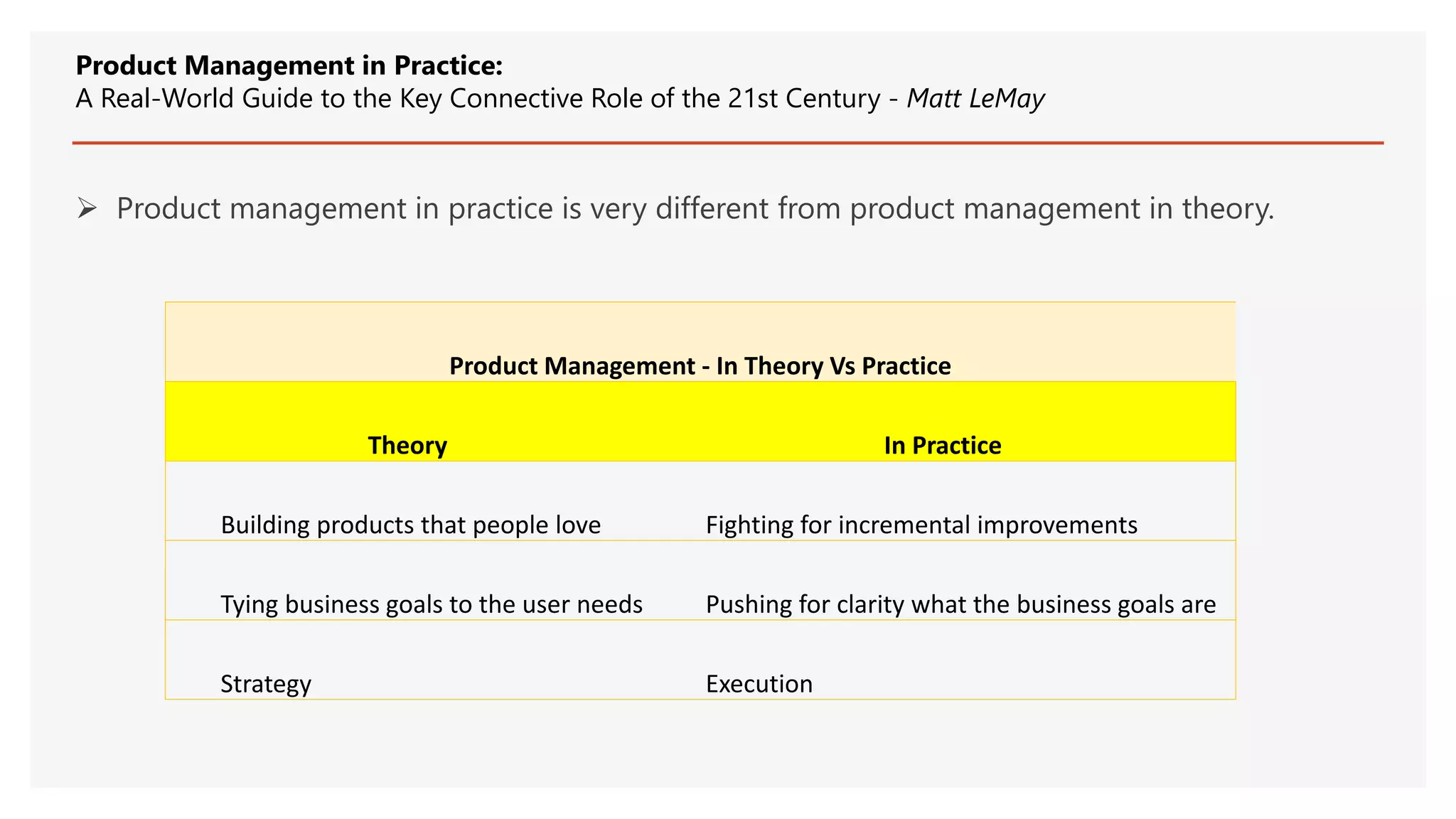
 Product management in practice is very different from product management in theory.
Product Management in Practice:
A Real-World Guide to the Key Connective Role of the 21st Century - Matt LeMay
Product Management - In Theory Vs Practice
Theory In Practice
Building products that people love Fighting for incremental improvements
Tying business goals to the user needs Pushing for clarity what the business goals are
Strategy Execution
 Product management is the role that connects user needs with business goals, technical
viability with user experience, and vision with execution.
 Product management ideally implies “building products that people love”, however, the day-
to-day practice involves much less building and more of supporting, facilitating, and
communicating.
Product Management in Practice:
A Real-World Guide to the Key Connective Role of the 21st Century - Matt LeMay
As a Product Manager
 You have lots of responsibility but little authority
 You must lead through influence, which requires developing an entirely different set of skills
and approaches.
 Most of the things you will need to get done as a product manager are not things you can do
alone.
Product Management in Practice:
A Real-World Guide to the Key Connective Role of the 21st Century - Matt LeMay
As a Product Manager
 Your stakeholders have different needs, perspectives, and skill sets. You must understand their
communication styles, their sensitivities, and the differences between what they say and what
they mean. Taking a genuine interest in the work of your colleagues is one of the most
important things you can do.
 You are not the boss and you are not actually building the product yourself.
 Some of the best product managers, need not have a technical background. They are people
who like to solve interesting problems, learn new things, and work with smart people.
Product Management in Practice:
A Real-World Guide to the Key Connective Role of the 21st Century - Matt LeMay
 Product management is a connective and facilitative role, the actual value product managers
bring to the table can be very difficult to quantify.
 The CORE Skills of Product Management: Communication, Organization, Research, and
Execution
Product Management in Practice:
A Real-World Guide to the Key Connective Role of the 21st Century - Matt LeMay
 In theory, product managers should know their market and know their user. In practice, this is
far from a given and often requires asking difficult questions and challenging deeply held
assumptions within an organization.
 Product managers are responsible for making sure that work gets done. This often means
stepping up to do even if that work is not technically part of your job description.
Product Management in Practice:
A Real-World Guide to the Key Connective Role of the 21st Century - Matt LeMay
 In Product Management, the distinction between soft and hard skills is particularly insidious.
Far too many people and organizations hire product managers based on hard skills that have
little to do with the day-to-day work that those product managers will be expected to
perform.
 At the same time, the qualities that make someone a universally respected PM rarely have to
do with technical expertise.
Product Management in Practice:
A Real-World Guide to the Key Connective Role of the 21st Century - Matt LeMay
 If you are going to succeed as a product manager, you must be willing to engage deeply with
people whose knowledge and expertise in a specific area greatly exceed your own.
 The best product managers always take time to learn about what makes an organization unique
before they start implementing — or even suggesting — specific best practices. And when they do
start implementing those best practices, they start small and build incrementally.
 The idea behind disagree and commit is simple: the goal of a meeting should not be to get
consensus, but rather to get commitment.
Product Management in Practice:
A Real-World Guide to the Key Connective Role of the 21st Century - Matt LeMay
 When you are a product manager, there will be times when you need to ask people to do things
that they don’t want to do. If you need something, ask for it, and be absolutely clear about why
you’re asking for it.
 And when you are working with senior stakeholders, the best way to “win” is often to help
somebody else win. A product manager cannot succeed if there is not clarity among senior leaders
about a company’s strategy and vision.
 As a product manager, it is all too easy to become collateral damage in somebody else’s quest to
vanquish their organizational foes. In many cases, though, the challenge is not that there are
competing visions for the company, but rather that there is no vision at all.
Product Management in Practice:
A Real-World Guide to the Key Connective Role of the 21st Century - Matt LeMay
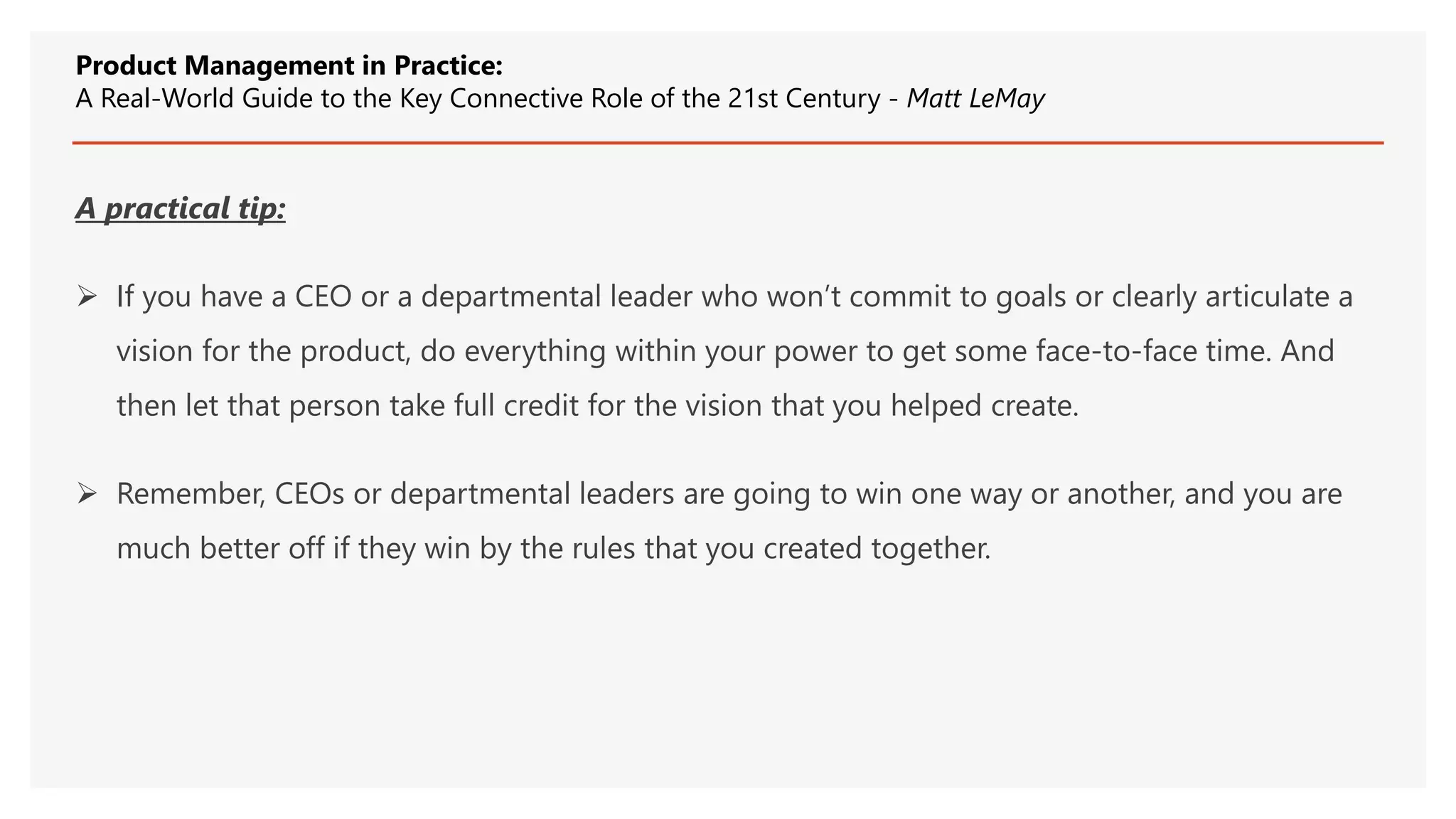
A practical tip:
 If you have a CEO or a departmental leader who won’t commit to goals or clearly articulate a
vision for the product, do everything within your power to get some face-to-face time. And
then let that person take full credit for the vision that you helped create.
 Remember, CEOs or departmental leaders are going to win one way or another, and you are
much better off if they win by the rules that you created together.
Product Management in Practice:
A Real-World Guide to the Key Connective Role of the 21st Century - Matt LeMay
Working with Seniors:
 When working with senior stakeholders, don’t set out to “win.” Help empower them to make great
decisions, and demonstrate that you can be a valuable and supportive thought partner. Push upward for
clarity around company strategy and vision, no matter how challenging it is.
 Never surprise a senior stakeholder with a big idea in an important meeting.
 Socialize ideas slowly and deliberately in one-on-one meetings. Let user needs guide your decision
making, and bring the user’s perspective to life in meetings with senior leaders.
Product Management in Practice:
A Real-World Guide to the Key Connective Role of the 21st Century - Matt LeMay
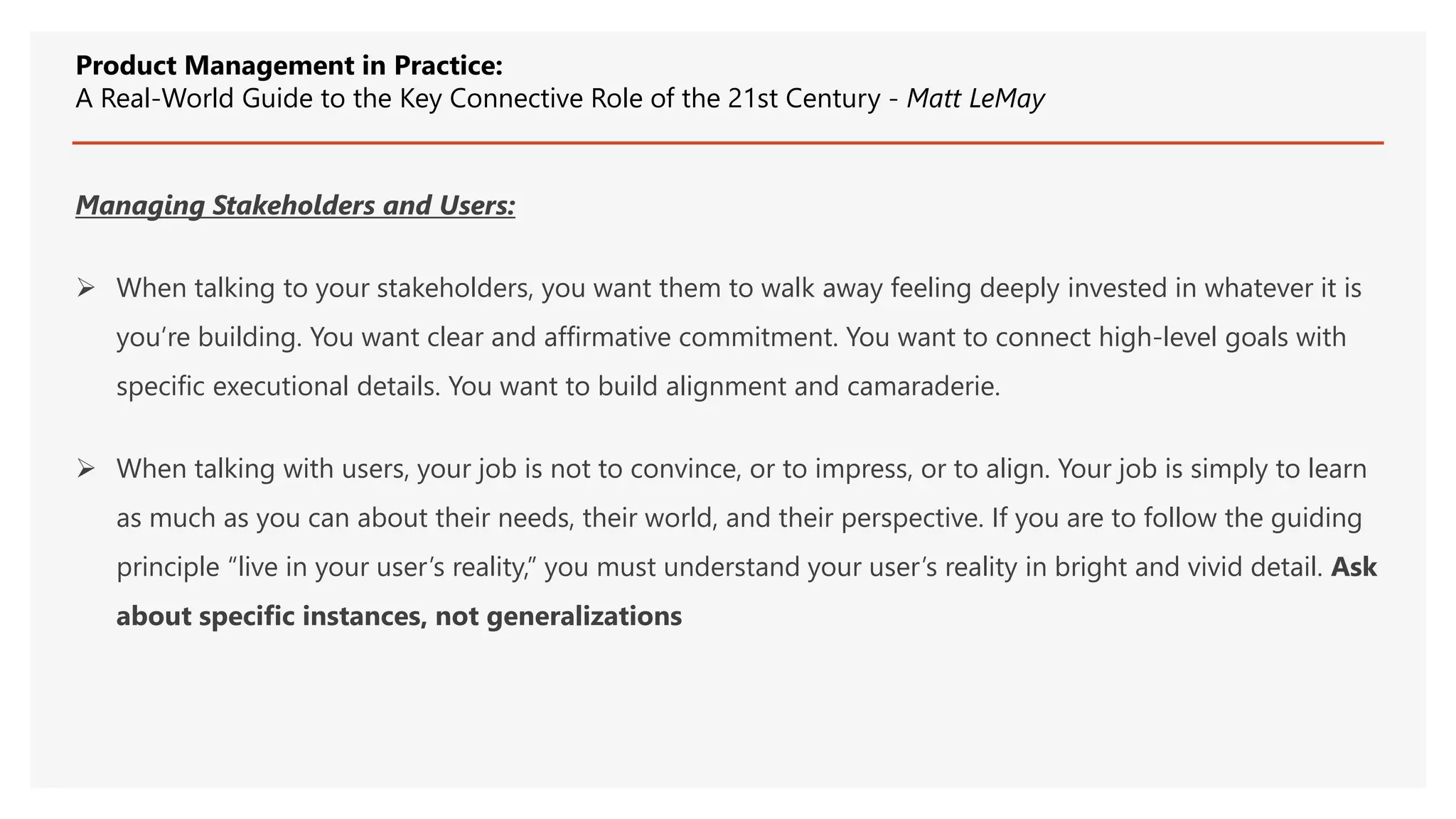
Managing Stakeholders and Users:
 When talking to your stakeholders, you want them to walk away feeling deeply invested in whatever it is
you’re building. You want clear and affirmative commitment. You want to connect high-level goals with
specific executional details. You want to build alignment and camaraderie.
 When talking with users, your job is not to convince, or to impress, or to align. Your job is simply to learn
as much as you can about their needs, their world, and their perspective. If you are to follow the guiding
principle “live in your user’s reality,” you must understand your user’s reality in bright and vivid detail. Ask
about specific instances, not generalizations
Product Management in Practice:
A Real-World Guide to the Key Connective Role of the 21st Century - Matt LeMay
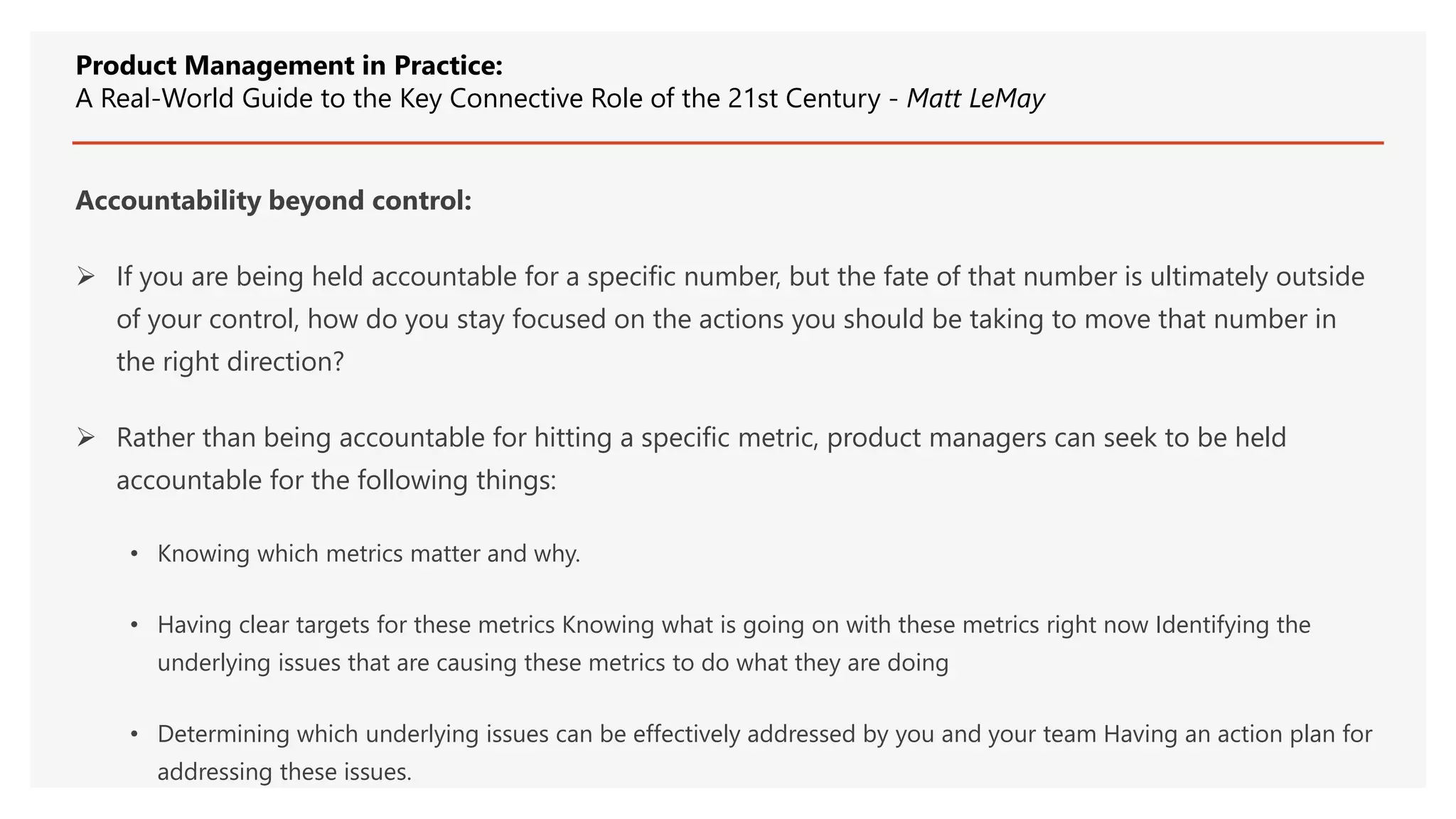
Accountability beyond control:
 If you are being held accountable for a specific number, but the fate of that number is ultimately outside
of your control, how do you stay focused on the actions you should be taking to move that number in
the right direction?
 Rather than being accountable for hitting a specific metric, product managers can seek to be held
accountable for the following things:
• Knowing which metrics matter and why.
• Having clear targets for these metrics Knowing what is going on with these metrics right now Identifying the
underlying issues that are causing these metrics to do what they are doing
• Determining which underlying issues can be effectively addressed by you and your team Having an action plan for
addressing these issues.
Product Management in Practice:
A Real-World Guide to the Key Connective Role of the 21st Century - Matt LeMay
Connecting the Organization:
 As a product manager, you are responsible for connecting people throughout the organization, and the
more broken and misaligned these connections are without your direct and constant intervention, the
more you can start to feel like you are the only thing standing between your team (or your company) and
oblivion.
 Product management necessitates being smack in the middle of whatever is going on with your team
and your organization, which means that if there’s a lot of difficult stuff going on, there’s going to be a lot
of difficult work to do.
Product Management in Practice:
A Real-World Guide to the Key Connective Role of the 21st Century - Matt LeMay
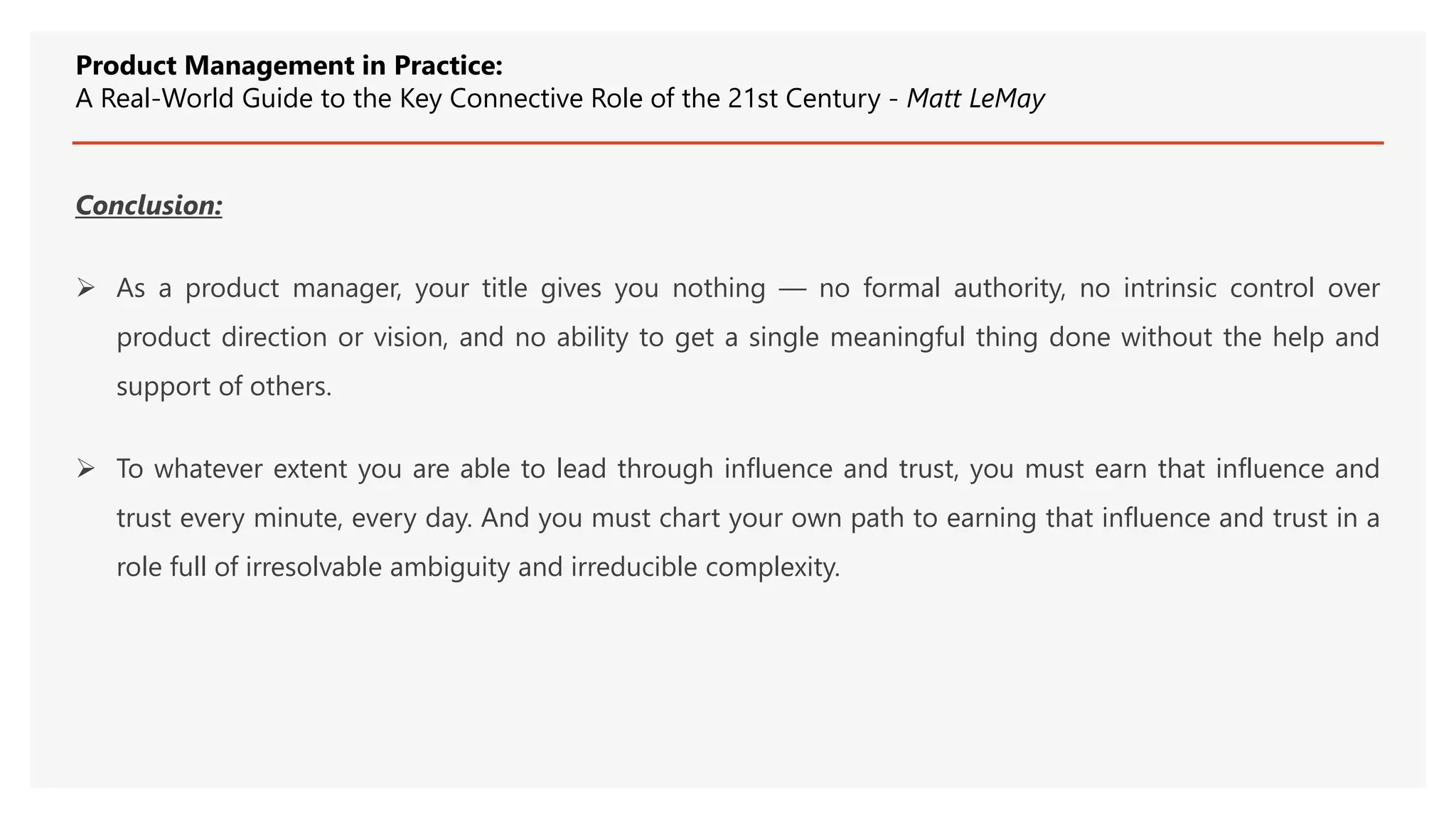
Conclusion:
 As a product manager, your title gives you nothing — no formal authority, no intrinsic control over
product direction or vision, and no ability to get a single meaningful thing done without the help and
support of others.
 To whatever extent you are able to lead through influence and trust, you must earn that influence and
trust every minute, every day. And you must chart your own path to earning that influence and trust in a
role full of irresolvable ambiguity and irreducible complexity.
Product Management in Practice:
A Real-World Guide to the Key Connective Role of the 21st Century - Matt LeMay
Conclusion:
The true beauty of product management is :
 No matter how smart you are, product management demands that you learn how to be wrong.
 No matter how charismatic you are, product management demands that you learn how to back up your words
with actions.
 And no matter how ambitious you are, product management demands that you learn how to respect and honor
your peers.
 Product management does not give you an airtight job description or a veneer of formal authority to hide
behind. If you want to succeed, you will need to become a better communicator, a better colleague, and a
better person.
Product Management in Practice:
A Real-World Guide to the Key Connective Role of the 21st Century - Matt LeMay

Product Management in Practice - Matt LeMay

  • 1.
    Book Summary Product Managementin Practice: A Real-World Guide to the Key Connective Role of the 21st Century Matt LeMay
  • 2.
     Product managementin practice is very different from product management in theory. Product Management in Practice: A Real-World Guide to the Key Connective Role of the 21st Century - Matt LeMay Product Management - In Theory Vs Practice Theory In Practice Building products that people love Fighting for incremental improvements Tying business goals to the user needs Pushing for clarity what the business goals are Strategy Execution
  • 3.
     Product managementis the role that connects user needs with business goals, technical viability with user experience, and vision with execution.  Product management ideally implies “building products that people love”, however, the day- to-day practice involves much less building and more of supporting, facilitating, and communicating. Product Management in Practice: A Real-World Guide to the Key Connective Role of the 21st Century - Matt LeMay
  • 4.
    As a ProductManager  You have lots of responsibility but little authority  You must lead through influence, which requires developing an entirely different set of skills and approaches.  Most of the things you will need to get done as a product manager are not things you can do alone. Product Management in Practice: A Real-World Guide to the Key Connective Role of the 21st Century - Matt LeMay
  • 5.
    As a ProductManager  Your stakeholders have different needs, perspectives, and skill sets. You must understand their communication styles, their sensitivities, and the differences between what they say and what they mean. Taking a genuine interest in the work of your colleagues is one of the most important things you can do.  You are not the boss and you are not actually building the product yourself.  Some of the best product managers, need not have a technical background. They are people who like to solve interesting problems, learn new things, and work with smart people. Product Management in Practice: A Real-World Guide to the Key Connective Role of the 21st Century - Matt LeMay
  • 6.
     Product managementis a connective and facilitative role, the actual value product managers bring to the table can be very difficult to quantify.  The CORE Skills of Product Management: Communication, Organization, Research, and Execution Product Management in Practice: A Real-World Guide to the Key Connective Role of the 21st Century - Matt LeMay
  • 7.
     In theory,product managers should know their market and know their user. In practice, this is far from a given and often requires asking difficult questions and challenging deeply held assumptions within an organization.  Product managers are responsible for making sure that work gets done. This often means stepping up to do even if that work is not technically part of your job description. Product Management in Practice: A Real-World Guide to the Key Connective Role of the 21st Century - Matt LeMay
  • 8.
     In ProductManagement, the distinction between soft and hard skills is particularly insidious. Far too many people and organizations hire product managers based on hard skills that have little to do with the day-to-day work that those product managers will be expected to perform.  At the same time, the qualities that make someone a universally respected PM rarely have to do with technical expertise. Product Management in Practice: A Real-World Guide to the Key Connective Role of the 21st Century - Matt LeMay
  • 9.
     If youare going to succeed as a product manager, you must be willing to engage deeply with people whose knowledge and expertise in a specific area greatly exceed your own.  The best product managers always take time to learn about what makes an organization unique before they start implementing — or even suggesting — specific best practices. And when they do start implementing those best practices, they start small and build incrementally.  The idea behind disagree and commit is simple: the goal of a meeting should not be to get consensus, but rather to get commitment. Product Management in Practice: A Real-World Guide to the Key Connective Role of the 21st Century - Matt LeMay
  • 10.
     When youare a product manager, there will be times when you need to ask people to do things that they don’t want to do. If you need something, ask for it, and be absolutely clear about why you’re asking for it.  And when you are working with senior stakeholders, the best way to “win” is often to help somebody else win. A product manager cannot succeed if there is not clarity among senior leaders about a company’s strategy and vision.  As a product manager, it is all too easy to become collateral damage in somebody else’s quest to vanquish their organizational foes. In many cases, though, the challenge is not that there are competing visions for the company, but rather that there is no vision at all. Product Management in Practice: A Real-World Guide to the Key Connective Role of the 21st Century - Matt LeMay
  • 11.
    A practical tip: If you have a CEO or a departmental leader who won’t commit to goals or clearly articulate a vision for the product, do everything within your power to get some face-to-face time. And then let that person take full credit for the vision that you helped create.  Remember, CEOs or departmental leaders are going to win one way or another, and you are much better off if they win by the rules that you created together. Product Management in Practice: A Real-World Guide to the Key Connective Role of the 21st Century - Matt LeMay
  • 12.
    Working with Seniors: When working with senior stakeholders, don’t set out to “win.” Help empower them to make great decisions, and demonstrate that you can be a valuable and supportive thought partner. Push upward for clarity around company strategy and vision, no matter how challenging it is.  Never surprise a senior stakeholder with a big idea in an important meeting.  Socialize ideas slowly and deliberately in one-on-one meetings. Let user needs guide your decision making, and bring the user’s perspective to life in meetings with senior leaders. Product Management in Practice: A Real-World Guide to the Key Connective Role of the 21st Century - Matt LeMay
  • 13.
    Managing Stakeholders andUsers:  When talking to your stakeholders, you want them to walk away feeling deeply invested in whatever it is you’re building. You want clear and affirmative commitment. You want to connect high-level goals with specific executional details. You want to build alignment and camaraderie.  When talking with users, your job is not to convince, or to impress, or to align. Your job is simply to learn as much as you can about their needs, their world, and their perspective. If you are to follow the guiding principle “live in your user’s reality,” you must understand your user’s reality in bright and vivid detail. Ask about specific instances, not generalizations Product Management in Practice: A Real-World Guide to the Key Connective Role of the 21st Century - Matt LeMay
  • 14.
    Accountability beyond control: If you are being held accountable for a specific number, but the fate of that number is ultimately outside of your control, how do you stay focused on the actions you should be taking to move that number in the right direction?  Rather than being accountable for hitting a specific metric, product managers can seek to be held accountable for the following things: • Knowing which metrics matter and why. • Having clear targets for these metrics Knowing what is going on with these metrics right now Identifying the underlying issues that are causing these metrics to do what they are doing • Determining which underlying issues can be effectively addressed by you and your team Having an action plan for addressing these issues. Product Management in Practice: A Real-World Guide to the Key Connective Role of the 21st Century - Matt LeMay
  • 15.
    Connecting the Organization: As a product manager, you are responsible for connecting people throughout the organization, and the more broken and misaligned these connections are without your direct and constant intervention, the more you can start to feel like you are the only thing standing between your team (or your company) and oblivion.  Product management necessitates being smack in the middle of whatever is going on with your team and your organization, which means that if there’s a lot of difficult stuff going on, there’s going to be a lot of difficult work to do. Product Management in Practice: A Real-World Guide to the Key Connective Role of the 21st Century - Matt LeMay
  • 16.
    Conclusion:  As aproduct manager, your title gives you nothing — no formal authority, no intrinsic control over product direction or vision, and no ability to get a single meaningful thing done without the help and support of others.  To whatever extent you are able to lead through influence and trust, you must earn that influence and trust every minute, every day. And you must chart your own path to earning that influence and trust in a role full of irresolvable ambiguity and irreducible complexity. Product Management in Practice: A Real-World Guide to the Key Connective Role of the 21st Century - Matt LeMay
  • 17.
    Conclusion: The true beautyof product management is :  No matter how smart you are, product management demands that you learn how to be wrong.  No matter how charismatic you are, product management demands that you learn how to back up your words with actions.  And no matter how ambitious you are, product management demands that you learn how to respect and honor your peers.  Product management does not give you an airtight job description or a veneer of formal authority to hide behind. If you want to succeed, you will need to become a better communicator, a better colleague, and a better person. Product Management in Practice: A Real-World Guide to the Key Connective Role of the 21st Century - Matt LeMay