
1
Product Experimentation
Masterclass:
Forming Strong Experiment
Hypotheses
Jason has been a member of Optimizely’s
Customer Success, Education, and Services
teams for over three years, enabling hundreds
of businesses to build their experimentation
programs, increase their testing and
personalization skills, and derive meaningful
insights from their experiment data.
OPTIMIZELYSERVICES
2018
Jason G’Sell
Lead Training Consultant,
EMEA
Opticon Training Day
Managed five training workshops tailored to all
skill levels delivered at the annual Opticon
conference.
Launch Customer Education in Europe
Expanded Optimizely Customer Education
training and support from US to EMEA region
Selected experience
Customers
Customized Training Programs
Build and deliver bespoke virtual and
in-person training programs for large
enterprises to effectively onboard
hundreds of teams globally
Education & Certification
University of Notre Dame, USA
Bachelor of Arts in Sociology, Minor in Gender
Studies
Association of Talent Development
ATD Training Certificate
Sr. Training Consultant, Optimizely
Training customers on high-value skills across
Web Experimentation, Personalization, and Full
Stack
Launch Manager, Optimizely
Onboarding Web Experimentation customers
at-scale, helping them achieve value as quickly
as possible
Customer Success Manager – Implementation,
ClearSlide
Developed train-the-trainer program to enable
onboarding for thousands of sales reps
nationally
Areas of expertise & industry
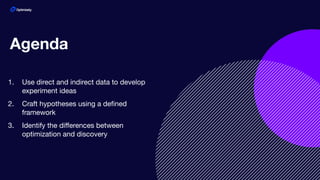
1. Use direct and indirect data to develop
experiment ideas
2. Craft hypotheses using a defined
framework
3. Identify the differences between
optimization and discovery
Agenda
Housekeeping
➔ This webinar will last around 60 minutes.
➔ Feel free to ask questions in the chat console at
any time!
➔ We are recording this session and will email a link
to the recording.
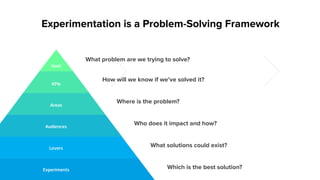
Audiences
Areas
KPIs
Goal
Levers
Experiments
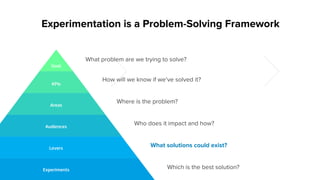
What problem are we trying to solve?
How will we know if we’ve solved it?
Where is the problem?
Who does it impact and how?
What solutions could exist?
Which is the best solution?
Experimentation is a Problem-Solving Framework
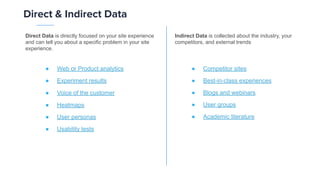
● Web or Product analytics
● Experiment results
● Voice of the customer
● Heatmaps
● User personas
● Usability tests
Indirect Data is collected about the industry, your
competitors, and external trends
Direct & Indirect Data
Direct Data is directly focused on your site experience
and can tell you about a specific problem in your site
experience.
● Competitor sites
● Best-in-class experiences
● Blogs and webinars
● User groups
● Academic literature
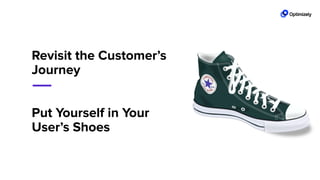
Revisit the Customer’s
Journey
Put Yourself in Your
User’s Shoes
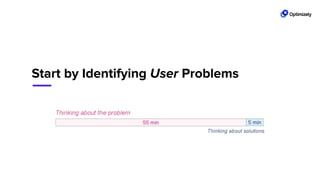
Start by Identifying User Problems
Formulate a
Problem Statement
A problem statement is a clear concise description of the issue(s) that
need(s) to be addressed.
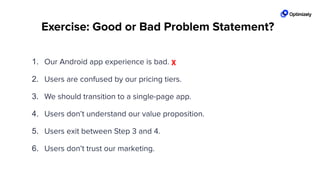
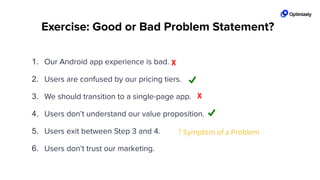
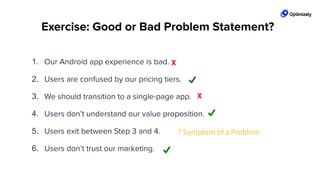
Exercise: Good or Bad Problem Statement?
1. Our Android app experience is bad.
2. Users are confused by our pricing tiers.
3. We should transition to a single-page app.
4. Users don’t understand our value proposition.
5. Users exit between Step 3 and 4.
6. Users don’t trust our marketing.
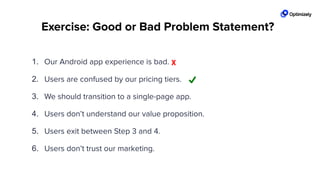
Exercise: Good or Bad Problem Statement?
1. Our Android app experience is bad.
2. Users are confused by our pricing tiers.
3. We should transition to a single-page app.
4. Users don’t understand our value proposition.
5. Users exit between Step 3 and 4.
6. Users don’t trust our marketing.
X
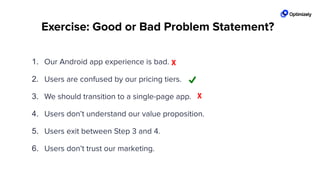
Exercise: Good or Bad Problem Statement?
1. Our Android app experience is bad.
2. Users are confused by our pricing tiers.
3. We should transition to a single-page app.
4. Users don’t understand our value proposition.
5. Users exit between Step 3 and 4.
6. Users don’t trust our marketing.
X
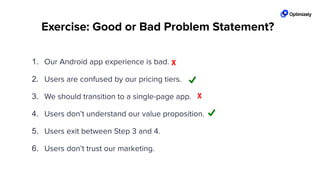
Exercise: Good or Bad Problem Statement?
1. Our Android app experience is bad.
2. Users are confused by our pricing tiers.
3. We should transition to a single-page app.
4. Users don’t understand our value proposition.
5. Users exit between Step 3 and 4.
6. Users don’t trust our marketing.
X
X
Exercise: Good or Bad Problem Statement?
1. Our Android app experience is bad.
2. Users are confused by our pricing tiers.
3. We should transition to a single-page app.
4. Users don’t understand our value proposition.
5. Users exit between Step 3 and 4.
6. Users don’t trust our marketing.
X
X
Exercise: Good or Bad Problem Statement?
1. Our Android app experience is bad.
2. Users are confused by our pricing tiers.
3. We should transition to a single-page app.
4. Users don’t understand our value proposition.
5. Users exit between Step 3 and 4.
6. Users don’t trust our marketing.
X
? Symptom of a Problem
X
Exercise: Good or Bad Problem Statement?
1. Our Android app experience is bad.
2. Users are confused by our pricing tiers.
3. We should transition to a single-page app.
4. Users don’t understand our value proposition.
5. Users exit between Step 3 and 4.
6. Users don’t trust our marketing.
X
? Symptom of a Problem
X
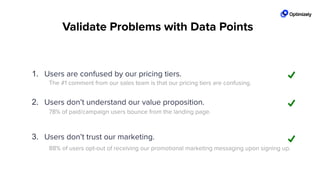
The #1 comment from our sales team is that our pricing tiers are confusing.
78% of paid/campaign users bounce from the landing page.
88% of users opt-out of receiving our promotional marketing messaging upon signing up.
1. Users are confused by our pricing tiers.
2. Users don’t understand our value proposition.
3. Users don’t trust our marketing.
Validate Problems with Data Points
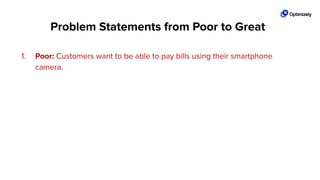
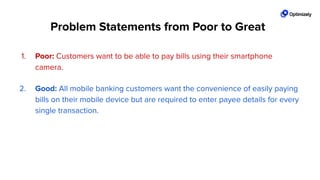
1. Poor: Customers want to be able to pay bills using their smartphone
camera.
2. Good: All mobile banking customers want the convenience of easily paying
bills on their mobile device but are required to enter payee details for every
single transaction.
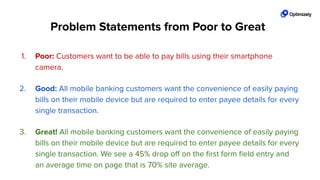
3. Great! All mobile banking customers want the convenience of easily paying
bills on their mobile device but are required to enter payee details for every
single transaction. We see a 45% drop off on the first form field entry and
an average time on page that is 70% site average.
Problem Statements from Poor to Great
1. Poor: Customers want to be able to pay bills using their smartphone
camera.
2. Good: All mobile banking customers want the convenience of easily paying
bills on their mobile device but are required to enter payee details for every
single transaction.
3. Great! All mobile banking customers want the convenience of easily paying
bills on their mobile device but are required to enter payee details for every
single transaction. We see a 45% drop off on the first form field entry and
an average time on page that is 70% site average.
Problem Statements from Poor to Great
1. Poor: Customers want to be able to pay bills using their smartphone
camera.
2. Good: All mobile banking customers want the convenience of easily paying
bills on their mobile device but are required to enter payee details for every
single transaction.
3. Great! All mobile banking customers want the convenience of easily paying
bills on their mobile device but are required to enter payee details for every
single transaction. We see a 45% drop off on the first form field entry and
an average time on page that is 70% site average.
Problem Statements from Poor to Great
Audiences
Areas
KPIs
Goal
Levers
Experiments
What problem are we trying to solve?
How will we know if we’ve solved it?
Where is the problem?
Who does it impact and how?
What solutions could exist?
Which is the best solution?
Experimentation is a Problem-Solving Framework
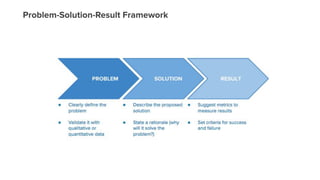
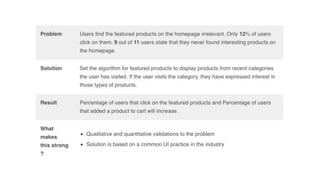
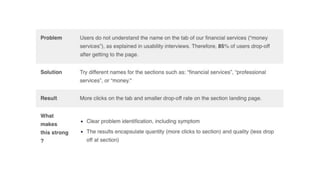
Problem-Solution-Result Framework
32
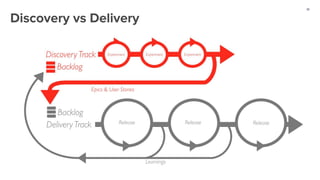
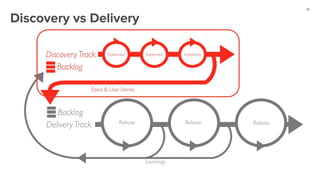
Discovery vs Delivery
33
Discovery vs Delivery
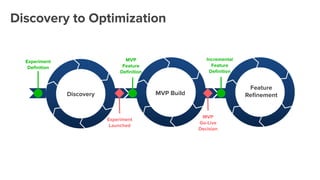
Discovery MVP Build
Feature
Refinement
Experiment
Launched
MVP
Go-Live
Decision
MVP
Feature
Definition
Experiment
Definition
Incremental
Feature
Definition
Discovery to Optimization
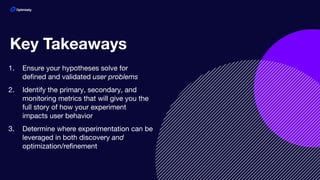
1. Ensure your hypotheses solve for
defined and validated user problems
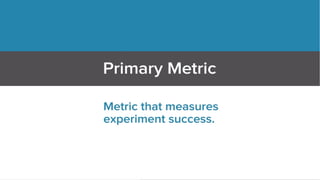
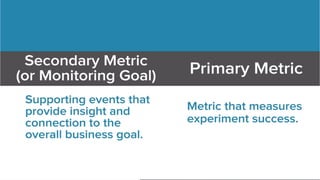
2. Identify the primary, secondary, and
monitoring metrics that will give you the
full story of how your experiment
impacts user behavior
3. Determine where experimentation can be
leveraged in both discovery and
optimization/refinement
Key Takeaways

Product Experimentation | Forming Strong Experiment Hypotheses

  • 1.
  • 2.
    Jason has beena member of Optimizely’s Customer Success, Education, and Services teams for over three years, enabling hundreds of businesses to build their experimentation programs, increase their testing and personalization skills, and derive meaningful insights from their experiment data. OPTIMIZELYSERVICES 2018 Jason G’Sell Lead Training Consultant, EMEA Opticon Training Day Managed five training workshops tailored to all skill levels delivered at the annual Opticon conference. Launch Customer Education in Europe Expanded Optimizely Customer Education training and support from US to EMEA region Selected experience Customers Customized Training Programs Build and deliver bespoke virtual and in-person training programs for large enterprises to effectively onboard hundreds of teams globally Education & Certification University of Notre Dame, USA Bachelor of Arts in Sociology, Minor in Gender Studies Association of Talent Development ATD Training Certificate Sr. Training Consultant, Optimizely Training customers on high-value skills across Web Experimentation, Personalization, and Full Stack Launch Manager, Optimizely Onboarding Web Experimentation customers at-scale, helping them achieve value as quickly as possible Customer Success Manager – Implementation, ClearSlide Developed train-the-trainer program to enable onboarding for thousands of sales reps nationally Areas of expertise & industry
  • 3.
    1. Use directand indirect data to develop experiment ideas 2. Craft hypotheses using a defined framework 3. Identify the differences between optimization and discovery Agenda
  • 4.
    Housekeeping ➔ This webinarwill last around 60 minutes. ➔ Feel free to ask questions in the chat console at any time! ➔ We are recording this session and will email a link to the recording.
  • 5.
    Audiences Areas KPIs Goal Levers Experiments What problem arewe trying to solve? How will we know if we’ve solved it? Where is the problem? Who does it impact and how? What solutions could exist? Which is the best solution? Experimentation is a Problem-Solving Framework
  • 6.
    ● Web orProduct analytics ● Experiment results ● Voice of the customer ● Heatmaps ● User personas ● Usability tests Indirect Data is collected about the industry, your competitors, and external trends Direct & Indirect Data Direct Data is directly focused on your site experience and can tell you about a specific problem in your site experience. ● Competitor sites ● Best-in-class experiences ● Blogs and webinars ● User groups ● Academic literature
  • 7.
    Revisit the Customer’s Journey PutYourself in Your User’s Shoes
  • 8.
    Start by IdentifyingUser Problems
  • 9.
    Formulate a Problem Statement Aproblem statement is a clear concise description of the issue(s) that need(s) to be addressed.
  • 10.
    Exercise: Good orBad Problem Statement? 1. Our Android app experience is bad. 2. Users are confused by our pricing tiers. 3. We should transition to a single-page app. 4. Users don’t understand our value proposition. 5. Users exit between Step 3 and 4. 6. Users don’t trust our marketing.
  • 11.
    Exercise: Good orBad Problem Statement? 1. Our Android app experience is bad. 2. Users are confused by our pricing tiers. 3. We should transition to a single-page app. 4. Users don’t understand our value proposition. 5. Users exit between Step 3 and 4. 6. Users don’t trust our marketing. X
  • 12.
    Exercise: Good orBad Problem Statement? 1. Our Android app experience is bad. 2. Users are confused by our pricing tiers. 3. We should transition to a single-page app. 4. Users don’t understand our value proposition. 5. Users exit between Step 3 and 4. 6. Users don’t trust our marketing. X
  • 13.
    Exercise: Good orBad Problem Statement? 1. Our Android app experience is bad. 2. Users are confused by our pricing tiers. 3. We should transition to a single-page app. 4. Users don’t understand our value proposition. 5. Users exit between Step 3 and 4. 6. Users don’t trust our marketing. X X
  • 14.
    Exercise: Good orBad Problem Statement? 1. Our Android app experience is bad. 2. Users are confused by our pricing tiers. 3. We should transition to a single-page app. 4. Users don’t understand our value proposition. 5. Users exit between Step 3 and 4. 6. Users don’t trust our marketing. X X
  • 15.
    Exercise: Good orBad Problem Statement? 1. Our Android app experience is bad. 2. Users are confused by our pricing tiers. 3. We should transition to a single-page app. 4. Users don’t understand our value proposition. 5. Users exit between Step 3 and 4. 6. Users don’t trust our marketing. X ? Symptom of a Problem X
  • 16.
    Exercise: Good orBad Problem Statement? 1. Our Android app experience is bad. 2. Users are confused by our pricing tiers. 3. We should transition to a single-page app. 4. Users don’t understand our value proposition. 5. Users exit between Step 3 and 4. 6. Users don’t trust our marketing. X ? Symptom of a Problem X
  • 17.
    The #1 commentfrom our sales team is that our pricing tiers are confusing. 78% of paid/campaign users bounce from the landing page. 88% of users opt-out of receiving our promotional marketing messaging upon signing up. 1. Users are confused by our pricing tiers. 2. Users don’t understand our value proposition. 3. Users don’t trust our marketing. Validate Problems with Data Points
  • 18.
    1. Poor: Customerswant to be able to pay bills using their smartphone camera. 2. Good: All mobile banking customers want the convenience of easily paying bills on their mobile device but are required to enter payee details for every single transaction. 3. Great! All mobile banking customers want the convenience of easily paying bills on their mobile device but are required to enter payee details for every single transaction. We see a 45% drop off on the first form field entry and an average time on page that is 70% site average. Problem Statements from Poor to Great
  • 19.
    1. Poor: Customerswant to be able to pay bills using their smartphone camera. 2. Good: All mobile banking customers want the convenience of easily paying bills on their mobile device but are required to enter payee details for every single transaction. 3. Great! All mobile banking customers want the convenience of easily paying bills on their mobile device but are required to enter payee details for every single transaction. We see a 45% drop off on the first form field entry and an average time on page that is 70% site average. Problem Statements from Poor to Great
  • 20.
    1. Poor: Customerswant to be able to pay bills using their smartphone camera. 2. Good: All mobile banking customers want the convenience of easily paying bills on their mobile device but are required to enter payee details for every single transaction. 3. Great! All mobile banking customers want the convenience of easily paying bills on their mobile device but are required to enter payee details for every single transaction. We see a 45% drop off on the first form field entry and an average time on page that is 70% site average. Problem Statements from Poor to Great
  • 21.
    Audiences Areas KPIs Goal Levers Experiments What problem arewe trying to solve? How will we know if we’ve solved it? Where is the problem? Who does it impact and how? What solutions could exist? Which is the best solution? Experimentation is a Problem-Solving Framework
  • 22.
  • 27.
  • 28.
  • 29.
  • 30.
    1. Ensure yourhypotheses solve for defined and validated user problems 2. Identify the primary, secondary, and monitoring metrics that will give you the full story of how your experiment impacts user behavior 3. Determine where experimentation can be leveraged in both discovery and optimization/refinement Key Takeaways