Product Design and
Development
C h a r l e s B r o n s o n A
D e e p a k P a n d a
D h a y a l k u m a r . M
H e n r y N e w m a n
G a d a m s e t t y M u r a l i d a r
L a v a P r a s a d . N
Abstract
Designing and developing a
product based on the concepts
explained in the coursework.
Introduction
Ever since the discovery of fire, human beings have been fascinated by the
power it produces one of which is heat. This heat is which supplies people
with hot water to drink, bath etc. It is well known that people like their
drinks hot rather than cold. But there is a dearth of products which enable
people to have hot water or drinks at their disposal or they need to have a
big machine to enable them to do so. This project tries to overcome these
obstacles
Customer Requirements and Statements:
Below are some of the statements as given exactly by the customer
1. Cost is very high. I want cheaper product
2. Power consumption is very high
3. I want temperature indication in my kettle
4. I want to see the contents inside the device.
5. I want to maintain the temperature for sometimes after heating
6. A.C power may not be available always; I want to run it with DC power.
7. I want it to be connected with my laptop for heating.
8. I want chargeable batteries for this device.
9. I want to hold it inside my pocket.
10. I am not satisfied with the aesthetics like colour, shape and size. I want
something new.
11. This is very large in size. So I want smaller size.
Problem Statement
The objective is to design a heating device that is portable, compact and
user friendly with several utility functions like temperature sensor,
temperature regulator etc,
Gathering Information
Kettle:
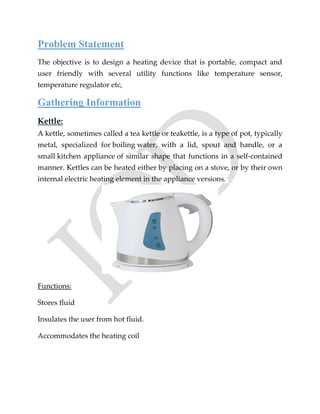
A kettle, sometimes called a tea kettle or teakettle, is a type of pot, typically
metal, specialized for boiling water, with a lid, spout and handle, or a
small kitchen appliance of similar shape that functions in a self-contained
manner. Kettles can be heated either by placing on a stove, or by their own
internal electric heating element in the appliance versions. `
Functions:
Stores fluid
Insulates the user from hot fluid.
Accommodates the heating coil
Cup:
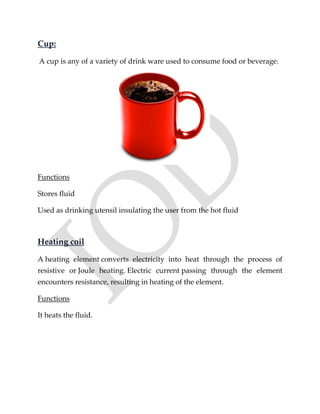
A cup is any of a variety of drink ware used to consume food or beverage.
Functions
Stores fluid
Used as drinking utensil insulating the user from the hot fluid
Heating coil
A heating element converts electricity into heat through the process of
resistive or Joule heating. Electric current passing through the element
encounters resistance, resulting in heating of the element.
Functions
It heats the fluid.
Concept Generation
Brainstorming
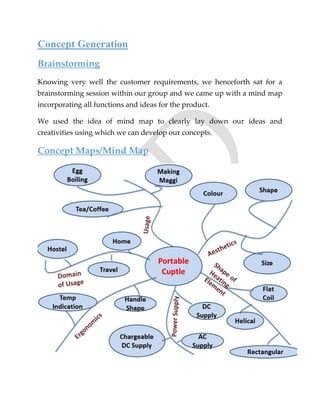
Knowing very well the customer requirements, we henceforth sat for a
brainstorming session within our group and we came up with a mind map
incorporating all functions and ideas for the product.
We used the idea of mind map to clearly lay down our ideas and
creativities using which we can develop our concepts.
Concept Maps/Mind Map
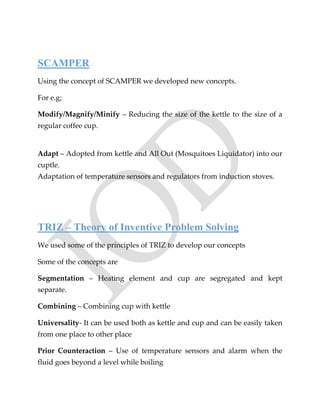
SCAMPER
Using the concept of SCAMPER we developed new concepts.
For e.g;
Modify/Magnify/Minify – Reducing the size of the kettle to the size of a
regular coffee cup.
Adapt – Adopted from kettle and All Out (Mosquitoes Liquidator) into our
cuptle.
Adaptation of temperature sensors and regulators from induction stoves.
TRIZ – Theory of Inventive Problem Solving
We used some of the principles of TRIZ to develop our concepts
Some of the concepts are
Segmentation – Heating element and cup are segregated and kept
separate.
Combining – Combining cup with kettle
Universality- It can be used both as kettle and cup and can be easily taken
from one place to other place
Prior Counteraction – Use of temperature sensors and alarm when the
fluid goes beyond a level while boiling
Product Concepts
Using the various tools/aids in improving creative thinking, and also the
tools for concept generation like SCAMPER and TRIZ. We developed three
new concepts incorporating the customer requirements.
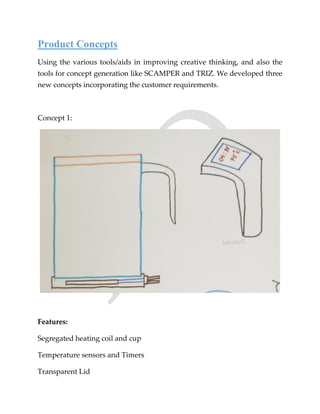
Concept 1:
Features:
Segregated heating coil and cup
Temperature sensors and Timers
Transparent Lid
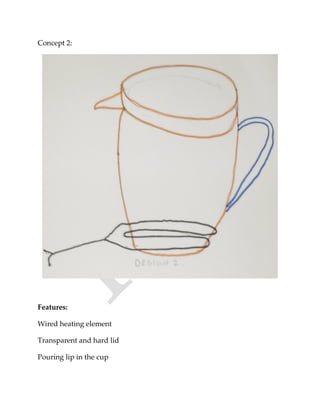
Concept 2:
Features:
Wired heating element
Transparent and hard lid
Pouring lip in the cup
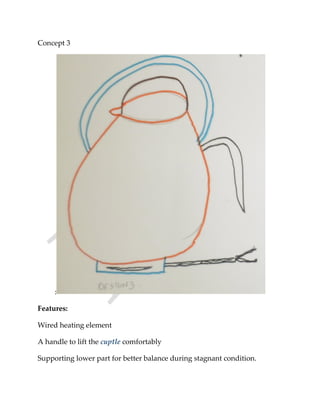
Concept 3
:
Features:
Wired heating element
A handle to lift the cuptle comfortably
Supporting lower part for better balance during stagnant condition.
Concept Evaluation
Using the principles of TRIZ and SCAMPER we developed three new
concepts for our product cuptle. We had to evaluate the concepts to select
one concept for further development. So we used the principle of
Benchmarking matrix to evaluate the design.
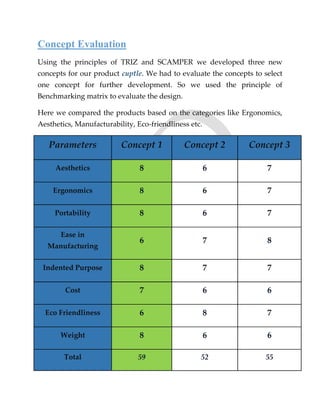
Here we compared the products based on the categories like Ergonomics,
Aesthetics, Manufacturability, Eco-friendliness etc.
Parameters Concept 1 Concept 2 Concept 3
Aesthetics 8 6 7
Ergonomics 8 6 7
Portability 8 6 7
Ease in
Manufacturing
6 7 8
Indented Purpose 8 7 7
Cost 7 6 6
Eco Friendliness 6 8 7
Weight 8 6 6
Total 59 52 55
Based on the benchmarking matrix we can find that Concept 1 is relatively
better based on the parameters of comparison. So we take Concept 1 for
further development.
Product Architecture
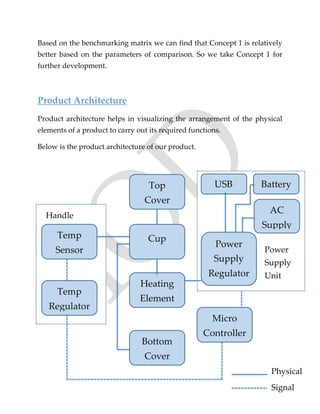
Product architecture helps in visualizing the arrangement of the physical
elements of a product to carry out its required functions.
Below is the product architecture of our product.
Top
Cover
Cup
Heating
Element
Bottom
Cover
Temp
Sensor
Temp
Regulator
Power
Supply
Regulator
Micro
Controller
USB Battery
AC
Supply
Physical
Signal
Power
Supply
Unit
Handle
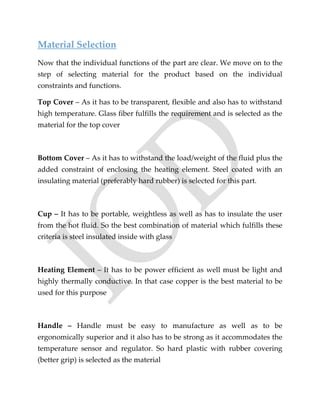
Material Selection
Now that the individual functions of the part are clear. We move on to the
step of selecting material for the product based on the individual
constraints and functions.
Top Cover – As it has to be transparent, flexible and also has to withstand
high temperature. Glass fiber fulfills the requirement and is selected as the
material for the top cover
Bottom Cover – As it has to withstand the load/weight of the fluid plus the
added constraint of enclosing the heating element. Steel coated with an
insulating material (preferably hard rubber) is selected for this part.
Cup – It has to be portable, weightless as well as has to insulate the user
from the hot fluid. So the best combination of material which fulfills these
criteria is steel insulated inside with glass
Heating Element – It has to be power efficient as well must be light and
highly thermally conductive. In that case copper is the best material to be
used for this purpose
Handle – Handle must be easy to manufacture as well as to be
ergonomically superior and it also has to be strong as it accommodates the
temperature sensor and regulator. So hard plastic with rubber covering
(better grip) is selected as the material
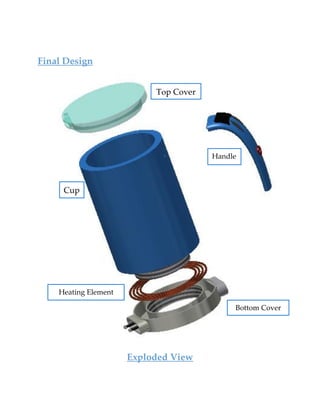
Final Design
Exploded View
Top Cover
Cup
Heating Element
Bottom Cover
Handle
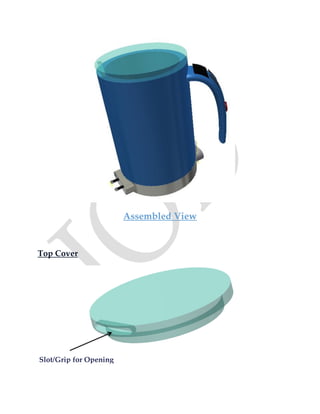
Assembled View
Top Cover
Slot/Grip for Opening
Features
Transparent material to see through easily
Interference fit so it seals the hotness of the fluid inside.
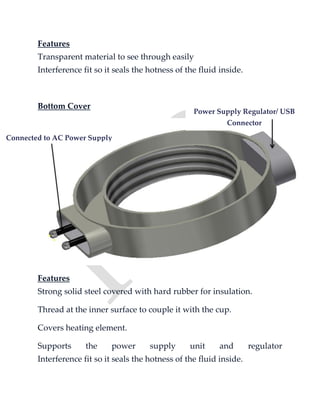
Bottom Cover
Features
Strong solid steel covered with hard rubber for insulation.
Thread at the inner surface to couple it with the cup.
Covers heating element.
Supports the power supply unit and regulator
Interference fit so it seals the hotness of the fluid inside.
Connected to AC Power Supply
Power Supply Regulator/ USB
Connector
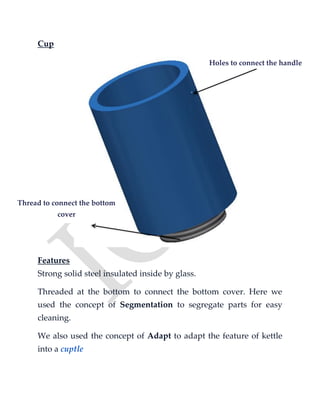
Cup
Features
Strong solid steel insulated inside by glass.
Threaded at the bottom to connect the bottom cover. Here we
used the concept of Segmentation to segregate parts for easy
cleaning.
We also used the concept of Adapt to adapt the feature of kettle
into a cuptle
Holes to connect the handle
Thread to connect the bottom
cover
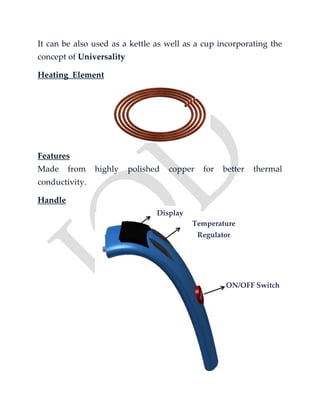
It can be also used as a kettle as well as a cup incorporating the
concept of Universality
Heating Element
Features
Made from highly polished copper for better thermal
conductivity.
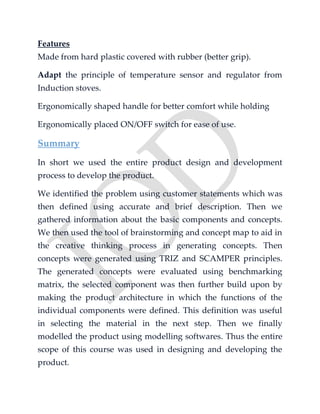
Handle
Display
Temperature
Regulator
ON/OFF Switch
Features
Made from hard plastic covered with rubber (better grip).
Adapt the principle of temperature sensor and regulator from
Induction stoves.
Ergonomically shaped handle for better comfort while holding
Ergonomically placed ON/OFF switch for ease of use.
Summary
In short we used the entire product design and development
process to develop the product.
We identified the problem using customer statements which was
then defined using accurate and brief description. Then we
gathered information about the basic components and concepts.
We then used the tool of brainstorming and concept map to aid in
the creative thinking process in generating concepts. Then
concepts were generated using TRIZ and SCAMPER principles.
The generated concepts were evaluated using benchmarking
matrix, the selected component was then further build upon by
making the product architecture in which the functions of the
individual components were defined. This definition was useful
in selecting the material in the next step. Then we finally
modelled the product using modelling softwares. Thus the entire
scope of this course was used in designing and developing the
product.

Product design and development

  • 1.
    Product Design and Development Ch a r l e s B r o n s o n A D e e p a k P a n d a D h a y a l k u m a r . M H e n r y N e w m a n G a d a m s e t t y M u r a l i d a r L a v a P r a s a d . N Abstract Designing and developing a product based on the concepts explained in the coursework.
  • 2.
    Introduction Ever since thediscovery of fire, human beings have been fascinated by the power it produces one of which is heat. This heat is which supplies people with hot water to drink, bath etc. It is well known that people like their drinks hot rather than cold. But there is a dearth of products which enable people to have hot water or drinks at their disposal or they need to have a big machine to enable them to do so. This project tries to overcome these obstacles Customer Requirements and Statements: Below are some of the statements as given exactly by the customer 1. Cost is very high. I want cheaper product 2. Power consumption is very high 3. I want temperature indication in my kettle 4. I want to see the contents inside the device. 5. I want to maintain the temperature for sometimes after heating 6. A.C power may not be available always; I want to run it with DC power. 7. I want it to be connected with my laptop for heating. 8. I want chargeable batteries for this device. 9. I want to hold it inside my pocket. 10. I am not satisfied with the aesthetics like colour, shape and size. I want something new. 11. This is very large in size. So I want smaller size.
  • 3.
    Problem Statement The objectiveis to design a heating device that is portable, compact and user friendly with several utility functions like temperature sensor, temperature regulator etc, Gathering Information Kettle: A kettle, sometimes called a tea kettle or teakettle, is a type of pot, typically metal, specialized for boiling water, with a lid, spout and handle, or a small kitchen appliance of similar shape that functions in a self-contained manner. Kettles can be heated either by placing on a stove, or by their own internal electric heating element in the appliance versions. ` Functions: Stores fluid Insulates the user from hot fluid. Accommodates the heating coil
  • 4.
    Cup: A cup isany of a variety of drink ware used to consume food or beverage. Functions Stores fluid Used as drinking utensil insulating the user from the hot fluid Heating coil A heating element converts electricity into heat through the process of resistive or Joule heating. Electric current passing through the element encounters resistance, resulting in heating of the element. Functions It heats the fluid.
  • 5.
    Concept Generation Brainstorming Knowing verywell the customer requirements, we henceforth sat for a brainstorming session within our group and we came up with a mind map incorporating all functions and ideas for the product. We used the idea of mind map to clearly lay down our ideas and creativities using which we can develop our concepts. Concept Maps/Mind Map
  • 6.
    SCAMPER Using the conceptof SCAMPER we developed new concepts. For e.g; Modify/Magnify/Minify – Reducing the size of the kettle to the size of a regular coffee cup. Adapt – Adopted from kettle and All Out (Mosquitoes Liquidator) into our cuptle. Adaptation of temperature sensors and regulators from induction stoves. TRIZ – Theory of Inventive Problem Solving We used some of the principles of TRIZ to develop our concepts Some of the concepts are Segmentation – Heating element and cup are segregated and kept separate. Combining – Combining cup with kettle Universality- It can be used both as kettle and cup and can be easily taken from one place to other place Prior Counteraction – Use of temperature sensors and alarm when the fluid goes beyond a level while boiling
  • 7.
    Product Concepts Using thevarious tools/aids in improving creative thinking, and also the tools for concept generation like SCAMPER and TRIZ. We developed three new concepts incorporating the customer requirements. Concept 1: Features: Segregated heating coil and cup Temperature sensors and Timers Transparent Lid
  • 8.
    Concept 2: Features: Wired heatingelement Transparent and hard lid Pouring lip in the cup
  • 9.
    Concept 3 : Features: Wired heatingelement A handle to lift the cuptle comfortably Supporting lower part for better balance during stagnant condition.
  • 10.
    Concept Evaluation Using theprinciples of TRIZ and SCAMPER we developed three new concepts for our product cuptle. We had to evaluate the concepts to select one concept for further development. So we used the principle of Benchmarking matrix to evaluate the design. Here we compared the products based on the categories like Ergonomics, Aesthetics, Manufacturability, Eco-friendliness etc. Parameters Concept 1 Concept 2 Concept 3 Aesthetics 8 6 7 Ergonomics 8 6 7 Portability 8 6 7 Ease in Manufacturing 6 7 8 Indented Purpose 8 7 7 Cost 7 6 6 Eco Friendliness 6 8 7 Weight 8 6 6 Total 59 52 55
  • 11.
    Based on thebenchmarking matrix we can find that Concept 1 is relatively better based on the parameters of comparison. So we take Concept 1 for further development. Product Architecture Product architecture helps in visualizing the arrangement of the physical elements of a product to carry out its required functions. Below is the product architecture of our product. Top Cover Cup Heating Element Bottom Cover Temp Sensor Temp Regulator Power Supply Regulator Micro Controller USB Battery AC Supply Physical Signal Power Supply Unit Handle
  • 12.
    Material Selection Now thatthe individual functions of the part are clear. We move on to the step of selecting material for the product based on the individual constraints and functions. Top Cover – As it has to be transparent, flexible and also has to withstand high temperature. Glass fiber fulfills the requirement and is selected as the material for the top cover Bottom Cover – As it has to withstand the load/weight of the fluid plus the added constraint of enclosing the heating element. Steel coated with an insulating material (preferably hard rubber) is selected for this part. Cup – It has to be portable, weightless as well as has to insulate the user from the hot fluid. So the best combination of material which fulfills these criteria is steel insulated inside with glass Heating Element – It has to be power efficient as well must be light and highly thermally conductive. In that case copper is the best material to be used for this purpose Handle – Handle must be easy to manufacture as well as to be ergonomically superior and it also has to be strong as it accommodates the temperature sensor and regulator. So hard plastic with rubber covering (better grip) is selected as the material
  • 13.
    Final Design Exploded View TopCover Cup Heating Element Bottom Cover Handle
  • 14.
  • 15.
    Features Transparent material tosee through easily Interference fit so it seals the hotness of the fluid inside. Bottom Cover Features Strong solid steel covered with hard rubber for insulation. Thread at the inner surface to couple it with the cup. Covers heating element. Supports the power supply unit and regulator Interference fit so it seals the hotness of the fluid inside. Connected to AC Power Supply Power Supply Regulator/ USB Connector
  • 16.
    Cup Features Strong solid steelinsulated inside by glass. Threaded at the bottom to connect the bottom cover. Here we used the concept of Segmentation to segregate parts for easy cleaning. We also used the concept of Adapt to adapt the feature of kettle into a cuptle Holes to connect the handle Thread to connect the bottom cover
  • 17.
    It can bealso used as a kettle as well as a cup incorporating the concept of Universality Heating Element Features Made from highly polished copper for better thermal conductivity. Handle Display Temperature Regulator ON/OFF Switch
  • 18.
    Features Made from hardplastic covered with rubber (better grip). Adapt the principle of temperature sensor and regulator from Induction stoves. Ergonomically shaped handle for better comfort while holding Ergonomically placed ON/OFF switch for ease of use. Summary In short we used the entire product design and development process to develop the product. We identified the problem using customer statements which was then defined using accurate and brief description. Then we gathered information about the basic components and concepts. We then used the tool of brainstorming and concept map to aid in the creative thinking process in generating concepts. Then concepts were generated using TRIZ and SCAMPER principles. The generated concepts were evaluated using benchmarking matrix, the selected component was then further build upon by making the product architecture in which the functions of the individual components were defined. This definition was useful in selecting the material in the next step. Then we finally modelled the product using modelling softwares. Thus the entire scope of this course was used in designing and developing the product.