Tools and methods for analysing value
chains - how far have we got in practice?
               Felicity Proctor
           fjp@proctorconsult.org

               UNECA/CTA
            November 6-9, 2012
            Session Respondent
This presentation:

• Overview and user demand – reflections from a CTA
  commissioned study
   – Felicity Proctor and Valerio Lucchesi (2011) Mapping Study on
     Value Chain Initiatives in ACP regions. See UNECA-CTA
     Conference 2012 website
     http://makingtheconnection.cta.int/resources/mapping-study
• Respondent to the session presentations
Mapping Study on Value Chain Initiatives in
                   ACP regions
    Methodology and approach – in summary

•   Literature review including grey
•   ACP commissioned papers
•   Key initiatives review (X15 programmes reviewed)
•   Key informant interviews (X15 – ACP regional)
•   Electronic survey (65 – all stakeholder types)
Mapping Study on Value Chain Initiatives in
      ACP regions – some observations
• Significant level of donor programme investment in Value
  Chain Development (VCD) in ACP regions
• Multiple tools and methods applied but few are explicit on the
  tools and methods used
• ‘VC Development paradigm’ - largely development partner and
  northern institution led
• Multiple interventions made within a given ‘value chain
  development’ initiative but weak articulation of how choices
  were made
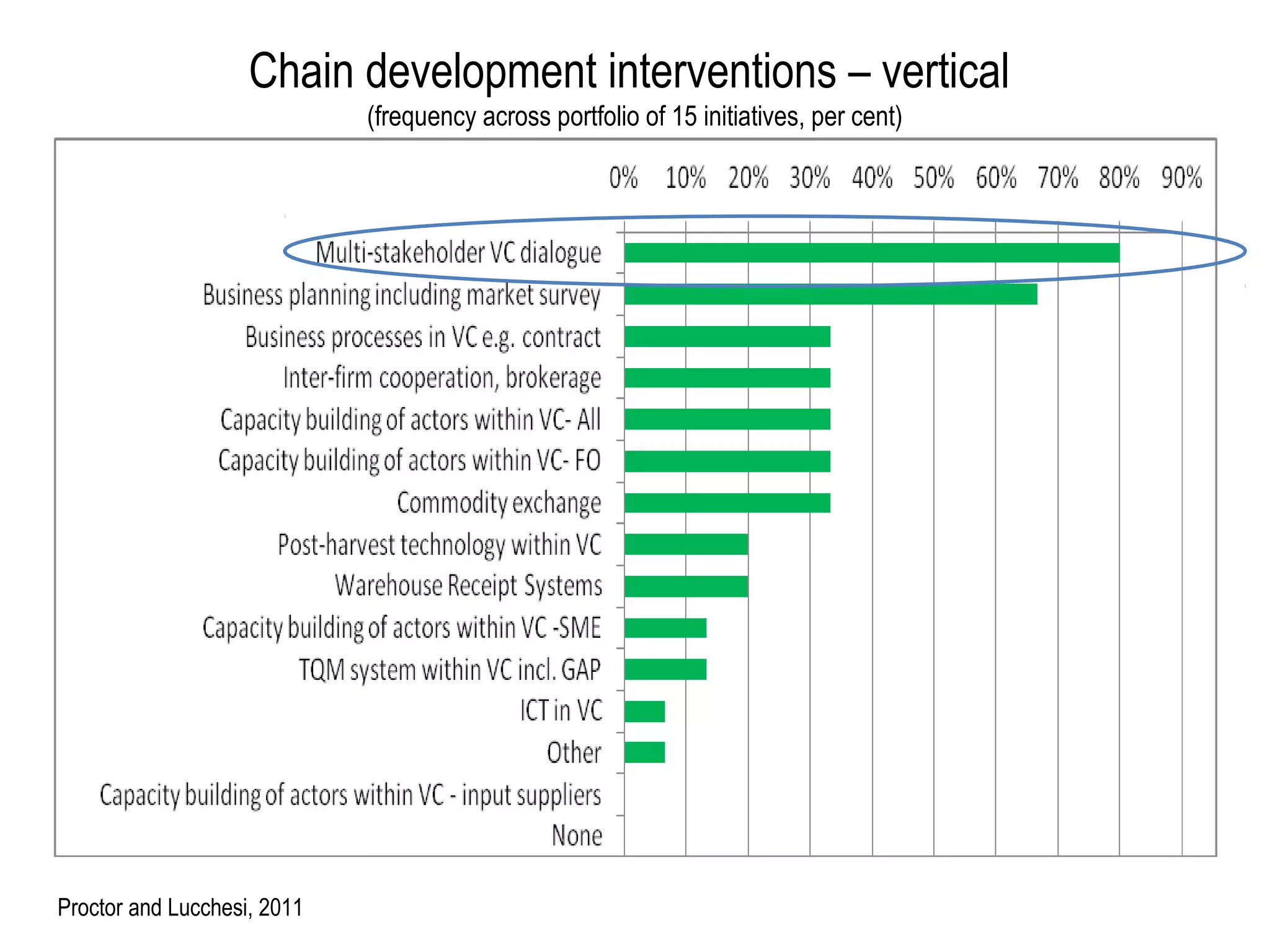
Chain development interventions – vertical
                             (frequency across portfolio of 15 initiatives, per cent)


Proctor and Lucchesi, 2011
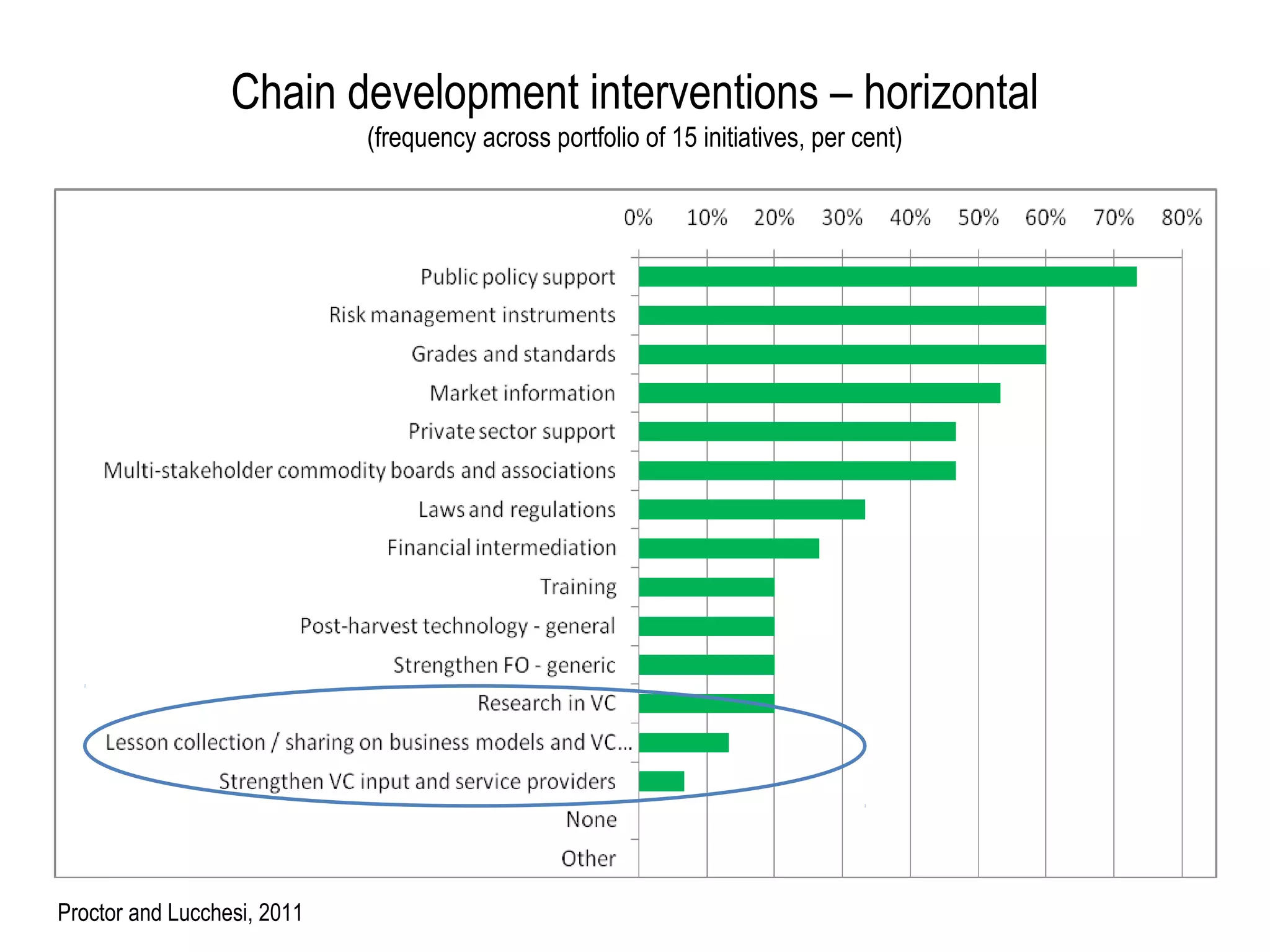
Chain development interventions – horizontal
                             (frequency across portfolio of 15 initiatives, per cent)


Proctor and Lucchesi, 2011
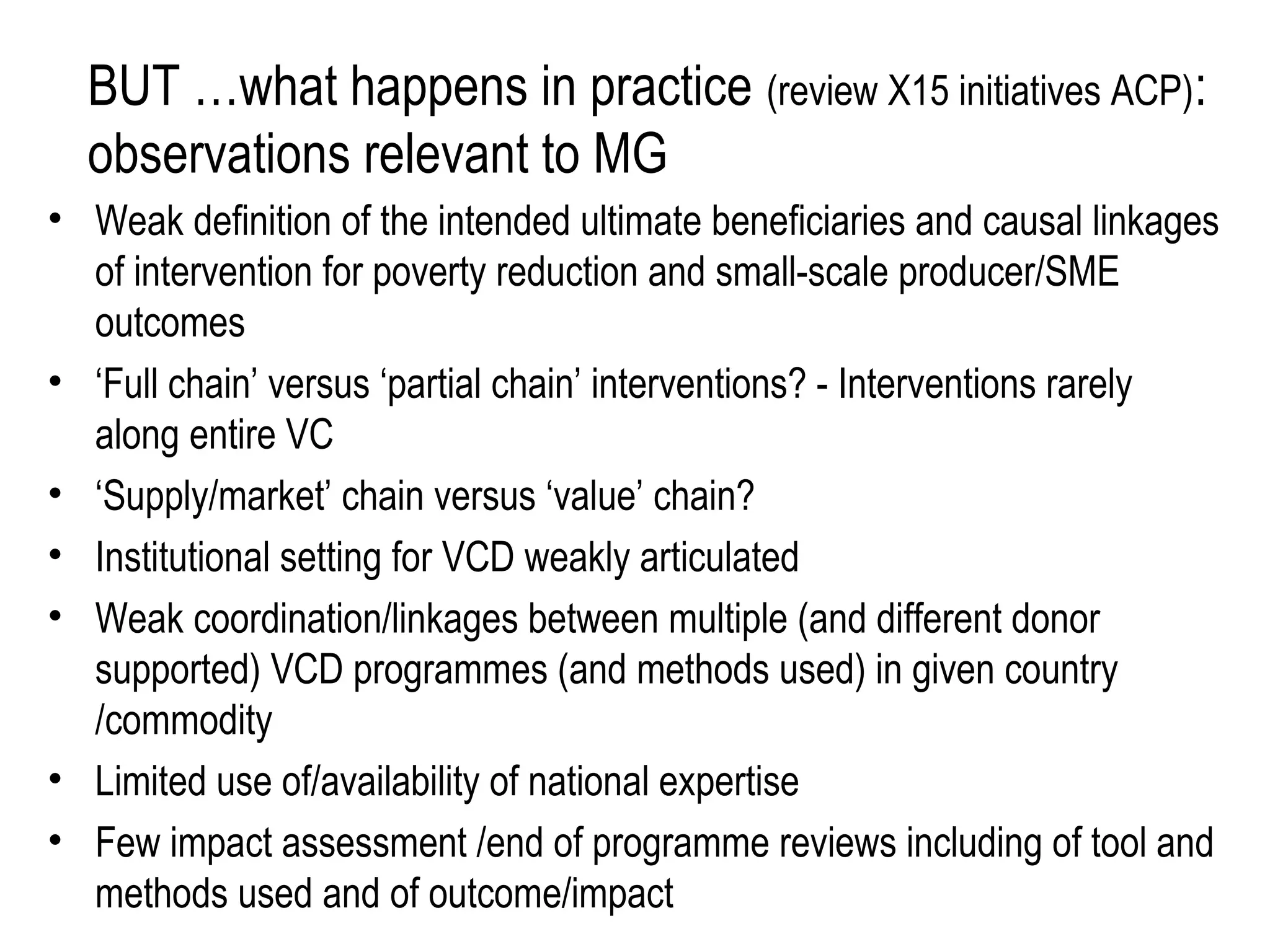
BUT …what happens in practice (review X15 initiatives ACP):
  observations relevant to MG
• Weak definition of the intended ultimate beneficiaries and causal linkages
  of intervention for poverty reduction and small-scale producer/SME
  outcomes
• ‘Full chain’ versus ‘partial chain’ interventions? - Interventions rarely
  along entire VC
• ‘Supply/market’ chain versus ‘value’ chain?
• Institutional setting for VCD weakly articulated
• Weak coordination/linkages between multiple (and different donor
  supported) VCD programmes (and methods used) in given country
  /commodity
• Limited use of/availability of national expertise
• Few impact assessment /end of programme reviews including of tool and
  methods used and of outcome/impact
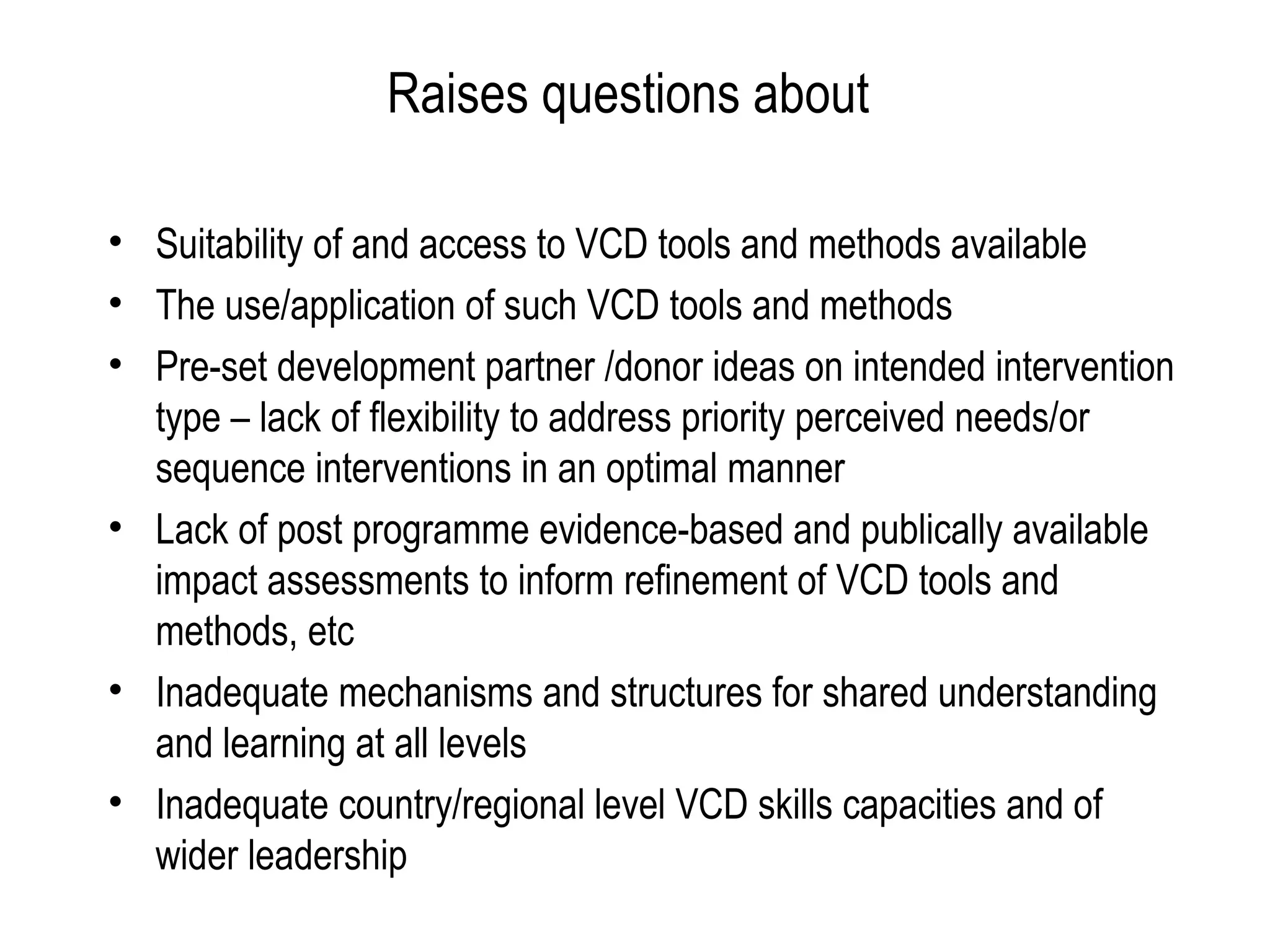
Raises questions about

• Suitability of and access to VCD tools and methods available
• The use/application of such VCD tools and methods
• Pre-set development partner /donor ideas on intended intervention
  type – lack of flexibility to address priority perceived needs/or
  sequence interventions in an optimal manner
• Lack of post programme evidence-based and publically available
  impact assessments to inform refinement of VCD tools and
  methods, etc
• Inadequate mechanisms and structures for shared understanding
  and learning at all levels
• Inadequate country/regional level VCD skills capacities and of
  wider leadership
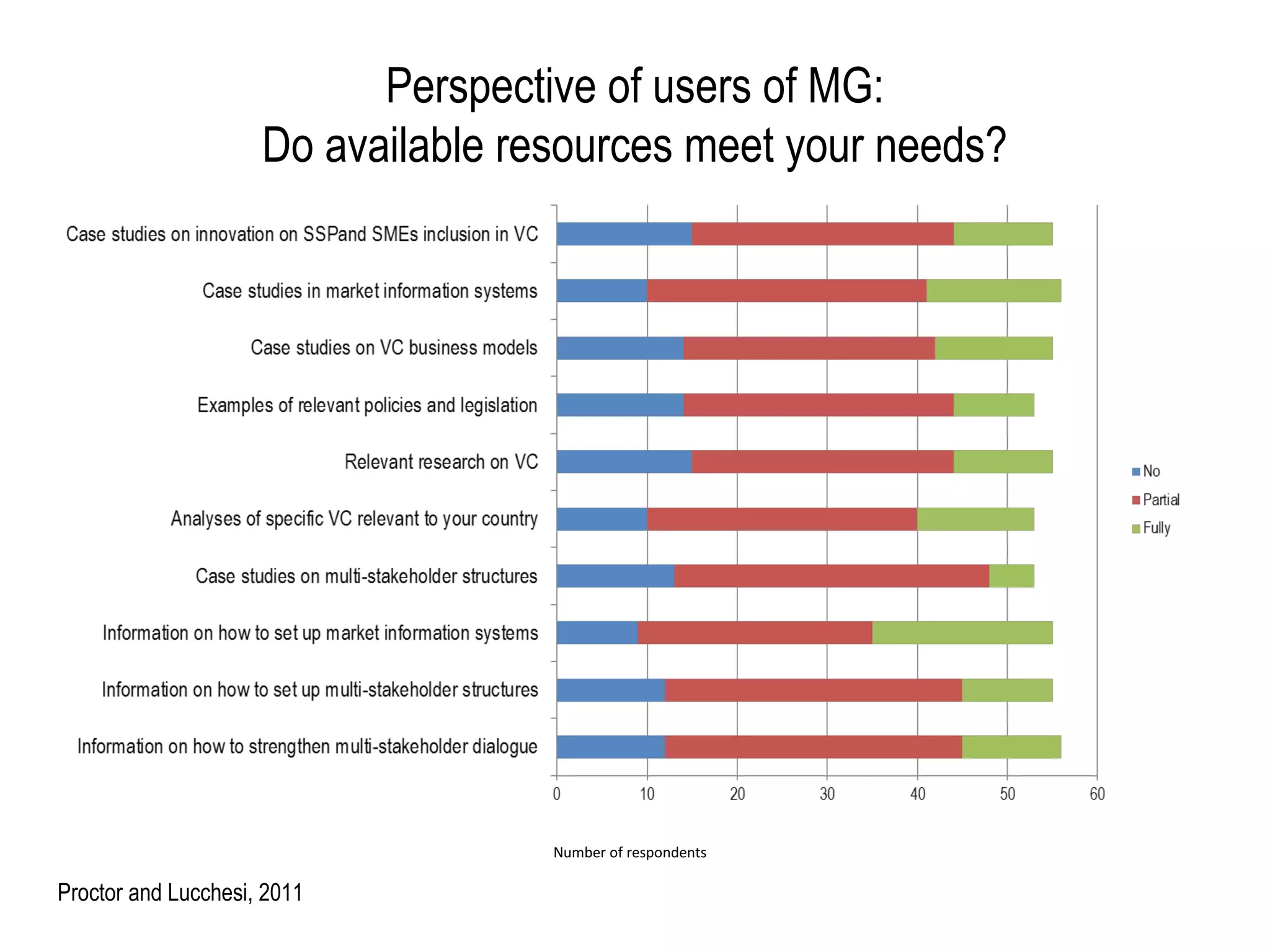
Perspective of users of MG:
                     Do available resources meet your needs?


                                    Number of respondents

Proctor and Lucchesi, 2011
Today's presentations:

• An analytical review of eleven Value Chain methodological guides
  (Donovan et al 20XX in draft- ICRAF/CTA)
• Two case examples: ValueLinks and CARE (which is based in the
  work of CIAT, 2007). Both case examples given are part of the
  ICRAF/CTA review

  This ICRAF-led methodological review is a first to try to do a
  comparative study of this type – thus a useful contribution to work
  on chain development
Analytical Review (ICRAF) - reflection
•   Sample – Methodological guides (MG) what sampling method used? omissions
    possibly those with strong VC quantitative (costs, value, time) assessments e.g.
     – Foreign Investment Advisory Service (FIAS)/IFC: Moving Toward
        Competitiveness: A Value Chain Approach - 2007
     – WB: Competitive Commercial Agriculture in SSA - Keyser 2006
     – CIRAD/CGPRT: Handbook based on CADIAC - Bourgeois and Herrera 1998
•   Intended users and accessibility of information
     – Provides information on scope/coverage of the 11 MGs . Much useful material
        reviewed – but currently researcher focussed
     – Categorised by 8 elements - Difficult to explore the causal linkages in given MG
        i.e. between development objectives’ (specifically ‘chain-wide development’ cf
        ‘VCD’) ‘data collection’ and ‘tools used’ – so not comparing like with like or
        providing easy access for practitioners
     – Would benefit from also presenting the ICRAFanalysis by each MG
Analytical Review (ICRAF) - reflection
• Setting market and value chain development in wider development
  context
   – Need for new thinking on how to place MGs on value and market chain
      development (tools and methods) in the wider development environment
• MGs cannot cover all aspects of interventions to support the
  development of the market-value chain
   – Need for new thinking on how MGs can draw down on related good
      practice e.g. laws/policy for wholesale market reform, grades and
      standards, contract law, etc
• How are MG updated and maintained
   – With some exceptions e.g. USAID and ValueLinks, there is little
      upgrading of the materials used on an ongoing basis
MGs in general - some final thoughts
• Enhance documentation and shared learning on VC methods and tools
   – We don’t know - what is used and by whom and when in practice and
      how well a given MG work and what has not worked – evidence based
• Enhance ease of access to content of MG for users in local context
   – No one tool or method is optimal – but more effort needed to make valid
      comparisons
   – Make tools and methods more accessible
• Increase debate and capacity at national and regional levels to select tools
  and methods fit for local context
   – Avoid multiplicity of different MGs used in local context by different
      donors and their consultants
   – Enable national practitioners to select and use the best tools and
      methods which work in their context (also called for in the ACP study)
Thank you

    Felicity Proctor
fjp@proctorconsult.org

Proctor tools and_methods_for_analysing_value_chains_respondent

  • 1.
    Tools and methodsfor analysing value chains - how far have we got in practice? Felicity Proctor fjp@proctorconsult.org UNECA/CTA November 6-9, 2012 Session Respondent
  • 2.
    This presentation: • Overviewand user demand – reflections from a CTA commissioned study – Felicity Proctor and Valerio Lucchesi (2011) Mapping Study on Value Chain Initiatives in ACP regions. See UNECA-CTA Conference 2012 website http://makingtheconnection.cta.int/resources/mapping-study • Respondent to the session presentations
  • 3.
    Mapping Study onValue Chain Initiatives in ACP regions Methodology and approach – in summary • Literature review including grey • ACP commissioned papers • Key initiatives review (X15 programmes reviewed) • Key informant interviews (X15 – ACP regional) • Electronic survey (65 – all stakeholder types)
  • 4.
    Mapping Study onValue Chain Initiatives in ACP regions – some observations • Significant level of donor programme investment in Value Chain Development (VCD) in ACP regions • Multiple tools and methods applied but few are explicit on the tools and methods used • ‘VC Development paradigm’ - largely development partner and northern institution led • Multiple interventions made within a given ‘value chain development’ initiative but weak articulation of how choices were made
  • 5.
    Chain development interventions– vertical (frequency across portfolio of 15 initiatives, per cent)     Proctor and Lucchesi, 2011
  • 6.
    Chain development interventions– horizontal (frequency across portfolio of 15 initiatives, per cent)   Proctor and Lucchesi, 2011
  • 7.
    BUT …what happensin practice (review X15 initiatives ACP): observations relevant to MG • Weak definition of the intended ultimate beneficiaries and causal linkages of intervention for poverty reduction and small-scale producer/SME outcomes • ‘Full chain’ versus ‘partial chain’ interventions? - Interventions rarely along entire VC • ‘Supply/market’ chain versus ‘value’ chain? • Institutional setting for VCD weakly articulated • Weak coordination/linkages between multiple (and different donor supported) VCD programmes (and methods used) in given country /commodity • Limited use of/availability of national expertise • Few impact assessment /end of programme reviews including of tool and methods used and of outcome/impact
  • 8.
    Raises questions about •Suitability of and access to VCD tools and methods available • The use/application of such VCD tools and methods • Pre-set development partner /donor ideas on intended intervention type – lack of flexibility to address priority perceived needs/or sequence interventions in an optimal manner • Lack of post programme evidence-based and publically available impact assessments to inform refinement of VCD tools and methods, etc • Inadequate mechanisms and structures for shared understanding and learning at all levels • Inadequate country/regional level VCD skills capacities and of wider leadership
  • 9.
    Perspective of usersof MG: Do available resources meet your needs? Number of respondents Proctor and Lucchesi, 2011
  • 10.
    Today's presentations: • Ananalytical review of eleven Value Chain methodological guides (Donovan et al 20XX in draft- ICRAF/CTA) • Two case examples: ValueLinks and CARE (which is based in the work of CIAT, 2007). Both case examples given are part of the ICRAF/CTA review This ICRAF-led methodological review is a first to try to do a comparative study of this type – thus a useful contribution to work on chain development
  • 11.
    Analytical Review (ICRAF)- reflection • Sample – Methodological guides (MG) what sampling method used? omissions possibly those with strong VC quantitative (costs, value, time) assessments e.g. – Foreign Investment Advisory Service (FIAS)/IFC: Moving Toward Competitiveness: A Value Chain Approach - 2007 – WB: Competitive Commercial Agriculture in SSA - Keyser 2006 – CIRAD/CGPRT: Handbook based on CADIAC - Bourgeois and Herrera 1998 • Intended users and accessibility of information – Provides information on scope/coverage of the 11 MGs . Much useful material reviewed – but currently researcher focussed – Categorised by 8 elements - Difficult to explore the causal linkages in given MG i.e. between development objectives’ (specifically ‘chain-wide development’ cf ‘VCD’) ‘data collection’ and ‘tools used’ – so not comparing like with like or providing easy access for practitioners – Would benefit from also presenting the ICRAFanalysis by each MG
  • 12.
    Analytical Review (ICRAF)- reflection • Setting market and value chain development in wider development context – Need for new thinking on how to place MGs on value and market chain development (tools and methods) in the wider development environment • MGs cannot cover all aspects of interventions to support the development of the market-value chain – Need for new thinking on how MGs can draw down on related good practice e.g. laws/policy for wholesale market reform, grades and standards, contract law, etc • How are MG updated and maintained – With some exceptions e.g. USAID and ValueLinks, there is little upgrading of the materials used on an ongoing basis
  • 13.
    MGs in general- some final thoughts • Enhance documentation and shared learning on VC methods and tools – We don’t know - what is used and by whom and when in practice and how well a given MG work and what has not worked – evidence based • Enhance ease of access to content of MG for users in local context – No one tool or method is optimal – but more effort needed to make valid comparisons – Make tools and methods more accessible • Increase debate and capacity at national and regional levels to select tools and methods fit for local context – Avoid multiplicity of different MGs used in local context by different donors and their consultants – Enable national practitioners to select and use the best tools and methods which work in their context (also called for in the ACP study)
  • 14.
    Thank you Felicity Proctor fjp@proctorconsult.org

Editor's Notes

  • #8 ICKM tools are traditional e.g. workshops
  • #9 ICKM tools are traditional e.g. workshops
  • #12 Value chain approaches are not a ‘silver bullet’ As a methodological tool, it is highly eclectic with a diverse application that is far from standardised It is an experience-based approach for problem solving, and learning and continues to need adaptation in order to become a tool to generate interventions
  • #13 Regional Co-ordination Centre for Research and Development of Coarse Grains, Pulses, Roots and Tuber Crops in Asia and the Pacific. Coarse grains, pulses, roots and tuber crops (CGPRT crops)