WATER AS
COOLING
FLUID IN
INDUSTRIAL
PLANTS
1
Water as cooling fluid
• To have good heat transfer, the cooling fluid
must be convenient from thermodinamic and cost
point of view
• High Thermal capacity
• Low specific volume
• Temperature sufficiently lower then that of the
process fluid
• High availability
• Low cost
2
Water as cooling fluid
• SPECIFIC HEAT
• is the measure of how well a substance can absorb
heat
• 1 Kcal/kg°C or 4,18 KJ/kg°C
• VAPORIZATION HEAT
• Energy to transform liquid to gaseous
• 540 Kcal/kg at 100°C
• 575 Kcal/kg at 40°C
3
Water as cooling fluid
• Main water characteristics
Water Air Glycerin
- ka (Kcal/hm °C) 0,541 0,023 0,243
- cp (kcal/kg °C) 0,998 0,24 0,6
- d (kg/m3
) 992 1,136 1250
- u - 104 (ns/m2
) 0,81 0,191 2800
- v . 106 (m2
/s) 0,686 16,8 2200
- Pr (cp.u/ka) 4,52 0,72 0,0025
- a . 104 (m2
/h) 5,46 841 3,2
ka = thermal conductivity
cp = specific heat
d = density
u = dynamic viscosity
v = cinematic viscosity
Pr = Prandtl number
a = thermal diffusivity
Water as cooling fluid
• However, due to the presence of
sevaral impurities, water can cause
severe problems to the heat transfer
equipment:
• HEAT TRANSFER BASICS
• WATER CHARACTERISTICS
• SCALE
• FOULING
• BIOLOGICAL FOULING
• CORROSION
5
Basics of heat
transfer
6
Basics of heat transfer
• To understand the impact of water
characteristics, is useful to remind the heat
transfer laws that help us to recognize the
importance of a right treatment
• CONDUCTION
• CONVECTION
• RADIATION
13/06/2024 7
Basics of heat transfer
• Conduction
• It is the transfer of heat between two
areas at different temperature of same
material (or different material in
contact), due to the heat flux between the
molecules without these move from their
average position
• Heat transfer capacity of a material,
called thermal conductivity, determine the
gradient of temperature accross the
material
• The foundamental law of the conduction is
the Fourier law:
where
13/06/2024 8
qk = ka (t2 - t1) / Lc
qk = heat flux, kcal/h m2
ka = thermal conductivity, kcal/m h°C
(t2-t1) = gradient of temperature through a layer of material, °C
Lc = thickness across which the heat transfer occurs, m
Basics of heat transfer
• Convection
• It is the heat transfer associated to the transport
of mass and energy beteen two points of a fluid or a
fluid with a solid
13/06/2024 9
Where:
qc = hc A (t2-t1)
qc = convection heat transfer, kcal/h
hc = convection heat transfer coefficient, kcal/hm2°C
A = heat transfer surface, m2
(t2-t1) = difference of temperature across a fluid film, °C
Basics of heat transfer
• Convection
• To get high heat transfer value it is
needed to reduce as much as possible the
limit film layer
• This can be done by increasing the flow
velocity and/or the turbolence of the
fluid
• The ratio between the gradient of
temperature inside the fluid in contact
with the surface and a reference gradient
of temperature is given by the Nusselt
Number (Nu)
• The Nu correlates the convection
coefficient h, the diameter D and the
13/06/2024 10
Nu = hc D / ka
Basics of heat transfer
• Convection
• Reynolds Number (Re) indicate if a fluid
is moving in the laminar or turbolence
region
• The Re is adimensional and it is
proportional directly to the diameter
(D)of the tube, the density (d) and
velocity (V) of the fluid and inverse to
the viscosity of the fluid (u)
• Approximatively, for clean tubes
Re = D d V / u
Re < 2100 laminar motion
Re > 2400 turbulent motion
Basics of heat transfer
• Convection
• According to the convection coefficient (hc), Nusselt
number is function of Reynolds number (Re) and Prantl
number (Pr)
• Where Pr is adimensional and it is given by the
relationship
• A realshionship to calculate the convection
coefficient, valid for turbulent region, is given by
Dittus and Boelter
13/06/2024 12
Nu = f(Re,Pr)
Pr = cp u / ka
hc D / ka = 0.023 Re0.6 Pr1/3 u/uw
uw = Skin temperature viscosity
Basics of heat transfer
• Radiation
• It is the heat transfer due to the radiation effect,
even in presence of material, between two bodies at
different temperature
• The radiation law is given by Stefan-Boltzman
(generalized)
13/06/2024 13
qi = ds e A1 (T4
1 - T4
2)
where: qi = thermal power of radiation, kcal/h
ds = Stefan-Boltzman’s constant, 4,88.10-8 kcal/m2h°K4
e = emissivity of the mateiral
A1 = surface, m2
(T1-T2) = differential of temperature across a fluid film, °K
Basics of heat transfer
• Heat transfer in the industrial equipments
• In the shell&tubes units the heat transfer occurs
mainly by conduction and convection
• In the furnaces and heaters the heat transfer occurs
by convection and radiation
13/06/2024 14
Hot Process In
Hot Cooling
Water Out
Cooled Process Out
Cold Cooling
Water In
Kcal's
Kcal's
SIMPLE HEAT TRANSFER
Basics of heat transfer
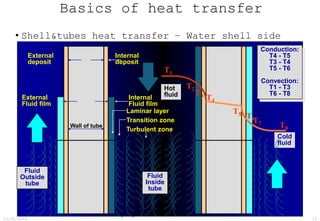
• Shell&tubes heat transfer – Water shell side
13/06/2024 15
External
deposit
External
Fluid film
Internal
deposit
Internal
Fluid film
Wall of tube
T1
T3
T2
T4
T5 T6
T8
T7
Cold
fluid
Hot
fluid
Laminar layer
Transition zone
Turbulent zone
Fluid
Outside
tube
Fluid
Inside
tube
Conduction:
T4 - T5
T3 - T4
T5 - T6
Convection:
T1 - T3
T6 - T8
Water
Characteristi
cs
6/13/2024 16
Impact of water
characteristics
• Industrial plants take advantage from the
thermodinamic properties of the water as cooling
fluid
• The impurities present in the water can cause
severe problems to the heat transfer units
• It is important to control the operation of heat
transfer equipments within the allowed limits of
the chemical-physical parameters
• Water, that become warmer due to the heat
transfer, couid cause problems due to the
original impurities, their concentration in
evaporative units and absorption of pollutants
from processes and atmosphere
13/06/2024 17
• Scale
• Deposit
• Corrosion
• Fouling
Impact of water
characteristics
• Aspect
• Can be observed materials suspended that could
potentially settled on the heat transfer surface
• These materials could cause deposit, scale,
corrosion, erosion, biological foulinf and foam
13/06/2024 18
Impact of water characteristics
• Temperature
• Specially the skin temperature, represents a
significative index of the potential problems that
can occurs (scale, corrosion, fouling)
• The solubility of scaling salts decrease with the
increase of the temperature. So, where this is
higher the potential precipitation is more
critical.
• Higher potential of scale formation occurs in the
hottest areas of the heat transfer unitse (i.e. The
inlet of the process where the temperature is
higher)
13/06/2024 19
Impact of water
characteristics
• pH
• pH units give the degree of acidity or basicity of
water
• pH represents a very important factor on the
development and entity of scale, corrosion and
biological fouling phenomena
• pH is the basic parameter to calssify the
corrosiveness of waters
13/06/2024 20
Impact of water
characteristics
• Electrical conductivity
• Electrical conductivity represents the reciprocal
of the resistivity to the flowing of the electrical
current
• It is typical for each electrolyte, function of the
ion concentration
• It is an indirect measurement of the dissociated
matters present in the water
• It is an index of the purity and salinity
• Higher ion concentration increase generally the
solubility of the scaling salts
• Lower resistance increases the aggressivity of the
water
13/06/2024 21
Impact of water
characteristics
• Total solids (TS)
• TS represents all the solids present in the water as
soluble, colloidal and suspended
• It is expressed as mg/liter and is determined by
evaporation at 180°C
• High ST value indicates normally poor water quality
13/06/2024 22
Impact of water
characteristics
• Total dissolved solids (TDS)
• TDS are the total dissolved solids in the water
• It is expressed as mg/liter and are determined by
evaporation at 180°C, after filtration at 0.45
micron
• High TDS value promote the scale and corrosion
phenomena
13/06/2024 23
Impact of water
characteristics
• Total hardness
• It represents the amount of alkaline salts, mainly
calcium and magnesium salts, that are solubilized in
the water
• It is expressed as mg/liter of Calcium carbonate
• The presence of hardness cause scale if no tretment
is applied to inhibit the precipitation of the
scaling salts
13/06/2024 24
Impact of water
characteristics
• Temporary hardness
• It represents the amount of earth-alkaline
bicarbonates (calcium and magnesium) in the water
• It is expressed as mg/liter of Calcium carbonate
• It is directly responsible for scale formation
13/06/2024 25
13/06/2024 26
Impact of water
characteristics
• Calcium hardness
• It represents the total content of calcium as
bicarbonate, sulfate and possible chloride present
in the water
UNITS OF HARDNESS
RELATION
Hardness, °d French, °d German, °D English, °D USA, °d mVal ppm
French 1.00 0.56 0.70 0.58 0.20 10.00
German 1.79 1.00 1.25 1.05 0.36 17.85
English 1.43 0.80 1.00 0.84 0.29 14.30
USA 1.71 0.96 1.20 1.00 0.34 17.10
Impact of water
characteristics
• Water hardness
13/06/2024 27
Temporary Hardness (carbonatic) Permanent Hardness (non-carbonatic
Calcium carbonate [CaCO 3] Calcium sulfate [CaSO 4
]
Magnesium carbonate[MgCO 3] Magnesium silicate [MgSiO3]
Calcium bicarbonate[Ca(HCO3)
2] Calcium chloride [CaCl
2]
Magnesium bicarbonate
[Mg(HCO 3)
2] Magnesium sulfate
Silicates
[MgSO 4]
Impact of water
characteristics
• Total alkalinity
• It represents the total alkaline salts present
in the water (bicarbonates, carbonates,
hydrates, alkaline phosphates)
• It is expressed as mg/liter of Calcium
carbonate
• Alkalinity < hardness = total calcium and
magnesium bicarbonate
• temporary hardness / carbonatic hardness
• Hardness - Alkalinity = non carbonatic
alkalinity
• permanent hardness
13/06/2024 28
Impact of water
characteristics
13/06/2024 29
5
5.5
6
6.5
7
7.5
8
8.5
9
9.5
pH
Total Alkalinity of recirculating water, ppm CaCO3
pH/Alkalinity Relationship
(Experimental values from operating cooling towers)
Impact of water
characteristics
13/06/2024 30
7
7.2
7.4
7.6
7.8
8
8.2
8.4
8.6
8.8
9
0
30
60
90
120
150
180
210
240
270
300
pH
Acid added
Effect of acid addition
Impact of water
characteristics
• Effect of acids on Malkalinity
13/06/2024 31
Acid Degrees Bè %Active ppm required to
reduce 1 ppm
“M” Alkalinity
H2SO4 (Sulfuric) 66 93.35 1.05
NH2SO3H (Sulfamic) Crystals 99.6 1.95
Granular 93 2.06
HCI (Muriatic) 18 30 2.43
36.5 2.00
HNO3 (Nitric) 36 52.3 2.41
38 56.5 2.23
40 61.4 2.05
42 67.2 1.87
HC2H3O2 (Acetic) 12 99.5 1.20
H3C6H4O7 (Citric) Crystals 99.5 1.28
HCHO2 (Formic) - - - 99.5 0.92
H2C2O4 2H2O (Oxalic) Crystals 99.0 0.91
ppm Acid = 1ppm Alk / PE CaCO3 * PE acido/ %activ acid
Impact of water
characteristics
• Alkalinity
13/06/2024 32
Impact of water
characteristics
• Alkalinity
13/06/2024 33
CONCENTRATION BASE ON ALKALINITY
M (methylorange) e P (phenolphtalein)
(HCO 3
-) (CO 3
-) (OH -),
P = 0 M 0 0
2P < M M-2P 2P 0
2P = M 0 M 0
2P > M > P 0 2(M-P) 2P - m
P = M 0 0 M
Impact of water
characteristics
• Alkalinity and acidity
13/06/2024 34
Impact of water
characteristics
• Chlorides
• High level of chlorides are corrosive to most of
metals, specially SS
• It is normally considered to calculate the
concentration ratio in the open systems compared to
that in the make-up water
• Can be used as indicator for a correct operating of
the cooling system
• It is expressed as mg/liter of Cl
13/06/2024 35
Impact of water
characteristics
• Silica
• Concentration of silica must be under control to
avoid severe scaling problem
• It can precipitate as silica or as magnesium
silicate
• Since the resistivity is high, the impact on heat
transfer is very critical
• Cleaning of silica deposits is very difficult
• It is expressed as mg/liter of SiO2
13/06/2024 36
Impact of water
characteristics
• Iron
• It can cause indirect deposition and corrosion
• High value of iron requires a specific pre-treatment
of the water
• Presence of iron at > 1ppm has significative impact
on the scale and corrosion inhibitor by incresing
the consumption by adsorption and chelation
phenomena
• It is expressed as mg/liter of Fe
13/06/2024 37
Impact of water
characteristics
• Organic matter
• It could be present in the make-up or adsorbed in
the circulating water from the atmosphere or leak
process or bacteria proliferation
• Presence of organic matter could cause foaming,
bacteria growth, which can initiate corrosion
processes
• It is expressed as mg/liter of KMnO4 or mg/liter O2
13/06/2024 38
Impact of water
characteristics
• Dissolved gases (CO2 / O2 / H2S / NH3 / light
hydrocarbons)
• Enter in the system with make-up, the atmosphere anf
process leaks
• Could cause severe corrosion problems, high bacteria
growth, react with the normal chemical treatments
• It is expressed as mg/liter of the gas
13/06/2024 39
Impact of water characteristics
• CO2
• Relationship
between
temperature (°C),
pressure and the
solubility of
carbon dioxide
(CO2) in water
13/06/2024 40
Impact of water characteristics
• NH3
• Relationship
between percent
ammonium ion
(NH4+) versus
temperature and
pH.
• As the pH and the
temperature rise,
the fraction of
NH3 in the NH4
+
form increases.
13/06/2024 41
Impact of water
characteristics
• Ether extractable
• Determines the presence of Greases & Oils
• Could affect the cooling system by promoting the
bacteria growth
• Could create deposits with bacteria growth and
initiating corrosion phenomena
• It is expressed as mg/liter as it is
13/06/2024 42
Impact of water
characteristics
• Manganese
• This element can be normally present in deep waters
• It is easily oxidized to form deposits, specially
in high temperature areas
• Could initiate galvanic corrosion by deposition of
the oxide with high electrochemical potential
• Presence of Mn at a value exceeding the recommended
value, need demanganizing pretreatment
• It is expressed as mg/liter Mn
13/06/2024 43
Impact of water
characteristics
• Copper
• It is rare to find significative concentration of
this element in the make-up waters (< 10 ppb)
• The source in the circulating water is normally the
corrosion process
• Can be deposited on carbon steel surface to initiate
galvanic corrosion
• It is expressed as mg/liter Cu
13/06/2024 44
Impact of water
characteristics
• Microbiological formations
• Include several different species (bacteria, algae,
fungi, yeasts) the proliferate in the ideal cooling
water conditions
• It is expressed as units per milliliter
• Microbiological growth is one of the most critical
factor for the cooling water system
• Produce bio-fouling with decomposition products
• Fast reduction of water flow and reduction of the
heat transfer
• Metabolize acidic environment and induced corrosion
(MIC)
13/06/2024 45
Microfouling
Mineral Salt
Scale
6/13/2024 46
Mineral Salt Scale
• Topics to be covered:
• Effects of Scale on Process
• Mechanisms of Scale Formation
• Factors Affecting Scale Formation
• Types of Commonly Encountered Scales
• Prediction of scale potential
• Scale Inhibition and Prevention
• Chemical Scale Inhibitors
• Control of Scale Inhibition Programs
• Norms and Economics
13/06/2024 47
Scale
• Effect of Scale on Cooling Water Systems
• Reduces heat transfer efficiency
• Decreases unit or production capacity
• Can promote corrosion & microbial growth
• Increases pump pressure requirements
• Higher operating costs/decreased profits
13/06/2024 48
Scale
• Impact on heat transfer
• Scale due to the formation of coherent and hard
deposits is the predominant cause of the reduction
of heat transfer
• It is formed with the precipitation of the scaling
salts by the effect of temperature increase, high
concentration (absolute and relative), pH and
alkalinity increase, and critical flu-dynamic
conditions
13/06/2024 49
Scale
• Impact on heat transfer
• From conduction heat transfer equation, is
derived the negative impact that deposits have
on the efficiency of the heat transfer
• The thermal resistance is determined by the
relationship
• where
• The resistance of the water side scale (Rde)
reduces the efficiency of the heat transfer
equipment
13/06/2024 50
Rd = 1 / Ud - 1 / Uc
1
Ud = ____________________________________
1 /he + Rde + Rk + Rdi Ae /Ai + Ae/Ai hi
Scale
Impact on heat transfer
13/06/2024 51
Type of deposit Thermal Conductivity
(W/m°C)
Calcium Carbonate 2.25 - 2.94
Calcium Sulfate 2.25
Calcium Phosphate 2.6
Magnesium Phosphate 2.25
Iron oxide 2.94
Biofilm 0.69
Iron metal 61,6
Scale
• Impact on heat transfer
13/06/2024 52
Insulating effect of foulant deposited uniformly
on clean heat-transfer surface
0.001
0.01
0.1
0
10
20
30
40
50
60
70
80
90
100
Heat transfer reduction, %
Scale
thickness,
in
SiO2
Clay
CaSO4
CaCO3
Al2O3
Scale
• Impact on heat transfer
• Economic value
• The thickness of the scale can be monitored by
both the increse of the pressure drop and the
reduction of the heat transfer
• The entity of the scale can be measured by
periodic computation of the “Global Heat
transfer Coefficient (U)”
• Comparing the value of the actual U with the
design U can be valued the loss of efficiency
and the increase of energy needed
• Added costs are:
13/06/2024 53
• Higher maintenance frequency
• Lower shelf life of the equipments – Under deposit corrosion
• Production loss
• Out of spec production
Scale
• Impact on heat transfer
• Economic value – Example 1
13/06/2024 54
Tube diameter = 12.7 mm
Deposit thickness = 1.6 mm
Water flow rate reduction = 40-50%
1.6 mm 12.7 mm
Scale
• Impact on heat transfer
• Economic value – Example 2
• Having 1 mm thickness of calcium carbonate scale in the
inside surface of the tubes in a shell-tubes exchanger –
water tube side – with the following design operating
conditions:
13/06/2024 55
Temp. outlet, (T2, t2) 46 41 °C
Specific heat, (Cp, cp) 0.56 1 Kcal/kg°C
Uc kcal/m2
.h.°C
Rd m2
.h.°C/kcal
Ud kcal/m2
.h.°C
Approach temperature, °C
Heat load (Q) Q=Wp x Cp x (T2 - T1) 1,713,600 kcal/h
Cooling water flow rate (Wc) Wc=Q / ((t2 - t1) x cp) 81600 m3
/h
Mean log temperature (LMTD) ((T2-t1)-(T1-t2)) / (Ln(T2-t1)/(T1-t2)) 32.06 °C
5
580
0.0004
471
Scale
• Impact on heat transfer
• Economic value – Example 2 (cont’d)
• We can calculate the extra energy cost of pumping to
compensate the heat transfer loss:
13/06/2024 56
Heat load (Q) Q=Wp x Cp x (T2 - T1) 1,713,600 kcal/h
Cooling water flow rate (Wc) Wc=Q / ((t2 - t1) x cp) 81600 m3
/h
Mean log temperature (LMTD) ((T2-t1)-(T1-t2)) / (Ln(T2-t1)/(T1-t2)) 32.06 °C
Heat transfer surface Q / (Ud x LMTD) 113.53 m2
Scale
• Impact on heat transfer
• Economic value – Example 2 (cont’d)
• Calculation of extra water flow needed
13/06/2024 57
Resistivity Calcium Carbonate 0.516 m2
.h.°C/kcal.m
Resistivity for 1 mm CaCO3 Rd 0.000516
Ui 1 / (1/Uc + Rd) 446.4 kcal/ m2
.h.°C
LMTDi Q / (Ui x S) 33.81 °C
(t2 - t1)x (found with solver) Q / (Wc x cp) 16.95 °C
t2i t1 + ((t2 - t1)i 36.95 °C
(T2 - T1)i (Wc x cp x (t2 - t1)i/ (Wc x Cp)) 34.00 °C
T2i T1 - (T2 - T1)i 46.00 °C
Approach temp. (T2 - t2)i 9.05 °C
Wci Q / (cp x (t2 - t1)i) 101,116 m3
/h
Wci - Wc 19,516 m3
/h
Qi Ui x S x LMTDi 1,713,600 kcal/h
Qi Wci*(t2i-t1) *cp 1,713,600 kcal/h
Qi Wc*(T2i-T1) *Cp 1,713,600 kcal/h
Check
Scale
Chemistry
• Four Requirements for Scale Formation
• Ion Supersaturation
• A Nucleation Site
• Adequate Contact Time
• Dissolution & Precipitation
13/06/2024 58
Scale
Chemistry
• Factors Affecting Scaling Potential
• Ion Concentration
• pH
• Time
• Temperature
13/06/2024 59
Scale
Chemistry
• Contributing Factors:
• Hydraulics and Flow Velocities
• Surface Characteristics
• Corrosion
• Fouling
• Microbial activity
• System design and operation
13/06/2024 60
Scale
Chemistry
• Contributing Factors (cont’d):
• Presence of Competing ions
• Latent period of precipitation
• Total Dissolved Solids (TDS)
• Total Suspended Solids (TSS)
• Co-precipitation
• Post-precipitation
13/06/2024 61
Scale
Chemistry
• Commonly Encountered Cooling Water Scales
• Calcium carbonate
• Calcium phosphate
• Iron phosphate
• Iron oxides
• Silicates
13/06/2024 62
Scale
• Chemistry
• Precipitation and crystal growing
13/06/2024 63
Scale
Chemistry
The solubility of calcium carbonate, main
component of scale, is function of
temperature and partial pressure of carbon
dioxide
13/06/2024 64
SOLUBILITY OF CALCIUM CARBONATE AS
FUNCTION OF TEMPERATURE
T °C Solubility of CaCO3 (ppm) at the p.p. (atm) CO2
Partial pressure
CO2 ----
0.0003
(P atm)
0.001 0.01 1.00 10.00
0 95 1600
10 75 1250
20 59 1000
25 53 78 170 900 2250
30 47 800
50 32 550
Scale
Chemistry
• Calcium carbonate
• Solubility as
function of
temperature
13/06/2024 65
Scale
Chemistry
• Calcium sulfate
• Solubility in
high salinity
water
13/06/2024 66
Scale
Chemistry
•Other Scales found in Cooling
Water Systems
• Magnesium silicate
• Silica
• Calcium sulfate
• Zinc phosphate
• Aluminum phosphate
• Calcium fluoride
13/06/2024 67
Scale
• Chemistry
13/06/2024 68
Magnesium silicate
Max concentration
of Mg
and SiO2 in
cooling water
systems
Scale
• Chemistry
13/06/2024 69
Silica
Solubility of different
silica state as function
of temperature
Scale
Chemistry
13/06/2024 70
Evaporative sea water cooling tower
Saturation curves of problematic scaling salts
0
0.5
1
1.5
2
2.5
3
3.5
4
4.5
5
0
10
20
30
40
50
60
70
80
90
100
110
120
130
140
150
160
170
180
190
200
Temperature
Seawater
concentration
facror
Experimented
operating
conditions
CaSO4.2H2O
CaSO4
CaSO4.1/2H2O
Mg(OH)2 pH=8.5
Mg(OH)2 pH=8.0 Mg(OH)2 pH=7.5
Scale
• Chemistry
13/06/2024 71
Deposit composition in sea water evaporator
0
10
20
30
40
50
60
70
80
90
100
60 66 71 77 82 88 93 99 104
Evaporator water temperature, °C
Composition
of
scale
CaSO4
CaCO3
Mg(OH)2
Nominal temperature
difference - 27 °C
Concentration factor = 2
Scale
Prediction
• To predict the scaling potential and/or the
aggressivity of the waters have been elaborated
several indices
• These are derived from thermodinamic and practical
experiences on natural waters
• These indices have low meaning in case the ionic
equilibrium is changed or, in presence of internal
chemical treatments that modify the natural
precipitation
13/06/2024 72
Scale
• Prediction
• Calcium carbonate indices
13/06/2024 73
CALCIUM CARBONATE INDICES
Index SCALING NO-SCALING
LI (Langelier) > 0 < 0
RI (Ryznar) < 6 > 6
DFI (Driving force) > 1 < 1
AI (Aggressiviness) > 10 < 10
ME (Momentary excess) > 0 < 0
LBI (Larson & Buswell) > 0 < 0
SDI (Stiff & Davis) > 0 < 0
PSI (Puckorious) < 6 > 6
CCPP (Rossum & Merril) > 0 < 0
Scale
• Prediction
• Langelier index (LI), with qualitative meaning,
determines the equilibrium pH of saturated water
with calcium carbonate, called saturation pH (pHs)
• This index is expressed by the relationship
• where:
• pH = pH actual
• pHs = pH saturation.
13/06/2024 74
LI = pH - pHs
Scale
• Prediction
• Langelier index
• It is calculated with the relationship
• Where
• pK'2 = - log10 second apparent dissociation constant of
carbonic acid
• pK' sp = - log10 solubility product of calcium carbonate
• pCa = - log10 (Ca) in mols/liter
• pAlk = - log10 (alk) in equivalents/liter
13/06/2024 75
pHs = (pK'2 - pK' sp) + pCa + pAlk
Scale
• Prediction
• Ryznar index
• Proposed by Ryznar, this index, called “Stability index” is
computed with the relationship
• Where
• pHs = saturation pH
• pH = actual pH
13/06/2024 76
RI = 2pHs - pH
Scale
• Prediction
• Ryznar Index
13/06/2024 77
CHARACTERIZATION OF THE WATERS BY RYZNAR INDEX
Ryznar Index Water characterization
4 to 5 High scaling
5 to 6 scaling
6 to 7 light scaling and/or aggressive
7 to 7.5 aggressive
7.5 to 9 very aggressiva
> 9 estremely aggressive
Scale
• Prediction
• Mineral solubility as function of cycles and pH in a open
cooling water system without pH control
13/06/2024 78
9
8
7
6
5
4
3
2
1
Cycles
number
5.5 6.0 7.0
6.5 8.0
7.5 9.0
8.5 9.5 10.0 10.5 11.0
CaCO3
Ca3(PO4)2(OH)
MgSiO3
SiO2
FePO4.H2O
Soluble
area
Insol.
Sol.
Not soluble:
FeO(OH)
Fe2O3
Fe3O4
pH
Sol. Ins.
Scale
Inhibition
• Methods
• Limit the Concentration of Precipitating Ions
• Alkalinity Reduction
• pH Reduction
• Cation Reduction
13/06/2024 79
Scale
Inhibition
• Methods (cont’d)
• Alter system design/operation
Velocity
Air Rumble
Modify Design
Metallurgy
Lower Heat Flux
13/06/2024 80
Scale
Inhibition
• Methods (cont’d)
• Add Chemical Scale Inhibitors
• Crystal Modifiers
• Chelants and Sequestering Agents
• Conditioners and Dispersants
13/06/2024 81
Scale
Mechanism of Chemical Scale Inhibitors
• To control the deposition of the scaling
salts are added specific chemicals capable
to be absorbed on the surface of micro
crystals limiting the growing process
• The absorption of the ions of these
materials represents the most important
factor for the control of growing process
• The kinetic of this process is dependant
also from the degree of super saturation
of the solution
• where:
13/06/2024 82
S = (Ci - Cf) / Cf
S = super saturation
Ci = initial concentration of salt
Cf = final concentration of salt at the steady state
Scale
Mechanism of Chemical Scale Inhibitors
13/06/2024 83
Scale of macrocrystal
Microcrystal layer
(corrosion protective) With inhibitor
Stabilization
Growth suppression Dispersion
Crystal modification
A
B
C
Microcrystal
solubility
Macrocrystal
solubility
A
C
B
Scale
Mechanism of Chemical Scale Inhibitors
• Crystal modification (organophosphonates)
• Modifies the Nucleation Site, allowing the
formation of stable microcrystals
• Sequestration (polyphosphates, polymers,
chelants)
• Formation of soluble ion complexes, preventing
precipitation reactions
• Scale conditioners (dispersants, lignins,
tannins)
• Prevent precipitants from depositing
13/06/2024 84
Scale
• Crystal modification
13/06/2024 85
Fouling
6/13/2024 86
Fouling
Some common foulants are:
• Silt, Sand, Mud and Iron
• Dirt and Dust
• Process contaminants, e.g. Oils,
Corrosion Products, Microbio growth
13/06/2024 87
Fouling
Factors which influence fouling are:
• Water Characteristics
• Water Temperature
• Water Flow Velocity
• Microbiological Growth
• Corrosion
• Process Contamination
• Environmental (i.e. atmospheric
pollutants)
13/06/2024 88
Fouling
Three levels to address the effects of fouling:
• 1. Prevention
• 2. Reduction
• 3. Ongoing Control
• Chemical Treatment
• Charge Reinforcers
• Wetting Agents
13/06/2024 89
Fouling
• Charge reinforcement mechanism
13/06/2024 90
Slightly Anionic
Suspended Particle
Suspended Solid
Which Has Adsorbed
Highly Anionic Chemical
Highly
Anionic
Chemical
Fouling
• Deposit break-up
13/06/2024 91
Bio Fouling
6/13/2024 92
Bio Fouling
Growth of microorganisms are affected by the
following
• Nutrients
• Temperature
• pH
• Location
• Atmosphere
13/06/2024 93
Bio Fouling
Types of Microorganism
• BACTERIA - need/ do not need Oxygen
• Aerobic - Slime and Spore former
• Anaerobic - SRB, Clostridia, etc.
• Iron bacteria – Gallionella
• Nitrification - Nitrosomas, Nitrobacter
• ALGAE - need light, food source
• FUNGI - destroys wood, reinforces deposits
• PROTOZOA - feed on bacteria/algae
13/06/2024 94
Bio Fouling
Microbiological Treatments
• Common Oxidizing Biocides
• Chlorine Gas
• Bleach – Hypochlorite
• Bromine Tablets
• Stabilized Chlorine and STABREX
• Ozone
• Non-oxidicing Biocides
• Aldehydes, Quats, Thiazolone, DBNPA
• Biodispersants
• do not kill but remove biofilm from surfaces
13/06/2024 95
Bio Fouling
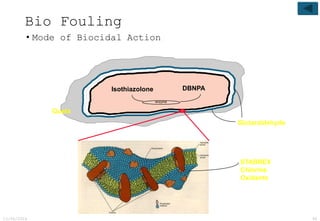
• Mode of Biocidal Action
13/06/2024 96
Isothiazolone DBNPA
Glutaraldehyde
Quats
STABREX
Chlorine
Oxidants
enzyme
Bio Fouling
pH Effect on Chlorine/Bromine
13/06/2024 97
-
Cl + H O HOCl OCl + H
2 2
+
0
10
20
30
40
50
60
70
80
90
100
4 5 6 7 8 9 10 11 12
pH
HOCl
or
HOBr
in
%
0
10
20
30
40
50
60
70
80
90
100
OCl-
or
OBr-
in
%
HOCl
HOBr
Bio Fouling
Volatility of Common Oxidants
• Stabilized HOBr 0.1 X
• HOBr 1 X
• Bleach - HOCl 1
2 X
• Chlorine Dioxide 1
1,800 X
• Ozone 2
160,000 X
•
1
Blatchley et al., 1992
2
Montgomery, 1985
13/06/2024 98
Bio fouling
Impact on heat transfer
13/06/2024 99
0
10
20
30
40
50
60
70
80
0 0,5 1 1,5 2 2,5 3 3,5 4 4,5 5
Deposits in mm
Losses
in
%
Biofilm
Calcium carbonate
Corrosion
6/13/2024 100
Corrosion
• Basic discussion
• Closed systems
• Open systems
• Once through
13/06/2024 101
Corrosion
• An electrochemical process in which a
metal (i.e. iron, zinc, copper) in
it’s elemental form returns to it’s
native (i.e., oxidized) state.
• For example, iron is naturally present
as iron oxide (FeO, Fe3
O4
, Fe2
O3
). By
reduction process it is transformed to
native iron (Fe°)
• In presence of water, the elemental
iron tends naturally to transform
again to the oxide state, normally as
combination of Fe3
O4
and Fe2
O3
13/06/2024 102
Corrosion
• Principles of the corrosion cell
• The following elements are required for corrosion to
occur:
• a corrodible surface - one with electrons to lose (ANOD)
• a difference in potential - a driving force for the
electrons
• an electron acceptor - a place for the electrons to go
(CATHOD)
• an electrolyte, to close the circuit - conditions conducive
for electron flow
13/06/2024 103
Corrosion
• Principles of the corrosion cell
• If one of these factors is not available, the
corrosion does not occurs
• Main reactions in neutral-alkaline conditions, are
the oxidation of the metal at the anod and the
reduction of the oxygen at the cathod
• Basic principle of the corrosion phenomenon is that
the anodic corrosion rate is equal to the cathodic
corrosion rate
13/06/2024 104
Corrosion
• Principles of the corrosion cell
• Chemistry of the corrosion reactions:
• Anodic reaction
• Fe°--- Fe
+2
+ 2e
-
(oxidation)
• Cathodic reaction
• 1/2 O2+ H2O + 2e
-
--- 2OH
-
(reduction)
• At low pH value (<5) the hydrogen ion (H
+
) can take the
place of the oxygen and close the electric circuit
according to the following reaction
• 2H
+
+ 2e
-
--- H2 (reduction)
13/06/2024 105
Corrosion
Principles of the corrosion cell
13/06/2024 106
Corrosion
The Type of Corrosion is Determined by the
Environment at the Anode:
• Chemistry Anomalies
• Differential Ion Cells
• Differential Oxygen Cells
• Surface Anomalies
• Deposits
• Surface Imperfections
• Dissimilar Metals
13/06/2024 107
Corrosion
Principles of the corrosion cell
13/06/2024 108
Corrosion
Impact of corrosion
• Reduction of the heat transfer efficiency
• Higher frequency for maintenance and cleaning
• Equipment replacement
• Leaks on water and process side
• Unscheduled shut-down
13/06/2024 109
Corrosion
Principles of the corrosion cell
• Polarization
• Polarization of the anod occurs as the corrosion products
form a tick and uniform layer on the metal surface
• Polarization of the cathod occurs as the hydroxyl ions, the
hydrogen or a corrosion inhibitor, form a barrier that
impedes a further reduction of the such gases (O2)
• As these barriers are breaked (depolarization), the
corrosion starts again
13/06/2024 110
Corrosion
Principles of the corrosion cell
• Depolarization
• Main factors that can case the depolarization are:
• Water velocity (erosion, cavitation)
• pH
• High water velocity can remove the barrier causing the
depolarization
• As the pH drops, the concentration of hydrogen increses.
These ions will react with the hydroxyl ions at the cathod
that is then depolarized
• Since at low pH the solubility of the anodic corrosion
products increses, also the anod will be depolarized
13/06/2024 111
Corrosion
Principles of the corrosion cell
• Polarization
13/06/2024 112
Corrosion
Principles of the corrosion cell
• Impact of water velocity
13/06/2024 113
Corrosion
Principles of the corrosion cell
• Galvanic corrosion
• It is a particular type of corrosion that occurs when two
different metals are in contact between them and to the
electrolyte
• Is formed a corrosion cell where one metal is the anod and
the other is the cathod
• One example is the copper in contact with the carbon steel
where this become the anod because, being less noble, will
release more easily the electrons, and copper will be the
cathod. Loss of metal occurs at the anod side, then the
carbon steel will be corroded
13/06/2024 114
Corrosion
Principles of the corrosion cell
• Galvanic corrosion
13/06/2024 115
- Wider cathodic area >> higher corrosion rate
- Small cathodic area >> lower corrosion rate
- Wide anodic area >> generalized corrosion
- Small anodic area >> pitting corrosion
Corrosion
Principles of the corrosion cell
• Galvanic series in sea water
13/06/2024 116
Magnesium
Magnesium Alloys
Zinc
Galvanized Steel
Aluminum 1100
Aluminum 6053
Alclad
Cadmium
Aluminum 2024 (4.5 Cu, 1.5 Mg, 0.6 Mn)
Mild Steel
Wrought Iron
Cast Iron
13% Chromium Stainless Steel
Type 410 (Active)
18-8 Stainless Steel
Type 304 (Active)
18-12-3 Stainless Steel
Type 316 (Active)
Lead-Tin Solders
Lead
Tin
Muntz Metal
Manganese Bronze
Naval Brass
Nickel (Active)
76 Ni - 16 Cr - 7 Fe Alloy (Active)
Ni - 30 Mo - 6 Fe - 1 Mn
Yellow Brass
Admiralty Brass
Aluminum Brass
Red Brass
Copper
Silicon Bronze
70:30 Cupro Nickel
G-Bronze
M-Bronze
Silver Solder
Nickel (Passive)
76 Ni - 16 Cr - 7 Fe
Alloy (Passive)
67 Ni - 33 Cu Alloy (Monel)
13% Chromium Stainless Steel
Type 410 (Passive)
Titanium
18-8 Stainless Steel
Type 304 (Passive)
18-12-3 Stainless Steel
Type 316 (Passive)
Silver
Graphite
Gold
Platinum
Passive Passive Passive
Active Active Active
Corrosion
• Types of Cooling Water Corrosion
• General Etch
• Concentration Cell Corrosion
• Cracking
• Mechanical Damage
13/06/2024 117
Corrosion
Types of Cooling Water
Corrosion
•General Etch
• Metal loss in which a given area is alternately a cathode
and an anode. Metal loss occurs uniformly over the entire
surface
• This is the preferred type of corrosion.
13/06/2024 118
Corrosion
Types of Cooling Water
Corrosion
•Concentration Cell Corrosion
• A localized attack caused by a chemical anomaly
• Crevice Corrosion
 Under Deposit Corrosion
 Tuberculation
 Biologically Induced Corrosion
 Acid or Alkaline Corrosion
13/06/2024 119
Corrosion
Types of Cooling Water
Corrosion
• Tuberculation
• Highly structured mounds of corrosion products that cap
localized regions of metal loss
13/06/2024 120
Corrosion
Types of Cooling Water Corrosion
• Cracking
• Failures caused by the combined effects of
corrosion and metal stress. Initiate on
the surface exposed to the corrodant, and
propagate into the metal in response to
the stress state. The critical factors
are:
• Sufficient Tensile Stress
• A Specific Corrodant
13/06/2024 121
Corrosion
Types of Cooling Water
Corrosion
•Mechanical Damage
• Corrosion Fatigue
• Erosion – Corrosion
• Cavitation
• Dealloying
13/06/2024 122
Corrosion
Principles of the corrosion cell
• Localized corrosion cell
• When the metal is exposed to different concentration of a
species in solution
• If the concentration of the oxygen or chloride ion is
different close to two areas of the metal surface, can be
formed a corrosion cell
• This type of cell is called differential aeration cell or
differential concentration cell
13/06/2024 123
Corrosion
Principles of the corrosion cell
• Differential aeration cell
• Different oxygen concentration available for different
surface area of the metal
• Deposit formation create the ideal conditions to form the
differential aration cell by creating a barrier to the
homogeneus oxygen diffusion
13/06/2024 124
Corrosion
Principles of the corrosion cell
• Differential aeration cell
13/06/2024 125
Corrosion
Principles of the corrosion cell
• Differential Concentration cell
• Deposit formation can increase pH at the cathod and decrease pH
at the anod
• This phenomenon is called corrosion cell at different ions
concentration and occurs in a occluded cell
• In the occluded cell, a barrier is formed that is permeable only
to particular species such as the chlorides or hydrogen (H2)
• The negative ions of chlorides are accumulated to the anod to
balance the cationic Fe++ produced by meta oxidation
• In the rich hydrogen and chlorides environmental most of the
metal are more soluble
13/06/2024 126
Corrosion
Principles of the corrosion cell
• Differential ion concentration cell
13/06/2024 127
Corrosion
Principles of the corrosion cell
• Differential ion concentration cell
13/06/2024 128
Corrosion
Principles of the corrosion cell
• Differential ion concentration cell
13/06/2024 129
Corrosion
Principles of the corrosion cell
• Impact on corrosion - Dissolved solids
13/06/2024 130
Corrosion
Principles of the corrosion cell
• Impact on corrosion - pH
13/06/2024 131
100
10
0
5 6 7 8 9 10
Corrosion
Rate,
Relative
Units
pH
Corrosion
Principles of the corrosion cell
• Impact on corrosion - Dissolved gas
• Main interesting gases in industrial cooling water
systems are carbonic dioxide and oxygen
• As CO2 increases, pH will drop causing the
depolarization of the cathodic areas
•In low buffered water (i.e.
Condensate or demineralized
water), the pH is dropped more
easily than in buffered water
• Sulfuric acid is almost totally ionized as hydrogen
sulfate ion and bisulfate ion that cause the
depolarization of the anodic areas
• Ammonia increases the corrosion of copper and alloys
of copper by complexing the copper present in the
protective layer of copper oxide or copper carbonate
13/06/2024 132
Corrosion
Principles of the corrosion cell
• Impact on corrosion - Dissolved gas
13/06/2024 133
Corrosion
Principles of the corrosion cell
• Impact on corrosion – Temperature
• As rule of thumb, each 10°C of water temperature increase,
corrosion rate will double
• This because, increasing the temperature, rises the
diffusion rate of the oxygen at the cathod and the kinetic
of the cathodic reaction of the oxygen reduction
• The oxygen corrosion on carbon steel is maximum at 80°C.
This beacuse the solubility of oxygen decreases with the
increment of the temperature that is in opposition with the
kinetic of reaction increment with the temperature
13/06/2024 134
Corrosion
• Principles of the corrosion cell
• Impact on corrosion – Water velocity
• If the water velocity is too high, the corrosion products
formed at the anod are removed from the metal surface and
the protective film cannot be formed
• In general, corrosion increases with the increment of the
water velocity
• However, more generalized and uniform corrosion occurs with
the increment of the water velocity
• Increment of the water velocity reduce the corrosion of
some metals, like the stainless steel and aluminum, that
need the oxygen to form the passive film
13/06/2024 135
13/06/2024 136
Factors impact on metal failure
• Fluid velocity
• Recommended fluid velocity for tube
material in salt water (m/s)
< 0.8 0.9-1.5 1.5-1.8
Copper
Tube
metal
1.8-2.7 2.7-3.6 3.6
Admiralty
C70600
C71500
C72200
70-30 2Fe 2Mn
SS
= good performance
= may give good performance, but may require a
closer study of the conditions at the site and
relationships with other factors
= material not performed well
Corrosion
General Methods for Corrosion Inhibition
• Use Corrosion Resistant Materials
• Apply Inert Barrier or Coating
• Use Cathodic Protection
• Adjustments to Water Chemistry
• Application of Corrosion Inhibitors
13/06/2024 137
Corrosion
Chemical Corrosion Inhibitors
• Mechanism
• Principally Anodic
• Principally Cathodic
• Both Anodic and Cathodic
13/06/2024 138
Corrosion
Anodic Inhibitors
• Function by adjusting the chemistry at the anode
(point of high potential)
• Chromate
• Molybdate
• Nitrite
• Ortho Phosphate (High Dose)
• Silicate
13/06/2024 139
Corrosion
Cathodic Inhibitors
•Function via reactions at the
cathode (point of high pH)
13/06/2024 140
electrons
O2
OH- OH- OH-
Cathode
Zn++ + 2 OH- Zn(OH)2
Ca++ + OH- + HCO3
- CaCO3 + H2O
Ca++ + OH- + H2PO4
- CaHPO4 + H2O
Corrosion
Cathodic Inhibitors
• Zinc
• Ortho Phosphate (low dose)
• Polyphosphate
• Phosphonates
• Calcium Carbonate
13/06/2024 141
Corrosion
Both Anodic and Cathodic Inhibitors
• Soluble Oils
• Azole Filmers (copper alloys protection)
 Mercaptobenzothiazole (MBT)
 Benzotriazole (BZT)
 Tolytriazole (TT)
13/06/2024 142
Corrosion
Closed systems
13/06/2024 143
Corrosion
• Closed system
• Operation
• Medium/High heat flux
• Use of demineralized water
• High residence time
• Presence of multi-metals
• Low/no water consumption (low/no fresh water / treatments)
13/06/2024 144
Corrosion
• Closed system – Operation
• Water characteristics
• Desalinated water quality (demineralized, softened,
condensate) is normally used to avoid scale problems
• However, desalinated water, not buffered, is very
aggressive to the metals, specially carbon steel and copper
alloys
• Biological fouling must also be under control to prevent
Microbiological Induced Corrosion (MIC)
• Good metal passivation is absolutely necessary to prevent
the damage of the equipments
13/06/2024 145
Corrosion
• Closed system - Metal protection
• Protection of closed circulating water systems
generally features both high pH and high inhibitor
levels
• System pH is most often held at 8,5-9,5 – This
reduce the corrosion of mild steel substantially
13/06/2024 146
Corrosion
• Closed system – Metal Protection
• Treatment (anodic)
• Must be capable to create a very strong passive barrier by
modifying the corrosion potential in the anodic direction
13/06/2024 147
Corrosion current
Equilibrium
potential
Anodic
Cathodic
Passive
potential
E
Log(i)
Corrosion
• Closed system – Metal Protection
• Basic treatments
• Chromates (200 – 1500 ppm)
• Restricted by envirnmental laws
• Pump seal failure at high dosage
• Nitrites (300 – 1500 ppm)
• Excellent mild steel protection, even for
pre-corroded surface
• Use borax as buffering agent (pH > 8,5)
• Nitrite is a nutrient for bacteria growth
(Nitrification)
• Bacteria produce low pH and slime deposits
• Molybdates (100 – 200 ppm)
• Week anodic inhibitor
• Often combined with nitrites and other agents
• High risk in case of under-dosing
13/06/2024 148
Corrosion
• Guideline for assessing corrosion*
13/06/2024 149
Metal Corrosion
rate
( mils /year )
Comment
Carbon steel 0 -2 Excellent corrosion resistance
2 - 3 Generally acceptable for all systems
3 - 5 Fair corrosion resistance; acceptable with
iron fouling-corrosion program
5 - 10 Unacceptable corrosion resistance:
migratory corrosion products may cause
severe iron fouling
Admiralty
brass
0 - 0.2 Generally safe for heat exchanger tubing
and mild steel equipment
0.2 - 0.5 High corrosion rate may enhance
corrosion of mild steel
> 0.5 Unacceptable high rate for long term;
significantly affects mild-steel corrosion
Stainless steel 0 - 1 Acceptable
> 1 Unacceptable corrosion resistance
*Indicated rates apply to general system corrosion
mm/year
0 to 0.05
0.05 to
0.075
0.075 to
0.13
0.13 to
0.25
0 to 0.05
0.05 to
0.13
>0.13
0 to 0.03
Monitoring
Detection methods for water problems:
13/06/2024 150
Problem Monitoring Technique
Corrosion Corrosion coupons
Electrical probe
Deposit monitor
Chemical analysis
Scale Deposit monitor - fouling of heat-transfer surface
Chemical analysis - pH, system balance
Deposit analysis
Biofilm Total counts - Microbiological differential analysis
Fouling factor

Process Cooling water Tower system basics.pptx

  • 1.
  • 2.
    Water as coolingfluid • To have good heat transfer, the cooling fluid must be convenient from thermodinamic and cost point of view • High Thermal capacity • Low specific volume • Temperature sufficiently lower then that of the process fluid • High availability • Low cost 2
  • 3.
    Water as coolingfluid • SPECIFIC HEAT • is the measure of how well a substance can absorb heat • 1 Kcal/kg°C or 4,18 KJ/kg°C • VAPORIZATION HEAT • Energy to transform liquid to gaseous • 540 Kcal/kg at 100°C • 575 Kcal/kg at 40°C 3
  • 4.
    Water as coolingfluid • Main water characteristics Water Air Glycerin - ka (Kcal/hm °C) 0,541 0,023 0,243 - cp (kcal/kg °C) 0,998 0,24 0,6 - d (kg/m3 ) 992 1,136 1250 - u - 104 (ns/m2 ) 0,81 0,191 2800 - v . 106 (m2 /s) 0,686 16,8 2200 - Pr (cp.u/ka) 4,52 0,72 0,0025 - a . 104 (m2 /h) 5,46 841 3,2 ka = thermal conductivity cp = specific heat d = density u = dynamic viscosity v = cinematic viscosity Pr = Prandtl number a = thermal diffusivity
  • 5.
    Water as coolingfluid • However, due to the presence of sevaral impurities, water can cause severe problems to the heat transfer equipment: • HEAT TRANSFER BASICS • WATER CHARACTERISTICS • SCALE • FOULING • BIOLOGICAL FOULING • CORROSION 5
  • 6.
  • 7.
    Basics of heattransfer • To understand the impact of water characteristics, is useful to remind the heat transfer laws that help us to recognize the importance of a right treatment • CONDUCTION • CONVECTION • RADIATION 13/06/2024 7
  • 8.
    Basics of heattransfer • Conduction • It is the transfer of heat between two areas at different temperature of same material (or different material in contact), due to the heat flux between the molecules without these move from their average position • Heat transfer capacity of a material, called thermal conductivity, determine the gradient of temperature accross the material • The foundamental law of the conduction is the Fourier law: where 13/06/2024 8 qk = ka (t2 - t1) / Lc qk = heat flux, kcal/h m2 ka = thermal conductivity, kcal/m h°C (t2-t1) = gradient of temperature through a layer of material, °C Lc = thickness across which the heat transfer occurs, m
  • 9.
    Basics of heattransfer • Convection • It is the heat transfer associated to the transport of mass and energy beteen two points of a fluid or a fluid with a solid 13/06/2024 9 Where: qc = hc A (t2-t1) qc = convection heat transfer, kcal/h hc = convection heat transfer coefficient, kcal/hm2°C A = heat transfer surface, m2 (t2-t1) = difference of temperature across a fluid film, °C
  • 10.
    Basics of heattransfer • Convection • To get high heat transfer value it is needed to reduce as much as possible the limit film layer • This can be done by increasing the flow velocity and/or the turbolence of the fluid • The ratio between the gradient of temperature inside the fluid in contact with the surface and a reference gradient of temperature is given by the Nusselt Number (Nu) • The Nu correlates the convection coefficient h, the diameter D and the 13/06/2024 10 Nu = hc D / ka
  • 11.
    Basics of heattransfer • Convection • Reynolds Number (Re) indicate if a fluid is moving in the laminar or turbolence region • The Re is adimensional and it is proportional directly to the diameter (D)of the tube, the density (d) and velocity (V) of the fluid and inverse to the viscosity of the fluid (u) • Approximatively, for clean tubes Re = D d V / u Re < 2100 laminar motion Re > 2400 turbulent motion
  • 12.
    Basics of heattransfer • Convection • According to the convection coefficient (hc), Nusselt number is function of Reynolds number (Re) and Prantl number (Pr) • Where Pr is adimensional and it is given by the relationship • A realshionship to calculate the convection coefficient, valid for turbulent region, is given by Dittus and Boelter 13/06/2024 12 Nu = f(Re,Pr) Pr = cp u / ka hc D / ka = 0.023 Re0.6 Pr1/3 u/uw uw = Skin temperature viscosity
  • 13.
    Basics of heattransfer • Radiation • It is the heat transfer due to the radiation effect, even in presence of material, between two bodies at different temperature • The radiation law is given by Stefan-Boltzman (generalized) 13/06/2024 13 qi = ds e A1 (T4 1 - T4 2) where: qi = thermal power of radiation, kcal/h ds = Stefan-Boltzman’s constant, 4,88.10-8 kcal/m2h°K4 e = emissivity of the mateiral A1 = surface, m2 (T1-T2) = differential of temperature across a fluid film, °K
  • 14.
    Basics of heattransfer • Heat transfer in the industrial equipments • In the shell&tubes units the heat transfer occurs mainly by conduction and convection • In the furnaces and heaters the heat transfer occurs by convection and radiation 13/06/2024 14 Hot Process In Hot Cooling Water Out Cooled Process Out Cold Cooling Water In Kcal's Kcal's SIMPLE HEAT TRANSFER
  • 15.
    Basics of heattransfer • Shell&tubes heat transfer – Water shell side 13/06/2024 15 External deposit External Fluid film Internal deposit Internal Fluid film Wall of tube T1 T3 T2 T4 T5 T6 T8 T7 Cold fluid Hot fluid Laminar layer Transition zone Turbulent zone Fluid Outside tube Fluid Inside tube Conduction: T4 - T5 T3 - T4 T5 - T6 Convection: T1 - T3 T6 - T8
  • 16.
  • 17.
    Impact of water characteristics •Industrial plants take advantage from the thermodinamic properties of the water as cooling fluid • The impurities present in the water can cause severe problems to the heat transfer units • It is important to control the operation of heat transfer equipments within the allowed limits of the chemical-physical parameters • Water, that become warmer due to the heat transfer, couid cause problems due to the original impurities, their concentration in evaporative units and absorption of pollutants from processes and atmosphere 13/06/2024 17 • Scale • Deposit • Corrosion • Fouling
  • 18.
    Impact of water characteristics •Aspect • Can be observed materials suspended that could potentially settled on the heat transfer surface • These materials could cause deposit, scale, corrosion, erosion, biological foulinf and foam 13/06/2024 18
  • 19.
    Impact of watercharacteristics • Temperature • Specially the skin temperature, represents a significative index of the potential problems that can occurs (scale, corrosion, fouling) • The solubility of scaling salts decrease with the increase of the temperature. So, where this is higher the potential precipitation is more critical. • Higher potential of scale formation occurs in the hottest areas of the heat transfer unitse (i.e. The inlet of the process where the temperature is higher) 13/06/2024 19
  • 20.
    Impact of water characteristics •pH • pH units give the degree of acidity or basicity of water • pH represents a very important factor on the development and entity of scale, corrosion and biological fouling phenomena • pH is the basic parameter to calssify the corrosiveness of waters 13/06/2024 20
  • 21.
    Impact of water characteristics •Electrical conductivity • Electrical conductivity represents the reciprocal of the resistivity to the flowing of the electrical current • It is typical for each electrolyte, function of the ion concentration • It is an indirect measurement of the dissociated matters present in the water • It is an index of the purity and salinity • Higher ion concentration increase generally the solubility of the scaling salts • Lower resistance increases the aggressivity of the water 13/06/2024 21
  • 22.
    Impact of water characteristics •Total solids (TS) • TS represents all the solids present in the water as soluble, colloidal and suspended • It is expressed as mg/liter and is determined by evaporation at 180°C • High ST value indicates normally poor water quality 13/06/2024 22
  • 23.
    Impact of water characteristics •Total dissolved solids (TDS) • TDS are the total dissolved solids in the water • It is expressed as mg/liter and are determined by evaporation at 180°C, after filtration at 0.45 micron • High TDS value promote the scale and corrosion phenomena 13/06/2024 23
  • 24.
    Impact of water characteristics •Total hardness • It represents the amount of alkaline salts, mainly calcium and magnesium salts, that are solubilized in the water • It is expressed as mg/liter of Calcium carbonate • The presence of hardness cause scale if no tretment is applied to inhibit the precipitation of the scaling salts 13/06/2024 24
  • 25.
    Impact of water characteristics •Temporary hardness • It represents the amount of earth-alkaline bicarbonates (calcium and magnesium) in the water • It is expressed as mg/liter of Calcium carbonate • It is directly responsible for scale formation 13/06/2024 25
  • 26.
    13/06/2024 26 Impact ofwater characteristics • Calcium hardness • It represents the total content of calcium as bicarbonate, sulfate and possible chloride present in the water UNITS OF HARDNESS RELATION Hardness, °d French, °d German, °D English, °D USA, °d mVal ppm French 1.00 0.56 0.70 0.58 0.20 10.00 German 1.79 1.00 1.25 1.05 0.36 17.85 English 1.43 0.80 1.00 0.84 0.29 14.30 USA 1.71 0.96 1.20 1.00 0.34 17.10
  • 27.
    Impact of water characteristics •Water hardness 13/06/2024 27 Temporary Hardness (carbonatic) Permanent Hardness (non-carbonatic Calcium carbonate [CaCO 3] Calcium sulfate [CaSO 4 ] Magnesium carbonate[MgCO 3] Magnesium silicate [MgSiO3] Calcium bicarbonate[Ca(HCO3) 2] Calcium chloride [CaCl 2] Magnesium bicarbonate [Mg(HCO 3) 2] Magnesium sulfate Silicates [MgSO 4]
  • 28.
    Impact of water characteristics •Total alkalinity • It represents the total alkaline salts present in the water (bicarbonates, carbonates, hydrates, alkaline phosphates) • It is expressed as mg/liter of Calcium carbonate • Alkalinity < hardness = total calcium and magnesium bicarbonate • temporary hardness / carbonatic hardness • Hardness - Alkalinity = non carbonatic alkalinity • permanent hardness 13/06/2024 28
  • 29.
    Impact of water characteristics 13/06/202429 5 5.5 6 6.5 7 7.5 8 8.5 9 9.5 pH Total Alkalinity of recirculating water, ppm CaCO3 pH/Alkalinity Relationship (Experimental values from operating cooling towers)
  • 30.
    Impact of water characteristics 13/06/202430 7 7.2 7.4 7.6 7.8 8 8.2 8.4 8.6 8.8 9 0 30 60 90 120 150 180 210 240 270 300 pH Acid added Effect of acid addition
  • 31.
    Impact of water characteristics •Effect of acids on Malkalinity 13/06/2024 31 Acid Degrees Bè %Active ppm required to reduce 1 ppm “M” Alkalinity H2SO4 (Sulfuric) 66 93.35 1.05 NH2SO3H (Sulfamic) Crystals 99.6 1.95 Granular 93 2.06 HCI (Muriatic) 18 30 2.43 36.5 2.00 HNO3 (Nitric) 36 52.3 2.41 38 56.5 2.23 40 61.4 2.05 42 67.2 1.87 HC2H3O2 (Acetic) 12 99.5 1.20 H3C6H4O7 (Citric) Crystals 99.5 1.28 HCHO2 (Formic) - - - 99.5 0.92 H2C2O4 2H2O (Oxalic) Crystals 99.0 0.91 ppm Acid = 1ppm Alk / PE CaCO3 * PE acido/ %activ acid
  • 32.
    Impact of water characteristics •Alkalinity 13/06/2024 32
  • 33.
    Impact of water characteristics •Alkalinity 13/06/2024 33 CONCENTRATION BASE ON ALKALINITY M (methylorange) e P (phenolphtalein) (HCO 3 -) (CO 3 -) (OH -), P = 0 M 0 0 2P < M M-2P 2P 0 2P = M 0 M 0 2P > M > P 0 2(M-P) 2P - m P = M 0 0 M
  • 34.
    Impact of water characteristics •Alkalinity and acidity 13/06/2024 34
  • 35.
    Impact of water characteristics •Chlorides • High level of chlorides are corrosive to most of metals, specially SS • It is normally considered to calculate the concentration ratio in the open systems compared to that in the make-up water • Can be used as indicator for a correct operating of the cooling system • It is expressed as mg/liter of Cl 13/06/2024 35
  • 36.
    Impact of water characteristics •Silica • Concentration of silica must be under control to avoid severe scaling problem • It can precipitate as silica or as magnesium silicate • Since the resistivity is high, the impact on heat transfer is very critical • Cleaning of silica deposits is very difficult • It is expressed as mg/liter of SiO2 13/06/2024 36
  • 37.
    Impact of water characteristics •Iron • It can cause indirect deposition and corrosion • High value of iron requires a specific pre-treatment of the water • Presence of iron at > 1ppm has significative impact on the scale and corrosion inhibitor by incresing the consumption by adsorption and chelation phenomena • It is expressed as mg/liter of Fe 13/06/2024 37
  • 38.
    Impact of water characteristics •Organic matter • It could be present in the make-up or adsorbed in the circulating water from the atmosphere or leak process or bacteria proliferation • Presence of organic matter could cause foaming, bacteria growth, which can initiate corrosion processes • It is expressed as mg/liter of KMnO4 or mg/liter O2 13/06/2024 38
  • 39.
    Impact of water characteristics •Dissolved gases (CO2 / O2 / H2S / NH3 / light hydrocarbons) • Enter in the system with make-up, the atmosphere anf process leaks • Could cause severe corrosion problems, high bacteria growth, react with the normal chemical treatments • It is expressed as mg/liter of the gas 13/06/2024 39
  • 40.
    Impact of watercharacteristics • CO2 • Relationship between temperature (°C), pressure and the solubility of carbon dioxide (CO2) in water 13/06/2024 40
  • 41.
    Impact of watercharacteristics • NH3 • Relationship between percent ammonium ion (NH4+) versus temperature and pH. • As the pH and the temperature rise, the fraction of NH3 in the NH4 + form increases. 13/06/2024 41
  • 42.
    Impact of water characteristics •Ether extractable • Determines the presence of Greases & Oils • Could affect the cooling system by promoting the bacteria growth • Could create deposits with bacteria growth and initiating corrosion phenomena • It is expressed as mg/liter as it is 13/06/2024 42
  • 43.
    Impact of water characteristics •Manganese • This element can be normally present in deep waters • It is easily oxidized to form deposits, specially in high temperature areas • Could initiate galvanic corrosion by deposition of the oxide with high electrochemical potential • Presence of Mn at a value exceeding the recommended value, need demanganizing pretreatment • It is expressed as mg/liter Mn 13/06/2024 43
  • 44.
    Impact of water characteristics •Copper • It is rare to find significative concentration of this element in the make-up waters (< 10 ppb) • The source in the circulating water is normally the corrosion process • Can be deposited on carbon steel surface to initiate galvanic corrosion • It is expressed as mg/liter Cu 13/06/2024 44
  • 45.
    Impact of water characteristics •Microbiological formations • Include several different species (bacteria, algae, fungi, yeasts) the proliferate in the ideal cooling water conditions • It is expressed as units per milliliter • Microbiological growth is one of the most critical factor for the cooling water system • Produce bio-fouling with decomposition products • Fast reduction of water flow and reduction of the heat transfer • Metabolize acidic environment and induced corrosion (MIC) 13/06/2024 45 Microfouling
  • 46.
  • 47.
    Mineral Salt Scale •Topics to be covered: • Effects of Scale on Process • Mechanisms of Scale Formation • Factors Affecting Scale Formation • Types of Commonly Encountered Scales • Prediction of scale potential • Scale Inhibition and Prevention • Chemical Scale Inhibitors • Control of Scale Inhibition Programs • Norms and Economics 13/06/2024 47
  • 48.
    Scale • Effect ofScale on Cooling Water Systems • Reduces heat transfer efficiency • Decreases unit or production capacity • Can promote corrosion & microbial growth • Increases pump pressure requirements • Higher operating costs/decreased profits 13/06/2024 48
  • 49.
    Scale • Impact onheat transfer • Scale due to the formation of coherent and hard deposits is the predominant cause of the reduction of heat transfer • It is formed with the precipitation of the scaling salts by the effect of temperature increase, high concentration (absolute and relative), pH and alkalinity increase, and critical flu-dynamic conditions 13/06/2024 49
  • 50.
    Scale • Impact onheat transfer • From conduction heat transfer equation, is derived the negative impact that deposits have on the efficiency of the heat transfer • The thermal resistance is determined by the relationship • where • The resistance of the water side scale (Rde) reduces the efficiency of the heat transfer equipment 13/06/2024 50 Rd = 1 / Ud - 1 / Uc 1 Ud = ____________________________________ 1 /he + Rde + Rk + Rdi Ae /Ai + Ae/Ai hi
  • 51.
    Scale Impact on heattransfer 13/06/2024 51 Type of deposit Thermal Conductivity (W/m°C) Calcium Carbonate 2.25 - 2.94 Calcium Sulfate 2.25 Calcium Phosphate 2.6 Magnesium Phosphate 2.25 Iron oxide 2.94 Biofilm 0.69 Iron metal 61,6
  • 52.
    Scale • Impact onheat transfer 13/06/2024 52 Insulating effect of foulant deposited uniformly on clean heat-transfer surface 0.001 0.01 0.1 0 10 20 30 40 50 60 70 80 90 100 Heat transfer reduction, % Scale thickness, in SiO2 Clay CaSO4 CaCO3 Al2O3
  • 53.
    Scale • Impact onheat transfer • Economic value • The thickness of the scale can be monitored by both the increse of the pressure drop and the reduction of the heat transfer • The entity of the scale can be measured by periodic computation of the “Global Heat transfer Coefficient (U)” • Comparing the value of the actual U with the design U can be valued the loss of efficiency and the increase of energy needed • Added costs are: 13/06/2024 53 • Higher maintenance frequency • Lower shelf life of the equipments – Under deposit corrosion • Production loss • Out of spec production
  • 54.
    Scale • Impact onheat transfer • Economic value – Example 1 13/06/2024 54 Tube diameter = 12.7 mm Deposit thickness = 1.6 mm Water flow rate reduction = 40-50% 1.6 mm 12.7 mm
  • 55.
    Scale • Impact onheat transfer • Economic value – Example 2 • Having 1 mm thickness of calcium carbonate scale in the inside surface of the tubes in a shell-tubes exchanger – water tube side – with the following design operating conditions: 13/06/2024 55 Temp. outlet, (T2, t2) 46 41 °C Specific heat, (Cp, cp) 0.56 1 Kcal/kg°C Uc kcal/m2 .h.°C Rd m2 .h.°C/kcal Ud kcal/m2 .h.°C Approach temperature, °C Heat load (Q) Q=Wp x Cp x (T2 - T1) 1,713,600 kcal/h Cooling water flow rate (Wc) Wc=Q / ((t2 - t1) x cp) 81600 m3 /h Mean log temperature (LMTD) ((T2-t1)-(T1-t2)) / (Ln(T2-t1)/(T1-t2)) 32.06 °C 5 580 0.0004 471
  • 56.
    Scale • Impact onheat transfer • Economic value – Example 2 (cont’d) • We can calculate the extra energy cost of pumping to compensate the heat transfer loss: 13/06/2024 56 Heat load (Q) Q=Wp x Cp x (T2 - T1) 1,713,600 kcal/h Cooling water flow rate (Wc) Wc=Q / ((t2 - t1) x cp) 81600 m3 /h Mean log temperature (LMTD) ((T2-t1)-(T1-t2)) / (Ln(T2-t1)/(T1-t2)) 32.06 °C Heat transfer surface Q / (Ud x LMTD) 113.53 m2
  • 57.
    Scale • Impact onheat transfer • Economic value – Example 2 (cont’d) • Calculation of extra water flow needed 13/06/2024 57 Resistivity Calcium Carbonate 0.516 m2 .h.°C/kcal.m Resistivity for 1 mm CaCO3 Rd 0.000516 Ui 1 / (1/Uc + Rd) 446.4 kcal/ m2 .h.°C LMTDi Q / (Ui x S) 33.81 °C (t2 - t1)x (found with solver) Q / (Wc x cp) 16.95 °C t2i t1 + ((t2 - t1)i 36.95 °C (T2 - T1)i (Wc x cp x (t2 - t1)i/ (Wc x Cp)) 34.00 °C T2i T1 - (T2 - T1)i 46.00 °C Approach temp. (T2 - t2)i 9.05 °C Wci Q / (cp x (t2 - t1)i) 101,116 m3 /h Wci - Wc 19,516 m3 /h Qi Ui x S x LMTDi 1,713,600 kcal/h Qi Wci*(t2i-t1) *cp 1,713,600 kcal/h Qi Wc*(T2i-T1) *Cp 1,713,600 kcal/h Check
  • 58.
    Scale Chemistry • Four Requirementsfor Scale Formation • Ion Supersaturation • A Nucleation Site • Adequate Contact Time • Dissolution & Precipitation 13/06/2024 58
  • 59.
    Scale Chemistry • Factors AffectingScaling Potential • Ion Concentration • pH • Time • Temperature 13/06/2024 59
  • 60.
    Scale Chemistry • Contributing Factors: •Hydraulics and Flow Velocities • Surface Characteristics • Corrosion • Fouling • Microbial activity • System design and operation 13/06/2024 60
  • 61.
    Scale Chemistry • Contributing Factors(cont’d): • Presence of Competing ions • Latent period of precipitation • Total Dissolved Solids (TDS) • Total Suspended Solids (TSS) • Co-precipitation • Post-precipitation 13/06/2024 61
  • 62.
    Scale Chemistry • Commonly EncounteredCooling Water Scales • Calcium carbonate • Calcium phosphate • Iron phosphate • Iron oxides • Silicates 13/06/2024 62
  • 63.
    Scale • Chemistry • Precipitationand crystal growing 13/06/2024 63
  • 64.
    Scale Chemistry The solubility ofcalcium carbonate, main component of scale, is function of temperature and partial pressure of carbon dioxide 13/06/2024 64 SOLUBILITY OF CALCIUM CARBONATE AS FUNCTION OF TEMPERATURE T °C Solubility of CaCO3 (ppm) at the p.p. (atm) CO2 Partial pressure CO2 ---- 0.0003 (P atm) 0.001 0.01 1.00 10.00 0 95 1600 10 75 1250 20 59 1000 25 53 78 170 900 2250 30 47 800 50 32 550
  • 65.
    Scale Chemistry • Calcium carbonate •Solubility as function of temperature 13/06/2024 65
  • 66.
    Scale Chemistry • Calcium sulfate •Solubility in high salinity water 13/06/2024 66
  • 67.
    Scale Chemistry •Other Scales foundin Cooling Water Systems • Magnesium silicate • Silica • Calcium sulfate • Zinc phosphate • Aluminum phosphate • Calcium fluoride 13/06/2024 67
  • 68.
    Scale • Chemistry 13/06/2024 68 Magnesiumsilicate Max concentration of Mg and SiO2 in cooling water systems
  • 69.
    Scale • Chemistry 13/06/2024 69 Silica Solubilityof different silica state as function of temperature
  • 70.
    Scale Chemistry 13/06/2024 70 Evaporative seawater cooling tower Saturation curves of problematic scaling salts 0 0.5 1 1.5 2 2.5 3 3.5 4 4.5 5 0 10 20 30 40 50 60 70 80 90 100 110 120 130 140 150 160 170 180 190 200 Temperature Seawater concentration facror Experimented operating conditions CaSO4.2H2O CaSO4 CaSO4.1/2H2O Mg(OH)2 pH=8.5 Mg(OH)2 pH=8.0 Mg(OH)2 pH=7.5
  • 71.
    Scale • Chemistry 13/06/2024 71 Depositcomposition in sea water evaporator 0 10 20 30 40 50 60 70 80 90 100 60 66 71 77 82 88 93 99 104 Evaporator water temperature, °C Composition of scale CaSO4 CaCO3 Mg(OH)2 Nominal temperature difference - 27 °C Concentration factor = 2
  • 72.
    Scale Prediction • To predictthe scaling potential and/or the aggressivity of the waters have been elaborated several indices • These are derived from thermodinamic and practical experiences on natural waters • These indices have low meaning in case the ionic equilibrium is changed or, in presence of internal chemical treatments that modify the natural precipitation 13/06/2024 72
  • 73.
    Scale • Prediction • Calciumcarbonate indices 13/06/2024 73 CALCIUM CARBONATE INDICES Index SCALING NO-SCALING LI (Langelier) > 0 < 0 RI (Ryznar) < 6 > 6 DFI (Driving force) > 1 < 1 AI (Aggressiviness) > 10 < 10 ME (Momentary excess) > 0 < 0 LBI (Larson & Buswell) > 0 < 0 SDI (Stiff & Davis) > 0 < 0 PSI (Puckorious) < 6 > 6 CCPP (Rossum & Merril) > 0 < 0
  • 74.
    Scale • Prediction • Langelierindex (LI), with qualitative meaning, determines the equilibrium pH of saturated water with calcium carbonate, called saturation pH (pHs) • This index is expressed by the relationship • where: • pH = pH actual • pHs = pH saturation. 13/06/2024 74 LI = pH - pHs
  • 75.
    Scale • Prediction • Langelierindex • It is calculated with the relationship • Where • pK'2 = - log10 second apparent dissociation constant of carbonic acid • pK' sp = - log10 solubility product of calcium carbonate • pCa = - log10 (Ca) in mols/liter • pAlk = - log10 (alk) in equivalents/liter 13/06/2024 75 pHs = (pK'2 - pK' sp) + pCa + pAlk
  • 76.
    Scale • Prediction • Ryznarindex • Proposed by Ryznar, this index, called “Stability index” is computed with the relationship • Where • pHs = saturation pH • pH = actual pH 13/06/2024 76 RI = 2pHs - pH
  • 77.
    Scale • Prediction • RyznarIndex 13/06/2024 77 CHARACTERIZATION OF THE WATERS BY RYZNAR INDEX Ryznar Index Water characterization 4 to 5 High scaling 5 to 6 scaling 6 to 7 light scaling and/or aggressive 7 to 7.5 aggressive 7.5 to 9 very aggressiva > 9 estremely aggressive
  • 78.
    Scale • Prediction • Mineralsolubility as function of cycles and pH in a open cooling water system without pH control 13/06/2024 78 9 8 7 6 5 4 3 2 1 Cycles number 5.5 6.0 7.0 6.5 8.0 7.5 9.0 8.5 9.5 10.0 10.5 11.0 CaCO3 Ca3(PO4)2(OH) MgSiO3 SiO2 FePO4.H2O Soluble area Insol. Sol. Not soluble: FeO(OH) Fe2O3 Fe3O4 pH Sol. Ins.
  • 79.
    Scale Inhibition • Methods • Limitthe Concentration of Precipitating Ions • Alkalinity Reduction • pH Reduction • Cation Reduction 13/06/2024 79
  • 80.
    Scale Inhibition • Methods (cont’d) •Alter system design/operation Velocity Air Rumble Modify Design Metallurgy Lower Heat Flux 13/06/2024 80
  • 81.
    Scale Inhibition • Methods (cont’d) •Add Chemical Scale Inhibitors • Crystal Modifiers • Chelants and Sequestering Agents • Conditioners and Dispersants 13/06/2024 81
  • 82.
    Scale Mechanism of ChemicalScale Inhibitors • To control the deposition of the scaling salts are added specific chemicals capable to be absorbed on the surface of micro crystals limiting the growing process • The absorption of the ions of these materials represents the most important factor for the control of growing process • The kinetic of this process is dependant also from the degree of super saturation of the solution • where: 13/06/2024 82 S = (Ci - Cf) / Cf S = super saturation Ci = initial concentration of salt Cf = final concentration of salt at the steady state
  • 83.
    Scale Mechanism of ChemicalScale Inhibitors 13/06/2024 83 Scale of macrocrystal Microcrystal layer (corrosion protective) With inhibitor Stabilization Growth suppression Dispersion Crystal modification A B C Microcrystal solubility Macrocrystal solubility A C B
  • 84.
    Scale Mechanism of ChemicalScale Inhibitors • Crystal modification (organophosphonates) • Modifies the Nucleation Site, allowing the formation of stable microcrystals • Sequestration (polyphosphates, polymers, chelants) • Formation of soluble ion complexes, preventing precipitation reactions • Scale conditioners (dispersants, lignins, tannins) • Prevent precipitants from depositing 13/06/2024 84
  • 85.
  • 86.
  • 87.
    Fouling Some common foulantsare: • Silt, Sand, Mud and Iron • Dirt and Dust • Process contaminants, e.g. Oils, Corrosion Products, Microbio growth 13/06/2024 87
  • 88.
    Fouling Factors which influencefouling are: • Water Characteristics • Water Temperature • Water Flow Velocity • Microbiological Growth • Corrosion • Process Contamination • Environmental (i.e. atmospheric pollutants) 13/06/2024 88
  • 89.
    Fouling Three levels toaddress the effects of fouling: • 1. Prevention • 2. Reduction • 3. Ongoing Control • Chemical Treatment • Charge Reinforcers • Wetting Agents 13/06/2024 89
  • 90.
    Fouling • Charge reinforcementmechanism 13/06/2024 90 Slightly Anionic Suspended Particle Suspended Solid Which Has Adsorbed Highly Anionic Chemical Highly Anionic Chemical
  • 91.
  • 92.
  • 93.
    Bio Fouling Growth ofmicroorganisms are affected by the following • Nutrients • Temperature • pH • Location • Atmosphere 13/06/2024 93
  • 94.
    Bio Fouling Types ofMicroorganism • BACTERIA - need/ do not need Oxygen • Aerobic - Slime and Spore former • Anaerobic - SRB, Clostridia, etc. • Iron bacteria – Gallionella • Nitrification - Nitrosomas, Nitrobacter • ALGAE - need light, food source • FUNGI - destroys wood, reinforces deposits • PROTOZOA - feed on bacteria/algae 13/06/2024 94
  • 95.
    Bio Fouling Microbiological Treatments •Common Oxidizing Biocides • Chlorine Gas • Bleach – Hypochlorite • Bromine Tablets • Stabilized Chlorine and STABREX • Ozone • Non-oxidicing Biocides • Aldehydes, Quats, Thiazolone, DBNPA • Biodispersants • do not kill but remove biofilm from surfaces 13/06/2024 95
  • 96.
    Bio Fouling • Modeof Biocidal Action 13/06/2024 96 Isothiazolone DBNPA Glutaraldehyde Quats STABREX Chlorine Oxidants enzyme
  • 97.
    Bio Fouling pH Effecton Chlorine/Bromine 13/06/2024 97 - Cl + H O HOCl OCl + H 2 2 + 0 10 20 30 40 50 60 70 80 90 100 4 5 6 7 8 9 10 11 12 pH HOCl or HOBr in % 0 10 20 30 40 50 60 70 80 90 100 OCl- or OBr- in % HOCl HOBr
  • 98.
    Bio Fouling Volatility ofCommon Oxidants • Stabilized HOBr 0.1 X • HOBr 1 X • Bleach - HOCl 1 2 X • Chlorine Dioxide 1 1,800 X • Ozone 2 160,000 X • 1 Blatchley et al., 1992 2 Montgomery, 1985 13/06/2024 98
  • 99.
    Bio fouling Impact onheat transfer 13/06/2024 99 0 10 20 30 40 50 60 70 80 0 0,5 1 1,5 2 2,5 3 3,5 4 4,5 5 Deposits in mm Losses in % Biofilm Calcium carbonate
  • 100.
  • 101.
    Corrosion • Basic discussion •Closed systems • Open systems • Once through 13/06/2024 101
  • 102.
    Corrosion • An electrochemicalprocess in which a metal (i.e. iron, zinc, copper) in it’s elemental form returns to it’s native (i.e., oxidized) state. • For example, iron is naturally present as iron oxide (FeO, Fe3 O4 , Fe2 O3 ). By reduction process it is transformed to native iron (Fe°) • In presence of water, the elemental iron tends naturally to transform again to the oxide state, normally as combination of Fe3 O4 and Fe2 O3 13/06/2024 102
  • 103.
    Corrosion • Principles ofthe corrosion cell • The following elements are required for corrosion to occur: • a corrodible surface - one with electrons to lose (ANOD) • a difference in potential - a driving force for the electrons • an electron acceptor - a place for the electrons to go (CATHOD) • an electrolyte, to close the circuit - conditions conducive for electron flow 13/06/2024 103
  • 104.
    Corrosion • Principles ofthe corrosion cell • If one of these factors is not available, the corrosion does not occurs • Main reactions in neutral-alkaline conditions, are the oxidation of the metal at the anod and the reduction of the oxygen at the cathod • Basic principle of the corrosion phenomenon is that the anodic corrosion rate is equal to the cathodic corrosion rate 13/06/2024 104
  • 105.
    Corrosion • Principles ofthe corrosion cell • Chemistry of the corrosion reactions: • Anodic reaction • Fe°--- Fe +2 + 2e - (oxidation) • Cathodic reaction • 1/2 O2+ H2O + 2e - --- 2OH - (reduction) • At low pH value (<5) the hydrogen ion (H + ) can take the place of the oxygen and close the electric circuit according to the following reaction • 2H + + 2e - --- H2 (reduction) 13/06/2024 105
  • 106.
    Corrosion Principles of thecorrosion cell 13/06/2024 106
  • 107.
    Corrosion The Type ofCorrosion is Determined by the Environment at the Anode: • Chemistry Anomalies • Differential Ion Cells • Differential Oxygen Cells • Surface Anomalies • Deposits • Surface Imperfections • Dissimilar Metals 13/06/2024 107
  • 108.
    Corrosion Principles of thecorrosion cell 13/06/2024 108
  • 109.
    Corrosion Impact of corrosion •Reduction of the heat transfer efficiency • Higher frequency for maintenance and cleaning • Equipment replacement • Leaks on water and process side • Unscheduled shut-down 13/06/2024 109
  • 110.
    Corrosion Principles of thecorrosion cell • Polarization • Polarization of the anod occurs as the corrosion products form a tick and uniform layer on the metal surface • Polarization of the cathod occurs as the hydroxyl ions, the hydrogen or a corrosion inhibitor, form a barrier that impedes a further reduction of the such gases (O2) • As these barriers are breaked (depolarization), the corrosion starts again 13/06/2024 110
  • 111.
    Corrosion Principles of thecorrosion cell • Depolarization • Main factors that can case the depolarization are: • Water velocity (erosion, cavitation) • pH • High water velocity can remove the barrier causing the depolarization • As the pH drops, the concentration of hydrogen increses. These ions will react with the hydroxyl ions at the cathod that is then depolarized • Since at low pH the solubility of the anodic corrosion products increses, also the anod will be depolarized 13/06/2024 111
  • 112.
    Corrosion Principles of thecorrosion cell • Polarization 13/06/2024 112
  • 113.
    Corrosion Principles of thecorrosion cell • Impact of water velocity 13/06/2024 113
  • 114.
    Corrosion Principles of thecorrosion cell • Galvanic corrosion • It is a particular type of corrosion that occurs when two different metals are in contact between them and to the electrolyte • Is formed a corrosion cell where one metal is the anod and the other is the cathod • One example is the copper in contact with the carbon steel where this become the anod because, being less noble, will release more easily the electrons, and copper will be the cathod. Loss of metal occurs at the anod side, then the carbon steel will be corroded 13/06/2024 114
  • 115.
    Corrosion Principles of thecorrosion cell • Galvanic corrosion 13/06/2024 115 - Wider cathodic area >> higher corrosion rate - Small cathodic area >> lower corrosion rate - Wide anodic area >> generalized corrosion - Small anodic area >> pitting corrosion
  • 116.
    Corrosion Principles of thecorrosion cell • Galvanic series in sea water 13/06/2024 116 Magnesium Magnesium Alloys Zinc Galvanized Steel Aluminum 1100 Aluminum 6053 Alclad Cadmium Aluminum 2024 (4.5 Cu, 1.5 Mg, 0.6 Mn) Mild Steel Wrought Iron Cast Iron 13% Chromium Stainless Steel Type 410 (Active) 18-8 Stainless Steel Type 304 (Active) 18-12-3 Stainless Steel Type 316 (Active) Lead-Tin Solders Lead Tin Muntz Metal Manganese Bronze Naval Brass Nickel (Active) 76 Ni - 16 Cr - 7 Fe Alloy (Active) Ni - 30 Mo - 6 Fe - 1 Mn Yellow Brass Admiralty Brass Aluminum Brass Red Brass Copper Silicon Bronze 70:30 Cupro Nickel G-Bronze M-Bronze Silver Solder Nickel (Passive) 76 Ni - 16 Cr - 7 Fe Alloy (Passive) 67 Ni - 33 Cu Alloy (Monel) 13% Chromium Stainless Steel Type 410 (Passive) Titanium 18-8 Stainless Steel Type 304 (Passive) 18-12-3 Stainless Steel Type 316 (Passive) Silver Graphite Gold Platinum Passive Passive Passive Active Active Active
  • 117.
    Corrosion • Types ofCooling Water Corrosion • General Etch • Concentration Cell Corrosion • Cracking • Mechanical Damage 13/06/2024 117
  • 118.
    Corrosion Types of CoolingWater Corrosion •General Etch • Metal loss in which a given area is alternately a cathode and an anode. Metal loss occurs uniformly over the entire surface • This is the preferred type of corrosion. 13/06/2024 118
  • 119.
    Corrosion Types of CoolingWater Corrosion •Concentration Cell Corrosion • A localized attack caused by a chemical anomaly • Crevice Corrosion  Under Deposit Corrosion  Tuberculation  Biologically Induced Corrosion  Acid or Alkaline Corrosion 13/06/2024 119
  • 120.
    Corrosion Types of CoolingWater Corrosion • Tuberculation • Highly structured mounds of corrosion products that cap localized regions of metal loss 13/06/2024 120
  • 121.
    Corrosion Types of CoolingWater Corrosion • Cracking • Failures caused by the combined effects of corrosion and metal stress. Initiate on the surface exposed to the corrodant, and propagate into the metal in response to the stress state. The critical factors are: • Sufficient Tensile Stress • A Specific Corrodant 13/06/2024 121
  • 122.
    Corrosion Types of CoolingWater Corrosion •Mechanical Damage • Corrosion Fatigue • Erosion – Corrosion • Cavitation • Dealloying 13/06/2024 122
  • 123.
    Corrosion Principles of thecorrosion cell • Localized corrosion cell • When the metal is exposed to different concentration of a species in solution • If the concentration of the oxygen or chloride ion is different close to two areas of the metal surface, can be formed a corrosion cell • This type of cell is called differential aeration cell or differential concentration cell 13/06/2024 123
  • 124.
    Corrosion Principles of thecorrosion cell • Differential aeration cell • Different oxygen concentration available for different surface area of the metal • Deposit formation create the ideal conditions to form the differential aration cell by creating a barrier to the homogeneus oxygen diffusion 13/06/2024 124
  • 125.
    Corrosion Principles of thecorrosion cell • Differential aeration cell 13/06/2024 125
  • 126.
    Corrosion Principles of thecorrosion cell • Differential Concentration cell • Deposit formation can increase pH at the cathod and decrease pH at the anod • This phenomenon is called corrosion cell at different ions concentration and occurs in a occluded cell • In the occluded cell, a barrier is formed that is permeable only to particular species such as the chlorides or hydrogen (H2) • The negative ions of chlorides are accumulated to the anod to balance the cationic Fe++ produced by meta oxidation • In the rich hydrogen and chlorides environmental most of the metal are more soluble 13/06/2024 126
  • 127.
    Corrosion Principles of thecorrosion cell • Differential ion concentration cell 13/06/2024 127
  • 128.
    Corrosion Principles of thecorrosion cell • Differential ion concentration cell 13/06/2024 128
  • 129.
    Corrosion Principles of thecorrosion cell • Differential ion concentration cell 13/06/2024 129
  • 130.
    Corrosion Principles of thecorrosion cell • Impact on corrosion - Dissolved solids 13/06/2024 130
  • 131.
    Corrosion Principles of thecorrosion cell • Impact on corrosion - pH 13/06/2024 131 100 10 0 5 6 7 8 9 10 Corrosion Rate, Relative Units pH
  • 132.
    Corrosion Principles of thecorrosion cell • Impact on corrosion - Dissolved gas • Main interesting gases in industrial cooling water systems are carbonic dioxide and oxygen • As CO2 increases, pH will drop causing the depolarization of the cathodic areas •In low buffered water (i.e. Condensate or demineralized water), the pH is dropped more easily than in buffered water • Sulfuric acid is almost totally ionized as hydrogen sulfate ion and bisulfate ion that cause the depolarization of the anodic areas • Ammonia increases the corrosion of copper and alloys of copper by complexing the copper present in the protective layer of copper oxide or copper carbonate 13/06/2024 132
  • 133.
    Corrosion Principles of thecorrosion cell • Impact on corrosion - Dissolved gas 13/06/2024 133
  • 134.
    Corrosion Principles of thecorrosion cell • Impact on corrosion – Temperature • As rule of thumb, each 10°C of water temperature increase, corrosion rate will double • This because, increasing the temperature, rises the diffusion rate of the oxygen at the cathod and the kinetic of the cathodic reaction of the oxygen reduction • The oxygen corrosion on carbon steel is maximum at 80°C. This beacuse the solubility of oxygen decreases with the increment of the temperature that is in opposition with the kinetic of reaction increment with the temperature 13/06/2024 134
  • 135.
    Corrosion • Principles ofthe corrosion cell • Impact on corrosion – Water velocity • If the water velocity is too high, the corrosion products formed at the anod are removed from the metal surface and the protective film cannot be formed • In general, corrosion increases with the increment of the water velocity • However, more generalized and uniform corrosion occurs with the increment of the water velocity • Increment of the water velocity reduce the corrosion of some metals, like the stainless steel and aluminum, that need the oxygen to form the passive film 13/06/2024 135
  • 136.
    13/06/2024 136 Factors impacton metal failure • Fluid velocity • Recommended fluid velocity for tube material in salt water (m/s) < 0.8 0.9-1.5 1.5-1.8 Copper Tube metal 1.8-2.7 2.7-3.6 3.6 Admiralty C70600 C71500 C72200 70-30 2Fe 2Mn SS = good performance = may give good performance, but may require a closer study of the conditions at the site and relationships with other factors = material not performed well
  • 137.
    Corrosion General Methods forCorrosion Inhibition • Use Corrosion Resistant Materials • Apply Inert Barrier or Coating • Use Cathodic Protection • Adjustments to Water Chemistry • Application of Corrosion Inhibitors 13/06/2024 137
  • 138.
    Corrosion Chemical Corrosion Inhibitors •Mechanism • Principally Anodic • Principally Cathodic • Both Anodic and Cathodic 13/06/2024 138
  • 139.
    Corrosion Anodic Inhibitors • Functionby adjusting the chemistry at the anode (point of high potential) • Chromate • Molybdate • Nitrite • Ortho Phosphate (High Dose) • Silicate 13/06/2024 139
  • 140.
    Corrosion Cathodic Inhibitors •Function viareactions at the cathode (point of high pH) 13/06/2024 140 electrons O2 OH- OH- OH- Cathode Zn++ + 2 OH- Zn(OH)2 Ca++ + OH- + HCO3 - CaCO3 + H2O Ca++ + OH- + H2PO4 - CaHPO4 + H2O
  • 141.
    Corrosion Cathodic Inhibitors • Zinc •Ortho Phosphate (low dose) • Polyphosphate • Phosphonates • Calcium Carbonate 13/06/2024 141
  • 142.
    Corrosion Both Anodic andCathodic Inhibitors • Soluble Oils • Azole Filmers (copper alloys protection)  Mercaptobenzothiazole (MBT)  Benzotriazole (BZT)  Tolytriazole (TT) 13/06/2024 142
  • 143.
  • 144.
    Corrosion • Closed system •Operation • Medium/High heat flux • Use of demineralized water • High residence time • Presence of multi-metals • Low/no water consumption (low/no fresh water / treatments) 13/06/2024 144
  • 145.
    Corrosion • Closed system– Operation • Water characteristics • Desalinated water quality (demineralized, softened, condensate) is normally used to avoid scale problems • However, desalinated water, not buffered, is very aggressive to the metals, specially carbon steel and copper alloys • Biological fouling must also be under control to prevent Microbiological Induced Corrosion (MIC) • Good metal passivation is absolutely necessary to prevent the damage of the equipments 13/06/2024 145
  • 146.
    Corrosion • Closed system- Metal protection • Protection of closed circulating water systems generally features both high pH and high inhibitor levels • System pH is most often held at 8,5-9,5 – This reduce the corrosion of mild steel substantially 13/06/2024 146
  • 147.
    Corrosion • Closed system– Metal Protection • Treatment (anodic) • Must be capable to create a very strong passive barrier by modifying the corrosion potential in the anodic direction 13/06/2024 147 Corrosion current Equilibrium potential Anodic Cathodic Passive potential E Log(i)
  • 148.
    Corrosion • Closed system– Metal Protection • Basic treatments • Chromates (200 – 1500 ppm) • Restricted by envirnmental laws • Pump seal failure at high dosage • Nitrites (300 – 1500 ppm) • Excellent mild steel protection, even for pre-corroded surface • Use borax as buffering agent (pH > 8,5) • Nitrite is a nutrient for bacteria growth (Nitrification) • Bacteria produce low pH and slime deposits • Molybdates (100 – 200 ppm) • Week anodic inhibitor • Often combined with nitrites and other agents • High risk in case of under-dosing 13/06/2024 148
  • 149.
    Corrosion • Guideline forassessing corrosion* 13/06/2024 149 Metal Corrosion rate ( mils /year ) Comment Carbon steel 0 -2 Excellent corrosion resistance 2 - 3 Generally acceptable for all systems 3 - 5 Fair corrosion resistance; acceptable with iron fouling-corrosion program 5 - 10 Unacceptable corrosion resistance: migratory corrosion products may cause severe iron fouling Admiralty brass 0 - 0.2 Generally safe for heat exchanger tubing and mild steel equipment 0.2 - 0.5 High corrosion rate may enhance corrosion of mild steel > 0.5 Unacceptable high rate for long term; significantly affects mild-steel corrosion Stainless steel 0 - 1 Acceptable > 1 Unacceptable corrosion resistance *Indicated rates apply to general system corrosion mm/year 0 to 0.05 0.05 to 0.075 0.075 to 0.13 0.13 to 0.25 0 to 0.05 0.05 to 0.13 >0.13 0 to 0.03
  • 150.
    Monitoring Detection methods forwater problems: 13/06/2024 150 Problem Monitoring Technique Corrosion Corrosion coupons Electrical probe Deposit monitor Chemical analysis Scale Deposit monitor - fouling of heat-transfer surface Chemical analysis - pH, system balance Deposit analysis Biofilm Total counts - Microbiological differential analysis Fouling factor