PROBLEMS WITH
 PREPOSITIONS
PROBLEMS WITH PREPOSITIONS

• Prepositions are words or phrases that
  clarify relationships.

• Prepositions are usually followed by
  nouns and pronouns. Sometimes the
  nouns are –ing form nouns.

• Prepositions are also used in idioms.
1. Place – Between and Among

Remember that between and among
have the same meaning, but between is
used with two nouns and among is
used with three or more nouns or a
plural noun.
Examples:
                       between       noun 1         noun 2
The work is distributed between the secretary and the receptionist


                             among noun 1      noun 2    noun 3
The rent payments are divided among Don,       Bill, and Gene


   Avoid using between with three or
   more nouns or a plural noun.
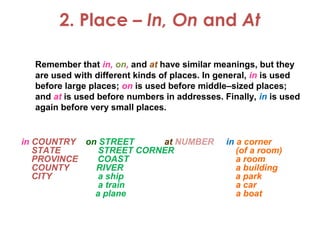
2. Place – In, On and At

  Remember that in, on, and at have similar meanings, but they
  are used with different kinds of places. In general, in is used
  before large places; on is used before middle–sized places;
  and at is used before numbers in addresses. Finally, in is used
  again before very small places.


in COUNTRY on STREET     at NUMBER             in a corner
   STATE      STREET CORNER                       (of a room)
   PROVINCE  COAST                                a room
   COUNTY    RIVER                                a building
   CITY       a ship                              a park
              a train                             a car
             a plane                              a boat
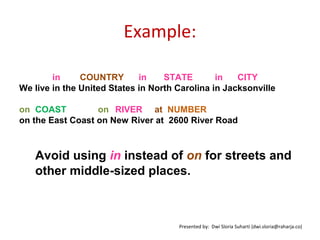
Example:

        in     COUNTRY       in    STATE        in   CITY
We live in the United States in North Carolina in Jacksonville

on COAST          on RIVER at NUMBER
on the East Coast on New River at 2600 River Road


   Avoid using in instead of on for streets and
   other middle-sized places.


                                      Presented by: Dwi Sloria Suharti (dwi.sloria@raharja.co)
3. Time – In, On and At
•   Remember that in, on, and at have similar meanings, but
    they are used with different times. In general, in is used
    before large units of time; on is used before middle–sized
    units of time; and at is used before numbers in clock time.


•   Idiomatic phrases such as in the morning, in the afternoon,
    in the evening, at night, at noon, must be learned
    individually like vocabulary.

    in YEAR          on Day        at TIME
       MONTH           DATE
Example:


              in YEAR in MONTH on DAY at TIME
Lily was born in 1919 in December on Sunday at 7:00


Avoid using in before days and dates.
The end
    &
Thank you
The end
    &
Thank you

Problems with prepositions

  • 1.
  • 2.
    PROBLEMS WITH PREPOSITIONS •Prepositions are words or phrases that clarify relationships. • Prepositions are usually followed by nouns and pronouns. Sometimes the nouns are –ing form nouns. • Prepositions are also used in idioms.
  • 3.
    1. Place –Between and Among Remember that between and among have the same meaning, but between is used with two nouns and among is used with three or more nouns or a plural noun.
  • 4.
    Examples: between noun 1 noun 2 The work is distributed between the secretary and the receptionist among noun 1 noun 2 noun 3 The rent payments are divided among Don, Bill, and Gene Avoid using between with three or more nouns or a plural noun.
  • 5.
    2. Place –In, On and At Remember that in, on, and at have similar meanings, but they are used with different kinds of places. In general, in is used before large places; on is used before middle–sized places; and at is used before numbers in addresses. Finally, in is used again before very small places. in COUNTRY on STREET at NUMBER in a corner STATE STREET CORNER (of a room) PROVINCE COAST a room COUNTY RIVER a building CITY a ship a park a train a car a plane a boat
  • 6.
    Example: in COUNTRY in STATE in CITY We live in the United States in North Carolina in Jacksonville on COAST on RIVER at NUMBER on the East Coast on New River at 2600 River Road Avoid using in instead of on for streets and other middle-sized places. Presented by: Dwi Sloria Suharti (dwi.sloria@raharja.co)
  • 7.
    3. Time –In, On and At • Remember that in, on, and at have similar meanings, but they are used with different times. In general, in is used before large units of time; on is used before middle–sized units of time; and at is used before numbers in clock time. • Idiomatic phrases such as in the morning, in the afternoon, in the evening, at night, at noon, must be learned individually like vocabulary. in YEAR on Day at TIME MONTH DATE
  • 8.
    Example: in YEAR in MONTH on DAY at TIME Lily was born in 1919 in December on Sunday at 7:00 Avoid using in before days and dates.
  • 9.
    The end & Thank you
  • 10.
    The end & Thank you