A Study On Problems In Unorganized Retail With Regards To Customer And
Retailer Perception
J. REKHA RANI
RESEARCH SCHOLAR, SRI SATYA SAI UNIVERSITY OF TECHNOLOGY & MEDICAL
SCIENCES, SEHORE
Abstract
The Indian retail market is one of the fastest growing retail markets in the world. With over 12
million retail outlets, India has one of the highest density of retailers in the world at one retail for
every 90 people. The Indian retail market is estimated to be US $ 600 billion and one of the top
five retail markets in the world by economic value. Retailing in India is one of the pillars of its
economy and accounts for about 10 per cent of its GDP. India is one of the fastest growing retail
markets in the world. The evolution of retail sector in India can be traced to super markets being
set up in the neighborhood. Government also encouraged Khadi and Village Industries
Commission to set up shops. Some Indian brands which started retail chains in India were
Raymond, Titan Bombay Dyeing etc. The rapidly growing retail sector grew as a result of better
supply chain management, inventory management, distribution networks, back-end operators etc.
unorganized retail refers to traditional low capital retailing viz local grocery shops, small
convenience stores, small pavement side vendors owner-manned general stores, chemists,
footwear shops, pan and hand-cart, hawkers etc. The concept of retailing is considered only as a
contemporary phenomenon. This study shows the problems in unorganized retail products with
regards to customer and retailer perception. Today, the retail industry in India is estimated to be
over INR 40 Lakh Crores and accounts to 10% of India‘s GDP. According to rough estimates,
the unorganized retail sector constitutes over 90% of the country‘s retail industry.
The Indian retail industry is estimated to be $470 billion. The organized or modern retailing with
6% share stands at $26 billion. It is projected to reach US$ 1.3 trillion by 2018 with the
organized retail market estimated to grow at the compounded annual growth rate of 40% and
reach US$107 billion by the year 2013. Entry of these retailers in different formats, including
online, has affected an irreversible change in consumer buying habits and businesses related to
serving these retailers. However, unlike many other countries, India has its own unique character
of size, geographical spread, cultural diversity, and multiplicity of formats being introduced at
quick succession. Retailers also face the challenge of developing infrastructure, on their own or
in cooperation with the government. This paper attempts to explore the industry and evaluate the
extent of its impact on distribution and procurement networks and changing consumption pattern
in India.
Keywords - customer perception, retailer perception, India, Retailing, Distribution,
Procurement, Consumption.
International Journal of Scientific Research and Review
Volume 8, Issue 5, 2019
ISSN NO: 2279-543X
Page No: 1693
Introduction
India has witnessed a revolution in the last two decades owing to rapid urbanization and
changing consumption. This has led retailers to concentrate their energies and leverage their
capacities to harness the potential. The entry of the leading corporate houses into retail created a
surge into the growth of the industry. The Indian retail industry is estimated to be $470 billion.
The organized or modern retailing with 6% share stands at $26 billion. i The Indian retail sector
is projected to reach US$ 1.3 trillion by 2018and the organized retail market is estimated at
compounded annual growth rate of 40% which is anticipated at 107 billion US$ by the year
2013. iiAs per the McKinsey Report, 'The rise of Indian Consumer Market', by the year 2025, the
Indian consumer market is expected to grow four fold iii. India with its current retail growth rate
turns out to be one of the most prominent countries for global retailers. Since the liberalization of
the Indian economy in the 1990s, there has been a continuous change in the consumer buying
behavior. The positive consumer sentiment has led to retailers expanding to even tier 1 and 2
cities.
The market dynamics in Indian retail industry are dissimilar when equated with other countries
and it is not easy to function in an Indian market. If we have a close look at the unique
demography of India, we would discover that it comprises of 25 states with different cultural
districts existing concurrently in a market. While urbanization seems to be mixing these cultures,
people tend to be living in coherent cultural group, mainly described by the state from where
they originate. Most stores have trading areas that are mixed in their demography, thereby
making the retailers work harder while meeting the varying demands of diverse consumers. The
areas consist of heterogeneous group of consumers who have predominantly varying buying
power. It IIMA INDIA Research and Publications W.P. No. 2012-12-04 Page No. 4 is posited
that for retailers in India, social class could be a better segmentation variable that other
demographic factors.
The unorganized retail market is the most dominant and popular mode of retailing and purchase
destination for the majority of India‘s 1.3 billion population. It forms the base or the foundation
stone of the retail industry in India and is a deeply rooted and strongly held market mechanism
which has stayed for over a century now and continues to rule the country‘s retail industry. The
unorganized retail sector primarily comprises of the small scale retail stores, with little or no
standardization, selling goods and services (ideally in fragmented quantities) to the local
customers within a small geographical area or locality. There is hardly any use of technology or
adherence to processes.
REVIEW OF LITERATURE
Review of previous studies is essential for every research to carry on investigation successfully.
Hence, the present study is also based on the following reviews.
International Journal of Scientific Research and Review
Volume 8, Issue 5, 2019
ISSN NO: 2279-543X
Page No: 1694
Aggarwal (2014) this study was suggested that Consumer behavior research is the scientific
study of the processes consumers use to select, secure, use and dispose of products and services
that satisfy their needs. Firms can satisfy those needs only to the extent they understand their
customers. The main objective of this paper is to study the demographic differences in
consumers‘ buying behavior of persons living in Madhya Pradesh and when they buy FMCG
products.
Hariharan.G. (2008) in his study ―profile and perception of retail consumers‖, analyzed the
consumers perception towards retail, in Palakkad. Visiting retail outlets has become a group
activity. Most of the shoppers are influenced by as well as accompanied by colleagues, friend
and relatives. Majority of the people who visit do not shop at all. The hang around meet friends,
do window – shopping and spend time leisurely.
Rathanyake (2008) studied in his research about ―customer complaining Behaviour in
Retailing‖, proper understanding of the dynamics of customer complaining behaviour support the
retailer to treat the customers who are not satisfied with the retail Experience.
Suresh (2007) studied in his research about ―Buying Behaviour and promotion in Textile
Retailing and concluded that increase in turnover should be achieved by reducing the margin in
this competitive era to survive in the long run. Keep updates about the price fluctuations and new
fashions in the supplier market. Always be in a receptive mood to know the preference and taste
of customers‖
Tamilarasan.R. (2007) in his study focused to ―A study on Retail store service Quality
Dimensions in select Retail stores‖. This study after an in depth analysis of a variety of store
dimensions and services quality dimensions reveals that all these dimensions have to be
improved to earn a competitive edge and survive in the retail Business in view of the changing
and emerging retail scenario, in India with the possible advent of the MNC‘s in the retail Indian
Market Scenario.
Thirumoorthi.P. (2006) studied in his research about ―A study on retailers and customer
attitude towards P & G Detergent Powder‖. It can be concluded that the company must
concentrate more on high margin to create a better performance. Importance must be given to
sales promotion. The retailers must also be asked to give more displays and discounts. Thus it
can be concluded that the customer and retailer attitude towards the P & G detergent powder is
positive.
Development of Modern Retail
As per the estimates of Indian Retail Report 2011, the modern retail in the next five years is
expected to would contribute to a minimum of one third of the market of 40 trillion. This report
estimates that by the year 2016, the modern retail would have 19.3 percentage share of the total
retail market iv. For some leading consumer product companies, modern retailers contribute
International Journal of Scientific Research and Review
Volume 8, Issue 5, 2019
ISSN NO: 2279-543X
Page No: 1695
about 10% of their total sale nationally and about 20% in top 10 cities. v The preeminent
outcome of the development of modern retailing in India is an increase of choice among
consumers. With the advent of modern retailing in the emerging markets have witnessed
developments in the areas of Technology Transfer, enhanced quality levels of produce, products
at competitive prices, better procurement practices and enhanced employment opportunities.
The development and growth of modern retailing is connected to the lower prices resulting from
the functional efficiencies in the supply chain (Minten and Reardon, 2008).Studies in the
developing countries have also indicated that there is no evidence of modern retailers exploiting
the producers or consumers and it is more to do with policy paralysis than the actual practices of
modern retailers (Swinnen and Vanderplas, 2007). While modern retailing is fast penetrating in a
developing country like India, it is significant to understand that it is quite complicated to
accurately assess its impact. Even though modern retailers have invested in the supply chain in
varying degrees, there is mixed evidence that consumers ultimately fetch lower prices in the
modern formats. As a result of this, it has been critical for the modern retailer to understand the
local consumption pattern to offer the right mix in the rapidly changing Indian market. Some
habits are unique to the country. Modern retailers in India find it quite challenging to sell meat
products because a large number of Indians would deliberately avoid visiting stores dealing in
meat, fish and poultry. There is a separate channel for these fresh produce which is largely in the
traditional format. With the increase in disposable incomes, abundant media choices, internet
penetration and modern amenities, the shopping activity which used to be mundane necessity has
become a pleasant activity for many consumers (Sinha, 2003). On one hand impulse buying and
brand switching behavior has become more evident (Sinha and Uniyal, 2005),on the other hand
unnecessary shopping has increased leading to consumers buying goods which are non-essential.
With a greater focus on supply chain efficiencies, modern retailing could do go better for both
consumers and farmers.
Global retailers and Indian conglomerates started to get serious about the large Indian retail
opportunity about a decade ago. Over the past ten years or so retail in India has seen many
domestic and global companies build a play into possibly the most promising consumer
opportunity around the world. However, even as the overall market numbers continue to look
very attractive and India continues to grow consumption at a pace faster than any other major
economy in the world, very few retailers have been able to crack the code for profitable growth.
For many, the Indian retail opportunity has thus far been a long chase, with profitability and
scale an elusive goal. As our research reveals, more than 85% of retailers have not been able to
meet their original vision and have had to rethink their goals. A lot has been said about the
disruption caused by the revolutionary pace of digital access which has made retailers rethink
their strategy and value proposition. Our research also reveals that the a large number of retailers
encountered myriad challenges of execution in an environment where quality of real estate, talent
and infrastructure were not keeping pace with the expansion plans of the retailers. In a bid to
scale fast many retailers made suboptimal choices which led to a dilution of the envisaged value
International Journal of Scientific Research and Review
Volume 8, Issue 5, 2019
ISSN NO: 2279-543X
Page No: 1696
proposition and poor profitability, consequently making them underprepared for the large-scale
disruption and new age competition with deep pockets. As the Industry today stands on the cusp
of a new future driven by growing consumption, improving infrastructure and supportive
regulation, retailers are still very bullish about growth prospects in India and several are indeed
delivering double digit growth. However, they do realise that in order to grow profitably and
achieve scale and relevance they will need to do things differently in the future. So, what is it
that retailers in India are missing? How should they replan their future to achieve the growth
trajectory they aspire to? This year we conducted an extensive research across CXOs from a
large cross section of global and domestic retailers present in India and present this report ‗The
promise of Indian retail: From vision to execution‘. This report aims to understand some of these
questions by taking a fresh look at the journey of these retailers in order to unravel and piece
together what it takes to grow profitably in this market. We hope this report stimulates increased
conversation and engagement in our ongoing quest to better unravel one of the largest retail
opportunities in the world.
Changing Consumption Patterns
In a developing economy like India, the biggest challenge a marketer faces would be to tackle
the ever changing consumption practices. The majority of the Indian consumers are shifting from
brand loyalist to value conscious, which would require greater efforts on the part of a retailer to
satisfy the billion demands and provision of enduring services. These changes are reflected in the
growing disposable income and per capita growth in the table below
Indicator 2010 2011 2012 2013 2014
GDP, Purchasing
Power parity ($ Per
Capita)
3453 3777 4103 4434 4819
GDP, Purchasing
Power parity (Per
Capita %)
12 9.3 8.6 8 8.6
GrossDisposable
Income Per
Household
5295 6151 6867 7627 8447
GrossDisposable
Income Per
Household Growth %
16.3 26.1 11.6 11.07 10.75
Rural Population % 70.21 69.98 69.75 69.53 69.3
Urban Population % 29.79 30.02 30.25 30.47 30.7
CUSTOMER PERCEPTION
The formal definition of customer perception is, ―A marketing concept that encompasses a
customer‘s impression, awareness and/or consciousness about a company or its offerings.‖ To
International Journal of Scientific Research and Review
Volume 8, Issue 5, 2019
ISSN NO: 2279-543X
Page No: 1697
put it simply, customer perception is what your customers and potential customers think of your
organization. This perception directly impacts the attraction of new customers and the capacity to
maintain good relationships with current customers.
Why is customer perception important?
In today‘s digital age, virtually everything is a Google search away. This makes your goods and
services easier to find, but the tradeoff is that your competition is easier to find as well. That
means it‘s easier for unhappy or unsatisfied customers to leave. Consumers want good quality,
but they also want to know they are getting good value. That value isn‘t just judged by the
product or service they are purchasing, but by the availability and usability of the customer
service that supports it. It‘s just not enough anymore to have brand recognition; consumers want
to feel good about a brand and company. They want to do business with civic-minded
corporations with positive world views.
NEGATIVE EFFECTS OF INCREASING MARKET SHARE ON CUSTOMER
PERCEPTION
• For premium and luxury products, customers may translate an increasing market share into a
loss of exclusivity and thus perceive it as less valuable.
• The quality of services may suffer if they are consumed by increasing numbers of users.
Diseconomies of scales and congestions can be observed with busy airports and many other
services so that customers may look out for other providers that promise more timely service and
convenience.
The concept of customer perception does not only relate to individual customers in consumer
markets. It is also valid in business to business situations. For example, a competitor
benchmarking survey of a large industrial supplier revealed that the market leader, although
recognized for excellent quality and service and known to be highly innovative, was perceived as
arrogant in some regions. If we take into consideration that there are about four other large
players with a similar level of quality and innovative ideas, this perceived arrogance could
develop into a serious problem. Customers here are well aware the main characteristics of all the
offerings available at the market are largely comparable. So they might use the development of a
new product generation of their own to switch to a supplier that can serve them not better or
worse, but with more responsiveness and understanding. Companies have done a lot to improve
customer satisfaction and customer relationships in the past. As discussed above, this will not be
enough anymore
MEASURING CUSTOMER PERCEPTION
Don‘t make false promises – Companies should strive for truth in advertising and truth in general
communication. If you say a product does something, make sure it ACTUALLY does it and
International Journal of Scientific Research and Review
Volume 8, Issue 5, 2019
ISSN NO: 2279-543X
Page No: 1698
when someone calls your customer service department and you tell them you can help, make
sure they do just that.
• Listen – Sounds easy enough but this can be a challenge for some organizations. When
customers talk (online, in person, on the phone), listen. When what a client is saying is complaint
related, it‘s easy to stop listening when you think you know the answer but it‘s important to
listen to what customer‘s expressed need is and then make sure your solution fits the problem.
• Communicate – Quickly, clearly and often. Train your agents and representatives to be
knowledgeable, compassionate and responsive when communicating with your customers.
Ensure they are providing facts not excuses.
• Use your social channels effectively – Social media presents unique opportunities and
challenges for communication. Many social channels actually track a company‘s responsiveness
to customers and rate them. In addition social media creates an open forum for customers
complain. The vocal minority can seemingly hijack your good name, but it is possible to take
negative comments and demonstrate positive outcomes. Responding quickly and with knowledge
and compassion can not only result in a favorable outcome with the situation at hand but increase
positive feelings about your company with the casual observers on the channel. Be proactive
when a negative review posts and work to rectify the issue openly when possible.
• Streamline – Wherever possible, make the decision making process easier. Are your
product/service benefit statements clear? Can existing and potential customers easily see how
you stack up against the competition? Make purchasing and customer service easy and don‘t
make customers jump through hoops to get resolution. This just exacerbates the problem. If you
can offer solutions that demonstrate you know your customer‘s time is valuable you make it easy
to keep doing business with your company. Offering quick response, centralizing information to
prevent the need for re-explaining issues and utilizing call back technology are just some of the
ways you can improve the perception of your company.
• Never get complacent – It‘s easy to get comfortable when everything appears to be going
well, but push your company to keep measuring your customer‘s satisfaction and keep training
your teams. Both internally and externally, ask questions and learn from situations that have
occurred.
In addition to growing consumption, unique drivers are leading to the rapid growth of
organised retail formats.
1. Growth in young urban consumers and nuclear families: Forty-seven percent of the
population is under the age of 25 years and India is slated to be the youngest country by
2020.5 Further, rising urbanisation (27% at the beginning of century to 32% in 2015) and
the growing participation of women in the workforce are also creating a time-starved
consumer group which is likely to pay a premium for convenience. Nuclear families are
International Journal of Scientific Research and Review
Volume 8, Issue 5, 2019
ISSN NO: 2279-543X
Page No: 1699
also increasing—70% of the households now have a nuclear structure, an increase of 13%
over the past two decades. Notably, nuclear families spend 20–30% higher than joint
families.
2. Digital influence: Digital penetration in India is growing rapidly. Thirteen percent of the
population uses smartphones; 91% of these users search for products to buy via their
device and 54% of them have completed a purchase.7 This level of digital maturity
comes to a population with 37% Internet penetration, growing at 31% CAGR, which is
higher than China and the US. This bodes well for the e-retail sector and Omni
channel players.
3. Improving regulatory environment: Easing FDI rules for retail will enable the entry of
more global players, with investment in back-end infrastructure such as warehouses,
logistics, and customer services creating ancillary jobs across the country and upgrading
the retail skills of Indian workforce.
4. Reducing infrastructure bottlenecks: Supply chain challenges in India have revolved
around poor infrastructure, a complex tax structure, and lack of technology adoption.
However, the situation is improving. The 12th Five Year Plan (2012–2017) invested 37
lakh crore INR on infrastructure development and upgrading the distribution network.
Additionally, the supply of retail space touched a five-year high of 5.3 million sq. ft
across eight cities in 2016. The recent implementation of GST is expected to eliminate
cascading tax impact and improve supply chain efficiency.
International Journal of Scientific Research and Review
Volume 8, Issue 5, 2019
ISSN NO: 2279-543X
Page No: 1700
5. . Partnerships: Although leading global retailers are keen to invest in the Indian retail
market, they are limited by tight FDI regulations. They have struggled to find the right
joint venture partnerships to set up operations in India or scale operations into new
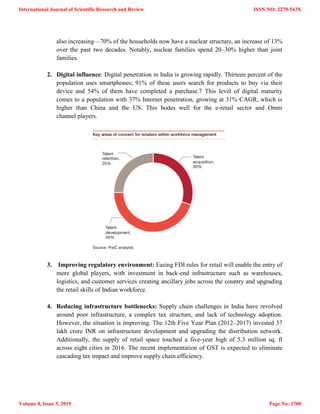
geographies. Talent retention, 25% Talent acquisition, 30% Talent development, 45%
These challenges had cumulatively put immense pressure on the unit economics of most
retailers at the time. Scale to survive – a strategy that failed owing to suboptimal real
estate choices To counter these challenges of the Indian retail market, retailers looked to
leverage economies of scale in order to win. Eager to achieve the envisioned scale,
retailers, though faced with limited real estate availability, selected sites for stores
governed by availability rather than fit. Over time, such suboptimal choice of stores over
time hit the profitability of retailers and hence limited their ability to fund their growth.
6. Poor catchment: As retailers chased on the site availability, compromises were made on
the relevance of the catchment of the site. The result was a poor sales throughout that
strained the unit economics of the store.
7. High rentals: In some cases, retailers chose locations that at the onset had high rentals
that disturbed the overall cost structure of operations. 10 PwC
8. Geographical spread: Given the unavailability of sites, retailers chose sites that were
not necessarily close to each other. The wide geographical spread led to a higher cost to
serve as well as higher management costs, with separate manpower required for store
supervision
9. Time to profitability: The rapid expansion of stores led to a retailer portfolio with a
significant number of stores that were low on the maturity scale. These stores, with their
poor unit economics, pushed the time to profitability that the retailers had not accounted
for. The impact on working capital posed constraints on scale and, in some cases, resulted
in massive closure of stores as retailers undertook initiatives to restore balance to their
portfolio.
As the Indian retail industry gears up for the future, it is important to understand the challenges
and incorporate the learnings from the past to gear up for future success. A survey
conducted by PwC India‘s Retail and Consumer practice in August–September 2017
focused on the following aspects of the Indian retail industry:
• Achievement of the scale envisioned by retailers
• Challenges retailers face in their journey from vision to execution
• Future outlook of the Indian retail industry
International Journal of Scientific Research and Review
Volume 8, Issue 5, 2019
ISSN NO: 2279-543X
Page No: 1701
• Key considerations for future success Our survey and conversations with CxOs revealed four
major reasons many offline retailers have struggled.
Access to capital: Lack of clear direction on FDI in multi brand retail regulations is leading to
delays in the implementation process for limited non-conglomerate Indian retailers to
access much-needed capital for fund growth.
Retail talent: Forty percent of retailers cited constraints in finding the right retail talent. With a
spurt in demand and limited availability, retaining the talent has become an increasing
challenge. As per the survey, 45% of retailers believed that talent development was one
of the major concerns they had faced in the past. HR and workforce practices were at a
nascent stage of development, leading to competency gaps across key retail areas like
vendor management, logistics and supply chain, inventory management and customer
relations. Talent acquisition was another key challenge in the retail industry as around
75–80% of the staff in a retail set-up works on the front end. Talent retention has also
been an area of concern for retail organisations, especially on the front end, where the
attrition rate in the past has been high to the tune of about 25–40%.
Add-Ons. Salespeople who have an in-depth knowledge of the products they sell should also
have a clear understanding of the items that complement those products. If they work in
electronics, they know that even the best 4K television only offers limited sound quality.
That can lead directly into a conversation about sound bars or surround-sound systems.
They‘ll know that a beautiful dress is not, by itself, an outfit. That a camera has a lot of
accessories to make it truly an artistic device. The customers leave with products that
exceed their initial expectations, and the salesperson gains higher per-ticket sales. To do
this effectively, your salespeople need to see the full picture when it comes to their
product lines, more-so than the product features. For even if they don‘t know the
specifics of an add-on but understand the concept of what it does, they‘ll be able to create
additional value for their customer and not settle for clerking a single item. In this
research we will study about what retailer has opinion about different electronic fans.
Retailer behavior can be judge on the basis of different factors. Retailer behavior is
defined as the behavior that retailer display that what they think about a particular brand,
there after Sales Service.
CONCLUSION
The retail sector has played a phenomenal role throughout the world in increasing productivity of
consumer goods and services. The Indian Retail Industry is the largest among all the
industries, accounting for over 10 percent of the country's GDP and around 8 per cent of
the employment. The Retail Industry in India has come forth as one of the most dynamic
International Journal of Scientific Research and Review
Volume 8, Issue 5, 2019
ISSN NO: 2279-543X
Page No: 1702
and fast paced industries with several players .The study helps to know the important
factors responsible for the changes in buying pattern. This change has come in the
consumer due to increased income, change in life styles and patterns of demography
which are favorable. From the study it was found that when compared to the unorganized
retail format most of the respondent had a good image about the unorganized retailers and
in future many of them are ready prefer organized retailers. Most of the customers are
attracted to unorganized retail stores because of the variety and assortment of products.
Middle aged people and youngsters are mostly approaches unorganized retailers in future.
They retailers should makes strategies to retain their customers by providing quality
goods and services and they should also go for collaborations within the regional level
then only they can survive in the globally competitive market.
The Indian retail industry is witnessing far reaching changes. The modernisation process started
by large retailers has spread across country. Even smaller independent stores are
upgrading in terms of assortments, delivery and ambience. The change is riding on an
overall growth in income and consumption across the country, including the rural areas.
While customers are getting better prices and assortments, the impact of large format
retailer in driving consumption is still limited.
The development and growth of modern retailing in India in different segments has been due to
different factors. The modern retailers would like to make substantial savings though
efficacy and pass this benefit to producers and end consumers. Since the entry of foreign
retailers would require substantial investments in supply chain systems, it would possibly
bring in innovative procurement and distribution systems which will further play an
important role in bringing more stability. In view of the fact that the retail industry is
largest employer after agriculture in India, the political parties always have reservation
towards opening up of retail sector to foreign investment. On the contrary small and
medium enterprises would stand to benefit from the fact that private label brands would
constitute the product mix of any modern retailer and thereby small suppliers would
effectively take their products to national platform.
REFERENCES
[1] Bitta J Della Albert & Loudo David: Consumer behavior: 4th edition, TMH publications.
(2002).
[2] East Robert Wright Marc: Consumer Behavior Applications in Marketing Sage South Asia
publications. (2009).
International Journal of Scientific Research and Review
Volume 8, Issue 5, 2019
ISSN NO: 2279-543X
Page No: 1703
[3]Foreign Agricultural Service (2009). ―India: The Retail Food Sector, 2009.‖ GAIN Report
IN1005. Veeck, A., and G. Veeck (2000), ―Consumer Segmentation and Changing Food
Purchase Patterns in Nanjing, PRC,‖ World Development, Vol.28 (3), pp. 457-471.
[4] Hawkins (2009). Consumer behavior building marketing strategy 11th Edition, TMH
Publication.
[5] Jain P C & Bhatt Monika: Consumer Behavior in Indian Perspective, S Chand publication
New Delhi.(2010)
[6] Kanuk Leslie & Schiffman Leon: Consumer Behavior: 10th edition, PHI. (2007).
[7] Kumar, Consumer Behaviour and Branding: concepts readings, and cases, Pearsons
publications
[8] .Adil Zia, Khalid Mohammad Azam Unorganized Retail Shopping Experience in India:An
Empirical Investigation, Pacific Business Review International, Volume 5 Issue 7
(January 2013)
[9] Ali, J., Kapoor, S., & Moorthy, J. 2010, Buying behavior of consumers for food products in
an emerging economy. British Food Journal, 112(2), pp 109-124.
[10] Arun Kumar Singh and P.K. Agarwal ,Study on Shifting Consumer Preferences from Un
Organized Retailing Vis-A Vis to Organized Retailing in Noida,Bookman International
Journal of Accounts, Economics & Business Management, Vol. 1 No. 2, October-
November-December 2012, ISSN No. 2319-426X
[11] Ghosh, H. S. and Srivastava, K. B. L. Impact of service quality on customer satisfaction,
loyalty, and commitment in the Indian banking sector. The Indian journal of marketing,
40(5), 23-35. (2010).
[12] Goswami, Paromita and Mishra S. Mridula (2009), ―Would Indian consumers move
fromGupta Himanshu, Dubey Neetu and Patani Pawan,Effect of Organized retail on
Unorganized retail in Indian retail market, Research Journal of Management Sciences,
Vol. 1(1), 7-13, August (2012)
[13]India Brand and Equity Foundation (IBEF). (2017). Retail. Retrieved from
https://www.ibef.org/download/ Retail-January-2017.pdf (last accessed on 12 September
2017)
International Journal of Scientific Research and Review
Volume 8, Issue 5, 2019
ISSN NO: 2279-543X
Page No: 1704
[14] G, Alex. (9 June 2017). These are the world‘s fastestgrowing economies in 2017. Future of
Economic Progress. Retrieved from https://www.weforum.org/ agenda/2017/06/these-
are-the-world-s-fastest-growingeconomies-in-2017-2/ (last accessed on 12 September
2017)
[15] Internet world stats. (2017). The world population and the top ten countries with the highest
population. Retrieved from http://www.internetworldstats.com/ stats8.htm (last accessed
on 12 September 2017)
[16] ET Retail. (14 June 2017). Indian retail industry: From potential to performance.
ETRetail.com. Retrieved from http://retail.economictimes.indiatimes.com/news/
industry/-indian-retail-industry-from-potential-toperformance/59141590 (last accessed on
12 September 2017)
[17]PwC. (2016). Shaping consumer trends. Retrieved from
https://www.pwc.in/assets/pdfs/publications/2016/ shaping-consumer-trends.pdf (last
accessed on 12 September 2017)
[18]Internet Live Stats. (2016). India Internet users. Retrieved from
www.internetlivestats.com/internet-users/india/ (last accessed on 12 September 2017)
[19]PwC. (2015). Are you profitability ready? Perspectives on the Indian retail industry.
Retrieved from https:// www.pwc.in/assets/pdfs/publications/2015/are-youprofitability-
ready-perspectives-on-the-indian-retailindustry.pdf (last accessed on 12 September 2017)
[20] Singhi, A. (4 October 2016). The rise of India‘s neo middle class. Retrieved from
http://www.livemint.com/ Politics/HY9TzjQzljCZNRHb2ejC2H/The-rise-of-Indiasneo-
middle-class.html (last accessed on 12 September 2017)
[21] Care ratings. (2 June 2017). Indian retail industry – structure and prospects. Retrieved from
http://www. careratings.com/upload/NewsFiles/SplAnalysis/
Indian%20Retail%20Industry%20-%20June%202017. pdf (last accessed on 12
September 2017)
[22]Singh, K. (2014). Retail sector in India: Present scenario, emerging opportunities and
challenges. IOSR Journal of Business and Management. Retrieved from http://
www.iosrjournals.org/iosr-jbm/papers/Vol16-issue4/ Version-1/J016417281.pdf (last
accessed on 12 September 2017)
International Journal of Scientific Research and Review
Volume 8, Issue 5, 2019
ISSN NO: 2279-543X
Page No: 1705
[23]Singh, K. (2014). Retail sector in India: Present scenario, emerging opportunities and
challenges. IOSR Journal of Business and Management. Retrieved from http://
www.iosrjournals.org/iosr-jbm/papers/Vol16-issue4/ Version-1/J016417281.pdf FICCI
sector profile: http://ficci.in/sector/33/Project_ docs/Sector-prof.pdf
http://ficci.in/sector/33/Project_docs/Sector-prof.pdf (last accessed on 12 September
2017)
[24]PwC. (2015). Total Retail 2015: Retailers and the age of disruption. Retrieved from
https://www.pwc.com/ gx/en/retail-consumer/retail-consumer-publications/ global-multi-
channel-consumer-survey/assets/pdf/totalretail-2015.pdf (last accessed on 12 September
2017)
[25]Birthal, P.S., P.K. Joshi, and A. Gulati (2005). ―Vertical Coordination in High Value
Commodities: Implications for the Smallholders.‖ MTID Discussion Paper No. 85.
International Food Policy Research Institute
[26]Washington,DC. Raghunath, S., Ashok, D.Mathur, PuneetPrakash and Joseph, Thomas
(2005), ―Indian Agricultural Produce Distribution System — Towards an Integrated Agri
Produce Flow‖, Indian Institute of Management, Bangalore.
[27]Reardon, T., and C.P. Timmer (2007). ―Transformation of Markets for Agricultural Output
in Developing Countries Since 1950: How Has Thinking Changed?‖ in R.E. Evenson and
P. Pingali (eds). Handbook of Agricultural Economics. Amsterdam: Elsevier Press.
[28]Liesbeth Dries and Vlaho Kojakovic (2004), ―Economic and Transitional Impact of Food
Retail Investments: Evidence from the Czech Republic‖, WB-CEI-FAO Workshop on
Agriculture, Agri-business and the Retail Sector in South-East Europe,
[29]Sarajevo, 24-26 May Minot, N., and D. Roy (2007). ―Impact of High-Value Agriculture and
Modern Marketing Channels on Poverty: An Analytical Framework.‖ Unpublished
manuscript, Trade and Institutions Division, International Food Policy Research Institute,
[30]Washington, DC. Minten, B., T. Reardon, and R. Sutradhar (2010). ―Food Prices and
Modern Retail: The Case of Delhi,‖ World Development, Vol. 38, No. 12, pp.1775-1787.
[31]Minten, B., and T. Reardon (2008), ―Food Prices, Quality, and Quality‘s Pricing in
Supermarkets Versus Traditional Markets in Developing Countries,‖ Review of
Agricultural Economics, Vol. 30(3), pp 480-490.
International Journal of Scientific Research and Review
Volume 8, Issue 5, 2019
ISSN NO: 2279-543X
Page No: 1706
[32]Swinnen, J.F.M., and A. Vandeplas (2007).―Quality, Efficiency Premia, and
Development.‖Discussion Paper 184, LICOS Centre for Institutions and Economic
Performance, KatholiekeUniversiteit Leuven. Sinha Piyush Kumar, ―Shopping
Orientation in the Evolving Indian Market‖, Vikalpa, Vol. 28 (2), April - June, 2003, pp.
13 - 22.
[33]Sinha Piyush Kumar, Mathew Elizabeth, Kansal Ankur (2004), ―Format Choice of Food and
Grocery Retailers‖, Working Paper, 2005-07-04, IIMA
[34]Sinha Piyush Kumar and Dwarika Prasad Uniyal (2005), ―Using Observation Research for
Segmenting Shoppers‖, Journal of Retailing and Consumer Research, Vol. 12, pp. 35 –
48.
[35]Tandon S., Landes M., Woolverton A. (2011), ―The expansion of Modern grocery retailing
and trade in developing countries‖. USDA, Economic Research Report, No.122. U.S.
Department of Agriculture,
International Journal of Scientific Research and Review
Volume 8, Issue 5, 2019
ISSN NO: 2279-543X
Page No: 1707

Problems in unorganized retail

  • 1.
    A Study OnProblems In Unorganized Retail With Regards To Customer And Retailer Perception J. REKHA RANI RESEARCH SCHOLAR, SRI SATYA SAI UNIVERSITY OF TECHNOLOGY & MEDICAL SCIENCES, SEHORE Abstract The Indian retail market is one of the fastest growing retail markets in the world. With over 12 million retail outlets, India has one of the highest density of retailers in the world at one retail for every 90 people. The Indian retail market is estimated to be US $ 600 billion and one of the top five retail markets in the world by economic value. Retailing in India is one of the pillars of its economy and accounts for about 10 per cent of its GDP. India is one of the fastest growing retail markets in the world. The evolution of retail sector in India can be traced to super markets being set up in the neighborhood. Government also encouraged Khadi and Village Industries Commission to set up shops. Some Indian brands which started retail chains in India were Raymond, Titan Bombay Dyeing etc. The rapidly growing retail sector grew as a result of better supply chain management, inventory management, distribution networks, back-end operators etc. unorganized retail refers to traditional low capital retailing viz local grocery shops, small convenience stores, small pavement side vendors owner-manned general stores, chemists, footwear shops, pan and hand-cart, hawkers etc. The concept of retailing is considered only as a contemporary phenomenon. This study shows the problems in unorganized retail products with regards to customer and retailer perception. Today, the retail industry in India is estimated to be over INR 40 Lakh Crores and accounts to 10% of India‘s GDP. According to rough estimates, the unorganized retail sector constitutes over 90% of the country‘s retail industry. The Indian retail industry is estimated to be $470 billion. The organized or modern retailing with 6% share stands at $26 billion. It is projected to reach US$ 1.3 trillion by 2018 with the organized retail market estimated to grow at the compounded annual growth rate of 40% and reach US$107 billion by the year 2013. Entry of these retailers in different formats, including online, has affected an irreversible change in consumer buying habits and businesses related to serving these retailers. However, unlike many other countries, India has its own unique character of size, geographical spread, cultural diversity, and multiplicity of formats being introduced at quick succession. Retailers also face the challenge of developing infrastructure, on their own or in cooperation with the government. This paper attempts to explore the industry and evaluate the extent of its impact on distribution and procurement networks and changing consumption pattern in India. Keywords - customer perception, retailer perception, India, Retailing, Distribution, Procurement, Consumption. International Journal of Scientific Research and Review Volume 8, Issue 5, 2019 ISSN NO: 2279-543X Page No: 1693
  • 2.
    Introduction India has witnesseda revolution in the last two decades owing to rapid urbanization and changing consumption. This has led retailers to concentrate their energies and leverage their capacities to harness the potential. The entry of the leading corporate houses into retail created a surge into the growth of the industry. The Indian retail industry is estimated to be $470 billion. The organized or modern retailing with 6% share stands at $26 billion. i The Indian retail sector is projected to reach US$ 1.3 trillion by 2018and the organized retail market is estimated at compounded annual growth rate of 40% which is anticipated at 107 billion US$ by the year 2013. iiAs per the McKinsey Report, 'The rise of Indian Consumer Market', by the year 2025, the Indian consumer market is expected to grow four fold iii. India with its current retail growth rate turns out to be one of the most prominent countries for global retailers. Since the liberalization of the Indian economy in the 1990s, there has been a continuous change in the consumer buying behavior. The positive consumer sentiment has led to retailers expanding to even tier 1 and 2 cities. The market dynamics in Indian retail industry are dissimilar when equated with other countries and it is not easy to function in an Indian market. If we have a close look at the unique demography of India, we would discover that it comprises of 25 states with different cultural districts existing concurrently in a market. While urbanization seems to be mixing these cultures, people tend to be living in coherent cultural group, mainly described by the state from where they originate. Most stores have trading areas that are mixed in their demography, thereby making the retailers work harder while meeting the varying demands of diverse consumers. The areas consist of heterogeneous group of consumers who have predominantly varying buying power. It IIMA INDIA Research and Publications W.P. No. 2012-12-04 Page No. 4 is posited that for retailers in India, social class could be a better segmentation variable that other demographic factors. The unorganized retail market is the most dominant and popular mode of retailing and purchase destination for the majority of India‘s 1.3 billion population. It forms the base or the foundation stone of the retail industry in India and is a deeply rooted and strongly held market mechanism which has stayed for over a century now and continues to rule the country‘s retail industry. The unorganized retail sector primarily comprises of the small scale retail stores, with little or no standardization, selling goods and services (ideally in fragmented quantities) to the local customers within a small geographical area or locality. There is hardly any use of technology or adherence to processes. REVIEW OF LITERATURE Review of previous studies is essential for every research to carry on investigation successfully. Hence, the present study is also based on the following reviews. International Journal of Scientific Research and Review Volume 8, Issue 5, 2019 ISSN NO: 2279-543X Page No: 1694
  • 3.
    Aggarwal (2014) thisstudy was suggested that Consumer behavior research is the scientific study of the processes consumers use to select, secure, use and dispose of products and services that satisfy their needs. Firms can satisfy those needs only to the extent they understand their customers. The main objective of this paper is to study the demographic differences in consumers‘ buying behavior of persons living in Madhya Pradesh and when they buy FMCG products. Hariharan.G. (2008) in his study ―profile and perception of retail consumers‖, analyzed the consumers perception towards retail, in Palakkad. Visiting retail outlets has become a group activity. Most of the shoppers are influenced by as well as accompanied by colleagues, friend and relatives. Majority of the people who visit do not shop at all. The hang around meet friends, do window – shopping and spend time leisurely. Rathanyake (2008) studied in his research about ―customer complaining Behaviour in Retailing‖, proper understanding of the dynamics of customer complaining behaviour support the retailer to treat the customers who are not satisfied with the retail Experience. Suresh (2007) studied in his research about ―Buying Behaviour and promotion in Textile Retailing and concluded that increase in turnover should be achieved by reducing the margin in this competitive era to survive in the long run. Keep updates about the price fluctuations and new fashions in the supplier market. Always be in a receptive mood to know the preference and taste of customers‖ Tamilarasan.R. (2007) in his study focused to ―A study on Retail store service Quality Dimensions in select Retail stores‖. This study after an in depth analysis of a variety of store dimensions and services quality dimensions reveals that all these dimensions have to be improved to earn a competitive edge and survive in the retail Business in view of the changing and emerging retail scenario, in India with the possible advent of the MNC‘s in the retail Indian Market Scenario. Thirumoorthi.P. (2006) studied in his research about ―A study on retailers and customer attitude towards P & G Detergent Powder‖. It can be concluded that the company must concentrate more on high margin to create a better performance. Importance must be given to sales promotion. The retailers must also be asked to give more displays and discounts. Thus it can be concluded that the customer and retailer attitude towards the P & G detergent powder is positive. Development of Modern Retail As per the estimates of Indian Retail Report 2011, the modern retail in the next five years is expected to would contribute to a minimum of one third of the market of 40 trillion. This report estimates that by the year 2016, the modern retail would have 19.3 percentage share of the total retail market iv. For some leading consumer product companies, modern retailers contribute International Journal of Scientific Research and Review Volume 8, Issue 5, 2019 ISSN NO: 2279-543X Page No: 1695
  • 4.
    about 10% oftheir total sale nationally and about 20% in top 10 cities. v The preeminent outcome of the development of modern retailing in India is an increase of choice among consumers. With the advent of modern retailing in the emerging markets have witnessed developments in the areas of Technology Transfer, enhanced quality levels of produce, products at competitive prices, better procurement practices and enhanced employment opportunities. The development and growth of modern retailing is connected to the lower prices resulting from the functional efficiencies in the supply chain (Minten and Reardon, 2008).Studies in the developing countries have also indicated that there is no evidence of modern retailers exploiting the producers or consumers and it is more to do with policy paralysis than the actual practices of modern retailers (Swinnen and Vanderplas, 2007). While modern retailing is fast penetrating in a developing country like India, it is significant to understand that it is quite complicated to accurately assess its impact. Even though modern retailers have invested in the supply chain in varying degrees, there is mixed evidence that consumers ultimately fetch lower prices in the modern formats. As a result of this, it has been critical for the modern retailer to understand the local consumption pattern to offer the right mix in the rapidly changing Indian market. Some habits are unique to the country. Modern retailers in India find it quite challenging to sell meat products because a large number of Indians would deliberately avoid visiting stores dealing in meat, fish and poultry. There is a separate channel for these fresh produce which is largely in the traditional format. With the increase in disposable incomes, abundant media choices, internet penetration and modern amenities, the shopping activity which used to be mundane necessity has become a pleasant activity for many consumers (Sinha, 2003). On one hand impulse buying and brand switching behavior has become more evident (Sinha and Uniyal, 2005),on the other hand unnecessary shopping has increased leading to consumers buying goods which are non-essential. With a greater focus on supply chain efficiencies, modern retailing could do go better for both consumers and farmers. Global retailers and Indian conglomerates started to get serious about the large Indian retail opportunity about a decade ago. Over the past ten years or so retail in India has seen many domestic and global companies build a play into possibly the most promising consumer opportunity around the world. However, even as the overall market numbers continue to look very attractive and India continues to grow consumption at a pace faster than any other major economy in the world, very few retailers have been able to crack the code for profitable growth. For many, the Indian retail opportunity has thus far been a long chase, with profitability and scale an elusive goal. As our research reveals, more than 85% of retailers have not been able to meet their original vision and have had to rethink their goals. A lot has been said about the disruption caused by the revolutionary pace of digital access which has made retailers rethink their strategy and value proposition. Our research also reveals that the a large number of retailers encountered myriad challenges of execution in an environment where quality of real estate, talent and infrastructure were not keeping pace with the expansion plans of the retailers. In a bid to scale fast many retailers made suboptimal choices which led to a dilution of the envisaged value International Journal of Scientific Research and Review Volume 8, Issue 5, 2019 ISSN NO: 2279-543X Page No: 1696
  • 5.
    proposition and poorprofitability, consequently making them underprepared for the large-scale disruption and new age competition with deep pockets. As the Industry today stands on the cusp of a new future driven by growing consumption, improving infrastructure and supportive regulation, retailers are still very bullish about growth prospects in India and several are indeed delivering double digit growth. However, they do realise that in order to grow profitably and achieve scale and relevance they will need to do things differently in the future. So, what is it that retailers in India are missing? How should they replan their future to achieve the growth trajectory they aspire to? This year we conducted an extensive research across CXOs from a large cross section of global and domestic retailers present in India and present this report ‗The promise of Indian retail: From vision to execution‘. This report aims to understand some of these questions by taking a fresh look at the journey of these retailers in order to unravel and piece together what it takes to grow profitably in this market. We hope this report stimulates increased conversation and engagement in our ongoing quest to better unravel one of the largest retail opportunities in the world. Changing Consumption Patterns In a developing economy like India, the biggest challenge a marketer faces would be to tackle the ever changing consumption practices. The majority of the Indian consumers are shifting from brand loyalist to value conscious, which would require greater efforts on the part of a retailer to satisfy the billion demands and provision of enduring services. These changes are reflected in the growing disposable income and per capita growth in the table below Indicator 2010 2011 2012 2013 2014 GDP, Purchasing Power parity ($ Per Capita) 3453 3777 4103 4434 4819 GDP, Purchasing Power parity (Per Capita %) 12 9.3 8.6 8 8.6 GrossDisposable Income Per Household 5295 6151 6867 7627 8447 GrossDisposable Income Per Household Growth % 16.3 26.1 11.6 11.07 10.75 Rural Population % 70.21 69.98 69.75 69.53 69.3 Urban Population % 29.79 30.02 30.25 30.47 30.7 CUSTOMER PERCEPTION The formal definition of customer perception is, ―A marketing concept that encompasses a customer‘s impression, awareness and/or consciousness about a company or its offerings.‖ To International Journal of Scientific Research and Review Volume 8, Issue 5, 2019 ISSN NO: 2279-543X Page No: 1697
  • 6.
    put it simply,customer perception is what your customers and potential customers think of your organization. This perception directly impacts the attraction of new customers and the capacity to maintain good relationships with current customers. Why is customer perception important? In today‘s digital age, virtually everything is a Google search away. This makes your goods and services easier to find, but the tradeoff is that your competition is easier to find as well. That means it‘s easier for unhappy or unsatisfied customers to leave. Consumers want good quality, but they also want to know they are getting good value. That value isn‘t just judged by the product or service they are purchasing, but by the availability and usability of the customer service that supports it. It‘s just not enough anymore to have brand recognition; consumers want to feel good about a brand and company. They want to do business with civic-minded corporations with positive world views. NEGATIVE EFFECTS OF INCREASING MARKET SHARE ON CUSTOMER PERCEPTION • For premium and luxury products, customers may translate an increasing market share into a loss of exclusivity and thus perceive it as less valuable. • The quality of services may suffer if they are consumed by increasing numbers of users. Diseconomies of scales and congestions can be observed with busy airports and many other services so that customers may look out for other providers that promise more timely service and convenience. The concept of customer perception does not only relate to individual customers in consumer markets. It is also valid in business to business situations. For example, a competitor benchmarking survey of a large industrial supplier revealed that the market leader, although recognized for excellent quality and service and known to be highly innovative, was perceived as arrogant in some regions. If we take into consideration that there are about four other large players with a similar level of quality and innovative ideas, this perceived arrogance could develop into a serious problem. Customers here are well aware the main characteristics of all the offerings available at the market are largely comparable. So they might use the development of a new product generation of their own to switch to a supplier that can serve them not better or worse, but with more responsiveness and understanding. Companies have done a lot to improve customer satisfaction and customer relationships in the past. As discussed above, this will not be enough anymore MEASURING CUSTOMER PERCEPTION Don‘t make false promises – Companies should strive for truth in advertising and truth in general communication. If you say a product does something, make sure it ACTUALLY does it and International Journal of Scientific Research and Review Volume 8, Issue 5, 2019 ISSN NO: 2279-543X Page No: 1698
  • 7.
    when someone callsyour customer service department and you tell them you can help, make sure they do just that. • Listen – Sounds easy enough but this can be a challenge for some organizations. When customers talk (online, in person, on the phone), listen. When what a client is saying is complaint related, it‘s easy to stop listening when you think you know the answer but it‘s important to listen to what customer‘s expressed need is and then make sure your solution fits the problem. • Communicate – Quickly, clearly and often. Train your agents and representatives to be knowledgeable, compassionate and responsive when communicating with your customers. Ensure they are providing facts not excuses. • Use your social channels effectively – Social media presents unique opportunities and challenges for communication. Many social channels actually track a company‘s responsiveness to customers and rate them. In addition social media creates an open forum for customers complain. The vocal minority can seemingly hijack your good name, but it is possible to take negative comments and demonstrate positive outcomes. Responding quickly and with knowledge and compassion can not only result in a favorable outcome with the situation at hand but increase positive feelings about your company with the casual observers on the channel. Be proactive when a negative review posts and work to rectify the issue openly when possible. • Streamline – Wherever possible, make the decision making process easier. Are your product/service benefit statements clear? Can existing and potential customers easily see how you stack up against the competition? Make purchasing and customer service easy and don‘t make customers jump through hoops to get resolution. This just exacerbates the problem. If you can offer solutions that demonstrate you know your customer‘s time is valuable you make it easy to keep doing business with your company. Offering quick response, centralizing information to prevent the need for re-explaining issues and utilizing call back technology are just some of the ways you can improve the perception of your company. • Never get complacent – It‘s easy to get comfortable when everything appears to be going well, but push your company to keep measuring your customer‘s satisfaction and keep training your teams. Both internally and externally, ask questions and learn from situations that have occurred. In addition to growing consumption, unique drivers are leading to the rapid growth of organised retail formats. 1. Growth in young urban consumers and nuclear families: Forty-seven percent of the population is under the age of 25 years and India is slated to be the youngest country by 2020.5 Further, rising urbanisation (27% at the beginning of century to 32% in 2015) and the growing participation of women in the workforce are also creating a time-starved consumer group which is likely to pay a premium for convenience. Nuclear families are International Journal of Scientific Research and Review Volume 8, Issue 5, 2019 ISSN NO: 2279-543X Page No: 1699
  • 8.
    also increasing—70% ofthe households now have a nuclear structure, an increase of 13% over the past two decades. Notably, nuclear families spend 20–30% higher than joint families. 2. Digital influence: Digital penetration in India is growing rapidly. Thirteen percent of the population uses smartphones; 91% of these users search for products to buy via their device and 54% of them have completed a purchase.7 This level of digital maturity comes to a population with 37% Internet penetration, growing at 31% CAGR, which is higher than China and the US. This bodes well for the e-retail sector and Omni channel players. 3. Improving regulatory environment: Easing FDI rules for retail will enable the entry of more global players, with investment in back-end infrastructure such as warehouses, logistics, and customer services creating ancillary jobs across the country and upgrading the retail skills of Indian workforce. 4. Reducing infrastructure bottlenecks: Supply chain challenges in India have revolved around poor infrastructure, a complex tax structure, and lack of technology adoption. However, the situation is improving. The 12th Five Year Plan (2012–2017) invested 37 lakh crore INR on infrastructure development and upgrading the distribution network. Additionally, the supply of retail space touched a five-year high of 5.3 million sq. ft across eight cities in 2016. The recent implementation of GST is expected to eliminate cascading tax impact and improve supply chain efficiency. International Journal of Scientific Research and Review Volume 8, Issue 5, 2019 ISSN NO: 2279-543X Page No: 1700
  • 9.
    5. . Partnerships:Although leading global retailers are keen to invest in the Indian retail market, they are limited by tight FDI regulations. They have struggled to find the right joint venture partnerships to set up operations in India or scale operations into new geographies. Talent retention, 25% Talent acquisition, 30% Talent development, 45% These challenges had cumulatively put immense pressure on the unit economics of most retailers at the time. Scale to survive – a strategy that failed owing to suboptimal real estate choices To counter these challenges of the Indian retail market, retailers looked to leverage economies of scale in order to win. Eager to achieve the envisioned scale, retailers, though faced with limited real estate availability, selected sites for stores governed by availability rather than fit. Over time, such suboptimal choice of stores over time hit the profitability of retailers and hence limited their ability to fund their growth. 6. Poor catchment: As retailers chased on the site availability, compromises were made on the relevance of the catchment of the site. The result was a poor sales throughout that strained the unit economics of the store. 7. High rentals: In some cases, retailers chose locations that at the onset had high rentals that disturbed the overall cost structure of operations. 10 PwC 8. Geographical spread: Given the unavailability of sites, retailers chose sites that were not necessarily close to each other. The wide geographical spread led to a higher cost to serve as well as higher management costs, with separate manpower required for store supervision 9. Time to profitability: The rapid expansion of stores led to a retailer portfolio with a significant number of stores that were low on the maturity scale. These stores, with their poor unit economics, pushed the time to profitability that the retailers had not accounted for. The impact on working capital posed constraints on scale and, in some cases, resulted in massive closure of stores as retailers undertook initiatives to restore balance to their portfolio. As the Indian retail industry gears up for the future, it is important to understand the challenges and incorporate the learnings from the past to gear up for future success. A survey conducted by PwC India‘s Retail and Consumer practice in August–September 2017 focused on the following aspects of the Indian retail industry: • Achievement of the scale envisioned by retailers • Challenges retailers face in their journey from vision to execution • Future outlook of the Indian retail industry International Journal of Scientific Research and Review Volume 8, Issue 5, 2019 ISSN NO: 2279-543X Page No: 1701
  • 10.
    • Key considerationsfor future success Our survey and conversations with CxOs revealed four major reasons many offline retailers have struggled. Access to capital: Lack of clear direction on FDI in multi brand retail regulations is leading to delays in the implementation process for limited non-conglomerate Indian retailers to access much-needed capital for fund growth. Retail talent: Forty percent of retailers cited constraints in finding the right retail talent. With a spurt in demand and limited availability, retaining the talent has become an increasing challenge. As per the survey, 45% of retailers believed that talent development was one of the major concerns they had faced in the past. HR and workforce practices were at a nascent stage of development, leading to competency gaps across key retail areas like vendor management, logistics and supply chain, inventory management and customer relations. Talent acquisition was another key challenge in the retail industry as around 75–80% of the staff in a retail set-up works on the front end. Talent retention has also been an area of concern for retail organisations, especially on the front end, where the attrition rate in the past has been high to the tune of about 25–40%. Add-Ons. Salespeople who have an in-depth knowledge of the products they sell should also have a clear understanding of the items that complement those products. If they work in electronics, they know that even the best 4K television only offers limited sound quality. That can lead directly into a conversation about sound bars or surround-sound systems. They‘ll know that a beautiful dress is not, by itself, an outfit. That a camera has a lot of accessories to make it truly an artistic device. The customers leave with products that exceed their initial expectations, and the salesperson gains higher per-ticket sales. To do this effectively, your salespeople need to see the full picture when it comes to their product lines, more-so than the product features. For even if they don‘t know the specifics of an add-on but understand the concept of what it does, they‘ll be able to create additional value for their customer and not settle for clerking a single item. In this research we will study about what retailer has opinion about different electronic fans. Retailer behavior can be judge on the basis of different factors. Retailer behavior is defined as the behavior that retailer display that what they think about a particular brand, there after Sales Service. CONCLUSION The retail sector has played a phenomenal role throughout the world in increasing productivity of consumer goods and services. The Indian Retail Industry is the largest among all the industries, accounting for over 10 percent of the country's GDP and around 8 per cent of the employment. The Retail Industry in India has come forth as one of the most dynamic International Journal of Scientific Research and Review Volume 8, Issue 5, 2019 ISSN NO: 2279-543X Page No: 1702
  • 11.
    and fast pacedindustries with several players .The study helps to know the important factors responsible for the changes in buying pattern. This change has come in the consumer due to increased income, change in life styles and patterns of demography which are favorable. From the study it was found that when compared to the unorganized retail format most of the respondent had a good image about the unorganized retailers and in future many of them are ready prefer organized retailers. Most of the customers are attracted to unorganized retail stores because of the variety and assortment of products. Middle aged people and youngsters are mostly approaches unorganized retailers in future. They retailers should makes strategies to retain their customers by providing quality goods and services and they should also go for collaborations within the regional level then only they can survive in the globally competitive market. The Indian retail industry is witnessing far reaching changes. The modernisation process started by large retailers has spread across country. Even smaller independent stores are upgrading in terms of assortments, delivery and ambience. The change is riding on an overall growth in income and consumption across the country, including the rural areas. While customers are getting better prices and assortments, the impact of large format retailer in driving consumption is still limited. The development and growth of modern retailing in India in different segments has been due to different factors. The modern retailers would like to make substantial savings though efficacy and pass this benefit to producers and end consumers. Since the entry of foreign retailers would require substantial investments in supply chain systems, it would possibly bring in innovative procurement and distribution systems which will further play an important role in bringing more stability. In view of the fact that the retail industry is largest employer after agriculture in India, the political parties always have reservation towards opening up of retail sector to foreign investment. On the contrary small and medium enterprises would stand to benefit from the fact that private label brands would constitute the product mix of any modern retailer and thereby small suppliers would effectively take their products to national platform. REFERENCES [1] Bitta J Della Albert & Loudo David: Consumer behavior: 4th edition, TMH publications. (2002). [2] East Robert Wright Marc: Consumer Behavior Applications in Marketing Sage South Asia publications. (2009). International Journal of Scientific Research and Review Volume 8, Issue 5, 2019 ISSN NO: 2279-543X Page No: 1703
  • 12.
    [3]Foreign Agricultural Service(2009). ―India: The Retail Food Sector, 2009.‖ GAIN Report IN1005. Veeck, A., and G. Veeck (2000), ―Consumer Segmentation and Changing Food Purchase Patterns in Nanjing, PRC,‖ World Development, Vol.28 (3), pp. 457-471. [4] Hawkins (2009). Consumer behavior building marketing strategy 11th Edition, TMH Publication. [5] Jain P C & Bhatt Monika: Consumer Behavior in Indian Perspective, S Chand publication New Delhi.(2010) [6] Kanuk Leslie & Schiffman Leon: Consumer Behavior: 10th edition, PHI. (2007). [7] Kumar, Consumer Behaviour and Branding: concepts readings, and cases, Pearsons publications [8] .Adil Zia, Khalid Mohammad Azam Unorganized Retail Shopping Experience in India:An Empirical Investigation, Pacific Business Review International, Volume 5 Issue 7 (January 2013) [9] Ali, J., Kapoor, S., & Moorthy, J. 2010, Buying behavior of consumers for food products in an emerging economy. British Food Journal, 112(2), pp 109-124. [10] Arun Kumar Singh and P.K. Agarwal ,Study on Shifting Consumer Preferences from Un Organized Retailing Vis-A Vis to Organized Retailing in Noida,Bookman International Journal of Accounts, Economics & Business Management, Vol. 1 No. 2, October- November-December 2012, ISSN No. 2319-426X [11] Ghosh, H. S. and Srivastava, K. B. L. Impact of service quality on customer satisfaction, loyalty, and commitment in the Indian banking sector. The Indian journal of marketing, 40(5), 23-35. (2010). [12] Goswami, Paromita and Mishra S. Mridula (2009), ―Would Indian consumers move fromGupta Himanshu, Dubey Neetu and Patani Pawan,Effect of Organized retail on Unorganized retail in Indian retail market, Research Journal of Management Sciences, Vol. 1(1), 7-13, August (2012) [13]India Brand and Equity Foundation (IBEF). (2017). Retail. Retrieved from https://www.ibef.org/download/ Retail-January-2017.pdf (last accessed on 12 September 2017) International Journal of Scientific Research and Review Volume 8, Issue 5, 2019 ISSN NO: 2279-543X Page No: 1704
  • 13.
    [14] G, Alex.(9 June 2017). These are the world‘s fastestgrowing economies in 2017. Future of Economic Progress. Retrieved from https://www.weforum.org/ agenda/2017/06/these- are-the-world-s-fastest-growingeconomies-in-2017-2/ (last accessed on 12 September 2017) [15] Internet world stats. (2017). The world population and the top ten countries with the highest population. Retrieved from http://www.internetworldstats.com/ stats8.htm (last accessed on 12 September 2017) [16] ET Retail. (14 June 2017). Indian retail industry: From potential to performance. ETRetail.com. Retrieved from http://retail.economictimes.indiatimes.com/news/ industry/-indian-retail-industry-from-potential-toperformance/59141590 (last accessed on 12 September 2017) [17]PwC. (2016). Shaping consumer trends. Retrieved from https://www.pwc.in/assets/pdfs/publications/2016/ shaping-consumer-trends.pdf (last accessed on 12 September 2017) [18]Internet Live Stats. (2016). India Internet users. Retrieved from www.internetlivestats.com/internet-users/india/ (last accessed on 12 September 2017) [19]PwC. (2015). Are you profitability ready? Perspectives on the Indian retail industry. Retrieved from https:// www.pwc.in/assets/pdfs/publications/2015/are-youprofitability- ready-perspectives-on-the-indian-retailindustry.pdf (last accessed on 12 September 2017) [20] Singhi, A. (4 October 2016). The rise of India‘s neo middle class. Retrieved from http://www.livemint.com/ Politics/HY9TzjQzljCZNRHb2ejC2H/The-rise-of-Indiasneo- middle-class.html (last accessed on 12 September 2017) [21] Care ratings. (2 June 2017). Indian retail industry – structure and prospects. Retrieved from http://www. careratings.com/upload/NewsFiles/SplAnalysis/ Indian%20Retail%20Industry%20-%20June%202017. pdf (last accessed on 12 September 2017) [22]Singh, K. (2014). Retail sector in India: Present scenario, emerging opportunities and challenges. IOSR Journal of Business and Management. Retrieved from http:// www.iosrjournals.org/iosr-jbm/papers/Vol16-issue4/ Version-1/J016417281.pdf (last accessed on 12 September 2017) International Journal of Scientific Research and Review Volume 8, Issue 5, 2019 ISSN NO: 2279-543X Page No: 1705
  • 14.
    [23]Singh, K. (2014).Retail sector in India: Present scenario, emerging opportunities and challenges. IOSR Journal of Business and Management. Retrieved from http:// www.iosrjournals.org/iosr-jbm/papers/Vol16-issue4/ Version-1/J016417281.pdf FICCI sector profile: http://ficci.in/sector/33/Project_ docs/Sector-prof.pdf http://ficci.in/sector/33/Project_docs/Sector-prof.pdf (last accessed on 12 September 2017) [24]PwC. (2015). Total Retail 2015: Retailers and the age of disruption. Retrieved from https://www.pwc.com/ gx/en/retail-consumer/retail-consumer-publications/ global-multi- channel-consumer-survey/assets/pdf/totalretail-2015.pdf (last accessed on 12 September 2017) [25]Birthal, P.S., P.K. Joshi, and A. Gulati (2005). ―Vertical Coordination in High Value Commodities: Implications for the Smallholders.‖ MTID Discussion Paper No. 85. International Food Policy Research Institute [26]Washington,DC. Raghunath, S., Ashok, D.Mathur, PuneetPrakash and Joseph, Thomas (2005), ―Indian Agricultural Produce Distribution System — Towards an Integrated Agri Produce Flow‖, Indian Institute of Management, Bangalore. [27]Reardon, T., and C.P. Timmer (2007). ―Transformation of Markets for Agricultural Output in Developing Countries Since 1950: How Has Thinking Changed?‖ in R.E. Evenson and P. Pingali (eds). Handbook of Agricultural Economics. Amsterdam: Elsevier Press. [28]Liesbeth Dries and Vlaho Kojakovic (2004), ―Economic and Transitional Impact of Food Retail Investments: Evidence from the Czech Republic‖, WB-CEI-FAO Workshop on Agriculture, Agri-business and the Retail Sector in South-East Europe, [29]Sarajevo, 24-26 May Minot, N., and D. Roy (2007). ―Impact of High-Value Agriculture and Modern Marketing Channels on Poverty: An Analytical Framework.‖ Unpublished manuscript, Trade and Institutions Division, International Food Policy Research Institute, [30]Washington, DC. Minten, B., T. Reardon, and R. Sutradhar (2010). ―Food Prices and Modern Retail: The Case of Delhi,‖ World Development, Vol. 38, No. 12, pp.1775-1787. [31]Minten, B., and T. Reardon (2008), ―Food Prices, Quality, and Quality‘s Pricing in Supermarkets Versus Traditional Markets in Developing Countries,‖ Review of Agricultural Economics, Vol. 30(3), pp 480-490. International Journal of Scientific Research and Review Volume 8, Issue 5, 2019 ISSN NO: 2279-543X Page No: 1706
  • 15.
    [32]Swinnen, J.F.M., andA. Vandeplas (2007).―Quality, Efficiency Premia, and Development.‖Discussion Paper 184, LICOS Centre for Institutions and Economic Performance, KatholiekeUniversiteit Leuven. Sinha Piyush Kumar, ―Shopping Orientation in the Evolving Indian Market‖, Vikalpa, Vol. 28 (2), April - June, 2003, pp. 13 - 22. [33]Sinha Piyush Kumar, Mathew Elizabeth, Kansal Ankur (2004), ―Format Choice of Food and Grocery Retailers‖, Working Paper, 2005-07-04, IIMA [34]Sinha Piyush Kumar and Dwarika Prasad Uniyal (2005), ―Using Observation Research for Segmenting Shoppers‖, Journal of Retailing and Consumer Research, Vol. 12, pp. 35 – 48. [35]Tandon S., Landes M., Woolverton A. (2011), ―The expansion of Modern grocery retailing and trade in developing countries‖. USDA, Economic Research Report, No.122. U.S. Department of Agriculture, International Journal of Scientific Research and Review Volume 8, Issue 5, 2019 ISSN NO: 2279-543X Page No: 1707