Privacy Preserving Public Auditing for Data
Storage Security in Cloud

Under the guidance of
M.Mohana Deepthi
Presented by :
R.V.Girish Chandra
Y.Tejaswi
G.Rama Devi
Ch.Alekhya
Contents


Abstract



Existing System
Proposed System
Required Software
Required Hardware
Modules

Conclusion






ABSTRACT
Cloud computing is a Internet based computing which enables
sharing of services. Using Cloud Storage, users can remotely store
their data and enjoy the on-demand high quality applications and
services from a shared pool of configurable computing resources.
Security in cloud is achieved by signing the data block before sending
to the cloud. Moreover, users should be able to just use the cloud
storage as if it is local, without worrying about the need to verify its
integrity. Thus, enabling public auditability for cloud storage is of
critical importance so that users can resort to a Third Party Auditor
(TPA) to check the integrity of outsourced data.
Existing System
In the Existing System, Cloud Computing brings new and challenging
security threats towards user’s outsourced data. First of all, although the
infrastructures under the cloud are much more powerful and reliable than
personal computing devices, they are still facing the broad range of both
internal and external threats for data integrity. Secondly, for the benefits of
their own, there do exist various motivations for Cloud Service Providers to
behave unfaithfully towards the cloud users regarding the status of their
outsourced data.
Proposed System


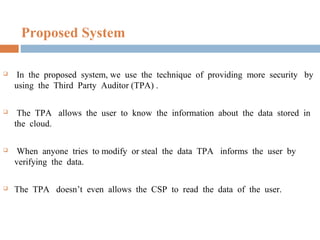
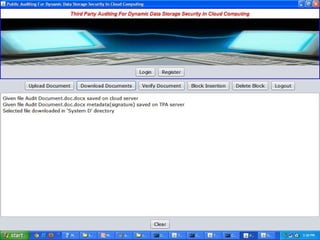
In the proposed system, we use the technique of providing more security by
using the Third Party Auditor (TPA) .



The TPA allows the user to know the information about the data stored in
the cloud.



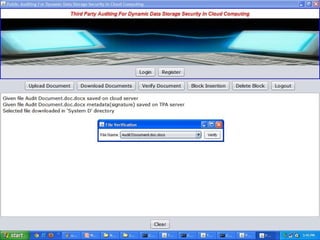
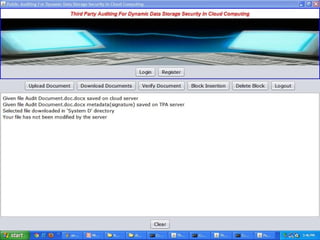
When anyone tries to modify or steal the data TPA informs the user by
verifying the data.



The TPA doesn’t even allows the CSP to read the data of the user.
Required Software


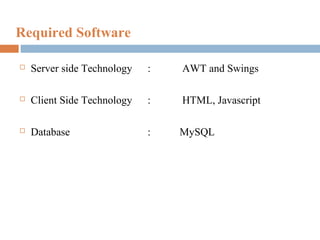
Server side Technology

:

AWT and Swings



Client Side Technology

:

HTML, Javascript



Database

:

MySQL
Required Hardware


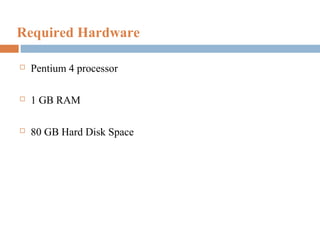
Pentium 4 processor



1 GB RAM



80 GB Hard Disk Space
MODULES


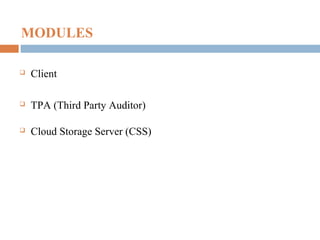
Client



TPA (Third Party Auditor)



Cloud Storage Server (CSS)
Conclusion


To ensure cloud data storage security, it is critical to enable a
TPA to evaluate the service quality from an objective and
independent perspective. Public auditability also allows clients to
delegate the integrity verification tasks to TPA while they
themselves can be unreliable or not be able tocommit necessary
computation resources performing continuous verifications.
Another major concern is how to construct verification protocols
that can accommodate dynamic data files. In this paper, we
explored the problem of providing simultaneous public
auditability and datadynamics for remote data integrity check in
Cloud Computing
Queries
Privacy Preserving Public Auditing for Data Storage Security in Cloud.ppt

Privacy Preserving Public Auditing for Data Storage Security in Cloud.ppt

  • 1.
    Privacy Preserving PublicAuditing for Data Storage Security in Cloud Under the guidance of M.Mohana Deepthi Presented by : R.V.Girish Chandra Y.Tejaswi G.Rama Devi Ch.Alekhya
  • 2.
    Contents  Abstract  Existing System Proposed System RequiredSoftware Required Hardware Modules Conclusion     
  • 3.
    ABSTRACT Cloud computing isa Internet based computing which enables sharing of services. Using Cloud Storage, users can remotely store their data and enjoy the on-demand high quality applications and services from a shared pool of configurable computing resources. Security in cloud is achieved by signing the data block before sending to the cloud. Moreover, users should be able to just use the cloud storage as if it is local, without worrying about the need to verify its integrity. Thus, enabling public auditability for cloud storage is of critical importance so that users can resort to a Third Party Auditor (TPA) to check the integrity of outsourced data.
  • 4.
    Existing System In theExisting System, Cloud Computing brings new and challenging security threats towards user’s outsourced data. First of all, although the infrastructures under the cloud are much more powerful and reliable than personal computing devices, they are still facing the broad range of both internal and external threats for data integrity. Secondly, for the benefits of their own, there do exist various motivations for Cloud Service Providers to behave unfaithfully towards the cloud users regarding the status of their outsourced data.
  • 5.
    Proposed System  In theproposed system, we use the technique of providing more security by using the Third Party Auditor (TPA) .  The TPA allows the user to know the information about the data stored in the cloud.  When anyone tries to modify or steal the data TPA informs the user by verifying the data.  The TPA doesn’t even allows the CSP to read the data of the user.
  • 6.
    Required Software  Server sideTechnology : AWT and Swings  Client Side Technology : HTML, Javascript  Database : MySQL
  • 7.
    Required Hardware  Pentium 4processor  1 GB RAM  80 GB Hard Disk Space
  • 8.
    MODULES  Client  TPA (Third PartyAuditor)  Cloud Storage Server (CSS)
  • 36.
    Conclusion  To ensure clouddata storage security, it is critical to enable a TPA to evaluate the service quality from an objective and independent perspective. Public auditability also allows clients to delegate the integrity verification tasks to TPA while they themselves can be unreliable or not be able tocommit necessary computation resources performing continuous verifications. Another major concern is how to construct verification protocols that can accommodate dynamic data files. In this paper, we explored the problem of providing simultaneous public auditability and datadynamics for remote data integrity check in Cloud Computing
  • 37.