Has Canada’s approach to identifying priority areas
     and setting wait-time targets helped or hindered
               Canadians’ access to care?

                          2012 Taming of the Queue Conference


March 29th, 2012

Dr. Vasanthi Srinivasan
Assistant Deputy Minister, Health System Strategy &
Policy Division
Ontario Ministry of Health and Long-Term Care
Introduction
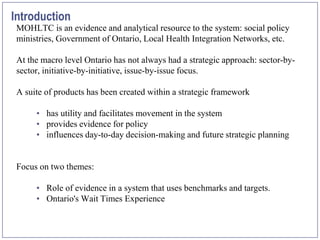
 MOHLTC is an evidence and analytical resource to the system: social policy
 ministries, Government of Ontario, Local Health Integration Networks, etc.

 At the macro level Ontario has not always had a strategic approach: sector-by-
 sector, initiative-by-initiative, issue-by-issue focus.

 A suite of products has been created within a strategic framework

      • has utility and facilitates movement in the system
      • provides evidence for policy
      • influences day-to-day decision-making and future strategic planning


 Focus on two themes:

      • Role of evidence in a system that uses benchmarks and targets.
      • Ontario's Wait Times Experience
Enhanced quality of care results when research knowledge is
translated to health care providers
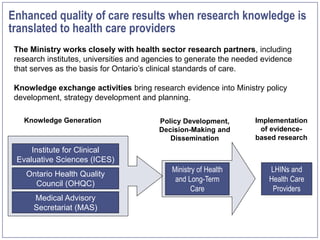
 The Ministry works closely with health sector research partners, including
 research institutes, universities and agencies to generate the needed evidence
 that serves as the basis for Ontario’s clinical standards of care.

 Knowledge exchange activities bring research evidence into Ministry policy
 development, strategy development and planning.

   Knowledge Generation                  Policy Development,        Implementation
                                         Decision-Making and          of evidence-
                                            Dissemination           based research
     Institute for Clinical
 Evaluative Sciences (ICES)
                                             Ministry of Health         LHINs and
    Ontario Health Quality
                                              and Long-Term             Health Care
      Council (OHQC)
                                                    Care                 Providers
      Medical Advisory
      Secretariat (MAS)
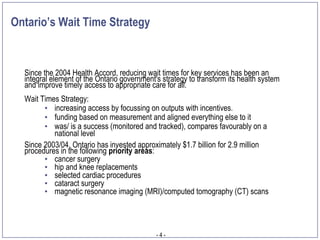
Ontario’s Wait Time Strategy


  Since the 2004 Health Accord, reducing wait times for key services has been an
  integral element of the Ontario government's strategy to transform its health system
  and improve timely access to appropriate care for all.
  Wait Times Strategy:
        • increasing access by focussing on outputs with incentives.
        • funding based on measurement and aligned everything else to it
        • was/ is a success (monitored and tracked), compares favourably on a
           national level
  Since 2003/04, Ontario has invested approximately $1.7 billion for 2.9 million
  procedures in the following priority areas:
        • cancer surgery
        • hip and knee replacements
        • selected cardiac procedures
        • cataract surgery
        • magnetic resonance imaging (MRI)/computed tomography (CT) scans


                                             -4-
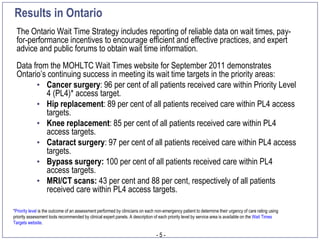
Results in Ontario
 The Ontario Wait Time Strategy includes reporting of reliable data on wait times, pay-
 for-performance incentives to encourage efficient and effective practices, and expert
 advice and public forums to obtain wait time information.
 Data from the MOHLTC Wait Times website for September 2011 demonstrates
 Ontario’s continuing success in meeting its wait time targets in the priority areas:
       • Cancer surgery: 96 per cent of all patients received care within Priority Level
          4 (PL4)* access target.
       • Hip replacement: 89 per cent of all patients received care within PL4 access
          targets.
       • Knee replacement: 85 per cent of all patients received care within PL4
          access targets.
       • Cataract surgery: 97 per cent of all patients received care within PL4 access
          targets.
       • Bypass surgery: 100 per cent of all patients received care within PL4
          access targets.
       • MRI/CT scans: 43 per cent and 88 per cent, respectively of all patients
          received care within PL4 access targets.

*Priority level is the outcome of an assessment performed by clinicians on each non-emergency patient to determine their urgency of care rating using
priority assessment tools recommended by clinical expert panels. A description of each priority level by service area is available on the Wait Times
Targets website.

                                                                                -5-
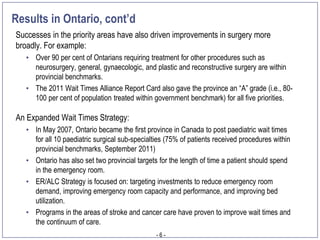
Results in Ontario, cont’d
Successes in the priority areas have also driven improvements in surgery more
broadly. For example:
   • Over 90 per cent of Ontarians requiring treatment for other procedures such as
     neurosurgery, general, gynaecologic, and plastic and reconstructive surgery are within
     provincial benchmarks.
   • The 2011 Wait Times Alliance Report Card also gave the province an “A” grade (i.e., 80-
     100 per cent of population treated within government benchmark) for all five priorities.

An Expanded Wait Times Strategy:
   • In May 2007, Ontario became the first province in Canada to post paediatric wait times
     for all 10 paediatric surgical sub-specialties (75% of patients received procedures within
     provincial benchmarks, September 2011)
   • Ontario has also set two provincial targets for the length of time a patient should spend
     in the emergency room.
   • ER/ALC Strategy is focused on: targeting investments to reduce emergency room
     demand, improving emergency room capacity and performance, and improving bed
     utilization.
   • Programs in the areas of stroke and cancer care have proven to improve wait times and
     the continuum of care.
                                                -6-
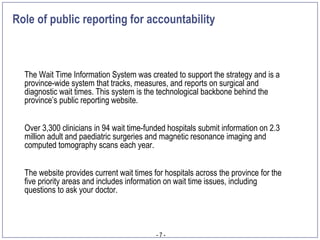
Role of public reporting for accountability


  The Wait Time Information System was created to support the strategy and is a
  province-wide system that tracks, measures, and reports on surgical and
  diagnostic wait times. This system is the technological backbone behind the
  province’s public reporting website.


  Over 3,300 clinicians in 94 wait time-funded hospitals submit information on 2.3
  million adult and paediatric surgeries and magnetic resonance imaging and
  computed tomography scans each year.


  The website provides current wait times for hospitals across the province for the
  five priority areas and includes information on wait time issues, including
  questions to ask your doctor.


                                           -7-
Final Thoughts
•   Setting and achieving targets is an accomplishment to be proud of . . .
•   . . . but it is important to remember that those areas outside of the “spotlight”
    of a target may not progress as much those “in the light”.
•   Target setting is never “done”.
•   There is a danger of confusing descriptions of activities (e.g. an Operational
    Plan) with a framework for measuring activities to know what is and is not
    working.
•   Public policy making requires that performance against targets is analysed
    thoroughly, and that new targets (in some cases in new areas) are
    established as appropriate.


                                          -8-

Priority Areas and Targets

  • 1.
    Has Canada’s approachto identifying priority areas and setting wait-time targets helped or hindered Canadians’ access to care? 2012 Taming of the Queue Conference March 29th, 2012 Dr. Vasanthi Srinivasan Assistant Deputy Minister, Health System Strategy & Policy Division Ontario Ministry of Health and Long-Term Care
  • 2.
    Introduction MOHLTC isan evidence and analytical resource to the system: social policy ministries, Government of Ontario, Local Health Integration Networks, etc. At the macro level Ontario has not always had a strategic approach: sector-by- sector, initiative-by-initiative, issue-by-issue focus. A suite of products has been created within a strategic framework • has utility and facilitates movement in the system • provides evidence for policy • influences day-to-day decision-making and future strategic planning Focus on two themes: • Role of evidence in a system that uses benchmarks and targets. • Ontario's Wait Times Experience
  • 3.
    Enhanced quality ofcare results when research knowledge is translated to health care providers The Ministry works closely with health sector research partners, including research institutes, universities and agencies to generate the needed evidence that serves as the basis for Ontario’s clinical standards of care. Knowledge exchange activities bring research evidence into Ministry policy development, strategy development and planning. Knowledge Generation Policy Development, Implementation Decision-Making and of evidence- Dissemination based research Institute for Clinical Evaluative Sciences (ICES) Ministry of Health LHINs and Ontario Health Quality and Long-Term Health Care Council (OHQC) Care Providers Medical Advisory Secretariat (MAS)
  • 4.
    Ontario’s Wait TimeStrategy Since the 2004 Health Accord, reducing wait times for key services has been an integral element of the Ontario government's strategy to transform its health system and improve timely access to appropriate care for all. Wait Times Strategy: • increasing access by focussing on outputs with incentives. • funding based on measurement and aligned everything else to it • was/ is a success (monitored and tracked), compares favourably on a national level Since 2003/04, Ontario has invested approximately $1.7 billion for 2.9 million procedures in the following priority areas: • cancer surgery • hip and knee replacements • selected cardiac procedures • cataract surgery • magnetic resonance imaging (MRI)/computed tomography (CT) scans -4-
  • 5.
    Results in Ontario The Ontario Wait Time Strategy includes reporting of reliable data on wait times, pay- for-performance incentives to encourage efficient and effective practices, and expert advice and public forums to obtain wait time information. Data from the MOHLTC Wait Times website for September 2011 demonstrates Ontario’s continuing success in meeting its wait time targets in the priority areas: • Cancer surgery: 96 per cent of all patients received care within Priority Level 4 (PL4)* access target. • Hip replacement: 89 per cent of all patients received care within PL4 access targets. • Knee replacement: 85 per cent of all patients received care within PL4 access targets. • Cataract surgery: 97 per cent of all patients received care within PL4 access targets. • Bypass surgery: 100 per cent of all patients received care within PL4 access targets. • MRI/CT scans: 43 per cent and 88 per cent, respectively of all patients received care within PL4 access targets. *Priority level is the outcome of an assessment performed by clinicians on each non-emergency patient to determine their urgency of care rating using priority assessment tools recommended by clinical expert panels. A description of each priority level by service area is available on the Wait Times Targets website. -5-
  • 6.
    Results in Ontario,cont’d Successes in the priority areas have also driven improvements in surgery more broadly. For example: • Over 90 per cent of Ontarians requiring treatment for other procedures such as neurosurgery, general, gynaecologic, and plastic and reconstructive surgery are within provincial benchmarks. • The 2011 Wait Times Alliance Report Card also gave the province an “A” grade (i.e., 80- 100 per cent of population treated within government benchmark) for all five priorities. An Expanded Wait Times Strategy: • In May 2007, Ontario became the first province in Canada to post paediatric wait times for all 10 paediatric surgical sub-specialties (75% of patients received procedures within provincial benchmarks, September 2011) • Ontario has also set two provincial targets for the length of time a patient should spend in the emergency room. • ER/ALC Strategy is focused on: targeting investments to reduce emergency room demand, improving emergency room capacity and performance, and improving bed utilization. • Programs in the areas of stroke and cancer care have proven to improve wait times and the continuum of care. -6-
  • 7.
    Role of publicreporting for accountability The Wait Time Information System was created to support the strategy and is a province-wide system that tracks, measures, and reports on surgical and diagnostic wait times. This system is the technological backbone behind the province’s public reporting website. Over 3,300 clinicians in 94 wait time-funded hospitals submit information on 2.3 million adult and paediatric surgeries and magnetic resonance imaging and computed tomography scans each year. The website provides current wait times for hospitals across the province for the five priority areas and includes information on wait time issues, including questions to ask your doctor. -7-
  • 8.
    Final Thoughts • Setting and achieving targets is an accomplishment to be proud of . . . • . . . but it is important to remember that those areas outside of the “spotlight” of a target may not progress as much those “in the light”. • Target setting is never “done”. • There is a danger of confusing descriptions of activities (e.g. an Operational Plan) with a framework for measuring activities to know what is and is not working. • Public policy making requires that performance against targets is analysed thoroughly, and that new targets (in some cases in new areas) are established as appropriate. -8-