Principles
of the Zero
Trust
Model
www.foxpass.com
Zero Trust
Model
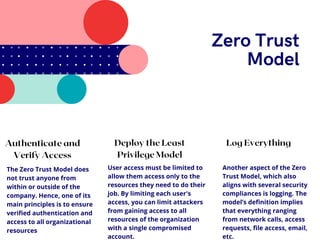
The Zero Trust Model does
not trust anyone from
within or outside of the
company. Hence, one of its
main principles is to ensure
verified authentication and
access to all organizational
resources
User access must be limited to
allow them access only to the
resources they need to do their
job. By limiting each user's
access, you can limit attackers
from gaining access to all
resources of the organization
with a single compromised
account.
Another aspect of the Zero
Trust Model, which also
aligns with several security
compliances is logging. The
model’s definition implies
that everything ranging
from network calls, access
requests, file access, email,
etc.
Authenticate and
Verify Access
Deploy the Least
Privilege Model
Log Everything
The
Architecture of
the Zero Trust
Model
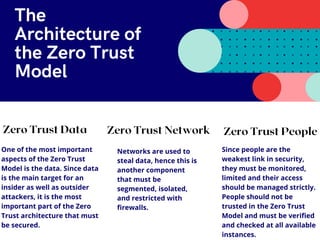
One of the most important
aspects of the Zero Trust
Model is the data. Since data
is the main target for an
insider as well as outsider
attackers, it is the most
important part of the Zero
Trust architecture that must
be secured.
Networks are used to
steal data, hence this is
another component
that must be
segmented, isolated,
and restricted with
firewalls.
Since people are the
weakest link in security,
they must be monitored,
limited and their access
should be managed strictly.
People should not be
trusted in the Zero Trust
Model and must be verified
and checked at all available
instances.
Zero Trust Data Zero Trust Network Zero Trust People
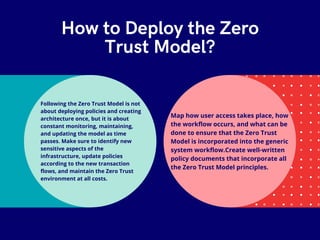
How to Deploy the Zero
Trust Model?
Following the Zero Trust Model is not
about deploying policies and creating
architecture once, but it is about
constant monitoring, maintaining,
and updating the model as time
passes. Make sure to identify new
sensitive aspects of the
infrastructure, update policies
according to the new transaction
flows, and maintain the Zero Trust
environment at all costs.
Map how user access takes place, how
the workflow occurs, and what can be
done to ensure that the Zero Trust
Model is incorporated into the generic
system workflow.Create well-written
policy documents that incorporate all
the Zero Trust Model principles.
Contact US
www.foxpass.com
+1 415-805-6350
neel@foxpass.com

Principles of the Zero Trust Model.pdf

  • 1.
  • 2.
    Zero Trust Model The ZeroTrust Model does not trust anyone from within or outside of the company. Hence, one of its main principles is to ensure verified authentication and access to all organizational resources User access must be limited to allow them access only to the resources they need to do their job. By limiting each user's access, you can limit attackers from gaining access to all resources of the organization with a single compromised account. Another aspect of the Zero Trust Model, which also aligns with several security compliances is logging. The model’s definition implies that everything ranging from network calls, access requests, file access, email, etc. Authenticate and Verify Access Deploy the Least Privilege Model Log Everything
  • 3.
    The Architecture of the ZeroTrust Model One of the most important aspects of the Zero Trust Model is the data. Since data is the main target for an insider as well as outsider attackers, it is the most important part of the Zero Trust architecture that must be secured. Networks are used to steal data, hence this is another component that must be segmented, isolated, and restricted with firewalls. Since people are the weakest link in security, they must be monitored, limited and their access should be managed strictly. People should not be trusted in the Zero Trust Model and must be verified and checked at all available instances. Zero Trust Data Zero Trust Network Zero Trust People
  • 4.
    How to Deploythe Zero Trust Model? Following the Zero Trust Model is not about deploying policies and creating architecture once, but it is about constant monitoring, maintaining, and updating the model as time passes. Make sure to identify new sensitive aspects of the infrastructure, update policies according to the new transaction flows, and maintain the Zero Trust environment at all costs. Map how user access takes place, how the workflow occurs, and what can be done to ensure that the Zero Trust Model is incorporated into the generic system workflow.Create well-written policy documents that incorporate all the Zero Trust Model principles.
  • 5.