Basic principles of Forensic
Science. (CSM)
By Sankalpa Mam
Lecture 2
22/09/2022
Principlesof
ForensicScience
1.Law of exchange
2.Law of individuality
3.Law of comparison
4.Law of progressive change
5.Law of analysis
6.Law of probability
7.Law of circumstantial facts
1.Lawof
exchange
This law is also called as
Locard’s exchange principle
 Every contact leaves a
trace
Dr. Edmond Locard is the
father of Forensic Science
2.Lawof
individual
Every evidence is unique .
It means every evidence will
have individual characteristics.
Characteristics are of 2 types
1. Class Characteristics.
Eg. Blood group.
2. Individual Characteristics.
Eg. DNA, Bite mark .
3.Lawof
comparison
Only likes can be compared
with each other .
Eg. Human blood should be
compared with human blood
only , not with animal blood
4.Lawof
progressive
change
After a particular duration of
time, the evidence tends to
loose it’s original property.
 Eg. Human hair, latent
finger print.
5.Lawof
analysis
Law of analysis states that
analysis the evidence and give
the reports based on
Observation.
6.Lawof
probabprobabili
ty
Always we have probability
with something.
Eg. Probability of having same
Fingerprint is 1060.
7.Lawof
circumstancircums
tantialfacts.
Facts donot lie ; Man can ,
they do .
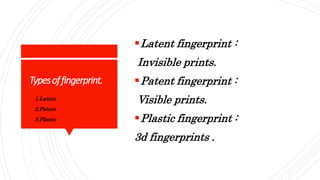
Typesoffingerprint.
Latent fingerprint :
Invisible prints.
Patent fingerprint :
Visible prints.
Plastic fingerprint :
3d fingerprints .
1. 1.Latent
2. 2.Patent
3. 3.Plastic

PRINCIPLES OF FORENSIC SCIENCE.pptx