Principles of Electronic Materials and Devices 4th Edition Kasap Solutions Manual
1.
Visit https://testbankdeal.com todownload the full version and
explore more testbank or solutions manual
Principles of Electronic Materials and Devices 4th
Edition Kasap Solutions Manual
_____ Click the link below to download _____
https://testbankdeal.com/product/principles-of-electronic-
materials-and-devices-4th-edition-kasap-solutions-manual/
Explore and download more testbank or solutions manual at testbankdeal.com
2.
Here are somerecommended products that we believe you will be
interested in. You can click the link to download.
Electronic Devices and Circuit Theory 11th Edition
Boylestad Solutions Manual
https://testbankdeal.com/product/electronic-devices-and-circuit-
theory-11th-edition-boylestad-solutions-manual/
Solid State Electronic Devices 7th Edition Streetman
Solutions Manual
https://testbankdeal.com/product/solid-state-electronic-devices-7th-
edition-streetman-solutions-manual/
Principles of Electronic Communication Systems 4th Edition
Frenzel Solutions Manual
https://testbankdeal.com/product/principles-of-electronic-
communication-systems-4th-edition-frenzel-solutions-manual/
Fundamentals of Management 8th Edition Ricky Griffin
Solutions Manual
https://testbankdeal.com/product/fundamentals-of-management-8th-
edition-ricky-griffin-solutions-manual/
3.
Intermediate Accounting Reportingand Analysis 3rd Edition
Wahlen Solutions Manual
https://testbankdeal.com/product/intermediate-accounting-reporting-
and-analysis-3rd-edition-wahlen-solutions-manual/
Macroeconomics 5th Edition Williamson Test Bank
https://testbankdeal.com/product/macroeconomics-5th-edition-
williamson-test-bank/
Seeing Sociology An Introduction 3rd Edition Ferrante Test
Bank
https://testbankdeal.com/product/seeing-sociology-an-introduction-3rd-
edition-ferrante-test-bank/
Writing with Style APA Style Made Easy 6th Edition
Szuchman Test Bank
https://testbankdeal.com/product/writing-with-style-apa-style-made-
easy-6th-edition-szuchman-test-bank/
Introduction To Digital Communications 1st Edition Pursley
Solutions Manual
https://testbankdeal.com/product/introduction-to-digital-
communications-1st-edition-pursley-solutions-manual/
4.
Sociology A BriefIntroduction Canadian Canadian 5th
Edition Schaefer Test Bank
https://testbankdeal.com/product/sociology-a-brief-introduction-
canadian-canadian-5th-edition-schaefer-test-bank/
“Why,” pricking herwork with her needle, “I think he—cares a great
deal, and he is so splendid that I want her to care. How they would
work together. Bensalem has been getting her ready.”
“Well, I declare!” he exclaimed, rising to his feet.
“Are you displeased?”
“There’s nothing to be displeased about. Is this the way girls plot
against each other? No wonder we men have to tread softly.”
“It isn’t plotting exactly. It’s only hoping.”
“Is that your secret?”
“Yes, and don’t you tell,” she said, alarmed.
“No; it shall be my secret; yours and mine. Now what are we going
to do about it?”
“We cannot do anything. She admires him around the edges,
somehow. And he’s as shy of her as he can be. I seem to be always
interpreting them to each other.”
He laughed, greatly amused.
“In spite of my selecting the most innocent love-stories for you, you
have grown up to the depth, or height, of this. I’ll never dare put a
finger in a girl’s education again.”
“But, Roger—”
“Don’t ask me to help you out.”
“Marion will not. She doesn’t seem to understand anything.”
“No wonder,” thought Roger, remembering her early experience;
“she has been a burnt child; she’ll never play with that kind of fire
27.
again.”
Aloud he replied:“She needs a wise head like yours. What would
you advise her to do?”
“To be natural; just her own self, and she isn’t. I believe she’s
afraid.”
“So will you be when you are as old as she is.”
“I don’t know what to be afraid of.”
“May you never know. Is that all you are in the dark about?” he
questioned, seating himself in his study chair, and wheeling around
to face the girl in the bay window.
A girl in blue, as she was when she sat in the bay window in
Summer Avenue and wrote letters to Aunt Affy; the same trustful
eyes, loving mouth, and yellow head.
Now, as then, she did not know what to be afraid of. It was only this
last month that she had brought her questions to Roger. Marion had
not grown ahead of her to answer her. And Aunt Affy had been so
absorbed in Aunt Rody this last year that she had feared to trouble
her with questions.
“I have a book-full of questions laid up for you; rather the answers
would be a book-full. Life seems full of questions. There’s always
something to ask about everything I read.”
“Ask the next book.”
“The next book doesn’t always know.”
“The next person may not always know.”
“I can easily find out,” she laughed.
28.
Then she becamegrave, and, after a moment’s silence, said: “I wish
I knew why we couldn’t have an idea, as we pray a long time for
something, whether it were going to be given us or not.”
“Something that you have no special promise for?”
“Yes; something in the ‘what-so-ever.’ It does seem so hard to have
it grow darker and harder, and not to know whether you may keep
on or not; whether giving up would be in faith—or despair.”
“Judith, you’ve touched a sensitive point in many a heart that keeps
on praying.”
“Do you know?” she asked.
“I can tell you a story.”
His story was all she desired.
“You know when Jairus came to the Lord to plead for his daughter,
he fell at his feet and besought him greatly, saying: ‘My little
daughter lieth at the point of death.’ Then Jesus went with him. We
do not know what he said, but he went with him. Then, as they
went together, the crowd came to a stand-still that the Lord might
perform a miracle and answer the prayer of a touch. But, by this
time, Jesus had been so long on the way that news came of the
death of the little daughter. It was too late. She was dead. They said
to the father: ‘Why troublest thou the Master any further?’ He might
as well go home to his dead child, the Master had not cared to
hasten—this woman was not at the point of death, she might have
been healed another day. But think of the comfort: as soon as Jesus
heard the message, he said to the father: ‘Be not afraid; only
believe.’ Is he not saying that every hour to us who are fainting
because he is so long on the way?”
“Yes,” said Judith, “but he did not say he would raise her from the
dead. Perhaps the ruler did not know he had power to raise from the
29.
dead.”
“No; he onlysaid: Be not afraid: only believe. Is not that assurance
enough for you?”
“Now, don’t think I am dreadfully wicked, but I know I am; I want
him to say: ‘Be not afraid, I know she is dead, but I have power
enough for that; believe I can do that. He did not tell him what to
believe.”
“He told him to believe in the sympathy and power that had just
healed this woman who had been incurable twelve years, all the
years his daughter had been living.”
“But,” persisted Judith, “he might believe that, for he had just seen
it; but to raise from the dead was beyond everything he had seen,
and Christ gave him no promise for that.”
“Perhaps he believed that the Master had power in reserve—he
surely knew he was going to his house for something—he did not
bid him believe, and then turn back; he went on with him to his
house.”
“Now you have said what I wanted. It was the going on with him
that kept up his faith. As long as Jesus kept on going his way he
couldn’t but believe. He gave him something even better than his
word to believe in. I shouldn’t think he would be afraid of anything
then.”
“Then don’t you be afraid of anything. Not until the Master turns and
goes the other way.”
“He will never do that,” Judith said to herself.
The clock on the mantel struck the half hour: half-past five. Judith
rolled up her work and went out to the kitchen. The tea kettle was
singing on the range; everything was ready for the supper, biscuits
30.
and cake ofher own making, jelly and fruit that she and Marion had
put up together in the long summer days, to which she would add
an omelet and creamed potatoes, for Roger was always hungry after
a walk, and then coffee, for Mrs. Kenney would like coffee after her
drive.
“I don’t mind now if my prayers do get stopped in the middle,” she
thought as she arranged the pretty cups and saucers on the supper
table, “if Jesus goes all the way with me—he will take care of the
rest of it, and next year—if something dies this year, he can bring it
to life next year. If He wants to; and I don’t want Him to, if He
doesn’t want to.”
Roger came out into the kitchen to watch her as she moved about,
and, to his own surprise, found himself asking her the question he
had intended not to ask at all.
“Would you like to go back home with mother for the winter? You
may have a music teacher, you have had none but Marion, and take
lessons in anything and everything. Mother would like it very much,”
he said, noting the gladness and gratitude in her face; “Martha will
take your place here with Marion.”
“Oh, yes, I would like it,” she answered, doubtfully. “Did she propose
it?”
“Yes.”
“You are sure you didn’t suggest it, even,” she questioned, still
doubtfully.
“I am not unselfish enough for that,” he answered, dryly.
“But who would pay for it?” she questioned, with a flush of shame.
“No; I will not go—until I earn money myself.”
31.
“A letter camelast night from your Cousin Don—I really believe I
forgot to tell you—perhaps I was jealous of his right to spend money
for you. He asked me to decide what would be best for you, from my
knowledge of yourself, and said any amount would be forthcoming
that your plans needed. His heart is in his native land still. He will
never come home to stay as long as his wife”—“lives” in his thought
was instantly changed to “objects” upon his lips.
“So you would really like to go back to city life?”
“Yes,” said Judith with slow decision.
Why should she not go home with John Kenney’s mother, she
argued, as she stood silent before Roger. He was studying medicine
in New York; he had written her once, only once, and then to tell her
that he had decided upon the medical course: “If I cannot have
something else I want I will have this. Life has got to have
something for me.”
A week later Lottie Kindare had written one of her infrequent letters;
the burden of the letter seemed to be a twenty-mile drive with John
Kenney and an engagement to go to see pictures with him.
“I have always liked John, you know—John with the crimson name.”
She was glad of both letters; they both revealed something she had
no other way of learning. She had not hurt John beyond recovery,
and Lottie would have something she wished for most.
“Don will be glad to take the responsibility of you. You give him
another reason for staying alive.”
“Hasn’t he reasons enough—without me?”
“He ought to have,” was the serious reply. “Everybody should have,
excepting yourself.”
“Myself appears to be the chief reason to me.”
32.
“Take as muchtime as you like to decide—and remember, you go of
your own free will.”
“Roger, you know it isn’t that I choose to go—” she began, earnestly.
“Oh, no,” he said, as he turned away, “not Caesar less, but Rome
more.”
He went into the study and shut the door.
“The child, the child,” he groaned, “she has no more thought of me
than—Uncle Cephas.”
When his mother and sister returned, and the supper bell rang, he
opened the door to say to Marion that he would have no supper, he
had work to do.
“Yes,” he thought grimly, “I have work to do—to fight myself into
shape.”
33.
XXXI. ABOUT WOMEN.
“Likea blind spinner in the sun,
I tread my days;
I know that all the threads will run
Appointed ways;
I know each day will bring its task,
And, being blind, no more I ask.”
—H. H.
“I wish you would tell Judith Mackenzie all you know about women’s
doings,” said Jean Draper Prince one morning late in November.
“I am ready to give the Bensalem girls a lecture upon what women
outside of Bensalem are doing,” said the lady in the bamboo rocker
with her knitting. “All the ambitious girls, all the discouraged girls.”
The bamboo rocker was Jean’s wedding present from Judith
Mackenzie; Jean had told Mrs. Lane that the broad blue ribbon bow
tied upon it was exactly the color of Judith’s eyes.
Mrs. Lane had not visited Bensalem since the summer she gave Jean
Draper the inspiration of her outing; but many letters had kept alive
her interest in the Bensalem girl, and kept growing the love and
admiration of the village girl for the lady who lived in the world and
knew all about it.
34.
Jean said herloveliest wedding present was the week Mrs. Lane
came to Bensalem to give to her. The loveliest wedding present was
shared with Judith Mackenzie.
Jean’s husband was the village blacksmith; his new, pretty house
was next door to his shop. It was not all paid for, and Jean was
helping to pay for it by saving all the money she could out of her
housekeeping. If she only might earn money, she sighed, but her
husband laughed at the idea, saying his two strong hands were to
be forever at her service.
The small parlor was in its usual pretty order; in the sitting-room
were a flower stand, and a canary’s cage; Mrs. Lane preferred the
sitting-room, but with her instinct that “company” should have the
best room, Jean had urged her into the parlor, drawing down the
shades a little that the sunlight should not fade the roses in the new
carpet.
“Judith is the craziest girl about doing things,” replied Jean; “she is
ambitious, and she thinks she must earn money. I told her you wrote
for a paper that was full of business for women, and could tell her
what to do.”
“What does she wish to do?”
“Study, and write—she writes the dearest little stories,—or anything
else, if she cannot do that. She has ideas,” said Jean, gravely; “she
is a rusher into new things. I wish she would be married and have a
nice little home and care how the bread rises and the pudding
comes out of the oven.”
“Isn’t she interested in housekeeping?”
“Oh, yes. But it is Miss Marion’s. Not her own. It is the own that
makes the difference,” replied the girl-wife contentedly, nodding and
smiling out the window to the man in shirt-sleeves and leather apron
35.
who stood inthe doorway of the shop talking to the minister on
horseback.
How could she ever tell Judith that Bensalem was gossiping about
her staying at the parsonage?
“Your work is your own; it comes to be your own, whatever it is.
Every girl cannot marry a blacksmith, Jean, and have a small home
of her own.”
“I know it. I wish they could. What I wish most for Judith is for her
to go back to Aunt Affy’s.”
That afternoon as the three sat together in the blacksmith’s parlor,
Jean with towels she was hemming for her mother, and the other
two with idle hands and work upon their laps, Jean suddenly asked
Mrs. Lane to tell them about women and their doings.
“As I waited in the station for my train the day I came here,” began
Mrs. Lane in the conversational tone of one prepared for a long talk,
“a lady sat near me, also waiting, with a bag in her hand. I had a
bag in my hand, but there was nothing unusual in mine; she told me
she was going to Dunellen to take care of ladies’ finger-nails. She
had a good business in Dunellen and the suburbs in summer, when
the people were in their country homes; there were a few ladies who
expected her that day.”
“I wouldn’t like to do that,” declared Jean, “although I would do
almost anything to pay off our mortgage.”
“In Buffalo is a woman who runs a street-cleaning bureau; in Kansas
City a woman is at the head of a fire department.”
“Worse and worse,” laughed Jean.
“A Louisville lady makes shopping trips to Paris.”
36.
“Splendid,” exclaimed Jean,who still dreamed of outings.
“A lady in New York makes flat-furnishing a business.”
“That is making a home for other people,” said Jean.
“But her own at the same time,” answered Judith.
“New Hampshire has a woman president of a street railway
company; and in Chicago is a woman who embalms—”
“Dead people,” interrupted Jean; “oh, dear me!”
“The world is learning the resources of the nineteenth century
woman. A Swiss woman has invented a watch for the blind. The
hours on the dial are indicated by pegs, which sink in, one every
hour.”
“That is worth doing,” observed Judith; “I want to do real work. I
know I do not mean my work to end with myself.”
“Lady Somebody has classified her husband’s books, with a
catalogue—his papers fill five rooms; think of the work before her.”
“But that is not for herself,” demurred Judith.
“I believe Judith would like to be famous,” said Jean with a laugh.
“Bensalem is such a little spot to her.”
“A lady is about to translate King Oscar of Sweden’s works into
English; would you like to do that, Judith?” asked Mrs. Lane, who
felt that she had been a friend of Judith MacKenzie’s ever since Jean
Draper had known her and written of their girlhood together.
“Not exactly that,” said Judith.
“The first woman rabbi in the world is in California. She has been
trained in a Hebrew College; Rabbi Moses, the celebrated Jewish
37.
divine in Chicago,urges her to take a congregation.”
“Then how can the men give thanks in their prayers that they are
not born women?” asked Judith quickly.
“Do the Jews do that?” inquired Jean.
“Yes. But I don’t believe old Moses did, or this Rabbi Moses,” said
Judith.
“A lady has received the degree of electrical engineer,” continued
Mrs. Lane, who appeared to both her listeners to be a Cyclopedia of
Information Concerning Women.
“Judith doesn’t mean such things,” explained Jean; “I don’t believe
she wants David to teach her to be a blacksmith. But there is a
woman in Dunellen who has a sick husband, and she is doing his
work in the butcher’s shop.”
“Would you rather go to Washington, that city of opportunities for
girls? The government offices are filled with women, and young
women. Those who pass the civil service examination must be over
twenty. Many states of the Union are represented. As the
departments close at four in the afternoon, some of the girls take
time for other employments, or for study. One I read of attends
medical lectures at night. Some, who love study, belong to the
Chautauqua Circle. French women, as a rule, have a good business
education. In the common schools they are taught household
bookkeeping. The French woman is expected to help her husband in
his business.”
“Not if he is a blacksmith,” interjects the blacksmith’s wife.
“Harper has published a series called the Distaff Series: all the
mechanical work, type-setting, printing, binding, covering, and
designing was all done by women.”
38.
“I think Iwould rather make the inside of a book,” said Judith. “But
think of the women that do that and every kind of a book.”
“A lady took the four hundred dollar prize mathematical scholarship
at Cornell University. There were twelve applicants; nine were
women.”
“That is hard work,” acknowledged Judith, to whom Arithmetic and
Algebra were never a success. She had even shed tears over
Geometry, and how Roger had laughed at her.
“There’s a lady on Long Island who has a farm of five hundred
acres; they call the farm, ‘Old Brick.’”
“Horrid name,” interrupted Jean, turning carefully the narrow hem of
the coarse towel.
“It was a dairy farm, but she found milk not profitable enough, and
gave it up and made a study of live stock. She has made a
reputation as a stock raiser; she raises trotters and road horses,”
said Mrs. Lane, watching the effect of her words upon Judith.
Judith colored and looked displeased. Was this all Mrs. Lane, Jean’s
ideal lady, had to tell her of women’s brave work?
“In Italy nearly two millions of women are employed in industrial
pursuits, cotton, silk, linen, and jute. Three million women are busy
in agriculture. You might try agriculture here in Bensalem.”
“What do their homes do?” inquired Jean, the home-maker.
“Oh, they do woman’s work, beside.”
“It is all woman’s work, I suppose, if women do it,” answered Judith,
discouraged.
39.
“Judith, who isthe sweetest woman you know?” asked Mrs. Lane,
touched by the droop of the girl’s head and the trouble in her eyes.
“I know ever so many. No one could be sweeter than my mother.
And my Aunt Affy is strong and sweet, and doing good to everybody.
And Mrs. Kenney, Marion’s mother, she is in things, busy and bright
always.”
“I have told you some things women may do; now I’ll tell you some
things a woman—one woman—may not do. She cannot do—is not
allowed to do—some things a washer-woman in Bensalem may do—
But I’ll read you the slip; I have it in my pocket-book.”
She took the cutting from her pocket-book and asked Judith to read
it aloud.
Judith read: “Queen Victoria, not being born a queen, probably
learned to read just like other persons. But after she became
afflicted with royalty she found that a queen is not allowed to have a
great many privileges that the humblest of her subjects can boast.
For instance, she isn’t allowed to handle a newspaper of any kind,
nor a magazine, nor a letter from any person except from her own
family, and no member of the royal family or household is allowed to
speak to her of any piece of news in any publication. All the
information the queen is permitted must first be strained through
the intellect of a man whose business it is to cut out from the papers
each day what he thinks she would like to know. These scraps he
fastens on a silken sheet with a gold fringe all about it, and presents
to her unfortunate majesty. This silken sheet with gold fringe is
imperative for all communications to the queen.
“Any one who wishes to send the queen a personal poem or a
communication of any kind (except a personal letter, which the poor
lady isn’t allowed to have at all) must have it printed in gold letters
on one side of these silk sheets with a gold fringe, just so many
inches wide and no wider, all about it. These gold trimmings will be
40.
returned to himin time, as they are expensive, and the queen is
kindly and thrifty; but for the queen’s presents they are imperative.
The deprivations of the queen’s life are pathetically illustrated by an
incident which occurred not long ago. An American lad sent her
majesty an immense collection of the flowers of this country,
pressed and mounted. The queen was delighted with the collection
and kept it for three months, turning over the leaves frequently with
great delight. At the end of that time, which was as long as she was
allowed by the court etiquette to keep it, she had it sent back with a
letter saying that, being queen of England, she was not allowed to
have any gifts, and that she parted from them with deep regret.”
“Well,” exclaimed Jean, with an energy that brought a laugh from
her small audience, “I would rather be the Bensalem blacksmith’s
wife.”
“I wish I could take this to Nettie,” said Judith; “she thinks
sometimes she would like to be a queen.”
“She is, in her small province,” replied Mrs. Lane. “I have something
for her; I think I can help her step out into as wide a world as she
cares to live in. No; don’t ask me; it is to be her secret and my own.
Now, Judith, tell me, what is the secret of the happy and useful lives
you know?”
“I don’t know,” replied Judith, truthfully. “But they are all married. I
am thinking of girls—like me. Their work came to them.”
“As mine did,” said Jean, contentedly, with a glance from her work
out the window where the blacksmith was shoeing a horse.
“Your Aunt Affy was not married—”
“No, she was not. She had her work. It was in her home. She was
born among her work. But I have not a home like that,” Judith
answered in short, sharp sentences.
41.
“Why, Judith,” reproachedJean, “what would Aunt Affy say to that?”
“It would hurt her. She would look sorry. I do not know what gets
into me, sometimes. She would adopt me and be like my own
mother.”
“Do you resist such a sweet mothering as that?” rebuked Mrs. Lane.
“I think I lost some of the sermon Sunday morning by looking at her
face.”
“I do not mean to resist her,” said Judith, not able to keep the tears
back.
“She told mother her heart ached to have you back,” persuaded
Jean, “since her sister died she had so longed for her little girl.”
“I’m afraid I am not doing right,” confessed Judith, “but I was almost
homesick there, when Aunt Rody was sick. And then, I think I must
learn to support myself, and not be dependent.”
“Oh, you American girl,” said Mrs. Lane.
“And with Aunt Affy for your mother,” added Jean; “I told Mrs. Lane
you had ideas.”
“I should think I had,” said Judith, laughing to keep the tears back.
“I’m afraid I’ve forgotten Aunt Affy. She loves two people in me, she
says; my mother and me. I don’t know what has possessed me.”
“Ambition, perhaps,” Mrs. Lane suggested, taking up her knitting,—a
long black stocking for her only grandchild.
“Not just that,” Judith reasoned; “it is more making something of
myself for myself. Culture for its own sake,” she quoted from Roger,
who had warned her against her devotion to self-culture; “and I give
it a self-sacrificing name; the desire to be independent. I do not
42.
know why Ishould not be dependent on Aunt Affy. My mother was—
and loved it.”
“No service could be more acceptable than serving her,” said Mrs.
Lane; “the world is only a larger Bensalem.”
“It isn’t the world I wanted,” replied Judith, impatiently.
When Judith went away Jean walked down the street with her. “Are
you disappointed in Mrs. Lane?” she asked.
“She did not tell me what I hoped and expected. She told me
something better. I think I can study at Aunt Affy’s,” in the tone of
one having made a sacrifice.
“And go to the parsonage every day,” said Jean eagerly, and yet
afraid of pressing her point.
“Yes—if I wish to,” replied Judith slowly, surprising herself by coming
to a decision.
“Bensalem is such a place for talk,” Jean ventured, not that she was
confident of success. “Everybody knows everybody’s business and is
interested in it.”
“But it is kindly talk,” said Judith, whom gossip had touched lightly.
“Yes, sometimes—not always,” Jean hesitated; “people will
misjudge.”
“Jean Draper, what do you mean?” asked Judith, blazing angrily;
“are you trying to tell me something?”
“No,” replied Jean, startled at Judith’s unusual vehemence. “I only
want you to understand that Aunt Affy is talked about for letting you
stay so much at the parsonage.”
“How could it hurt anybody?”
43.
“They say AuntAffy is—scheming,” she said, watching the effect of
her words.
“Scheming. What about? What does she gain?” asked Judith,
provoked.
“The gain is for you,” said Jean, at last, desperately; “they say she
wants to marry you to the minister.”
Now she had said it. She stood still, frightened. Judith left her
without another word, going straight on to the parsonage. After a
moment Jean turned and went home.
What would Judith do? She looked angry enough to do anything. But
she had shielded her from further talk. Bensalem should have no
more to say.
Judith went on dazed. Now she understood it all; Martha was
coming that she might go; they did not like to tell her to go; they
were all too kind. As if Aunt Affy could plot like that. As if Aunt Affy
cared for that: Aunt Affy who wanted to keep her always.
Had Marion heard the talk? And Roger? Was he glad to send her
away with his mother? She would fly to Aunt Affy that very night;
the old house would be her refuge. She would go back to Aunt Affy
—and her mother’s home. Roger, her saint, her hero, her ideal—he
could never think of her—like that.
She opened the door and went in. Marion had taken her mother for
a drive. The study door was shut, the usual signal when Roger was
busy. But she often ventured; the shut door had never barred her
out. Nothing had ever kept her away from Roger. She tapped; Roger
called: “Come in.”
He was writing and did not lift his eyes.
She waited; he looked up and smiled.
44.
“Can you stopone minute?” she asked, faintly.
“One and a half.”
“I came to tell you that I have thought it over; I would rather not go
home with Mrs. Kenney.”
“Stay then, with all my heart.”
“But not with all my heart. I am going to Aunt Affy’s instead. She
wants me,” she said, quietly, with a quiver of the lip.
“I should think she would.”
“I did not know how much. She herself would not tell me. Jean
Draper told me. Aunt Affy told her mother.”
“That will not change our plans of study at all.”
“No; it need not.”
“It shall not.”
“I think I can get on alone awhile. You have taught me how to use
books. You have shown me that they are tools. I can write by
myself. You have been to me like Maria Edgeworth’s father. Perhaps
it is time for Maria to stand alone.”
“You are tired of my teaching.”
“Oh, no; I am not tired of anything—excepting Bensalem. I hate
Bensalem,” she burst out with anger and contrition.
“What has Bensalem done now?”
“Nothing unusual. Will you tell Marion I am going—home to stay to-
night? Martha will come and help her in the housekeeping.”
45.
“Judith, has anyone hurt you?”
“No,” said Judith, smiling with the tears starting; “you are all too
kind.”
“Is it for Aunt Affy you are going? Judith, you cannot deceive me.”
“No; I do not think I can. I am going for Aunt Affy’s sake, Roger.”
“Because she misses you?”
“Yes, because she misses me, and needs me. People think and say—
she is not taking good care of me. I wish to prove to them that she
is.”
“That is sheer nonsense,” he exclaimed, angrily.
“It is not nonsense that she misses me now that her sister is gone. I
never had any sister excepting Marion, but I know it was dreadful for
Aunt Affy to lose her sister. If you haven’t helped me to study alone,
to depend upon myself, you have been very little help to me.”
“That is true,” he laughed, “but the studying is only a part of what
the parsonage is to you.”
“It was my reason for coming, and staying,” she said, simply,
flushing and trembling.
“True; I had forgotten that. Yes; it is better for you to go; best for
you to go. Come to-morrow and talk it over to Marion and my
mother. I will tell them only that you have gone—home, to spend the
night.”
He took up his pen, it trembled in his grasp; Judith went out and
shut the door that he might not be disturbed.
“I am giving it all up,” she thought, as she pressed a few things into
a satchel; “all I was going away to get; perhaps this is the way my
46.
prayer for workis being answered.”
They were at supper when she stood in the doorway; Aunt Affy at
the head of the table behind the tea-pot and the cups and saucers;
her husband opposite her, genial, handsome, satisfied, and Joe, at
one side of the round table, tall, fine-looking, with his gray,
thoughtful eyes, refined lips, and modest manner. Joe was a son to
be proud of, the old people sometimes said to each other.
There was no chair opposite Joe, no plate, and knife and fork and
napkin. Uncle Cephas liked a hot supper; they had chicken stew to-
night, and boiled rice. It was like home, the faces, the things on the
supper-table. She was homesick enough to long for some place
“like” home. The parsonage could never be her home again, with
Martha in her place; perhaps Martha had been wishing to come for
years; perhaps her selfishness had kept Martha away.
John would be married, Martha would be in her place at the
parsonage,—Don was too far away to know, and too absorbed in his
wife to care; Mrs. Kenney did not really want her, she had only asked
her to go home with her to get her away from the parsonage; the
only home she had a right to was this home where her mother had
been a little girl.
“Why, Judith,” cried Aunt Affy, rising, “dear child, what is the
matter?”
“I wanted to come home,” said Judith.
47.
XXXII. AUNT AFFY’SPICTURE.
“That only which we have within can we see without.”
—Emerson.
Judith stood at the sitting-room window looking out into the March
snow-storm. There had been many snow-storms since that
November night she came to the threshold and stood looking in at
the happy supper-table. Aunt Affy had opened her arms and heart
anew and folded her close: “My lamb has come back,” she said.
“To stay back,” Judith whispered, hiding her face on Aunt Affy’s
shoulder.
That night was nearly two years ago; she would be twenty in April.
She was not “twenty in April” to Aunt Affy; she was still her “lamb”
and her “little girl.”
In her dark blue cloth dress, and with her yellow head and rose-
tinted cheeks, she did not look as grown-up as she felt; she had
taken life, not only with both hands, but with heart, brain, and spirit,
and with all her might. There was nothing in her that she had not
put into her life; her simple, Bensalem life.
“Aunt Affy,” she said, as Aunt Affy’s step paused on the threshold
between kitchen and sitting-room, “Come and rest awhile in this fire-
light. This fire on the hearth to-night reminds me of the glow of the
grate in Summer Avenue when I used to tell pictures to mother.”
48.
Aunt Affy pulleddown the shades; Judith drew Aunt Affy’s chair to
the home-made rug—Aunt Rody’s rug,—to the hearth, and then sat
down on the hassock at her feet, and looked into the fire, not the
curly-headed girl in Summer Avenue, but the girl grown up.
“Aunt Affy, tell me a picture,” she coaxed.
“What about?”
“About myself. I’m afraid I am too full of myself. I cannot understand
something. I can tell you about it, for it is past, and I can look at it
as something in the past. You know those years I was at the
parsonage, at my boarding-school, I was crammed full with one
hope.”
Judith was looking at the fire; the eyes looking down at her were
solicitous, tender. She had been afraid Judith “cared too much” for
the young minister; but it must be over now, or she could not tell
her about it so frankly.
“I dreamed it, I studied it, I wrote it, I prayed about it, I breathed
it.”
“Oh,” said Aunt Affy, with a quick, heavy sigh.
“Don’t pity me. It was good for me, blessed for me, or it could not
have happened, you know. I thought there was some great work for
me to do—”
“Oh,” said Aunt Affy, with a quick, relieved cry.
“I was not sure whether it were to write a book, or to teach, or to go
as a foreign missionary; I think I hoped it would be the foreign
missionary, because that was the most self-sacrificing. The book was
all one great joy. The teaching was absorbing, but I must go away to
study. I was afraid to go away, I did not like to go away from
Bensalem, I would miss my mother away from Bensalem, and you,
49.
and all theparsonage, and the whole village. But I thought I was
called; as called as Roger was to preach, or any woman, saint, or
heroine, who had done a great thing. You cannot think what it was
to me. It made me old. I wanted God to speak out of Heaven and
tell me what to do. It began to lose its selfishness, after that. The
first thing that began to shake my confidence was something Mrs.
Lane said that afternoon she talked to Jean and me about what
women were doing and could do. She did not make woman’s work
attractive; she took the heart out of me. I did not know why she
should do that. I knew better all the time. I knew what women had
done and were doing. I knew she was doing a noble work, literary
work, work in prisons, temperance work; the instances she gave me
seemed trivial, as if she were laughing at me. But something opened
my eyes; I felt that I might be disobedient to my heavenly vision,
that I was looking up into the heavens for my call, and the voice
might be all the time in my ear. That was the night I came back here
and found you so cozy and satisfied under your own roof-tree, with
the voice in your ear, and the work in your hand. The world went
away from me. I stayed. I am glad I stayed. My only trouble is, and
it is a real trouble, that God did not care for my purpose, or my
prayers; that he has let them go as if they never entered into his
mind; I thought they were in his heart as well as mine.”
“They are, Deary,” said Aunt Affy, wiping her eyes; “He will not let
one of them go.”
“But He did not do anything with them. He did not love my plan, and
my prayers,” said Judith, wearily.
“Do you remember one time when Jesus was on the earth, a man,
clothed and in his right mind, sat at Jesus’ feet? He had so much to
be thankful for; no man ever had so much. And he sat at Jesus’ feet,
near him because he loved him, and looked up into his face and
listened. That was all he wanted on the earth, to be with Jesus; to
follow him everywhere, to obey every word he said, to always see
his face, to serve him. Did not the Lord care for such love when so
50.
many were scorninghim and ashamed to be his disciples? When he
came to his own, and his own received him not. When the man
found that Jesus was going away, that his countrymen were sending
him away, beseeching him to go, he besought Jesus, which was
more than one asking, that he might go with him. That was all he
wanted: just to go with him. Just as all you wanted was to be with
him and do something he said, and be sure he said it. But Jesus sent
this man away. He refused him; he denied his prayer.”
“That was very hard,” said Judith.
“Very hard. It was like giving him a glimpse of Heaven—it was
Heaven, and then shutting the door in his face as he prayed.”
“Yes,” said Judith, who understood.
“But he did speak to him; he told him what to do: ‘Return to thine
own house.’ If he had father, mother, brother, sister, wife, children,
go back to them and tell them how good God had been to him.
When I look at you, Deary, stepping about the house, so pretty and
bright, I think of how glad your mother must be if she sees you.
How glad to know the little girl she left was taken care of. And in
church when you play the organ, and in Sunday School, and at the
Lord’s own table, and doing errands all around the village, you are a
blessing in your ‘own house.’”
Judith’s head went down on Aunt Affy’s knee.
“This man went through the ‘whole city’ beside; his own house grew
into the whole city. Your life isn’t ended yet; to old folks like Uncle
Cephas and me, it seems just begun. Your own house is only just
the beginning of the whole city. I’ve only had my own house and
Bensalem, but I seem to think there’s a whole city for you. The Lord
knew about the whole city when he denied his prayer and sent him
to his own house.”
51.
Judith did notlift her head; her tears were tears of shame and
penitence.
“Now, here come the men folks,” roused Aunt Affy, cheerily; “and
supper they must have to keep them good-natured.”
“I am only in my ‘own house’ yet,” said Judith, as she moved about
setting the supper table as she had done when she was a little girl.
52.
XXXIII. NETTIE’S OUTING.
“Doesthe road wind up hill all the way?”
“Yes, to the very end.”
“Will the day’s journey take the whole, long day?”
“From morn to night, my friend.”
—Christina G. Rossetti.
This same evening, in the March snow-storm, Nettie Evans sat in her
invalid chair beside the table in her chamber. Nettie had not grown
up in appearance; face and figure were slight, her cheeks were pale,
her eyes large and luminous; her laugh was as light-hearted as the
laugh of any girl in the village; her father often told her that she was
the busiest maiden in Bensalem.
Her busy times grew out of Mrs. Lane’s secret.
Nettie was the member of a society; the Shut-In Society. It was an
organized society; it published a magazine monthly: The Open
Window, with a motto upon its title-page:
“The windows of my soul I throw
Wide open to the sun.”
Since Mrs. Lane had told her about the Society and made her a
member she had thrown the windows of her soul wide open to the
sun.
53.
And the Lordshut him in, was the motto of the Society. Nettie had
marked the precious words in her Bible with the date of her
accident, and another date: the day when she became a member of
the Shut-In Society.
The Open Window had come in to-night’s mail; Nettie had been
counting the hours until mail time, and laughed a joyful little laugh
all to herself when she heard her father say to her mother in the hall
below: “It’s mail time, and I must go to the office to-night, storm or
no storm; Nettie will not sleep a wink unless she has her magazine.”
It was her feast every month. The members and associates
numbered hundreds and hundreds, Nettie did not know how many;
and they were all around the world. Nettie herself had had a letter
from the Sandwich Islands: the magazine was sent to a leper colony,
but she would never dare to write a letter to such a place. With
every fresh magazine she read the object and aim of the Society:—
“This Association shall be called the Shut-in Society, and shall consist
of Members and Associates. Its object shall be: To relieve the
weariness of the sick-room by sending and receiving letters and
other tokens of remembrance; to testify to the love and presence of
Christ in the hour of suffering and privation; to pray for one another
at set times: daily, at the twilight hour, and weekly on Tuesday
morning at ten o’clock; to stimulate faith, hope, patience, and
courage in fellow-sufferers by the study and presentation of Bible
promises.
“To be a sufferer, shut in from the outside world, constitutes one a
proper candidate for membership in this Society. All members are
requested to send with their application, if possible, the name of
their pastor or their physician, or of some Associate of the Society,
as introduction; and no name should be forwarded for membership
until the individual has been consulted and consent obtained. If able,
members are expected to pay 50 cents yearly for The Open Window.
Any who are unable will please inform the Secretary.
54.
“As this isnot an almsgiving society, its members are requested not
to apply for money or other material aid to the officers, Associates,
or other members. Any assistance which can be given in the way of
remunerative work will be cheerfully rendered.
“Members are not to urge upon any one in the Society the peculiar
belief of any particular sect or denomination.
“Associate members are not themselves invalids, but, being in tender
sympathy with the suffering, volunteer in this ministry of love for
Jesus’ sake.”
Mrs. Lane had been an Associate member from the time of the
organization of the Society in 1877. Jean Draper Prince, coming to
Nettie’s chamber upon the Shut-In’s last birthday, and finding her
with a tableful and lapful of mail packages, had told her that Mrs.
Lane had given her the biggest “outing” any girl in the village ever
had.
Nettie had fifteen regular correspondents, and never a week passed
that she was not touched by an appeal for letters and did not write
an extra letter to some one not on her “list.” The wool slippers in her
work-basket she had finished to-day for a Shut-In birthday gift next
month. Every night in her prayer she gave thanks for the blessings
that widened and brightened her life through “the dear Shut-In
Society.”
As she sat reading her magazine, too deep in it to hear a sound,
light feet ran up the narrow stairway. She did not lift her eyes until
Pet Draper, Jean’s youngest sister, pushed the door open.
“Why, Pet,” she exclaimed. “Are you out in this storm?”
“No,” laughed Pet, “I am in in this storm. I came to stay all night.”
“I shouldn’t think you would want to go out again to-night.”
55.
“Oh, it isn’tso bad. The snow is light. Joe brought me,” she said,
with sudden meaning in her tones.
“Did he?” asked Nettie, absently; “just let me read you this. ‘This
lady walked forty steps to go out to tea—for the first time in thirty-
two years.’ I wonder if I shall ever go out to tea.”
“Nettie, you shall come to my wedding.”
“Pet!” exclaimed Nettie, in delight and surprise.
“Yes. And I came to tell you. I told Joe tonight I would marry him,”
she said, laughing and coloring.
“I’m so glad. I’m so glad,” repeated Nettie; “he is so good and kind.”
“He is as good as David Prince any day. Jean needn’t put on airs
because he was only a farm boy. He is more than that now. Mr.
Brush has promised to build a little house just opposite his house,
across the road, and Joe is not to be paid wages, but to take the
farm on shares. Plenty of people do that. Mr. Brush says he is his
right-hand. Father will furnish our house—it will not take much.
Perhaps some day Joe will have a farm of his own. My father had to
earn his farm, and that’s why the mortgage isn’t off yet. Joe has
saved some money, and so have I. Agnes Trembly will try to give me
her customers when she is married; she always speaks a good word
for me. I’ve made dresses for Mrs. Brush and Judith and Miss
Marion.”
“And wrappers for me,” said Nettie.
“Yes, I shall always have you to make my fortune.”
“That is splendid, and I am so glad. But here’s my letter in the Open
Window: do let me read it to you.”
56.
Pet laughed, andlistened. She believed Nettie liked the Shut-In
Society as well as having a new little house and a husband. Nettie
would have told her she liked it better.
While Pet slept her happy, healthful sleep that night, after her
somewhat hurried two minutes of kneeling to pray, Nettie lay
peacefully awake remembering the “requests for prayer” in her Open
Window.
“Our prayers are earnestly asked for an aged man, who has lost the
home of his childhood, that he may feel that God does it for the best
and may love God. Also a lady whose life is very sad, that she may
look up to God and rejoice in him.
“Pray for one who fears blindness, that if possible it may be averted,
but if it must be, in the midst of darkness there may be the light of
God’s countenance.
“Let us remember the sorrowing hearts from whom sisters or
parents or children have been taken by death.
“One long a sufferer from disease, asks us to pray that if it be God’s
will she may be healed.
“One who feels that answers to our prayers have been granted, asks
that we still pray that the use of his limbs may be restored and that
a beloved mother may long be spared to him.”
“One of our number writes, ‘Pray that father and the children may
be saved and that mother and I love God better.’ It is hard
sometimes for Christians so to live that unconverted members of the
family be drawn by their lives toward Christ. This mother and
daughter truly need our prayers.
“One of our band is trying to build up a church in a lonely spot. She
asks us to pray God’s help for her.”
57.
Nettie’s outing wentout farther than anyone knew. She could tell
about her gifts and her letters, but never about her intercession.
“I wonder,” she planned, “if I couldn’t have a little Fair; all the girls
would do something; I have so little money to give. I couldn’t go—
unless I have it in my room.”
She wanted to wake Pet to talk about it, but that would be selfish,
and then—Pet might be cross.
She fell asleep beside the strong young girl who lent her life from
her own vitality; the full, breathing lips, the warm cheeks, the head
with its masses of auburn hair, the touch of the hand upon her own
were all life giving. Nettie loved girls; the girls who were what she
might have been.
Awaking out of restless sleep, she remembered the Midnight Circle
to pray for the sleepless, and prayed: “Father, give them all sleep, if
thou wilt; but, if thy will be not so, give them all something better
than sleep.”
58.
XXXIV. “SENSATIONS.”
“Being fruitfulin every good work, and increasing
in the knowledge of God.”
This same March night in the snow-storm the Bensalem preacher sat
alone in his study among his books, with his thoughts among his
people whom he loved.
Marion brought her work-basket and took her seat on the other side
of the lamp. The evening’s mail was upon the table.
“What do the letters bring to-night, Roger?” she inquired in the tone
of one hungry for news.
“Enough to stir us up for one while.”
“Good. I am always ready to be stirred up. I have been stagnant all
day.”
“What a girl you are for wanting new sensations.”
“Aren’t you always after them?”
“No, they are always after me.”
“Which one is after you now?”
“Four.”
59.
“Four letters,” shesaid, eagerly.
“There are more than four letters. But four have sensations.”
“Do give me half a sensation.”
“What do you think of John writing me that he is tired of medicine, it
is too big a pull; he wants me to break it to father, and ask him to
take him into the business.”
“Father will be glad enough; but he will not like John to give up for
such a reason.”
“I imagine that girl is at the bottom of it. Girls are usually at the
bottom of things. Her father will be willing for the marriage if John
goes into business; he did not relish the idea of a struggling
professional man.”
“Lottie Kindare is not the girl to relish a long engagement, either. I
am not surprised at that sensation.”
“You will not be surprised that Richard King has resigned and
accepted a call to the Summer Avenue church.”
“Oh, no; father said they were determined to have him.”
“And he’s to be married, too.”
“I cannot be surprised at that. That is not a sensation. I knew he
was taken with Agnes Trembly that first time he met her here. She
did look as sweet as a violet. She has grown like a flower this last
year.”
“Thanks to you. You have been a wonderful help to her. You took her
into a new world.”
“That is what I tried to do. She was ready for it. And to think our
little country dressmaker will be the wife of the Summer Avenue
60.
Welcome to ourwebsite – the ideal destination for book lovers and
knowledge seekers. With a mission to inspire endlessly, we offer a
vast collection of books, ranging from classic literary works to
specialized publications, self-development books, and children's
literature. Each book is a new journey of discovery, expanding
knowledge and enriching the soul of the reade
Our website is not just a platform for buying books, but a bridge
connecting readers to the timeless values of culture and wisdom. With
an elegant, user-friendly interface and an intelligent search system,
we are committed to providing a quick and convenient shopping
experience. Additionally, our special promotions and home delivery
services ensure that you save time and fully enjoy the joy of reading.
Let us accompany you on the journey of exploring knowledge and
personal growth!
testbankdeal.com





![Solutions to Principles of Electronic Materials and Devices: 4th Edition (1 December15 April 2017)
Copyright © McGraw-Hill Education. All rights reserved. No reproduction or distribution without the prior written consent of
McGraw-Hill Education.
Fourth Edition ( 2017 McGraw-Hill)
Chapter 6
Answers to "Why?" in the text
Page 541, line 4 below Equation 6.17
"At the highest currents, invariably, the bulk resistances of the neutral regions limit the current (why?)."
Let D and R be the ideal pn junction (diode) and the resistance of the neutral regions respectively as in
the left figure below. At low currents, the voltage drop V2 across R is small and the applied voltage drops
across D, V = V1, and the observed I-V represents D. At high currents, the voltage drop V2 (= IR) across
R becomes significant, and the applied voltage is almost entirely across R and the current is V2/R or V/R.
A more rigorous analysis would involve a load line.
An ideal diode D in series with a resistor
representing the bulk resistance of the
neutral regions.
An intuitive illustration
of the observed I−V
characteristics. The
observed (overall)
current (blue) is limited
by the element that has a
lower current. Initially
this is D but at high
currents (or voltages) it
is R. (Schematic only.)
6.1 The pn junction Consider an abrupt Si pn +
junction that has 1015
acceptors cm−3
on the p-side and
1019
donors on the n-side. The minority carrier recombination times are τe ≈ 500 ns for electrons in the
p-side and τh = 2.5 ns for holes in the n -
side. The cross-sectional area is 1 mm2
.
Assuming a long diode, calculate the
current, I, through the diode at room
temperature when the voltage, V, across
it is 0.6 V. What are V/I and the
incremental resistance (rd) of the diode
and why are they different?
Solution
Consider room temperature, T = 300 K
so that kT/e = 0.02585 V.
The general expression for the diffusion
length is L = √[Dτ] where D is the
diffusion coefficient and τ is the carrier
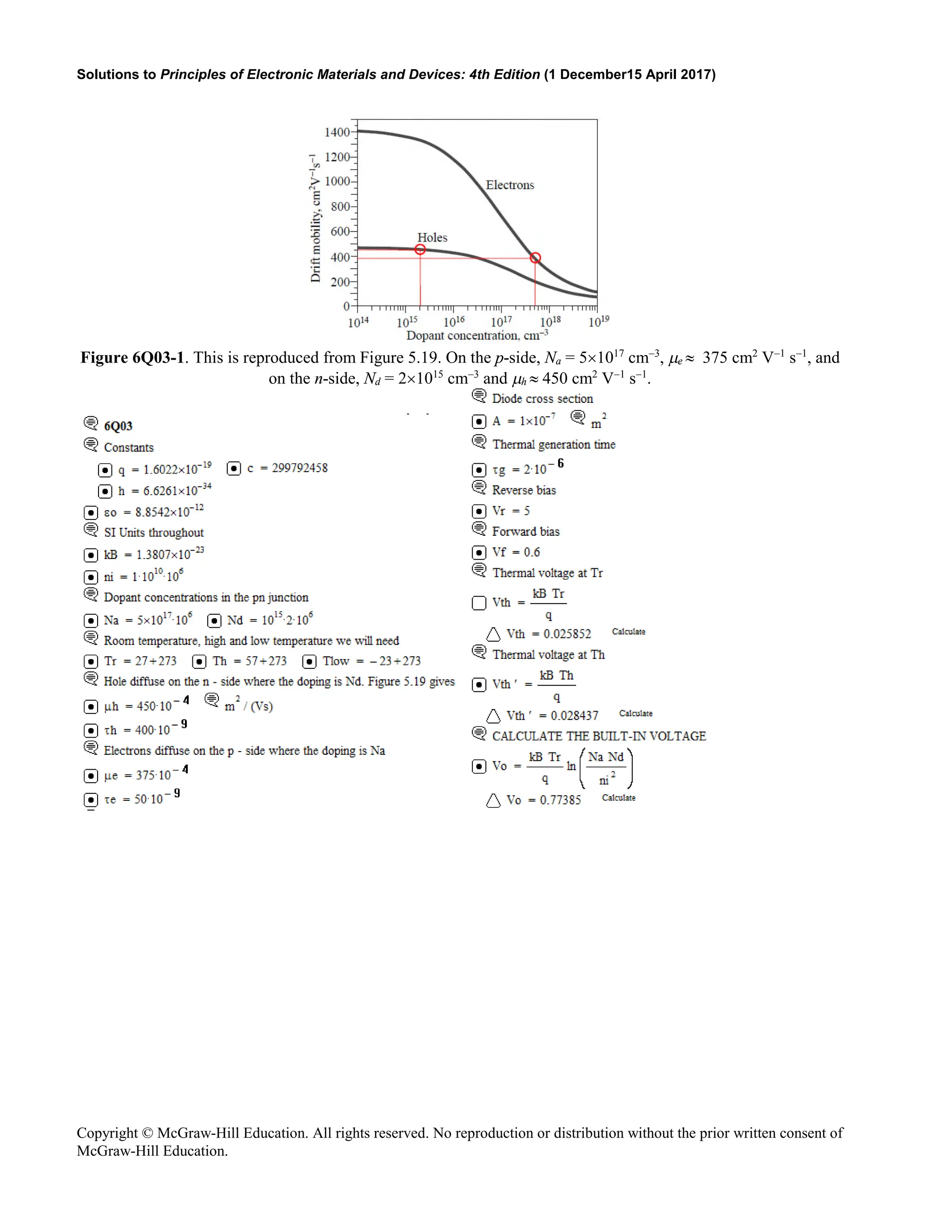
Figure 5.19 The variation of the drift mobility with dopant
concentration in Si for electrons and holes at 300 K.](https://image.slidesharecdn.com/19001-250305005648-f4bc66e5/75/Principles-of-Electronic-Materials-and-Devices-4th-Edition-Kasap-Solutions-Manual-6-2048.jpg)
![Solutions to Principles of Electronic Materials and Devices: 4th Edition (1 December15 April 2017)
Copyright © McGraw-Hill Education. All rights reserved. No reproduction or distribution without the prior written consent of
McGraw-Hill Education.
lifetime. D is related to the mobility of the carrier, µ, via the Einstein relationship, D/µ = kT/e. We
therefore need to know µ to calculate D and hence L. Electrons diffuse in the p-region and holes in the n-
region so that we need µe in the presence of Na acceptors and µh in the presence of Nd donors. From the
drift mobility, µ vs. dopant concentration graph for silicon (see Figure 5.19) we have the following: with
Na = 1015
cm−3
, µe ≈ 1350 cm2
V−1
s−1
, and with Nd = 1019
cm−3
, µh ≈ 75 cm2
V−1
s−1
. Thus,
De = kTµe/e ≈ (0.02585 V)(1350 cm2
V−1
s−1
) = 34.90 cm2
s−1
and Dh = kTµh/e ≈ (0.02585 V)(75 cm2
V−1
s−1
) = 1.939 cm2
s−1
The diffusion lengths are
Le = √(Deτe) = √[(34.90 cm2
s−1
)(500 × 10−9
s)] = 4.18 × 10⁻³
cm or 41.8 µm
and Lh = √(Dhτh) = √[(1.939 cm2
s−1
)(2.5 × 10⁻⁹
s)] = 6.96 × 10⁻⁵
cm or 0.696 µm
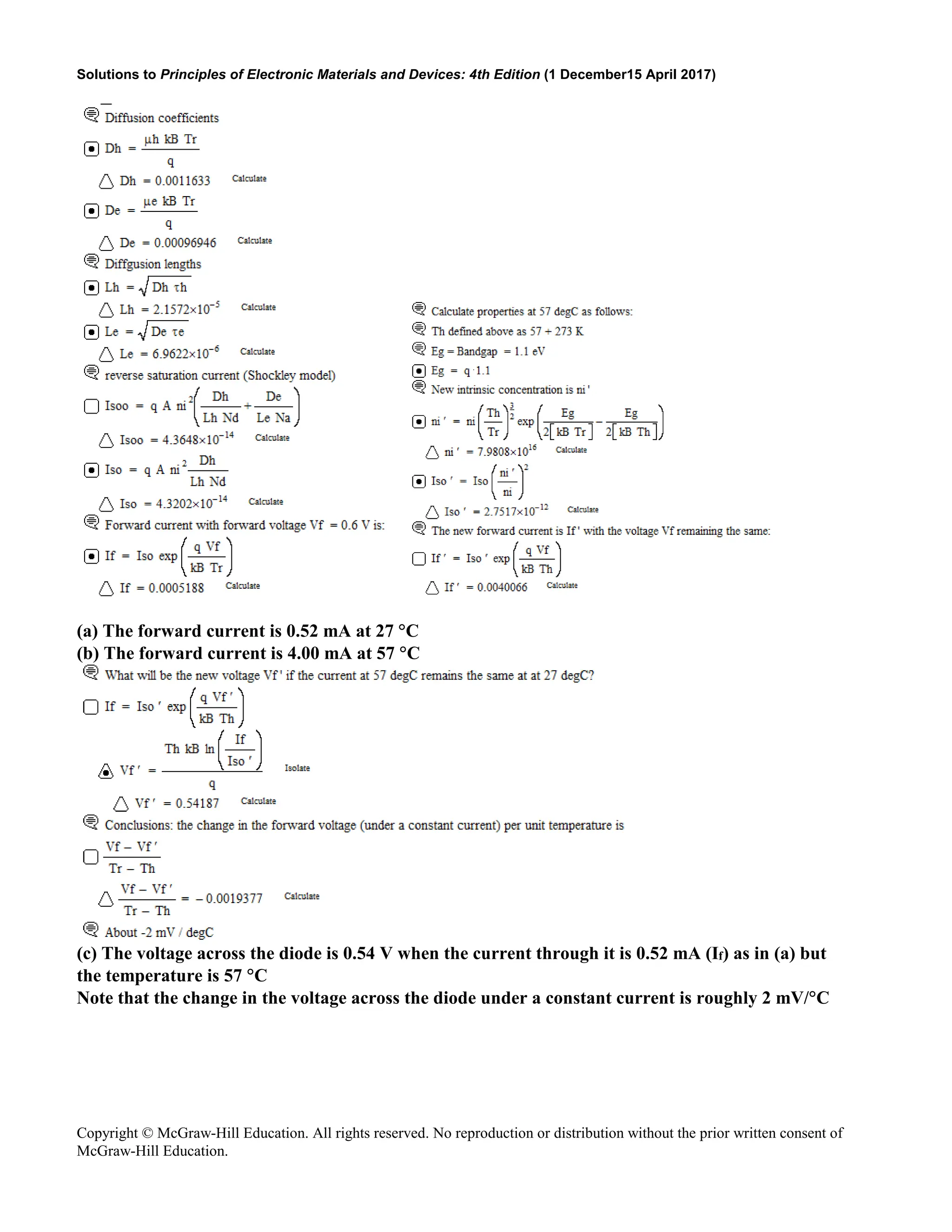
To calculate the forward current when V = 0.6 V we need to evaluate both the diffusion and
recombination components of the current. It is likely that the diffusion component will exceed the
recombination component at this forward bias (this can be easily verified). Assuming that the forward
current is due to minority carrier diffusion in neutral regions,
I = Iso[exp(eV/kT) − 1] ≈ Isoexp(eV/kT) for V >> kT/e (≈ 0.02586 V)
where Iso = AJso = Aeni
2
[(Dh/(LhNd)) + (De/(LeNa))] ≈ Aeni
2
De/(LeNa)
as Nd >> Na. In other words, the current is mainly (almost totally) due to the diffusion of electrons in the
p-region. Taking, ni = 1.0 × 10¹⁰
cm−3
from Table 5.1,
)
cm
10
)(
cm
10
18
.
4
(
)
s
cm
34.90
(
)
cm
10
0
.
1
)(
C
10
602
.
1
)(
cm
10
1
(
3
15
3
1
2
2
-3
10
19
2
2
−
−
−
−
−
×
×
×
×
=
soe
I
∴ Isoe = 1.34× 10⁻¹²
A or 1.34 pA
and
)
cm
10
)(
cm
10
96
.
6
(
)
s
cm
939
.
1
(
)
cm
10
0
.
1
)(
C
10
602
.
1
)(
cm
10
1
(
3
19
5
1
2
2
3
10
19
2
2
−
−
−
−
−
−
×
×
×
×
=
soh
I
∴ Isoh = 4.46 × 10⁻¹⁶
A or 0.00045 pA
Clearly, as expected, Isoe >> Isoh and therefore Iso = Isoe.
The forward current is then
I = Isoexp[eV/(kT)] = (1.34 × 10⁻¹²
A)exp[(0.6 V)/(0.02586 V)]
∴ I ≈ 0.016 A or 16 mA
∴ R = V/I = (0.6 V) / (0.016 A) ≈ 37.5 Ω
Author’s Note: This is not a true resistance but V/I for a
nonlinear device.
The incremental diode resistance is
rd = dV/dI = (kT/e)/I
= (0.02585 V) / (0.016 A) ≈ 1.62 Ω
Figure 6Q01-1 The dynamic resistance of
the diode is defined as dV/dI, which is the
inverse tangent at I.](https://image.slidesharecdn.com/19001-250305005648-f4bc66e5/75/Principles-of-Electronic-Materials-and-Devices-4th-Edition-Kasap-Solutions-Manual-7-2048.jpg)
![Solutions to Principles of Electronic Materials and Devices: 4th Edition (1 December15 April 2017)
Copyright © McGraw-Hill Education. All rights reserved. No reproduction or distribution without the prior written consent of
McGraw-Hill Education.
See Figure 6Q01-1 for the meaning for rd (rd = δV/δI) which is very different than V/I.
*6.2 The Si pn junction Consider a long pn junction diode with an acceptor doping, Na, of 1018
cm−3
on the p-side and donor concentration of Nd on the n-side. The diode is forward biased and has a voltage
of 0.6 V across it. The diode cross-sectional area is 1 mm2
. The minority carrier recombination time, τ,
depends on the dopant concentration, Ndopant (cm−3
), through the following approximate relation
( )
dopant
17
7
10
2
1
10
5
N
−
−
×
+
×
≈
τ
The dependence of the drift mobility on the dopant concentration is given by Equation 5.94 and Table
5.4
a. Suppose that Nd = 1015
cm−3
. Then the depletion layer extends essentially into the n-side and we
have to consider minority carrier recombination time, τh, in this region. Calculate the diffusion and
recombination contributions to the total diode current. What is your conclusion?
b. Suppose that Nd = Na = 1018
cm−3
. Then W extends equally to both sides and, further, τe = τh.
Calculate the diffusion and recombination contributions to the diode current. What is your
conclusion?
Solution
Consider temperature, T = 300 K. kT/e = kT/e = 0.02586 V.
a. This is a p+
n diode: Nd = 1015
cm−3
. Hole lifetime τh in the n-side is
( ) ( )
3
15
17
7
dopant
17
7
cm
10
10
2
1
10
5
10
2
1
10
5
−
−
−
−
−
×
×
+
×
=
×
+
×
≈
N
h
τ = 490 ns
and, using the same equation with Ndopant = 1018
cm−3
, electron lifetime in the p-side is τe = 23.8 ns.
I. Diffusion component of diode current
We can use Equation 5.94 and Table 5.4 as follows. Electrons diffusing on the p-side,
711
.
0
16
18
ref
min
max
min
)
10
2
.
9
/
10
1
(
1
)
5
.
68
1414
(
5
.
68
)
/
(
1 ×
×
+
−
+
=
+
−
+
≈ α
µ
µ
µ
µ
N
Na
e ≈ 277 cm2
V−1
s−1
and holes diffusing on the n-side
719
.
0
17
18
ref
min
max
min
)
10
23
.
2
/
10
1
(
1
)
9
.
44
5
.
470
(
9
.
44
)
/
(
1 ×
×
+
−
+
=
+
−
+
≈ α
µ
µ
µ
µ
N
Nd
h ≈ 462 cm2
V−1
s−1
Thus,
De = kTµe/e ≈ (0.02585 V)(277 cm2
V−1
s−1
) = 7.161 cm2
s−1
and Dh = kTµh/e ≈ (0.02585 V)(462 cm2
V−1
s−1
) = 11.94 cm2
s−1
The diffusion lengths are then:
Le = √(Deτe) = √[7.161 cm2
s−1
)(23.8 × 10⁻⁹
s)] = 4.128 × 10⁻⁴
cm, or 4.13 µm
and Lh = √(Dhτh) = √[(11.94 cm2
s−1
)(490 × 10−9
s)] = 24.19 × 10⁻⁴
cm, or 24.2 µm
The diffusion component of the current is](https://image.slidesharecdn.com/19001-250305005648-f4bc66e5/75/Principles-of-Electronic-Materials-and-Devices-4th-Edition-Kasap-Solutions-Manual-8-2048.jpg)
![Solutions to Principles of Electronic Materials and Devices: 4th Edition (1 December15 April 2017)
Copyright © McGraw-Hill Education. All rights reserved. No reproduction or distribution without the prior written consent of
McGraw-Hill Education.
Idiff = Iso[exp(eV/(kT)) − 1] ≈ Isoexp(eV/(kT)) for V >> kT/e (≈ 0.02586 V)
where Iso = AJso = Aeni
2
[(Dh/(LhNd)) + (De/(LeNa))] ≈ Aeni
2
Dh/(LhNd)
as Na >> Nd. In other words, the current is mainly due to the diffusion of holes in the n-region.
Thus:
)
cm
10
1
)(
cm
10
2
.
24
(
)
s
cm
94
.
11
(
)
cm
10
1
)(
C
10
602
.
1
)(
cm
10
1
(
3
15
4
1
2
2
3
10
19
2
2
−
−
−
−
−
−
×
×
×
×
×
=
so
I
∴ Iso = 7.91 × 10⁻¹³
A or 0.79 pA
The forward current due to diffusion is
Idiff = Isoexp[(eV/(kT)] = (0.79 × 10⁻¹²
A)exp[(0.6 V)/(0.02585 V)]
∴ Idiff = 0.0095 A or 9.5 mA
Note: It is left as an exercise to show that Isoh/Isoe = 285, so we can indeed neglect the electron injection
contribution to the current.
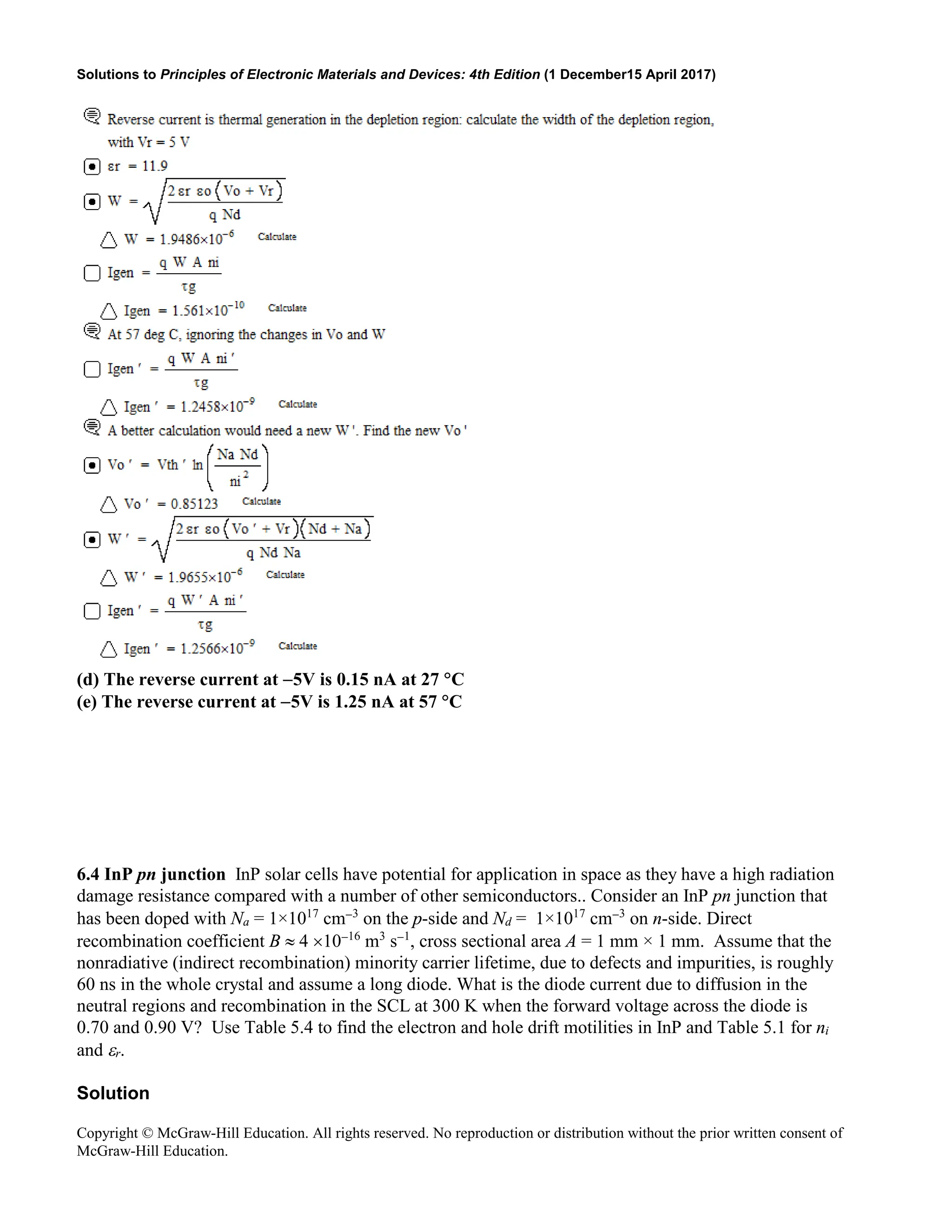
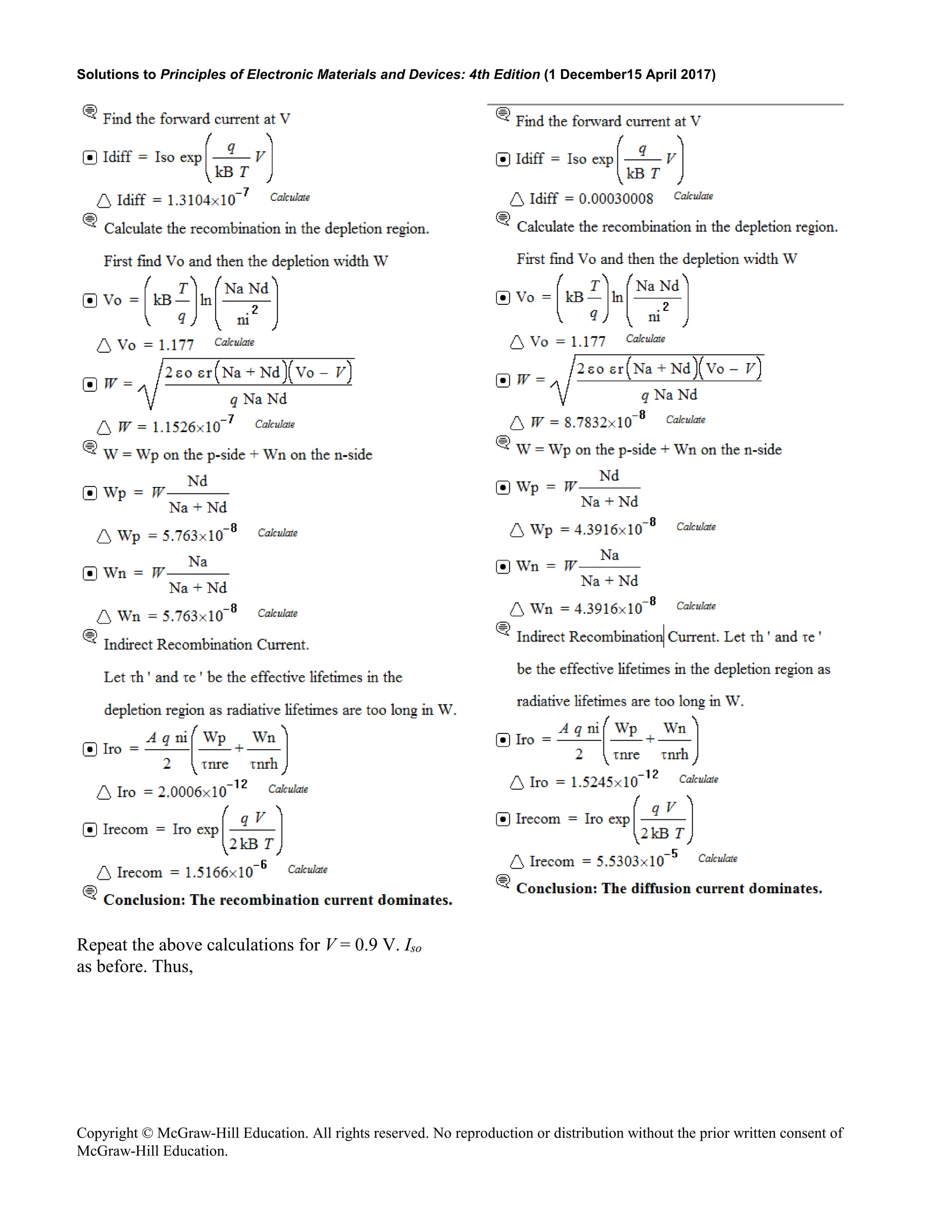
II. Recombination component
To find the recombination current, we need to use Equation 6.15.
+
=
kT
eV
W
W
en
J
e
p
h
n
i
2
exp
2 τ
τ
which represents diffusing holes recombining within Wn on the n-side and diffusing electrons
recombining in Wp on the p-side. We need Wn and Wp.
The built-in potential is (where ni is the intrinsic concentration, found in Table 5.1)
Vo = (kT/e)ln(NdNa/ni
2
) = (0.02585 V)ln[(1018
cm−3
× 1015
cm−3
)/(1.0 × 1010
cm−3
)2
]
∴ Vo = 0.774 V
The depletion region width W is mainly on the n-side (εr of Si is 11.9 from Table 5.1).
2
/
1
)
)(
(
2
−
+
=
d
a
o
d
a
N
eN
V
V
N
N
W
ε
∴
2
/
1
3
24
3
21
19
3
24
3
21
1
12
)
m
10
)(
m
10
)(
C
10
6
.
1
(
)
V
6
.
0
774
.
0
)(
m
10
m
10
)(
m
F
10
854
.
8
)(
9
.
11
(
2
×
−
+
×
= −
−
−
−
−
−
−
W
i.e. W ≈ 0.4783 × 10⁻⁶
m or 0.4783 µm
From Equation 6.1, the depletion width on the n-side is
)
10
1
10
1
(
)
10
1
(
)
μm
4783
.
0
(
)
( 15
18
18
×
+
×
×
=
+
=
d
a
a
n
N
N
N
W
W = 0.47785 µm
and
)
10
1
10
1
(
)
10
1
(
)
μm
4783
.
0
(
)
( 15
18
15
×
+
×
×
=
+
=
d
a
d
p
N
N
N
W
W = 4.7785×10⁻⁴
µm](https://image.slidesharecdn.com/19001-250305005648-f4bc66e5/75/Principles-of-Electronic-Materials-and-Devices-4th-Edition-Kasap-Solutions-Manual-9-2048.jpg)
![Solutions to Principles of Electronic Materials and Devices: 4th Edition (1 December15 April 2017)
Copyright © McGraw-Hill Education. All rights reserved. No reproduction or distribution without the prior written consent of
McGraw-Hill Education.
Clearly depletion width is almost totally on the n-side.
The hole recombination current preexponential factor is
)
s
10
490
(
2
)
cm
10
1
(
cm)
10
47785
.
0
)(
C
10
602
.
1
)(
cm
10
1
(
2 9
3
10
4
19
2
2
−
−
−
−
−
×
×
×
×
×
=
=
h
i
n
roh
n
AeW
I
τ
∴ Iroh = 7.81×10⁻¹⁰
A
The electron recombination current preexponential is
)
s
10
8
.
23
(
2
)
cm
10
1
(
cm)
10
7785
.
4
)(
C
10
602
.
1
)(
cm
10
1
(
2 9
3
10
4
19
2
2
−
−
−
−
−
×
×
×
×
×
=
=
e
i
p
roe
n
AeW
I
τ
∴ Iroe = 1.61×10⁻¹¹
A
Thus the recombination current preexponential factor is
Iro = Iroh + Iroe = 7.81×10⁻¹⁰
A + 1.61×10⁻¹¹
A = 8.0×10⁻¹⁰
A = 0.80 pA
The forward current due to recombination is
Irecom = Iroexp(eV/2kT) = (0.80 × 10⁻¹²
A)exp[(0.6 V)/(2 × 0.0259 V)]
∴ Irecom = 8.7 × 10⁻⁵ A or 0.087 mA
Clearly, the diffusion component dominates the recombination component.
Note: For simplicity, we could have considered the recombination of holes within Wn only since the
depletion width is almost totally Wn. The result would have been only 2.4% out (and acceptable, given
the other approximations in the theory).
b. This is a symmetrical pn diode: Nd = Na = 1018
cm−3
. Hole lifetime τh in the n-side is
( ) ( )
3
18
17
7
dopant
17
7
cm
10
10
2
1
10
5
10
2
1
10
5
−
−
−
−
−
×
×
+
×
=
×
+
×
=
=
N
e
h τ
τ = 23.8 × 10⁻⁹
s
I. Diffusion component
We can use Equation 5.94 and Table 5.4 as follows. Electrons diffusing on the p-side,
711
.
0
16
18
ref
min
max
min
)
10
2
.
9
/
10
1
(
1
)
5
.
68
1414
(
5
.
68
)
/
(
1 ×
×
+
−
+
=
+
−
+
≈ α
µ
µ
µ
µ
N
Nd
e ≈ 277 cm2
V−1
s−1
and holes diffusing on the n-side
719
.
0
17
18
ref
min
max
min
)
10
23
.
2
/
10
1
(
1
)
9
.
44
5
.
470
(
9
.
44
)
/
(
1 ×
×
+
−
+
=
+
−
+
≈ α
µ
µ
µ
µ
N
Na
h ≈ 153 cm2
V−1
s−1
From Figure 5.19, with Na = 1018
cm−3
, µe ≈ 277 cm2
V−1
s−1
, and with Nd = 1018
cm−3
, µh ≈ 153 cm2
V−1
s−1
. Thus
De = kTµe/e ≈ (0.02586 V)(277 cm2
V−1
s−1
) = 7.161 cm2
s−1](https://image.slidesharecdn.com/19001-250305005648-f4bc66e5/75/Principles-of-Electronic-Materials-and-Devices-4th-Edition-Kasap-Solutions-Manual-10-2048.jpg)
![Solutions to Principles of Electronic Materials and Devices: 4th Edition (1 December15 April 2017)
Copyright © McGraw-Hill Education. All rights reserved. No reproduction or distribution without the prior written consent of
McGraw-Hill Education.
and Dh = kTµh/e ≈ (0.02586 V)(153 cm2
V−1
s−1
) = 3.955 cm2
s−1
Diffusion lengths are
Le = √(Deτe) = √[7.161 cm2
s−1
)(23.8 × 10⁻⁹
s)] = 4.128 × 10⁻⁴
cm or 4.128 µm
and Lh = √(Dhτh) = √[(3.955 cm2
s−1
)(23.8 × 10⁻⁹
s)] = 3.068 × 10⁻⁴
cm or 3.068 µm
The diffusion component of the current is
Idiff = Isoexp(eV/kT) for V >> kT/e (≈ 0.02586 V)
where Iso = AJso = Aeni
2
[(Dh/(LhNd)) + (De/(LeNa))]
×
×
+
×
×
×
×
×
×
=
−
−
−
−
−
−
−
−
−
)
cm
10
1
)(
cm
10
128
.
4
(
)
s
cm
161
.
7
(
)
cm
10
1
)(
cm
10
068
.
3
(
)
s
cm
955
.
3
(
)
cm
10
1
)(
C
10
602
.
1
)(
cm
10
1
(
3
18
4
1
2
3
18
4
1
2
2
3
10
19
2
2
so
I
∴ Iso = 4.84 × 10⁻¹⁵
A
The forward current due to diffusion is
Idiff = Isoexp(eV/kT) = (4.84 × 10⁻¹⁵
A)exp(0.6 V/0.02585 V)
∴ Idiff = 5.8 × 10⁻⁵ A or 0.058 mA
II. Recombination component
The built-in potential is
Vo = (kT/e)ln(NdNa/ni
2
) = (0.02585 V)ln[(1018
cm−3
× 1018
cm−3
)/(1.0 × 1010
cm−3
)2
]
∴ Vo = 0.952 V
The depletion region width is symmetrical about the junction as Na = Nd.
∴
2
/
1
2
/
1
)
(
4
)
)(
(
2
−
≈
−
+
=
d
o
d
a
o
d
a
eN
V
V
N
eN
V
V
N
N
W
ε
ε
2
/
1
3
24
19
1
12
)
m
10
)(
C
10
6
.
1
(
)
V
6
.
0
952
.
0
)(
m
F
10
854
.
8
)(
9
.
11
(
4
×
−
×
= −
−
−
−
W
i.e. W = 3.044 × 10⁻⁸
m or 0.0304 µm
This depletion width is split equally been the p and n-sides, because this is a symmetric device, Na = Nd.
∴ Wp = Wn = W/2 = 1.522 × 10⁻⁸
m or 0.0152 µm
×
×
+
×
×
×
×
×
=
+
=
−
−
−
−
−
−
−
−
−
)
s
10
8
.
23
(
cm
10
522
.
1
)
s
10
8
.
23
(
cm
10
522
.
1
2
)
cm
10
1
)(
C
10
602
.
1
)(
cm
10
1
(
2
9
3
8
9
3
8
3
10
19
2
2
e
p
h
n
i
ro
W
W
Aen
I
τ
τ
∴ Iro = 1.025 × 10⁻⁹
A](https://image.slidesharecdn.com/19001-250305005648-f4bc66e5/75/Principles-of-Electronic-Materials-and-Devices-4th-Edition-Kasap-Solutions-Manual-11-2048.jpg)
![Solutions to Principles of Electronic Materials and Devices: 4th Edition (1 December15 April 2017)
Copyright © McGraw-Hill Education. All rights reserved. No reproduction or distribution without the prior written consent of
McGraw-Hill Education.
The forward current due to recombination is
Irecom = Iroexp(eV/2kT) = (1.025 × 10⁻⁹
A)exp[(0.6 V)/(2 × 0.02585 V)]
∴ Irecom = 1.1× 10⁻⁴ A or 0.11 mA
Clearly, the recombination component dominates the diffusion component.
Author's Note: This problem clearly shows that in a Si pn junction the current can be diffusion or
recombination limited depending on the device structure, and also on the voltage across the device. For
many Si diodes η is therefore between 1 and 2. The calculations were done on Livemath (originally
Theorist) and they are shown to three to four significant figures to avoid round-up and truncation errors.
Otherwise a final current value of two significant figures is sufficient.
Author's Comment: The minority lifetime equation above is an order of magnitude type of equation. It is
empirically derived and the values of the constants, in particular the numerator (5×10⁻⁷ s), depend on
impurities and defects in the crystal, that is, the quality of the Si wafer. The values given in this
particular equation have been rounded to convenient numbers and have been taken from D.L. Pulfrey
and N.G. Tarr, Introduction to Microelectronic Devices, Prentice Hall, Englewood Cliffs, NJ, 1989. See
also Appendix A.
6.3 A Si p+n junction Consider an abrupt Si p+
n junction which has 2×10¹⁵
donors cm−3
on the n-side
and 5×10¹⁷
acceptors cm−3
on the p-side. The minority carrier recombination times are τh ≈ 400 ns for
holes in the n-side and τe ≈ 50 ns for electrons in the p+
-side. The cross sectional area is 0.1 mm2
.
Assume a long diode. The thermal generation time τg in the depletion region is 2 µs. Assume that the
reverse current is dominated by the thermal generation rate in the depletion region. (a) Calculate the
forward current at 27 °C when the voltage across the diode is 0.6V. (b) Estimate the forward current at
57 °C when the voltage across the diode is still 0.6V (c) Calculate the voltage across the diode at 57 °C
if the forward current in (a) at 27 °C is kept constant. (d) What is the reverse current at 27 °C when the
diode voltage is –5V. (e) Estimate the reverse current at 57 °C when the diode voltage is –5V. Note:
Assume that the forward current is determined by the Shockley equation (minority carrier diffusion).
Solution
From Figure 5.19, we can find the electron and hole drift mobilities in the p and n-sides of the pn
junction respectively as in Figure 6Q03-1. On the p-side, Na = 5×10¹⁷
cm−3
, µe ≈ 375 cm2
V−1
s−1
, and
on the n-side, Nd = 2×10¹⁵
cm−3
and µh ≈ 450 cm2
V−1
s−1
. Take room temperature as 300 K (27 °C) or
Vth = 0.02585.
Here is the solution on Livemath (Theorist). SI Units used throughout the calculations
Note: "If" means forward current If and so on since subscript notation could be not used.](https://image.slidesharecdn.com/19001-250305005648-f4bc66e5/75/Principles-of-Electronic-Materials-and-Devices-4th-Edition-Kasap-Solutions-Manual-12-2048.jpg)