LECTURE 1
CONSTRUCTION INDUSTRY
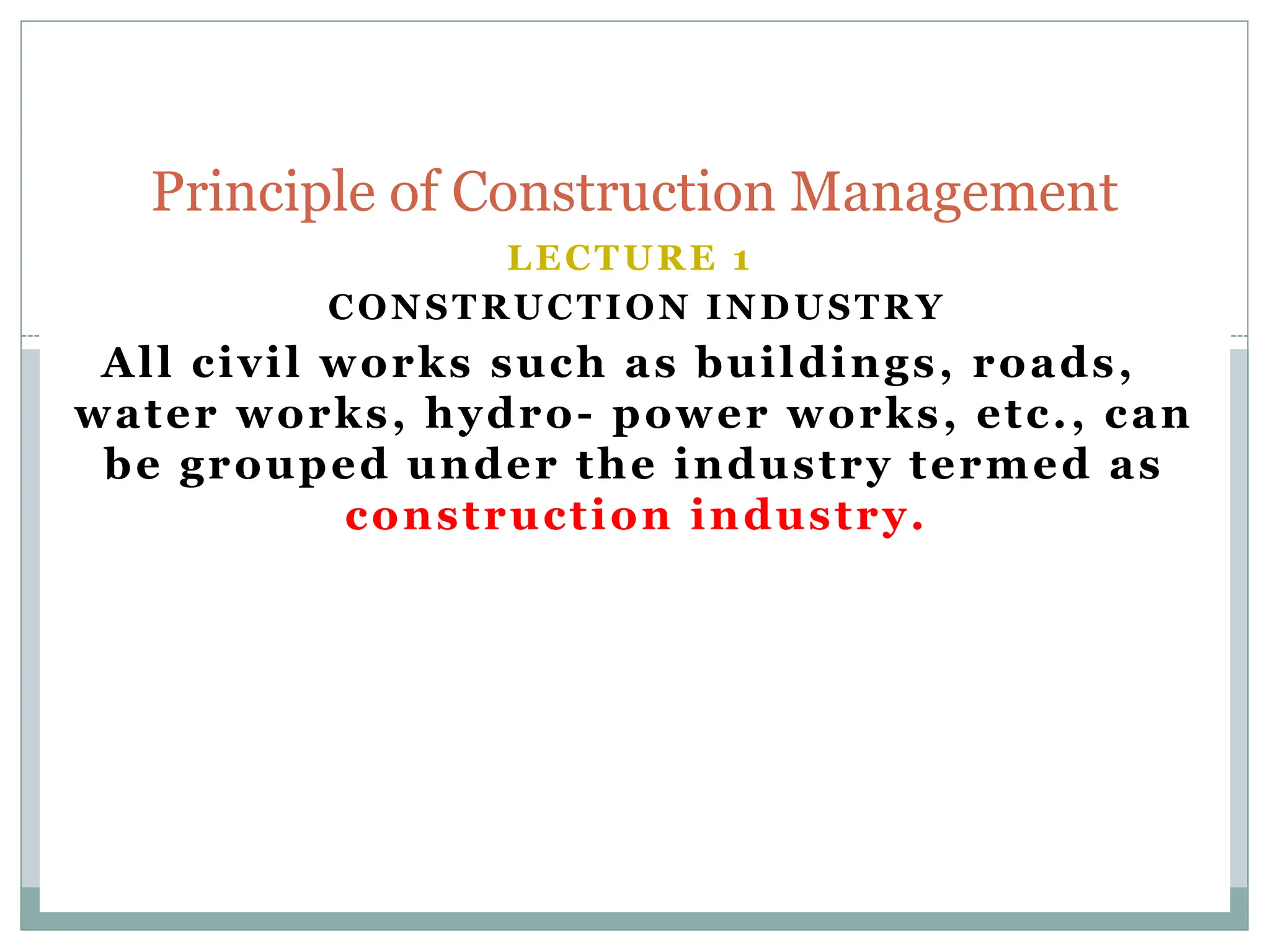
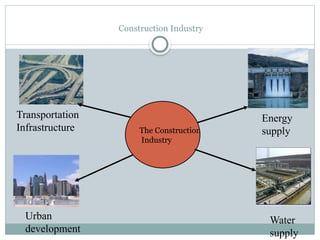
Allcivil works such as buildings, roads,
water works, hydro- power works, etc., can
be grouped under the industry termed as
construction industry.
Principle of Construction Management
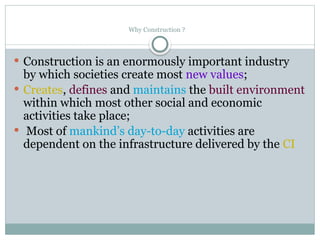
Construction isan enormously important industry
by which societies create most new values;
Creates, defines and maintains the built environment
within which most other social and economic
activities take place;
Most of mankind’s day-to-day activities are
dependent on the infrastructure delivered by the CI
Why Construction ?
4.
The History ofConstruction
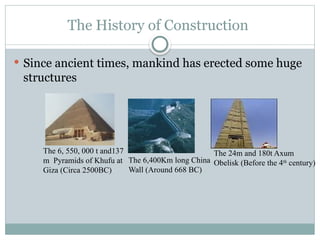
Since ancient times, mankind has erected some huge
structures
The 6, 550, 000 t and137
m Pyramids of Khufu at
Giza (Circa 2500BC)
The 6,400Km long China
Wall (Around 668 BC)
The 24m and 180t Axum
Obelisk (Before the 4th
century)
5.
The Development ofConstruction in Ethiopia
Though some spectacular structures have been
erected, Ethiopia’s construction as industry is very
infant
Ethiopian modernization started under Menelik II
The Ethio-Djibouti rail ways is best example
The Construction industry is set up in modern form
During the Majesty’s era
Established Ministry of works, BaTCoDA, IHA, etc
6.
The Current setupin Construction
Under the current format major players of the
construction sector are
Ministry of Infrastructure
Ministry of Works and Urban Development
ERA, IUHDPO, etc
Ministry of Water Resources
Ministry of Mining and Energy
EEPCo
7.
Status of theGlobal CI
Compared to other industries, CI is labeled as
‘conservative’
Different arguments about the advantages and disadvantages of its
conservatism.
Some serious critics about ‘inefficiencies’ in the
industry
Fragmented industry
Sequential project delivery system and adversarial supply-chain
relationship
Known for late delivery, over budget, low
profitability, poor returns and slow up take of new
technology and management philosophies
8.
Characteristics of CI
Nature of production: [usually] on site
Changing supply-chain relationship and production site
Exposed to inclement weather condition
Seasonal disruption
Health and safety concerns
9.
Characteristics of CI
Nature of product: large, heavy, durable, expensive,
heterogeneous, and immobile
Demand is localized
Demand doesn’t vary extensively
Costly to abandon and rebuild
10.
Characteristics of CI
Demand for the product
Demand is usually driven by ‘other’ goods and services; not
controlled by industry,
In the majority of cases, clients define requirements before the
industry provides it,
Time lags b/n demand and supply is long.
11.
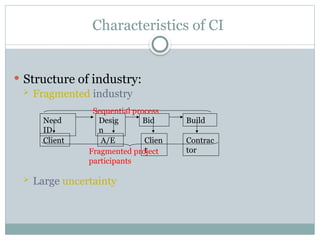
Characteristics of CI
Structure of industry:
Fragmented industry
Large uncertainty
Need
ID
Desig
n
Bid Build
Client Clien
t
A/E Contrac
tor
Fragmented project
participants
Sequential process
12.
Stakeholders
Definition
Areindividuals or groups who has a vested interest in the
project or its product.
Are parties who could have a telling effect on the
success or failure of the project
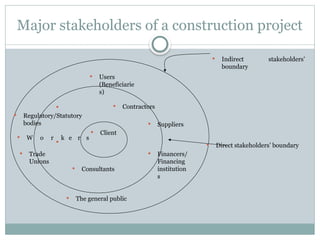
Major stakeholders ofa construction project
The general public
W o r k e r s
Indirect stakeholders’
boundary
Direct stakeholders’ boundary
Client
Suppliers
Users
(Beneficiarie
s)
Regulatory/Statutory
bodies
Consultants
Contractors
Financers/
Financing
institution
s
Trade
Unions
15.
Major stakeholders ofa construction project
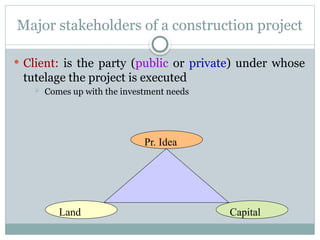
Client: is the party (public or private) under whose
tutelage the project is executed
Comes up with the investment needs
Land
Pr. Idea
Capital
16.
Major stakeholders ofa construction project
Client:
[Usually] provides the infrastructure needed
Takes care of some of the legal constraints & permits
Pays for the project’s execution
Major public clients in Ethiopia;
Roads (ERA & its regional counterparts)
Housing (IUHDPO, MoE, MoH, etc)
Energy (EEPCo)
Water sector (MoWR)
17.
Major stakeholders ofa construction project
Consultants: are professional bodies who design the
project
Change the clients project idea into economic and constructable
artifact
Make sure that design satisfies requirements
[Usually] prepare BoQ and contract documents
If assigned to supervise:
Look after proper execution of project
Certify payment certificates
Issue provisional and final acceptance certificate
18.
Major stakeholders ofa construction project
Contactors: is the party that changes the drawings
and specification made by the A/E into a physical
structure
Provides the resources needed to execute the project
Executes the project according to plan
Monitors project execution
Rectifies defects
19.
Major stakeholders ofa construction project
Statutory bodies: are government bodies that looks
after the project’s compliance with the general
public’s interest
Prepare a general development scheme and make sure that the
project satisfies that
Look after the safety, legal, commercial etc issues associated with
the project
Look into the environmental, cultural, social etc effect that the
project induces
The major regulatory bodies in the sector are
MoWUD, Municipalities, The ERA, The MoWR
20.
Major stakeholders ofa construction project
Suppliers: are parties that supply the varies materials,
equipments and services needed for the project
Financers/Financial institutions: are institutions like
banks, insurances, pension agencies etc who could
provide loan services for the project
Works in the industry: are professionals, occupationals
or unskilled laborers who earn their living from
working in the industry or its supply chain.
Trade (labor) unions: are unions of the working class
that look after unfair treatment of workers (like
payment issues, firing issues) as well as issues related
to occupational health and safety
21.
Major stakeholders ofa construction project
Project product users: are parties who may be
using the end product of the project
The general public: are communities of the
locality, the general society of a country or even
the globe who may have a vested interest in the
project
Other sectors: are sectors which could have
interest in the process or product on the
construction project
22.
Importance of construction
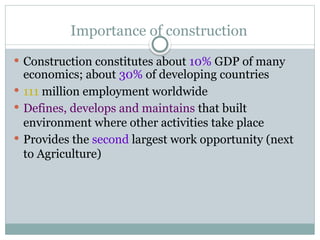
Construction constitutes about 10% GDP of many
economics; about 30% of developing countries
111 million employment worldwide
Defines, develops and maintains that built
environment where other activities take place
Provides the second largest work opportunity (next
to Agriculture)
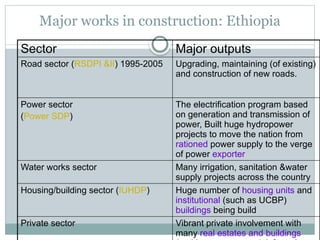
Major works inconstruction: Ethiopia
Sector Major outputs
Road sector (RSDPI &II) 1995-2005 Upgrading, maintaining (of existing)
and construction of new roads.
Power sector
(Power SDP)
The electrification program based
on generation and transmission of
power, Built huge hydropower
projects to move the nation from
rationed power supply to the verge
of power exporter
Water works sector Many irrigation, sanitation &water
supply projects across the country
Housing/building sector (IUHDP) Huge number of housing units and
institutional (such as UCBP)
buildings being build
Private sector Vibrant private involvement with
many real estates and buildings
25.
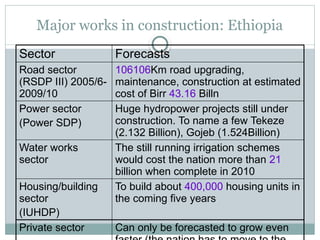
Major works inconstruction: Ethiopia
Sector Forecasts
Road sector
(RSDP III) 2005/6-
2009/10
106106Km road upgrading,
maintenance, construction at estimated
cost of Birr 43.16 Billn
Power sector
(Power SDP)
Huge hydropower projects still under
construction. To name a few Tekeze
(2.132 Billion), Gojeb (1.524Billion)
Water works
sector
The still running irrigation schemes
would cost the nation more than 21
billion when complete in 2010
Housing/building
sector
(IUHDP)
To build about 400,000 housing units in
the coming five years
Private sector Can only be forecasted to grow even
26.
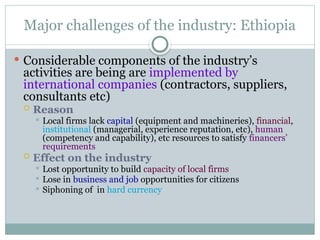
Major challenges ofthe industry: Ethiopia
Considerable components of the industry’s
activities are being are implemented by
international companies (contractors, suppliers,
consultants etc)
Reason
Local firms lack capital (equipment and machineries), financial,
institutional (managerial, experience reputation, etc), human
(competency and capability), etc resources to satisfy financers’
requirements
Effect on the industry
Lost opportunity to build capacity of local firms
Lose in business and job opportunities for citizens
Siphoning of in hard currency
27.
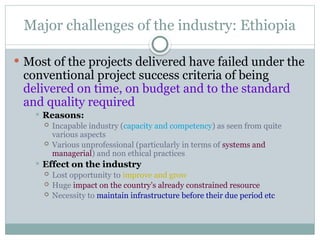
Major challenges ofthe industry: Ethiopia
Most of the projects delivered have failed under the
conventional project success criteria of being
delivered on time, on budget and to the standard
and quality required
Reasons:
Incapable industry (capacity and competency) as seen from quite
various aspects
Various unprofessional (particularly in terms of systems and
managerial) and non ethical practices
Effect on the industry
Lost opportunity to improve and grow
Huge impact on the country’s already constrained resource
Necessity to maintain infrastructure before their due period etc
28.
Why Construction Management?
Management is defined as the art of arranging
and/or organizing various activities, operating
equipment and group of people in a suitable manner
to create systematic operation with continuity to
achieve a common goal.
As construction is also one of the industries which
need the proper systematic coordination of activities,
materials, labor and operating equipment, therefore
managing such industry is necessary.
29.
Why Construction Management?
Constructionmanagement is necessary to insure:
Proper planning and organization of the works,
The effective use of resources,
The completion of works within estimated budget and specified
time,
In time delivery and utilization of materials,
The necessary quality of the work,
Proper usage of equipment and latest methods of construction
and technology,
Evolving a reputation for high quality of workmanship,
Controlling over the contract agreed upon and specification
30.
Why Construction Management?
Motivating people to work to their best and creating an
organization that works as a team,
In taking sound decisions at the lowest practical
management level through delegation of authorities,
Proper communication and reporting of the works
executed,
The provisions of safe and satisfactory working conditions
for all workers,
Monitoring of the works to be executed against planning,
31.
Why Construction Management?
Proper sequence of flow of construction, and
Proper coordination of the resources to create an
organization that works as wholesome to fulfill the
objectives.

![Characteristics of CI
Nature of production: [usually] on site
Changing supply-chain relationship and production site
Exposed to inclement weather condition
Seasonal disruption
Health and safety concerns](https://image.slidesharecdn.com/principlesofconstructionmanagement-250809083634-eca7d810/85/Principles-Of-Construction-Management-pptx-8-320.jpg)
![Major stakeholders of a construction project
Client:
[Usually] provides the infrastructure needed
Takes care of some of the legal constraints & permits
Pays for the project’s execution
Major public clients in Ethiopia;
Roads (ERA & its regional counterparts)
Housing (IUHDPO, MoE, MoH, etc)
Energy (EEPCo)
Water sector (MoWR)](https://image.slidesharecdn.com/principlesofconstructionmanagement-250809083634-eca7d810/85/Principles-Of-Construction-Management-pptx-16-320.jpg)
![Major stakeholders of a construction project
Consultants: are professional bodies who design the
project
Change the clients project idea into economic and constructable
artifact
Make sure that design satisfies requirements
[Usually] prepare BoQ and contract documents
If assigned to supervise:
Look after proper execution of project
Certify payment certificates
Issue provisional and final acceptance certificate](https://image.slidesharecdn.com/principlesofconstructionmanagement-250809083634-eca7d810/85/Principles-Of-Construction-Management-pptx-17-320.jpg)


![Chapter_One[1] (2).ppt](https://cdn.slidesharecdn.com/ss_thumbnails/chapterone12-220824080609-2de3a355-thumbnail.jpg?width=640&height=640&fit=bounds)


