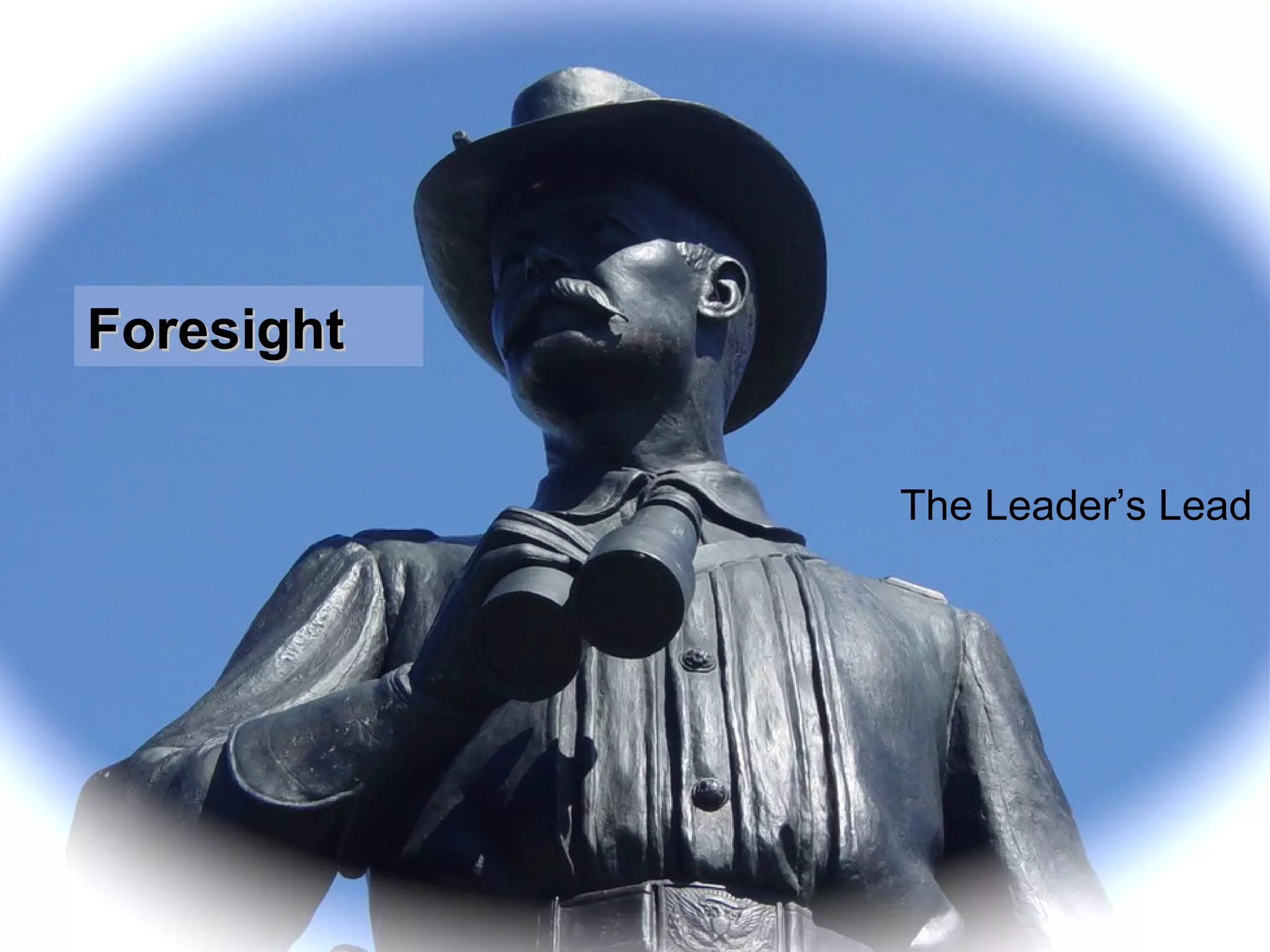

The Leader’s Lead Foresight
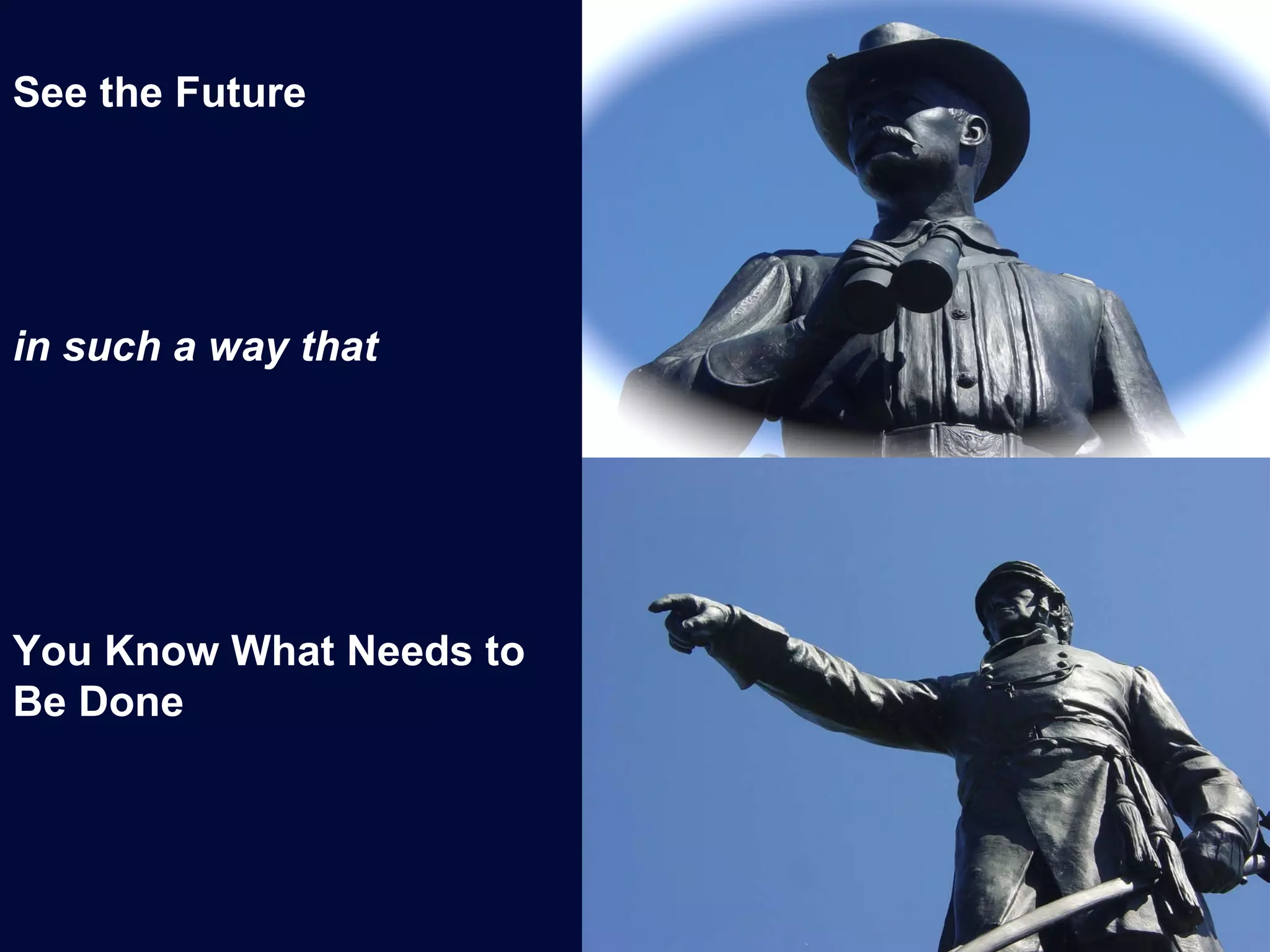
See the Future in such a way that   You Know What Needs to Be Done
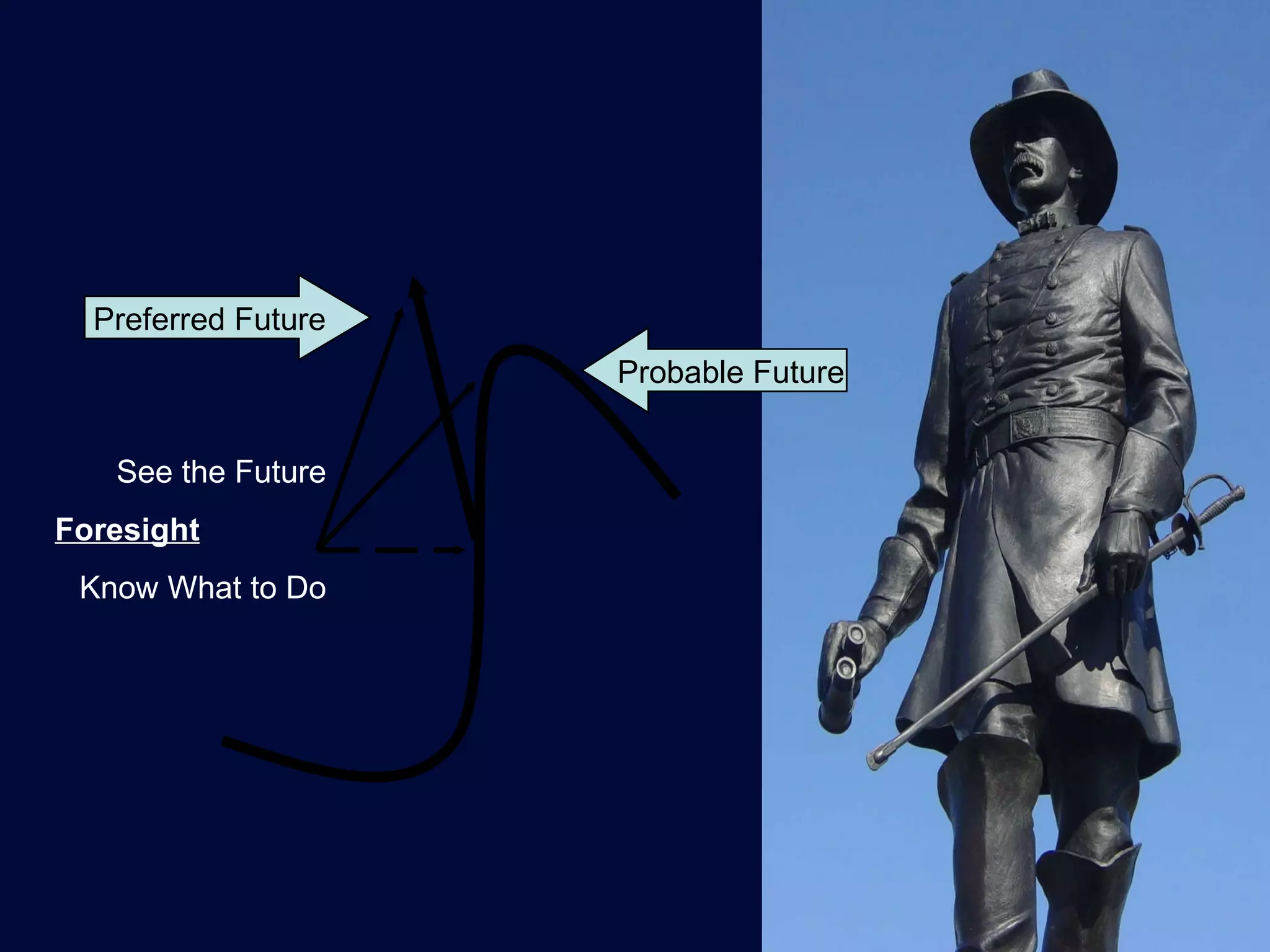
See the Future Foresight Know What to Do Preferred Future Probable Future
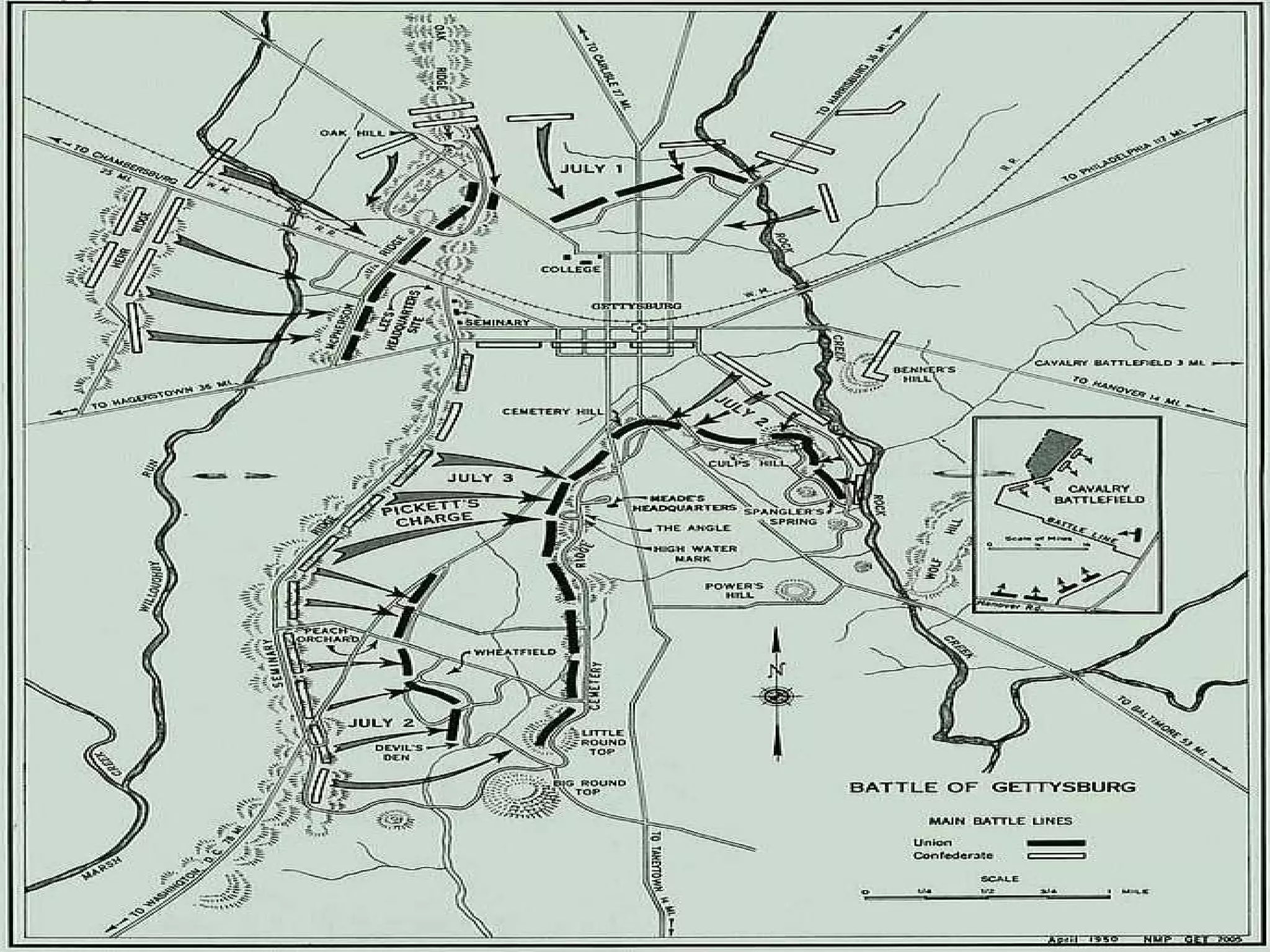
Buford’s Foresight  Issac Trimble’s Report   Look for the constant reference to “seeing:” In each clip, what was the  probable future   and    what was the  preferred future ?
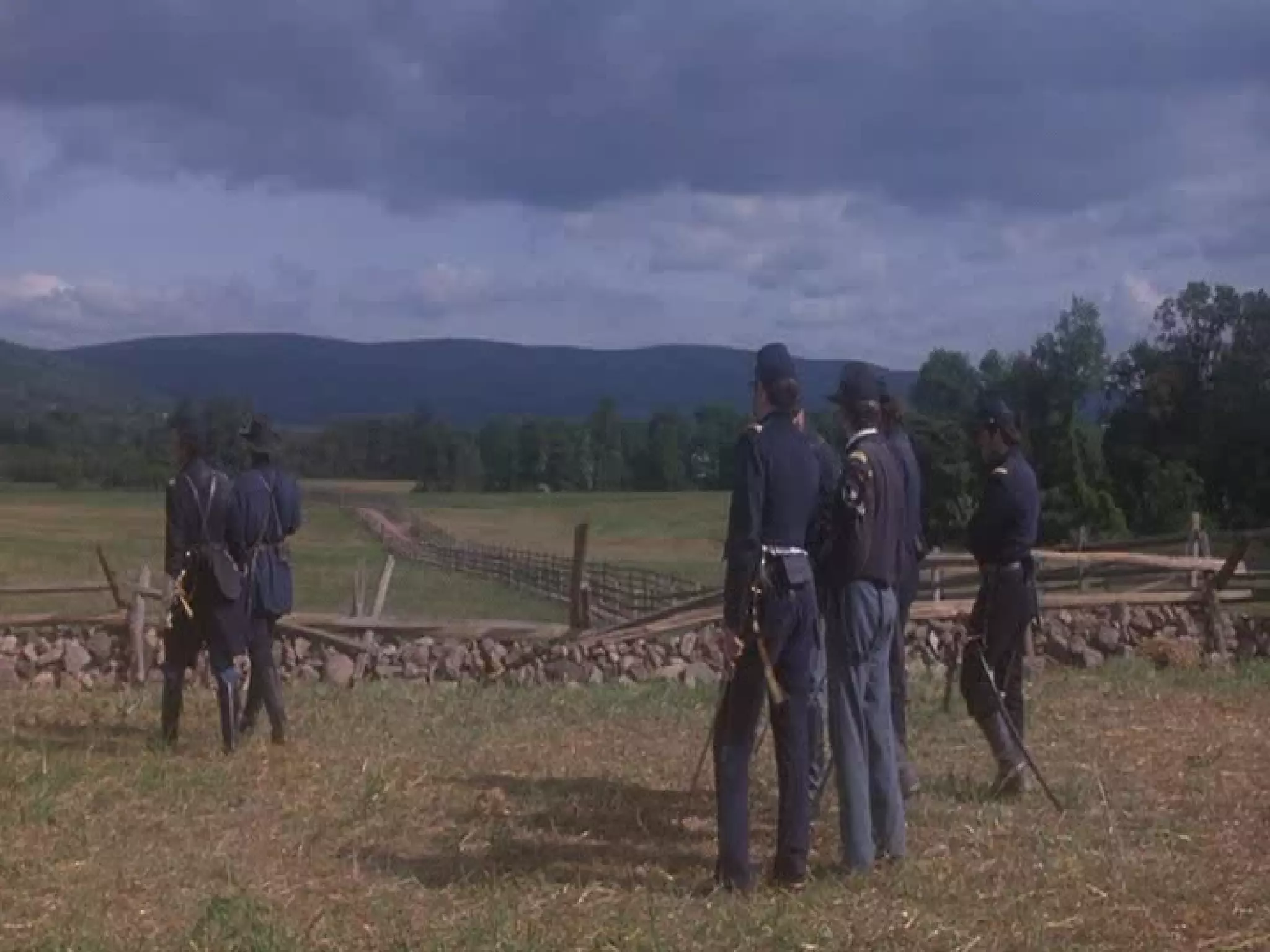
Buford video
Trimble video
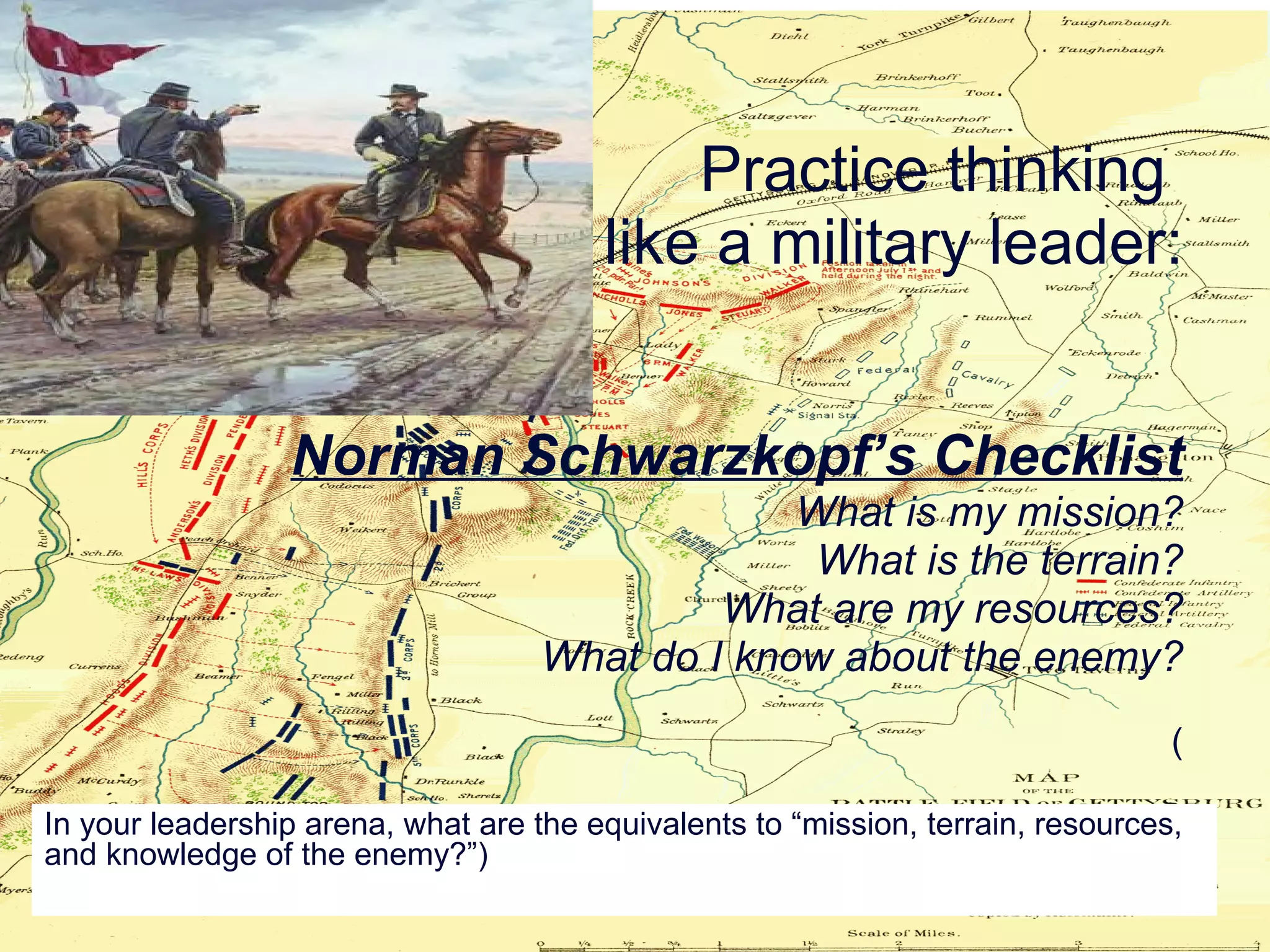
Practice thinking  like a military leader: Norman Schwarzkopf’s Checklist What is my mission? What is the terrain? What are my resources? What do I know about the enemy? ( In your leadership arena, what are the equivalents to “mission, terrain, resources, and knowledge of the enemy?”)
Norman Schwarzkop quotes: “ Leadership is a potent combination of strategy and character. But if you must be without one, be without the strategy.” “ It doesn't take a hero to order men into battle. It takes a hero to be one of those men who goes into battle.”  “ Do what is right, not what you think the high headquarters wants or what you think will make you look good.”  He is neither a strategist nor is he schooled in the operational arts, nor is he a tactician, nor is he a general. Other than that he's a great military man.  (describing Saddam Hussein of Iraq, 1991)
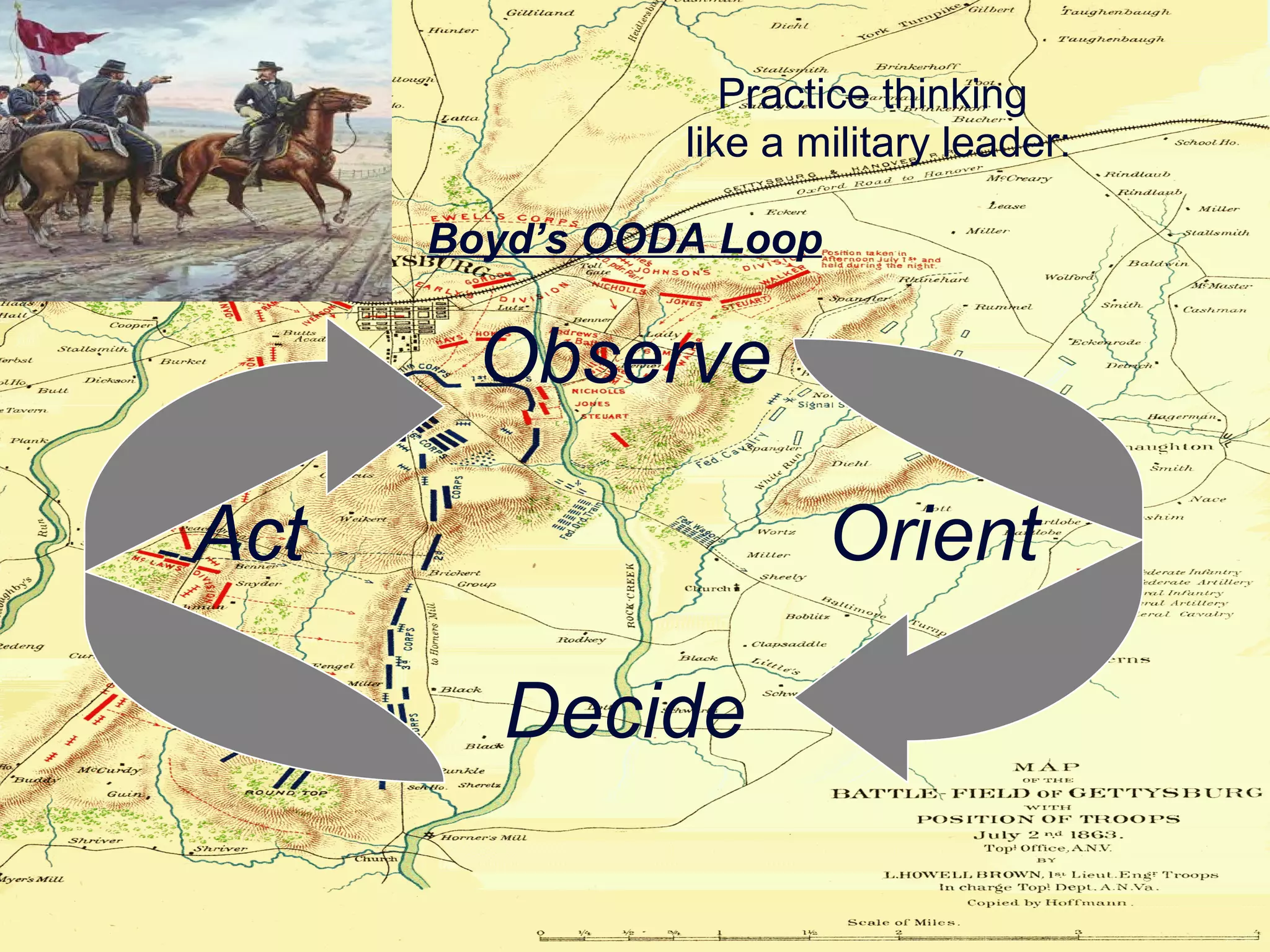
Practice thinking  like a military leader: Boyd’s OODA Loop Observe Act Orient Decide
Recognize a Follower’s Greatest Frustration with Leadership:    Indecision
Dante’s Inferno:  This is the sorrowful state of souls unsure, Whose lives earned neither honor nor bad fame, Who, neither rebellious to God nor faithful to Him, Chose neither side, but kept them selves apart— Now Heaven expels them . . . And Hell rejects them To the memory of them, the world is deaf
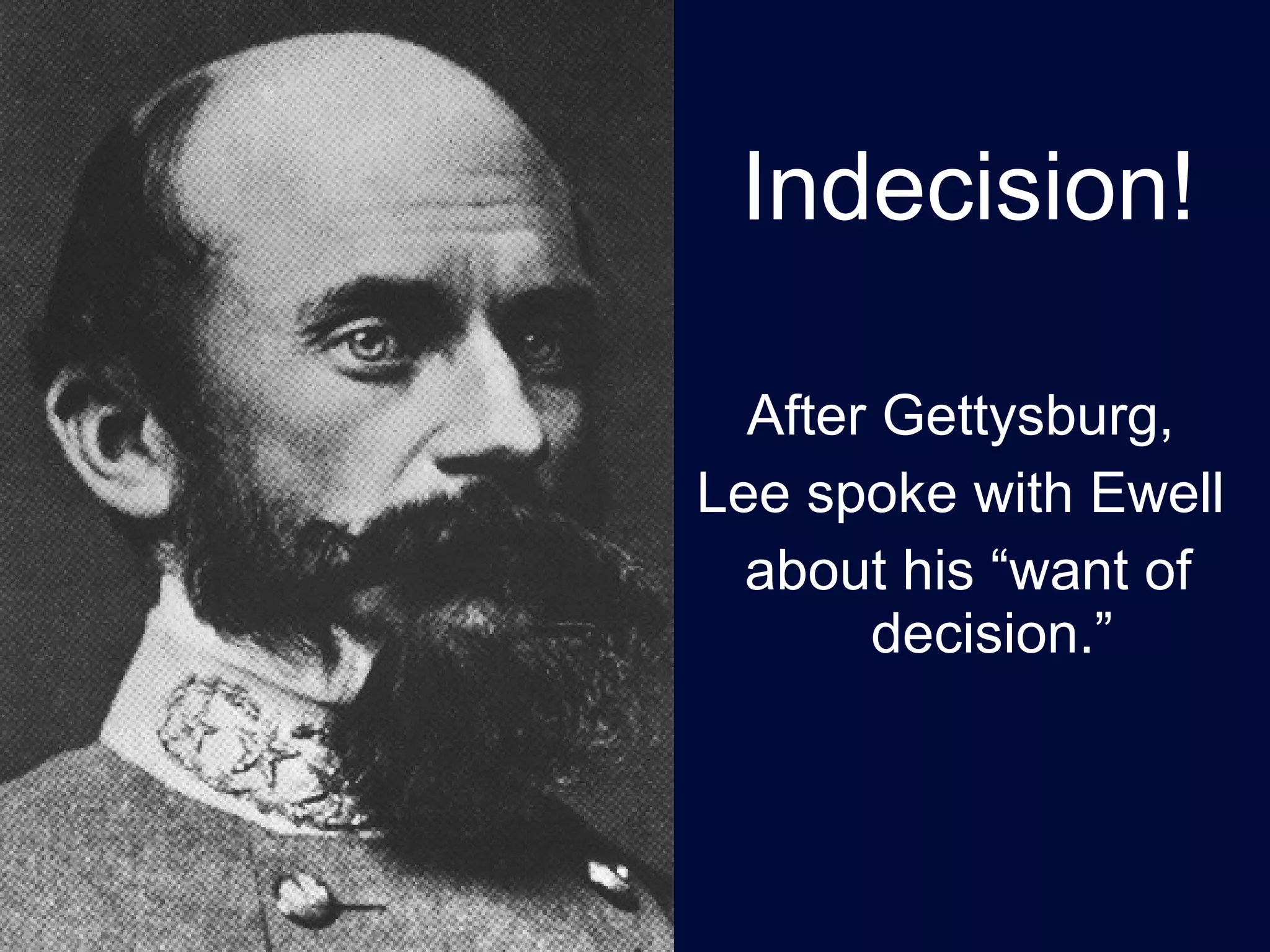
Indecision! After Gettysburg,  Lee spoke with Ewell  about his “want of decision.”
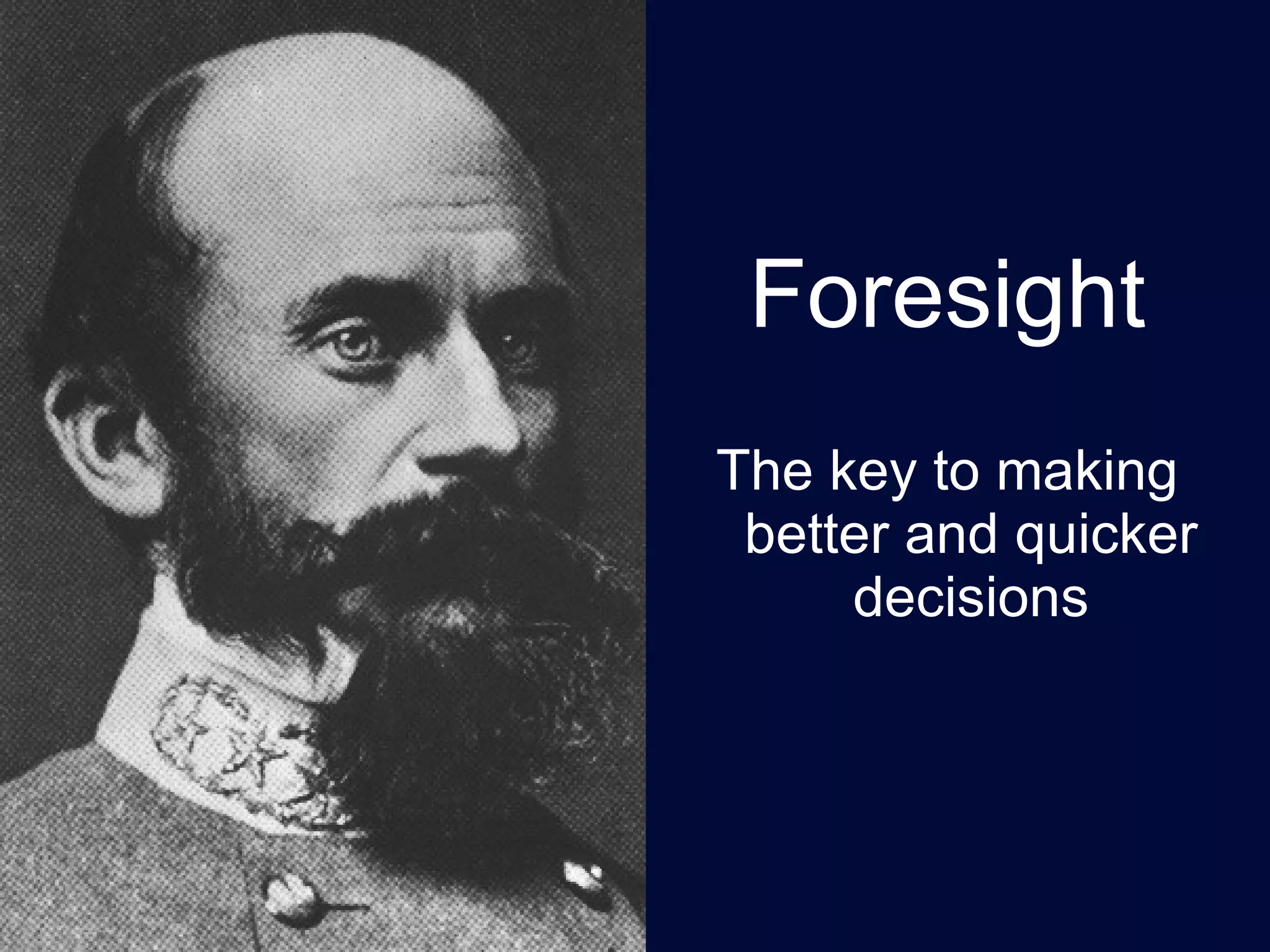
Foresight The key to making better and quicker decisions
You must make a decision,   but that decision needs to be the best decision you can make.  How?
Face  Current REALITY Reality is Your Friend!
Actively gather  information,  data,  impressions,  opinions,  insights,  etc.
Develop an instinctive  sense for: What is relevant? and what is not? What is latent or  potential in the present?
Leaders are better than others at identifying opportunities and possibilities . — Tom Marshall
Leaders confront the brutal facts and act on the implications.
Watch   Your Ego Ego and self-esteem always intertwine with our ability to lead . . . there is always the tendency to put a positive spin on everything imaginable, while ignoring evidence to the contrary.  We easily lose sight of what is really happening.-P. Senge
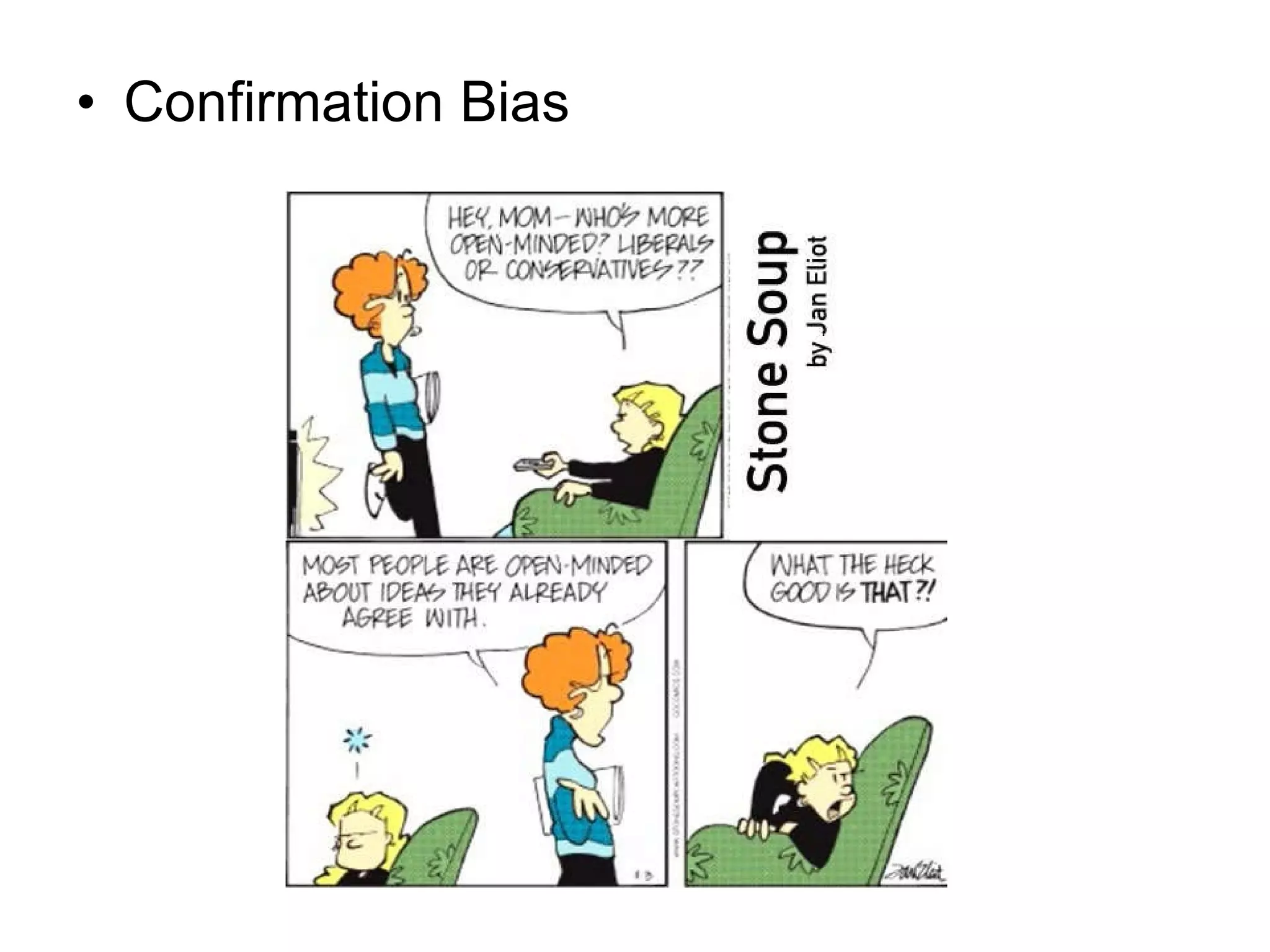
Confirmation Bias
Comprehensive framework about what leaders do and why ! 1: Shape the future . Leaders answers the question  “where are we going? ” and make sure that others understand the direction as well. Leaders are strategists and practical futurists. They figure out what the organization needs to succeed and map the direction they must go based on current and planned resources. They work effectively with others to figure out how to get from the present to the desired future. They manage the paradox of being open-minded about the possibilities while also staying rooted in reality. 2: Make things happen .  How will you make sure you get to where you’re going?  If you are a leader that makes things happen, then you are an executor (as in, one who executes). Executors translate strategy into action. They put systems in place that help others do the same. They focus on getting things done. Good leaders ensure a clear line of sight between the short term and the long term. They meet promises by taking action. 3: Engage today’s talent . Effective leaders know how to engage others to get immediate results by drawing the right talent close: communicating well, and connecting the individual to the mission. They are in a way  talent managers, generating intense personal, professional and organizational loyalty.  They understand what skills are required to carry out their mission, and they know how to attract the right talent to their organization. 4: Build the next generation .  Who stays and sustains the next generation?  Leaders with this focus are human capital developers. They ensure long-term leadership development and focus on assuring the growth and progress of their organization. They can spot future talent and understand how to develop those who possess it.These leaders work to build a cadre of people with the longer-term competencies for strategic success. They create a workforce plan focused on future talent, develop that talent, and help the talented leaders find a future in their organization. 5: Invest in yourself.  Great leaders always ask themselves: “ Am I prepared for what’s next?”  They invest in themselves by constantly learning. Leaders are learners: they learn from their successes and from failures, they read books, take classes and learn from life itself. “Effective leaders inspire loyalty and goodwill in others because they themselves act with integrity and trust.” They are decisive and have a passion for making bold and courageous moves.
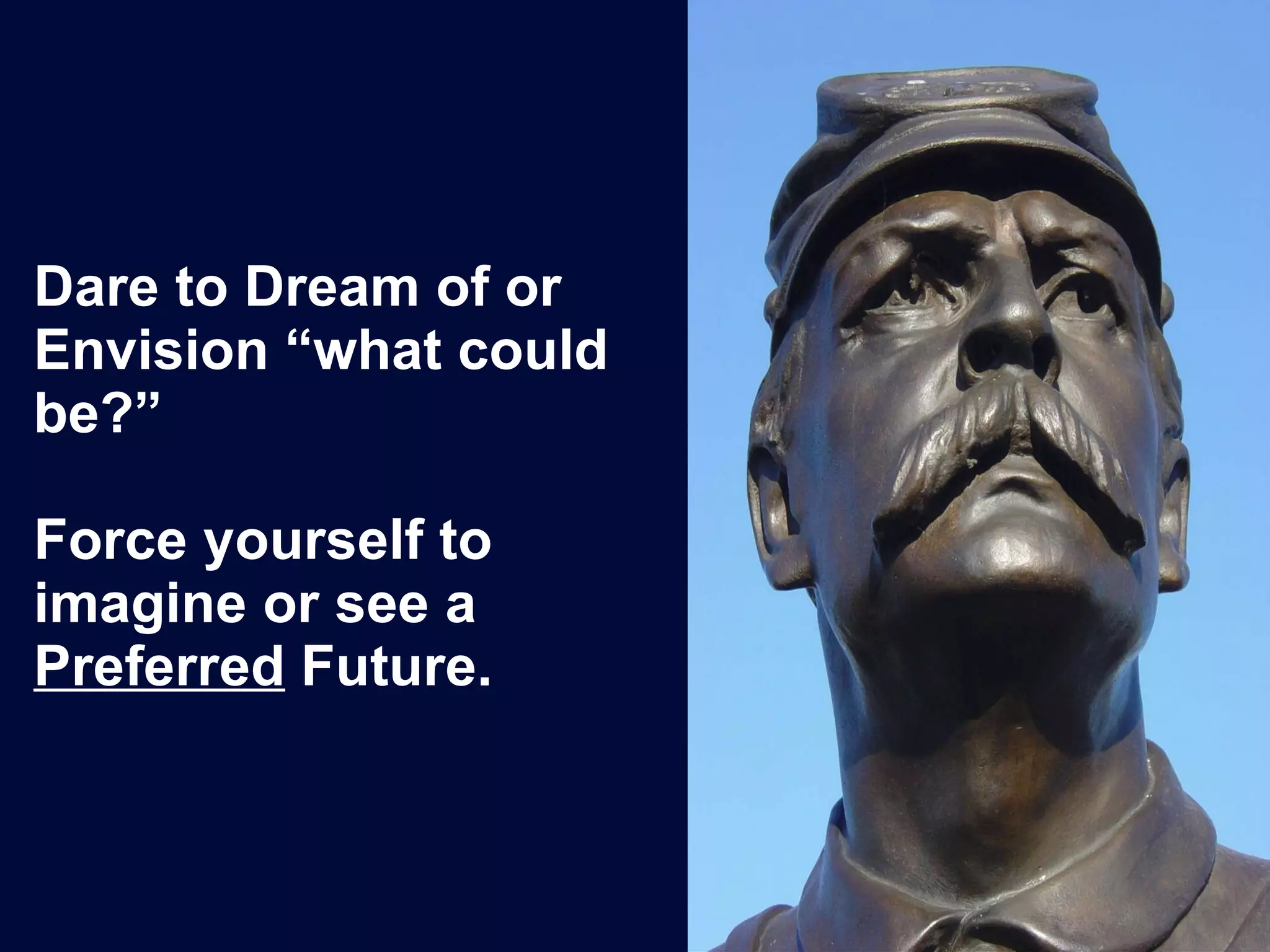
Dare to Dream of or Envision “what could be?”  Force yourself to imagine or see a  Preferred  Future.
Recognize the  Tension : The Present    vs. The Future The Current Reality vs. The Dream
The Stockdale Paradox for Leaders “ Retain absolute faith that you can and will prevail in the end, regardless of the difficulties AND at the same time confront the most brutal facts of your current reality, whatever they might be.”
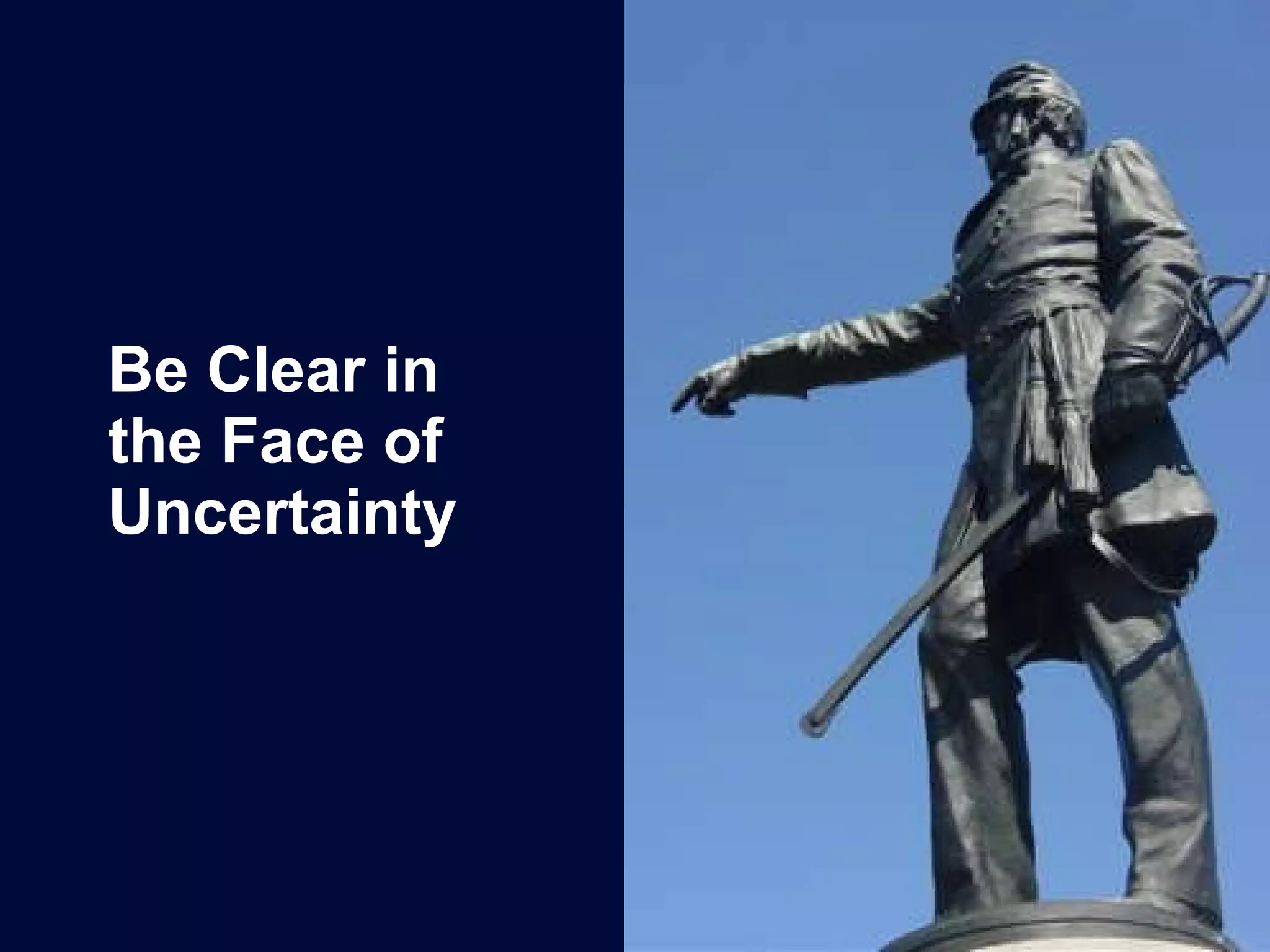
Be Clear in the Face of Uncertainty
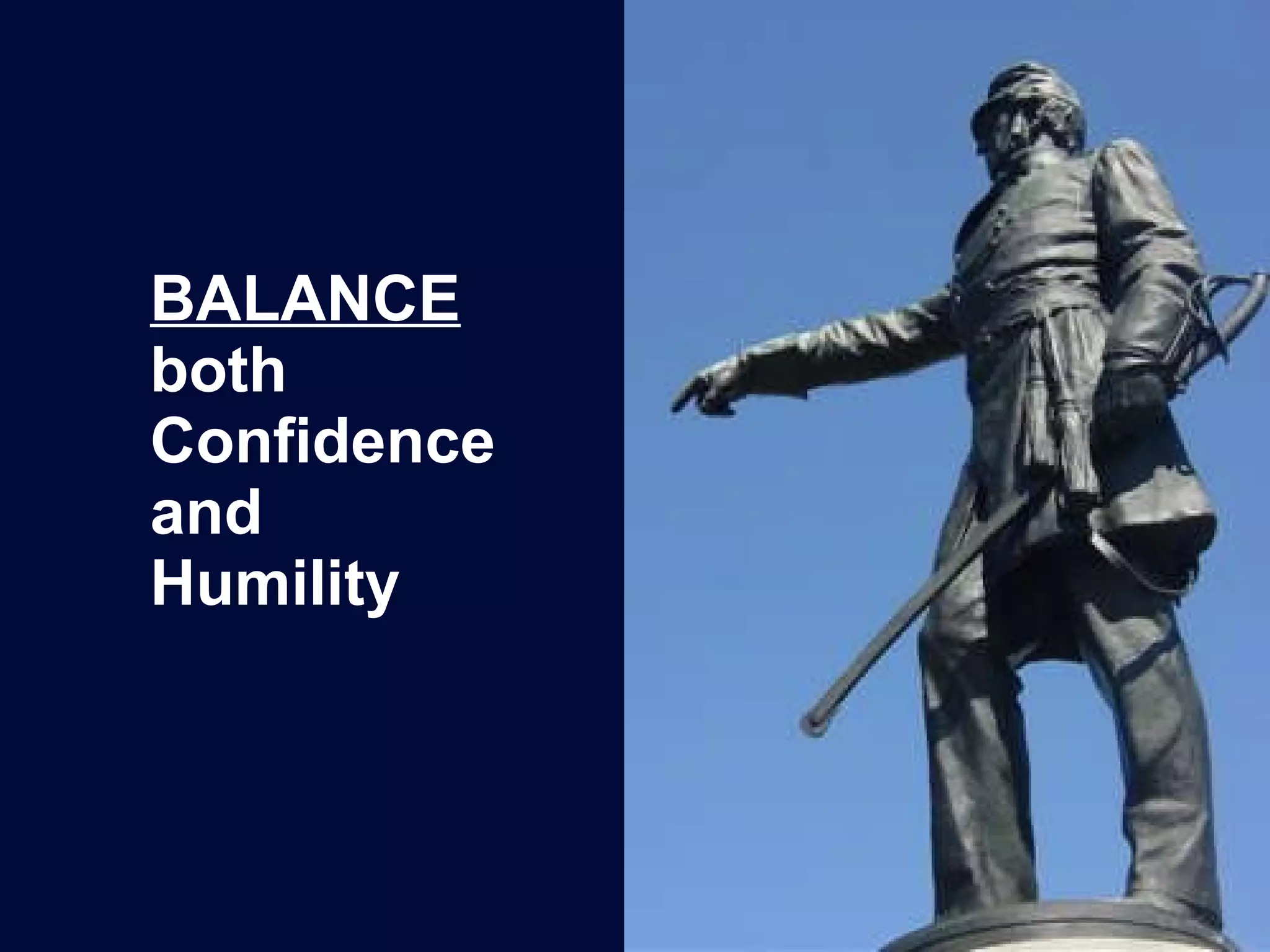
BALANCE both Confidence and  Humility
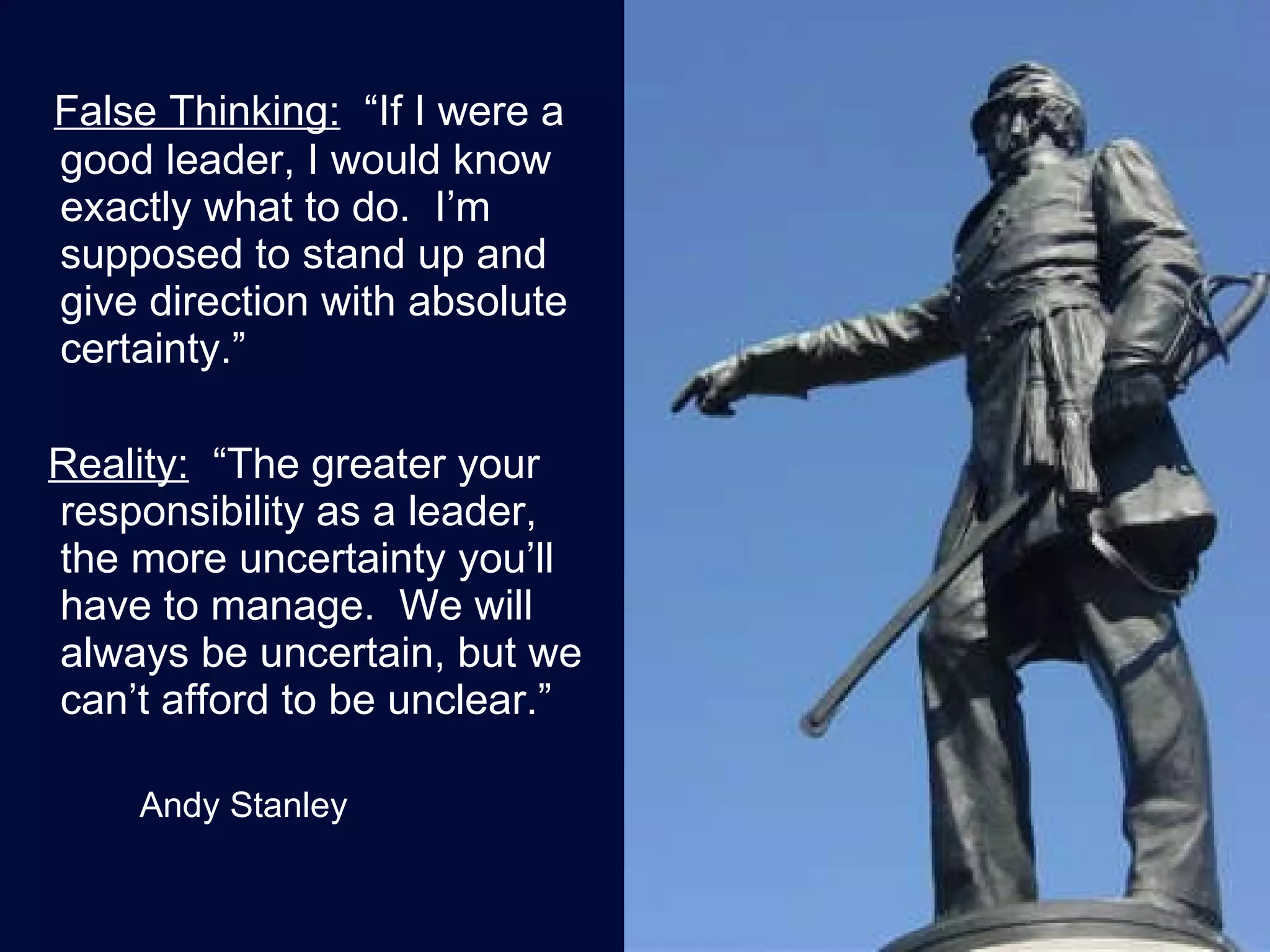
False Thinking:   “If I were a good leader, I would know exactly what to do.  I’m supposed to stand up and give direction with absolute certainty.” Reality:   “The greater your responsibility as a leader, the more uncertainty you’ll have to manage.  We will always be uncertain, but we can’t afford to be unclear.” Andy Stanley
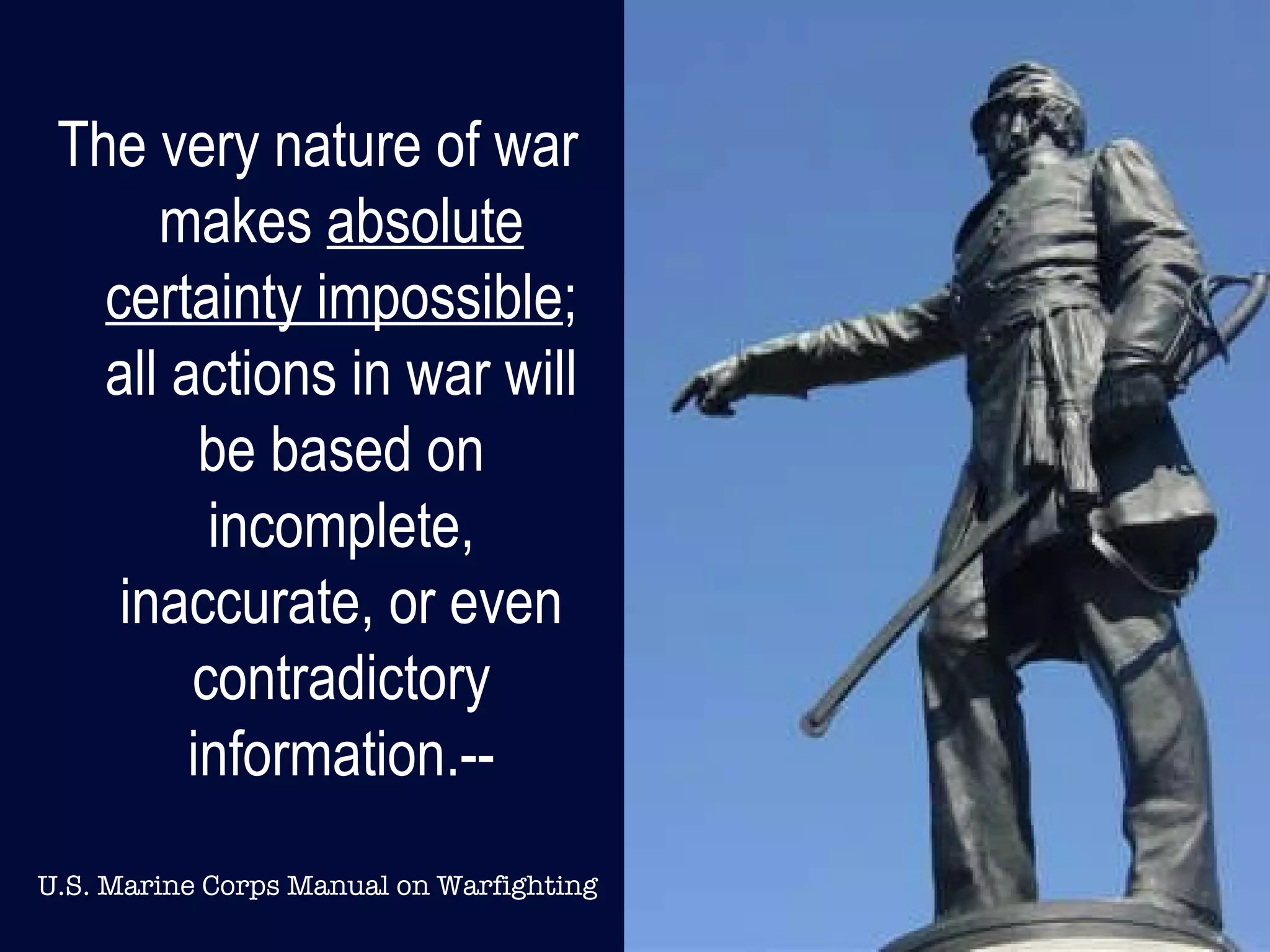
The very nature of war makes  absolute certainty impossible ; all actions in war will be based on incomplete, inaccurate, or even contradictory information.-- U.S. Marine Corps Manual on Warfighting
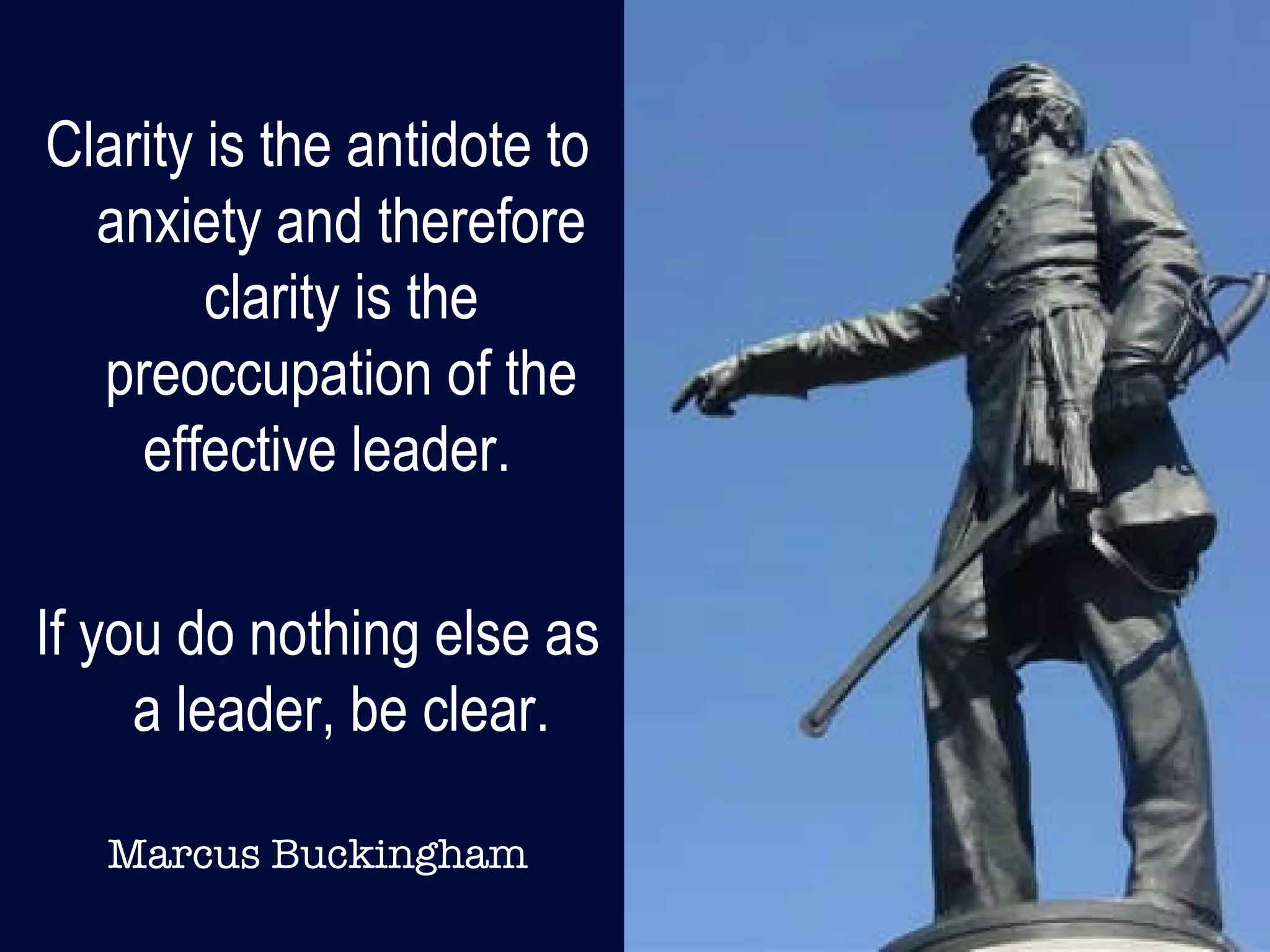
Clarity is the antidote to anxiety and therefore clarity is the preoccupation of the effective leader.  If you do nothing else as a leader, be clear. Marcus Buckingham
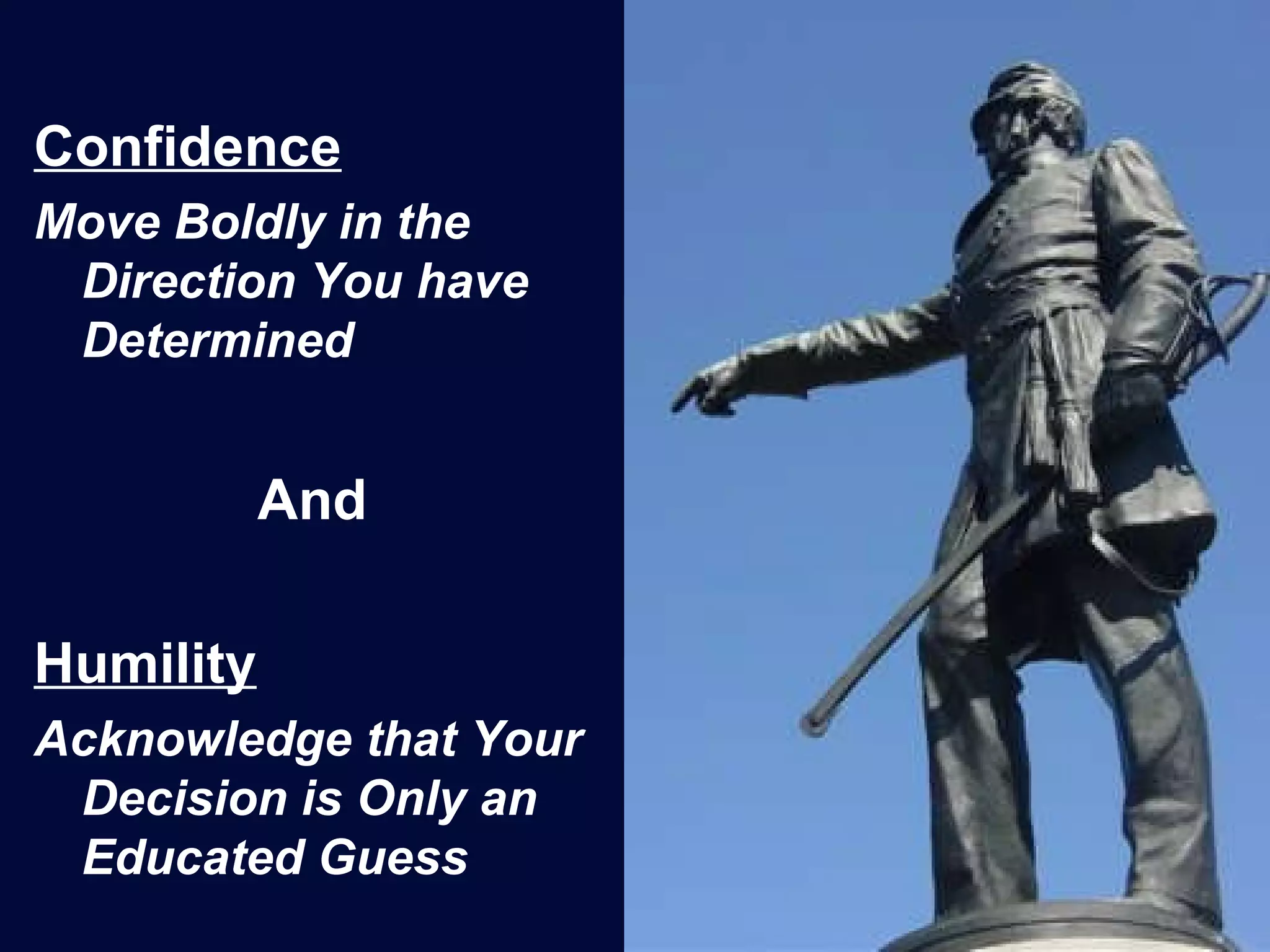
Confidence Move Boldly in the Direction You have Determined And Humility Acknowledge that Your Decision is Only an Educated Guess
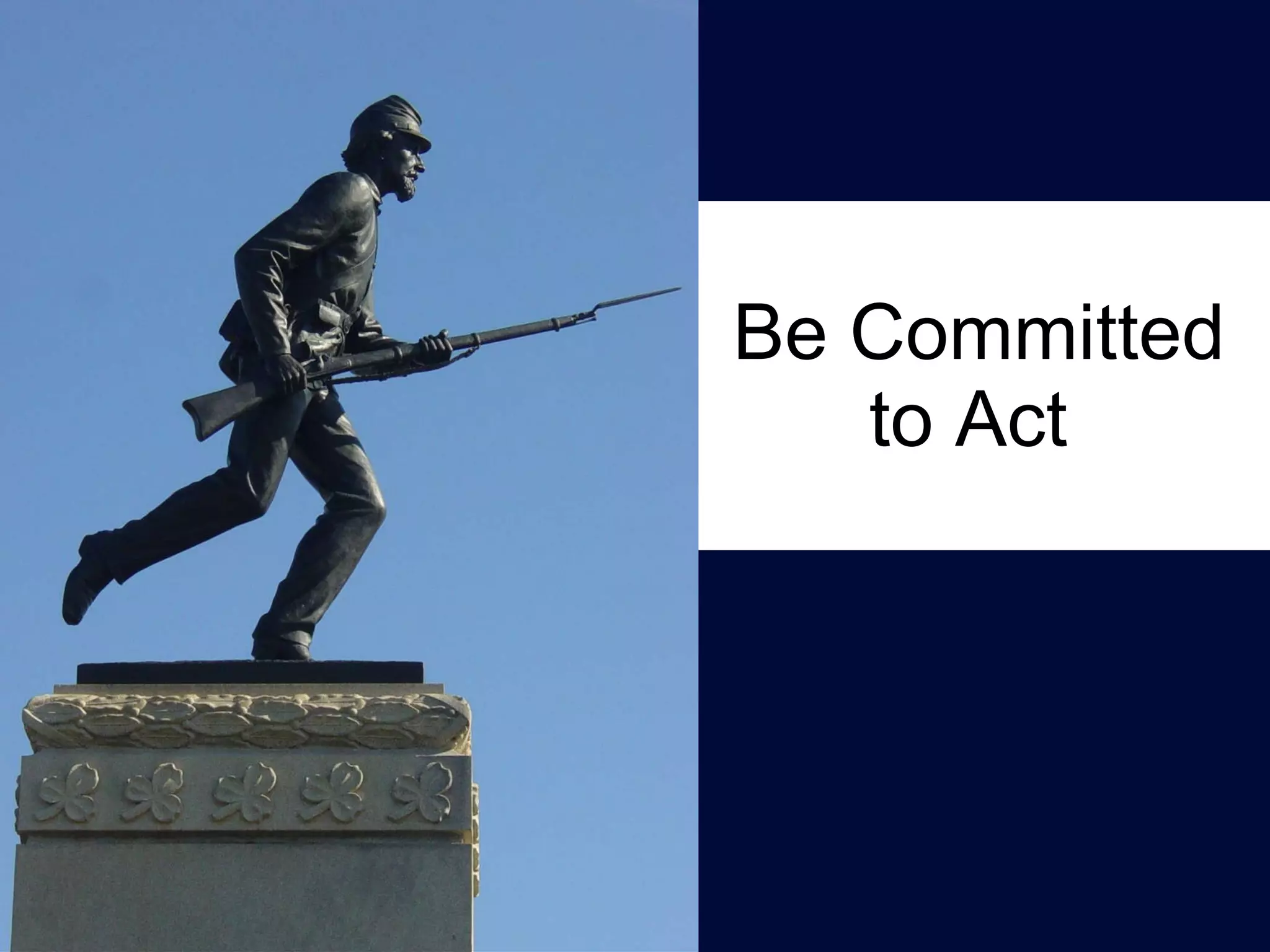
Be Committed to Act
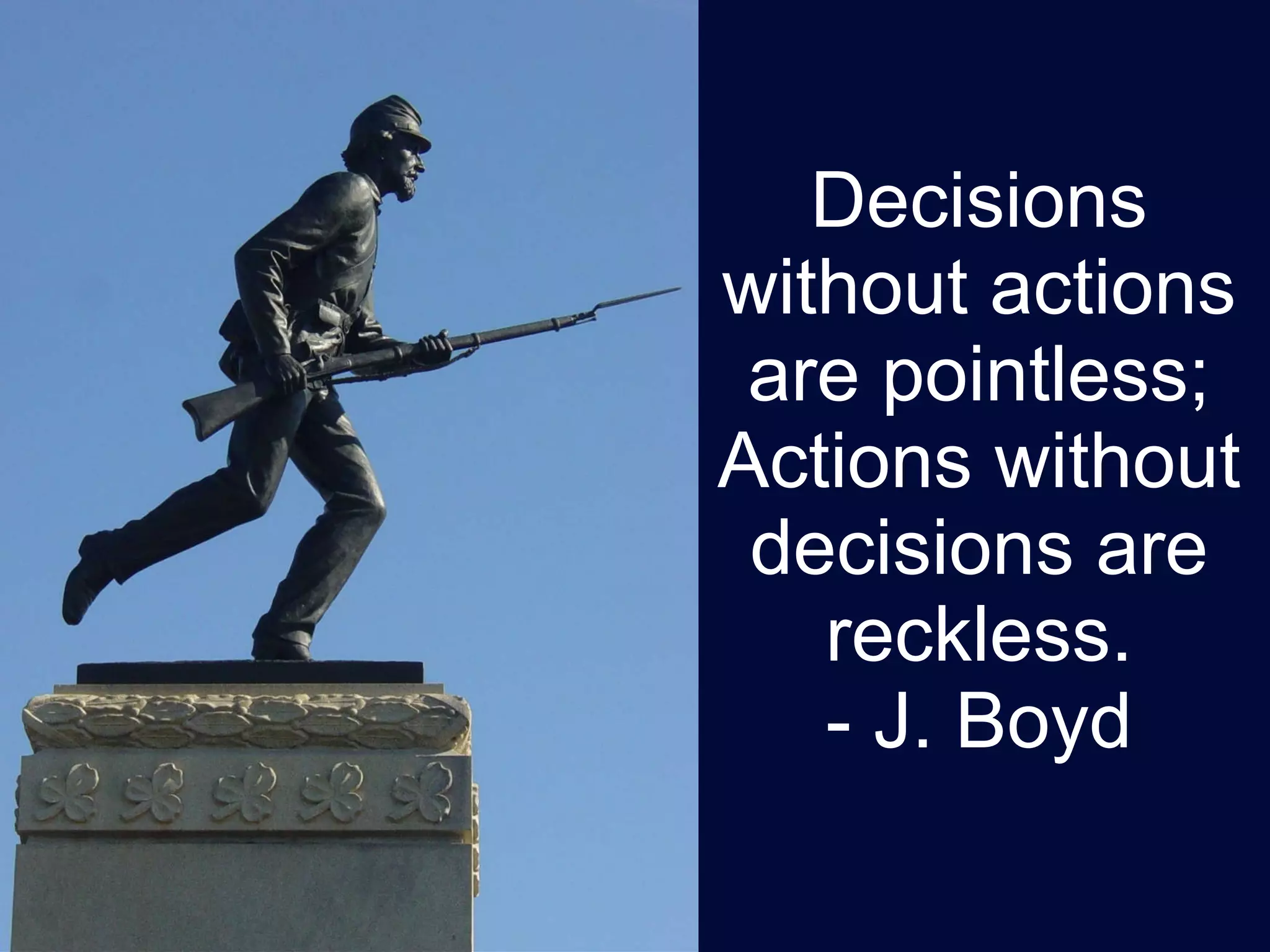
Decisions without actions are pointless; Actions without decisions are reckless. - J. Boyd
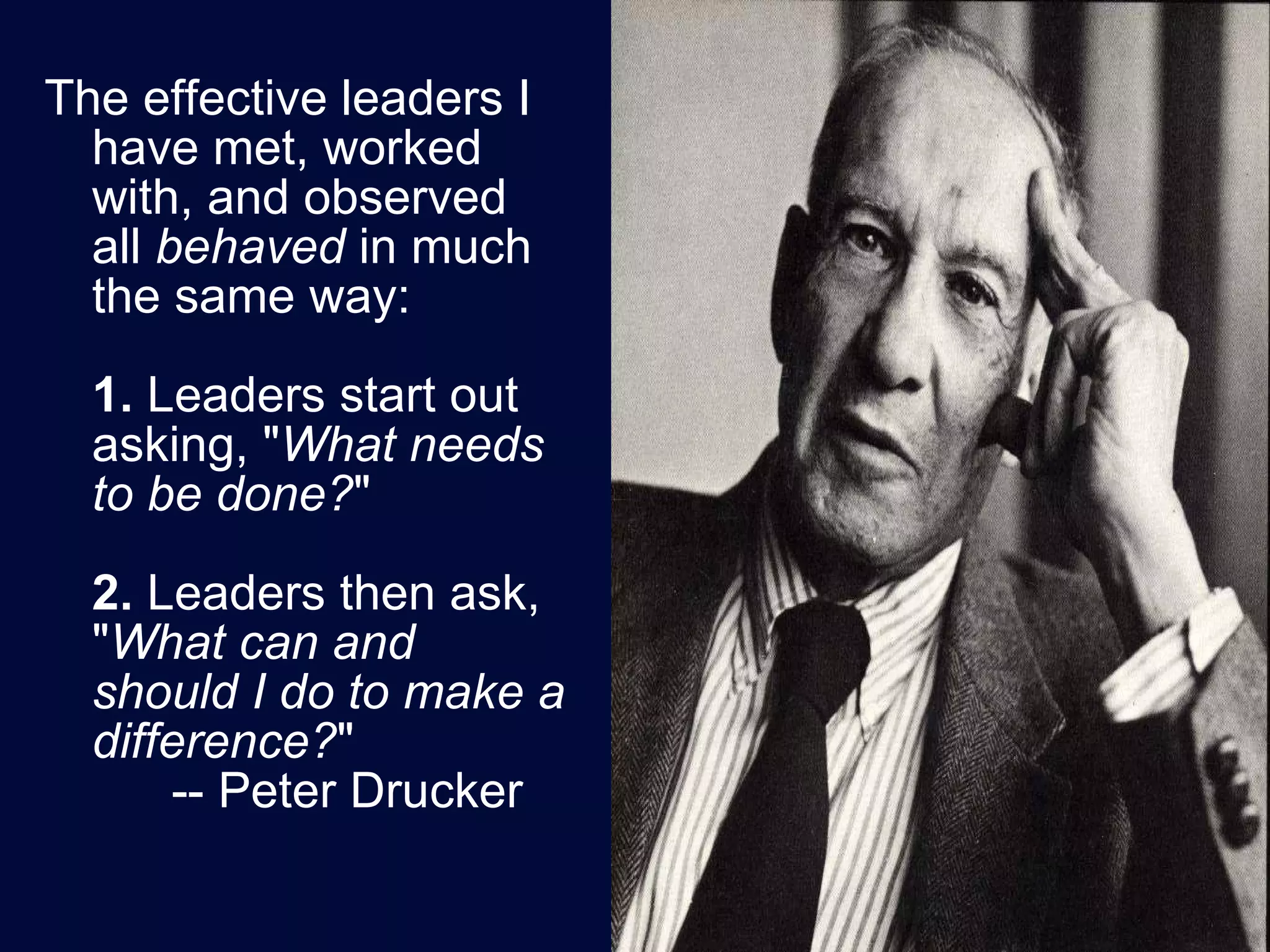
The effective leaders I have met, worked with, and observed all  behaved  in much the same way: 1.  Leaders start out asking, " What needs to be done? "  2.  Leaders then ask, " What can and should I do to make a difference? "  -- Peter Drucker
Get  Educated
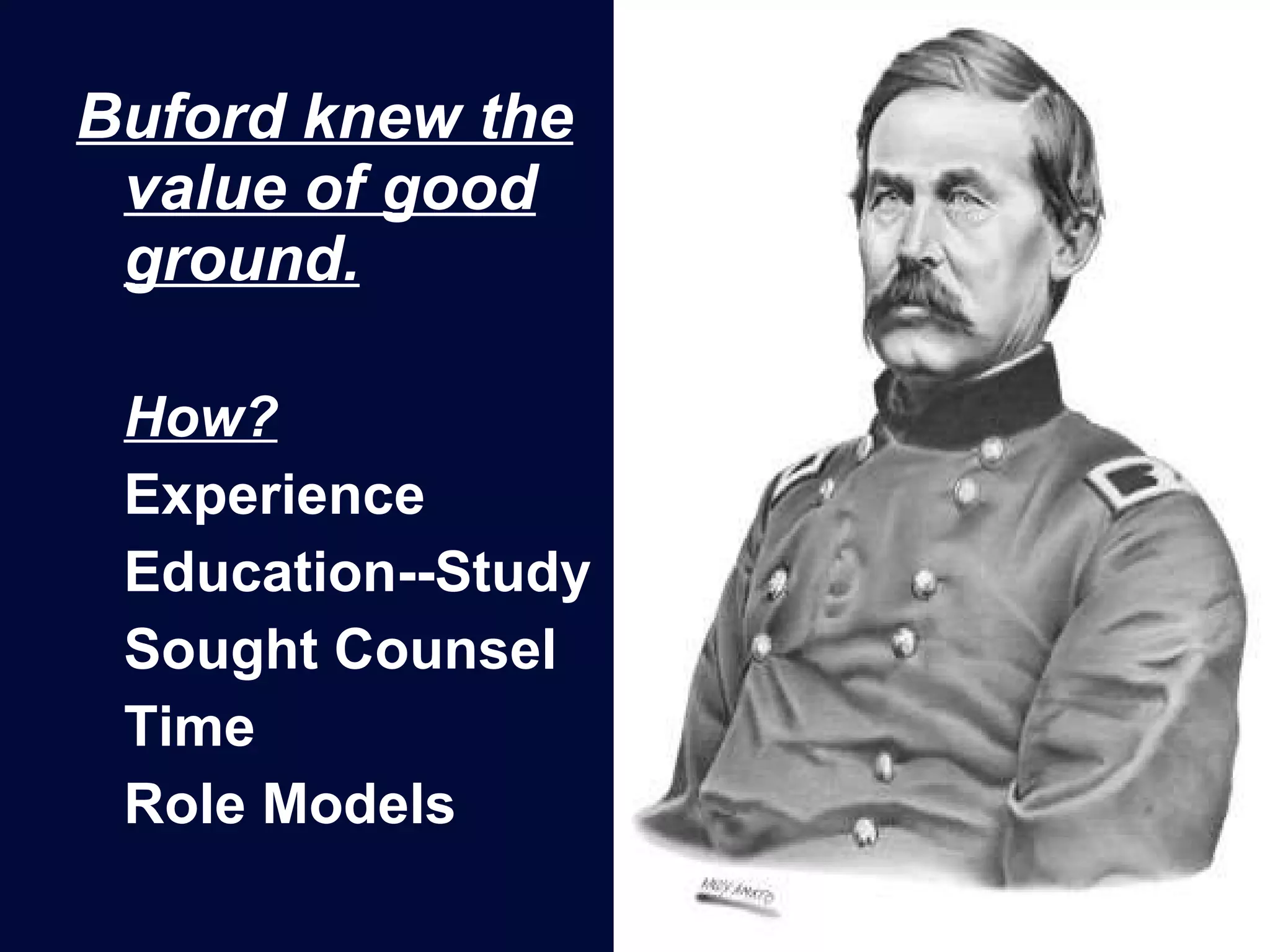
Buford knew the value of good ground. How?   Experience Education--Study Sought Counsel Time Role Models
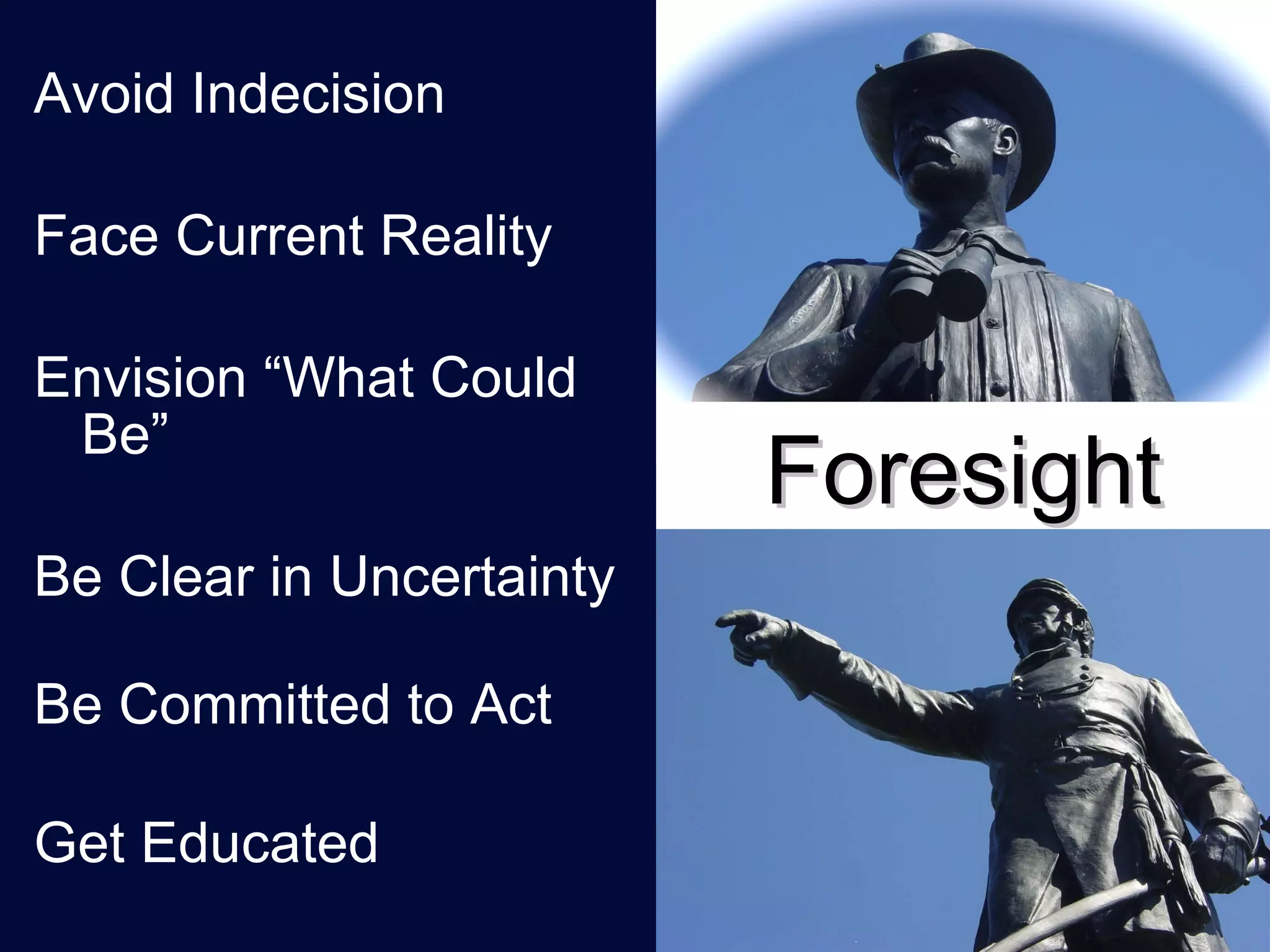
Avoid Indecision Face Current Reality Envision “What Could Be” Be Clear in Uncertainty Be Committed to Act Get Educated Foresight
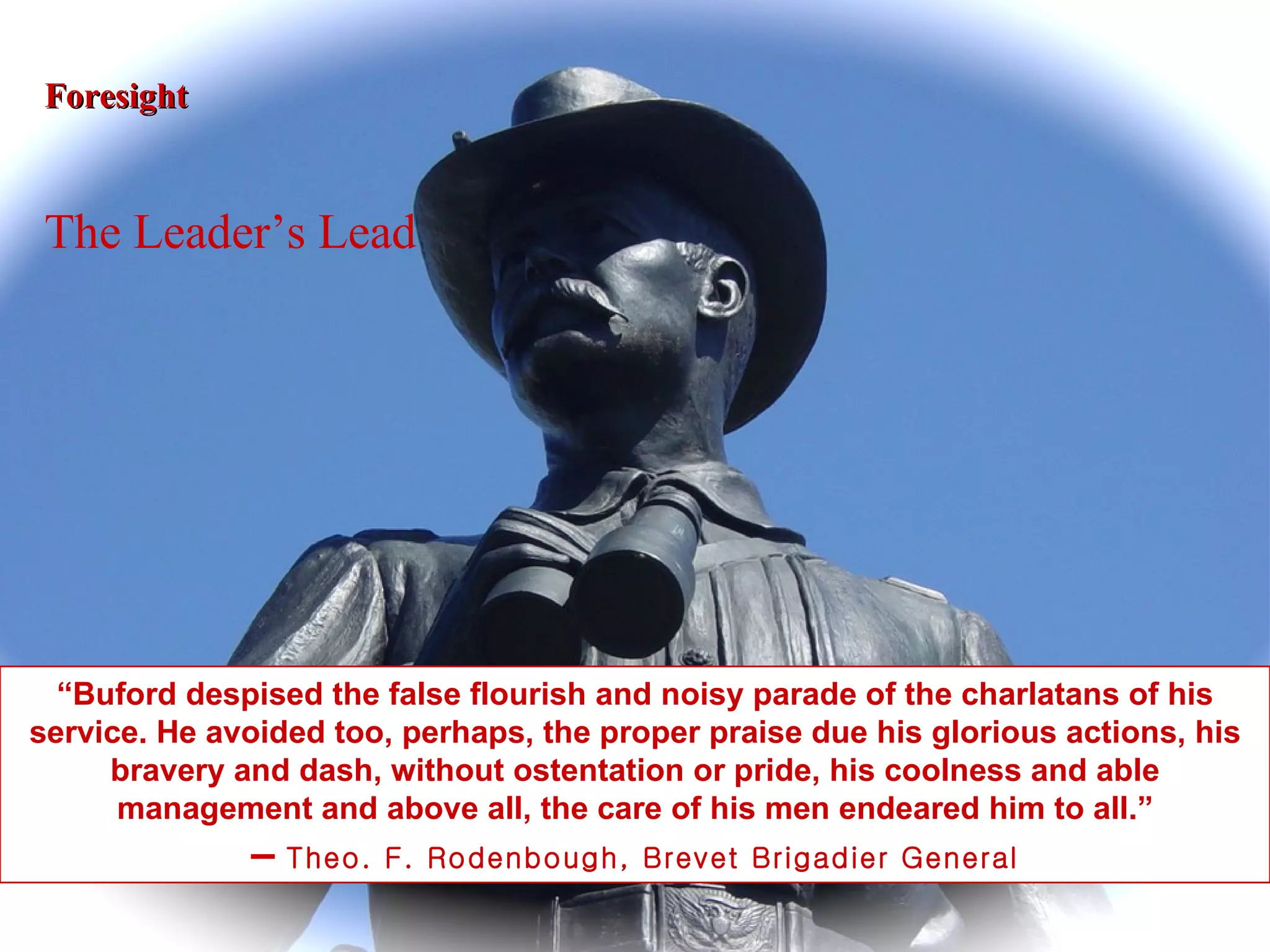
“ Buford despised the false flourish and noisy parade of the charlatans of his service. He avoided too, perhaps, the proper praise due his glorious actions, his bravery and dash, without ostentation or pride, his coolness and able management and above all, the care of his men endeared him to all.” –  Theo. F. Rodenbough, Brevet Brigadier General Foresight The Leader’s Lead

Principal 1 Foresight

  • 1.
  • 2.
  • 3.
    See the Futurein such a way that You Know What Needs to Be Done
  • 4.
    See the FutureForesight Know What to Do Preferred Future Probable Future
  • 5.
    Buford’s Foresight Issac Trimble’s Report Look for the constant reference to “seeing:” In each clip, what was the probable future and what was the preferred future ?
  • 6.
  • 7.
  • 8.
    Practice thinking like a military leader: Norman Schwarzkopf’s Checklist What is my mission? What is the terrain? What are my resources? What do I know about the enemy? ( In your leadership arena, what are the equivalents to “mission, terrain, resources, and knowledge of the enemy?”)
  • 9.
    Norman Schwarzkop quotes:“ Leadership is a potent combination of strategy and character. But if you must be without one, be without the strategy.” “ It doesn't take a hero to order men into battle. It takes a hero to be one of those men who goes into battle.” “ Do what is right, not what you think the high headquarters wants or what you think will make you look good.” He is neither a strategist nor is he schooled in the operational arts, nor is he a tactician, nor is he a general. Other than that he's a great military man. (describing Saddam Hussein of Iraq, 1991)
  • 10.
    Practice thinking like a military leader: Boyd’s OODA Loop Observe Act Orient Decide
  • 11.
    Recognize a Follower’sGreatest Frustration with Leadership: Indecision
  • 12.
    Dante’s Inferno: This is the sorrowful state of souls unsure, Whose lives earned neither honor nor bad fame, Who, neither rebellious to God nor faithful to Him, Chose neither side, but kept them selves apart— Now Heaven expels them . . . And Hell rejects them To the memory of them, the world is deaf
  • 13.
    Indecision! After Gettysburg, Lee spoke with Ewell about his “want of decision.”
  • 14.
    Foresight The keyto making better and quicker decisions
  • 15.
    You must makea decision, but that decision needs to be the best decision you can make. How?
  • 16.
    Face CurrentREALITY Reality is Your Friend!
  • 17.
    Actively gather information, data, impressions, opinions, insights, etc.
  • 18.
    Develop an instinctive sense for: What is relevant? and what is not? What is latent or potential in the present?
  • 19.
    Leaders are betterthan others at identifying opportunities and possibilities . — Tom Marshall
  • 20.
    Leaders confront thebrutal facts and act on the implications.
  • 21.
    Watch Your Ego Ego and self-esteem always intertwine with our ability to lead . . . there is always the tendency to put a positive spin on everything imaginable, while ignoring evidence to the contrary. We easily lose sight of what is really happening.-P. Senge
  • 22.
  • 23.
    Comprehensive framework aboutwhat leaders do and why ! 1: Shape the future . Leaders answers the question “where are we going? ” and make sure that others understand the direction as well. Leaders are strategists and practical futurists. They figure out what the organization needs to succeed and map the direction they must go based on current and planned resources. They work effectively with others to figure out how to get from the present to the desired future. They manage the paradox of being open-minded about the possibilities while also staying rooted in reality. 2: Make things happen . How will you make sure you get to where you’re going? If you are a leader that makes things happen, then you are an executor (as in, one who executes). Executors translate strategy into action. They put systems in place that help others do the same. They focus on getting things done. Good leaders ensure a clear line of sight between the short term and the long term. They meet promises by taking action. 3: Engage today’s talent . Effective leaders know how to engage others to get immediate results by drawing the right talent close: communicating well, and connecting the individual to the mission. They are in a way talent managers, generating intense personal, professional and organizational loyalty. They understand what skills are required to carry out their mission, and they know how to attract the right talent to their organization. 4: Build the next generation . Who stays and sustains the next generation? Leaders with this focus are human capital developers. They ensure long-term leadership development and focus on assuring the growth and progress of their organization. They can spot future talent and understand how to develop those who possess it.These leaders work to build a cadre of people with the longer-term competencies for strategic success. They create a workforce plan focused on future talent, develop that talent, and help the talented leaders find a future in their organization. 5: Invest in yourself. Great leaders always ask themselves: “ Am I prepared for what’s next?” They invest in themselves by constantly learning. Leaders are learners: they learn from their successes and from failures, they read books, take classes and learn from life itself. “Effective leaders inspire loyalty and goodwill in others because they themselves act with integrity and trust.” They are decisive and have a passion for making bold and courageous moves.
  • 24.
    Dare to Dreamof or Envision “what could be?” Force yourself to imagine or see a Preferred Future.
  • 25.
    Recognize the Tension : The Present vs. The Future The Current Reality vs. The Dream
  • 26.
    The Stockdale Paradoxfor Leaders “ Retain absolute faith that you can and will prevail in the end, regardless of the difficulties AND at the same time confront the most brutal facts of your current reality, whatever they might be.”
  • 27.
    Be Clear inthe Face of Uncertainty
  • 28.
  • 29.
    False Thinking: “If I were a good leader, I would know exactly what to do. I’m supposed to stand up and give direction with absolute certainty.” Reality: “The greater your responsibility as a leader, the more uncertainty you’ll have to manage. We will always be uncertain, but we can’t afford to be unclear.” Andy Stanley
  • 30.
    The very natureof war makes absolute certainty impossible ; all actions in war will be based on incomplete, inaccurate, or even contradictory information.-- U.S. Marine Corps Manual on Warfighting
  • 31.
    Clarity is theantidote to anxiety and therefore clarity is the preoccupation of the effective leader. If you do nothing else as a leader, be clear. Marcus Buckingham
  • 32.
    Confidence Move Boldlyin the Direction You have Determined And Humility Acknowledge that Your Decision is Only an Educated Guess
  • 33.
  • 34.
    Decisions without actionsare pointless; Actions without decisions are reckless. - J. Boyd
  • 35.
    The effective leadersI have met, worked with, and observed all behaved in much the same way: 1. Leaders start out asking, " What needs to be done? " 2. Leaders then ask, " What can and should I do to make a difference? " -- Peter Drucker
  • 36.
  • 37.
    Buford knew thevalue of good ground. How? Experience Education--Study Sought Counsel Time Role Models
  • 38.
    Avoid Indecision FaceCurrent Reality Envision “What Could Be” Be Clear in Uncertainty Be Committed to Act Get Educated Foresight
  • 39.
    “ Buford despisedthe false flourish and noisy parade of the charlatans of his service. He avoided too, perhaps, the proper praise due his glorious actions, his bravery and dash, without ostentation or pride, his coolness and able management and above all, the care of his men endeared him to all.” – Theo. F. Rodenbough, Brevet Brigadier General Foresight The Leader’s Lead