School Library Development and   Information Literacy :   The Cook Islands Experience Elizabeth Jones and Kathy George Pacific Knowledge Societies: Developing Equitable Access to Quality Resources and Information Literacy   9 th  PRIDE Regional Workshop, September 2008
Overview of Presentation Background  Aim and Goals Development and Support Model Programme Framework: Phase 1 – Phase 4 Core Training Content Development Support  Impact of programme Where to from here? – Challenges & Opportunities
Background of Project Cook Islands Ministry of Education (CIMOE) identified the school library as a specialist learning area to promote student learning including information literacy CIMOE wanted to see the school library extended to the wider community as community learning centres Applied for Pacific Regional Initiatives for the Delivery of basic Education (PRIDE) funding
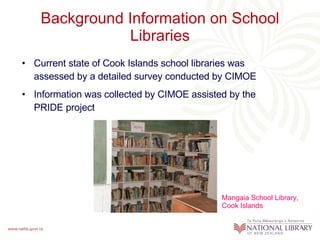
Background Information on School Libraries Current state of Cook Islands school libraries was assessed by a detailed survey conducted by CIMOE Information was collected by CIMOE assisted by the PRIDE project Mangaia School Library, Cook Islands
Establishment of Cook Islands Project PRIDE & CIMOE approached National Library of New Zealand to help establish and organize an interactive and capacity building training programme focusing on information literacy and library learning environments.  The training programme included funding for resources, shelving and library software  Mangaia School Library, Cook Islands
Educational Objectives of the Project Training literacy lead teachers in school library management and information literacy Training literacy lead teachers how to connect the library across the curriculum programmes Building capacity of lead teachers to provide ongoing training and support to other schools Assisting an audit staff member in developing school library indicators for Cook Island schools
Development Model Phased development:  Building knowledge and skills of participants and practical library developments in incremental phases Programme style : Interactive, and clearly structured Mix of training:  professional development  –  building knowledge and awareness, practical support, hands on learning experiences and reflections Build on existing strengths:  Directed at those with influence in the school sector, to further build leadership and capability  Development of supportive professional learning community:  Focusing on group learning and support (include online mentoring) Relevance  to and respect for the Cook Islands environment Set in the broader educational context of  effective learning and literacy
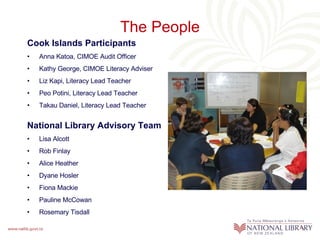
The People Cook Islands Participants Anna Katoa, CIMOE Audit Officer Kathy George, CIMOE Literacy Adviser  Liz Kapi, Literacy Lead Teacher Peo Potini, Literacy Lead Teacher Takau Daniel, Literacy Lead Teacher National Library Advisory Team  Lisa Alcott Rob Finlay Alice Heather Dyane Hosler Fiona Mackie Pauline McCowan Rosemary Tisdall
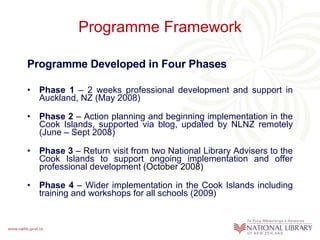
Programme Framework Programme Developed in Four Phases Phase 1  – 2 weeks professional development and support in Auckland, NZ (May 2008) Phase 2  – Action planning and beginning implementation in the Cook Islands, supported via blog, updated by NLNZ remotely (June – Sept 2008) Phase 3  – Return visit from two National Library Advisers to the Cook Islands to support ongoing implementation and offer professional development  (October 2008) Phase 4  – Wider implementation in the Cook Islands including training and workshops for all schools (2009)
Programme Framework Coverage of core content and knowledge Visits to a range of school libraries and youth libraries Practical development support Purchase of library resources Demonstrations of automated school library systems Development of audit/evaluation framework for school libraries Reflections and action planning Phase 1 : Two Week Programme in Auckland
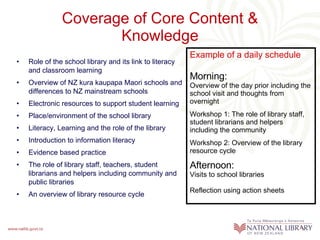
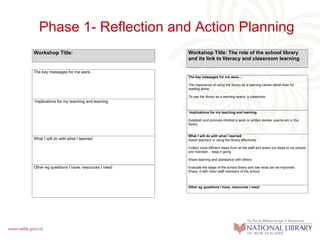
Coverage of Core Content & Knowledge Role of the school library and its link to literacy and classroom learning Overview of NZ kura kaupapa Maori schools and differences to NZ mainstream schools Electronic resources to support student learning Place/environment of the school library Literacy, Learning and the role of the library Introduction to information literacy Evidence based practice The role of library staff, teachers, student librarians and helpers including community and public libraries An overview of library resource cycle Example of a daily schedule Morning: Overview of the day prior including the school visit and thoughts from overnight Workshop 1: The role of library staff, student librarians and helpers including the community Workshop 2: Overview of the library resource cycle Afternoon:  Visits to school libraries Reflection using action sheets
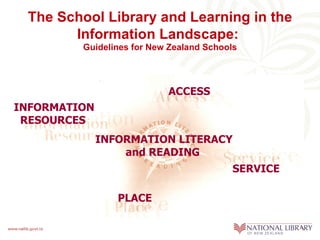
The School Library and Learning in the Information Landscape:   Guidelines for New Zealand Schools INFORMATION RESOURCES ACCESS INFORMATION LITERACY and READING   PLACE SERVICE
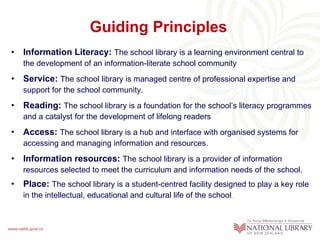
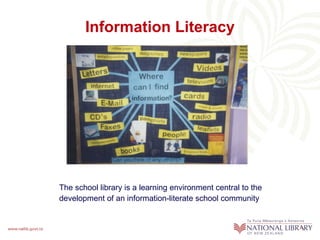
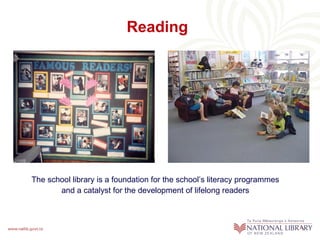
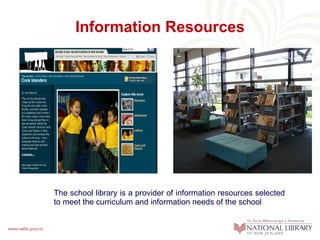
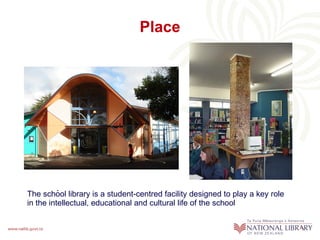
Guiding Principles   Information Literacy:  The school library is a learning environment central to the development of an information-literate school community Service:  The school library is managed centre of professional expertise and support for the school community.  Reading:  The school library is a foundation for the school’s literacy programmes and a catalyst for the development of lifelong readers Access:  The school library is a hub and interface with organised systems for accessing and managing information and resources.  Information resources:  The school library is a provider of information resources selected to meet the curriculum and information needs of the school.  Place:  The school library is a student-centred facility designed to play a key role in the intellectual, educational and cultural life of the school .
Information Literacy The school library is a learning environment central to the development of an information-literate school community Point View School, Auckland
Reading Papatoetoe High School   , Auckland The school library is a foundation for the school’s literacy programmes and a catalyst for the development of lifelong readers
Service a The school library is a managed centre of professional expertise and support for the school community
Information Resources Glamorgan School, Auckland The school library is a provider of information resources selected to meet the curriculum and information needs of the school
Access The school library is a hub and interface with organised systems for accessing and managing information and resources Onepoto School, Auckland
Place . Glen Innes School, Auckland   Diocesan Senior School,Auckland   New Lynn Primary Opaheke Primary The school library is a student-centred facility designed to play a key role  in the intellectual, educational and cultural life of the school
Phase 1- Reflection and Action Planning
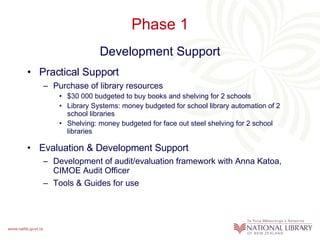
Phase 1 Development Support Practical Support Purchase of library resources $30 000 budgeted to buy books and shelving for 2 schools Library Systems: money budgeted for school library automation of 2 school libraries Shelving: money budgeted for face out steel shelving for 2 school libraries  Evaluation & Development Support Development of audit/evaluation framework with Anna Katoa, CIMOE Audit Officer Tools & Guides for use
Practical Support Purchase of Library Resources $30 000 – books and shelving for two schools Book purchasing – based on needs assessment : Non-fiction  :   for eg  – Bible stories, Pasifika folklore & Curriculum topics (insects, solar system, science concepts, celebrations etc.) Reference :  Encyclopaedias, Dictionaries Fiction : Picture Books – From pre-school concepts to sophisticated picture books Books for emerging readers and reluctant readers Contemporary fiction for older readers
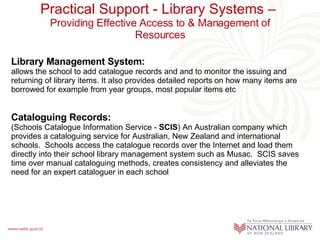
Practical Support - Library Systems –  Providing Effective Access to & Management of Resources Library Management System:  allows the school to add catalogue records and  and to monitor the issuing and returning of library items. It also provides detailed reports on how many items are borrowed for example from year groups, most popular items etc  Cataloguing Records: (Schools Catalogue Information Service -  SCIS ) An Australian company which provides a  cataloguing service for Australian, New Zealand and international schools.  Schools access the catalogue records over the Internet and load them directly into their school library management system such as Musac.  SCIS saves time over manual cataloguing methods, creates consistency and alleviates the need for an expert cataloguer in each school
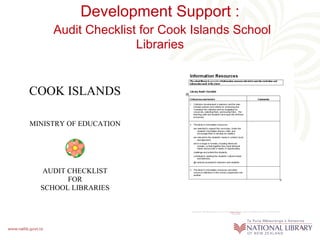
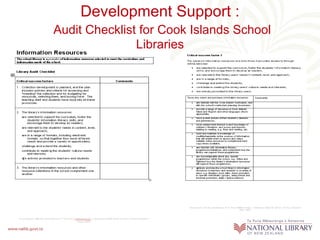
Development Support :   Audit Checklist for Cook Islands School Libraries
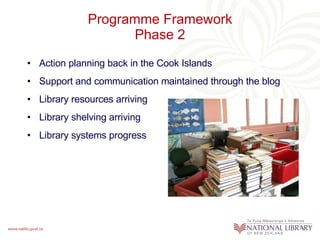
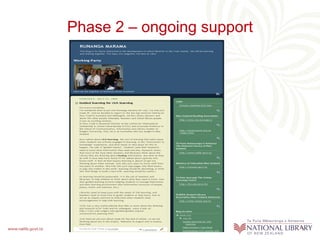
Programme Framework Phase 2 Action planning back in the Cook Islands Support and communication maintained through the blog Library resources arriving Library shelving arriving Library systems progress
Phase 2 – ongoing support
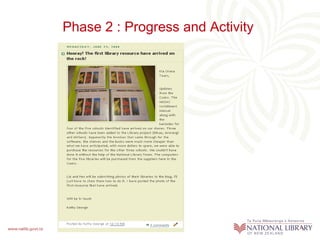
Phase 2 : Progress and Activity
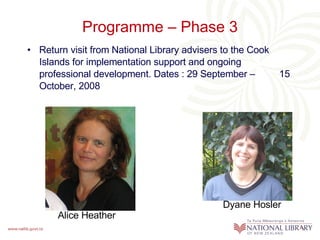
Programme – Phase 3 Return visit from National Library advisers to the Cook Islands for implementation support and ongoing professional development. Dates : 29 September –  15 October, 2008 Alice Heather Dyane Hosler
Programme – Phase 3 National Library advisors working with the lead training group in the Cook Island for ongoing professional development and implementation support   Two week programme will include: Help resolve issues around arrival and processing of the new resources Workshops with teachers on information literacy, the library resource cycle, library services, access and reading for students Training in use of Blog as a communication tool Joint planning and confirmation with the Literacy Adviser and Lead Teachers of objectives for the Library and Information Literacy  Workshop planned for April 2009 3 day workshop on the six guiding principles of school libraries with all teachers in charge of Library Management from all Rarotonga schools.
Programme – Phase 4 Continuing implementation of school library development in the Cook Islands Workshop for all teachers in April 2009
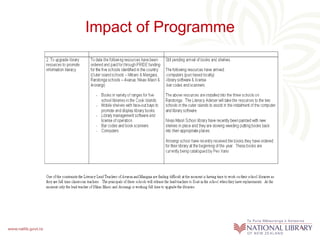
Impact of Programme Summary of Results to Date
Impact of Programme
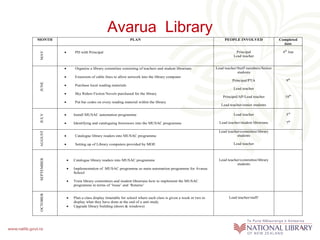
Avarua  Library
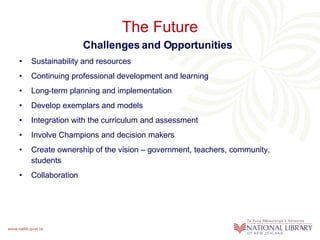
The Future Challenges and Opportunities Sustainability and resources Continuing professional development and learning Long-term planning and implementation Develop exemplars and models Integration with the curriculum and assessment Involve Champions and decision makers Create ownership of the vision – government, teachers, community, students Collaboration
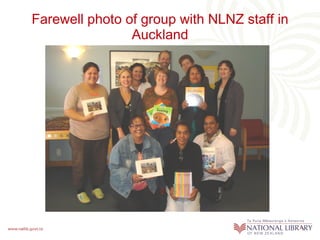
Farewell photo of group with NLNZ staff in Auckland
Sustainability and Working Together Kaua e rangiruatia te h ä  o te hoe; e kore t ö  t ä tou waka e  ü  ki uta. ‘Do not lift the paddle out of unison or our canoe will never reach the shore.’

Pride Presentation of Cook Islands School Libraries

  • 1.
    School Library Developmentand Information Literacy : The Cook Islands Experience Elizabeth Jones and Kathy George Pacific Knowledge Societies: Developing Equitable Access to Quality Resources and Information Literacy 9 th PRIDE Regional Workshop, September 2008
  • 2.
    Overview of PresentationBackground Aim and Goals Development and Support Model Programme Framework: Phase 1 – Phase 4 Core Training Content Development Support Impact of programme Where to from here? – Challenges & Opportunities
  • 3.
    Background of ProjectCook Islands Ministry of Education (CIMOE) identified the school library as a specialist learning area to promote student learning including information literacy CIMOE wanted to see the school library extended to the wider community as community learning centres Applied for Pacific Regional Initiatives for the Delivery of basic Education (PRIDE) funding
  • 4.
    Background Information onSchool Libraries Current state of Cook Islands school libraries was assessed by a detailed survey conducted by CIMOE Information was collected by CIMOE assisted by the PRIDE project Mangaia School Library, Cook Islands
  • 5.
    Establishment of CookIslands Project PRIDE & CIMOE approached National Library of New Zealand to help establish and organize an interactive and capacity building training programme focusing on information literacy and library learning environments. The training programme included funding for resources, shelving and library software Mangaia School Library, Cook Islands
  • 6.
    Educational Objectives ofthe Project Training literacy lead teachers in school library management and information literacy Training literacy lead teachers how to connect the library across the curriculum programmes Building capacity of lead teachers to provide ongoing training and support to other schools Assisting an audit staff member in developing school library indicators for Cook Island schools
  • 7.
    Development Model Phaseddevelopment: Building knowledge and skills of participants and practical library developments in incremental phases Programme style : Interactive, and clearly structured Mix of training: professional development – building knowledge and awareness, practical support, hands on learning experiences and reflections Build on existing strengths: Directed at those with influence in the school sector, to further build leadership and capability Development of supportive professional learning community: Focusing on group learning and support (include online mentoring) Relevance to and respect for the Cook Islands environment Set in the broader educational context of effective learning and literacy
  • 8.
    The People CookIslands Participants Anna Katoa, CIMOE Audit Officer Kathy George, CIMOE Literacy Adviser Liz Kapi, Literacy Lead Teacher Peo Potini, Literacy Lead Teacher Takau Daniel, Literacy Lead Teacher National Library Advisory Team Lisa Alcott Rob Finlay Alice Heather Dyane Hosler Fiona Mackie Pauline McCowan Rosemary Tisdall
  • 9.
    Programme Framework ProgrammeDeveloped in Four Phases Phase 1 – 2 weeks professional development and support in Auckland, NZ (May 2008) Phase 2 – Action planning and beginning implementation in the Cook Islands, supported via blog, updated by NLNZ remotely (June – Sept 2008) Phase 3 – Return visit from two National Library Advisers to the Cook Islands to support ongoing implementation and offer professional development (October 2008) Phase 4 – Wider implementation in the Cook Islands including training and workshops for all schools (2009)
  • 10.
    Programme Framework Coverageof core content and knowledge Visits to a range of school libraries and youth libraries Practical development support Purchase of library resources Demonstrations of automated school library systems Development of audit/evaluation framework for school libraries Reflections and action planning Phase 1 : Two Week Programme in Auckland
  • 11.
    Coverage of CoreContent & Knowledge Role of the school library and its link to literacy and classroom learning Overview of NZ kura kaupapa Maori schools and differences to NZ mainstream schools Electronic resources to support student learning Place/environment of the school library Literacy, Learning and the role of the library Introduction to information literacy Evidence based practice The role of library staff, teachers, student librarians and helpers including community and public libraries An overview of library resource cycle Example of a daily schedule Morning: Overview of the day prior including the school visit and thoughts from overnight Workshop 1: The role of library staff, student librarians and helpers including the community Workshop 2: Overview of the library resource cycle Afternoon: Visits to school libraries Reflection using action sheets
  • 12.
    The School Libraryand Learning in the Information Landscape: Guidelines for New Zealand Schools INFORMATION RESOURCES ACCESS INFORMATION LITERACY and READING PLACE SERVICE
  • 13.
    Guiding Principles Information Literacy: The school library is a learning environment central to the development of an information-literate school community Service: The school library is managed centre of professional expertise and support for the school community. Reading: The school library is a foundation for the school’s literacy programmes and a catalyst for the development of lifelong readers Access: The school library is a hub and interface with organised systems for accessing and managing information and resources. Information resources: The school library is a provider of information resources selected to meet the curriculum and information needs of the school. Place: The school library is a student-centred facility designed to play a key role in the intellectual, educational and cultural life of the school .
  • 14.
    Information Literacy Theschool library is a learning environment central to the development of an information-literate school community Point View School, Auckland
  • 15.
    Reading Papatoetoe HighSchool , Auckland The school library is a foundation for the school’s literacy programmes and a catalyst for the development of lifelong readers
  • 16.
    Service a Theschool library is a managed centre of professional expertise and support for the school community
  • 17.
    Information Resources GlamorganSchool, Auckland The school library is a provider of information resources selected to meet the curriculum and information needs of the school
  • 18.
    Access The schoollibrary is a hub and interface with organised systems for accessing and managing information and resources Onepoto School, Auckland
  • 19.
    Place . GlenInnes School, Auckland Diocesan Senior School,Auckland New Lynn Primary Opaheke Primary The school library is a student-centred facility designed to play a key role in the intellectual, educational and cultural life of the school
  • 20.
    Phase 1- Reflectionand Action Planning
  • 21.
    Phase 1 DevelopmentSupport Practical Support Purchase of library resources $30 000 budgeted to buy books and shelving for 2 schools Library Systems: money budgeted for school library automation of 2 school libraries Shelving: money budgeted for face out steel shelving for 2 school libraries Evaluation & Development Support Development of audit/evaluation framework with Anna Katoa, CIMOE Audit Officer Tools & Guides for use
  • 22.
    Practical Support Purchaseof Library Resources $30 000 – books and shelving for two schools Book purchasing – based on needs assessment : Non-fiction : for eg – Bible stories, Pasifika folklore & Curriculum topics (insects, solar system, science concepts, celebrations etc.) Reference : Encyclopaedias, Dictionaries Fiction : Picture Books – From pre-school concepts to sophisticated picture books Books for emerging readers and reluctant readers Contemporary fiction for older readers
  • 23.
    Practical Support -Library Systems – Providing Effective Access to & Management of Resources Library Management System: allows the school to add catalogue records and and to monitor the issuing and returning of library items. It also provides detailed reports on how many items are borrowed for example from year groups, most popular items etc Cataloguing Records: (Schools Catalogue Information Service - SCIS ) An Australian company which provides a cataloguing service for Australian, New Zealand and international schools. Schools access the catalogue records over the Internet and load them directly into their school library management system such as Musac. SCIS saves time over manual cataloguing methods, creates consistency and alleviates the need for an expert cataloguer in each school
  • 24.
    Development Support : Audit Checklist for Cook Islands School Libraries
  • 25.
    Development Support : Audit Checklist for Cook Islands School Libraries
  • 26.
    Programme Framework Phase2 Action planning back in the Cook Islands Support and communication maintained through the blog Library resources arriving Library shelving arriving Library systems progress
  • 27.
    Phase 2 –ongoing support
  • 28.
    Phase 2 :Progress and Activity
  • 29.
    Programme – Phase3 Return visit from National Library advisers to the Cook Islands for implementation support and ongoing professional development. Dates : 29 September – 15 October, 2008 Alice Heather Dyane Hosler
  • 30.
    Programme – Phase3 National Library advisors working with the lead training group in the Cook Island for ongoing professional development and implementation support Two week programme will include: Help resolve issues around arrival and processing of the new resources Workshops with teachers on information literacy, the library resource cycle, library services, access and reading for students Training in use of Blog as a communication tool Joint planning and confirmation with the Literacy Adviser and Lead Teachers of objectives for the Library and Information Literacy Workshop planned for April 2009 3 day workshop on the six guiding principles of school libraries with all teachers in charge of Library Management from all Rarotonga schools.
  • 31.
    Programme – Phase4 Continuing implementation of school library development in the Cook Islands Workshop for all teachers in April 2009
  • 32.
    Impact of ProgrammeSummary of Results to Date
  • 33.
  • 34.
  • 35.
    The Future Challengesand Opportunities Sustainability and resources Continuing professional development and learning Long-term planning and implementation Develop exemplars and models Integration with the curriculum and assessment Involve Champions and decision makers Create ownership of the vision – government, teachers, community, students Collaboration
  • 36.
    Farewell photo ofgroup with NLNZ staff in Auckland
  • 37.
    Sustainability and WorkingTogether Kaua e rangiruatia te h ä o te hoe; e kore t ö t ä tou waka e ü ki uta. ‘Do not lift the paddle out of unison or our canoe will never reach the shore.’