Pricing Decision
bijubodheswar@gmail.com
Govt.college for women,
thiruvananthapuram
Meaning
• Price is the monetary value that a
product or service- during a
transaction
• Pricing – Determination of selling
price of a product or service
• Pricing decision- the choice that
business make when setting price
for their product or service
Objectives of Pricing
• ROI (target return)
• Market share (good market share- % of market for the
product based on total market for the concerned product)
• Profit Maximisation
• Preventing Competition (low price at introductory stage
to reduce competition)
• Price stabilisation (preventing frequent fluctuations in
price)
• Pricing for market skimming (Maximisation of profit in
short run)
• Survival
Factors
influencing
Pricing
Decisions
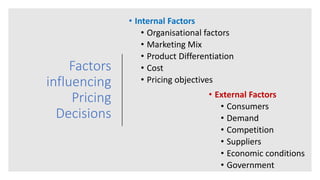
• External Factors
• Consumers
• Demand
• Competition
• Suppliers
• Economic conditions
• Government
• Internal Factors
• Organisational factors
• Marketing Mix
• Product Differentiation
• Cost
• Pricing objectives
Factors influencing Pricing Decisions
• Internal Factors (Built in factors)
• Organisational factors
• top level consider the market segment, lower level consider product strategies
• Marketing Mix
• (modification of Product, promotion, place will affect the price)
• Product Differentiation
• (modify the product to attract customers)
• Cost
• (increase in cost of production)
• Pricing objectives
• ( eg; profit maximization, facing competition, survival fixes the price)
Factors influencing Pricing Decisions
• External Factors (Beyond the control of marketer)
• Consumers (capacity of consumer)
• Demand (inverse relation)
• Competition (equal or lower than competitor)
• Suppliers (increase the cost of raw materials- increase price)
• Economic conditions (Boom-Depression)
• Government (levy tax, import & export policy)
Pricing
strategies
• The tactics, company uses to
increases sales and maximise
profits
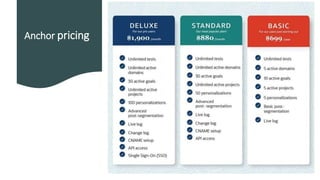
Anchor pricing
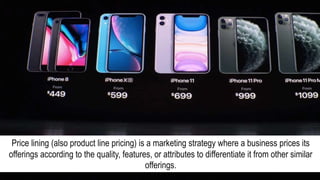
Price lining (also product line pricing) is a marketing strategy where a business prices its
offerings according to the quality, features, or attributes to differentiate it from other similar
offerings.
Captive Pricing
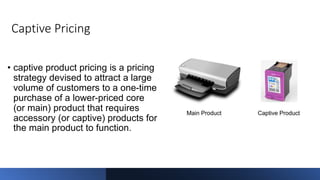
• captive product pricing is a pricing
strategy devised to attract a large
volume of customers to a one-time
purchase of a lower-priced core
(or main) product that requires
accessory (or captive) products for
the main product to function.
Captive Pricing
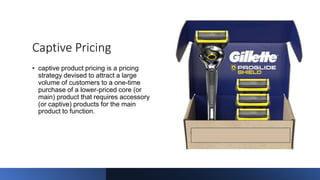
• captive product pricing is a pricing
strategy devised to attract a large
volume of customers to a one-time
purchase of a lower-priced core (or
main) product that requires accessory
(or captive) products for the main
product to function.
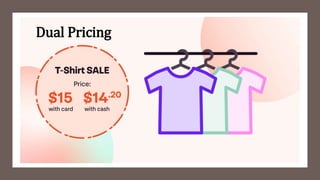
Dual Pricing
Pricing strategies
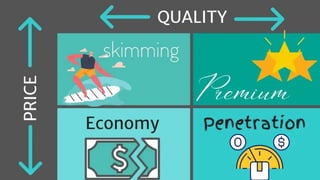
• Premium pricing (Charging high profit to create a favourable
perception among customers)
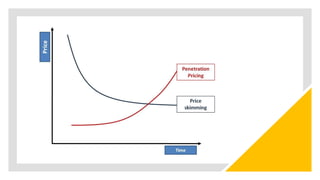
• Penetration pricing (Low initial price)
• Skimming pricing (High initial price)
• Economy Pricing (Low price low quality)
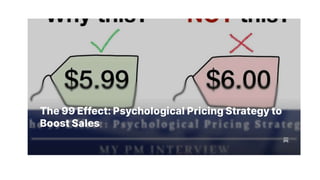
• Psychological Pricing (motivate the customer)
• Going rate Pricing (Pricing at the prevailing price in the market)
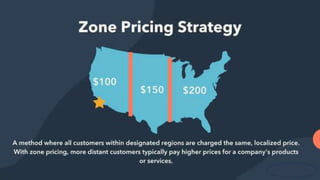
• Geographical pricing (Zone pricing)
• Dual Pricing (two price)
• Administrated pricing ( Price fixed based on the direction of seller)
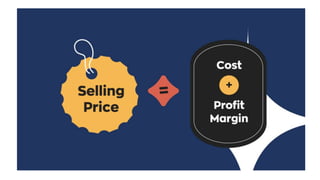
• Markup pricing (Cost plus pricing)
• Price lining (different price based on features)
• Negotiated pricing (manufactured on the basis of buyers’ specification)
• Monopolistic pricing ( only one seller, pricing is easy)
• Expected pricing (Conducting survey among the customers-consumer pricing)
• Promotional pricing (selling price is fixed to increase the sales volume)
• Perceived value pricing (customer is ready to pay for it)
Pricing strategies
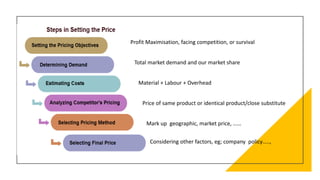
Profit Maximisation, facing competition, or survival
Total market demand and our market share
Material + Labour + Overhead
Price of same product or identical product/close substitute
Mark up geographic, market price, ……
Considering other factors, eg; company policy…..,
Steps in formulating
Pricing
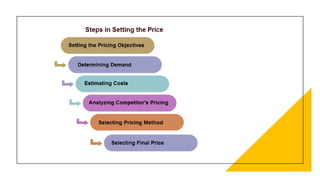
1. Setting Pricing objectives
2. Identifying target customers
3. Estimating the demand for the product
4. Estimating the expected market share
5. Cost estimation
6. Selection of the pricing Strategy
Steps in formulating
Pricing
7. Measuring the extent of price sensitivity
8. Studying the price of competitive products
9. Studying the environmental factors and forces
10. Selecting a pricing method
11. Selecting the final price

Pricing.pptx

  • 1.
  • 2.
    Meaning • Price isthe monetary value that a product or service- during a transaction • Pricing – Determination of selling price of a product or service • Pricing decision- the choice that business make when setting price for their product or service
  • 3.
    Objectives of Pricing •ROI (target return) • Market share (good market share- % of market for the product based on total market for the concerned product) • Profit Maximisation • Preventing Competition (low price at introductory stage to reduce competition) • Price stabilisation (preventing frequent fluctuations in price) • Pricing for market skimming (Maximisation of profit in short run) • Survival
  • 4.
    Factors influencing Pricing Decisions • External Factors •Consumers • Demand • Competition • Suppliers • Economic conditions • Government • Internal Factors • Organisational factors • Marketing Mix • Product Differentiation • Cost • Pricing objectives
  • 5.
    Factors influencing PricingDecisions • Internal Factors (Built in factors) • Organisational factors • top level consider the market segment, lower level consider product strategies • Marketing Mix • (modification of Product, promotion, place will affect the price) • Product Differentiation • (modify the product to attract customers) • Cost • (increase in cost of production) • Pricing objectives • ( eg; profit maximization, facing competition, survival fixes the price)
  • 6.
    Factors influencing PricingDecisions • External Factors (Beyond the control of marketer) • Consumers (capacity of consumer) • Demand (inverse relation) • Competition (equal or lower than competitor) • Suppliers (increase the cost of raw materials- increase price) • Economic conditions (Boom-Depression) • Government (levy tax, import & export policy)
  • 7.
    Pricing strategies • The tactics,company uses to increases sales and maximise profits
  • 13.
  • 14.
    Price lining (alsoproduct line pricing) is a marketing strategy where a business prices its offerings according to the quality, features, or attributes to differentiate it from other similar offerings.
  • 15.
    Captive Pricing • captiveproduct pricing is a pricing strategy devised to attract a large volume of customers to a one-time purchase of a lower-priced core (or main) product that requires accessory (or captive) products for the main product to function.
  • 16.
    Captive Pricing • captiveproduct pricing is a pricing strategy devised to attract a large volume of customers to a one-time purchase of a lower-priced core (or main) product that requires accessory (or captive) products for the main product to function.
  • 18.
  • 22.
    Pricing strategies • Premiumpricing (Charging high profit to create a favourable perception among customers) • Penetration pricing (Low initial price) • Skimming pricing (High initial price) • Economy Pricing (Low price low quality) • Psychological Pricing (motivate the customer) • Going rate Pricing (Pricing at the prevailing price in the market) • Geographical pricing (Zone pricing)
  • 23.
    • Dual Pricing(two price) • Administrated pricing ( Price fixed based on the direction of seller) • Markup pricing (Cost plus pricing) • Price lining (different price based on features) • Negotiated pricing (manufactured on the basis of buyers’ specification) • Monopolistic pricing ( only one seller, pricing is easy) • Expected pricing (Conducting survey among the customers-consumer pricing) • Promotional pricing (selling price is fixed to increase the sales volume) • Perceived value pricing (customer is ready to pay for it) Pricing strategies
  • 25.
    Profit Maximisation, facingcompetition, or survival Total market demand and our market share Material + Labour + Overhead Price of same product or identical product/close substitute Mark up geographic, market price, …… Considering other factors, eg; company policy…..,
  • 26.
    Steps in formulating Pricing 1.Setting Pricing objectives 2. Identifying target customers 3. Estimating the demand for the product 4. Estimating the expected market share 5. Cost estimation 6. Selection of the pricing Strategy
  • 27.
    Steps in formulating Pricing 7.Measuring the extent of price sensitivity 8. Studying the price of competitive products 9. Studying the environmental factors and forces 10. Selecting a pricing method 11. Selecting the final price