http://www.bized.ac.uk


Pricing Strategies


                     Copyright 2006 – Biz/ed
http://www.bized.ac.uk


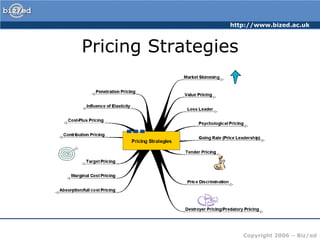
Pricing Strategies


                     Copyright 2006 – Biz/ed
http://www.bized.ac.uk


Absorption/Full Cost Pricing


                        Copyright 2006 – Biz/ed
http://www.bized.ac.uk


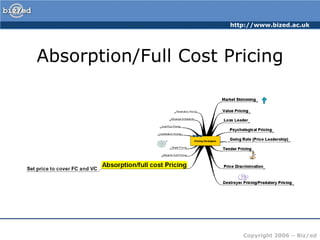
 Absorption/Full Cost Pricing
• Full Cost Pricing – attempting to
  set price to cover both fixed and
  variable costs
• Absorption Cost Pricing – Price set
  to ‘absorb’ some of the fixed costs
  of production


                                Copyright 2006 – Biz/ed
http://www.bized.ac.uk


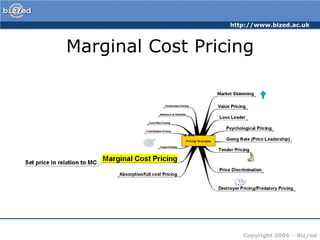
Marginal Cost Pricing


                     Copyright 2006 – Biz/ed
http://www.bized.ac.uk


       Marginal Cost Pricing
• Marginal cost – the cost of producing ONE
  extra or ONE fewer item of production
• MC pricing – allows flexibility
• Particularly relevant in transport where fixed
  costs may be relatively high
• Allows variable pricing structure – e.g. on a
  flight from London to New York – providing
  the cost of the extra passenger is covered, the
  price could be varied a good deal to attract
  customers and fill the aircraft


                                        Copyright 2006 – Biz/ed
http://www.bized.ac.uk


              Marginal Cost Pricing
 • Example:


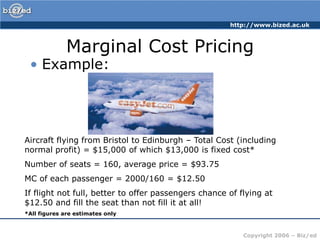
Aircraft flying from Bristol to Edinburgh – Total Cost (including
normal profit) = $15,000 of which $13,000 is fixed cost*
Number of seats = 160, average price = $93.75
MC of each passenger = 2000/160 = $12.50
If flight not full, better to offer passengers chance of flying at
$12.50 and fill the seat than not fill it at all!
*All figures are estimates only


                                                          Copyright 2006 – Biz/ed
http://www.bized.ac.uk


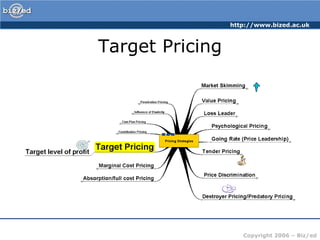
Target Pricing


                    Copyright 2006 – Biz/ed
http://www.bized.ac.uk


          Target Pricing
• Setting price to ‘target’ a specified
  profit level
• Estimates of the cost and potential
  revenue at different prices, and
  thus the break-even have to be
  made, to determine the mark-up
• Mark-up = Profit/Cost x 100


                                 Copyright 2006 – Biz/ed
http://www.bized.ac.uk


Contribution Pricing


                    Copyright 2006 – Biz/ed
http://www.bized.ac.uk


       Contribution Pricing
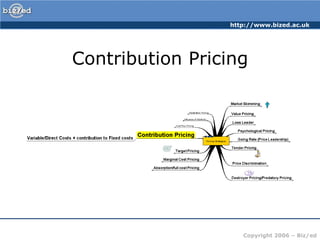
• Contribution = Selling Price – Variable
  (direct costs)
• Prices set to ensure coverage of
  variable costs and a ‘contribution’ to the
  fixed costs
• Similar in principle to marginal cost
  pricing
• Break-even analysis might be useful in
  such circumstances

                                     Copyright 2006 – Biz/ed
http://www.bized.ac.uk


Cost-Plus Pricing


                    Copyright 2006 – Biz/ed
http://www.bized.ac.uk


        Cost-Plus Pricing
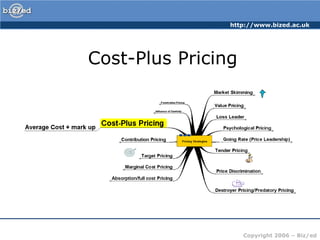
• Calculation of the average cost
  (AC) plus a mark up
• AC = Total Cost/Output


                               Copyright 2006 – Biz/ed
http://www.bized.ac.uk


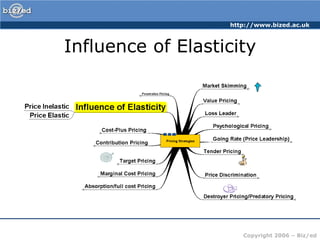
Influence of Elasticity


                      Copyright 2006 – Biz/ed
http://www.bized.ac.uk


     Influence of Elasticity
• Any pricing decision must be mindful of
  the impact of price elasticity
• The degree of price elasticity impacts
  on the level of sales and hence revenue
• Elasticity focuses on proportionate
  (percentage) changes
    • PED = % Change in Quantity
     demanded/% Change in Price


                                  Copyright 2006 – Biz/ed
http://www.bized.ac.uk


     Influence of Elasticity
• Price Inelastic:
• % change in Q < % change in P
• e.g. a 5% increase in price would be
  met by a fall in sales of something less
  than 5%
• Revenue would rise
• A 7% reduction in price would lead to a
  rise in sales of something less than 7%
• Revenue would fall

                                   Copyright 2006 – Biz/ed
http://www.bized.ac.uk


      Influence of Elasticity
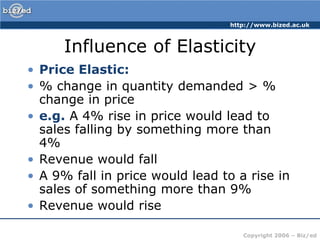
• Price Elastic:
• % change in quantity demanded > %
  change in price
• e.g. A 4% rise in price would lead to
  sales falling by something more than
  4%
• Revenue would fall
• A 9% fall in price would lead to a rise in
  sales of something more than 9%
• Revenue would rise

                                     Copyright 2006 – Biz/ed
http://www.bized.ac.uk


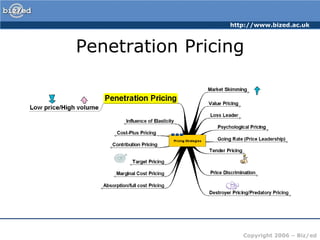
Penetration Pricing


                    Copyright 2006 – Biz/ed
http://www.bized.ac.uk


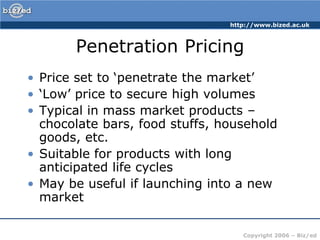
       Penetration Pricing
• Price set to ‘penetrate the market’
• ‘Low’ price to secure high volumes
• Typical in mass market products –
  chocolate bars, food stuffs, household
  goods, etc.
• Suitable for products with long
  anticipated life cycles
• May be useful if launching into a new
  market

                                   Copyright 2006 – Biz/ed

Pricing strategy presentation_part_ii

  • 1.
  • 2.
  • 3.
  • 4.
    http://www.bized.ac.uk Absorption/Full CostPricing • Full Cost Pricing – attempting to set price to cover both fixed and variable costs • Absorption Cost Pricing – Price set to ‘absorb’ some of the fixed costs of production Copyright 2006 – Biz/ed
  • 5.
  • 6.
    http://www.bized.ac.uk Marginal Cost Pricing • Marginal cost – the cost of producing ONE extra or ONE fewer item of production • MC pricing – allows flexibility • Particularly relevant in transport where fixed costs may be relatively high • Allows variable pricing structure – e.g. on a flight from London to New York – providing the cost of the extra passenger is covered, the price could be varied a good deal to attract customers and fill the aircraft Copyright 2006 – Biz/ed
  • 7.
    http://www.bized.ac.uk Marginal Cost Pricing • Example: Aircraft flying from Bristol to Edinburgh – Total Cost (including normal profit) = $15,000 of which $13,000 is fixed cost* Number of seats = 160, average price = $93.75 MC of each passenger = 2000/160 = $12.50 If flight not full, better to offer passengers chance of flying at $12.50 and fill the seat than not fill it at all! *All figures are estimates only Copyright 2006 – Biz/ed
  • 8.
    http://www.bized.ac.uk Target Pricing Copyright 2006 – Biz/ed
  • 9.
    http://www.bized.ac.uk Target Pricing • Setting price to ‘target’ a specified profit level • Estimates of the cost and potential revenue at different prices, and thus the break-even have to be made, to determine the mark-up • Mark-up = Profit/Cost x 100 Copyright 2006 – Biz/ed
  • 10.
  • 11.
    http://www.bized.ac.uk Contribution Pricing • Contribution = Selling Price – Variable (direct costs) • Prices set to ensure coverage of variable costs and a ‘contribution’ to the fixed costs • Similar in principle to marginal cost pricing • Break-even analysis might be useful in such circumstances Copyright 2006 – Biz/ed
  • 12.
  • 13.
    http://www.bized.ac.uk Cost-Plus Pricing • Calculation of the average cost (AC) plus a mark up • AC = Total Cost/Output Copyright 2006 – Biz/ed
  • 14.
  • 15.
    http://www.bized.ac.uk Influence of Elasticity • Any pricing decision must be mindful of the impact of price elasticity • The degree of price elasticity impacts on the level of sales and hence revenue • Elasticity focuses on proportionate (percentage) changes • PED = % Change in Quantity demanded/% Change in Price Copyright 2006 – Biz/ed
  • 16.
    http://www.bized.ac.uk Influence of Elasticity • Price Inelastic: • % change in Q < % change in P • e.g. a 5% increase in price would be met by a fall in sales of something less than 5% • Revenue would rise • A 7% reduction in price would lead to a rise in sales of something less than 7% • Revenue would fall Copyright 2006 – Biz/ed
  • 17.
    http://www.bized.ac.uk Influence of Elasticity • Price Elastic: • % change in quantity demanded > % change in price • e.g. A 4% rise in price would lead to sales falling by something more than 4% • Revenue would fall • A 9% fall in price would lead to a rise in sales of something more than 9% • Revenue would rise Copyright 2006 – Biz/ed
  • 18.
  • 19.
    http://www.bized.ac.uk Penetration Pricing • Price set to ‘penetrate the market’ • ‘Low’ price to secure high volumes • Typical in mass market products – chocolate bars, food stuffs, household goods, etc. • Suitable for products with long anticipated life cycles • May be useful if launching into a new market Copyright 2006 – Biz/ed