Preventive orthodontics
Prevention is not only better than cure but more
  stable and cheaper as well.
What is the ideal time to start orthodontic
 treatment?
Graber: preventive orthodontics as the action
  taken to preserve the integrity of what
  appears to be a normal occlusion at a specific
  time.
• Profitt and Ackermann -has defined as
  prevention of potential interference with
  occlusal development.
Interceptive orthodontics
• that phase of the science and art of
  orthodontics employed to recognize and
  eliminate potential irregularities and
  malpositions in the developing dentofacial
  complex.
Preventive procedures: in anticipation of
  development of problem

Interceptive procedures:after the problem is
  manifested
• The importance of deciduous dentition

• Awareness about the preservation of primary
  teeth
• The impact of primary teeth integrity on
  permanent teeth
• The responsibility of pedodontists

• General practioners

• Orthodontists
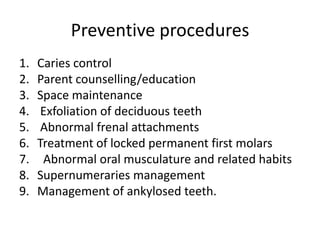
Preventive procedures
1.   Caries control
2.   Parent counselling/education
3.   Space maintenance
4.    Exfoliation of deciduous teeth
5.    Abnormal frenal attachments
6.   Treatment of locked permanent first molars
7.    Abnormal oral musculature and related habits
8.   Supernumeraries management
9.   Management of ankylosed teeth.
Parent education
•   1.pre-natal counselling----?
•   2.post-natal------?
•   3.nutrition----role
•   4.feeding of child----?
•   5.?
Research shows


• possible corelationship between the mothers'
  poor oraI hygiene and premature births.
Prenatal counseling may involve the following:

i. The importance of oral hygiene maintenance by the mother.

ii. How irregular eating and hunger pangs by the mother can result in her
developing decayed teeth, which can be quite painful on pulpal
involvement, especially during the third trimester of pregnancy.

ill. Recent studies have indicated a possible corelationship between the mothers'
poor oraI hygiene and premature births.

iv. A mother suffering from pregnancy induced diabetes mellitus, would be more
difficult to manage during the pregnancy period especially if her oral hygiene is
poor.
v. The increased risk of a mother suffering from poor oral hygiene transmitting
the strains of caries inducing bacteria to the baby on sharing the same feeding
spoon or on tasting the food with the same are high.
Six months to One-year of Age
This is the most important period of counseling. The
parents are made aware of:
i. Teething and the associated irritation, slight loose motions are possible in
mildly elevated febrile condition.
ii. Most of the parents are appalled on seeing the deciduous teeth erupting in
rotated positions. Awareness to be brought about as to how they are in that
position and that they would eventually straighten out on erupting fully.
iii. No sugar addition to bottle milk, however mothers' milk is preferred and the
best for the TMJdevelopment as well as for non- development of tongue
thrusting habits.
iv. Brushing with the help of a finger brush during bathing should be introduced.
Cleaning of the deciduous dentition with a clean, soft cotton cloth dipped in
warm saline is also recommended, to prevent the initiation of nursingor rampant
caries
v. Child should be initiated to drinking from a glass by one year of age.
Two years of Age
i. Bottle-feeding if previously initiated should never be given during the passage to
sleep. Bottlefeeding to be withdrawn completely by 18 to 24
months of age. These would decrease the chances of initiation of decay and the
potential for nursing
caries.
ii. Brushing to be initiated post-breakfast and post dinner.

iii, Clinical examination to assess any incipient decay and eruption status of teeth.
Three years of Age
i. Clinical examination-generally the full compliment of deciduous
dentition should have erupted by now. To assess the occlusion, molar
and canine
relationships and if there is the presence of any discrepancies away
from the normal, e.g. unilateral cross bite ,supernumerary teeth
,missing teeth, fused teeth, etc.

ii. Oral habits such as thumb sucking, lip sucking, oral breathing, etc.
and their effects on the development of occlusion should be
considered.
iii. To assess clinically for incomplete eruption of deciduous second
molars/pericoronal flaps may lead to decay on the same.
iv. Child to be encouraged to begin brushing on hisown at least once a
day-preferably postbreakfast.
Five to Six years of Age
i. Parents to be informed about the initiation of
    exfoliation of deciduous teeth and that it would
    go up to 12 to 13 years of age.

ii. Clinical examination.

iii. The need for constant review and recall on a
regular basis.

iv. In case of extraction of deciduous teeth due to
decay, etc. the need, advantages and importance of
space maintainers should be explained.
Caries control
Caries initiation can be prevented by diet
 counseling,
topical fluoride application,
pit and fissure sealants
and educating parents (prenatal counseling and
 postnatal counseling).
EXFOLIATION OF DECIDUOUS TEETH
Generally the deciduous teeth should exfoliate in about 3 months of
exfoliation of the one in the contralateral arch. Any delay more than that
should be considered with suspicion and the following should be ruled
out:

a. Over-retained deciduous/root stumps.

b. Fibrous gingivae.

c. Ankylosed/submerged deciduous teeth to be
assessed radiographically.

d. Restoration overhangs of the adjacent tooth.

e. Presence of any supernumerary tooth.
ABNORMAL FRENAL ATTACHMENTS

May cause the development of diastemas/excess spacing between the
teeth, which in turn may not allow the eruption of succedaneous
teeth. Surgical correction of the high frenal attachments is therefore
advised .

The tongue should also be assessed for ankyloglossia/ tongue-tie
LOCKED PERMANENT FIRST MOLARS

The permanent first molars may get locked distal to the
deciduous second molars, at times. Slight distal (proximal)
stripping of the deciduous second molar allows the
permanent first molar to erupt in their proper place.
ABNORMAL ORAL MUSCULATURE

a. Tongue thrusting habits or retained infantile swallow patterns are related to
   prolonged breast feeding or bottle feeding by the mother. The same should be
   withdrawn by 18-24 months of age.

b. Hyperactive mentalis action results in the lingual inclination of mandibular
incisors resulting in decreased arch length and an increased chance for the
developing anterior crowding. Oral habits such
as:
i. Thumb/digit/lip sucking the child can be distracted from indulging
in the same.
ii. Mouth breathing-the child can be given adequate medical attention, regarding
recurrent upper respiratory tract infection. Oral screens and the recently
introduced myofunctional appliances such as the pre-orthodontic trainers train
the child to breathe through the nose, thus allowing the proper development of
nasal passage, regression of adenoid mass and the development of a
shallow, broad palate.
Next class:

Space maintainers
•   What is prevention?
•   What is interception?
•   Role of parent counselling?
•   Caries control measures?

Preventive orthodontics pdch

  • 1.
  • 2.
    Prevention is notonly better than cure but more stable and cheaper as well.
  • 3.
    What is theideal time to start orthodontic treatment?
  • 4.
    Graber: preventive orthodonticsas the action taken to preserve the integrity of what appears to be a normal occlusion at a specific time.
  • 5.
    • Profitt andAckermann -has defined as prevention of potential interference with occlusal development.
  • 6.
    Interceptive orthodontics • thatphase of the science and art of orthodontics employed to recognize and eliminate potential irregularities and malpositions in the developing dentofacial complex.
  • 7.
    Preventive procedures: inanticipation of development of problem Interceptive procedures:after the problem is manifested
  • 8.
    • The importanceof deciduous dentition • Awareness about the preservation of primary teeth • The impact of primary teeth integrity on permanent teeth
  • 9.
    • The responsibilityof pedodontists • General practioners • Orthodontists
  • 10.
    Preventive procedures 1. Caries control 2. Parent counselling/education 3. Space maintenance 4. Exfoliation of deciduous teeth 5. Abnormal frenal attachments 6. Treatment of locked permanent first molars 7. Abnormal oral musculature and related habits 8. Supernumeraries management 9. Management of ankylosed teeth.
  • 11.
    Parent education • 1.pre-natal counselling----? • 2.post-natal------? • 3.nutrition----role • 4.feeding of child----? • 5.?
  • 12.
    Research shows • possiblecorelationship between the mothers' poor oraI hygiene and premature births.
  • 13.
    Prenatal counseling mayinvolve the following: i. The importance of oral hygiene maintenance by the mother. ii. How irregular eating and hunger pangs by the mother can result in her developing decayed teeth, which can be quite painful on pulpal involvement, especially during the third trimester of pregnancy. ill. Recent studies have indicated a possible corelationship between the mothers' poor oraI hygiene and premature births. iv. A mother suffering from pregnancy induced diabetes mellitus, would be more difficult to manage during the pregnancy period especially if her oral hygiene is poor. v. The increased risk of a mother suffering from poor oral hygiene transmitting the strains of caries inducing bacteria to the baby on sharing the same feeding spoon or on tasting the food with the same are high.
  • 14.
    Six months toOne-year of Age This is the most important period of counseling. The parents are made aware of: i. Teething and the associated irritation, slight loose motions are possible in mildly elevated febrile condition. ii. Most of the parents are appalled on seeing the deciduous teeth erupting in rotated positions. Awareness to be brought about as to how they are in that position and that they would eventually straighten out on erupting fully. iii. No sugar addition to bottle milk, however mothers' milk is preferred and the best for the TMJdevelopment as well as for non- development of tongue thrusting habits. iv. Brushing with the help of a finger brush during bathing should be introduced. Cleaning of the deciduous dentition with a clean, soft cotton cloth dipped in warm saline is also recommended, to prevent the initiation of nursingor rampant caries v. Child should be initiated to drinking from a glass by one year of age.
  • 15.
    Two years ofAge i. Bottle-feeding if previously initiated should never be given during the passage to sleep. Bottlefeeding to be withdrawn completely by 18 to 24 months of age. These would decrease the chances of initiation of decay and the potential for nursing caries. ii. Brushing to be initiated post-breakfast and post dinner. iii, Clinical examination to assess any incipient decay and eruption status of teeth.
  • 16.
    Three years ofAge i. Clinical examination-generally the full compliment of deciduous dentition should have erupted by now. To assess the occlusion, molar and canine relationships and if there is the presence of any discrepancies away from the normal, e.g. unilateral cross bite ,supernumerary teeth ,missing teeth, fused teeth, etc. ii. Oral habits such as thumb sucking, lip sucking, oral breathing, etc. and their effects on the development of occlusion should be considered. iii. To assess clinically for incomplete eruption of deciduous second molars/pericoronal flaps may lead to decay on the same. iv. Child to be encouraged to begin brushing on hisown at least once a day-preferably postbreakfast.
  • 17.
    Five to Sixyears of Age i. Parents to be informed about the initiation of exfoliation of deciduous teeth and that it would go up to 12 to 13 years of age. ii. Clinical examination. iii. The need for constant review and recall on a regular basis. iv. In case of extraction of deciduous teeth due to decay, etc. the need, advantages and importance of space maintainers should be explained.
  • 18.
    Caries control Caries initiationcan be prevented by diet counseling, topical fluoride application, pit and fissure sealants and educating parents (prenatal counseling and postnatal counseling).
  • 19.
    EXFOLIATION OF DECIDUOUSTEETH Generally the deciduous teeth should exfoliate in about 3 months of exfoliation of the one in the contralateral arch. Any delay more than that should be considered with suspicion and the following should be ruled out: a. Over-retained deciduous/root stumps. b. Fibrous gingivae. c. Ankylosed/submerged deciduous teeth to be assessed radiographically. d. Restoration overhangs of the adjacent tooth. e. Presence of any supernumerary tooth.
  • 20.
    ABNORMAL FRENAL ATTACHMENTS Maycause the development of diastemas/excess spacing between the teeth, which in turn may not allow the eruption of succedaneous teeth. Surgical correction of the high frenal attachments is therefore advised . The tongue should also be assessed for ankyloglossia/ tongue-tie
  • 21.
    LOCKED PERMANENT FIRSTMOLARS The permanent first molars may get locked distal to the deciduous second molars, at times. Slight distal (proximal) stripping of the deciduous second molar allows the permanent first molar to erupt in their proper place.
  • 22.
    ABNORMAL ORAL MUSCULATURE a.Tongue thrusting habits or retained infantile swallow patterns are related to prolonged breast feeding or bottle feeding by the mother. The same should be withdrawn by 18-24 months of age. b. Hyperactive mentalis action results in the lingual inclination of mandibular incisors resulting in decreased arch length and an increased chance for the developing anterior crowding. Oral habits such as: i. Thumb/digit/lip sucking the child can be distracted from indulging in the same. ii. Mouth breathing-the child can be given adequate medical attention, regarding recurrent upper respiratory tract infection. Oral screens and the recently introduced myofunctional appliances such as the pre-orthodontic trainers train the child to breathe through the nose, thus allowing the proper development of nasal passage, regression of adenoid mass and the development of a shallow, broad palate.
  • 23.
  • 24.
    What is prevention? • What is interception? • Role of parent counselling? • Caries control measures?