Determining the Economic Value of
Preventive Maintenance
Preventive maintenance has been more popular in principle than in practice over the years.One scarcely can
argue with the idea of keeping equipment well maintained to extend its expected life and avoid future repair
costs.Less clear is an understanding of the actual relationship between the cost of preventive maintenance and
the returns such activities can be expected to deliver.This article describes a process of assessing the value of
preventive maintenance programs and activities by analyzing them in terms of key financial ratios.
Engineers and building operators trying to persuade property owners and managers to invest in preventive
maintenance (PM) for their portfolios offer a range of solid arguments:
“The equipment will perform better.”
“Equipment life will be extended.”
“Repair costs will fall.”
“Downtime will be reduced.”
“Tenant satisfaction will increase.”
“The manufacturer says we need to do it.”
Although most owners acknowledge these issues,they may be more concerned with saving money and obtaining
optimum value from their investments.Given that perspective,a more convincing argument for preventive
maintenance would demonstrate that PM generates a solid rate of return in terms of risk mitigation and asset
protection.Anecdotal evidence does suggest that preventive maintenance is valuable.Until now,however,no one
has placed a firm value on the relationship between costs and returns.For one thing,the economic value of
preventive maintenance is difficult to determine.No specific statistical methods exist.No empirical studies have
been performed.How does one quantify the extended life of a chiller? How can one know how much longer a
compressor will last if it receives proper preventive maintenance than it would if no PM took place?
Establishing a Baseline: How Much Is Actually Spent?
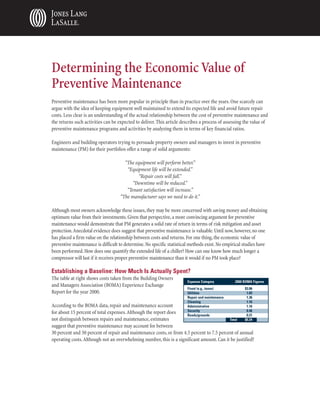
The table at right shows costs taken from the Building Owners
and Managers Association (BOMA) Experience Exchange
Report for the year 2000.
According to the BOMA data,repair and maintenance account
for about 15 percent of total expenses.Although the report does
not distinguish between repairs and maintenance,estimates
suggest that preventive maintenance may account for between
30 percent and 50 percent of repair and maintenance costs,or from 4.5 percent to 7.5 percent of annual
operating costs.Although not an overwhelming number,this is a significant amount.Can it be justified?
Expense Category 2000 BOMA Figures
Fixed (e.g., taxes) $3.06
Utilities 1.83
Repair and maintenance 1.36
Cleaning 1.16
Administrative 1.16
Security 0.46
Roads/grounds 0.21
Total $9.24
2
Jones Lang LaSalle Determining the Economic Value of Preventive Maintenance
Property owners and managers, after all, continually seek ways
to reduce expenses, and common cost-cutting targets include
real estate and operating expenses. In this environment,
funding requests for preventive maintenance may not be
warmly received.
Quantifying the Value of Preventive Maintenance
Consider the example of the corporate real estate managers of a
large telecommunications firm who believed that their preventive
maintenance program had been significantly underfunded for
years.They wanted to ask corporate management for additional
funds but needed financial backup to support their request.To
convince the decision makers that investing in preventive
maintenance makes good financial sense,the managers had to
show a significant return on any proposed investment.
The company partnered with Jones Lang LaSalle to conduct an
analysis.The team set out to develop a system that would quantify
the net present value (NPV) and return on investment (ROI)1
of
investing in preventive maintenance for the client’s portfolio.
Developing the Financial Model
To determine the value of preventive maintenance,
the team set out to identify:
• Actual cost of preventive maintenance
• Cost of repair/corrective maintenance
• Cost of replacing equipment
• Expected useful life of equipment
• Effects of preventive maintenance on expected useful life
• Frequency of required repairs when equipment is not
maintained
• Effect of PM on energy consumption
The team surveyed approximately 12 percent of the company’s
entire portfolio of 119 million square feet.For this 14 million
square feet of mixed property types,they ascertained:
• Type of equipment in each building (e.g.,chillers)
• Amount of equipment (e.g.,number of chillers)
• Size of equipment (e.g.,tons)
• Age of equipment
• Annual preventive maintenance expenditures for equipment
In its analysis,the team proceeded on the assumption that this
proxy portfolio was representative of the full corporate portfolio.
Average size and age was calculated for each piece of equipment,
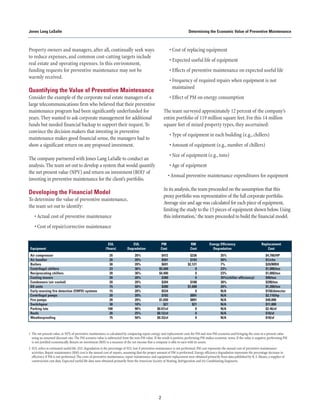
limiting the study to the 15 pieces of equipment shown below.Using
this information,2
the team proceeded to build the financial model.
EUL EUL PM RM Energy Efficiency Replacement
Equipment (Years) Degradation Cost Cost Degradation Cost
Air compressor 20 20% $472 $236 35% $4,700/HP
Air handler 20 20% $501 $193 50% $1/cfm
Boilers 30 20% $691 $2,121 7% $20/MBH
Centrifugal chillers 23 36% $5,500 0 23% $1,000/ton
Reciprocating chillers 20 36% $4,400 0 23% $1,000/ton
Cooling towers 20 20% $300 0 35%(chiller efficiency) $90/ton
Condensers (air cooled) 20 20% $204 $188 30% $290/ton
DX units 15 50% $200 $1,600 20% $1,200/ton
Early-warning fire detection (EWFD) systems 15 20% $534 0 N/A $150/detector
Centrifugal pumps 20 20% $102 $891 N/A $2,110/hp
Fire pumps 20 20% $1,650 $891 N/A $40,000
Switchgear 30 10% $27 $21 N/A $11,000
Parking lots 100 90% $0.07/sf 0 N/A $2.46/sf
Roofs 20 25% $0.12/sf 0 N/A $10/sf
Weatherproofing 75 50% $0.33/sf 0 N/A $18/sf
1 The net present value,or NPV,of preventive maintenance is calculated by comparing repair,energy and replacement costs for PM and non-PM scenarios and bringing the costs to a present value
using an assumed discount rate.The PM scenario value is subtracted from the non-PM value.If the result is positive,performing PM makes economic sense.If the value is negative,performing PM
is not justified economically.Return on investment (ROI) is a measure of the net income that a company is able to earn with its assets.
2 EUL refers to estimated useful life.EUL degradation is the percentage of EUL lost if preventive maintenance is not performed.PM cost represents the annual cost of preventive maintenance
activities.Repair maintenance (RM) cost is the annual cost of repairs,assuming that the proper amount of PM is performed.Energy efficiency degradation represents the percentage decrease in
efficiency if PM is not performed.The costs of preventive maintenance,repair maintenance and equipment replacement were obtained primarily from data published by R.S.Means,a supplier of
construction cost data.Expected useful life data were obtained primarily from the American Society of Heating,Refrigeration and Air Conditioning Engineers.
The most difficult information to obtain was the effect of
maintenance on the expected useful life of equipment.The team
studied textbooks,spoke with industry experts and manufacturers,
and reviewed articles on preventive maintenance to identify these
data.One consistent message was that preventive maintenance
would extend the life of equipment,but few sources provided
estimates of the amount of life added by PM.The study employed
the most conservative estimates sourced from equipment
manufacturers,reference books and sales material.
The team used the data to build a financial model.The
assumptions built into the model are shown below.(Because the
team could not quantify lost revenue due to downtime,the most
conservative possibility,zero downtime,was used in the model.)
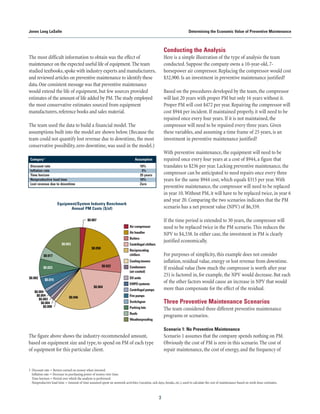
The figure above shows the industry-recommended amount,
based on equipment size and type,to spend on PM of each type
of equipment for this particular client.
Conducting the Analysis
Here is a simple illustration of the type of analysis the team
conducted.Suppose the company owns a 10-year-old,7-
horsepower air compressor.Replacing the compressor would cost
$32,900.Is an investment in preventive maintenance justified?
Based on the procedures developed by the team,the compressor
will last 20 years with proper PM but only 16 years without it.
Proper PM will cost $472 per year.Repairing the compressor will
cost $944 per incident.If maintained properly,it will need to be
repaired once every four years.If it is not maintained,the
compressor will need to be repaired every three years.Given
these variables,and assuming a time frame of 25 years,is an
investment in preventive maintenance justified?
With preventive maintenance,the equipment will need to be
repaired once every four years at a cost of $944,a figure that
translates to $236 per year.Lacking preventive maintenance,the
compressor can be anticipated to need repairs once every three
years for the same $944 cost,which equals $315 per year.With
preventive maintenance,the compressor will need to be replaced
in year 10.Without PM,it will have to be replaced twice, in year 6
and year 20.Comparing the two scenarios indicates that the PM
scenario has a net present value (NPV) of $6,359.
If the time period is extended to 30 years,the compressor will
need to be replaced twice in the PM scenario.This reduces the
NPV to $4,338.In either case,the investment in PM is clearly
justified economically.
For purposes of simplicity,this example does not consider
inflation,residual value,energy or lost revenue from downtime.
If residual value (how much the compressor is worth after year
25) is factored in,for example,the NPV would decrease.But each
of the other factors would cause an increase in NPV that would
more than compensate for the effect of the residual.
Three Preventive Maintenance Scenarios
The team considered three different preventive maintenance
programs or scenarios.
Scenario 1: No Preventive Maintenance
Scenario 1 assumes that the company spends nothing on PM.
Obviously the cost of PM is zero in this scenario.The cost of
repair maintenance,the cost of energy,and the frequency of
3
Jones Lang LaSalle Determining the Economic Value of Preventive Maintenance
Category3
Assumption
Discount rate 10%
Inflation rate 3%
Time horizon 25 years
Nonproductive load time 10%
Lost revenue due to downtime Zero
3 Discount rate = Return earned on money when invested.
Inflation rate = Decrease in purchasing power of money over time.
Time horizon = Period over which the analysis is performed.
Nonproductive load time = Amount of time assumed spent on nonwork activities (vacation,sick days,breaks,etc.),used to calculate the cost of maintenance based on work-hour estimates.
Aircompressor
Airhandler
Boilers
Centrifugalchillers
Reciprocating
chillers
Coolingtowers
Condensers
(aircooled)
DXunits
EWFDsystems
Centrifugalpumps
Firepumps
Switchgear
Parkinglots
Roofs
Weatherproofing
$0.004
$0.007
$0.058
$0.022
$0.064
$0.046
$0.004
$0.003
$0.053
$0.017
$0.023
$0.002 $0.015
$0.004
$0.008
Equipment/System Industry Benchmark
Annual PM Costs (S/sf)
4
Jones Lang LaSalle Determining the Economic Value of Preventive Maintenance
equipment replacement will increase,however,because the
equipment will not be properly maintained.The amount of
energy degradation and expected life degradation is based on
the research previously mentioned.It is also assumed that the
frequency of repairs will increase in an amount similar to the
expected-life degradation.For example, the team’s research
indicated that,even with proper maintenance,a compressor
would need to undergo minor repair every four years.The model
assumes that this repair frequency will increase by 20 percent
when the compressor is not properly maintained,adding
additional repair costs over the life of the compressor.
Scenario 2: Current PM Levels
In scenario 2, the cost of PM represents the actual amount
spent by the company at the time the analysis was conducted.
For most of the 15 types of equipment, significantly less was
being invested than recommendations based on benchmarks
collected by the team. In these cases, the amount of energy and
expected-life degradation was extrapolated between the no-PM
scenario and the industry benchmark scenario. For example, an
air compressor’s expected life will decrease by 20 percent if not
maintained, and proper maintenance will cost $472 per year. If
the company spent $236 (half the recommended amount) on
compressor maintenance, the expected life would decrease by
10 percent instead of 20 percent.
Scenario 3: Industry Benchmark PM
In scenario 3,the model assumes that the company spends the
industry benchmark amount on preventive maintenance
activities.This scenario also assumes that the equipment will last
its full expected life and that energy performance will not
degrade over the life of the equipment.
For each scenario,the team calculated the yearly cost of operating a
piece of equipment and built a timeline of expenditures.The cost
consisted solely of energy,repair maintenance,preventive
maintenance and equipment replacement.To calculate the cost of
energy,the model assumes an average figure for annual operating
hours and an average efficiency.In scenarios one and two,efficiency
was degraded based on the amount of PM performed.The average
life of each piece of equipment was used to determine when the
equipment would need to be replaced.For example,the average age
of an air compressor in the company’s portfolio was 17 years.The
expected useful life of an air compressor is 20 years,so in years 3
and 23 of the scenario 3 analysis,the compressor needed to be
replaced.In scenario 1,the expected useful life of the compressor is
16 years,so it needs to be replaced in years 1 and 17 of the analysis.
Obviously, replacing equipment in later years is superior to
replacing equipment in early years.In simplest terms,this
represents the difference between spending,say,$10,000 today
on new equipment or $10,000 ten years from now.Most
companies would rather wait.And because of the time value of
money,the net present value of spending $10,000 in year 10
equates to spending $3,800 today.Which would a company
rather do: spend $3,800 to buy a new piece of equipment or
spend $10,000 to buy the same piece of equipment? The analysis
indicates that the expense can be pushed out over time by
properly maintaining the equipment.
All expenditures were brought back to present value for each of
the three scenarios for each piece of equipment.In each case,
scenario 1 (no PM) was compared to scenario 3 (industry
benchmark PM),and NPV and ROI were calculated.Scenario 2
(current PM) was also compared to scenario 3 to determine the
effect of increasing the spending on preventive maintenance.
The analysis also considered the portfolio as a whole by adding
up all the expenditures and calculating an overall NPV and ROI.
Results
The results of the analysis comparing scenario 1 to scenario 3
(no PM to industry benchmark PM) were overwhelmingly
positive for performing preventive maintenance.The analysis
shows that an investment in PM not only pays for itself but also
produces a huge return on the investment.
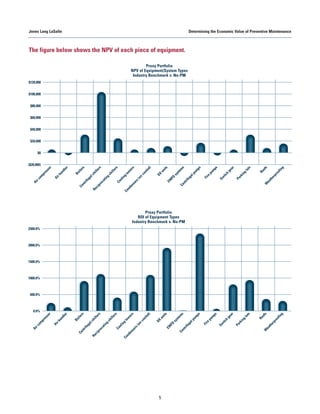
At the portfolio level,the analysis indicated an NPV of $2 billion
over a 25-year period for a $39 million per year ($0.33/sf) PM
program.That represents an ROI of 545 percent.The bulk of the
return comes from increasing the useful life of equipment.Energy
savings account for approximately 7 percent of the return.
A 545 percent ROI seems like a huge return,and it is.Consider,
however,the cost of just one piece of equipment: a chiller.The
average size of the company’s chillers was 350 tons.At $1,000 per
ton,chillers would cost an average of $350,000 to replace.
Maintaining the chiller costs $5,500 per year,and proper
maintenance adds years to the equipment’s life,avoiding the
extremely expensive capital outlay needed to replace it.The
longer the capital expense can be delayed,the higher the ROI.
Maintaining all the equipment in the portfolio produces the
significant returns identified by the analysis and offers a
powerful argument for the value of preventive maintenance and
the dramatic impact PM can have on real estate investments.
5
Jones Lang LaSalle Determining the Economic Value of Preventive Maintenance
$120,000
$100,000
$80,000
$60,000
$40,000
$20,000
$0
($20,000)
Aircom
pressor
Airhandler
Boilers
Centrifugalchillers
Reciprocating
chillersCooling
tow
ers
Condensers(aircooled)
DX
units
EW
FD
system
sCentrifugalpum
ps
Fire
pum
ps
Sw
itch
gear
Parking
lots
RoofsW
eatherproofing
Proxy Portfolio
NPV of Equipment/System Types
Industry Benchmark v. No-PM
2500.0%
2000.0%
1500.0%
1000.0%
500.0%
0.0%
Proxy Portfolio
ROI of Equipment Types
Industry Benchmark v. No-PM
Aircom
pressor
Airhandler
Boilers
Centrifugalchillers
Reciprocating
chillersCooling
tow
ers
Condensers(aircooled)
DX
units
EW
FD
system
sCentrifugalpum
ps
Fire
pum
ps
Sw
itch
gear
Parking
lots
W
eatherproofing
Roofs
The figure below shows the NPV of each piece of equipment.
Jones Lang LaSalle Determining the Economic Value of Preventive Maintenance
6
About the Authors
Wei Lin Koo
Vice President
Strategic Consulting
Wei Lin Koo is aVice President with Jones Lang LaSalle’s Strategic Consulting group.
Mr.Koo specializes in occupier portfolio strategy and related services.In addition,Mr.
Koo is one of the firm’s experts on the Financial Alignment and Optimization©
(FAO©
)
decision support framework.FAO©
enables companies to make quick,consistent,
informed real estate financing decisions that are in alignment with the broader
corporate goals and objectives.
Tracy Van Hoy, P.E.
Vice President
Engineering and Operations
As a member of the Engineering and Operations group of Jones Lang LaSalle,Ms.Van
Hoy manages the Operations and Maintenance Systems product across the managed
portfolio business units. Ms.Van Hoy assists in real estate transactions by evaluating
building systems for both operational and capital requirements. In addition Ms.Van
Hoy is responsible for the research and development of new products and procedures
pertaining to the operations of commercial buildings. Ms.Van Hoy has a Professional
Engineering License in the state of Illinois and holds a Master of Science degree from
Vanderbilt University.

Preventive maintenance

  • 1.
    Determining the EconomicValue of Preventive Maintenance Preventive maintenance has been more popular in principle than in practice over the years.One scarcely can argue with the idea of keeping equipment well maintained to extend its expected life and avoid future repair costs.Less clear is an understanding of the actual relationship between the cost of preventive maintenance and the returns such activities can be expected to deliver.This article describes a process of assessing the value of preventive maintenance programs and activities by analyzing them in terms of key financial ratios. Engineers and building operators trying to persuade property owners and managers to invest in preventive maintenance (PM) for their portfolios offer a range of solid arguments: “The equipment will perform better.” “Equipment life will be extended.” “Repair costs will fall.” “Downtime will be reduced.” “Tenant satisfaction will increase.” “The manufacturer says we need to do it.” Although most owners acknowledge these issues,they may be more concerned with saving money and obtaining optimum value from their investments.Given that perspective,a more convincing argument for preventive maintenance would demonstrate that PM generates a solid rate of return in terms of risk mitigation and asset protection.Anecdotal evidence does suggest that preventive maintenance is valuable.Until now,however,no one has placed a firm value on the relationship between costs and returns.For one thing,the economic value of preventive maintenance is difficult to determine.No specific statistical methods exist.No empirical studies have been performed.How does one quantify the extended life of a chiller? How can one know how much longer a compressor will last if it receives proper preventive maintenance than it would if no PM took place? Establishing a Baseline: How Much Is Actually Spent? The table at right shows costs taken from the Building Owners and Managers Association (BOMA) Experience Exchange Report for the year 2000. According to the BOMA data,repair and maintenance account for about 15 percent of total expenses.Although the report does not distinguish between repairs and maintenance,estimates suggest that preventive maintenance may account for between 30 percent and 50 percent of repair and maintenance costs,or from 4.5 percent to 7.5 percent of annual operating costs.Although not an overwhelming number,this is a significant amount.Can it be justified? Expense Category 2000 BOMA Figures Fixed (e.g., taxes) $3.06 Utilities 1.83 Repair and maintenance 1.36 Cleaning 1.16 Administrative 1.16 Security 0.46 Roads/grounds 0.21 Total $9.24
  • 2.
    2 Jones Lang LaSalleDetermining the Economic Value of Preventive Maintenance Property owners and managers, after all, continually seek ways to reduce expenses, and common cost-cutting targets include real estate and operating expenses. In this environment, funding requests for preventive maintenance may not be warmly received. Quantifying the Value of Preventive Maintenance Consider the example of the corporate real estate managers of a large telecommunications firm who believed that their preventive maintenance program had been significantly underfunded for years.They wanted to ask corporate management for additional funds but needed financial backup to support their request.To convince the decision makers that investing in preventive maintenance makes good financial sense,the managers had to show a significant return on any proposed investment. The company partnered with Jones Lang LaSalle to conduct an analysis.The team set out to develop a system that would quantify the net present value (NPV) and return on investment (ROI)1 of investing in preventive maintenance for the client’s portfolio. Developing the Financial Model To determine the value of preventive maintenance, the team set out to identify: • Actual cost of preventive maintenance • Cost of repair/corrective maintenance • Cost of replacing equipment • Expected useful life of equipment • Effects of preventive maintenance on expected useful life • Frequency of required repairs when equipment is not maintained • Effect of PM on energy consumption The team surveyed approximately 12 percent of the company’s entire portfolio of 119 million square feet.For this 14 million square feet of mixed property types,they ascertained: • Type of equipment in each building (e.g.,chillers) • Amount of equipment (e.g.,number of chillers) • Size of equipment (e.g.,tons) • Age of equipment • Annual preventive maintenance expenditures for equipment In its analysis,the team proceeded on the assumption that this proxy portfolio was representative of the full corporate portfolio. Average size and age was calculated for each piece of equipment, limiting the study to the 15 pieces of equipment shown below.Using this information,2 the team proceeded to build the financial model. EUL EUL PM RM Energy Efficiency Replacement Equipment (Years) Degradation Cost Cost Degradation Cost Air compressor 20 20% $472 $236 35% $4,700/HP Air handler 20 20% $501 $193 50% $1/cfm Boilers 30 20% $691 $2,121 7% $20/MBH Centrifugal chillers 23 36% $5,500 0 23% $1,000/ton Reciprocating chillers 20 36% $4,400 0 23% $1,000/ton Cooling towers 20 20% $300 0 35%(chiller efficiency) $90/ton Condensers (air cooled) 20 20% $204 $188 30% $290/ton DX units 15 50% $200 $1,600 20% $1,200/ton Early-warning fire detection (EWFD) systems 15 20% $534 0 N/A $150/detector Centrifugal pumps 20 20% $102 $891 N/A $2,110/hp Fire pumps 20 20% $1,650 $891 N/A $40,000 Switchgear 30 10% $27 $21 N/A $11,000 Parking lots 100 90% $0.07/sf 0 N/A $2.46/sf Roofs 20 25% $0.12/sf 0 N/A $10/sf Weatherproofing 75 50% $0.33/sf 0 N/A $18/sf 1 The net present value,or NPV,of preventive maintenance is calculated by comparing repair,energy and replacement costs for PM and non-PM scenarios and bringing the costs to a present value using an assumed discount rate.The PM scenario value is subtracted from the non-PM value.If the result is positive,performing PM makes economic sense.If the value is negative,performing PM is not justified economically.Return on investment (ROI) is a measure of the net income that a company is able to earn with its assets. 2 EUL refers to estimated useful life.EUL degradation is the percentage of EUL lost if preventive maintenance is not performed.PM cost represents the annual cost of preventive maintenance activities.Repair maintenance (RM) cost is the annual cost of repairs,assuming that the proper amount of PM is performed.Energy efficiency degradation represents the percentage decrease in efficiency if PM is not performed.The costs of preventive maintenance,repair maintenance and equipment replacement were obtained primarily from data published by R.S.Means,a supplier of construction cost data.Expected useful life data were obtained primarily from the American Society of Heating,Refrigeration and Air Conditioning Engineers.
  • 3.
    The most difficultinformation to obtain was the effect of maintenance on the expected useful life of equipment.The team studied textbooks,spoke with industry experts and manufacturers, and reviewed articles on preventive maintenance to identify these data.One consistent message was that preventive maintenance would extend the life of equipment,but few sources provided estimates of the amount of life added by PM.The study employed the most conservative estimates sourced from equipment manufacturers,reference books and sales material. The team used the data to build a financial model.The assumptions built into the model are shown below.(Because the team could not quantify lost revenue due to downtime,the most conservative possibility,zero downtime,was used in the model.) The figure above shows the industry-recommended amount, based on equipment size and type,to spend on PM of each type of equipment for this particular client. Conducting the Analysis Here is a simple illustration of the type of analysis the team conducted.Suppose the company owns a 10-year-old,7- horsepower air compressor.Replacing the compressor would cost $32,900.Is an investment in preventive maintenance justified? Based on the procedures developed by the team,the compressor will last 20 years with proper PM but only 16 years without it. Proper PM will cost $472 per year.Repairing the compressor will cost $944 per incident.If maintained properly,it will need to be repaired once every four years.If it is not maintained,the compressor will need to be repaired every three years.Given these variables,and assuming a time frame of 25 years,is an investment in preventive maintenance justified? With preventive maintenance,the equipment will need to be repaired once every four years at a cost of $944,a figure that translates to $236 per year.Lacking preventive maintenance,the compressor can be anticipated to need repairs once every three years for the same $944 cost,which equals $315 per year.With preventive maintenance,the compressor will need to be replaced in year 10.Without PM,it will have to be replaced twice, in year 6 and year 20.Comparing the two scenarios indicates that the PM scenario has a net present value (NPV) of $6,359. If the time period is extended to 30 years,the compressor will need to be replaced twice in the PM scenario.This reduces the NPV to $4,338.In either case,the investment in PM is clearly justified economically. For purposes of simplicity,this example does not consider inflation,residual value,energy or lost revenue from downtime. If residual value (how much the compressor is worth after year 25) is factored in,for example,the NPV would decrease.But each of the other factors would cause an increase in NPV that would more than compensate for the effect of the residual. Three Preventive Maintenance Scenarios The team considered three different preventive maintenance programs or scenarios. Scenario 1: No Preventive Maintenance Scenario 1 assumes that the company spends nothing on PM. Obviously the cost of PM is zero in this scenario.The cost of repair maintenance,the cost of energy,and the frequency of 3 Jones Lang LaSalle Determining the Economic Value of Preventive Maintenance Category3 Assumption Discount rate 10% Inflation rate 3% Time horizon 25 years Nonproductive load time 10% Lost revenue due to downtime Zero 3 Discount rate = Return earned on money when invested. Inflation rate = Decrease in purchasing power of money over time. Time horizon = Period over which the analysis is performed. Nonproductive load time = Amount of time assumed spent on nonwork activities (vacation,sick days,breaks,etc.),used to calculate the cost of maintenance based on work-hour estimates. Aircompressor Airhandler Boilers Centrifugalchillers Reciprocating chillers Coolingtowers Condensers (aircooled) DXunits EWFDsystems Centrifugalpumps Firepumps Switchgear Parkinglots Roofs Weatherproofing $0.004 $0.007 $0.058 $0.022 $0.064 $0.046 $0.004 $0.003 $0.053 $0.017 $0.023 $0.002 $0.015 $0.004 $0.008 Equipment/System Industry Benchmark Annual PM Costs (S/sf)
  • 4.
    4 Jones Lang LaSalleDetermining the Economic Value of Preventive Maintenance equipment replacement will increase,however,because the equipment will not be properly maintained.The amount of energy degradation and expected life degradation is based on the research previously mentioned.It is also assumed that the frequency of repairs will increase in an amount similar to the expected-life degradation.For example, the team’s research indicated that,even with proper maintenance,a compressor would need to undergo minor repair every four years.The model assumes that this repair frequency will increase by 20 percent when the compressor is not properly maintained,adding additional repair costs over the life of the compressor. Scenario 2: Current PM Levels In scenario 2, the cost of PM represents the actual amount spent by the company at the time the analysis was conducted. For most of the 15 types of equipment, significantly less was being invested than recommendations based on benchmarks collected by the team. In these cases, the amount of energy and expected-life degradation was extrapolated between the no-PM scenario and the industry benchmark scenario. For example, an air compressor’s expected life will decrease by 20 percent if not maintained, and proper maintenance will cost $472 per year. If the company spent $236 (half the recommended amount) on compressor maintenance, the expected life would decrease by 10 percent instead of 20 percent. Scenario 3: Industry Benchmark PM In scenario 3,the model assumes that the company spends the industry benchmark amount on preventive maintenance activities.This scenario also assumes that the equipment will last its full expected life and that energy performance will not degrade over the life of the equipment. For each scenario,the team calculated the yearly cost of operating a piece of equipment and built a timeline of expenditures.The cost consisted solely of energy,repair maintenance,preventive maintenance and equipment replacement.To calculate the cost of energy,the model assumes an average figure for annual operating hours and an average efficiency.In scenarios one and two,efficiency was degraded based on the amount of PM performed.The average life of each piece of equipment was used to determine when the equipment would need to be replaced.For example,the average age of an air compressor in the company’s portfolio was 17 years.The expected useful life of an air compressor is 20 years,so in years 3 and 23 of the scenario 3 analysis,the compressor needed to be replaced.In scenario 1,the expected useful life of the compressor is 16 years,so it needs to be replaced in years 1 and 17 of the analysis. Obviously, replacing equipment in later years is superior to replacing equipment in early years.In simplest terms,this represents the difference between spending,say,$10,000 today on new equipment or $10,000 ten years from now.Most companies would rather wait.And because of the time value of money,the net present value of spending $10,000 in year 10 equates to spending $3,800 today.Which would a company rather do: spend $3,800 to buy a new piece of equipment or spend $10,000 to buy the same piece of equipment? The analysis indicates that the expense can be pushed out over time by properly maintaining the equipment. All expenditures were brought back to present value for each of the three scenarios for each piece of equipment.In each case, scenario 1 (no PM) was compared to scenario 3 (industry benchmark PM),and NPV and ROI were calculated.Scenario 2 (current PM) was also compared to scenario 3 to determine the effect of increasing the spending on preventive maintenance. The analysis also considered the portfolio as a whole by adding up all the expenditures and calculating an overall NPV and ROI. Results The results of the analysis comparing scenario 1 to scenario 3 (no PM to industry benchmark PM) were overwhelmingly positive for performing preventive maintenance.The analysis shows that an investment in PM not only pays for itself but also produces a huge return on the investment. At the portfolio level,the analysis indicated an NPV of $2 billion over a 25-year period for a $39 million per year ($0.33/sf) PM program.That represents an ROI of 545 percent.The bulk of the return comes from increasing the useful life of equipment.Energy savings account for approximately 7 percent of the return. A 545 percent ROI seems like a huge return,and it is.Consider, however,the cost of just one piece of equipment: a chiller.The average size of the company’s chillers was 350 tons.At $1,000 per ton,chillers would cost an average of $350,000 to replace. Maintaining the chiller costs $5,500 per year,and proper maintenance adds years to the equipment’s life,avoiding the extremely expensive capital outlay needed to replace it.The longer the capital expense can be delayed,the higher the ROI. Maintaining all the equipment in the portfolio produces the significant returns identified by the analysis and offers a powerful argument for the value of preventive maintenance and the dramatic impact PM can have on real estate investments.
  • 5.
    5 Jones Lang LaSalleDetermining the Economic Value of Preventive Maintenance $120,000 $100,000 $80,000 $60,000 $40,000 $20,000 $0 ($20,000) Aircom pressor Airhandler Boilers Centrifugalchillers Reciprocating chillersCooling tow ers Condensers(aircooled) DX units EW FD system sCentrifugalpum ps Fire pum ps Sw itch gear Parking lots RoofsW eatherproofing Proxy Portfolio NPV of Equipment/System Types Industry Benchmark v. No-PM 2500.0% 2000.0% 1500.0% 1000.0% 500.0% 0.0% Proxy Portfolio ROI of Equipment Types Industry Benchmark v. No-PM Aircom pressor Airhandler Boilers Centrifugalchillers Reciprocating chillersCooling tow ers Condensers(aircooled) DX units EW FD system sCentrifugalpum ps Fire pum ps Sw itch gear Parking lots W eatherproofing Roofs The figure below shows the NPV of each piece of equipment.
  • 6.
    Jones Lang LaSalleDetermining the Economic Value of Preventive Maintenance 6 About the Authors Wei Lin Koo Vice President Strategic Consulting Wei Lin Koo is aVice President with Jones Lang LaSalle’s Strategic Consulting group. Mr.Koo specializes in occupier portfolio strategy and related services.In addition,Mr. Koo is one of the firm’s experts on the Financial Alignment and Optimization© (FAO© ) decision support framework.FAO© enables companies to make quick,consistent, informed real estate financing decisions that are in alignment with the broader corporate goals and objectives. Tracy Van Hoy, P.E. Vice President Engineering and Operations As a member of the Engineering and Operations group of Jones Lang LaSalle,Ms.Van Hoy manages the Operations and Maintenance Systems product across the managed portfolio business units. Ms.Van Hoy assists in real estate transactions by evaluating building systems for both operational and capital requirements. In addition Ms.Van Hoy is responsible for the research and development of new products and procedures pertaining to the operations of commercial buildings. Ms.Van Hoy has a Professional Engineering License in the state of Illinois and holds a Master of Science degree from Vanderbilt University.