Building Resiliency
Preventing Adverse Childhood Experiences [ACEs]
The Centers for Disease Control and Prevention (CDC),in
partnership with Kaiser-San Diego, have been studying the
effects of Adverse Childhood Experiences (ACEs) in an ongoing
longitudinal study of approximately 17,000 patients for the
past 15 years. The original study was based on information
from health history questionnaires collected from adult
patients at Kaiser Permanente clinics in San Diego. This study
illuminated how common ACEs are. The study also showed a
strong association between the amount of ACEs an individual
experienced during childhood and the increased risk for
negative health behaviors (smoking, drug and alcohol abuse
and risky sexual behaviors), chronic mental health concerns
(depression and suicidal thoughts) and chronic diseases (heart
disease, stroke, diabetes and cancer) later in life. 1
Due to the importance of the ACEs research, the CDC added an
ACEs module to the Behavioral Risk Factor Surveillance System
(BRFSS) in 2009. BRFSS is a state-based system of health
surveys conducted over the phone. These surveys collect
information on general demographics, health status and well
being, health behaviors, risks for chronic diseases and injuries,
preventative health practices and access to health care and
support services. In 2011, the Adverse Childhood Experience
Module was added to the Oregon BRFSS. More than 4,000
adults in Oregon responded to these questions about their
childhood experiences.
Like the Kaiser study in San Diego, ACEs were found to be
common in Oregon. 62% of Oregonians who responded to the
ACEs questions in the BRFSS survey experienced at least one
ACE. The people who experienced many ACEs (4 or more) were
typically younger, graduated from high school less frequently
and often made less than $25,000 annually. Additionally, a
higher ACE score was associated with increased tobacco use,
increased risk for respiratory diseases, depression and suicide.
PREVENTING ACEs CAN IMPROVE
HEALTH OVER THE LIFE SPAN.
BUILDING RESILIENCY I 2
ACEs
WHAT IS AN ACE?
Adverse Childhood Experiences (ACEs) is a term used to
describe neglect, abuse, violence and/or distressed family
environments that children under the age of 18 years
may experience. The cumulative effect of ACEs can be
traumatic, especially if experienced repeatedly beginning
at a young age.3
In the Oregon BRFSS survey, respondents
were asked 11 questions to establish eight categories of ACEs. These categories include: household substance abuse, verbal
abuse, parental separation or divorce, physical abuse, household mental illness, violent treatment of mother, sexual abuse and
incarcerated household member.
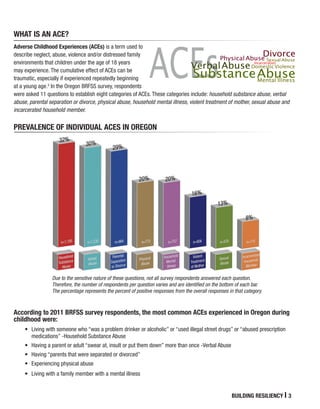
PREVALENCE OF INDIVIDUAL ACES IN OREGON
•	 Living with someone who “was a problem drinker or alcoholic” or “used illegal street drugs” or “abused prescription
medications” -Household Substance Abuse
•	 Having a parent or adult “swear at, insult or put them down” more than once -Verbal Abuse
•	 Having “parents that were separated or divorced”
•	 Experiencing physical abuse
•	 Living with a family member with a mental illness
According to 2011 BRFSS survey respondents, the most common ACEs experienced in Oregon during
childhood were:
Due to the sensitive nature of these questions, not all survey respondents answered each question.
Therefore, the number of respondents per question varies and are identified on the bottom of each bar.
The percentage represents the percent of positive responses from the overall responses in that category.
BUILDING RESILIENCY I 3
ACEs are common in Oregon. Individuals who responded to the 2011
BRFSS who experienced four or more ACEs generally had higher
rates of negative health behaviors, mental health concerns and
chronic diseases.
As individuals, communities and a state, our primary goal is to try
to prevent ACEs from occurring initially. However, we must also
continue to promote wellness and resiliency even in the presence
of adversity. 4
38%
n=1,754
23%
n=908
13%
n=519
10%
n=347
7%
n=241
9%
n=286 0 ACEs
1 ACE
2 ACEs
3 ACEs
4 ACEs
5+
ACEs
N=4,055
HOW MANY ACEs DO OREGONIANS EXPERIENCE?
0
50%
0
1
2
3
4+
Suicidal Thoughts
1+
in last two weeks
n=123
Smoker
(current)
n=497
Health Status
(fair/poor)
n=671
Depression
≥ 2 weeks
n=365
Chronic Bronchitis/
Emphysema
n=296
Asthma
(current)
n=396
Percentofpeoplewhoreportedbehaviorand/orhealtheffect
10%
40%
30%
20%
Number of ACEs
experienced during
childhood
THE RELATIONSHIP BETWEEN ACEs and WELLNESS IN OREGON
This figure highlights the correlation between mental health concerns, smoking and chronic respiratory disease, perceived health status and the
number of ACEs identified by respondents in the 2011 Oregon BRFSS. This table illustrated the impact that a threshold of 4 or more ACEs had on
some areas of health.
[Caution: The 2011 BRFSS represents one period in time. With repeated years of implementation, the data may reflect stronger correlations with
negative health outcomes.]
ACEs represent a wide range of abuse and family dysfunction. More research is needed to evaluate the impacts of various programs on
ACEs. However, there are practices that build protective factors for individuals, communities and families and may reduce the risk of ACEs.
According to the Center for the Study of Social Policy Strategies, communities can do the following to promote these family protective
factors:
For more information about the strengthening families approach: http://www.cssp.org/reform/strengthening-families/the-basics/protective-factors
•	 Promote children’s social and emotional development
•	 Provide resources for family crisis
•	 Identify and respond to early warning signs of child abuse
and neglect
•	 Facilitate friendships and mutual support among parents
•	 Strengthen parenting skills, resources and education.
•	 Value and support all parents through culturally competent
practices
PROMOTING HEALTHY AND RESILIENT INDIVIDUALS, FAMILIES AND COMMUNITIES REDUCES THE RISK FOR ADVERSE
CHILDHOOD EXPERIENCES
BUILDING RESILIENCY I 4
2. Support programs that encourage attachment and healthy relationships
How do we promote safe and nurturing relationships and environments for all families and children?
How can we promote protective factors in all individuals and families so they can cope and adapt even during challenging times?
1. Learn more about ACEs and health effects of trauma
Offer Workforce, Schools and Community Trainings:
Attachment, Self-Regulation and Competence Framework
Motivational Interviewing
Positive Youth Development
Trauma informed workforces and system reform in healthcare and education
Violence Prevention Programs
ACEs 360- Iowa: www.iowaaces360.org/resources-and-web-links.html
ACEs Too High: www.acestoohigh.com
The Adverse Childhood Experiences Study: www.acestudy.org
Center on the Developing Child: www.developingchild.harvard.edu/resources
Centers for Disease Control and Prevention: www.cdc.gov/ace
Family Policy Council: www.fpc.wa.gov
National Center for Infants, Toddlers, and Families: www.zerotothree.org
Resilience Trumps ACEs: www.resiliencetrumpsaces.org
3. Promote trauma-informed workforce, schools, and communities
Home Visiting:
•	Babies First!
•	Early Head Start
•	Healthy Families Oregon
•	Nurse Family Partnership
•	Relief Nurseries
Parenting:
Classes and Workshops
•	Incredible Years
•	Make Parenting a Pleasure
•	Parents as Teachers
•	 Nurturing Parenting Programs
Parenting Supports
•	Parents Anonymous
•	Relief Nurseries
Parenting Cafes
Therapeutic Interventions
•	Child-Parent Psychotherapy
•	Parent-Child Interaction Therapy
•	Relief Nurseries
•	Trauma Informed Cognitive Behavioral Therapy
WHAT CAN I DO TO SUPPORT HEALTH AND RESILIENCY IN INDIVIDUALS,
FAMILIES AND COMMUNITIES?
BUILDING RESILIENCY I 5
REFERENCES:
1
Felitti VJ, Anda RF, Nordenberg D, Williamson DF, Spitz AM, Edwards V, Koss MP, Marks JS. Relationship of childhood
abuse and household dysfunction to many of the leading causes of death in adults: The Adverse Childhood Experiences
(ACE) Study . American Journal of Preventive Medicine 1998;14:245–258.
2
Centers for Disease Control and Prevention. Adverse Childhood Experiences (ACEs) Study. http://cdc.gov/ace
3
Shonkoff, Jack, The Foundations of Lifelong Health Are Built in Early Childhood, Center for the Developing Child, Harvard
University http://developingchild.harvard.edu/resources/reports_and_working_papers/foundations-of-lifelong-health/
4
Christopher Blodgett, PhD; Quen Zorrah, PHN, MSN Adverse Childhood Experiences and Public Health Practice. January
20, 2012. http://www.nwcphp.org/training/courses/maternal-child-health-mch-training-for-professionals
Cate Wilcox
Maternal & Child Health Section Manager
Center for Prevention and Health Promotion
Oregon Public Health Division
800 NE Oregon Ave, Suite 825
Portland, OR 97232-2186
Phone: 971-673-0299
Fax: 971-673-0240
ADDITIONAL SOURCES:
Anda , Robert F, MD, MS Co-Principal Investigator and Co-Founder Adverse Childhood Experiences (ACE) Study and David
W. Brown, DSc, MScPH, MSc Adverse Childhood Experiences and Population Health in Washington: The Face of a Chronic
Public Health Disaster Results from the 2009 Behavioral Risk Factor Surveillance System (BRFSS), July 2, 2010.
Felitti VJ, and Anda RF. The Relationship of Adverse Childhood Experience to Adult Medical Disease, Psychiatric Disorders,
and Sexual Behavior: Implications for Healthcare. Book Chapter for “the Hidden Epidemic: the Impact of Early Life Trauma
on Health and Disease” R. Lanius & E.Vermetten editors. Cambridge University Press, 2009.
Felitti VJ, Anda RF, Nordenberg D, Williamson DF, Spitz AM, Edwards V, Koss MP, Marks JS. Relationship of childhood abuse
and household dysfunction to many of the leading causes of death in adults: The Adverse Childhood Experiences (ACE)
Study . American Journal of Preventive Medicine 1998;14:245–258.
BUILDING RESILIENCY I 6
This document can be provided upon request in an alternate format for individuals with disabilities
or in a language other than English for people with limited English skills. To request this publication in another format
or language, contact the Maternal and Child Health Section at (971) 673-0252/ (971) 673-0372 for TTY

OregonACEsReport 2011 BRFSS data

  • 1.
    Building Resiliency Preventing AdverseChildhood Experiences [ACEs]
  • 3.
    The Centers forDisease Control and Prevention (CDC),in partnership with Kaiser-San Diego, have been studying the effects of Adverse Childhood Experiences (ACEs) in an ongoing longitudinal study of approximately 17,000 patients for the past 15 years. The original study was based on information from health history questionnaires collected from adult patients at Kaiser Permanente clinics in San Diego. This study illuminated how common ACEs are. The study also showed a strong association between the amount of ACEs an individual experienced during childhood and the increased risk for negative health behaviors (smoking, drug and alcohol abuse and risky sexual behaviors), chronic mental health concerns (depression and suicidal thoughts) and chronic diseases (heart disease, stroke, diabetes and cancer) later in life. 1 Due to the importance of the ACEs research, the CDC added an ACEs module to the Behavioral Risk Factor Surveillance System (BRFSS) in 2009. BRFSS is a state-based system of health surveys conducted over the phone. These surveys collect information on general demographics, health status and well being, health behaviors, risks for chronic diseases and injuries, preventative health practices and access to health care and support services. In 2011, the Adverse Childhood Experience Module was added to the Oregon BRFSS. More than 4,000 adults in Oregon responded to these questions about their childhood experiences. Like the Kaiser study in San Diego, ACEs were found to be common in Oregon. 62% of Oregonians who responded to the ACEs questions in the BRFSS survey experienced at least one ACE. The people who experienced many ACEs (4 or more) were typically younger, graduated from high school less frequently and often made less than $25,000 annually. Additionally, a higher ACE score was associated with increased tobacco use, increased risk for respiratory diseases, depression and suicide. PREVENTING ACEs CAN IMPROVE HEALTH OVER THE LIFE SPAN. BUILDING RESILIENCY I 2
  • 4.
    ACEs WHAT IS ANACE? Adverse Childhood Experiences (ACEs) is a term used to describe neglect, abuse, violence and/or distressed family environments that children under the age of 18 years may experience. The cumulative effect of ACEs can be traumatic, especially if experienced repeatedly beginning at a young age.3 In the Oregon BRFSS survey, respondents were asked 11 questions to establish eight categories of ACEs. These categories include: household substance abuse, verbal abuse, parental separation or divorce, physical abuse, household mental illness, violent treatment of mother, sexual abuse and incarcerated household member. PREVALENCE OF INDIVIDUAL ACES IN OREGON • Living with someone who “was a problem drinker or alcoholic” or “used illegal street drugs” or “abused prescription medications” -Household Substance Abuse • Having a parent or adult “swear at, insult or put them down” more than once -Verbal Abuse • Having “parents that were separated or divorced” • Experiencing physical abuse • Living with a family member with a mental illness According to 2011 BRFSS survey respondents, the most common ACEs experienced in Oregon during childhood were: Due to the sensitive nature of these questions, not all survey respondents answered each question. Therefore, the number of respondents per question varies and are identified on the bottom of each bar. The percentage represents the percent of positive responses from the overall responses in that category. BUILDING RESILIENCY I 3
  • 5.
    ACEs are commonin Oregon. Individuals who responded to the 2011 BRFSS who experienced four or more ACEs generally had higher rates of negative health behaviors, mental health concerns and chronic diseases. As individuals, communities and a state, our primary goal is to try to prevent ACEs from occurring initially. However, we must also continue to promote wellness and resiliency even in the presence of adversity. 4 38% n=1,754 23% n=908 13% n=519 10% n=347 7% n=241 9% n=286 0 ACEs 1 ACE 2 ACEs 3 ACEs 4 ACEs 5+ ACEs N=4,055 HOW MANY ACEs DO OREGONIANS EXPERIENCE? 0 50% 0 1 2 3 4+ Suicidal Thoughts 1+ in last two weeks n=123 Smoker (current) n=497 Health Status (fair/poor) n=671 Depression ≥ 2 weeks n=365 Chronic Bronchitis/ Emphysema n=296 Asthma (current) n=396 Percentofpeoplewhoreportedbehaviorand/orhealtheffect 10% 40% 30% 20% Number of ACEs experienced during childhood THE RELATIONSHIP BETWEEN ACEs and WELLNESS IN OREGON This figure highlights the correlation between mental health concerns, smoking and chronic respiratory disease, perceived health status and the number of ACEs identified by respondents in the 2011 Oregon BRFSS. This table illustrated the impact that a threshold of 4 or more ACEs had on some areas of health. [Caution: The 2011 BRFSS represents one period in time. With repeated years of implementation, the data may reflect stronger correlations with negative health outcomes.] ACEs represent a wide range of abuse and family dysfunction. More research is needed to evaluate the impacts of various programs on ACEs. However, there are practices that build protective factors for individuals, communities and families and may reduce the risk of ACEs. According to the Center for the Study of Social Policy Strategies, communities can do the following to promote these family protective factors: For more information about the strengthening families approach: http://www.cssp.org/reform/strengthening-families/the-basics/protective-factors • Promote children’s social and emotional development • Provide resources for family crisis • Identify and respond to early warning signs of child abuse and neglect • Facilitate friendships and mutual support among parents • Strengthen parenting skills, resources and education. • Value and support all parents through culturally competent practices PROMOTING HEALTHY AND RESILIENT INDIVIDUALS, FAMILIES AND COMMUNITIES REDUCES THE RISK FOR ADVERSE CHILDHOOD EXPERIENCES BUILDING RESILIENCY I 4
  • 6.
    2. Support programsthat encourage attachment and healthy relationships How do we promote safe and nurturing relationships and environments for all families and children? How can we promote protective factors in all individuals and families so they can cope and adapt even during challenging times? 1. Learn more about ACEs and health effects of trauma Offer Workforce, Schools and Community Trainings: Attachment, Self-Regulation and Competence Framework Motivational Interviewing Positive Youth Development Trauma informed workforces and system reform in healthcare and education Violence Prevention Programs ACEs 360- Iowa: www.iowaaces360.org/resources-and-web-links.html ACEs Too High: www.acestoohigh.com The Adverse Childhood Experiences Study: www.acestudy.org Center on the Developing Child: www.developingchild.harvard.edu/resources Centers for Disease Control and Prevention: www.cdc.gov/ace Family Policy Council: www.fpc.wa.gov National Center for Infants, Toddlers, and Families: www.zerotothree.org Resilience Trumps ACEs: www.resiliencetrumpsaces.org 3. Promote trauma-informed workforce, schools, and communities Home Visiting: • Babies First! • Early Head Start • Healthy Families Oregon • Nurse Family Partnership • Relief Nurseries Parenting: Classes and Workshops • Incredible Years • Make Parenting a Pleasure • Parents as Teachers • Nurturing Parenting Programs Parenting Supports • Parents Anonymous • Relief Nurseries Parenting Cafes Therapeutic Interventions • Child-Parent Psychotherapy • Parent-Child Interaction Therapy • Relief Nurseries • Trauma Informed Cognitive Behavioral Therapy WHAT CAN I DO TO SUPPORT HEALTH AND RESILIENCY IN INDIVIDUALS, FAMILIES AND COMMUNITIES? BUILDING RESILIENCY I 5
  • 7.
    REFERENCES: 1 Felitti VJ, AndaRF, Nordenberg D, Williamson DF, Spitz AM, Edwards V, Koss MP, Marks JS. Relationship of childhood abuse and household dysfunction to many of the leading causes of death in adults: The Adverse Childhood Experiences (ACE) Study . American Journal of Preventive Medicine 1998;14:245–258. 2 Centers for Disease Control and Prevention. Adverse Childhood Experiences (ACEs) Study. http://cdc.gov/ace 3 Shonkoff, Jack, The Foundations of Lifelong Health Are Built in Early Childhood, Center for the Developing Child, Harvard University http://developingchild.harvard.edu/resources/reports_and_working_papers/foundations-of-lifelong-health/ 4 Christopher Blodgett, PhD; Quen Zorrah, PHN, MSN Adverse Childhood Experiences and Public Health Practice. January 20, 2012. http://www.nwcphp.org/training/courses/maternal-child-health-mch-training-for-professionals Cate Wilcox Maternal & Child Health Section Manager Center for Prevention and Health Promotion Oregon Public Health Division 800 NE Oregon Ave, Suite 825 Portland, OR 97232-2186 Phone: 971-673-0299 Fax: 971-673-0240 ADDITIONAL SOURCES: Anda , Robert F, MD, MS Co-Principal Investigator and Co-Founder Adverse Childhood Experiences (ACE) Study and David W. Brown, DSc, MScPH, MSc Adverse Childhood Experiences and Population Health in Washington: The Face of a Chronic Public Health Disaster Results from the 2009 Behavioral Risk Factor Surveillance System (BRFSS), July 2, 2010. Felitti VJ, and Anda RF. The Relationship of Adverse Childhood Experience to Adult Medical Disease, Psychiatric Disorders, and Sexual Behavior: Implications for Healthcare. Book Chapter for “the Hidden Epidemic: the Impact of Early Life Trauma on Health and Disease” R. Lanius & E.Vermetten editors. Cambridge University Press, 2009. Felitti VJ, Anda RF, Nordenberg D, Williamson DF, Spitz AM, Edwards V, Koss MP, Marks JS. Relationship of childhood abuse and household dysfunction to many of the leading causes of death in adults: The Adverse Childhood Experiences (ACE) Study . American Journal of Preventive Medicine 1998;14:245–258. BUILDING RESILIENCY I 6
  • 8.
    This document canbe provided upon request in an alternate format for individuals with disabilities or in a language other than English for people with limited English skills. To request this publication in another format or language, contact the Maternal and Child Health Section at (971) 673-0252/ (971) 673-0372 for TTY