P H I L O S O P H I C A L
P R E S U P P O S I T I O N S O F G U I D A N C E
I N T H E P H I L I P P I N E S
Foundations of Guidance and Counseling
July 1, 2022
Discussant: Catherine T. Antonio
B R I E F H I S T O R I C A L D E V E L O P M E N T O F
C O U N S E L I N G I N T H E P H I L I P P I N E S
The development of counseling as a profession in the
Philippines has been shaped by socio-economic contexts and as
well as the historical development of psychology and counseling
as scientific disciplines.
The counseling profession started in the Philippines as part of
the educational and social reform initiated by the colonial rule of
the USA.
During the post-World War II era until the late 1960’s, 3
important development ushered the initial growth of the
counseling profession in the Philippines: 1) the establishment of
counselor education programs in the country, 2) the formation of
professional counseling organizations; and 3)the offering of
guidance and counseling services in local schools (Salazar-
GUIDANCE …
Aims people to help in terms of:
 pre-problem
 preparation
GUIDANCE …
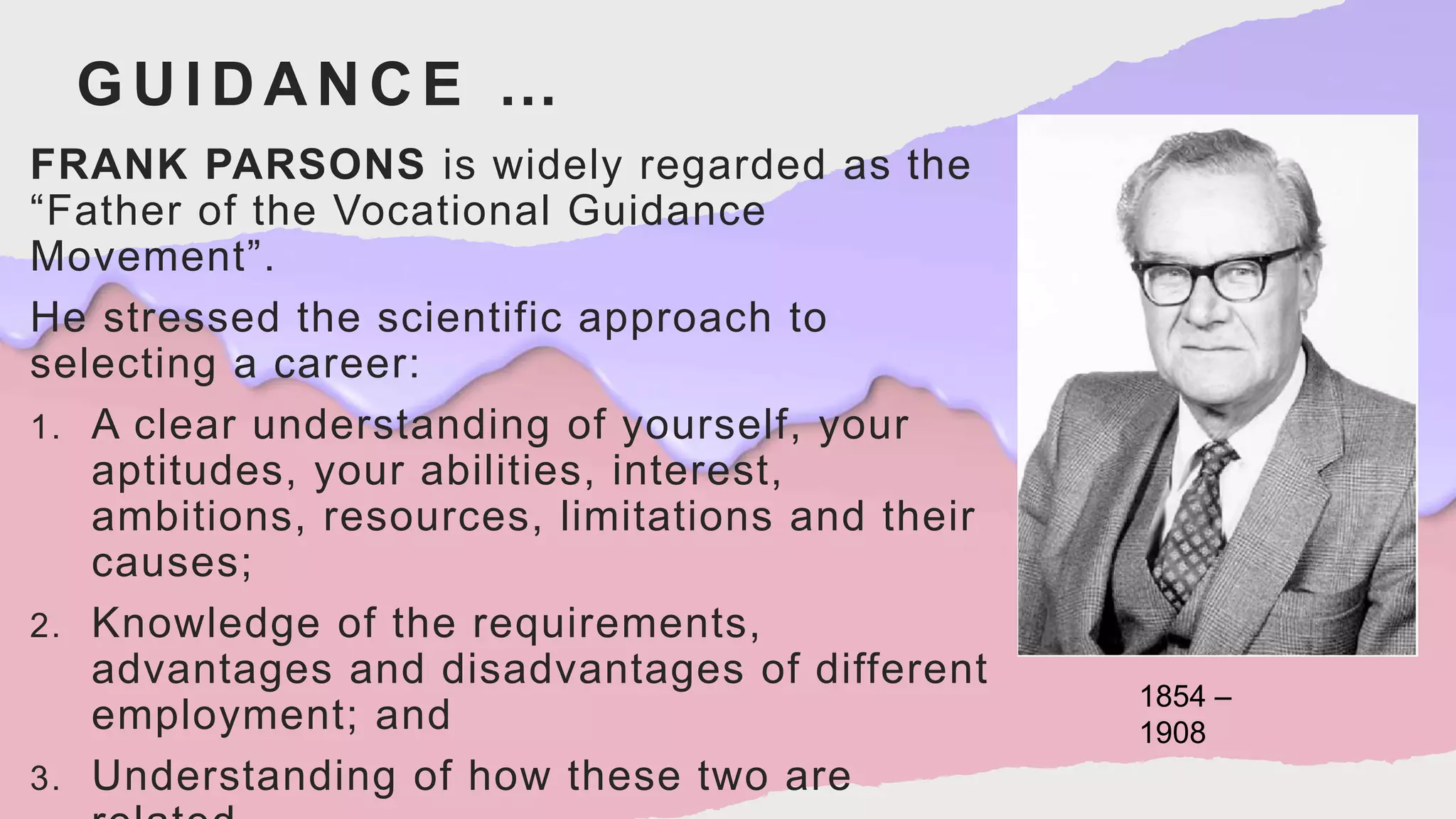
FRANK PARSONS is widely regarded as the
“Father of the Vocational Guidance
Movement”.
He stressed the scientific approach to
selecting a career:
1. A clear understanding of yourself, your
aptitudes, your abilities, interest,
ambitions, resources, limitations and their
causes;
2. Knowledge of the requirements,
advantages and disadvantages of different
employment; and
3. Understanding of how these two are
1854 –
1908
GUIDANCE …
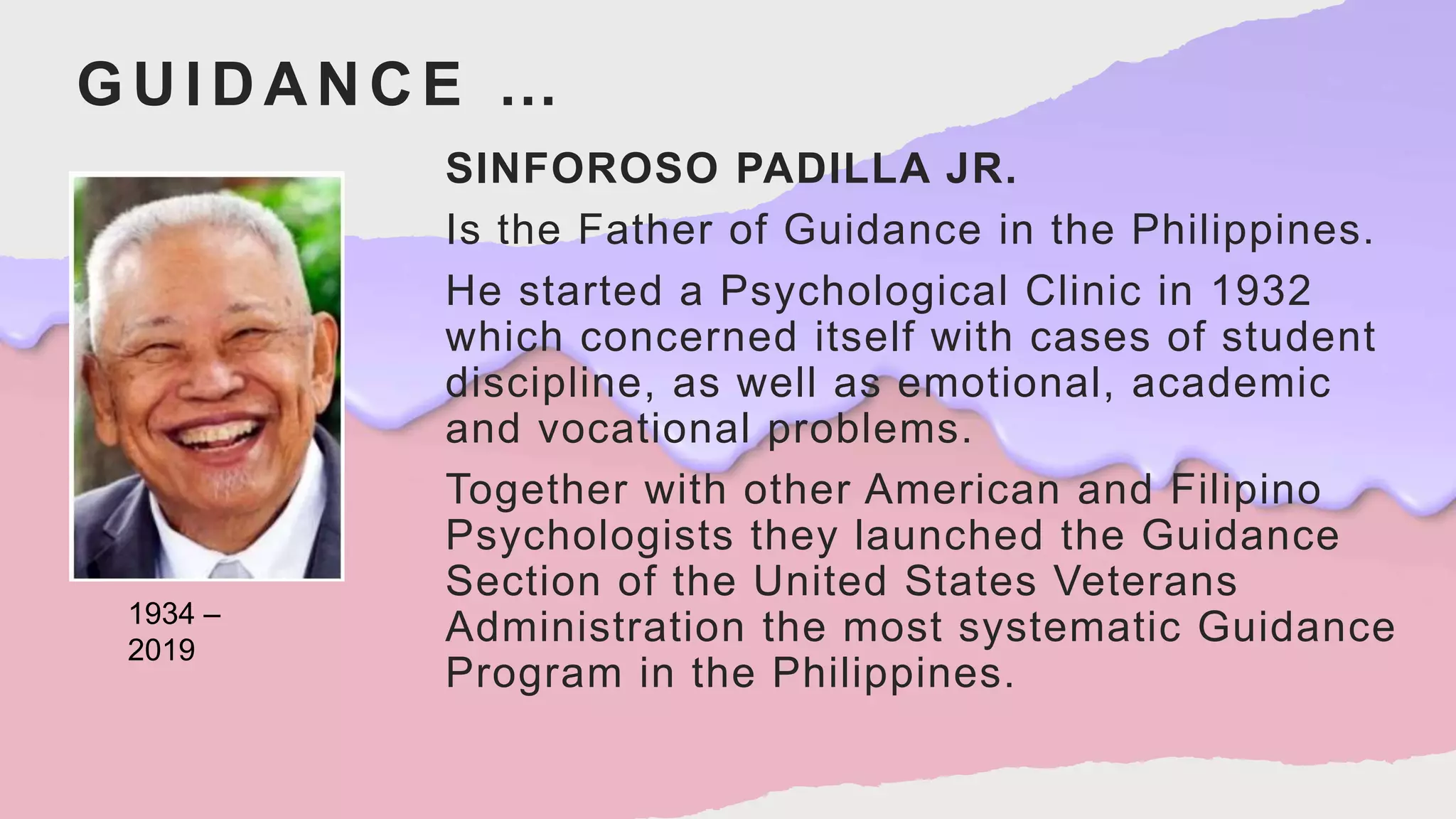
SINFOROSO PADILLA JR.
Is the Father of Guidance in the Philippines.
He started a Psychological Clinic in 1932
which concerned itself with cases of student
discipline, as well as emotional, academic
and vocational problems.
Together with other American and Filipino
Psychologists they launched the Guidance
Section of the United States Veterans
Administration the most systematic Guidance
Program in the Philippines.
1934 –
2019
L E G A L B A S E S O F G U I D A N C E I N T H E
P H I L I P P I N E S
The legal foundation of guidance in the Philippines has
its own beginning in 1951 when the Joint Congressional
Committee on Education, in its report to Congress
stated:
“there should be established in every secondary school
a functional guidance and counseling program to help
the students, to guide them in their work in school and
at home and to help them solve their problems”
L E G A L B A S E S O F G U I D A N C E I N T H E
P H I L I P P I N E S
To give more impact on the role of guidance in the Philippine
educational system, Section 4 of Batas Pambansa blg. 232 of
the Educational Act of 1982 states that the educational system
shall aim to
“provide for a broad general education that will assist each
individual, in the peculiar ecology of his own society, to: a)
attain his potential as a human being; b) enhance the range
and quality of individual and group participation in the basic
functions of society; and c) acquire the essential educational
foundation of his development into a productive and versatile
citizen”
L E G A L B A S E S O F G U I D A N C E I N T H E
P H I L I P P I N E S
The realization of these objectives are stipulated under
Section 3, Article XIV of the 1987 Constitution to which:
“All educational institutions shall inculcate patriotism and
nationalism, foster love of humanity, respect for human rights,
appreciation of the role of national heroes in the historical
development of the country, teach the rights and duties of
citizenship, strengthen ethical and spiritual values, develop
moral character and personal discipline, encourage critical and
creative thinking, broaden scientific and technological
knowledge and promote vocational efficiency.”
P H I L O S O P H Y B E H I N D G U I D A N C E
The underlying philosophies of guidance are as follows:
1. Know the individual
2. Guidance is primarily dedicated to implement the essential
concern of democracy for the dignity and worth of the
individual
3. Guidance is a life-long process
4. Guidance is based on human needs
5. Guidance is an art of helping individuals to plan their own
action wisely, in the full light of all the facts about the world
in which they will live and work
D E V E L O P M E N T O F G U I D A N C E I N T H E
P H I L I P P I N E S
 University of the Philippines started in 1932 a Psychological
Clinic which dealt with student case of discipline, emotional,
academic and vocational problems
 SY 1934-1940, the Division of City Schools Manila, selected
and appointed “Dean of Boys” and “Dean of Girls” – they are
assigned to look after the general behavior and conduct of
students
 1945 – the first Guidance Institute seminar was held at the
National Teachers College, Manila with the United Army
psychologist as resources person
 Guidance Association of the Philippines – participants of the
Guidance Institute Seminar organized the association
D E V E L O P M E N T O F G U I D A N C E I N T H E
P H I L I P P I N E S
 1952 – the Division Superintendent of Schools
recommended the establishment of guidance services in the
public schools
 1953 – another organization was organized, this was the
Philippines Association of Guidance Counselors
 Advisement and Guidance Section was established by the
United States Veterans Administration, setting up first
systematic guidance program in the Philippines
 Colleges and Universities started offering courses such as
Counseling Psych, Industrial Psych, Clinical Psych and
Human Service Tech.
G U I D A N C E P E R S O N N E L A N D T H E R O L E O F
T E A C H E R S I N G U I D A N C E
 School Heads - they determines the destiny of the guidance service
by his attitude toward it. If he sees it as having the potential for
aiding youngster in their development and decision-making, chances
are good that the service will flourish
 Guidance Counselor
a. Stimulates interest of other staff members towards that guidance
program
b. Solicits the participation of students
c. Plans the guidance program carefully
d. Keeps well-informed on educational trends
e. Seeks the advice and recommendations of others
f. Keeps parents, teachers and students informed
g. Counsel students
h. Works closely with teachers
G U I D A N C E P E R S O N N E L A N D T H E R O L E O F
T E A C H E R S I N G U I D A N C E
 Teacher – teacher’s ideas, suggestions and aid are essential
throughout all phases of the program’s establishment and
development; they provide appropriate learning experiences and
aiding young people in their personal development
Responsibilities of Teachers in Guidance
1. Effective teaching
2. Noting vocational possibilities of various subject areas
3. Demonstrating a genuine interest in students
4. Encouraging high academic achievement
5. Holding individual conferences with students
6. Providing anecdotal records
7. Assisting the pupil inventory
8. Making student referral
G U I D A N C E P E R S O N N E L A N D T H E R O L E O F
T E A C H E R S I N G U I D A N C E
 School Doctors and Nurses – they are invaluable assistance to the
school guidance program by helping administrators and teachers to
become more aware of their responsibilities to the children in the
realm of health
 School Librarian – her position in the guidance service is unique,
they guide the children’s habits to love books to a great degree. The
librarians help in the upgrading of children’s reading habits, ability
and interests.
PRESUPPOSITIONS OF GUIDANCE IN THE PHILIPPINES.ppt

PRESUPPOSITIONS OF GUIDANCE IN THE PHILIPPINES.ppt

  • 1.
    P H IL O S O P H I C A L P R E S U P P O S I T I O N S O F G U I D A N C E I N T H E P H I L I P P I N E S Foundations of Guidance and Counseling July 1, 2022 Discussant: Catherine T. Antonio
  • 2.
    B R IE F H I S T O R I C A L D E V E L O P M E N T O F C O U N S E L I N G I N T H E P H I L I P P I N E S The development of counseling as a profession in the Philippines has been shaped by socio-economic contexts and as well as the historical development of psychology and counseling as scientific disciplines. The counseling profession started in the Philippines as part of the educational and social reform initiated by the colonial rule of the USA. During the post-World War II era until the late 1960’s, 3 important development ushered the initial growth of the counseling profession in the Philippines: 1) the establishment of counselor education programs in the country, 2) the formation of professional counseling organizations; and 3)the offering of guidance and counseling services in local schools (Salazar-
  • 3.
    GUIDANCE … Aims peopleto help in terms of:  pre-problem  preparation
  • 4.
    GUIDANCE … FRANK PARSONSis widely regarded as the “Father of the Vocational Guidance Movement”. He stressed the scientific approach to selecting a career: 1. A clear understanding of yourself, your aptitudes, your abilities, interest, ambitions, resources, limitations and their causes; 2. Knowledge of the requirements, advantages and disadvantages of different employment; and 3. Understanding of how these two are 1854 – 1908
  • 5.
    GUIDANCE … SINFOROSO PADILLAJR. Is the Father of Guidance in the Philippines. He started a Psychological Clinic in 1932 which concerned itself with cases of student discipline, as well as emotional, academic and vocational problems. Together with other American and Filipino Psychologists they launched the Guidance Section of the United States Veterans Administration the most systematic Guidance Program in the Philippines. 1934 – 2019
  • 6.
    L E GA L B A S E S O F G U I D A N C E I N T H E P H I L I P P I N E S The legal foundation of guidance in the Philippines has its own beginning in 1951 when the Joint Congressional Committee on Education, in its report to Congress stated: “there should be established in every secondary school a functional guidance and counseling program to help the students, to guide them in their work in school and at home and to help them solve their problems”
  • 7.
    L E GA L B A S E S O F G U I D A N C E I N T H E P H I L I P P I N E S To give more impact on the role of guidance in the Philippine educational system, Section 4 of Batas Pambansa blg. 232 of the Educational Act of 1982 states that the educational system shall aim to “provide for a broad general education that will assist each individual, in the peculiar ecology of his own society, to: a) attain his potential as a human being; b) enhance the range and quality of individual and group participation in the basic functions of society; and c) acquire the essential educational foundation of his development into a productive and versatile citizen”
  • 8.
    L E GA L B A S E S O F G U I D A N C E I N T H E P H I L I P P I N E S The realization of these objectives are stipulated under Section 3, Article XIV of the 1987 Constitution to which: “All educational institutions shall inculcate patriotism and nationalism, foster love of humanity, respect for human rights, appreciation of the role of national heroes in the historical development of the country, teach the rights and duties of citizenship, strengthen ethical and spiritual values, develop moral character and personal discipline, encourage critical and creative thinking, broaden scientific and technological knowledge and promote vocational efficiency.”
  • 9.
    P H IL O S O P H Y B E H I N D G U I D A N C E The underlying philosophies of guidance are as follows: 1. Know the individual 2. Guidance is primarily dedicated to implement the essential concern of democracy for the dignity and worth of the individual 3. Guidance is a life-long process 4. Guidance is based on human needs 5. Guidance is an art of helping individuals to plan their own action wisely, in the full light of all the facts about the world in which they will live and work
  • 10.
    D E VE L O P M E N T O F G U I D A N C E I N T H E P H I L I P P I N E S  University of the Philippines started in 1932 a Psychological Clinic which dealt with student case of discipline, emotional, academic and vocational problems  SY 1934-1940, the Division of City Schools Manila, selected and appointed “Dean of Boys” and “Dean of Girls” – they are assigned to look after the general behavior and conduct of students  1945 – the first Guidance Institute seminar was held at the National Teachers College, Manila with the United Army psychologist as resources person  Guidance Association of the Philippines – participants of the Guidance Institute Seminar organized the association
  • 11.
    D E VE L O P M E N T O F G U I D A N C E I N T H E P H I L I P P I N E S  1952 – the Division Superintendent of Schools recommended the establishment of guidance services in the public schools  1953 – another organization was organized, this was the Philippines Association of Guidance Counselors  Advisement and Guidance Section was established by the United States Veterans Administration, setting up first systematic guidance program in the Philippines  Colleges and Universities started offering courses such as Counseling Psych, Industrial Psych, Clinical Psych and Human Service Tech.
  • 12.
    G U ID A N C E P E R S O N N E L A N D T H E R O L E O F T E A C H E R S I N G U I D A N C E  School Heads - they determines the destiny of the guidance service by his attitude toward it. If he sees it as having the potential for aiding youngster in their development and decision-making, chances are good that the service will flourish  Guidance Counselor a. Stimulates interest of other staff members towards that guidance program b. Solicits the participation of students c. Plans the guidance program carefully d. Keeps well-informed on educational trends e. Seeks the advice and recommendations of others f. Keeps parents, teachers and students informed g. Counsel students h. Works closely with teachers
  • 13.
    G U ID A N C E P E R S O N N E L A N D T H E R O L E O F T E A C H E R S I N G U I D A N C E  Teacher – teacher’s ideas, suggestions and aid are essential throughout all phases of the program’s establishment and development; they provide appropriate learning experiences and aiding young people in their personal development Responsibilities of Teachers in Guidance 1. Effective teaching 2. Noting vocational possibilities of various subject areas 3. Demonstrating a genuine interest in students 4. Encouraging high academic achievement 5. Holding individual conferences with students 6. Providing anecdotal records 7. Assisting the pupil inventory 8. Making student referral
  • 14.
    G U ID A N C E P E R S O N N E L A N D T H E R O L E O F T E A C H E R S I N G U I D A N C E  School Doctors and Nurses – they are invaluable assistance to the school guidance program by helping administrators and teachers to become more aware of their responsibilities to the children in the realm of health  School Librarian – her position in the guidance service is unique, they guide the children’s habits to love books to a great degree. The librarians help in the upgrading of children’s reading habits, ability and interests.