images.businessweek.com

By Selia Wagoner
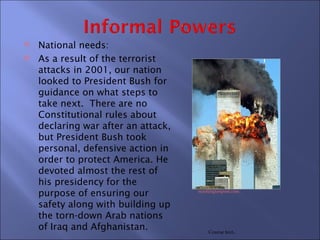
   National needs:
   As a result of the terrorist
    attacks in 2001, our nation
    looked to President Bush for
    guidance on what steps to
    take next. There are no
    Constitutional rules about
    declaring war after an attack,
    but President Bush took
    personal, defensive action in
    order to protect America. He
    devoted almost the rest of
    his presidency for the
    purpose of ensuring our          washingtonpost.com


    safety along with building up
    the torn-down Arab nations
    of Iraq and Afghanistan.             Course text   .
   Another informal power of the
    President is the use of media
    outlets. President Bush did not
    misuse media outlets as some
    presidents and current
    campaign runners have.
    President Bush tactfully
    addressed the nation in State
    of the Union addresses. He did
    not explode on Facebook or
    Twitter. He did not produce
    mass amounts of hateful           http://thecaucus.blogs.nytimes.com/2006/11/02/big-blue-sky-
    slander against that other        country-and-the-senate/

    candidates during election.
    Instead, he did what he had to
    to produce education reform              Stevenson, Richard W. “Can Obama 2012
    and protect our country.                 Replicate Bush 2004?”. nytimes.com.
                                             October, 2011.
   A formal power that
    President Bush certainly
    utilized was the Power to
    Make War, as granted in
    the Constitution under
    Article 1, section 8. In
    order to wage war on
    another “state” (country),
    one has to make an
    official declaration of          skyvalleychronicle.com

    war. President Bush
    made this declaration on
    September 20, 2001.
                                 Yoo, John C., Deputy Assistant Attorney General Office of Legal
                                 Counsel. justice.gov. Sept.,2001.
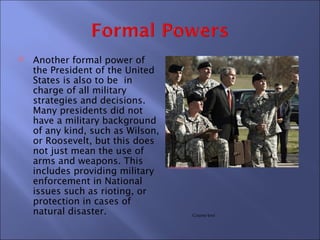
   Another formal power of
    the President of the United
    States is also to be in
    charge of all military
    strategies and decisions.
    Many presidents did not
    have a military background
    of any kind, such as Wilson,
    or Roosevelt, but this does
    not just mean the use of
    arms and weapons. This
                                   chinadaily.com.cn
    includes providing military
    enforcement in National
    issues such as rioting, or
    protection in cases of
    natural disaster.                         Course text

Presidential Powers

  • 1.
  • 2.
    National needs:  As a result of the terrorist attacks in 2001, our nation looked to President Bush for guidance on what steps to take next. There are no Constitutional rules about declaring war after an attack, but President Bush took personal, defensive action in order to protect America. He devoted almost the rest of his presidency for the purpose of ensuring our washingtonpost.com safety along with building up the torn-down Arab nations of Iraq and Afghanistan. Course text .
  • 3.
    Another informal power of the President is the use of media outlets. President Bush did not misuse media outlets as some presidents and current campaign runners have. President Bush tactfully addressed the nation in State of the Union addresses. He did not explode on Facebook or Twitter. He did not produce mass amounts of hateful http://thecaucus.blogs.nytimes.com/2006/11/02/big-blue-sky- slander against that other country-and-the-senate/ candidates during election. Instead, he did what he had to to produce education reform Stevenson, Richard W. “Can Obama 2012 and protect our country. Replicate Bush 2004?”. nytimes.com. October, 2011.
  • 4.
    A formal power that President Bush certainly utilized was the Power to Make War, as granted in the Constitution under Article 1, section 8. In order to wage war on another “state” (country), one has to make an official declaration of skyvalleychronicle.com war. President Bush made this declaration on September 20, 2001. Yoo, John C., Deputy Assistant Attorney General Office of Legal Counsel. justice.gov. Sept.,2001.
  • 5.
    Another formal power of the President of the United States is also to be in charge of all military strategies and decisions. Many presidents did not have a military background of any kind, such as Wilson, or Roosevelt, but this does not just mean the use of arms and weapons. This chinadaily.com.cn includes providing military enforcement in National issues such as rioting, or protection in cases of natural disaster. Course text