Campaign Honorary Chairs
Jo Anne and Donald Petersen
Campaign Chairs
Sue and Bill Vititoe
Donald J. Bachand
Andrew Bethune
Ashley Boger, SVSU Student Rep
Madeline Burke
Matt Davis
Kelly Fabiano
Carl M. Fredericks
Chris Fredericks
Suzanne (Suki) Fredericks
Rosalind C. Fredericks
Konnie Gill
Theresa Harlan
Barbara Heller
James Jaime
Gary Labadie
Ernest E. Paulick
Museum Board of Directors
Dawn Pumford
Avril Roundtree
Roz Fredericks Rymal
Odail Thorns
Donna VanSteenhouse
Sue Vititoe, Chair
Preserving the Legacy
of Marshall M. Fredericks
A legacy worth preserving…
Marshall Fredericks was an incredible
man with an iconic career. It can
be said that his life was defined by
connections.
Marshall Fredericks’s earliest training led to the prestigious Herman
Matzen Traveling Scholarship in Sculpture from the Cleveland
School of Art, which allowed a twenty-two year old Fredericks to seek
out renowned sculptor Carl Milles, whose bronze fountain figures
intrigued the young artist. After giving Fredericks the opportunity
to work among the stone carvers in his studio at Millesgården
in Sweden, Milles sent him to Munich where he worked at two
of the finest schools of the time and, while traveling throughout
Europe, experienced the art and architecture of Rome, London and
Copenhagen.
When he returned to the states, Fredericks reconnected with
Milles, then sculptor-in-residence at Cranbrook Academy of Art
in Bloomfield Hills, Michigan. Milles invited Fredericks to assist
in his studio, where the young artist could apply his knowledge of
the mechanics of large-scale sculpture. Here the budding artist’s
career path became clear. Cranbrook was arguably the finest place to
develop a mastery of the arduous process of bronze sculpture, a key
factor in the artist’s ongoing training.
The founder of Cranbrook,
George G. Booth,
unknowingly gave Fredericks
an early opportunity to
combine his wit and talent
when he asked the sculptor to
create a Thinker that would
lend gravitas to the entry of
the Cranbrook Art Museum,
following in the steps of
Auguste Rodin’s Thinker at the entrance to The Detroit Institute of
Arts and the Cleveland Museum of Art. Fredericks displayed both
his skill and astute humor when he produced a large black granite
chimpanzee, The Thinker, which continues to welcome visitors to the
Cranbrook Art Museum today.
1
2
Important connections informed
Fredericks’s extraordinary career path.
•	 In 1936, he won a national competition and was selected to
design the Levi L. Barbour Memorial Fountain on Belle Isle,
an island park in the Detroit River.
•	 Three years later Malcolm Stirton, chief designer at Harley,
Ellington and Day, Architects, who had been selected to
design the Horace H. Rackham Educational Memorial
Building across from Paul Cret’s spectacular Detroit Institute
of Arts, hired Fredericks to create 46 carved reliefs for the
facade and several significant architectural enhancements
for the interior. Stirton’s desire to hire local talent and his
familiarity with Fredericks’s Belle Isle fountain and Cranbrook
sculptures sealed the deal.
•	 This Rackham Building project led to a commission to design
a fountain for the Glass Industries Building at the 1939 New
York World’s Fair.
•	 Fredericks’s remarkable ability to understand the unique
challenges of outdoor sculpture brought about the creation
of one of his most winning early works, the Two Sisters
Fountain at Cranbrook’s Kingswood School for Girls, which
he designed in 1940.
•	 World War II inspired Fredericks to join the Army Air Corp
in 1942 where he rose to the rank of Lieutenant Colonel,
serving in south Asia.
•	 During that period, Fredericks made one of the most
significant connections of his life when he reacquainted
himself with Rosalind Bell Cooke, a volunteer driver on the
base in Arizona where he was stationed, and married her in
1943. Rosalind became a partner in the development and
management of her artist husband’s career, and helped raise
their five children: Carl, Christopher, Frances, Rosalind, and
Suzanne (Suki).
•	 The post war resurgence in American pride stimulated
a revitalization of art and architecture, and a desire to
memorialize the fight for freedom. Fredericks was tapped for
significant works like the Cleveland War Memorial Fountain,
the Veterans Memorial Building in Detroit, and the war
memorials for Cleveland’s Eaton Manufacturing Corporation
and the University of Michigan.
•	 The artist’s synergistic link with architecture made him a
favorite among those who planned, designed and erected
hospitals, civic centers, universities, libraries and auditoriums.
Later works, such as The Expanding Universe in the inner court
of the State Department Building in Washington, D.C. and
the spectacular The Spirit of Detroit are shining examples of
Fredericks’s determination to connect the viewer of his work
with both aesthetics and a profound message of optimism.
4
3
5
Along the way, Fredericks’s work connected
with the heart of a young woman, Dorothy
(Honey) Doan, who was studying at
Cranbrook’s Kingswood School for Girls.
Years later the artist and Honey became
reacquainted through her uncle Alden
B. Dow, an accomplished architect and
sometimes collaborator with Fredericks.
Marshall and Rosalind Fredericks became
friends with Honey and her husband
Ned Arbury. That friendship was central
to the incorporation of the Marshall M.
Fredericks Sculpture Gallery into the plans for a new fine arts center at
Saginaw Valley State University that the Arburys were helping to fund.
The purpose of the Gallery was to collect, exhibit, preserve, study,
and interpret Marshall Fredericks’s work. It was intended to be an
educational asset and
tool for SVSU faculty
and students, as well as
a significant resource for
the region. It was to be a
place that scholars from
around the globe, as well
as art aficionados and the
general public, would
visit and thus serve as
a defining asset for the
University.
The name was officially changed from Gallery to Museum in 1999 to
better reflect its educational and outreach mission. Today, SVSU classes
from a variety of disciplines, a dedicated student group, students from
the region’s K-12 schools, corporations, businesses and civic groups
avail themselves of the resources at the Marshall M. Fredericks Sculpture
Museum.
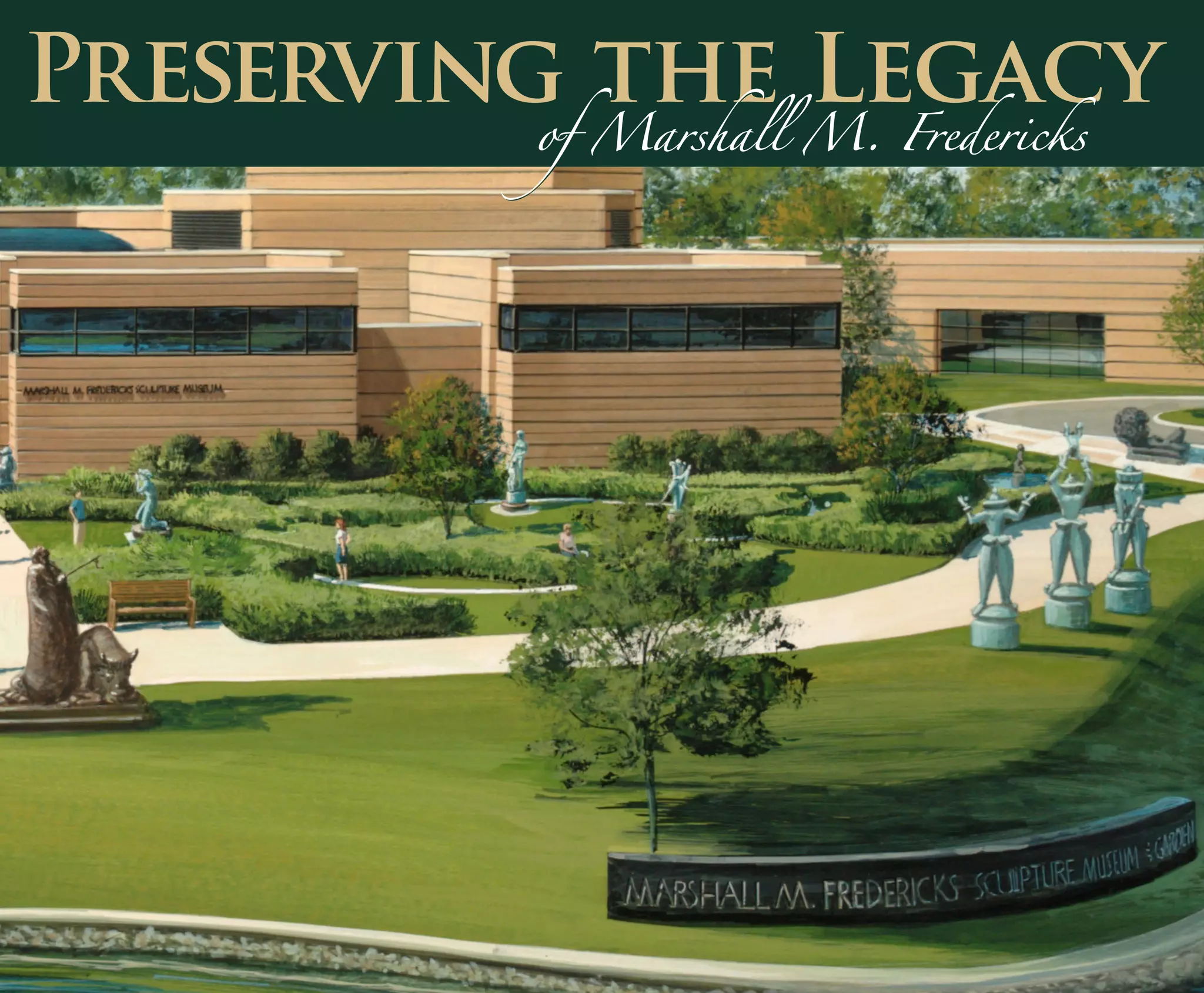
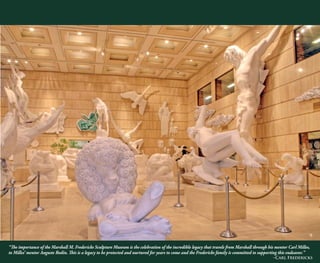
In 2003, an addition to the gallery where over 200 of Fredericks’s works
are permanently displayed doubled the size of the Museum, with space
for changing exhibitions, an expanded gift shop, the Sculptor’s Studio (a
representation of the artist’s well-known Royal Oak studio), archives and
research reading room, and a large classroom.
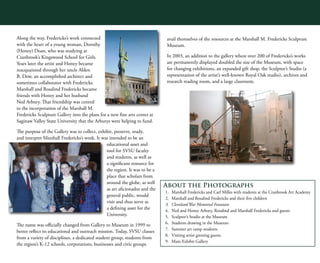
About the Photographs
1.	 Marshall Fredericks and Carl Milles with students at the Cranbrook Art Academy
2.	 Marshall and Rosalind Fredericks and their five children
3.	 Cleveland War Memorial Fountain
4.	 Ned and Honey Arbury, Rosalind and Marshall Fredericks and guests
5.	 Sculptor’s Studio at the Museum
6.	 Students drawing in the Museum
7.	 Summer art camp students
8.	 Visiting artist greeting guests
9.	 Main Exhibit Gallery
Marshall M. Fredericks and his Museum at SVSU ...
“Businesses seeking to attract creative professionals understand the value of having cultural amenities like the Marshall M. Fredericks Sculpture Museum in
the region because they enhance our quality of life.” -Matt Davis, The Dow Chemical Company
6
7
The Connections Continue
“The Museum teaches how inspiration and imagination can take shape and
become images that move people to thought and laughter and remembrance
and reverence. The gifts from Marshall are a treasure for our campus and all
those with whom they are shared.”
- Eric Gilbertson, President, SVSU
•	 One of America’s most important and prolific sculptors found a fitting
repository for his art collection, archives, and a representation of his
working studio.
•	 One of Michigan’s state universities became home to a world-class
museum and extraordinary collection, one of just a few in the country
devoted to the work of a single artist.
•	 Students’ academic and personal lives
are enriched by the accessibility of the
Museum that is utilized by faculty in fine
arts, nursing, creative writing, history,
sciences, and athletics.
•	 The University has an invaluable asset for
attracting students.
•	 An important bond exists between the
University and its neighbors throughout
the Great Lakes Bay Region as the
Museum functions as an asset to area schools, businesses and community
groups.
•	 Community cultural life is greatly enhanced by the Museum’s
temporary exhibitions, classes, lectures, gallery talks, summer art
camps, and much, much more.
The Marshall M. Fredericks Sculpture Museum at Saginaw Valley State
University connects the past to the present and will connect the present to a
bright and sustainable future.
Each donor to this critical effort will play a significant role in preserving the
legacy of a truly gifted and important artist and ensuring the accessibility
of the artwork and archives
of a remarkable Michigan
resource.
A Private/Public
Partnership that
Works
While Marshall Fredericks
referred to the complex
process of turning a sketch into a monumental bronze sculpture as
“Magic,” the magic of this Museum is found in the amazing public/private
collaboration that enables it to be open to the public, school groups, and
classes from SVSU and other institutions of higher learning six days a week
free of charge! The University supports operations, including accounting,
security, custodial, marketing services, utilities, information technology,
and insurance. The private sector, through memberships, donations, event
sponsorships and gifts to the endowments, provides the additional revenue
necessary to fund temporary exhibitions, educational programs, and
professional and administrative staff to ensure that this remarkable resource
is accessible to visitors of all ages, literally from across the quad and around
the globe. Working together, these two critical sources of support prove that
the whole is truly greater than the sum of its parts.
“When I take my students to the Marshall M. Fredericks Museum I am sharing with them the gift Mr. Fredericks left all of us: a vision that provides a respite
from the daily grind and a thoughtful reflection on humanity that we might not otherwise bother to examine.” -Sara Clark, SVSU Ceramics Instructor
8
Mission Statement
The mission of the Marshall M. Fredericks Sculpture Museum is to celebrate
the artistic legacy of Marshall M. Fredericks through collecting, preserving,
presenting, and interpreting his life’s work for the educational and cultural
enrichment of Saginaw Valley State University and the broadest possible
audience. Through the Marshall Fredericks objects collection and archives,
temporary exhibitions, publications, and education programs, the Museum
contributes to scholarly discourse and serves diverse audiences.
To accomplish this mission, the Museum pursues the following strategic
objectives:
•	 Promote awareness, appreciation,
preservation, and understanding
of the life and works of Marshall
M. Fredericks.
•	 Embed an educational
component in everything we do.
•	 Maintain the collection and
present exhibitions of Marshall
Fredericks and other artists in
accordance with the highest
museum standards.
•	 Foster the mission of the Museum and Saginaw Valley State University
through education, research, exhibitions, publications, and outreach
efforts.
•	 Increase community awareness and attendance.
•	 Operate in a fiscally responsible and sustainable manner.
•	 Sustain accreditation by the American Alliance of Museums.
The First 25 Years
1988 Dedication ceremonies of the Marshall M. Fredericks Sculpture
Gallery at SVSU.
1989 First Museum director hired, setting the path for the institution’s
future growth.
1992 Marshall and Rosalind Fredericks established a Conservation
Endowment for the preservation and conservation of his sculptures
and works on paper.
1994 Rosalind C. Fredericks Educational Trust established to enhance
educational programming.
2001 Full-time curator of education hired, enabling significant expansion
of classes, summer art camps, and programs for youth and adults.
2003 Grand opening of Museum expansion that doubled the size of the facility.
2006 Strategic plan adopted by the Board of Advisors that would guide
the Museum through 2013.
2007 Exhibition Endowment established to support temporary exhibitions.
2008 Full-time registrar hired, allowing for rigorous cataloging of the
objects collection, making it accessible to scholars and interested
parties and ensuring up-to-date condition records; Fredericks’s
Harlequins restored and unveiled at 20th anniversary celebration.
2009 Full-time archivist hired, ensuring that the full body of Fredericks’s
personal and project files are properly documented and made
accessible through digitization and other technologies.
2010 Sketches to Sculptures, Rendered Reality: SixtyYears with Marshall M.
Fredericks exhibition created to travel throughout the state and nationally.
2011 Board of Advisors approved construction of an exterior entrance and
sculpture garden.
2012 Museum launched the Preserving the Legacy of Marshall M. Fredericks
Campaign, a plan to raise $5 million for capital improvements and
endowments.
2013 Museum celebrates 25th anniversary, introduces its new logo, and is
awarded accreditation by the American Alliance of Museums.
“Having been a fan of Marshall Fredericks for many years I looked forward to the time when I could bring my two
children to visit the museum. After 30 minutes of great fun and conversation, I thought it time to offer my attention-
challenged 3 and 5 year olds an opportunity to play outside. “Can’t we stay with the sculptures a little longer please?”
replied my three year old. I felt my eyes well up as I was again reminded what a wonderful legacy Marshall Fredericks
has left to the world, and how fortunate we are to have this collection of his creations available for all to enjoy.”
-Madeline Burke
A future designed to preserve that legacy...
All that has been accomplished is simply a stepping off point for the
future in which we ensure that the legacy of both Marshall Fredericks
and his Museum lives in perpetuity.
A long-range strategic plan was completed in 2012, with substantial
input from the University, community, Museum board and staff, and
other key constituents. In addition to calling for continual growth in
exhibitions, educational programs and community outreach, the plan
highlights significant enhancements to the facility and its endowments
to further its artistic mission, continue its impressive path as a
university and regional educational and cultural asset, and expand its
service to artists, scholars, researchers and visitors from around the
globe. Key improvements focus on:
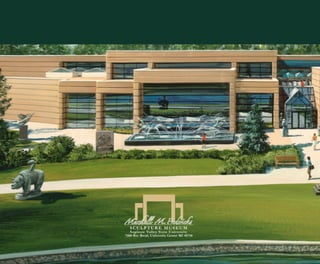
•	 The addition of an exterior entrance that will create a highly
visible and welcoming threshold into the galleries and set a
level of anticipation about what awaits inside, while serving as
a physical connection between the indoor galleries and a greatly
enhanced exterior space. It is an essential step in distinguishing
the Museum’s presence on the SVSU campus.
•	 Extending the gallery space by expanding the Sculpture Garden
to display more than twenty of Fredericks’s works, some of
which will be relocated from other areas of campus. Small
botanical displays, seating, and winding pathways complementing the
stunning Night and Day Fountain will encourage extended visits and
heighten usage.
•	 With the recent granting of accreditation by the American Alliance of
Museums, a very significant recognition of the highest of professional
standards and practices, the board realized that ensuring the future
is absolutely critical. Thus the strategic vision calls for building the
endowments to ensure adequate investment income that will guarantee
a top rate, professional staff to plan and implement a heightened
level of educational programs, ensure conservation of art work and
preservation of the archives, and bring memorable exhibitions to the
Museum, all for the benefit of the University and the region.
To accomplish these goals, the Museum Board of Advisors and University
Board of Control have approved the launch of Preserving the Legacy of
Marshall M. Fredericks Campaign.
Please become a part of this movement to ensure: maintenance of the
collection; accessibility of the archives; extraordinary experiences visiting the
Sculptor’s Studio; and diversity and quality of temporary exhibitions. With
YOUR support, the trajectory of the first 25 years will continue well into
the future.
A future designed to preserve that legacy...
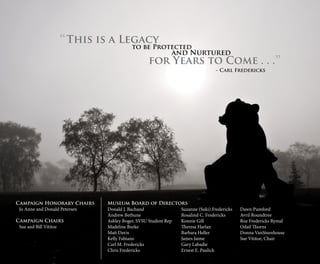
“The importance of the Marshall M. Fredericks Sculpture Museum is the celebration of the incredible legacy that travels from Marshall through his mentor Carl Milles,
to Milles’ mentor Auguste Rodin. This is a legacy to be protected and nurtured for years to come and the Fredericks family is committed to supporting this endeavor.”
-Carl Fredericks
9
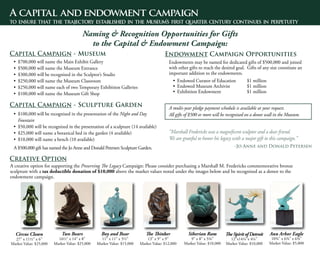
A creative option for supporting the Preserving The Legacy Campaign: Please consider purchasing a Marshall M. Fredericks commemorative bronze
sculpture with a tax deductible donation of $10,000 above the market values noted under the images below and be recognized as a donor to the
endowment campaign.
Naming & Recognition Opportunities for Gifts
to the Capital & Endowment Campaign:
A capital and endowment campaign
to ensure that the trajectory established in the Museum’s first quarter century continues in perpetuity
Capital Campaign - Museum
•	 $700,000 will name the Main Exhibit Gallery		
•	 $500,000 will name the Museum Entrance
•	 $300,000 will be recognized in the Sculptor’s Studio	
•	 $250,000 will name the Museum Classroom
•	 $250,000 will name each of two Temporary Exhibition Galleries
•	 $100,000 will name the Museum Gift Shop
Capital Campaign - Sculpture Garden
•	 $100,000 will be recognized in the presentation of the Night and Day
Fountain
•	 $50,000 will be recognized in the presentation of a sculpture (14 available)
•	 $25,000 will name a botanical bed in the garden (4 available)
•	 $10,000 will name a bench (10 available)
A $500,000 gift has named the Jo Anne and Donald Petersen Sculpture Garden.
Endowment Campaign Opportunities
Endowments may be named for dedicated gifts of $500,000 and joined
with other gifts to reach the desired goal. Gifts of any size constitute an
important addition to the endowments.
•	 Endowed Curator of Education	 $1 million
•	 Endowed Museum Archivist		 $1 million
•	 Exhibition Endowment		 $1 million
A multi-year pledge payment schedule is available at your request.
All gifts of $500 or more will be recognized on a donor wall in the Museum.
“Marshall Fredericks was a magnificent sculptor and a dear friend.
We are grateful to honor his legacy with a major gift to this campaign.”
-Jo Anne and Donald Petersen
Circus Clown
27” x 11½” x 6”
Market Value: $25,000
Two Bears
16½” x 14” x 8”
Market Value: $25,000
Boy and Bear
11” x 11” x 5½”
Market Value: $15,000
The Thinker
13” x 9” x 9”
Market Value: $12,000
Siberian Ram
9” x 8” x 5¾”
Market Value: $10,000
Ann Arbor Eagle
10¾” x 6¾” x 6¾”
Market Value: $5,000
The Spirit of Detroit
12”x14¼”x 4¼”
Market Value: $10,000
Creative Option
Preserving thelegacy

Preserving thelegacy

  • 2.
    Campaign Honorary Chairs JoAnne and Donald Petersen Campaign Chairs Sue and Bill Vititoe Donald J. Bachand Andrew Bethune Ashley Boger, SVSU Student Rep Madeline Burke Matt Davis Kelly Fabiano Carl M. Fredericks Chris Fredericks Suzanne (Suki) Fredericks Rosalind C. Fredericks Konnie Gill Theresa Harlan Barbara Heller James Jaime Gary Labadie Ernest E. Paulick Museum Board of Directors Dawn Pumford Avril Roundtree Roz Fredericks Rymal Odail Thorns Donna VanSteenhouse Sue Vititoe, Chair
  • 3.
    Preserving the Legacy ofMarshall M. Fredericks A legacy worth preserving… Marshall Fredericks was an incredible man with an iconic career. It can be said that his life was defined by connections. Marshall Fredericks’s earliest training led to the prestigious Herman Matzen Traveling Scholarship in Sculpture from the Cleveland School of Art, which allowed a twenty-two year old Fredericks to seek out renowned sculptor Carl Milles, whose bronze fountain figures intrigued the young artist. After giving Fredericks the opportunity to work among the stone carvers in his studio at Millesgården in Sweden, Milles sent him to Munich where he worked at two of the finest schools of the time and, while traveling throughout Europe, experienced the art and architecture of Rome, London and Copenhagen. When he returned to the states, Fredericks reconnected with Milles, then sculptor-in-residence at Cranbrook Academy of Art in Bloomfield Hills, Michigan. Milles invited Fredericks to assist in his studio, where the young artist could apply his knowledge of the mechanics of large-scale sculpture. Here the budding artist’s career path became clear. Cranbrook was arguably the finest place to develop a mastery of the arduous process of bronze sculpture, a key factor in the artist’s ongoing training. The founder of Cranbrook, George G. Booth, unknowingly gave Fredericks an early opportunity to combine his wit and talent when he asked the sculptor to create a Thinker that would lend gravitas to the entry of the Cranbrook Art Museum, following in the steps of Auguste Rodin’s Thinker at the entrance to The Detroit Institute of Arts and the Cleveland Museum of Art. Fredericks displayed both his skill and astute humor when he produced a large black granite chimpanzee, The Thinker, which continues to welcome visitors to the Cranbrook Art Museum today. 1
  • 4.
    2 Important connections informed Fredericks’sextraordinary career path. • In 1936, he won a national competition and was selected to design the Levi L. Barbour Memorial Fountain on Belle Isle, an island park in the Detroit River. • Three years later Malcolm Stirton, chief designer at Harley, Ellington and Day, Architects, who had been selected to design the Horace H. Rackham Educational Memorial Building across from Paul Cret’s spectacular Detroit Institute of Arts, hired Fredericks to create 46 carved reliefs for the facade and several significant architectural enhancements for the interior. Stirton’s desire to hire local talent and his familiarity with Fredericks’s Belle Isle fountain and Cranbrook sculptures sealed the deal. • This Rackham Building project led to a commission to design a fountain for the Glass Industries Building at the 1939 New York World’s Fair. • Fredericks’s remarkable ability to understand the unique challenges of outdoor sculpture brought about the creation of one of his most winning early works, the Two Sisters Fountain at Cranbrook’s Kingswood School for Girls, which he designed in 1940. • World War II inspired Fredericks to join the Army Air Corp in 1942 where he rose to the rank of Lieutenant Colonel, serving in south Asia. • During that period, Fredericks made one of the most significant connections of his life when he reacquainted himself with Rosalind Bell Cooke, a volunteer driver on the base in Arizona where he was stationed, and married her in 1943. Rosalind became a partner in the development and management of her artist husband’s career, and helped raise their five children: Carl, Christopher, Frances, Rosalind, and Suzanne (Suki). • The post war resurgence in American pride stimulated a revitalization of art and architecture, and a desire to memorialize the fight for freedom. Fredericks was tapped for significant works like the Cleveland War Memorial Fountain, the Veterans Memorial Building in Detroit, and the war memorials for Cleveland’s Eaton Manufacturing Corporation and the University of Michigan. • The artist’s synergistic link with architecture made him a favorite among those who planned, designed and erected hospitals, civic centers, universities, libraries and auditoriums. Later works, such as The Expanding Universe in the inner court of the State Department Building in Washington, D.C. and the spectacular The Spirit of Detroit are shining examples of Fredericks’s determination to connect the viewer of his work with both aesthetics and a profound message of optimism.
  • 5.
    4 3 5 Along the way,Fredericks’s work connected with the heart of a young woman, Dorothy (Honey) Doan, who was studying at Cranbrook’s Kingswood School for Girls. Years later the artist and Honey became reacquainted through her uncle Alden B. Dow, an accomplished architect and sometimes collaborator with Fredericks. Marshall and Rosalind Fredericks became friends with Honey and her husband Ned Arbury. That friendship was central to the incorporation of the Marshall M. Fredericks Sculpture Gallery into the plans for a new fine arts center at Saginaw Valley State University that the Arburys were helping to fund. The purpose of the Gallery was to collect, exhibit, preserve, study, and interpret Marshall Fredericks’s work. It was intended to be an educational asset and tool for SVSU faculty and students, as well as a significant resource for the region. It was to be a place that scholars from around the globe, as well as art aficionados and the general public, would visit and thus serve as a defining asset for the University. The name was officially changed from Gallery to Museum in 1999 to better reflect its educational and outreach mission. Today, SVSU classes from a variety of disciplines, a dedicated student group, students from the region’s K-12 schools, corporations, businesses and civic groups avail themselves of the resources at the Marshall M. Fredericks Sculpture Museum. In 2003, an addition to the gallery where over 200 of Fredericks’s works are permanently displayed doubled the size of the Museum, with space for changing exhibitions, an expanded gift shop, the Sculptor’s Studio (a representation of the artist’s well-known Royal Oak studio), archives and research reading room, and a large classroom. About the Photographs 1. Marshall Fredericks and Carl Milles with students at the Cranbrook Art Academy 2. Marshall and Rosalind Fredericks and their five children 3. Cleveland War Memorial Fountain 4. Ned and Honey Arbury, Rosalind and Marshall Fredericks and guests 5. Sculptor’s Studio at the Museum 6. Students drawing in the Museum 7. Summer art camp students 8. Visiting artist greeting guests 9. Main Exhibit Gallery
  • 6.
    Marshall M. Fredericksand his Museum at SVSU ... “Businesses seeking to attract creative professionals understand the value of having cultural amenities like the Marshall M. Fredericks Sculpture Museum in the region because they enhance our quality of life.” -Matt Davis, The Dow Chemical Company 6 7 The Connections Continue “The Museum teaches how inspiration and imagination can take shape and become images that move people to thought and laughter and remembrance and reverence. The gifts from Marshall are a treasure for our campus and all those with whom they are shared.” - Eric Gilbertson, President, SVSU • One of America’s most important and prolific sculptors found a fitting repository for his art collection, archives, and a representation of his working studio. • One of Michigan’s state universities became home to a world-class museum and extraordinary collection, one of just a few in the country devoted to the work of a single artist. • Students’ academic and personal lives are enriched by the accessibility of the Museum that is utilized by faculty in fine arts, nursing, creative writing, history, sciences, and athletics. • The University has an invaluable asset for attracting students. • An important bond exists between the University and its neighbors throughout the Great Lakes Bay Region as the Museum functions as an asset to area schools, businesses and community groups. • Community cultural life is greatly enhanced by the Museum’s temporary exhibitions, classes, lectures, gallery talks, summer art camps, and much, much more. The Marshall M. Fredericks Sculpture Museum at Saginaw Valley State University connects the past to the present and will connect the present to a bright and sustainable future. Each donor to this critical effort will play a significant role in preserving the legacy of a truly gifted and important artist and ensuring the accessibility of the artwork and archives of a remarkable Michigan resource. A Private/Public Partnership that Works While Marshall Fredericks referred to the complex process of turning a sketch into a monumental bronze sculpture as “Magic,” the magic of this Museum is found in the amazing public/private collaboration that enables it to be open to the public, school groups, and classes from SVSU and other institutions of higher learning six days a week free of charge! The University supports operations, including accounting, security, custodial, marketing services, utilities, information technology, and insurance. The private sector, through memberships, donations, event sponsorships and gifts to the endowments, provides the additional revenue necessary to fund temporary exhibitions, educational programs, and professional and administrative staff to ensure that this remarkable resource is accessible to visitors of all ages, literally from across the quad and around the globe. Working together, these two critical sources of support prove that the whole is truly greater than the sum of its parts.
  • 7.
    “When I takemy students to the Marshall M. Fredericks Museum I am sharing with them the gift Mr. Fredericks left all of us: a vision that provides a respite from the daily grind and a thoughtful reflection on humanity that we might not otherwise bother to examine.” -Sara Clark, SVSU Ceramics Instructor 8 Mission Statement The mission of the Marshall M. Fredericks Sculpture Museum is to celebrate the artistic legacy of Marshall M. Fredericks through collecting, preserving, presenting, and interpreting his life’s work for the educational and cultural enrichment of Saginaw Valley State University and the broadest possible audience. Through the Marshall Fredericks objects collection and archives, temporary exhibitions, publications, and education programs, the Museum contributes to scholarly discourse and serves diverse audiences. To accomplish this mission, the Museum pursues the following strategic objectives: • Promote awareness, appreciation, preservation, and understanding of the life and works of Marshall M. Fredericks. • Embed an educational component in everything we do. • Maintain the collection and present exhibitions of Marshall Fredericks and other artists in accordance with the highest museum standards. • Foster the mission of the Museum and Saginaw Valley State University through education, research, exhibitions, publications, and outreach efforts. • Increase community awareness and attendance. • Operate in a fiscally responsible and sustainable manner. • Sustain accreditation by the American Alliance of Museums. The First 25 Years 1988 Dedication ceremonies of the Marshall M. Fredericks Sculpture Gallery at SVSU. 1989 First Museum director hired, setting the path for the institution’s future growth. 1992 Marshall and Rosalind Fredericks established a Conservation Endowment for the preservation and conservation of his sculptures and works on paper. 1994 Rosalind C. Fredericks Educational Trust established to enhance educational programming. 2001 Full-time curator of education hired, enabling significant expansion of classes, summer art camps, and programs for youth and adults. 2003 Grand opening of Museum expansion that doubled the size of the facility. 2006 Strategic plan adopted by the Board of Advisors that would guide the Museum through 2013. 2007 Exhibition Endowment established to support temporary exhibitions. 2008 Full-time registrar hired, allowing for rigorous cataloging of the objects collection, making it accessible to scholars and interested parties and ensuring up-to-date condition records; Fredericks’s Harlequins restored and unveiled at 20th anniversary celebration. 2009 Full-time archivist hired, ensuring that the full body of Fredericks’s personal and project files are properly documented and made accessible through digitization and other technologies. 2010 Sketches to Sculptures, Rendered Reality: SixtyYears with Marshall M. Fredericks exhibition created to travel throughout the state and nationally. 2011 Board of Advisors approved construction of an exterior entrance and sculpture garden. 2012 Museum launched the Preserving the Legacy of Marshall M. Fredericks Campaign, a plan to raise $5 million for capital improvements and endowments. 2013 Museum celebrates 25th anniversary, introduces its new logo, and is awarded accreditation by the American Alliance of Museums.
  • 8.
    “Having been afan of Marshall Fredericks for many years I looked forward to the time when I could bring my two children to visit the museum. After 30 minutes of great fun and conversation, I thought it time to offer my attention- challenged 3 and 5 year olds an opportunity to play outside. “Can’t we stay with the sculptures a little longer please?” replied my three year old. I felt my eyes well up as I was again reminded what a wonderful legacy Marshall Fredericks has left to the world, and how fortunate we are to have this collection of his creations available for all to enjoy.” -Madeline Burke A future designed to preserve that legacy... All that has been accomplished is simply a stepping off point for the future in which we ensure that the legacy of both Marshall Fredericks and his Museum lives in perpetuity. A long-range strategic plan was completed in 2012, with substantial input from the University, community, Museum board and staff, and other key constituents. In addition to calling for continual growth in exhibitions, educational programs and community outreach, the plan highlights significant enhancements to the facility and its endowments to further its artistic mission, continue its impressive path as a university and regional educational and cultural asset, and expand its service to artists, scholars, researchers and visitors from around the globe. Key improvements focus on: • The addition of an exterior entrance that will create a highly visible and welcoming threshold into the galleries and set a level of anticipation about what awaits inside, while serving as a physical connection between the indoor galleries and a greatly enhanced exterior space. It is an essential step in distinguishing the Museum’s presence on the SVSU campus. • Extending the gallery space by expanding the Sculpture Garden to display more than twenty of Fredericks’s works, some of which will be relocated from other areas of campus. Small botanical displays, seating, and winding pathways complementing the stunning Night and Day Fountain will encourage extended visits and heighten usage. • With the recent granting of accreditation by the American Alliance of Museums, a very significant recognition of the highest of professional standards and practices, the board realized that ensuring the future is absolutely critical. Thus the strategic vision calls for building the endowments to ensure adequate investment income that will guarantee a top rate, professional staff to plan and implement a heightened level of educational programs, ensure conservation of art work and preservation of the archives, and bring memorable exhibitions to the Museum, all for the benefit of the University and the region. To accomplish these goals, the Museum Board of Advisors and University Board of Control have approved the launch of Preserving the Legacy of Marshall M. Fredericks Campaign. Please become a part of this movement to ensure: maintenance of the collection; accessibility of the archives; extraordinary experiences visiting the Sculptor’s Studio; and diversity and quality of temporary exhibitions. With YOUR support, the trajectory of the first 25 years will continue well into the future. A future designed to preserve that legacy...
  • 9.
    “The importance ofthe Marshall M. Fredericks Sculpture Museum is the celebration of the incredible legacy that travels from Marshall through his mentor Carl Milles, to Milles’ mentor Auguste Rodin. This is a legacy to be protected and nurtured for years to come and the Fredericks family is committed to supporting this endeavor.” -Carl Fredericks 9
  • 10.
    A creative optionfor supporting the Preserving The Legacy Campaign: Please consider purchasing a Marshall M. Fredericks commemorative bronze sculpture with a tax deductible donation of $10,000 above the market values noted under the images below and be recognized as a donor to the endowment campaign. Naming & Recognition Opportunities for Gifts to the Capital & Endowment Campaign: A capital and endowment campaign to ensure that the trajectory established in the Museum’s first quarter century continues in perpetuity Capital Campaign - Museum • $700,000 will name the Main Exhibit Gallery • $500,000 will name the Museum Entrance • $300,000 will be recognized in the Sculptor’s Studio • $250,000 will name the Museum Classroom • $250,000 will name each of two Temporary Exhibition Galleries • $100,000 will name the Museum Gift Shop Capital Campaign - Sculpture Garden • $100,000 will be recognized in the presentation of the Night and Day Fountain • $50,000 will be recognized in the presentation of a sculpture (14 available) • $25,000 will name a botanical bed in the garden (4 available) • $10,000 will name a bench (10 available) A $500,000 gift has named the Jo Anne and Donald Petersen Sculpture Garden. Endowment Campaign Opportunities Endowments may be named for dedicated gifts of $500,000 and joined with other gifts to reach the desired goal. Gifts of any size constitute an important addition to the endowments. • Endowed Curator of Education $1 million • Endowed Museum Archivist $1 million • Exhibition Endowment $1 million A multi-year pledge payment schedule is available at your request. All gifts of $500 or more will be recognized on a donor wall in the Museum. “Marshall Fredericks was a magnificent sculptor and a dear friend. We are grateful to honor his legacy with a major gift to this campaign.” -Jo Anne and Donald Petersen Circus Clown 27” x 11½” x 6” Market Value: $25,000 Two Bears 16½” x 14” x 8” Market Value: $25,000 Boy and Bear 11” x 11” x 5½” Market Value: $15,000 The Thinker 13” x 9” x 9” Market Value: $12,000 Siberian Ram 9” x 8” x 5¾” Market Value: $10,000 Ann Arbor Eagle 10¾” x 6¾” x 6¾” Market Value: $5,000 The Spirit of Detroit 12”x14¼”x 4¼” Market Value: $10,000 Creative Option