BPA
Creating One Brooklyn through the Creative Arts!
BROOKLYN PUBLIC ARTWORKS
proposed by Savona Bailey-McClain & Scherezade Garcia

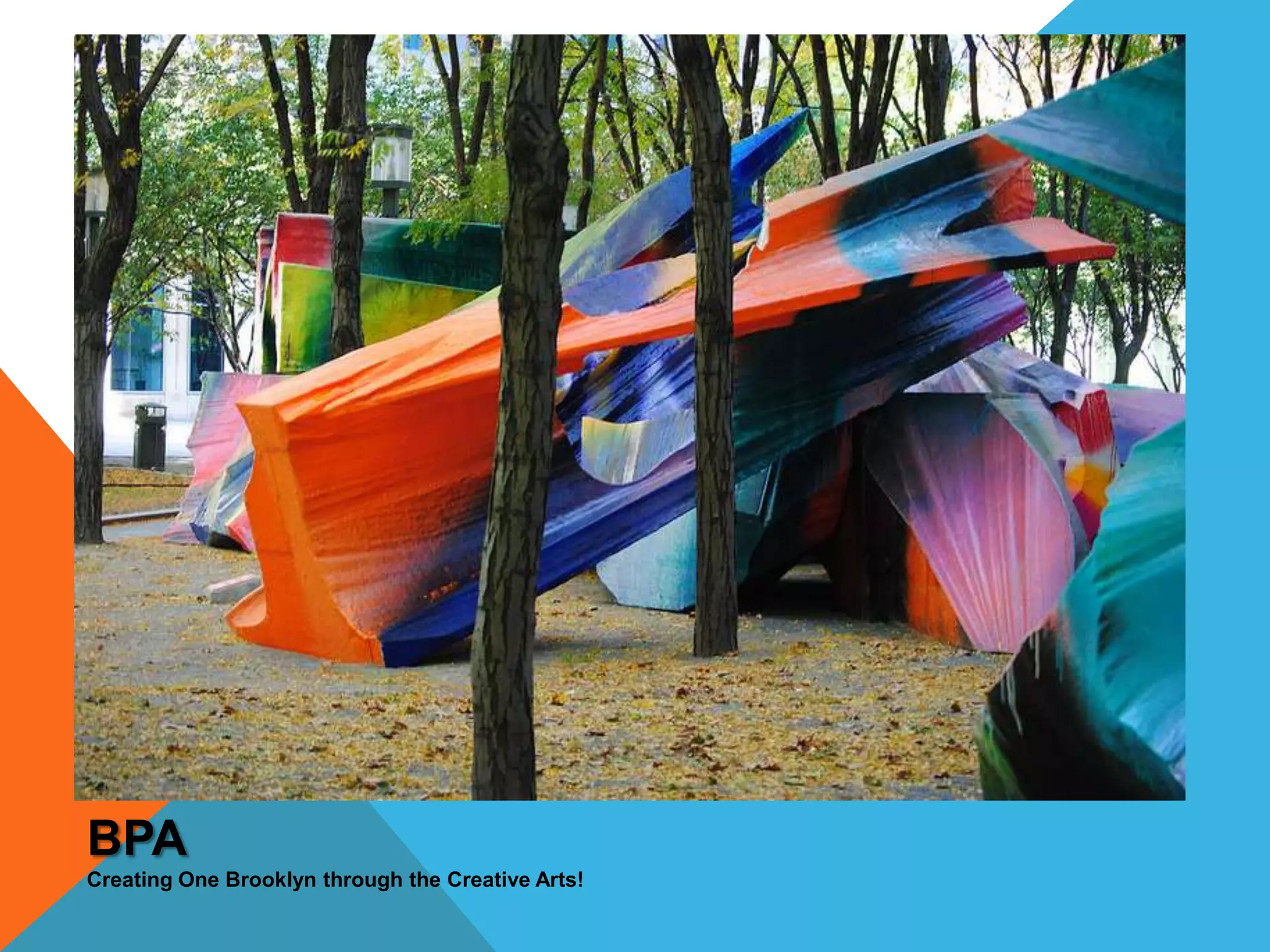
The Borough of Brooklyn is in a unique position to leverage its existing open spaces, parks and rooftops into public art districts.
According to the NYC Department of Parks & Recreation, Brooklyn is home to sixteen featured parks (Adam Yauch Park, Brooklyn
Bridge Park, Canarsie Park, Commodore Barry Park, Coney Island Beach & Boardwalk, Fort Greene Park, Herbert Von King
Park, Kaiser Park, Maria Hernandez Park, Marine Park, McCarren Park, Owl’s Head Park, Prospect Park, Red Hook Recreation
Area, Sunset Park, Wingate Park). Scattered across the borough, these sites are great breeding grounds for public artist. Also
advantageous, are the ten art districts that are located in the neighborhoods of Greenpoint, Williamsburg, Bushwick, BedfordStyuvesant, Red Hook, DUMBO and Downtown, Fort Greene and Clinton Hill, Park Slope, Gowanus and Sunset Park which already
houses galleries, arts organizations and interior designers.
When coupled with nearby business improvement districts, various restaurants, cafes, and retail, Brooklyn can explode economically
even more. Food businesses have transformed Brooklyn and brought meaningful jobs and lifestyles to many who already live here.
Most Americans, still believe that the ―arts‖ are still for the rich and not a necessity of everyday life for average people which is so
wrong.
If the City of New York can make streets pedestrian friendly with bicycles, imagine what public art can do to inspire families wanting a
better life. The possibilities are endless. Innovation will occur.
What will it take to realize this initiative?
• Increasing capacity for small to mid-size arts group
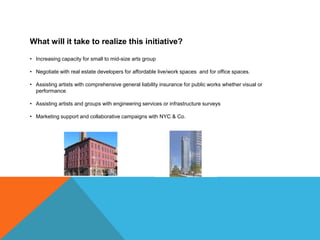
• Negotiate with real estate developers for affordable live/work spaces and for office spaces.
• Assisting artists with comprehensive general liability insurance for public works whether visual or
performance
• Assisting artists and groups with engineering services or infrastructure surveys
• Marketing support and collaborative campaigns with NYC & Co.
Lead Curators

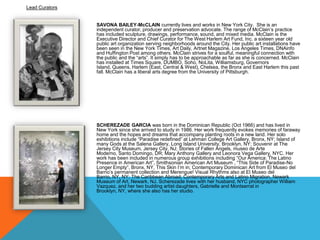
SAVONA BAILEY-McCLAIN currently lives and works in New York City. She is an
independent curator, producer and preservation advocate. The range of McClain’s practice
has included sculpture, drawings, performance, sound, and mixed media. McClain is the
Executive Director and Chief Curator for The West Harlem Art Fund, Inc. a sixteen year old
public art organization serving neighborhoods around the City. Her public art installations have
been seen in the New York Times, Art Daily, Artnet Magazine, Los Angeles Times, DNAinfo
and Huffington Post among others. McClain strives for a soulful, meaningful connection with
the public and the ―arts‖. It simply has to be approachable as far as she is concerned. McClain
has installed at Times Square, DUMBO, Soho, NoLita, Williamsburg, Governors
Island, Queens, Harlem (East, Central & West), Chelsea, the Bronx and East Harlem this past
fall. McClain has a liberal arts degree from the University of Pittsburgh.

SCHEREZADE GARCIA was born in the Dominican Republic (Oct 1966) and has lived in
New York since she arrived to study in 1986. Her work frequently evokes memories of faraway
home and the hopes and dreams that accompany planting roots in a new land. Her solo
exhibitions include ―Paradise redefined‖ at Lehman College Art Gallery, Bronx, NY; Island of
many Gods at the Salena Gallery, Long Island University, Brooklyn, NY; Souvenir at The
Jersey City Museum, Jersey City, NJ; Stories of Fallen Angels, museo de Arte
Moderno, Santo Domingo, DR; Mary Anthony Gallery and Leonora Vega Gallery, NYC. Her
work has been included in numerous group exhibitions including ―Our America: The Latino
Presence in American Art‖, Smithsonian American Art Museum , ―This Side of Paradise-No
Longer Empty―, Bronx, NY, This Skin I’m in; Contemporary Dominican Art from El Museo del
Barrio’s permanent collection and Merengue! Visual Rhythms also at El Museo del
Barrio, NY, NY; The Caribbean Abroad; Contemporary Arts and Latino Migration, Newark
Museum of Art, Newark, NJ. Scherezade lives with her husband, NYC photographer William
Vazquez, and her two budding artist daughters, Gabrielle and Montserrat in
Brooklyn, NY, where she also has her studio.
Case Study

History
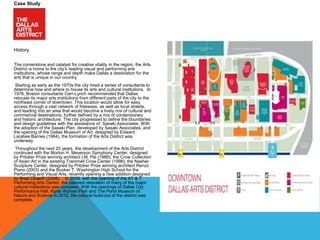
The cornerstone and catalyst for creative vitality in the region, the Arts
District is home to the city’s leading visual and performing arts
institutions, whose range and depth make Dallas a destination for the
arts that is unique in our country.

Starting as early as the 1970s the city hired a series of consultants to
determine how and where to house its arts and cultural institutions. In
1978, Boston consultants Carr-Lynch recommended that Dallas
relocate its major arts institutions from different parts of the city to the
northeast corner of downtown. This location would allow for easy
access through a vast network of freeways, as well as local
streets, and leading into an area that would become a lively mix of
cultural and commercial destinations, further defined by a mix of
contemporary and historic architecture. The city progressed to define
the boundaries and design guidelines with the assistance of Sasaki
Associates. With the adoption of the Sasaki Plan, developed by
Sasaki Associates, and the opening of the Dallas Museum of
Art, designed by Edward Larabee Barnes (1984), the formation of the
Arts District was underway.
Throughout the next 20 years, the development of the Arts District
continued with the Morton H. Meyerson Symphony Center, designed
by Pritzker Prize winning architect I.M. Pei (1989); the Crow Collection
of Asian Art in the existing Trammell Crow Center (1998); the Nasher
Sculpture Center, designed by Pritzker Prize winning architect Renzo
Piano (2003) and the Booker T. Washington High School for the
Performing and Visual Arts, recently opening a new addition designed
by Brad Cloepfil (2008). In 2009, with the opening of the AT & T
Performing Arts Center, the planned relocation of many of the major
cultural institutions was complete. With the openings of Dallas City
Performance Hall, Klyde Warren Park and The Perot Museum of
Nature and Science in 2012, the cultural build-out of the district was
complete.
Public Art
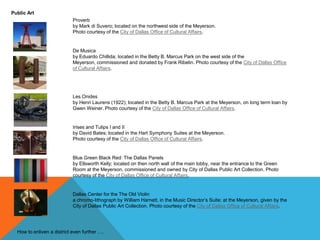
Proverb
by Mark di Suvero; located on the northwest side of the Meyerson.
Photo courtesy of the City of Dallas Office of Cultural Affairs.

De Musica
by Eduardo Chillida; located in the Betty B. Marcus Park on the west side of the
Meyerson, commissioned and donated by Frank Ribelin. Photo courtesy of the City of Dallas Office
of Cultural Affairs.

Les Onides
by Henri Laurens (1922); located in the Betty B. Marcus Park at the Meyerson, on long term loan by
Gwen Weiner. Photo courtesy of the City of Dallas Office of Cultural Affairs.

Irises and Tulips I and II
by David Bates; located in the Hart Symphony Suites at the Meyerson.
Photo courtesy of the City of Dallas Office of Cultural Affairs.

Blue Green Black Red: The Dallas Panels
by Ellsworth Kelly; located on then north wall of the main lobby, near the entrance to the Green
Room at the Meyerson, commissioned and owned by City of Dallas Public Art Collection. Photo
courtesy of the City of Dallas Office of Cultural Affairs.

Dallas Center for the The Old Violin
a chromo-lithograph by William Harnett, in the Music Director’s Suite; at the Meyerson, given by the
City of Dallas Public Art Collection. Photo courtesy of the City of Dallas Office of Cultural Affairs.

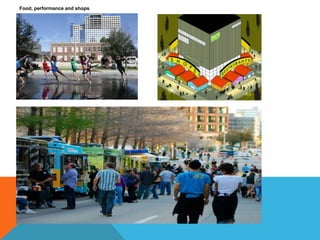
How to enliven a district even further ….
Food, performance and shops
Case Study

History
We were startups before startups were cool.
It all started in 1999, when Wayne State University President Irvin D. Reid decided the city needed an incubator that could help stimulate
the local economy but also further the region’s economic diversification efforts by initially serving technology-based
businesses, including those spun out of the university.

To get the ball rolling, he negotiated partnership agreements with General Motors and Henry Ford Health System. Start-up funding came
from a public, private coalition of local and national sources, with investment totaling approximately $35 million.
As part of its involvement, GM contributed its approximately 140,000-square-foot facility at 440 Burroughs Street. The
structure, designed by famed Detroit architect Albert Kahn in 1927, was first a service department for Pontiac then later became the
Chevrolet Creative Services building. The Corvette was designed on the building’s third floor, and auto show displays were built here as
well.
TechTown incorporated in 2000 and we officially opened our doors to a renovated facility in 2004. Today our work supports industry
verticals that are specific to the region’s inherent assets and address the city’s identified needs, supporting not only tech businesses but
also retail and wholesale enterprises for a more holistic approach to economic development.
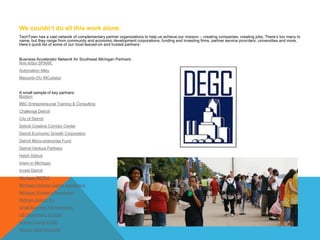
We couldn’t do all this work alone.
TechTown has a vast network of complementary partner organizations to help us achieve our mission – creating companies, creating jobs. There’s too many to
name, but they range from community and economic development corporations, funding and investing firms, partner service providers, universities and more.
Here’s quick list of some of our most leaned-on and trusted partners:

Business Accelerator Network for Southeast Michigan Partners:
Ann Arbor SPARK
Automation Alley
Macomb-OU INCubator

A small sample of key partners:
Bizdom
BBC Entrepreneurial Training & Consulting
Challenge Detroit
City of Detroit
Detroit Creative Corridor Center
Detroit Economic Growth Corporation
Detroit Micro-enterprise Fund
Detroit Venture Partners
Hatch Detroit
Intern in Michigan
Invest Detroit
Michigan SBTDC
Michigan Venture Capital Association

Michigan Women’s Foundation
Midtown Detroit, Inc.
Small Business Administration
US Department of State
Wayne County EDGE
Wayne State University
Case Study

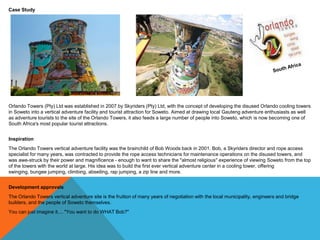
Orlando Towers (Pty) Ltd was established in 2007 by Skyriders (Pty) Ltd, with the concept of developing the disused Orlando cooling towers
in Soweto into a vertical adventure facility and tourist attraction for Soweto. Aimed at drawing local Gauteng adventure enthusiasts as well
as adventure tourists to the site of the Orlando Towers, it also feeds a large number of people into Soweto, which is now becoming one of
South Africa's most popular tourist attractions.

Inspiration
The Orlando Towers vertical adventure facility was the brainchild of Bob Woods back in 2001. Bob, a Skyriders director and rope access
specialist for many years, was contracted to provide the rope access technicians for maintenance operations on the disused towers, and
was awe-struck by their power and magnificence - enough to want to share the "almost religious" experience of viewing Soweto from the top
of the towers with the world at large. His idea was to build the first ever vertical adventure center in a cooling tower, offering
swinging, bungee jumping, climbing, abseiling, rap jumping, a zip line and more.
Development approvals
The Orlando Towers vertical adventure site is the fruition of many years of negotiation with the local municipality, engineers and bridge
builders, and the people of Soweto themselves.
You can just imagine it.... "You want to do WHAT Bob?"
Bob worked together with the Johannesburg Property Company (JPC) until the plans for the Orlando Ekhaya Precinct were launched in
2005. Detailed plans for the Orlando Towers vertical adventure centre were finally approved late in 2007, and a lease agreement was
finally signed in November 2007 for the use of the towers as a vertical adventure facility.
Construction
Ground was broken in January 2008. The lift up the side of the left tower was completed in mid-March, and the stairs and platform
installed by the end of July, in time for the official opening on Saturday 12 July 2008.
The Bungee Bridge
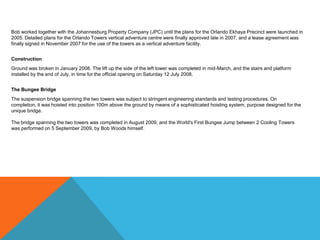
The suspension bridge spanning the two towers was subject to stringent engineering standards and testing procedures. On
completion, it was hoisted into position 100m above the ground by means of a sophisticated hoisting system, purpose designed for the
unique bridge.
The bridge spanning the two towers was completed in August 2009, and the World's First Bungee Jump between 2 Cooling Towers
was performed on 5 September 2009, by Bob Woods himself.
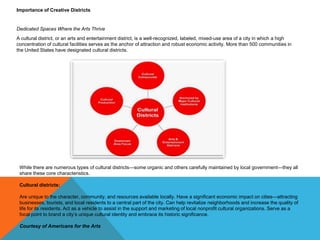
Importance of Creative Districts

Dedicated Spaces Where the Arts Thrive
A cultural district, or an arts and entertainment district, is a well-recognized, labeled, mixed-use area of a city in which a high
concentration of cultural facilities serves as the anchor of attraction and robust economic activity. More than 500 communities in
the United States have designated cultural districts.

While there are numerous types of cultural districts—some organic and others carefully maintained by local government—they all
share these core characteristics.
Cultural districts:
Are unique to the character, community, and resources available locally. Have a significant economic impact on cities—attracting
businesses, tourists, and local residents to a central part of the city. Can help revitalize neighborhoods and increase the quality of
life for its residents. Act as a vehicle to assist in the support and marketing of local nonprofit cultural organizations. Serve as a
focal point to brand a city’s unique cultural identity and embrace its historic significance.
Courtesy of Americans for the Arts
Brooklyn Possibilities
There are 58 communities in Brooklyn with approximately twenty communities that are seriously distressed economically. Capital
investments in those neighborhoods are not plentiful but with art, talks could be had about streetscaping and land use planning.
The most pressing needs for artists regardless of color is: affordable housing, living wage, available workspace, reaching a broad
audience). The entire borough could be transformed. The curators would like to develop these districts under the Office of the
Brooklyn Borough President as consultants or special advisors to work on this initiative for the next three years with pilot projects
to bring about IMMEDIATE RESULTS. When economic development and tourism is tied to the ―arts‖ jobs can be created.
Leverage New Partnerships/Working with seasoned events

BPA -- Brooklyn Public Artworks

  • 1.
    BPA Creating One Brooklynthrough the Creative Arts!
  • 2.
    BROOKLYN PUBLIC ARTWORKS proposedby Savona Bailey-McClain & Scherezade Garcia The Borough of Brooklyn is in a unique position to leverage its existing open spaces, parks and rooftops into public art districts. According to the NYC Department of Parks & Recreation, Brooklyn is home to sixteen featured parks (Adam Yauch Park, Brooklyn Bridge Park, Canarsie Park, Commodore Barry Park, Coney Island Beach & Boardwalk, Fort Greene Park, Herbert Von King Park, Kaiser Park, Maria Hernandez Park, Marine Park, McCarren Park, Owl’s Head Park, Prospect Park, Red Hook Recreation Area, Sunset Park, Wingate Park). Scattered across the borough, these sites are great breeding grounds for public artist. Also advantageous, are the ten art districts that are located in the neighborhoods of Greenpoint, Williamsburg, Bushwick, BedfordStyuvesant, Red Hook, DUMBO and Downtown, Fort Greene and Clinton Hill, Park Slope, Gowanus and Sunset Park which already houses galleries, arts organizations and interior designers. When coupled with nearby business improvement districts, various restaurants, cafes, and retail, Brooklyn can explode economically even more. Food businesses have transformed Brooklyn and brought meaningful jobs and lifestyles to many who already live here. Most Americans, still believe that the ―arts‖ are still for the rich and not a necessity of everyday life for average people which is so wrong. If the City of New York can make streets pedestrian friendly with bicycles, imagine what public art can do to inspire families wanting a better life. The possibilities are endless. Innovation will occur.
  • 3.
    What will ittake to realize this initiative? • Increasing capacity for small to mid-size arts group • Negotiate with real estate developers for affordable live/work spaces and for office spaces. • Assisting artists with comprehensive general liability insurance for public works whether visual or performance • Assisting artists and groups with engineering services or infrastructure surveys • Marketing support and collaborative campaigns with NYC & Co.
  • 4.
    Lead Curators SAVONA BAILEY-McCLAINcurrently lives and works in New York City. She is an independent curator, producer and preservation advocate. The range of McClain’s practice has included sculpture, drawings, performance, sound, and mixed media. McClain is the Executive Director and Chief Curator for The West Harlem Art Fund, Inc. a sixteen year old public art organization serving neighborhoods around the City. Her public art installations have been seen in the New York Times, Art Daily, Artnet Magazine, Los Angeles Times, DNAinfo and Huffington Post among others. McClain strives for a soulful, meaningful connection with the public and the ―arts‖. It simply has to be approachable as far as she is concerned. McClain has installed at Times Square, DUMBO, Soho, NoLita, Williamsburg, Governors Island, Queens, Harlem (East, Central & West), Chelsea, the Bronx and East Harlem this past fall. McClain has a liberal arts degree from the University of Pittsburgh. SCHEREZADE GARCIA was born in the Dominican Republic (Oct 1966) and has lived in New York since she arrived to study in 1986. Her work frequently evokes memories of faraway home and the hopes and dreams that accompany planting roots in a new land. Her solo exhibitions include ―Paradise redefined‖ at Lehman College Art Gallery, Bronx, NY; Island of many Gods at the Salena Gallery, Long Island University, Brooklyn, NY; Souvenir at The Jersey City Museum, Jersey City, NJ; Stories of Fallen Angels, museo de Arte Moderno, Santo Domingo, DR; Mary Anthony Gallery and Leonora Vega Gallery, NYC. Her work has been included in numerous group exhibitions including ―Our America: The Latino Presence in American Art‖, Smithsonian American Art Museum , ―This Side of Paradise-No Longer Empty―, Bronx, NY, This Skin I’m in; Contemporary Dominican Art from El Museo del Barrio’s permanent collection and Merengue! Visual Rhythms also at El Museo del Barrio, NY, NY; The Caribbean Abroad; Contemporary Arts and Latino Migration, Newark Museum of Art, Newark, NJ. Scherezade lives with her husband, NYC photographer William Vazquez, and her two budding artist daughters, Gabrielle and Montserrat in Brooklyn, NY, where she also has her studio.
  • 5.
    Case Study History The cornerstoneand catalyst for creative vitality in the region, the Arts District is home to the city’s leading visual and performing arts institutions, whose range and depth make Dallas a destination for the arts that is unique in our country. Starting as early as the 1970s the city hired a series of consultants to determine how and where to house its arts and cultural institutions. In 1978, Boston consultants Carr-Lynch recommended that Dallas relocate its major arts institutions from different parts of the city to the northeast corner of downtown. This location would allow for easy access through a vast network of freeways, as well as local streets, and leading into an area that would become a lively mix of cultural and commercial destinations, further defined by a mix of contemporary and historic architecture. The city progressed to define the boundaries and design guidelines with the assistance of Sasaki Associates. With the adoption of the Sasaki Plan, developed by Sasaki Associates, and the opening of the Dallas Museum of Art, designed by Edward Larabee Barnes (1984), the formation of the Arts District was underway. Throughout the next 20 years, the development of the Arts District continued with the Morton H. Meyerson Symphony Center, designed by Pritzker Prize winning architect I.M. Pei (1989); the Crow Collection of Asian Art in the existing Trammell Crow Center (1998); the Nasher Sculpture Center, designed by Pritzker Prize winning architect Renzo Piano (2003) and the Booker T. Washington High School for the Performing and Visual Arts, recently opening a new addition designed by Brad Cloepfil (2008). In 2009, with the opening of the AT & T Performing Arts Center, the planned relocation of many of the major cultural institutions was complete. With the openings of Dallas City Performance Hall, Klyde Warren Park and The Perot Museum of Nature and Science in 2012, the cultural build-out of the district was complete.
  • 6.
    Public Art Proverb by Markdi Suvero; located on the northwest side of the Meyerson. Photo courtesy of the City of Dallas Office of Cultural Affairs. De Musica by Eduardo Chillida; located in the Betty B. Marcus Park on the west side of the Meyerson, commissioned and donated by Frank Ribelin. Photo courtesy of the City of Dallas Office of Cultural Affairs. Les Onides by Henri Laurens (1922); located in the Betty B. Marcus Park at the Meyerson, on long term loan by Gwen Weiner. Photo courtesy of the City of Dallas Office of Cultural Affairs. Irises and Tulips I and II by David Bates; located in the Hart Symphony Suites at the Meyerson. Photo courtesy of the City of Dallas Office of Cultural Affairs. Blue Green Black Red: The Dallas Panels by Ellsworth Kelly; located on then north wall of the main lobby, near the entrance to the Green Room at the Meyerson, commissioned and owned by City of Dallas Public Art Collection. Photo courtesy of the City of Dallas Office of Cultural Affairs. Dallas Center for the The Old Violin a chromo-lithograph by William Harnett, in the Music Director’s Suite; at the Meyerson, given by the City of Dallas Public Art Collection. Photo courtesy of the City of Dallas Office of Cultural Affairs. How to enliven a district even further ….
  • 7.
  • 8.
    Case Study History We werestartups before startups were cool. It all started in 1999, when Wayne State University President Irvin D. Reid decided the city needed an incubator that could help stimulate the local economy but also further the region’s economic diversification efforts by initially serving technology-based businesses, including those spun out of the university. To get the ball rolling, he negotiated partnership agreements with General Motors and Henry Ford Health System. Start-up funding came from a public, private coalition of local and national sources, with investment totaling approximately $35 million. As part of its involvement, GM contributed its approximately 140,000-square-foot facility at 440 Burroughs Street. The structure, designed by famed Detroit architect Albert Kahn in 1927, was first a service department for Pontiac then later became the Chevrolet Creative Services building. The Corvette was designed on the building’s third floor, and auto show displays were built here as well. TechTown incorporated in 2000 and we officially opened our doors to a renovated facility in 2004. Today our work supports industry verticals that are specific to the region’s inherent assets and address the city’s identified needs, supporting not only tech businesses but also retail and wholesale enterprises for a more holistic approach to economic development.
  • 9.
    We couldn’t doall this work alone. TechTown has a vast network of complementary partner organizations to help us achieve our mission – creating companies, creating jobs. There’s too many to name, but they range from community and economic development corporations, funding and investing firms, partner service providers, universities and more. Here’s quick list of some of our most leaned-on and trusted partners: Business Accelerator Network for Southeast Michigan Partners: Ann Arbor SPARK Automation Alley Macomb-OU INCubator A small sample of key partners: Bizdom BBC Entrepreneurial Training & Consulting Challenge Detroit City of Detroit Detroit Creative Corridor Center Detroit Economic Growth Corporation Detroit Micro-enterprise Fund Detroit Venture Partners Hatch Detroit Intern in Michigan Invest Detroit Michigan SBTDC Michigan Venture Capital Association Michigan Women’s Foundation Midtown Detroit, Inc. Small Business Administration US Department of State Wayne County EDGE Wayne State University
  • 10.
    Case Study Orlando Towers(Pty) Ltd was established in 2007 by Skyriders (Pty) Ltd, with the concept of developing the disused Orlando cooling towers in Soweto into a vertical adventure facility and tourist attraction for Soweto. Aimed at drawing local Gauteng adventure enthusiasts as well as adventure tourists to the site of the Orlando Towers, it also feeds a large number of people into Soweto, which is now becoming one of South Africa's most popular tourist attractions. Inspiration The Orlando Towers vertical adventure facility was the brainchild of Bob Woods back in 2001. Bob, a Skyriders director and rope access specialist for many years, was contracted to provide the rope access technicians for maintenance operations on the disused towers, and was awe-struck by their power and magnificence - enough to want to share the "almost religious" experience of viewing Soweto from the top of the towers with the world at large. His idea was to build the first ever vertical adventure center in a cooling tower, offering swinging, bungee jumping, climbing, abseiling, rap jumping, a zip line and more. Development approvals The Orlando Towers vertical adventure site is the fruition of many years of negotiation with the local municipality, engineers and bridge builders, and the people of Soweto themselves. You can just imagine it.... "You want to do WHAT Bob?"
  • 11.
    Bob worked togetherwith the Johannesburg Property Company (JPC) until the plans for the Orlando Ekhaya Precinct were launched in 2005. Detailed plans for the Orlando Towers vertical adventure centre were finally approved late in 2007, and a lease agreement was finally signed in November 2007 for the use of the towers as a vertical adventure facility. Construction Ground was broken in January 2008. The lift up the side of the left tower was completed in mid-March, and the stairs and platform installed by the end of July, in time for the official opening on Saturday 12 July 2008. The Bungee Bridge The suspension bridge spanning the two towers was subject to stringent engineering standards and testing procedures. On completion, it was hoisted into position 100m above the ground by means of a sophisticated hoisting system, purpose designed for the unique bridge. The bridge spanning the two towers was completed in August 2009, and the World's First Bungee Jump between 2 Cooling Towers was performed on 5 September 2009, by Bob Woods himself.
  • 12.
    Importance of CreativeDistricts Dedicated Spaces Where the Arts Thrive A cultural district, or an arts and entertainment district, is a well-recognized, labeled, mixed-use area of a city in which a high concentration of cultural facilities serves as the anchor of attraction and robust economic activity. More than 500 communities in the United States have designated cultural districts. While there are numerous types of cultural districts—some organic and others carefully maintained by local government—they all share these core characteristics. Cultural districts: Are unique to the character, community, and resources available locally. Have a significant economic impact on cities—attracting businesses, tourists, and local residents to a central part of the city. Can help revitalize neighborhoods and increase the quality of life for its residents. Act as a vehicle to assist in the support and marketing of local nonprofit cultural organizations. Serve as a focal point to brand a city’s unique cultural identity and embrace its historic significance. Courtesy of Americans for the Arts
  • 13.
    Brooklyn Possibilities There are58 communities in Brooklyn with approximately twenty communities that are seriously distressed economically. Capital investments in those neighborhoods are not plentiful but with art, talks could be had about streetscaping and land use planning. The most pressing needs for artists regardless of color is: affordable housing, living wage, available workspace, reaching a broad audience). The entire borough could be transformed. The curators would like to develop these districts under the Office of the Brooklyn Borough President as consultants or special advisors to work on this initiative for the next three years with pilot projects to bring about IMMEDIATE RESULTS. When economic development and tourism is tied to the ―arts‖ jobs can be created. Leverage New Partnerships/Working with seasoned events