Present Perfect vs.
Past Simple
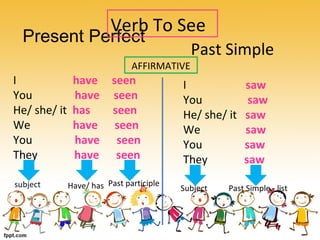
Present Perfect
Verb To See
AFFIRMATIVE
I have seen
You have seen
He/ she/ it has seen
We have seen
You have seen
They have seen
I saw
You saw
He/ she/ it saw
We saw
You saw
They saw
Past Simple
subject Have/ has Past participle
Subject Past Simple - list
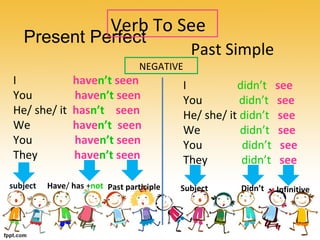
Present Perfect
Verb To See
NEGATIVE
I haven’t seen
You haven’t seen
He/ she/ it hasn’t seen
We haven’t seen
You haven’t seen
They haven’t seen
I didn’t see
You didn’t see
He/ she/ it didn’t see
We didn’t see
You didn’t see
They didn’t see
Past Simple
subject Have/ has +not Past participle Subject Didn’t Infinitive
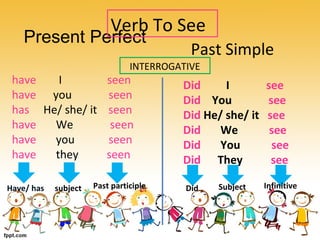
Present Perfect
Verb To See
INTERROGATIVE
have I seen
have you seen
has He/ she/ it seen
have We seen
have you seen
have they seen
Did I see
Did You see
Did He/ she/ it see
Did We see
Did You see
Did They see
Past Simple
Have/ has subject Past participle Did Subject Infinitive
Present
perfect
Past
simple
We don’t say
exactly when
the action
happened.
Present Perfect
We say exactly
when the
action
happened.
Past simple
PRESENT PERFECT
• I have been to London
but I haven’t been to
Oxford.
(past experience)
• I’ve cut my finger.
(recent past action)
• They have been married
for 20 years.
(unfinished states)
PAST SIMPLE
• I was in London last
summer.
(on one specific ocasion)
• I cut my finger last night.
(I say when)
• He was married to Jane
3 years.
(he is not married now)
With the present
perfect, we talk
about the present
results or the
effects of the past
actions.
Present Perfect Past simple
With the past
simple, we talk
about what
happened in the
past.
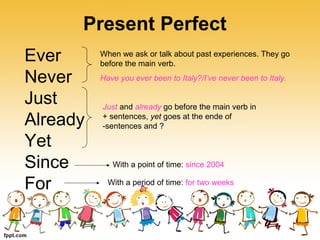
Present Perfect
Ever
Never
Just
Already
Yet
Since
For
When we ask or talk about past experiences. They go
before the main verb.
Have you ever been to Italy?/I’ve never been to Italy.
Just and already go before the main verb in
+ sentences, yet goes at the ende of
-sentences and ?
With a point of time: since 2004
With a period of time: for two weeks
Past simple
Yesterday
Last week/month/year/lesson
3 years ago
1997

Presentperfect vs pastsimple

  • 1.
  • 2.
    Present Perfect Verb ToSee AFFIRMATIVE I have seen You have seen He/ she/ it has seen We have seen You have seen They have seen I saw You saw He/ she/ it saw We saw You saw They saw Past Simple subject Have/ has Past participle Subject Past Simple - list
  • 3.
    Present Perfect Verb ToSee NEGATIVE I haven’t seen You haven’t seen He/ she/ it hasn’t seen We haven’t seen You haven’t seen They haven’t seen I didn’t see You didn’t see He/ she/ it didn’t see We didn’t see You didn’t see They didn’t see Past Simple subject Have/ has +not Past participle Subject Didn’t Infinitive
  • 4.
    Present Perfect Verb ToSee INTERROGATIVE have I seen have you seen has He/ she/ it seen have We seen have you seen have they seen Did I see Did You see Did He/ she/ it see Did We see Did You see Did They see Past Simple Have/ has subject Past participle Did Subject Infinitive
  • 5.
  • 6.
    We don’t say exactlywhen the action happened. Present Perfect We say exactly when the action happened. Past simple
  • 7.
    PRESENT PERFECT • Ihave been to London but I haven’t been to Oxford. (past experience) • I’ve cut my finger. (recent past action) • They have been married for 20 years. (unfinished states) PAST SIMPLE • I was in London last summer. (on one specific ocasion) • I cut my finger last night. (I say when) • He was married to Jane 3 years. (he is not married now)
  • 8.
    With the present perfect,we talk about the present results or the effects of the past actions. Present Perfect Past simple With the past simple, we talk about what happened in the past.
  • 9.
    Present Perfect Ever Never Just Already Yet Since For When weask or talk about past experiences. They go before the main verb. Have you ever been to Italy?/I’ve never been to Italy. Just and already go before the main verb in + sentences, yet goes at the ende of -sentences and ? With a point of time: since 2004 With a period of time: for two weeks
  • 10.