INTRODUCTION
Role-playing is aninteractive teaching method that allows
learners to act out real-life scenarios in a controlled
environment. This method encourages active learning,
improves communication, and builds confidence in handling
complex or high-pressure situations.
3.
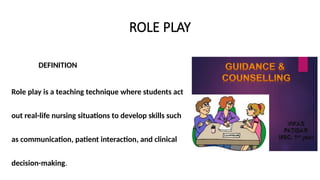
ROLE PLAY
DEFINITION
Role playis a teaching technique where students act
out real-life nursing situations to develop skills such
as communication, patient interaction, and clinical
decision-making.
4.
TYPE OF ROLEPLAY
1. Multiple role play
2. Single role play
3. Role rotation
4. Spontaneous role play
5.
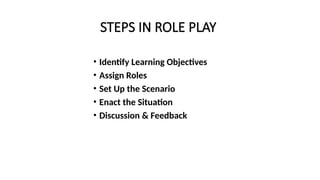
STEPS IN ROLEPLAY
• Identify Learning Objectives
• Assign Roles
• Set Up the Scenario
• Enact the Situation
• Discussion & Feedback
6.
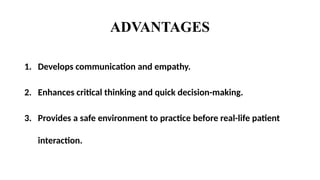
ADVANTAGES
1. Develops communicationand empathy.
2. Enhances critical thinking and quick decision-making.
3. Provides a safe environment to practice before real-life patient
interaction.
7.
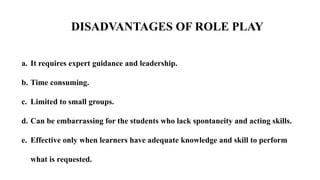
a. It requiresexpert guidance and leadership.
b. Time consuming.
c. Limited to small groups.
d. Can be embarrassing for the students who lack spontaneity and acting skills.
e. Effective only when learners have adequate knowledge and skill to perform
what is requested.
DISADVANTAGES OF ROLE PLAY
8.
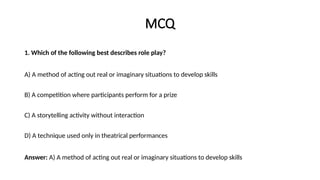
MCQ
1. Which ofthe following best describes role play?
A) A method of acting out real or imaginary situations to develop skills
B) A competition where participants perform for a prize
C) A storytelling activity without interaction
D) A technique used only in theatrical performances
Answer: A) A method of acting out real or imaginary situations to develop skills
9.
2. Which skillis most commonly developed through role play?
A) Physical strength
B) Communication and decision-making
C) Mathematical calculations
D) Memorization skills
Answer: B) Communication and decision-making
10.
3. Which ofthe following is a common use of role play in professional
training?
A) Practicing real-world scenarios to improve job-related skills
B) Watching training videos without participation
C) Reading theoretical concepts without discussion
D) Avoiding interaction with colleagues
Answer: A) Practicing real-world scenarios to improve job-related skills
11.
PROJECT METHOD
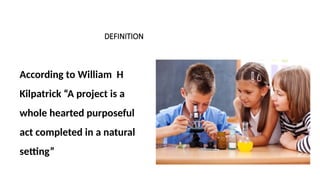
This methodis based on the philosophy pragmatism and
it is based on the principle of learning by doing
developed by William H Kilpatrick. The project method
is a student-centered approach which is done in a
natural setting
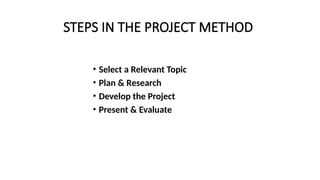
STEPS IN THEPROJECT METHOD
• Select a Relevant Topic
• Plan & Research
• Develop the Project
• Present & Evaluate
14.
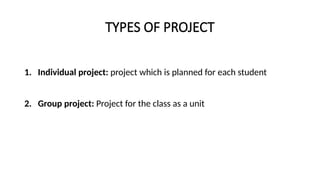
TYPES OF PROJECT
1.Individual project: project which is planned for each student
2. Group project: Project for the class as a unit
15.
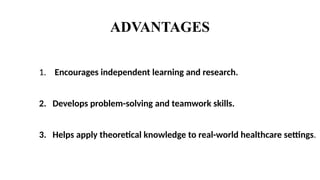
ADVANTAGES
1. Encourages independentlearning and research.
2. Develops problem-solving and teamwork skills.
3. Helps apply theoretical knowledge to real-world healthcare settings.
16.
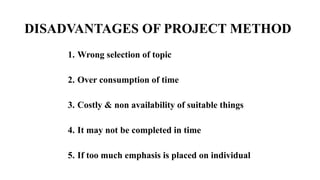
DISADVANTAGES OF PROJECTMETHOD
1. Wrong selection of topic
2. Over consumption of time
3. Costly & non availability of suitable things
4. It may not be completed in time
5. If too much emphasis is placed on individual
17.
MCQ
1. What isthe Project Method in nursing education primarily focused on?
A) Encouraging students to learn through real-life projects and problem-solving
B) Relying solely on lecture-based teaching
C) Memorizing nursing theories without application
D) Eliminating group activities from learning
Answer: A) Encouraging students to learn through real-life projects and problem-solving
18.
2. Which ofthe following is a key characteristic of the Project Method?
A) Students work on practical, real-world problems
B) Teachers provide all the answers without student involvement
C) Learning occurs only through passive listening
D) Individual learning is discouraged
Answer: A) Students work on practical, real-world problems
19.
3. What isone major advantage of the Project Method in nursing education?
A) It enhances critical thinking and problem-solving skills
B) It removes the need for practical training
C) It only focuses on theoretical learning
D) It discourages teamwork and collaboration
Answer: A) It enhances critical thinking and problem-solving skills
20.
FIELD TRIP METHOD
Fieldvisit as a means to teaching-learning activity was used by
Socrates and Aristotle as an important part of the instruction. The
educational field visit serves as a first hand source of information and
knowledge as the student will have a direct contact with the
situation.
A field trip allows nursing students to visit healthcare facilities or
community settings to observe and learn real-world applications of
nursing concepts.
21.
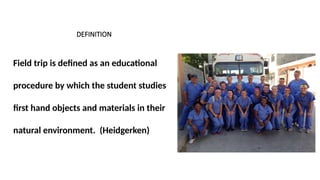
DEFINITION
Field trip isdefined as an educational
procedure by which the student studies
first hand objects and materials in their
natural environment. (Heidgerken)
STEPS IN AFIELD TRIP
1. Identify a Learning Goal
2. Plan Logistics
3. Prepare Students
4. Visit the Location
5. Post-Trip Reflection
24.
ADVANTAGES
1. Provides real-worldexposure to clinical settings.
2. Helps students connect theory with practical nursing.
3. Improves observation and reporting skills.
25.
DISADVANTAGES
1. logistic issuesuch as transportation may cause inconvenience
2. Most field visits require more than one class period
3. Lack of support from school administrations for field trips
4. Difficulty in controlling student.
26.
MCQ
1. What isthe primary purpose of a field trip in nursing education?
A) To provide hands-on experience in real-world healthcare settings
B) To replace classroom lectures entirely
C) To give students a break from studies
D) To test students' memory of theoretical concepts
Answer: A) To provide hands-on experience in real-world healthcare settings
27.
2. Who amongthe following used field trip as method of teaching learning in
education?
A) Socrates and Aristotle
B) William H Patrick
C) Heidgerken
D) John Dewy
Answer: A) Socrates and Aristotle
28.
3. What isa potential challenge of organizing a field trip?
A) Logistical issues such as transportation and scheduling
B) Students learning too much in a short time
C) Lack of interest from students in real-world experiences
D) The field trip eliminating the need for further study
Answer: A) Logistical issues such as transportation and scheduling
29.
CONCLUSION
Field trips area valuable method of experiential learning, contributing
to the holistic development of students and leaving a lasting impact
on their educational journey



![2nd yr bsc[n] cet ppt-methods of teaching -nsg education](https://cdn.slidesharecdn.com/ss_thumbnails/2ndyrbscncet-ppt-methodsofteaching-nsgeducation-200426055039-thumbnail.jpg?width=640&height=640&fit=bounds)


![ONFH[AVN HIP] -TRIPLE REGIME -A NOVAL SURGICAL CONCEPT .pptx](https://cdn.slidesharecdn.com/ss_thumbnails/onfhavnhip2026koaconcalicutdrgokuldevdrmashraf-260210064517-213ec005-thumbnail.jpg?width=640&height=640&fit=bounds)


