Abstract
The packing problem is very important to manufacturing
industry. This paper deals with the problem of searching
for the densest lattice packing of identical parts on the
rectangular sheet and proposes a new approach to the
nesting problems of nearly identical or similar parts. A
new nesting technique has been developed by
incorporating a lattice packing algorithm in order to find
the best arrangements for similar parts. Based on the
lattice structure, parts are placed on the sheet by utilising
hodograph and contour matching techniques. This paper
is a first approach to the use of lattice packing in the
solution of similar part nesting. The proposed algorithm
has useful applications in industry, particularly clothing
manufacture. The example of solving of the real
problem is given.
Keywords: Lattice packing, Nesting
1. Introduction
Packing problems are optimization problems concerned
with finding good arrangement of multiple items without
overlap in larger containing regions. This type of
problem is encountered in many areas of business and
industry. The objective of the packing process is to
maximize the utilization of material. A classification
and up−to−date bibliographies on the 2D packing
problems can be found in [1].
The lattice packing problem is the task to find a
lattice of minimal determinant. The ratio of the area of
the object to the determinant of such an optimal lattice is
called the density of a densest lattice packing. It can be
interpreted as the maximal proportion of the space that
can be occupied by non−overlapping lattice translates of
the object. The problems of lattice packing of geometric
objects were considered in the works of Refs. [2,3,4].
In some industrial packing problems, the large set of
parts consists of several sets of parts which are much
smaller than the container. Furthermore, the parts can
vary somewhat in size and shape according to the needs
of customers. This paper addresses these aspects of the
actual layout problem based on the densest lattice
packing algorithm as well.
2. Definitions, Background and Lattice
Packing
2.1 Minkowski Sum and Hodograph
The Minkowski sum and difference are powerful and
effective preprocessing tools for polygon intersection
and packing problems. Comprehensive descriptions of
the algorithm have been presented in [5,6,7].
The shape of parts to be placed is approximated as a
polygon with n vertices. As the number of vertices
increases, curved edges on the blank can be
approximated to any desired accuracy. Given two
polygons, A and B, the Minkowski sum is defined as the
summation of each point in A with each point in B,
A ⊕ B = {a + b | a ∈ A, b ∈ B} (1)
The Minkowski difference is defined as
A B = {a − b | a ∈ A, b ∈ B} (2)
Let −A = 2
 A denote the se complement of A.
−A = {−a | a ∈ A} (3)
defines a point reflection of A at the origin. The
hodograph Hij of a polygon Si relative to a Sj, 1≤i,j≤k,
can be defined by using the Minkowski sum:
Hij = −(Sj ⊕ −(Si bi)) (4)
The hodograph Hij is the set of points in 2
onto which
the reference point bi of Si can be placed such that Si
and Sj do not overlap. Both Si and Sj must not be
rotated. For lattice packing, the same polygon is
repeated on the sheet. So polygons Si and Sj are same
ones. Boundary of the hodograph Hij can be called in
some ways such as a dense placement function, 0−level
surface of the Φ−function[2,3] or No−fit−Polygon[8].
Fig. 1. Example of a hodograph Hij (shade area) of a
polygon Si relative to a polygon Sj and its boundary for
dense lattice packing.
Fig. 1 shows an example of hodograph for two identical
polygons Si and Sj. Boundary of hodograph is the locus
of points traced by the reference point of Si (the orbital
polygon) when it slides along the contour of Sj (the
stationary polygon). The use of hodograph makes to get
a feasible(without intersecting) and dense layout.
Lattice Based Packing of 2D Similar Parts
Guk−Chan Han
Institute for Algorithms and Scientific Computing(SCAI)
Fraunhofer, Schloss Birlinghoven, 53757 Sankt Augustin, Germany
Email: Guk−Chan.Han@scai.fhg.de
2.2. Lattice and Lattice Packing
If l1, l2 ∈R2
are linearly independent, a set of vectors
r = n l1 + m l2, n,m={0, ±1, ±2, ...} (5)
is called a lattice with the basis l1, l2 and is denoted by
L=Λ(l1, l2) where Λ is the operator mapping a set of
pairs of vectors at a set of families of the form (5). The
absolute value of the determinant composed of the
coordinates of the lattice basis vectors is call the the
lattice determinant and is denoted by del L, i.e.
det Λ((l1x, l1y ),(l2x, l2y )) = abs(l1x • l2y − l1y • l2x) (6)
According to Eq. (5) the density of a lattice packing
δ(L) = s / det L, where s is the area of S. The pair
W=(L,L + b) of two lattices L and L+ b, b= (bx, by)
where L + b is the translation of the L onto the vector b,
is called a double lattice. Double lattice packing can be
considered as the lattice packing of Sb
= S0
∪ S1
(b),
where S1
can be obtained by the rotation of the other
polygon S0
about the angle π.
With account of Eq. (4) and Eq. (6), the problem of
finding the maximal density lattice packing in the plane
can be defined as to minimize det Λ(l1, l2 ) where Si has
to be placed on the boundary of Hij .
2.3 Construction of Lattice Structure
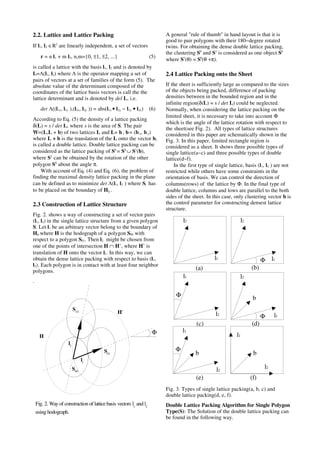
Fig. 2. shows a way of constructing a set of vector pairs
(l1, l2) in the single lattice structure from a given polygon
S. Let l1 be an arbitrary vector belong to the boundary of
H, where H is the hodograph of a polygon S00 with
respect to a polygon S01. Then l2 might be chosen from
one of the points of intersection H ∩ H’, where H’ is
translation of H onto the vector l1. In this way, we can
obtain the dense lattice packing with respect to basis (l1,
l2). Each polygon is in contact with at least four neighbor
polygons.
.
A general "rule of thumb" in hand layout is that it is
good to pair polygons with their 180−degree rotated
twins. For obtaining the dense double lattice packing,
the clustering S0
and S1
is considered as one object Sb
where S1
(θ) = S0
(θ +π).
2.4 Lattice Packing onto the Sheet
If the sheet is sufficiently large as compared to the sizes
of the objects being packed, difference of packing
densities between in the bounded region and in the
infinite region(δ(L) = s / det L) could be neglected.
Normally, when considering the lattice packing on the
limited sheet, it is necessary to take into account Φ
which is the angle of the lattice rotation with respect to
the sheet(see Fig. 2). All types of lattice structures
considered in this paper are schematically shown in the
Fig. 3. In this paper, limited rectangle region is
considered as a sheet. It shows three possible types of
single lattice(a~c) and three possible types of double
lattice(d~f).
In the first type of single lattice, basis (l1, l2 ) are not
restricted while others have some constraints in the
orientation of basis. We can control the direction of
columns(rows) of the lattice by Φ. In the final type of
double lattice, columns and lows are parallel to the both
sides of the sheet. In this case, only clustering vector b is
the control parameter for constructing densest lattice
structure.
Fig. 3. Types of single lattice packing(a, b, c) and
double lattice packing(d, e, f).
Double Lattice Packing Algorithm for Single Polygon
Type(S): The Solution of the double lattice packing can
be found in the following way.
l1
l2
l1
l2
Φ
l2
l1
Φ
l1
l2
Φ
b
l2
l1
Φ
b
l2
l1
b
l1
l2
S00
S01
S10
H
H’
Φ
Fig. 2. Way of construction of lattice basis vectors l1
and l2
using hodograph.
(a) (b)
(c) (d)
(e) (f)
1. For each polygon angle, construct hodograph H of S
relative to S.
2. For each clustering vector b that belong to the
hodograph H:
2.1. Unify two pieces Sb
= S(θ) ∩ S(θ +π).
2.2. Construct hodograph Hb
of Sb
relative to Sb
.
2.3. Calculate lattice basis (l1, l2 ) which belong to
the hodograph Hb
.
2.4. Calculate packing density.
2.5. Renew record and proceed to the next clustering
vector.
3. Select the densest lattice packing.
3. Application of Lattice Packing to Similar
Parts
In some industrial layout problems, the parts to be
placed vary somewhat in size and shape even they are in
the same geometric group. This paper deals with a
heuristic way to generate good industrial layouts from
the densest lattice packing technique for the nearly
identical parts in which their similarity is high. In this
paper, we use a constructive layout which involve
gradually building a solution by adding a new part at
each step. The best strategy we have found is to place
the larger part early in the placement process to keep
fairly good regular structure. According to the dense
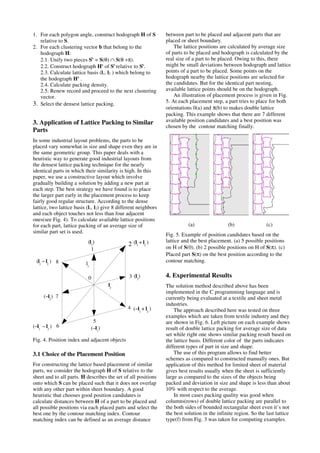
lattice, two lattice basis (l1, l2) give 8 different neighbors
and each object touches not less than four adjacent
ones(see Fig. 4). To calculate available lattice positions
for each part, lattice packing of an average size of
similar part set is used.
Fig. 4. Position index and adjacent objects
3.1 Choice of the Placement Position
For constructing the lattice based placement of similar
parts, we consider the hodograph H of S relative to the
sheet and to all parts. H describes the set of all positions
onto which S can be placed such that it does not overlap
with any other part within sheet boundary. A good
heuristic that chooses good position candidates is
calculate distances between H of a part to be placed and
all possible positions via each placed parts and select the
best one by the contour matching index. Contour
matching index can be defined as an average distance
between part to be placed and adjacent parts that are
placed or sheet boundary.
The lattice positions are calculated by average size
of parts to be placed and hodograph is calculated by the
real size of a part to be placed. Owing to this, there
might be small deviations between hodograph and lattice
points of a part to be placed. Some points on the
hodograph nearby the lattice positions are selected for
the candidates. But for the identical part nesting,
available lattice points should be on the hodograph.
An illustration of placement process is given in Fig.
5. At each placement step, a part tries to place for both
orientations 0(a) and π(b) to makes double lattice
packing. This example shows that there are 7 different
available position candidates and a best position was
chosen by the contour matching finally.
(a) (b) (c)
Fig. 5. Example of position candidates based on the
lattice and the best placement. (a) 5 possible positions
on H of S(0). (b) 2 possible positions on H of S(π). (c)
Placed part S(π) on the best position according to the
contour matching.
4. Experimental Results
The solution method described above has been
implemented in the C programming language and is
currently being evaluated at a textile and sheet metal
industries.
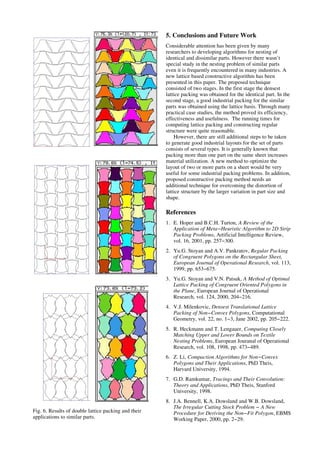
The approach described here was tested on three
examples which are taken from textile industry and they
are shown in Fig. 6. Left picture on each example shows
result of double lattice packing for average size of data
set while right one shows similar packing result based on
the lattice basis. Different color of the parts indicates
different types of part in size and shape.
The use of this program allows to find better
schemes as compared to constructed manually ones. But
application of this method for limited sheet of material
gives best results usually when the sheet is sufficiently
large as compared to the sizes of the objects being
packed and deviation in size and shape is less than about
10% with respect to the average.
In most cases packing quality was good when
columns(rows) of double lattice packing are parallel to
the both sides of bounded rectangular sheet even it’s not
the best solution in the infinite region. So the last lattice
type(f) from Fig. 3 was taken for computing examples.
0
1
2
3
4
5
6
7
8
l2
l1
(l1
+ l2
)
(−l1
+ l2
)
(−l1
− l2
)
(l1
− l2
)
(−l1
)
(−l2
)
(l1
)
(l2
)
Fig. 6. Results of double lattice packing and their
applications to similar parts.
5. Conclusions and Future Work
Considerable attention has been given by many
researchers to developing algorithms for nesting of
identical and dissimilar parts. However there wasn’t
special study in the nesting problem of similar parts
even it is frequently encountered in many industries. A
new lattice based constructive algorithm has been
presented in this paper. The proposed technique
consisted of two stages. In the first stage the densest
lattice packing was obtained for the identical part. In the
second stage, a good industrial packing for the similar
parts was obtained using the lattice basis. Through many
practical case studies, the method proved its efficiency,
effectiveness and usefulness. The running times for
computing lattice packing and constructing regular
structure were quite reasonable.
However, there are still additional steps to be taken
to generate good industrial layouts for the set of parts
consists of several types. It is generally known that
packing more than one part on the same sheet increases
material utilization. A new method to optimize the
layout of two or more parts on a sheet would be very
useful for some industrial packing problems. In addition,
proposed constructive packing method needs an
additional technique for overcoming the distortion of
lattice structure by the larger variation in part size and
shape.
References
1. E. Hoper and B.C.H. Turton, A Review of the
Application of Meta−Heuristic Algorithm to 2D Strip
Packing Problems, Artificial Intelligence Review,
vol. 16, 2001, pp. 257−300.
2. Yu.G. Stoyan and A.V. Pankratov, Regular Packing
of Congruent Polygons on the Rectangular Sheet,
European Journal of Operational Research, vol. 113,
1999, pp. 653−675.
3. Yu.G. Stoyan and V.N. Patsuk, A Method of Optimal
Lattice Packing of Congruent Oriented Polygons in
the Plane, European Journal of Operational
Research, vol. 124, 2000, 204−216.
4. V.J. Milenkovic, Densest Translational Lattice
Packing of Non−Convex Polygons, Computational
Geometry, vol. 22, no. 1−3, Jane 2002, pp. 205−222.
5. R. Heckmann and T. Lengauer, Computing Closely
Matching Upper and Lower Bounds on Textile
Nesting Problems, European Jouranal of Operational
Research, vol. 108, 1998, pp. 473−489.
6. Z. Li, Compaction Algorithms for Non−Convex
Polygons and Their Applications, PhD Theis,
Harvard University, 1994.
7. G.D. Ramkumar, Tracings and Their Convolution:
Theory and Applications, PhD Theis, Stanford
University, 1998.
8. J.A. Bennell, K.A. Dowsland and W.B. Dowsland,
The Irregular Cutting Stock Problem − A New
Procedure for Deriving the Non−Fit Polygon, EBMS
Working Paper, 2000, pp. 2−29.

presentation-geseke

  • 1.
    Abstract The packing problemis very important to manufacturing industry. This paper deals with the problem of searching for the densest lattice packing of identical parts on the rectangular sheet and proposes a new approach to the nesting problems of nearly identical or similar parts. A new nesting technique has been developed by incorporating a lattice packing algorithm in order to find the best arrangements for similar parts. Based on the lattice structure, parts are placed on the sheet by utilising hodograph and contour matching techniques. This paper is a first approach to the use of lattice packing in the solution of similar part nesting. The proposed algorithm has useful applications in industry, particularly clothing manufacture. The example of solving of the real problem is given. Keywords: Lattice packing, Nesting 1. Introduction Packing problems are optimization problems concerned with finding good arrangement of multiple items without overlap in larger containing regions. This type of problem is encountered in many areas of business and industry. The objective of the packing process is to maximize the utilization of material. A classification and up−to−date bibliographies on the 2D packing problems can be found in [1]. The lattice packing problem is the task to find a lattice of minimal determinant. The ratio of the area of the object to the determinant of such an optimal lattice is called the density of a densest lattice packing. It can be interpreted as the maximal proportion of the space that can be occupied by non−overlapping lattice translates of the object. The problems of lattice packing of geometric objects were considered in the works of Refs. [2,3,4]. In some industrial packing problems, the large set of parts consists of several sets of parts which are much smaller than the container. Furthermore, the parts can vary somewhat in size and shape according to the needs of customers. This paper addresses these aspects of the actual layout problem based on the densest lattice packing algorithm as well. 2. Definitions, Background and Lattice Packing 2.1 Minkowski Sum and Hodograph The Minkowski sum and difference are powerful and effective preprocessing tools for polygon intersection and packing problems. Comprehensive descriptions of the algorithm have been presented in [5,6,7]. The shape of parts to be placed is approximated as a polygon with n vertices. As the number of vertices increases, curved edges on the blank can be approximated to any desired accuracy. Given two polygons, A and B, the Minkowski sum is defined as the summation of each point in A with each point in B, A ⊕ B = {a + b | a ∈ A, b ∈ B} (1) The Minkowski difference is defined as A B = {a − b | a ∈ A, b ∈ B} (2) Let −A = 2 A denote the se complement of A. −A = {−a | a ∈ A} (3) defines a point reflection of A at the origin. The hodograph Hij of a polygon Si relative to a Sj, 1≤i,j≤k, can be defined by using the Minkowski sum: Hij = −(Sj ⊕ −(Si bi)) (4) The hodograph Hij is the set of points in 2 onto which the reference point bi of Si can be placed such that Si and Sj do not overlap. Both Si and Sj must not be rotated. For lattice packing, the same polygon is repeated on the sheet. So polygons Si and Sj are same ones. Boundary of the hodograph Hij can be called in some ways such as a dense placement function, 0−level surface of the Φ−function[2,3] or No−fit−Polygon[8]. Fig. 1. Example of a hodograph Hij (shade area) of a polygon Si relative to a polygon Sj and its boundary for dense lattice packing. Fig. 1 shows an example of hodograph for two identical polygons Si and Sj. Boundary of hodograph is the locus of points traced by the reference point of Si (the orbital polygon) when it slides along the contour of Sj (the stationary polygon). The use of hodograph makes to get a feasible(without intersecting) and dense layout. Lattice Based Packing of 2D Similar Parts Guk−Chan Han Institute for Algorithms and Scientific Computing(SCAI) Fraunhofer, Schloss Birlinghoven, 53757 Sankt Augustin, Germany Email: Guk−Chan.Han@scai.fhg.de
  • 2.
    2.2. Lattice andLattice Packing If l1, l2 ∈R2 are linearly independent, a set of vectors r = n l1 + m l2, n,m={0, ±1, ±2, ...} (5) is called a lattice with the basis l1, l2 and is denoted by L=Λ(l1, l2) where Λ is the operator mapping a set of pairs of vectors at a set of families of the form (5). The absolute value of the determinant composed of the coordinates of the lattice basis vectors is call the the lattice determinant and is denoted by del L, i.e. det Λ((l1x, l1y ),(l2x, l2y )) = abs(l1x • l2y − l1y • l2x) (6) According to Eq. (5) the density of a lattice packing δ(L) = s / det L, where s is the area of S. The pair W=(L,L + b) of two lattices L and L+ b, b= (bx, by) where L + b is the translation of the L onto the vector b, is called a double lattice. Double lattice packing can be considered as the lattice packing of Sb = S0 ∪ S1 (b), where S1 can be obtained by the rotation of the other polygon S0 about the angle π. With account of Eq. (4) and Eq. (6), the problem of finding the maximal density lattice packing in the plane can be defined as to minimize det Λ(l1, l2 ) where Si has to be placed on the boundary of Hij . 2.3 Construction of Lattice Structure Fig. 2. shows a way of constructing a set of vector pairs (l1, l2) in the single lattice structure from a given polygon S. Let l1 be an arbitrary vector belong to the boundary of H, where H is the hodograph of a polygon S00 with respect to a polygon S01. Then l2 might be chosen from one of the points of intersection H ∩ H’, where H’ is translation of H onto the vector l1. In this way, we can obtain the dense lattice packing with respect to basis (l1, l2). Each polygon is in contact with at least four neighbor polygons. . A general "rule of thumb" in hand layout is that it is good to pair polygons with their 180−degree rotated twins. For obtaining the dense double lattice packing, the clustering S0 and S1 is considered as one object Sb where S1 (θ) = S0 (θ +π). 2.4 Lattice Packing onto the Sheet If the sheet is sufficiently large as compared to the sizes of the objects being packed, difference of packing densities between in the bounded region and in the infinite region(δ(L) = s / det L) could be neglected. Normally, when considering the lattice packing on the limited sheet, it is necessary to take into account Φ which is the angle of the lattice rotation with respect to the sheet(see Fig. 2). All types of lattice structures considered in this paper are schematically shown in the Fig. 3. In this paper, limited rectangle region is considered as a sheet. It shows three possible types of single lattice(a~c) and three possible types of double lattice(d~f). In the first type of single lattice, basis (l1, l2 ) are not restricted while others have some constraints in the orientation of basis. We can control the direction of columns(rows) of the lattice by Φ. In the final type of double lattice, columns and lows are parallel to the both sides of the sheet. In this case, only clustering vector b is the control parameter for constructing densest lattice structure. Fig. 3. Types of single lattice packing(a, b, c) and double lattice packing(d, e, f). Double Lattice Packing Algorithm for Single Polygon Type(S): The Solution of the double lattice packing can be found in the following way. l1 l2 l1 l2 Φ l2 l1 Φ l1 l2 Φ b l2 l1 Φ b l2 l1 b l1 l2 S00 S01 S10 H H’ Φ Fig. 2. Way of construction of lattice basis vectors l1 and l2 using hodograph. (a) (b) (c) (d) (e) (f)
  • 3.
    1. For eachpolygon angle, construct hodograph H of S relative to S. 2. For each clustering vector b that belong to the hodograph H: 2.1. Unify two pieces Sb = S(θ) ∩ S(θ +π). 2.2. Construct hodograph Hb of Sb relative to Sb . 2.3. Calculate lattice basis (l1, l2 ) which belong to the hodograph Hb . 2.4. Calculate packing density. 2.5. Renew record and proceed to the next clustering vector. 3. Select the densest lattice packing. 3. Application of Lattice Packing to Similar Parts In some industrial layout problems, the parts to be placed vary somewhat in size and shape even they are in the same geometric group. This paper deals with a heuristic way to generate good industrial layouts from the densest lattice packing technique for the nearly identical parts in which their similarity is high. In this paper, we use a constructive layout which involve gradually building a solution by adding a new part at each step. The best strategy we have found is to place the larger part early in the placement process to keep fairly good regular structure. According to the dense lattice, two lattice basis (l1, l2) give 8 different neighbors and each object touches not less than four adjacent ones(see Fig. 4). To calculate available lattice positions for each part, lattice packing of an average size of similar part set is used. Fig. 4. Position index and adjacent objects 3.1 Choice of the Placement Position For constructing the lattice based placement of similar parts, we consider the hodograph H of S relative to the sheet and to all parts. H describes the set of all positions onto which S can be placed such that it does not overlap with any other part within sheet boundary. A good heuristic that chooses good position candidates is calculate distances between H of a part to be placed and all possible positions via each placed parts and select the best one by the contour matching index. Contour matching index can be defined as an average distance between part to be placed and adjacent parts that are placed or sheet boundary. The lattice positions are calculated by average size of parts to be placed and hodograph is calculated by the real size of a part to be placed. Owing to this, there might be small deviations between hodograph and lattice points of a part to be placed. Some points on the hodograph nearby the lattice positions are selected for the candidates. But for the identical part nesting, available lattice points should be on the hodograph. An illustration of placement process is given in Fig. 5. At each placement step, a part tries to place for both orientations 0(a) and π(b) to makes double lattice packing. This example shows that there are 7 different available position candidates and a best position was chosen by the contour matching finally. (a) (b) (c) Fig. 5. Example of position candidates based on the lattice and the best placement. (a) 5 possible positions on H of S(0). (b) 2 possible positions on H of S(π). (c) Placed part S(π) on the best position according to the contour matching. 4. Experimental Results The solution method described above has been implemented in the C programming language and is currently being evaluated at a textile and sheet metal industries. The approach described here was tested on three examples which are taken from textile industry and they are shown in Fig. 6. Left picture on each example shows result of double lattice packing for average size of data set while right one shows similar packing result based on the lattice basis. Different color of the parts indicates different types of part in size and shape. The use of this program allows to find better schemes as compared to constructed manually ones. But application of this method for limited sheet of material gives best results usually when the sheet is sufficiently large as compared to the sizes of the objects being packed and deviation in size and shape is less than about 10% with respect to the average. In most cases packing quality was good when columns(rows) of double lattice packing are parallel to the both sides of bounded rectangular sheet even it’s not the best solution in the infinite region. So the last lattice type(f) from Fig. 3 was taken for computing examples. 0 1 2 3 4 5 6 7 8 l2 l1 (l1 + l2 ) (−l1 + l2 ) (−l1 − l2 ) (l1 − l2 ) (−l1 ) (−l2 ) (l1 ) (l2 )
  • 4.
    Fig. 6. Resultsof double lattice packing and their applications to similar parts. 5. Conclusions and Future Work Considerable attention has been given by many researchers to developing algorithms for nesting of identical and dissimilar parts. However there wasn’t special study in the nesting problem of similar parts even it is frequently encountered in many industries. A new lattice based constructive algorithm has been presented in this paper. The proposed technique consisted of two stages. In the first stage the densest lattice packing was obtained for the identical part. In the second stage, a good industrial packing for the similar parts was obtained using the lattice basis. Through many practical case studies, the method proved its efficiency, effectiveness and usefulness. The running times for computing lattice packing and constructing regular structure were quite reasonable. However, there are still additional steps to be taken to generate good industrial layouts for the set of parts consists of several types. It is generally known that packing more than one part on the same sheet increases material utilization. A new method to optimize the layout of two or more parts on a sheet would be very useful for some industrial packing problems. In addition, proposed constructive packing method needs an additional technique for overcoming the distortion of lattice structure by the larger variation in part size and shape. References 1. E. Hoper and B.C.H. Turton, A Review of the Application of Meta−Heuristic Algorithm to 2D Strip Packing Problems, Artificial Intelligence Review, vol. 16, 2001, pp. 257−300. 2. Yu.G. Stoyan and A.V. Pankratov, Regular Packing of Congruent Polygons on the Rectangular Sheet, European Journal of Operational Research, vol. 113, 1999, pp. 653−675. 3. Yu.G. Stoyan and V.N. Patsuk, A Method of Optimal Lattice Packing of Congruent Oriented Polygons in the Plane, European Journal of Operational Research, vol. 124, 2000, 204−216. 4. V.J. Milenkovic, Densest Translational Lattice Packing of Non−Convex Polygons, Computational Geometry, vol. 22, no. 1−3, Jane 2002, pp. 205−222. 5. R. Heckmann and T. Lengauer, Computing Closely Matching Upper and Lower Bounds on Textile Nesting Problems, European Jouranal of Operational Research, vol. 108, 1998, pp. 473−489. 6. Z. Li, Compaction Algorithms for Non−Convex Polygons and Their Applications, PhD Theis, Harvard University, 1994. 7. G.D. Ramkumar, Tracings and Their Convolution: Theory and Applications, PhD Theis, Stanford University, 1998. 8. J.A. Bennell, K.A. Dowsland and W.B. Dowsland, The Irregular Cutting Stock Problem − A New Procedure for Deriving the Non−Fit Polygon, EBMS Working Paper, 2000, pp. 2−29.