BASICS OF
INTERNATIONAL TRADE
ASSIGNMENT : 2
BY TEAM 2
ROLL NUMBER :14-26
CHAPTER 2 ( TRADE POLICY : FREE
TRADE AND PROTECTION)
 1. _______a system of international commercial activity in which there are
no limits or taxes on imports and exports.
A) Free trade
B) Economicintegration
C) Special Economic Zones
D) Trade Policy
Ans: A) Free trade
 2.patents are granted for all products for a period of ___ years from the
date of application.
A) 30
B) 20
C) 15
D) 10
Ans:B) 20
 3.Patent protection was introduced in India in the century.
A) 19
B) 18
C) 20
D) 17
Ans: B) 18
 A is a legal protection granted for an inventionthat is new, non-obvious
and useful.
A) Patent
B) Copyright
C) Intellectual property right
D) Royalty
Ans: A) patent
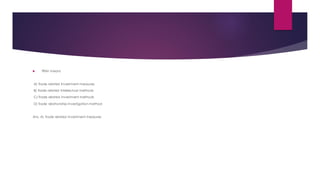
 TRIM means
A) Trade related Investment measures
B) Trade related Intellectual methods
C) Trade related investment methods
D) Trade relationship investigation method
Ans: A) Trade related investment measures
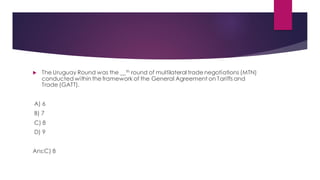
 The Uruguay Round was the __th round of multilateral trade negotiations (MTN)
conducted within the framework of the General Agreement on Tariffs and
Trade (GATT).
A) 6
B) 7
C) 8
D) 9
Ans:C) 8
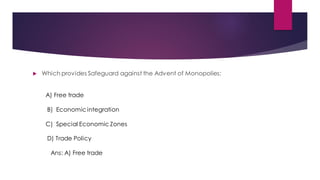
 Which provides Safeguard against the Advent of Monopolies:
A) Free trade
B) Economicintegration
C) Special Economic Zones
D) Trade Policy
Ans: A) Free trade
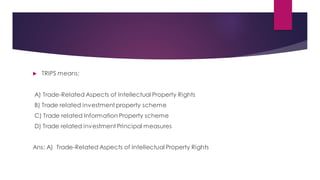
 TRIPS means:
A) Trade-Related Aspects of Intellectual Property Rights
B) Trade related investment property scheme
C) Trade related Information Property scheme
D) Trade related investment Principal measures
Ans: A) Trade-Related Aspects of Intellectual Property Rights
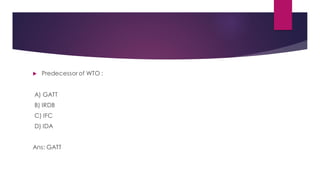
 Predecessor of WTO :
A) GATT
B) IRDB
C) IFC
D) IDA
Ans: GATT
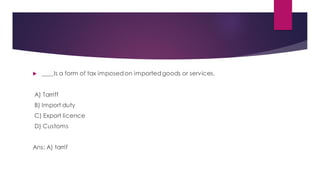
 ____Is a form of tax imposedon importedgoods or services.
A) Tarriff
B) Import duty
C) Export licence
D) Customs
Ans: A) tarrif
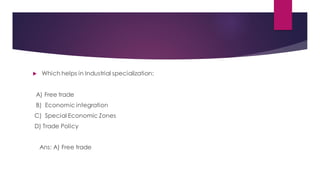
 Which helps in Industrial specialization:
A) Free trade
B) Economicintegration
C) Special Economic Zones
D) Trade Policy
Ans: A) Free trade
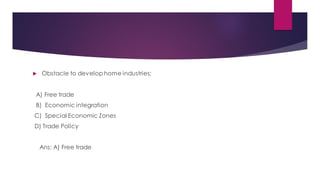
 Obstacle to develophome industries:
A) Free trade
B) Economicintegration
C) Special Economic Zones
D) Trade Policy
Ans: A) Free trade
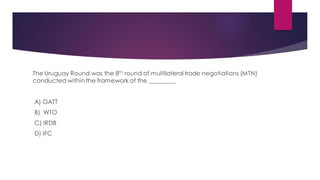
The Uruguay Round was the 8th round of multilateral trade negotiations (MTN)
conducted within the framework of the _________
A) GATT
B) WTO
C) IRDB
D) IFC
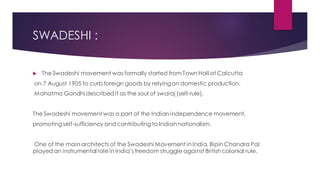
SWADESHI :
 The Swadeshi movement was formally started from Town Hall at Calcutta
on 7 August 1905 to curb foreign goods by relying on domestic production.
Mahatma Gandhi described it as the soul of swaraj (self-rule).
The Swadeshi movement was a part of the Indian independence movement,
promotingself-sufficiency and contributingto Indian nationalism.
One of the main architects of the Swadeshi Movement in India, Bipin Chandra Pal
played an instrumental role in India’s freedom struggle against British colonial rule.
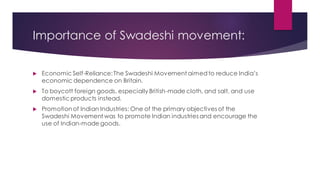
Importance of Swadeshi movement:
 EconomicSelf-Reliance:The Swadeshi Movement aimedto reduce India’s
economic dependence on Britain.
 To boycott foreign goods, especially British-made cloth, and salt, and use
domesticproducts instead.
 Promotionof Indian Industries: One of the primary objectives of the
Swadeshi Movement was to promote Indian industries and encourage the
use of Indian-made goods.
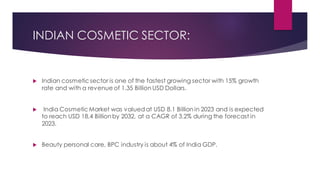
INDIAN COSMETIC SECTOR:
 Indian cosmeticsector is one of the fastest growing sector with 15% growth
rate and with a revenue of 1.35 Billion USD Dollars.
 India CosmeticMarket was valuedat USD 8.1 Billion in 2023 and is expected
to reach USD 18.4 Billionby 2032, at a CAGR of 3.2% during the forecast in
2023.
 Beauty personal care, BPC industry is about 4% of India GDP.
TYPES OF COSMETICS:
 Cosmetics are products which helps to take care of our skin. There are
seven categories of cosmetics and personal care products –
 oral care,
 skin care,
 sun care,
 hair care,
 decorativecosmetics,
 body care
 perfumes.
IMPORTANCE OF COSMETIC SECTOR:
 EconomicImpact: The beauty and cosmetics industry is a significant
contributor to the global economy.It generates jobs, supports innovation,
and drives consumer spending.
 Good skin care routine will reduce visible pores, wrinkles,and under eye
circles.Protection from harmful sun rays will prevent sun damage,
blemishes, and hyper-pigmentation
 Cosmetics are pharmaceutical products that are used for improving skin
appearance and body odor.
COST AND REVENUE IN COSMETIC
SECTOR:
 Indian buyers spent over ₹5,000 crore on more than 100 million cosmetic
products in the last six months, with 40% making purchases online,
according to Kantar Worldpanel’s initial study on the industry in India.
 The Indian cosmetics products market size is estimatedat $1.35 billion in
2023. It is projected to reach $2.27 billion by 2028, registering a CAGR of
10.91% during the forecast period (2023-2028), they added.
 Changing lifestyles,and growing awareness contributed to a significant
development in India’s cosmeticindustry. India is ranked fourth globally for
generating the highest revenue from the beauty and personal care
market in 2022
GROWTH OF COSMETIC SECTOR:
 Over the last decade, India has seen consistent growth in the personal
care and cosmetics market with increasing shelf space in boutiques and
retail stores across the country.
 Many multinational brands have entered the Indian market, primarily
aided by dedicated support structure and their respective pricing
strategies.
 It has a 15 % constant growth rate.
TRADITIONAL COSMETIC SECTOR:
 Before 1950, the contributionof foreign companies to the cosmetics sector
in India was relatively limited.
 The market was primarily dominatedby traditional and locally made
beauty products.
 However, with the gradual globalization and liberalizationof the Indian
economypost-independence, foreign companies began to enter the
Indian market and establishtheir presence in the cosmetics sector.
PRESENT COSMETIC SECTOR:
 The contributionof foreign companies to the cosmetic sector in India has
been steadily increasing over the years. International cosmetic brands
have been attracted to the Indian market due to its growing economy,
increasing consumer spending power, and evolving beauty trends. These
foreign companies bring in a wide range of products, technology, and
marketing strategies, contributing to the diversity and competitiveness of
the Indian cosmeticindustry.
 While domestic companies still dominate the market, the presence and
influence of foreign companies continue to grow, particularly in urban
areas
COSMETIC SECTOR DOMINATION:
 The cosmetics market worldwide is controlled by a handful of conglomerates like Unilever,
Procter & Gamble, and L’Oréal. Although these were immensely successful in India,
domestic counterparts have an equal footing, with newer, organic brands entering the
market.
 January 2022, the cosmetics sector in India is predominantly driven by domestic
companies. However, the exact percentage of contribution can vary over time due to
market dynamics, industry regulations, and the entry of international brands. Generally,
domestic companies play a significant role in this sector, catering to diverse consumer
needs and preferences across the country. Like Ayurveda. ...
 Mamaearth. ...
 The Body Shop. ...
 Plum. ...
 Lotus Herbals
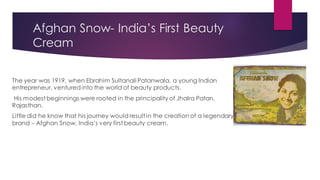
Afghan Snow- India’s First Beauty
Cream
The year was 1919, when Ebrahim Sultanali Patanwala, a young Indian
entrepreneur, venturedinto the world of beauty products.
His modest beginnings were rooted in the principality of Jhalra Patan,
Rajasthan.
Little did he know that his journey would result in the creation of a legendary
brand – Afghan Snow, India’s very first beauty cream.
LEADING COSMETIC BRAND:
 Lakme is India’s leading brand in cosmetics as it fulfills the needs of various skin
tones and skin types from oily to dry. Across the world, Lakme is well renowned
because of its natural makeup range. The main focus of this brand is providing
affordable yet quality makeup.
 It was founded in 1952 by JRD Tata by the request of Jawaharlal Nehru , he
was worried Indian woman wastingmoney on cosmetics to foreign countries.
In the mid-1980s, the market research agency I worked for was commissioned
by Lakmé, the pioneering company that brought makeup to Indian women as
early as 1952, supposedly at the instance of Jawaharlal Nehru who was
concerned that Indian women were wastingprecious foreign exchange on
cosmetics
AWARENESS MESSAGE:
 Half of the people believe that cosmetic have no negative effect on
them, “Using cosmetics excessively can harm your skin. Practice
moderation and choose products that are gentle on your skin. You
natural beauty shines best when you take care of your skin’s health!”
THANK YOU

Presentation(2). pptx.pdfffd 5vrgrcrfrfrçrf

  • 1.
    BASICS OF INTERNATIONAL TRADE ASSIGNMENT: 2 BY TEAM 2 ROLL NUMBER :14-26
  • 2.
    CHAPTER 2 (TRADE POLICY : FREE TRADE AND PROTECTION)  1. _______a system of international commercial activity in which there are no limits or taxes on imports and exports. A) Free trade B) Economicintegration C) Special Economic Zones D) Trade Policy Ans: A) Free trade
  • 3.
     2.patents aregranted for all products for a period of ___ years from the date of application. A) 30 B) 20 C) 15 D) 10 Ans:B) 20
  • 4.
     3.Patent protectionwas introduced in India in the century. A) 19 B) 18 C) 20 D) 17 Ans: B) 18
  • 5.
     A isa legal protection granted for an inventionthat is new, non-obvious and useful. A) Patent B) Copyright C) Intellectual property right D) Royalty Ans: A) patent
  • 6.
     TRIM means A)Trade related Investment measures B) Trade related Intellectual methods C) Trade related investment methods D) Trade relationship investigation method Ans: A) Trade related investment measures
  • 7.
     The UruguayRound was the __th round of multilateral trade negotiations (MTN) conducted within the framework of the General Agreement on Tariffs and Trade (GATT). A) 6 B) 7 C) 8 D) 9 Ans:C) 8
  • 8.
     Which providesSafeguard against the Advent of Monopolies: A) Free trade B) Economicintegration C) Special Economic Zones D) Trade Policy Ans: A) Free trade
  • 9.
     TRIPS means: A)Trade-Related Aspects of Intellectual Property Rights B) Trade related investment property scheme C) Trade related Information Property scheme D) Trade related investment Principal measures Ans: A) Trade-Related Aspects of Intellectual Property Rights
  • 10.
     Predecessor ofWTO : A) GATT B) IRDB C) IFC D) IDA Ans: GATT
  • 11.
     ____Is aform of tax imposedon importedgoods or services. A) Tarriff B) Import duty C) Export licence D) Customs Ans: A) tarrif
  • 12.
     Which helpsin Industrial specialization: A) Free trade B) Economicintegration C) Special Economic Zones D) Trade Policy Ans: A) Free trade
  • 13.
     Obstacle todevelophome industries: A) Free trade B) Economicintegration C) Special Economic Zones D) Trade Policy Ans: A) Free trade
  • 14.
    The Uruguay Roundwas the 8th round of multilateral trade negotiations (MTN) conducted within the framework of the _________ A) GATT B) WTO C) IRDB D) IFC
  • 15.
    SWADESHI :  TheSwadeshi movement was formally started from Town Hall at Calcutta on 7 August 1905 to curb foreign goods by relying on domestic production. Mahatma Gandhi described it as the soul of swaraj (self-rule). The Swadeshi movement was a part of the Indian independence movement, promotingself-sufficiency and contributingto Indian nationalism. One of the main architects of the Swadeshi Movement in India, Bipin Chandra Pal played an instrumental role in India’s freedom struggle against British colonial rule.
  • 16.
    Importance of Swadeshimovement:  EconomicSelf-Reliance:The Swadeshi Movement aimedto reduce India’s economic dependence on Britain.  To boycott foreign goods, especially British-made cloth, and salt, and use domesticproducts instead.  Promotionof Indian Industries: One of the primary objectives of the Swadeshi Movement was to promote Indian industries and encourage the use of Indian-made goods.
  • 17.
    INDIAN COSMETIC SECTOR: Indian cosmeticsector is one of the fastest growing sector with 15% growth rate and with a revenue of 1.35 Billion USD Dollars.  India CosmeticMarket was valuedat USD 8.1 Billion in 2023 and is expected to reach USD 18.4 Billionby 2032, at a CAGR of 3.2% during the forecast in 2023.  Beauty personal care, BPC industry is about 4% of India GDP.
  • 18.
    TYPES OF COSMETICS: Cosmetics are products which helps to take care of our skin. There are seven categories of cosmetics and personal care products –  oral care,  skin care,  sun care,  hair care,  decorativecosmetics,  body care  perfumes.
  • 19.
    IMPORTANCE OF COSMETICSECTOR:  EconomicImpact: The beauty and cosmetics industry is a significant contributor to the global economy.It generates jobs, supports innovation, and drives consumer spending.  Good skin care routine will reduce visible pores, wrinkles,and under eye circles.Protection from harmful sun rays will prevent sun damage, blemishes, and hyper-pigmentation  Cosmetics are pharmaceutical products that are used for improving skin appearance and body odor.
  • 20.
    COST AND REVENUEIN COSMETIC SECTOR:  Indian buyers spent over ₹5,000 crore on more than 100 million cosmetic products in the last six months, with 40% making purchases online, according to Kantar Worldpanel’s initial study on the industry in India.  The Indian cosmetics products market size is estimatedat $1.35 billion in 2023. It is projected to reach $2.27 billion by 2028, registering a CAGR of 10.91% during the forecast period (2023-2028), they added.  Changing lifestyles,and growing awareness contributed to a significant development in India’s cosmeticindustry. India is ranked fourth globally for generating the highest revenue from the beauty and personal care market in 2022
  • 21.
    GROWTH OF COSMETICSECTOR:  Over the last decade, India has seen consistent growth in the personal care and cosmetics market with increasing shelf space in boutiques and retail stores across the country.  Many multinational brands have entered the Indian market, primarily aided by dedicated support structure and their respective pricing strategies.  It has a 15 % constant growth rate.
  • 22.
    TRADITIONAL COSMETIC SECTOR: Before 1950, the contributionof foreign companies to the cosmetics sector in India was relatively limited.  The market was primarily dominatedby traditional and locally made beauty products.  However, with the gradual globalization and liberalizationof the Indian economypost-independence, foreign companies began to enter the Indian market and establishtheir presence in the cosmetics sector.
  • 23.
    PRESENT COSMETIC SECTOR: The contributionof foreign companies to the cosmetic sector in India has been steadily increasing over the years. International cosmetic brands have been attracted to the Indian market due to its growing economy, increasing consumer spending power, and evolving beauty trends. These foreign companies bring in a wide range of products, technology, and marketing strategies, contributing to the diversity and competitiveness of the Indian cosmeticindustry.  While domestic companies still dominate the market, the presence and influence of foreign companies continue to grow, particularly in urban areas
  • 24.
    COSMETIC SECTOR DOMINATION: The cosmetics market worldwide is controlled by a handful of conglomerates like Unilever, Procter & Gamble, and L’Oréal. Although these were immensely successful in India, domestic counterparts have an equal footing, with newer, organic brands entering the market.  January 2022, the cosmetics sector in India is predominantly driven by domestic companies. However, the exact percentage of contribution can vary over time due to market dynamics, industry regulations, and the entry of international brands. Generally, domestic companies play a significant role in this sector, catering to diverse consumer needs and preferences across the country. Like Ayurveda. ...  Mamaearth. ...  The Body Shop. ...  Plum. ...  Lotus Herbals
  • 25.
    Afghan Snow- India’sFirst Beauty Cream The year was 1919, when Ebrahim Sultanali Patanwala, a young Indian entrepreneur, venturedinto the world of beauty products. His modest beginnings were rooted in the principality of Jhalra Patan, Rajasthan. Little did he know that his journey would result in the creation of a legendary brand – Afghan Snow, India’s very first beauty cream.
  • 26.
    LEADING COSMETIC BRAND: Lakme is India’s leading brand in cosmetics as it fulfills the needs of various skin tones and skin types from oily to dry. Across the world, Lakme is well renowned because of its natural makeup range. The main focus of this brand is providing affordable yet quality makeup.  It was founded in 1952 by JRD Tata by the request of Jawaharlal Nehru , he was worried Indian woman wastingmoney on cosmetics to foreign countries. In the mid-1980s, the market research agency I worked for was commissioned by Lakmé, the pioneering company that brought makeup to Indian women as early as 1952, supposedly at the instance of Jawaharlal Nehru who was concerned that Indian women were wastingprecious foreign exchange on cosmetics
  • 27.
    AWARENESS MESSAGE:  Halfof the people believe that cosmetic have no negative effect on them, “Using cosmetics excessively can harm your skin. Practice moderation and choose products that are gentle on your skin. You natural beauty shines best when you take care of your skin’s health!”
  • 28.