TRADE BETWEEN SOUTH AFRICA
AND EUROPE
 South Africa has been engaged in foreign trade
since the mid-1600s.
 For the 1st few centuries thereafter, South
Africa exported agricultural products and
imported virtually everything that could not be
made from local resources.
 The trade relations between South Africa and
the European Union are regulated by the
Trade, Development and Cooperation
agreement concluded with European Union in
1999
 According to the European Commission, South
Africa is the European Union’s largest partner
in Africa
 In the text below, we will be explaining this
trade in terms of types of goods and services
South Africa exports and imports from Europe.
 According to European Commission Union
(2005- 2016) the primary products that South
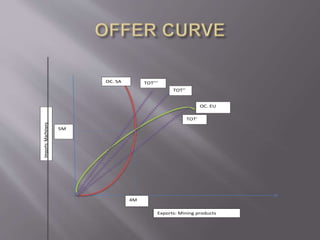
Africa exports to Europe are as follows: Fuels
and mining products, machinery and transport
equipment, agro-processing products and other
intermediate goods.
 The primary products that South Africa
imports from Europe are as follows:
machineries, chemicals and vehicles.
 HOW IMPORTANT ARE CHEMICALS
 Chemicals are very important as they ensure that we
have healed and powers and that we access to
telecommunication, music and media everywhere.
 Vehicle working to deliver goods and lowering
delivery costs.
 Machineries used at mining construction and road
construction .
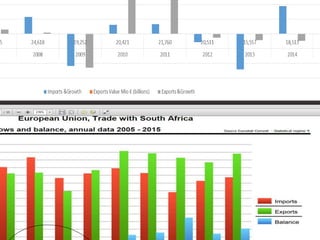
 Since the agreement between South Africa and
Europe has been established, trade between
these two countries has improved
substantially.
 South Africa bilateral economic relations also
raised exports in goods and services, from 106
billion in 1994 to R892 billion in nominal terms
in 2012.
 Trade in goods between the two partners has
increased by more than 120%
 When the storm hit, South Africa had been sitting on relatively strong fundamentals and
emerging from a protracted period of economic expansion. The meltdown allowed “not-
so-well-hidden” vulnerabilities to surface. Unemployment, inequality, poverty, crime,
and HIV/AIDS still continue to plague the country. Agriculture, mining and
manufacturing declined while the trade and current account deficit (CAD) widened.
Household indebtedness reached worrying levels in a low-interest rate environment and
inflationary pressures mounted. Moreover, severe energy shortages erupted (inducing
blackouts) and a tense political climate resulted in President Mbeki’s resignation.
 In months ahead, the sustainability of the CAD and the impact of the crisis on the real
economy will remain the key issues. The financial account has so far been sufficient to
finance the CAD, but sudden stops of capital inflows are not unheard of in developing
countries during hard times. While the free-floating exchange rate rules out insolvency
issues, financing the CAD will be much more difficult and costly; on the other hand,
lower global demand will hurt South Africa’s export-sector and the falling rand is not
expected to significantly counter the decline.
 The crisis has also impacted the real economy. House prices have been declining, along
with vehicle sales. Manufacturing production has slowed, the mining sector is shrinking
further, and retrenchments are on the increase. Growth is expected to slow-down which
is a risky proposition for South Africa and for Africa as a whole. Luckily, the sound fiscal
position will somewhat cushion the economic slowdown.
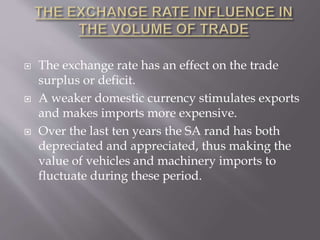
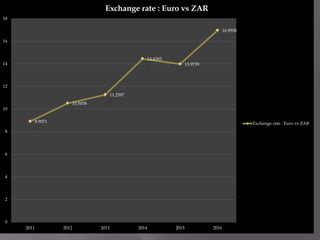
 The exchange rate has an effect on the trade
surplus or deficit.
 A weaker domestic currency stimulates exports
and makes imports more expensive.
 Over the last ten years the SA rand has both
depreciated and appreciated, thus making the
value of vehicles and machinery imports to
fluctuate during these period.
8.9071
10.5038
11.2597
14.4393
13.9739
16.9558
0
2
4
6
8
10
12
14
16
18
2011 2012 2013 2014 2015 2016
Exchange rate : Euro vs ZAR
TOT’’
TOT’’’
TOT’
OC. EU
OC. SA
Imports:Machinery
Exports: Mining products
5M
4M
 DEMOCRAPHIC CHANGE
 BARRIERS TO ENTRY
 NON BARRIERS TO ENTRY
 TECHNOLOGY
 ENERGY AND OTHER NATURAL
RESOURCES
 TRANSPORTATION COSTS
 South Africa is an open economy driven by
extensive trade routes that developed between
cities and kingdoms, some trade routes were
overland.
 Trade has driven much of growth in Africa’s
economy in the early twenty first century.
Europe is an increasily important trading
partner exporting greater goods from South
Africa.
Presentation1

Presentation1

  • 1.
    TRADE BETWEEN SOUTHAFRICA AND EUROPE
  • 2.
     South Africahas been engaged in foreign trade since the mid-1600s.  For the 1st few centuries thereafter, South Africa exported agricultural products and imported virtually everything that could not be made from local resources.  The trade relations between South Africa and the European Union are regulated by the Trade, Development and Cooperation agreement concluded with European Union in 1999
  • 3.
     According tothe European Commission, South Africa is the European Union’s largest partner in Africa  In the text below, we will be explaining this trade in terms of types of goods and services South Africa exports and imports from Europe.
  • 4.
     According toEuropean Commission Union (2005- 2016) the primary products that South Africa exports to Europe are as follows: Fuels and mining products, machinery and transport equipment, agro-processing products and other intermediate goods.
  • 5.
     The primaryproducts that South Africa imports from Europe are as follows: machineries, chemicals and vehicles.  HOW IMPORTANT ARE CHEMICALS  Chemicals are very important as they ensure that we have healed and powers and that we access to telecommunication, music and media everywhere.  Vehicle working to deliver goods and lowering delivery costs.  Machineries used at mining construction and road construction .
  • 6.
     Since theagreement between South Africa and Europe has been established, trade between these two countries has improved substantially.  South Africa bilateral economic relations also raised exports in goods and services, from 106 billion in 1994 to R892 billion in nominal terms in 2012.  Trade in goods between the two partners has increased by more than 120%
  • 7.
     When thestorm hit, South Africa had been sitting on relatively strong fundamentals and emerging from a protracted period of economic expansion. The meltdown allowed “not- so-well-hidden” vulnerabilities to surface. Unemployment, inequality, poverty, crime, and HIV/AIDS still continue to plague the country. Agriculture, mining and manufacturing declined while the trade and current account deficit (CAD) widened. Household indebtedness reached worrying levels in a low-interest rate environment and inflationary pressures mounted. Moreover, severe energy shortages erupted (inducing blackouts) and a tense political climate resulted in President Mbeki’s resignation.  In months ahead, the sustainability of the CAD and the impact of the crisis on the real economy will remain the key issues. The financial account has so far been sufficient to finance the CAD, but sudden stops of capital inflows are not unheard of in developing countries during hard times. While the free-floating exchange rate rules out insolvency issues, financing the CAD will be much more difficult and costly; on the other hand, lower global demand will hurt South Africa’s export-sector and the falling rand is not expected to significantly counter the decline.  The crisis has also impacted the real economy. House prices have been declining, along with vehicle sales. Manufacturing production has slowed, the mining sector is shrinking further, and retrenchments are on the increase. Growth is expected to slow-down which is a risky proposition for South Africa and for Africa as a whole. Luckily, the sound fiscal position will somewhat cushion the economic slowdown.
  • 9.
     The exchangerate has an effect on the trade surplus or deficit.  A weaker domestic currency stimulates exports and makes imports more expensive.  Over the last ten years the SA rand has both depreciated and appreciated, thus making the value of vehicles and machinery imports to fluctuate during these period.
  • 10.
    8.9071 10.5038 11.2597 14.4393 13.9739 16.9558 0 2 4 6 8 10 12 14 16 18 2011 2012 20132014 2015 2016 Exchange rate : Euro vs ZAR Exchange rate : Euro vs ZAR
  • 11.
  • 12.
     DEMOCRAPHIC CHANGE BARRIERS TO ENTRY  NON BARRIERS TO ENTRY  TECHNOLOGY  ENERGY AND OTHER NATURAL RESOURCES  TRANSPORTATION COSTS
  • 13.
     South Africais an open economy driven by extensive trade routes that developed between cities and kingdoms, some trade routes were overland.  Trade has driven much of growth in Africa’s economy in the early twenty first century. Europe is an increasily important trading partner exporting greater goods from South Africa.