What is Representation?
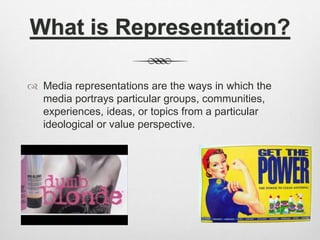
 Media representations are the ways in which the
media portrays particular groups, communities,
experiences, ideas, or topics from a particular
ideological or value perspective.
Social Groups
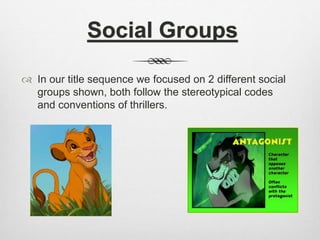
 In our title sequence we focused on 2 different social
groups shown, both follow the stereotypical codes
and conventions of thrillers.
Main Character
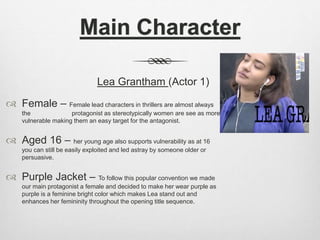
Lea Grantham (Actor 1)
 Female – Female lead characters in thrillers are almost always
the protagonist as stereotypically women are see as more
vulnerable making them an easy target for the antagonist.
 Aged 16 – her young age also supports vulnerability as at 16
you can still be easily exploited and led astray by someone older or
persuasive.
 Purple Jacket – To follow this popular convention we made
our main protagonist a female and decided to make her wear purple as
purple is a feminine bright color which makes Lea stand out and
enhances her femininity throughout the opening title sequence.
Real media Films
Real media thriller films follow the stereotypical generic
codes and conventions of representation of the female
characters by making them look vulnerable, making
sure they are young (mainly teens or young adults).
This helps to create empathy for the main protagonist
character which ultimately attracts an audience and
creates elements of suspense which keeps the
audience excited and engaged throughout the film.
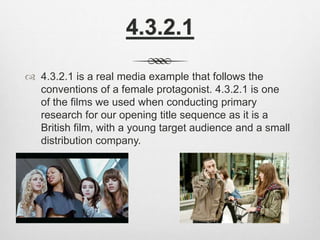
4.3.2.1
 4.3.2.1 is a real media example that follows the
conventions of a female protagonist. 4.3.2.1 is one
of the films we used when conducting primary
research for our opening title sequence as it is a
British film, with a young target audience and a small
distribution company.
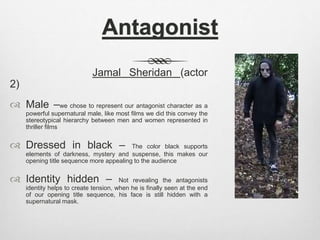
Antagonist
Jamal Sheridan (actor
2)
 Male –we chose to represent our antagonist character as a
powerful supernatural male, like most films we did this convey the
stereotypical hierarchy between men and women represented in
thriller films
 Dressed in black – The color black supports
elements of darkness, mystery and suspense, this makes our
opening title sequence more appealing to the audience
 Identity hidden – Not revealing the antagonists
identity helps to create tension, when he is finally seen at the end
of our opening title sequence, his face is still hidden with a
supernatural mask.
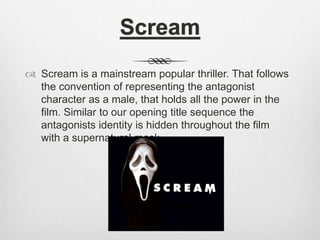
Scream
 Scream is a mainstream popular thriller. That follows
the convention of representing the antagonist
character as a male, that holds all the power in the
film. Similar to our opening title sequence the
antagonists identity is hidden throughout the film
with a supernatural mask.
 In our opening title sequence we have represented our
social groups very stereotypically. Showing our
protagonists character in a positive way as a vulnerable
female, with no power and as a main victim. Showing our
antagonist in a negative way as a aggressive male
character that holds all the power but uses it negatively to
harm and create fear upon the female character.
 This shows that our opening title sequence supports the
common generic representation seen in thrillers, with our
use of stereotypes combined with our codes and
conventions.

Presentation1

  • 2.
    What is Representation? Media representations are the ways in which the media portrays particular groups, communities, experiences, ideas, or topics from a particular ideological or value perspective.
  • 3.
    Social Groups  Inour title sequence we focused on 2 different social groups shown, both follow the stereotypical codes and conventions of thrillers.
  • 4.
    Main Character Lea Grantham(Actor 1)  Female – Female lead characters in thrillers are almost always the protagonist as stereotypically women are see as more vulnerable making them an easy target for the antagonist.  Aged 16 – her young age also supports vulnerability as at 16 you can still be easily exploited and led astray by someone older or persuasive.  Purple Jacket – To follow this popular convention we made our main protagonist a female and decided to make her wear purple as purple is a feminine bright color which makes Lea stand out and enhances her femininity throughout the opening title sequence.
  • 5.
    Real media Films Realmedia thriller films follow the stereotypical generic codes and conventions of representation of the female characters by making them look vulnerable, making sure they are young (mainly teens or young adults). This helps to create empathy for the main protagonist character which ultimately attracts an audience and creates elements of suspense which keeps the audience excited and engaged throughout the film.
  • 6.
    4.3.2.1  4.3.2.1 isa real media example that follows the conventions of a female protagonist. 4.3.2.1 is one of the films we used when conducting primary research for our opening title sequence as it is a British film, with a young target audience and a small distribution company.
  • 7.
    Antagonist Jamal Sheridan (actor 2) Male –we chose to represent our antagonist character as a powerful supernatural male, like most films we did this convey the stereotypical hierarchy between men and women represented in thriller films  Dressed in black – The color black supports elements of darkness, mystery and suspense, this makes our opening title sequence more appealing to the audience  Identity hidden – Not revealing the antagonists identity helps to create tension, when he is finally seen at the end of our opening title sequence, his face is still hidden with a supernatural mask.
  • 8.
    Scream  Scream isa mainstream popular thriller. That follows the convention of representing the antagonist character as a male, that holds all the power in the film. Similar to our opening title sequence the antagonists identity is hidden throughout the film with a supernatural mask.
  • 9.
     In ouropening title sequence we have represented our social groups very stereotypically. Showing our protagonists character in a positive way as a vulnerable female, with no power and as a main victim. Showing our antagonist in a negative way as a aggressive male character that holds all the power but uses it negatively to harm and create fear upon the female character.  This shows that our opening title sequence supports the common generic representation seen in thrillers, with our use of stereotypes combined with our codes and conventions.