RESEARCH METHODOLOGY
Dr. Md Fazlul Haque
Associate Professor
Dept. of Zoology
Rajshahi University
INTRODUCTION TO RESEARCH
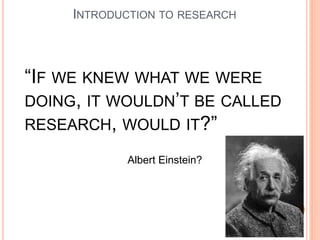
“IF WE KNEW WHAT WE WERE
DOING, IT WOULDN’T BE CALLED
RESEARCH, WOULD IT?”
Albert Einstein?
DEFINITION OF RESEARCH
 Research is the process of asking questions and
answering them in an organized way through:
 Survey
 Experiment
 It involves:
 Examination of limits of knowledge
 Assessing what is known up to that point
 Defining unanswered questions
 Devising ways of answering them in an
organized and meaningful way
 It will be within the capability of every thinking
person
DEFINITION OF RESEARCH
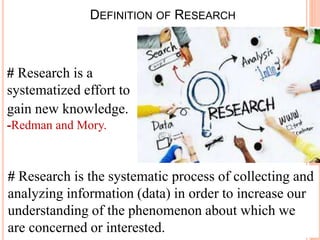
# Research is a
systematized effort to
gain new knowledge.
-Redman and Mory.
# Research is the systematic process of collecting and
analyzing information (data) in order to increase our
understanding of the phenomenon about which we
are concerned or interested.
DEFINITION OF RESEARCH
Research is knowledge acquisition gained
 through reasoning
 through intuition
 but most importantly through the use of
appropriate methods (The scientific method)
-Polgar, Thomas
 Research is an endeavour to discover answers to
intellectual and practical problems through the
application of scientific method.
SCIENTIFIC METHOD
 Scientific method is the systematic collection of
data (facts) and their theoretical treatment
through-
 proper observation,
 experimentation and
 interpretation.
 Scientific method attempts to achieve a systematic
interrelation of facts by experimentation,
observation, and logical arguments from accepted
postulates (Hypothesis) and a combination of
these three in varying proportions.
BASIC POSTULATES IN SCIENTIFIC METHOD
 It relies on empirical (Experimental) evidence.
 It utilizes relevant concepts.
 It is committed to only objective considerations.
 It presupposes ethical neutrality.
 It results into probabilistic predictions.
 The methodology is made known.
 Aims at formulating scientific theories.
Objectives of Research
The purpose of research is to discover answers through
the application of scientific procedures.
The objectives are:
To gain familiarity with a phenomenon or to achieve new
insights into it – Exploratory or Formulative Research.
To portray accurately the characteristics of a particular
individual, situation or a group – Descriptive Research.
To determine the frequency with which something occurs
or with which it is associated with something else –
Diagnostic Research.
To test a hypothesis of a causal relationship between
variables – Hypothesis-Testing Research.
Characteristics of research
Research is directed towards the solution of a problem.
Research is based upon observable experience or empirical
evidence.
Research demands accurate observation and description.
Research involves gathering new data from primary sources or
using existing data for a new purpose.
Research activities are characterized by carefully designed
procedures.
Research requires expertise i.e., skill necessary to carryout
investigation, search the related literature and to understand and
analyze the data gathered.
Research is objective and logical – applying every possible test
to validate the data collected and conclusions reached.
Research involves the quest for answers to unsolved problems.
Research requires courage.
Research is characterized by patient and unhurried activity.
Research is carefully recorded and reported.
GOOD RESEARCH PROCESS
Research is an extremely cyclic process.
This isn’t a weakness of the process but is
part of the built-in error correction machinery.
Because of the cyclic nature of research, it
can be difficult to determine where to start
and when to stop.
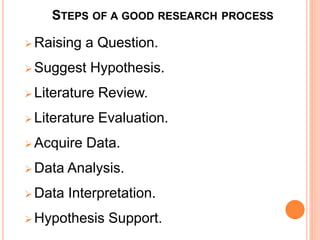
STEPS OF A GOOD RESEARCH PROCESS
 Raising a Question.
 Suggest Hypothesis.
 Literature Review.
 Literature Evaluation.
 Acquire Data.
 Data Analysis.
 Data Interpretation.
 Hypothesis Support.
STEP 1 A QUESTION IS RAISED
A question occurs to or is posed to the
researcher for which that researcher has no
answer.
Example: What is the impact of microplastic on
the growth and reproduction of aquatic animals
in the Padma river, Bangladesh?
The question needs to be converted to an
appropriate problem statement like that
documented in a research proposal.
Example: What if microplastic affect the growth
and reproduction of aquatic animals in the
Padma river, Bangladesh?
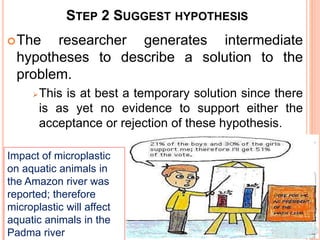
STEP 2 SUGGEST HYPOTHESIS
The researcher generates intermediate
hypotheses to describe a solution to the
problem.
This is at best a temporary solution since there
is as yet no evidence to support either the
acceptance or rejection of these hypothesis.
Impact of microplastic
on aquatic animals in
the Amazon river was
reported; therefore
microplastic will affect
aquatic animals in the
Padma river
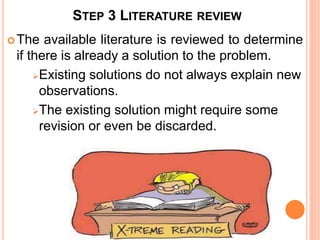
STEP 3 LITERATURE REVIEW
The available literature is reviewed to determine
if there is already a solution to the problem.
Existing solutions do not always explain new
observations.
The existing solution might require some
revision or even be discarded.
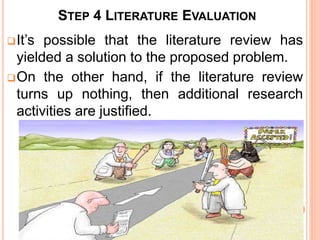
STEP 4 LITERATURE EVALUATION
It’s possible that the literature review has
yielded a solution to the proposed problem.
On the other hand, if the literature review
turns up nothing, then additional research
activities are justified.
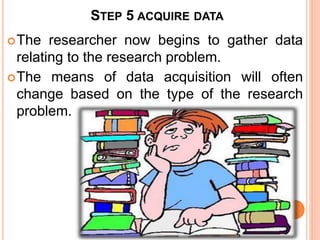
STEP 5 ACQUIRE DATA
The researcher now begins to gather data
relating to the research problem.
The means of data acquisition will often
change based on the type of the research
problem.
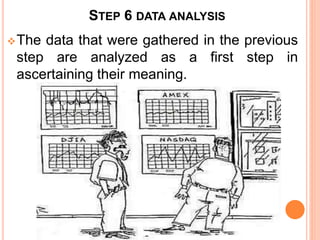
STEP 6 DATA ANALYSIS
The data that were gathered in the previous
step are analyzed as a first step in
ascertaining their meaning.
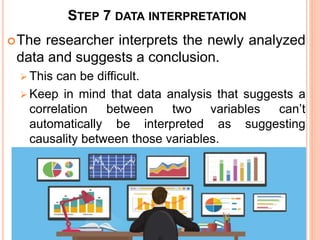
STEP 7 DATA INTERPRETATION
The researcher interprets the newly analyzed
data and suggests a conclusion.
 This can be difficult.
 Keep in mind that data analysis that suggests a
correlation between two variables can’t
automatically be interpreted as suggesting
causality between those variables.
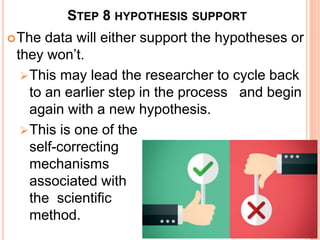
STEP 8 HYPOTHESIS SUPPORT
The data will either support the hypotheses or
they won’t.
This may lead the researcher to cycle back
to an earlier step in the process and begin
again with a new hypothesis.
This is one of the
self-correcting
mechanisms
associated with
the scientific
method.
TYPES OF SCIENTIFIC RESEARCH
 The research is broadly classified into two main
classes:
 1. Fundamental or basic research
 2. Applied research.
 Both basic and applied researches are generally of
two kinds:
 1. Normal research
 2. Revolutionary research.
 In addition, both basic and applied researches can
be classified into three types:
 Quantitative
 Qualitative
 Even both (mixed research).
TYPES OF SCIENTIFIC RESEARCH
 Fundamental or basic research
 Study or investigation of some natural
phenomenon or relating to pure science are
termed as basic research.
 It is also called theoretical research.
 Basic research is an investigation on basic
principles and reasons for occurrence of a
particular event or process or phenomenon.
 It is not concerned with solving any practical
problems of immediate interest.
 But it is original or basic in character.
TYPES OF SCIENTIFIC RESEARCH
 Fundamental or basic research
 It provides a systematic and deep insight into a
problem and facilitates extraction of scientific and
logical explanation and conclusion on it.
 It helps build new frontiers of knowledge.
 The outcomes of basic research form the basis for
many applied research.
Main Characteristics
 Seeks generalization
 Aims at basic processes
 Attempts to explain why things happen
 Tries to get all the facts
 Reports in technical language of the topic
TYPES OF SCIENTIFIC RESEARCH
 Applied research
 In an applied research one solves certain
problems using well known and accepted
theories and principles.
 Most of the experimental research, case studies
and inter-disciplinary research are essentially
applied research.
 Applied research is helpful for basic research.
 A research, the outcome of which has immediate
application is also termed as applied research.
TYPES OF SCIENTIFIC RESEARCH
 Applied research
Main Characteristics
 Studies individual or specific cases without the
objective to generalize
 Aims at any variable which makes the desired
difference
 Tries to say how things can be changed
 Tries to correct the facts which are problematic
 Reports in common language
TYPES OF SCIENTIFIC RESEARCH
 Normal research
In any particular field, normal research is performed
in accordance with a set of rules, concepts and
procedures called a paradigm, which is well
accepted by the scientists working in that field.
 Revolutionary research
In the context of science and technology, a
revolution can be defined as a complete or marked
change in rules, concepts and procedures called a
paradigm. A revolutionary research will result in a
paradigm shift that provides a new or perhaps highly
revised map of the knowledge as it is currently
understood.
TYPES OF SCIENTIFIC RESEARCH
 Quantitative research
 It is numerical, non-descriptive, applies statistics or
mathematics and uses numbers.
 It is an iterative process whereby evidence is
evaluated.
 The results are often presented in tables and
graphs.
 It is conclusive.
 It investigates the what, where and when of
decision making.
TYPES OF SCIENTIFIC RESEARCH
 Qualitative research
 It is non-numerical, descriptive, applies reasoning
and uses words.
 Its aim is to get the meaning, feeling and describe
the situation.
 Qualitative data cannot be graphed.
 It is exploratory.
 It investigates the why and how of decision
making.
 Mixed research
 Mixed research that involves the mixing of
quantitative and qualitative methods or paradigm
characteristics.
 Nature of data is mixture of variables, words and
images.
TYPES OF SCIENTIFIC RESEARCH
OTHER TYPES OF RESEARCH
 Exploratory research
 Exploratory research might involve a literature
search or conducting focus group interviews.
 The exploration of new phenomena in this way
may help the researcher’s need for better
understanding, may test the feasibility of a more
extensive study, or determine the best methods to
be used in a subsequent study.
 For these reasons, exploratory research is broad in
focus and rarely provides definite answers to
specific research issues.
 The objective of exploratory research is to identify
key issues and key variables.
TYPES OF SCIENTIFIC RESEARCH
OTHER TYPES OF RESEARCH
 Exploratory research
 Exploratory research might involve a literature
search or conducting focus group interviews.
 The exploration of new phenomena in this way
may help the researcher’s need for better
understanding, may test the feasibility of a more
extensive study, or determine the best methods to
be used in a subsequent study.
 For these reasons, exploratory research is broad in
focus and rarely provides definite answers to
specific research issues.
 The objective of exploratory research is to identify
key issues and key variables.
TYPES OF SCIENTIFIC RESEARCH
 Descriptive research
The descriptive research is directed toward studying
“what” and how many off this “what”. Thus, it is
directed toward answering questions such as, “What
is this?”.
 Explanatory research
 Its primary goal is to understand or to explain
relationships.
 It uses correlations to study relationships between
dimensions or characteristics off individuals,
groups, situations, or events.
 Explanatory research explains (How the parts of a
phenomenon are related to each other).
 Explanatory research asks the “Why” question.
TYPES OF SCIENTIFIC RESEARCH
 Longitudinal Research
 Research carried out longitudinally involves data
collection at multiple points in time.
 Longitudinal studies may take the form of:
 Trend study- looks at population characteristics
over time, e.g. organizational absenteeism rates
during the course of a year
 Cohort study- traces a sub-population over time,
e.g. absenteeism rates for the sales department;
 Panel study- traces the same sample repeatedly
over time, often many year, e.g. graduate career
tracks over the period 1990 – 2000 for the same
starting cohort.
TYPES OF SCIENTIFIC RESEARCH
 Cross-sectional Research
 One-shot or cross-sectional studies are those in
which data is gathered once, during a period of days,
weeks or months.
 Many cross-sectional studies are exploratory or
descriptive in purpose.
 They are designed to look at how things are now,
without any sense of whether there is a history or
trend at work.
 While longitudinal studies will often be more time
consuming and expensive than cross-sectional
studies, they are more likely to identify causal
relationships between variables.
TYPES OF SCIENTIFIC RESEARCH
 Action Research
 Action research can be defined as “an approach in
which the action researcher and a client collaborate
in the diagnosis of the problem and in the
development of a solution based on the diagnosis”.
 Action study assumes social world to be constantly
changing, both, researcher and research being one
part of that change.
 Policy-Oriented Research
 Reports employing this type of research focus on the
question ‘How can problem ‘X’ be solved or
prevented?’
TYPES OF SCIENTIFIC RESEARCH
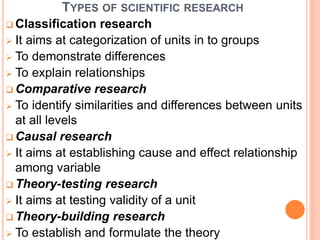
 Classification research
 It aims at categorization of units in to groups
 To demonstrate differences
 To explain relationships
 Comparative research
 To identify similarities and differences between units
at all levels
 Causal research
 It aims at establishing cause and effect relationship
among variable
 Theory-testing research
 It aims at testing validity of a unit
 Theory-building research
 To establish and formulate the theory
PROBLEMS AND BOTTLENECKS FACED BY
RESEARCHERS OF BANGLADESH
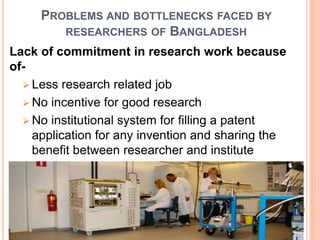
Lack of commitment in research work because
of-
 Less research related job
 No incentive for good research
 No institutional system for filling a patent
application for any invention and sharing the
benefit between researcher and institute
PROBLEMS AND BOTTLENECKS FACED BY
RESEARCHERS OF BANGLADESH
 Lack of research-friendly curriculum
 Lack of knowledge and experience in research
work
 Lack of good supervision for research. A good
supervision ensures-
 sufficient time,
 hands-on training,
 regular meeting
 Allocation of inadequate time resulting in
excess workload for research work
 Lack of required instruments and reagents
PROBLEMS AND BOTTLENECKS FACED BY
RESEARCHERS OF BANGLADESH
 Inadequate and problematic fund for research:
 Not enough fund for all
 Huge gape between proposed fund and
allocated fund
 Time gape between allocation of fund and
research schedule
 Usually no fund for long-term project for
individual researcher
 No allocated fund for maintenance/repairing the
valuable instruments
 Insufficient fund for good publication
PROBLEMS AND BOTTLENECKS FACED BY
RESEARCHERS OF BANGLADESH
 Lack of central laboratory and related facilities
in many institutes
 Lack of research project/cell/council in many
institutes resulting in-
 Inadequate guidance by the institute.
 No collaborative approach for research quality
control
 Inadequate resources and staffs for research
quality control such as Plagiarism check, Thesis
writing format check, Biosafety ensure, Ethical
assurance etc.
RESEARCH PROBLEM
What is a research problem?
 The term ‘problem’ means a question or issue to be
examined.
 Research Problem refers to some difficulty /need
which a researcher experiences in the context of either
theoretical or practical situation and wants to obtain a
solution for the same.
A research problem is a statement about an area of
concern, a condition to be improved, a difficulty to be
eliminated, or a troubling question that exists in scholarly
literature, in theory, or in practice that points to the need
for meaningful understanding and deliberate
investigation.
The purpose of a problem statement is to:
 Introduce the reader to the importance of the topic
being studied. The reader is oriented to the
significance of the study and the research
questions or hypotheses to follow.
 Places the problem into a particular context that
defines the parameters of what is to be
investigated.
 Provides the framework for reporting the
results and indicates what is probably necessary to
conduct the study and explain how the findings will
present this information.
RESEARCH PROBLEM
 Reading
 Academic Experience
 Daily Experience
 Exposure to Field Situations
 Consultations
 Brainstorming
 Research
 Intuition
SOURCES OF PROBLEMS
Step 1: Identify a broad problem area
 As you discuss and read about your topic, look for:
under-explored aspects and
areas of concern,
conflict or controversy.
 Your goal is to find a gap that your research project
can fill.
 To find the Practical or Theoretical research
problems the focus will be different
How to find a research problem?
 Practical research problems
If you are doing practical research, you can identify a
problem by reading reports, following up on previous
research, and talking to people who work in the
relevant field or organization.
 Theoretical research problems
Theoretical research focuses on expanding
knowledge and understanding rather than directly
contributing to change.
You can identify a research problem by reading
recent research, theory and debates on your topic to
find a gap in what is currently known about it.
How to find a research problem?
Step 2: Learn more about the problem
 Next, you have to find out what is already known
about the problem, and pinpoint the exact aspect
that your research will address.
 It have to include
 the context and background of problem
 specificity and relevance of problem
How to find a research problem?
Context and background
 Who does the problem affect?
 Has it been an issue for a long time, or is it a newly
discovered problem?
 What research has already been done?
 Have any solutions been proposed?
 What are the current debates about the problem,
and what do you think is missing from them?
How to find a research problem?
Specificity and relevance
 What particular place, time and/or animals/ people
will you focus on?
 What aspects will you not be able to tackle?
 What will be the consequences if the problem is
not resolved?
 Whose will benefit from resolving the problem
How to find a research problem?
SELECTION OF A RESEARCH TOPIC
The selection of one appropriate researchable topic
out of the identified problems or topics requires
evaluation of certain criteria. These are:
 Internal / Personal criteria – Researcher’s Interest,
Researcher’s Competence, Researcher’s own
Resource: finance and time.
 External Criteria or Factors – Researchable
problem, Importance and Urgency, Novelty of the
Problem, Feasibility, Facilities, Usefulness and
Social Relevance, Research Personnel.

Research methodology for intermediate and advanced students

  • 1.
    RESEARCH METHODOLOGY Dr. MdFazlul Haque Associate Professor Dept. of Zoology Rajshahi University
  • 2.
    INTRODUCTION TO RESEARCH “IFWE KNEW WHAT WE WERE DOING, IT WOULDN’T BE CALLED RESEARCH, WOULD IT?” Albert Einstein?
  • 3.
    DEFINITION OF RESEARCH Research is the process of asking questions and answering them in an organized way through:  Survey  Experiment  It involves:  Examination of limits of knowledge  Assessing what is known up to that point  Defining unanswered questions  Devising ways of answering them in an organized and meaningful way  It will be within the capability of every thinking person
  • 4.
    DEFINITION OF RESEARCH #Research is a systematized effort to gain new knowledge. -Redman and Mory. # Research is the systematic process of collecting and analyzing information (data) in order to increase our understanding of the phenomenon about which we are concerned or interested.
  • 5.
    DEFINITION OF RESEARCH Researchis knowledge acquisition gained  through reasoning  through intuition  but most importantly through the use of appropriate methods (The scientific method) -Polgar, Thomas  Research is an endeavour to discover answers to intellectual and practical problems through the application of scientific method.
  • 6.
    SCIENTIFIC METHOD  Scientificmethod is the systematic collection of data (facts) and their theoretical treatment through-  proper observation,  experimentation and  interpretation.  Scientific method attempts to achieve a systematic interrelation of facts by experimentation, observation, and logical arguments from accepted postulates (Hypothesis) and a combination of these three in varying proportions.
  • 7.
    BASIC POSTULATES INSCIENTIFIC METHOD  It relies on empirical (Experimental) evidence.  It utilizes relevant concepts.  It is committed to only objective considerations.  It presupposes ethical neutrality.  It results into probabilistic predictions.  The methodology is made known.  Aims at formulating scientific theories.
  • 8.
    Objectives of Research Thepurpose of research is to discover answers through the application of scientific procedures. The objectives are: To gain familiarity with a phenomenon or to achieve new insights into it – Exploratory or Formulative Research. To portray accurately the characteristics of a particular individual, situation or a group – Descriptive Research. To determine the frequency with which something occurs or with which it is associated with something else – Diagnostic Research. To test a hypothesis of a causal relationship between variables – Hypothesis-Testing Research.
  • 9.
    Characteristics of research Researchis directed towards the solution of a problem. Research is based upon observable experience or empirical evidence. Research demands accurate observation and description. Research involves gathering new data from primary sources or using existing data for a new purpose. Research activities are characterized by carefully designed procedures. Research requires expertise i.e., skill necessary to carryout investigation, search the related literature and to understand and analyze the data gathered. Research is objective and logical – applying every possible test to validate the data collected and conclusions reached. Research involves the quest for answers to unsolved problems. Research requires courage. Research is characterized by patient and unhurried activity. Research is carefully recorded and reported.
  • 10.
    GOOD RESEARCH PROCESS Researchis an extremely cyclic process. This isn’t a weakness of the process but is part of the built-in error correction machinery. Because of the cyclic nature of research, it can be difficult to determine where to start and when to stop.
  • 11.
    STEPS OF AGOOD RESEARCH PROCESS  Raising a Question.  Suggest Hypothesis.  Literature Review.  Literature Evaluation.  Acquire Data.  Data Analysis.  Data Interpretation.  Hypothesis Support.
  • 12.
    STEP 1 AQUESTION IS RAISED A question occurs to or is posed to the researcher for which that researcher has no answer. Example: What is the impact of microplastic on the growth and reproduction of aquatic animals in the Padma river, Bangladesh? The question needs to be converted to an appropriate problem statement like that documented in a research proposal. Example: What if microplastic affect the growth and reproduction of aquatic animals in the Padma river, Bangladesh?
  • 13.
    STEP 2 SUGGESTHYPOTHESIS The researcher generates intermediate hypotheses to describe a solution to the problem. This is at best a temporary solution since there is as yet no evidence to support either the acceptance or rejection of these hypothesis. Impact of microplastic on aquatic animals in the Amazon river was reported; therefore microplastic will affect aquatic animals in the Padma river
  • 14.
    STEP 3 LITERATUREREVIEW The available literature is reviewed to determine if there is already a solution to the problem. Existing solutions do not always explain new observations. The existing solution might require some revision or even be discarded.
  • 15.
    STEP 4 LITERATUREEVALUATION It’s possible that the literature review has yielded a solution to the proposed problem. On the other hand, if the literature review turns up nothing, then additional research activities are justified.
  • 16.
    STEP 5 ACQUIREDATA The researcher now begins to gather data relating to the research problem. The means of data acquisition will often change based on the type of the research problem.
  • 17.
    STEP 6 DATAANALYSIS The data that were gathered in the previous step are analyzed as a first step in ascertaining their meaning.
  • 18.
    STEP 7 DATAINTERPRETATION The researcher interprets the newly analyzed data and suggests a conclusion.  This can be difficult.  Keep in mind that data analysis that suggests a correlation between two variables can’t automatically be interpreted as suggesting causality between those variables.
  • 19.
    STEP 8 HYPOTHESISSUPPORT The data will either support the hypotheses or they won’t. This may lead the researcher to cycle back to an earlier step in the process and begin again with a new hypothesis. This is one of the self-correcting mechanisms associated with the scientific method.
  • 20.
    TYPES OF SCIENTIFICRESEARCH  The research is broadly classified into two main classes:  1. Fundamental or basic research  2. Applied research.  Both basic and applied researches are generally of two kinds:  1. Normal research  2. Revolutionary research.  In addition, both basic and applied researches can be classified into three types:  Quantitative  Qualitative  Even both (mixed research).
  • 21.
    TYPES OF SCIENTIFICRESEARCH  Fundamental or basic research  Study or investigation of some natural phenomenon or relating to pure science are termed as basic research.  It is also called theoretical research.  Basic research is an investigation on basic principles and reasons for occurrence of a particular event or process or phenomenon.  It is not concerned with solving any practical problems of immediate interest.  But it is original or basic in character.
  • 22.
    TYPES OF SCIENTIFICRESEARCH  Fundamental or basic research  It provides a systematic and deep insight into a problem and facilitates extraction of scientific and logical explanation and conclusion on it.  It helps build new frontiers of knowledge.  The outcomes of basic research form the basis for many applied research. Main Characteristics  Seeks generalization  Aims at basic processes  Attempts to explain why things happen  Tries to get all the facts  Reports in technical language of the topic
  • 23.
    TYPES OF SCIENTIFICRESEARCH  Applied research  In an applied research one solves certain problems using well known and accepted theories and principles.  Most of the experimental research, case studies and inter-disciplinary research are essentially applied research.  Applied research is helpful for basic research.  A research, the outcome of which has immediate application is also termed as applied research.
  • 24.
    TYPES OF SCIENTIFICRESEARCH  Applied research Main Characteristics  Studies individual or specific cases without the objective to generalize  Aims at any variable which makes the desired difference  Tries to say how things can be changed  Tries to correct the facts which are problematic  Reports in common language
  • 25.
    TYPES OF SCIENTIFICRESEARCH  Normal research In any particular field, normal research is performed in accordance with a set of rules, concepts and procedures called a paradigm, which is well accepted by the scientists working in that field.  Revolutionary research In the context of science and technology, a revolution can be defined as a complete or marked change in rules, concepts and procedures called a paradigm. A revolutionary research will result in a paradigm shift that provides a new or perhaps highly revised map of the knowledge as it is currently understood.
  • 26.
    TYPES OF SCIENTIFICRESEARCH  Quantitative research  It is numerical, non-descriptive, applies statistics or mathematics and uses numbers.  It is an iterative process whereby evidence is evaluated.  The results are often presented in tables and graphs.  It is conclusive.  It investigates the what, where and when of decision making.
  • 27.
    TYPES OF SCIENTIFICRESEARCH  Qualitative research  It is non-numerical, descriptive, applies reasoning and uses words.  Its aim is to get the meaning, feeling and describe the situation.  Qualitative data cannot be graphed.  It is exploratory.  It investigates the why and how of decision making.  Mixed research  Mixed research that involves the mixing of quantitative and qualitative methods or paradigm characteristics.  Nature of data is mixture of variables, words and images.
  • 28.
    TYPES OF SCIENTIFICRESEARCH OTHER TYPES OF RESEARCH  Exploratory research  Exploratory research might involve a literature search or conducting focus group interviews.  The exploration of new phenomena in this way may help the researcher’s need for better understanding, may test the feasibility of a more extensive study, or determine the best methods to be used in a subsequent study.  For these reasons, exploratory research is broad in focus and rarely provides definite answers to specific research issues.  The objective of exploratory research is to identify key issues and key variables.
  • 29.
    TYPES OF SCIENTIFICRESEARCH OTHER TYPES OF RESEARCH  Exploratory research  Exploratory research might involve a literature search or conducting focus group interviews.  The exploration of new phenomena in this way may help the researcher’s need for better understanding, may test the feasibility of a more extensive study, or determine the best methods to be used in a subsequent study.  For these reasons, exploratory research is broad in focus and rarely provides definite answers to specific research issues.  The objective of exploratory research is to identify key issues and key variables.
  • 30.
    TYPES OF SCIENTIFICRESEARCH  Descriptive research The descriptive research is directed toward studying “what” and how many off this “what”. Thus, it is directed toward answering questions such as, “What is this?”.  Explanatory research  Its primary goal is to understand or to explain relationships.  It uses correlations to study relationships between dimensions or characteristics off individuals, groups, situations, or events.  Explanatory research explains (How the parts of a phenomenon are related to each other).  Explanatory research asks the “Why” question.
  • 31.
    TYPES OF SCIENTIFICRESEARCH  Longitudinal Research  Research carried out longitudinally involves data collection at multiple points in time.  Longitudinal studies may take the form of:  Trend study- looks at population characteristics over time, e.g. organizational absenteeism rates during the course of a year  Cohort study- traces a sub-population over time, e.g. absenteeism rates for the sales department;  Panel study- traces the same sample repeatedly over time, often many year, e.g. graduate career tracks over the period 1990 – 2000 for the same starting cohort.
  • 32.
    TYPES OF SCIENTIFICRESEARCH  Cross-sectional Research  One-shot or cross-sectional studies are those in which data is gathered once, during a period of days, weeks or months.  Many cross-sectional studies are exploratory or descriptive in purpose.  They are designed to look at how things are now, without any sense of whether there is a history or trend at work.  While longitudinal studies will often be more time consuming and expensive than cross-sectional studies, they are more likely to identify causal relationships between variables.
  • 33.
    TYPES OF SCIENTIFICRESEARCH  Action Research  Action research can be defined as “an approach in which the action researcher and a client collaborate in the diagnosis of the problem and in the development of a solution based on the diagnosis”.  Action study assumes social world to be constantly changing, both, researcher and research being one part of that change.  Policy-Oriented Research  Reports employing this type of research focus on the question ‘How can problem ‘X’ be solved or prevented?’
  • 34.
    TYPES OF SCIENTIFICRESEARCH  Classification research  It aims at categorization of units in to groups  To demonstrate differences  To explain relationships  Comparative research  To identify similarities and differences between units at all levels  Causal research  It aims at establishing cause and effect relationship among variable  Theory-testing research  It aims at testing validity of a unit  Theory-building research  To establish and formulate the theory
  • 35.
    PROBLEMS AND BOTTLENECKSFACED BY RESEARCHERS OF BANGLADESH Lack of commitment in research work because of-  Less research related job  No incentive for good research  No institutional system for filling a patent application for any invention and sharing the benefit between researcher and institute
  • 36.
    PROBLEMS AND BOTTLENECKSFACED BY RESEARCHERS OF BANGLADESH  Lack of research-friendly curriculum  Lack of knowledge and experience in research work  Lack of good supervision for research. A good supervision ensures-  sufficient time,  hands-on training,  regular meeting  Allocation of inadequate time resulting in excess workload for research work  Lack of required instruments and reagents
  • 37.
    PROBLEMS AND BOTTLENECKSFACED BY RESEARCHERS OF BANGLADESH  Inadequate and problematic fund for research:  Not enough fund for all  Huge gape between proposed fund and allocated fund  Time gape between allocation of fund and research schedule  Usually no fund for long-term project for individual researcher  No allocated fund for maintenance/repairing the valuable instruments  Insufficient fund for good publication
  • 38.
    PROBLEMS AND BOTTLENECKSFACED BY RESEARCHERS OF BANGLADESH  Lack of central laboratory and related facilities in many institutes  Lack of research project/cell/council in many institutes resulting in-  Inadequate guidance by the institute.  No collaborative approach for research quality control  Inadequate resources and staffs for research quality control such as Plagiarism check, Thesis writing format check, Biosafety ensure, Ethical assurance etc.
  • 39.
    RESEARCH PROBLEM What isa research problem?  The term ‘problem’ means a question or issue to be examined.  Research Problem refers to some difficulty /need which a researcher experiences in the context of either theoretical or practical situation and wants to obtain a solution for the same. A research problem is a statement about an area of concern, a condition to be improved, a difficulty to be eliminated, or a troubling question that exists in scholarly literature, in theory, or in practice that points to the need for meaningful understanding and deliberate investigation.
  • 40.
    The purpose ofa problem statement is to:  Introduce the reader to the importance of the topic being studied. The reader is oriented to the significance of the study and the research questions or hypotheses to follow.  Places the problem into a particular context that defines the parameters of what is to be investigated.  Provides the framework for reporting the results and indicates what is probably necessary to conduct the study and explain how the findings will present this information. RESEARCH PROBLEM
  • 41.
     Reading  AcademicExperience  Daily Experience  Exposure to Field Situations  Consultations  Brainstorming  Research  Intuition SOURCES OF PROBLEMS
  • 42.
    Step 1: Identifya broad problem area  As you discuss and read about your topic, look for: under-explored aspects and areas of concern, conflict or controversy.  Your goal is to find a gap that your research project can fill.  To find the Practical or Theoretical research problems the focus will be different How to find a research problem?
  • 43.
     Practical researchproblems If you are doing practical research, you can identify a problem by reading reports, following up on previous research, and talking to people who work in the relevant field or organization.  Theoretical research problems Theoretical research focuses on expanding knowledge and understanding rather than directly contributing to change. You can identify a research problem by reading recent research, theory and debates on your topic to find a gap in what is currently known about it. How to find a research problem?
  • 44.
    Step 2: Learnmore about the problem  Next, you have to find out what is already known about the problem, and pinpoint the exact aspect that your research will address.  It have to include  the context and background of problem  specificity and relevance of problem How to find a research problem?
  • 45.
    Context and background Who does the problem affect?  Has it been an issue for a long time, or is it a newly discovered problem?  What research has already been done?  Have any solutions been proposed?  What are the current debates about the problem, and what do you think is missing from them? How to find a research problem?
  • 46.
    Specificity and relevance What particular place, time and/or animals/ people will you focus on?  What aspects will you not be able to tackle?  What will be the consequences if the problem is not resolved?  Whose will benefit from resolving the problem How to find a research problem?
  • 47.
    SELECTION OF ARESEARCH TOPIC The selection of one appropriate researchable topic out of the identified problems or topics requires evaluation of certain criteria. These are:  Internal / Personal criteria – Researcher’s Interest, Researcher’s Competence, Researcher’s own Resource: finance and time.  External Criteria or Factors – Researchable problem, Importance and Urgency, Novelty of the Problem, Feasibility, Facilities, Usefulness and Social Relevance, Research Personnel.

Editor's Notes

  • #3 Spinach, it turns out, is not an especially good source of iron. As the story goes, people believe it’s a good source of iron because of a misplaced decimal point in a publication in the 1930s, reporting the iron content of spinach as ten times its actual level. 
  • #4 The research process can be performed by every thinking person. There are well tried paths which can be seen in published works. Knowledge of basic rules greatly facilitate any beginner.
  • #27 iterative process: A process for arriving at a decision or a desired result by repeating rounds of analysis or a cycle of operations.
  • #32 Panel studies are a particular design of longitudinal study in which the unit of analysis is followed at specified intervals over a long period, often many years. The key feature of panel studies is that they collect repeated measures from the same sample at different points in time.