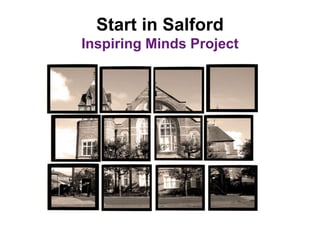
Start in Salford
Inspiring Minds Project
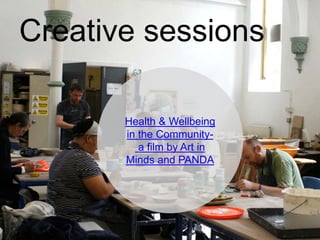
Creative sessions
Health & Wellbeing
in the Community-
a film by Art in
Minds and PANDA
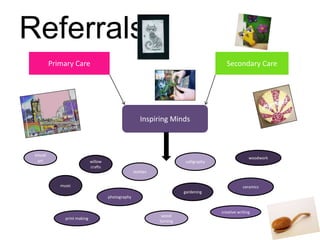
Referrals
Primary Care Secondary Care
Inspiring Minds
visual
art willow
crafts
textiles
calligraphy
woodwork
ceramics
photography
gardening
music
wood
turning
print making
creative writing
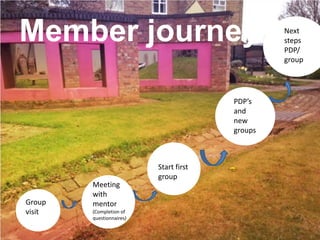
Member journey Next
steps
PDP/
group
PDP’s
and
new
groups
Start first
group
Group
visit
Meeting
with
mentor
(Completion of
questionnaires)
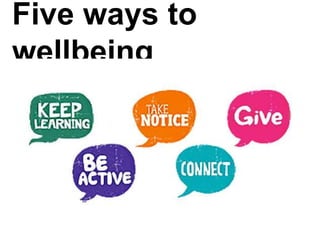
Five ways to
wellbeingConnect
Be active
Learn
Give
Take notice
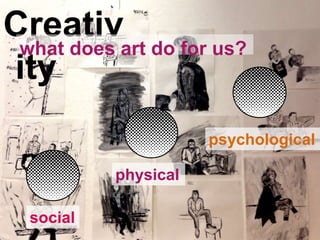
Creativ
ity
what does art do for us?
physical
psychological
social
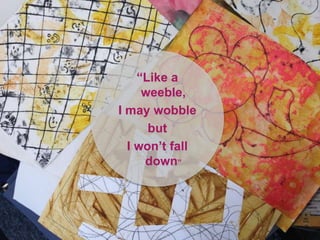
“Like a
weeble,
I may wobble
but
I won’t fall
down”
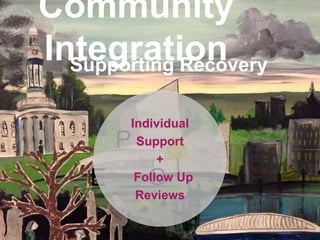
Community
IntegrationSupporting Recovery
P
OE
Individual
Support
+
Follow Up
Reviews
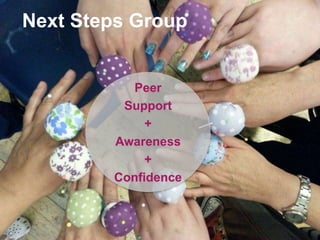
Next Steps Group
Peer
Support
+
Awareness
+
Confidence
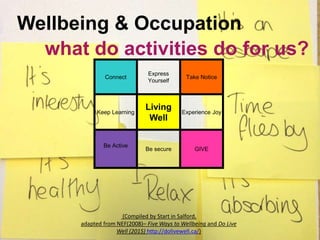
Wellbeing & Occupation
what do activities do for us?
(Compiled by Start in Salford,
adapted from NEF(2008)– Five Ways to Wellbeing and Do Live
Well (2015) http://dolivewell.ca/)
Connect
Express
Yourself
Take Notice
Keep Learning
Living
Well
Experience Joy
Be Active
Be secure GIVE
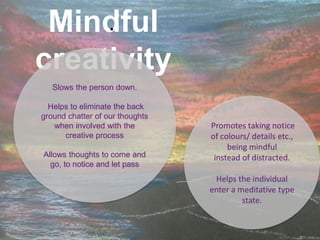
Mindful
creativity
•
Slows the person down.
Helps to eliminate the back
ground chatter of our thoughts
when involved with the
creative process
Allows thoughts to come and
go, to notice and let pass
Promotes taking notice
of colours/ details etc.,
being mindful
instead of distracted.
Helps the individual
enter a meditative type
state.
Research
Invest to Save: Arts and health evaluation
Exploring the impact of creativity, culture and the arts on health & wellbeing
Kilroy & Garner 2008
Key points :
confidence, self esteem, interest in life, more concern for own health & wellbeing,
increased empowerment to make choices about health and greater capacity to cope
with health issues, reduced isolation, increased motivation.
Raised expectations and greater inspiration for personal growth, capacity to cope
with challenge and gaining more mastery and control over their environment.
Creative flow state where people experience deep concentration/absorption providing
a means of forgetting about pain, illness or concerns – beyond distraction.
This process stimulates a process of transformational change where people start to
see things differently and there is a shift in existing thinking & patterns of behaviour.
Key findings :
Talking therapy does not overcome persistent problems with social
functioning and networks
Doing not talking ,was required following therapy to get back to ‘normal’, a
stepping stone to other things giving meaning to and direction in life.
More than just social groups as there is an end product leads to sense of
achievement/ belief in own abilities.
‘Getting back to normal’: the added value of an arts based programme in
promoting recovery for common but chronic mental health problems
Makin & Gask 2011
Thank You
June Wilcock
Delivery Manager
june.wilcock@
startinsalford.org.uk
Rachel Jones
Community Integration
Worker
rachel.jones@
startinsalford.org.uk

Presentation to OT Study Day Lancaster 2016

  • 1.
  • 2.
    Creative sessions Health &Wellbeing in the Community- a film by Art in Minds and PANDA
  • 3.
    Referrals Primary Care SecondaryCare Inspiring Minds visual art willow crafts textiles calligraphy woodwork ceramics photography gardening music wood turning print making creative writing
  • 4.
    Member journey Next steps PDP/ group PDP’s and new groups Startfirst group Group visit Meeting with mentor (Completion of questionnaires)
  • 5.
    Five ways to wellbeingConnect Beactive Learn Give Take notice
  • 6.
    Creativ ity what does artdo for us? physical psychological social
  • 7.
    “Like a weeble, I maywobble but I won’t fall down”
  • 8.
  • 9.
  • 10.
    Wellbeing & Occupation whatdo activities do for us? (Compiled by Start in Salford, adapted from NEF(2008)– Five Ways to Wellbeing and Do Live Well (2015) http://dolivewell.ca/) Connect Express Yourself Take Notice Keep Learning Living Well Experience Joy Be Active Be secure GIVE
  • 11.
    Mindful creativity • Slows the persondown. Helps to eliminate the back ground chatter of our thoughts when involved with the creative process Allows thoughts to come and go, to notice and let pass Promotes taking notice of colours/ details etc., being mindful instead of distracted. Helps the individual enter a meditative type state.
  • 12.
    Research Invest to Save:Arts and health evaluation Exploring the impact of creativity, culture and the arts on health & wellbeing Kilroy & Garner 2008 Key points : confidence, self esteem, interest in life, more concern for own health & wellbeing, increased empowerment to make choices about health and greater capacity to cope with health issues, reduced isolation, increased motivation. Raised expectations and greater inspiration for personal growth, capacity to cope with challenge and gaining more mastery and control over their environment. Creative flow state where people experience deep concentration/absorption providing a means of forgetting about pain, illness or concerns – beyond distraction. This process stimulates a process of transformational change where people start to see things differently and there is a shift in existing thinking & patterns of behaviour.
  • 13.
    Key findings : Talkingtherapy does not overcome persistent problems with social functioning and networks Doing not talking ,was required following therapy to get back to ‘normal’, a stepping stone to other things giving meaning to and direction in life. More than just social groups as there is an end product leads to sense of achievement/ belief in own abilities. ‘Getting back to normal’: the added value of an arts based programme in promoting recovery for common but chronic mental health problems Makin & Gask 2011
  • 14.
    Thank You June Wilcock DeliveryManager june.wilcock@ startinsalford.org.uk Rachel Jones Community Integration Worker rachel.jones@ startinsalford.org.uk