Productivity through leadership & supervisory skill
Relations with supervisor
 What are the improvement areas in Section Chief’s
management style?
New Employee
What are the issues a supervisor should consider
before assigning tasks to a new employee?
Mr. Nitta and Section Chief Baba
1. Why didn’t the section chief succeed?
2. What were some of Mr. Baba’s mistakes?
3. What kinds of treatment do subordinates
expect from their managers in workplace?
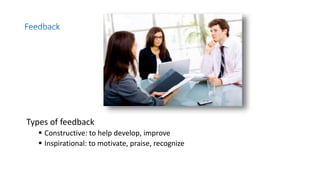
Types of feedback
 Constructive: to help develop, improve
 Inspirational: to motivate, praise, recognize
• Give it directly and in a spirit of mutual trust
• Be specific, not general; use clear examples
• Focus on things the receiver can control
• Limit how much receiver gets at one time
• Give it when the receiver is most ready to accept
• Be accurate; check its validity with others as appropriate
• Separate constructive and inspirational feedback
• Confidential vs. public?
A Good Supervisor:
 Treats others as you wish to be treated (or as you wish your loved ones to be
treated)
 Remembers that staff are multi-faceted human beings, with needs, interests
and lives that are important to them.
 Be honest and ethical and fair.
 Recognizes that problems are a normal part of life and approach them in an
effort to find solutions rather than place blame.
A Good Supervisor:
 Establish trust and credibility
 Gives praise and recognition when it is due.
 Shows those who work for you that you too are human – laugh, share.
 Apologizes when it is called for and let them get to know you. No one
expects a supervisor to be perfect.
Mr. Nitta and section chief Ueno
What are the difference between treatments of Mr.
Ueno and Mr. Baba and their ways of grasping facts?
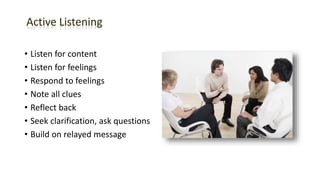
• Listen for content
• Listen for feelings
• Respond to feelings
• Note all clues
• Reflect back
• Seek clarification, ask questions
• Build on relayed message
Successful Supervisors Supervisors Who Fail
Are always prepared with well-thought-out plans, clearly
communicated goals, and the right resources in place
Always react instead of thinking ahead and planning ahead
Stay positive, show strength when under pressure Do not understand that it is not what they can do that counts—
it is what they can get others to
accomplish that is important
Listen more than they talk and work hard to become good
communicators
Supervisors without listening give orders, make demands, and
keep the pressure on without considering the capacity or
feelings of the people who work for them
Establish high standards for quality and set a good example Allow problems to get them down
Take time to teach their staff what they need to know Rush in with instructions to their staff, then fail to follow up
Set reasonable and consistent standards and limits Yell and scream at staff members—and sometimes humiliate
them
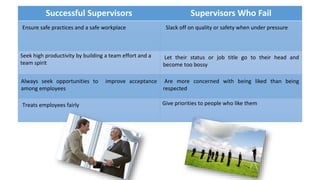
Successful Supervisors Supervisors Who Fail
Ensure safe practices and a safe workplace Slack off on quality or safety when under pressure
Seek high productivity by building a team effort and a
team spirit
Let their status or job title go to their head and
become too bossy
Always seek opportunities to improve acceptance
among employees
Are more concerned with being liked than being
respected
Treats employees fairly Give priorities to people who like them
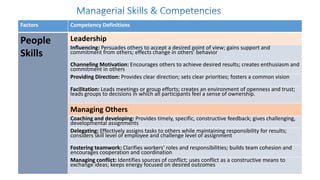
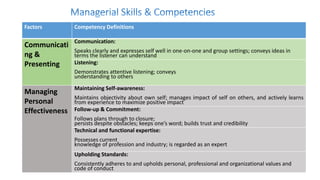
Factors Competency Definitions
People
Skills
Leadership
Influencing: Persuades others to accept a desired point of view; gains support and
commitment from others; effects change in others’ behavior
Channeling Motivation: Encourages others to achieve desired results; creates enthusiasm and
commitment in others
Providing Direction: Provides clear direction; sets clear priorities; fosters a common vision
Facilitation: Leads meetings or group efforts; creates an environment of openness and trust;
leads groups to decisions in which all participants feel a sense of ownership.
Managing Others
Coaching and developing: Provides timely, specific, constructive feedback; gives challenging,
developmental assignments
Delegating: Effectively assigns tasks to others while maintaining responsibility for results;
considers skill level of employee and challenge level of assignment
Fostering teamwork: Clarifies workers’ roles and responsibilities; builds team cohesion and
encourages cooperation and coordination
Managing conflict: Identifies sources of conflict; uses conflict as a constructive means to
exchange ideas; keeps energy focused on desired outcomes
Factors Competency Definitions
Communicati
ng &
Presenting
Communication:
Speaks clearly and expresses self well in one-on-one and group settings; conveys ideas in
terms the listener can understand
Listening:
Demonstrates attentive listening; conveys
understanding to others
Managing
Personal
Effectiveness
Maintaining Self-awareness:
Maintains objectivity about own self; manages impact of self on others, and actively learns
from experience to maximize positive impact
Follow-up & Commitment:
Follows plans through to closure;
persists despite obstacles; keeps one’s word; builds trust and credibility
Technical and functional expertise:
Possesses current
knowledge of profession and industry; is regarded as an expert
Upholding Standards:
Consistently adheres to and upholds personal, professional and organizational values and
code of conduct
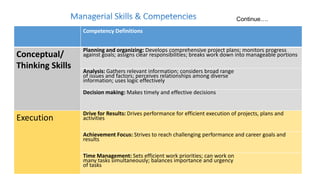
Competency Definitions
Conceptual/
Thinking Skills
Planning and organizing: Develops comprehensive project plans; monitors progress
against goals; assigns clear responsibilities; breaks work down into manageable portions
Analysis: Gathers relevant information; considers broad range
of issues and factors; perceives relationships among diverse
information; uses logic effectively
Decision making: Makes timely and effective decisions
Execution
Drive for Results: Drives performance for efficient execution of projects, plans and
activities
Achievement Focus: Strives to reach challenging performance and career goals and
results
Time Management: Sets efficient work priorities; can work on
many tasks simultaneously; balances importance and urgency
of tasks
Continue….
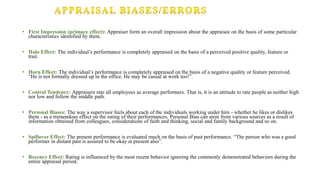
• First Impression (primacy effect): Appraiser form an overall impression about the appraisee on the basis of some particular
characteristics identified by them.
• Halo Effect: The individual’s performance is completely appraised on the basis of a perceived positive quality, feature or
trait.
• Horn Effect: The individual’s performance is completely appraised on the basis of a negative quality or feature perceived.
“He is not formally dressed up in the office. He may be casual at work too!”.
• Central Tendency: Appraisers rate all employees as average performers. That is, it is an attitude to rate people as neither high
nor low and follow the middle path.
• Personal Biases: The way a supervisor feels about each of the individuals working under him - whether he likes or dislikes
them - as a tremendous effect on the rating of their performances. Personal Bias can stem from various sources as a result of
information obtained from colleagues, considerations of faith and thinking, social and family background and so on.
• Spillover Effect: The present performance is evaluated much on the basis of past performance. “The person who was a good
performer in distant past is assured to be okay at present also”.
• Recency Effect: Rating is influenced by the most recent behavior ignoring the commonly demonstrated behaviors during the
entire appraisal period.
17
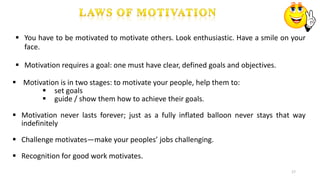
 You have to be motivated to motivate others. Look enthusiastic. Have a smile on your
face.
 Motivation requires a goal: one must have clear, defined goals and objectives.
 Motivation is in two stages: to motivate your people, help them to:
 set goals
 guide / show them how to achieve their goals.
 Motivation never lasts forever; just as a fully inflated balloon never stays that way
indefinitely
 Challenge motivates—make your peoples’ jobs challenging.
 Recognition for good work motivates.
Thank you for your valuable time

Presentation Slides-Supervisory Skills.pptx

  • 1.
  • 2.
    Relations with supervisor What are the improvement areas in Section Chief’s management style?
  • 3.
    New Employee What arethe issues a supervisor should consider before assigning tasks to a new employee?
  • 4.
    Mr. Nitta andSection Chief Baba 1. Why didn’t the section chief succeed? 2. What were some of Mr. Baba’s mistakes? 3. What kinds of treatment do subordinates expect from their managers in workplace?
  • 5.
    Types of feedback Constructive: to help develop, improve  Inspirational: to motivate, praise, recognize
  • 6.
    • Give itdirectly and in a spirit of mutual trust • Be specific, not general; use clear examples • Focus on things the receiver can control • Limit how much receiver gets at one time • Give it when the receiver is most ready to accept • Be accurate; check its validity with others as appropriate • Separate constructive and inspirational feedback • Confidential vs. public?
  • 7.
    A Good Supervisor: Treats others as you wish to be treated (or as you wish your loved ones to be treated)  Remembers that staff are multi-faceted human beings, with needs, interests and lives that are important to them.  Be honest and ethical and fair.  Recognizes that problems are a normal part of life and approach them in an effort to find solutions rather than place blame.
  • 8.
    A Good Supervisor: Establish trust and credibility  Gives praise and recognition when it is due.  Shows those who work for you that you too are human – laugh, share.  Apologizes when it is called for and let them get to know you. No one expects a supervisor to be perfect.
  • 9.
    Mr. Nitta andsection chief Ueno What are the difference between treatments of Mr. Ueno and Mr. Baba and their ways of grasping facts?
  • 10.
    • Listen forcontent • Listen for feelings • Respond to feelings • Note all clues • Reflect back • Seek clarification, ask questions • Build on relayed message
  • 11.
    Successful Supervisors SupervisorsWho Fail Are always prepared with well-thought-out plans, clearly communicated goals, and the right resources in place Always react instead of thinking ahead and planning ahead Stay positive, show strength when under pressure Do not understand that it is not what they can do that counts— it is what they can get others to accomplish that is important Listen more than they talk and work hard to become good communicators Supervisors without listening give orders, make demands, and keep the pressure on without considering the capacity or feelings of the people who work for them Establish high standards for quality and set a good example Allow problems to get them down Take time to teach their staff what they need to know Rush in with instructions to their staff, then fail to follow up Set reasonable and consistent standards and limits Yell and scream at staff members—and sometimes humiliate them
  • 12.
    Successful Supervisors SupervisorsWho Fail Ensure safe practices and a safe workplace Slack off on quality or safety when under pressure Seek high productivity by building a team effort and a team spirit Let their status or job title go to their head and become too bossy Always seek opportunities to improve acceptance among employees Are more concerned with being liked than being respected Treats employees fairly Give priorities to people who like them
  • 13.
    Factors Competency Definitions People Skills Leadership Influencing:Persuades others to accept a desired point of view; gains support and commitment from others; effects change in others’ behavior Channeling Motivation: Encourages others to achieve desired results; creates enthusiasm and commitment in others Providing Direction: Provides clear direction; sets clear priorities; fosters a common vision Facilitation: Leads meetings or group efforts; creates an environment of openness and trust; leads groups to decisions in which all participants feel a sense of ownership. Managing Others Coaching and developing: Provides timely, specific, constructive feedback; gives challenging, developmental assignments Delegating: Effectively assigns tasks to others while maintaining responsibility for results; considers skill level of employee and challenge level of assignment Fostering teamwork: Clarifies workers’ roles and responsibilities; builds team cohesion and encourages cooperation and coordination Managing conflict: Identifies sources of conflict; uses conflict as a constructive means to exchange ideas; keeps energy focused on desired outcomes
  • 14.
    Factors Competency Definitions Communicati ng& Presenting Communication: Speaks clearly and expresses self well in one-on-one and group settings; conveys ideas in terms the listener can understand Listening: Demonstrates attentive listening; conveys understanding to others Managing Personal Effectiveness Maintaining Self-awareness: Maintains objectivity about own self; manages impact of self on others, and actively learns from experience to maximize positive impact Follow-up & Commitment: Follows plans through to closure; persists despite obstacles; keeps one’s word; builds trust and credibility Technical and functional expertise: Possesses current knowledge of profession and industry; is regarded as an expert Upholding Standards: Consistently adheres to and upholds personal, professional and organizational values and code of conduct
  • 15.
    Competency Definitions Conceptual/ Thinking Skills Planningand organizing: Develops comprehensive project plans; monitors progress against goals; assigns clear responsibilities; breaks work down into manageable portions Analysis: Gathers relevant information; considers broad range of issues and factors; perceives relationships among diverse information; uses logic effectively Decision making: Makes timely and effective decisions Execution Drive for Results: Drives performance for efficient execution of projects, plans and activities Achievement Focus: Strives to reach challenging performance and career goals and results Time Management: Sets efficient work priorities; can work on many tasks simultaneously; balances importance and urgency of tasks Continue….
  • 16.
    • First Impression(primacy effect): Appraiser form an overall impression about the appraisee on the basis of some particular characteristics identified by them. • Halo Effect: The individual’s performance is completely appraised on the basis of a perceived positive quality, feature or trait. • Horn Effect: The individual’s performance is completely appraised on the basis of a negative quality or feature perceived. “He is not formally dressed up in the office. He may be casual at work too!”. • Central Tendency: Appraisers rate all employees as average performers. That is, it is an attitude to rate people as neither high nor low and follow the middle path. • Personal Biases: The way a supervisor feels about each of the individuals working under him - whether he likes or dislikes them - as a tremendous effect on the rating of their performances. Personal Bias can stem from various sources as a result of information obtained from colleagues, considerations of faith and thinking, social and family background and so on. • Spillover Effect: The present performance is evaluated much on the basis of past performance. “The person who was a good performer in distant past is assured to be okay at present also”. • Recency Effect: Rating is influenced by the most recent behavior ignoring the commonly demonstrated behaviors during the entire appraisal period.
  • 17.
    17  You haveto be motivated to motivate others. Look enthusiastic. Have a smile on your face.  Motivation requires a goal: one must have clear, defined goals and objectives.  Motivation is in two stages: to motivate your people, help them to:  set goals  guide / show them how to achieve their goals.  Motivation never lasts forever; just as a fully inflated balloon never stays that way indefinitely  Challenge motivates—make your peoples’ jobs challenging.  Recognition for good work motivates.
  • 18.
    Thank you foryour valuable time