
PRESENTATION  SKILLS Presented by: Maam Lumanglas DENR-HRDS, 21 and 25 January 2008
The  3 things you must know Use visual aids where you can Rehearse, rehearse, rehearse  The audience will only remember three messages
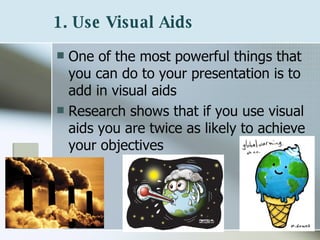
1. Use Visual Aids   One of the most powerful things that you can do to your presentation is to add in visual aids Research shows that if you use visual aids you are twice as likely to achieve your objectives
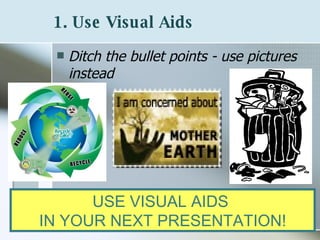
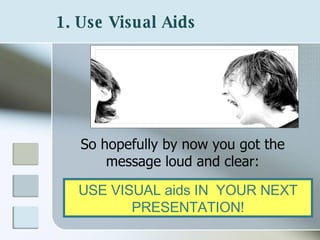
1. Use Visual Aids   Ditch the bullet points - use pictures instead USE VISUAL AIDS  IN YOUR NEXT PRESENTATION!
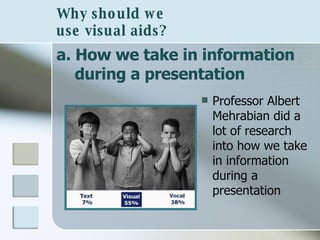
Why should we  use visual aids? a. How we take in information during a presentation Professor Albert Mehrabian did a lot of research into how we take in information during a presentation
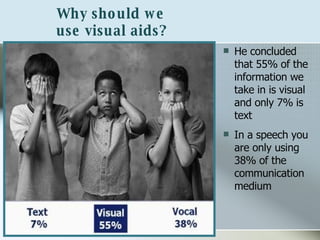
Why should we  use visual aids? He concluded that 55% of the information we take in is visual and only 7% is text In a speech you are only using 38% of the communication medium
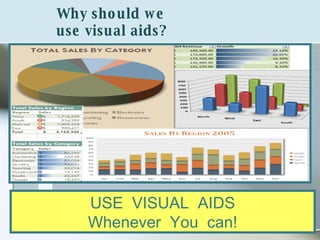
Why should we  use visual aids? USE  VISUAL  AIDS Whenever  You  can!
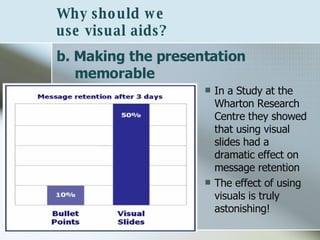
b. Making the presentation memorable In a Study at the Wharton Research Centre they showed that using visual slides had a dramatic effect on message retention The effect of using visuals is truly astonishing! Why should we  use visual aids?
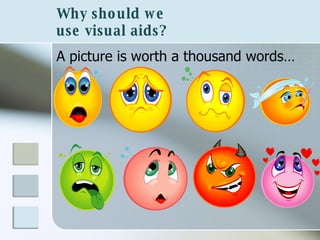
A picture is worth a thousand words… Why should we  use visual aids?
 
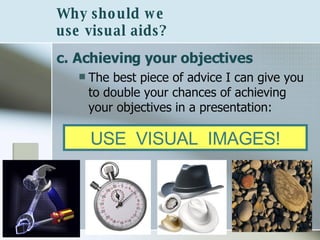
c. Achieving your objectives   The best piece of advice I can give you to double your chances of achieving your objectives in a presentation:  Why should we  use visual aids? USE  VISUAL  IMAGES!
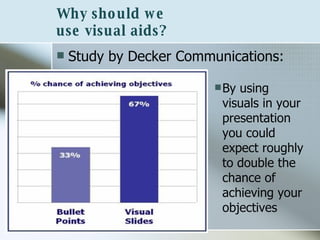
Study by Decker Communications: By using visuals in your presentation you could expect roughly to double the chance of achieving your objectives Why should we  use visual aids?
1. Use Visual Aids   So hopefully by now you got the message loud and clear: USE VISUAL aids IN  YOUR NEXT PRESENTATION!
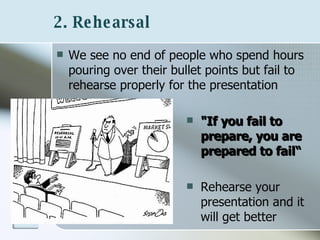
2. Rehearsal   We see no end of people who spend hours pouring over their bullet points but fail to rehearse properly for the presentation "If you fail to prepare, you are prepared to fail“ Rehearse your presentation and it will get better
2. Rehearsal   Rehearsing can be a bit of a drag, and it’s easy to forget Not rehearsing is probably the most common mistake of all presentations Imagine a contestant singing a Regine Velasquez song without rehearsing!  Rehearsing  could  make  the difference  between  a  good and  an  average  presentation Rehearse and  you will get better
3. The Rule of Three   This is one of the oldest of all the presentation techniques - known since the time of Aristotle People tend to remember lists of three things -- structure your presentation around threes and it will become more memorable  The Rule of Three:   We remember three things
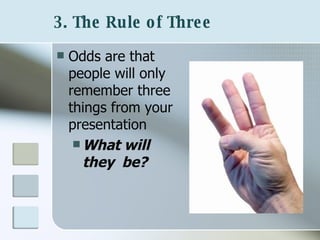
3. The Rule of Three   Odds are that people will only remember three things from your presentation What will they  be?
3. The Rule of Three   a. The audience are likely to remember only three things from your presentation   Plan in advance what these will be Before you start writing your presentation, plan what your three key messages will be Then structure the main part of your presentation around these three key themes and look at how they could be better illustrated
3. The Rule of Three   b. There are three parts to your presentation:  Beginning – Middle – End   Start to plan out what you will do in these three parts The beginning is ideal for an attention grabber or for an ice breaker The end is great to wrap things up or to end with a grand finale
3. The Rule of Three   c. Use lists of three wherever you can in your presentation Lists of three have been used from early times up to the present day They are particularly used by politicians and advertisers who know the value of using the rule of three to sell their ideas EXAMPLES…
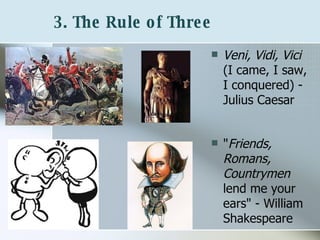
3. The Rule of Three   Veni, Vidi, Vici  (I came, I saw, I conquered) - Julius Caesar " Friends, Romans, Countrymen  lend me your ears" - William Shakespeare
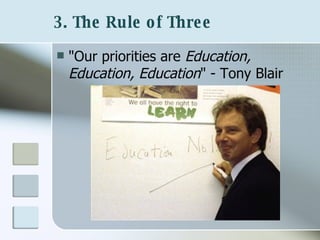
3. The Rule of Three   "Our priorities are  Education, Education, Education " - Tony Blair
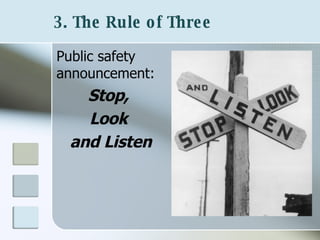
3. The Rule of Three   Public safety announcement:  Stop,  Look  and Listen
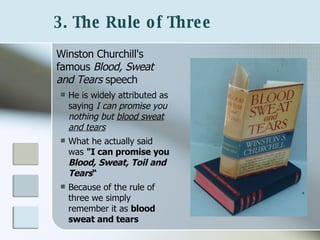
3. The Rule of Three   Winston Churchill's famous  Blood, Sweat and Tears  speech He is widely attributed as saying  I can promise you nothing but  blood sweat and tears What he actually said was  "I can promise you  Blood, Sweat, Toil and Tears “ Because of the rule of three we simply remember it as  blood sweat and tears
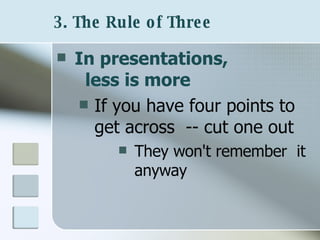
3. The Rule of Three   In presentations,  less is more If you have four points to get across  -- cut one out They won't remember  it anyway
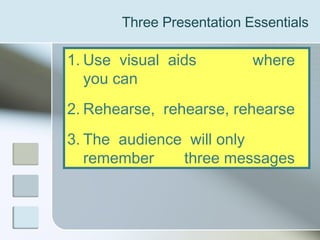
Three Presentation Essentials Use  visual  aids  where you can Rehearse,  rehearse, rehearse The  audience  will only  remember  three messages
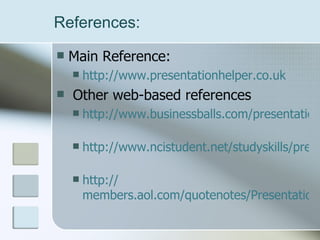
References: Main Reference: http://www.presentationhelper.co.uk   Other web-based references http://www.businessballs.com/presentation.htm   http://www.ncistudent.net/studyskills/presentationskills/presentations1.htm   http:// members.aol.com/quotenotes/PresentationSkills.htm

Presentation Skills

  • 1.
    PRESENTATION SKILLSPresented by: Maam Lumanglas DENR-HRDS, 21 and 25 January 2008
  • 2.
    The 3things you must know Use visual aids where you can Rehearse, rehearse, rehearse The audience will only remember three messages
  • 3.
    1. Use VisualAids One of the most powerful things that you can do to your presentation is to add in visual aids Research shows that if you use visual aids you are twice as likely to achieve your objectives
  • 4.
    1. Use VisualAids Ditch the bullet points - use pictures instead USE VISUAL AIDS IN YOUR NEXT PRESENTATION!
  • 5.
    Why should we use visual aids? a. How we take in information during a presentation Professor Albert Mehrabian did a lot of research into how we take in information during a presentation
  • 6.
    Why should we use visual aids? He concluded that 55% of the information we take in is visual and only 7% is text In a speech you are only using 38% of the communication medium
  • 7.
    Why should we use visual aids? USE VISUAL AIDS Whenever You can!
  • 8.
    b. Making thepresentation memorable In a Study at the Wharton Research Centre they showed that using visual slides had a dramatic effect on message retention The effect of using visuals is truly astonishing! Why should we use visual aids?
  • 9.
    A picture isworth a thousand words… Why should we use visual aids?
  • 10.
  • 11.
    c. Achieving yourobjectives The best piece of advice I can give you to double your chances of achieving your objectives in a presentation: Why should we use visual aids? USE VISUAL IMAGES!
  • 12.
    Study by DeckerCommunications: By using visuals in your presentation you could expect roughly to double the chance of achieving your objectives Why should we use visual aids?
  • 13.
    1. Use VisualAids So hopefully by now you got the message loud and clear: USE VISUAL aids IN YOUR NEXT PRESENTATION!
  • 14.
    2. Rehearsal We see no end of people who spend hours pouring over their bullet points but fail to rehearse properly for the presentation "If you fail to prepare, you are prepared to fail“ Rehearse your presentation and it will get better
  • 15.
    2. Rehearsal Rehearsing can be a bit of a drag, and it’s easy to forget Not rehearsing is probably the most common mistake of all presentations Imagine a contestant singing a Regine Velasquez song without rehearsing! Rehearsing could make the difference between a good and an average presentation Rehearse and you will get better
  • 16.
    3. The Ruleof Three This is one of the oldest of all the presentation techniques - known since the time of Aristotle People tend to remember lists of three things -- structure your presentation around threes and it will become more memorable The Rule of Three: We remember three things
  • 17.
    3. The Ruleof Three Odds are that people will only remember three things from your presentation What will they be?
  • 18.
    3. The Ruleof Three a. The audience are likely to remember only three things from your presentation Plan in advance what these will be Before you start writing your presentation, plan what your three key messages will be Then structure the main part of your presentation around these three key themes and look at how they could be better illustrated
  • 19.
    3. The Ruleof Three b. There are three parts to your presentation: Beginning – Middle – End Start to plan out what you will do in these three parts The beginning is ideal for an attention grabber or for an ice breaker The end is great to wrap things up or to end with a grand finale
  • 20.
    3. The Ruleof Three c. Use lists of three wherever you can in your presentation Lists of three have been used from early times up to the present day They are particularly used by politicians and advertisers who know the value of using the rule of three to sell their ideas EXAMPLES…
  • 21.
    3. The Ruleof Three Veni, Vidi, Vici (I came, I saw, I conquered) - Julius Caesar " Friends, Romans, Countrymen lend me your ears" - William Shakespeare
  • 22.
    3. The Ruleof Three "Our priorities are Education, Education, Education " - Tony Blair
  • 23.
    3. The Ruleof Three Public safety announcement: Stop, Look and Listen
  • 24.
    3. The Ruleof Three Winston Churchill's famous Blood, Sweat and Tears speech He is widely attributed as saying I can promise you nothing but blood sweat and tears What he actually said was "I can promise you Blood, Sweat, Toil and Tears “ Because of the rule of three we simply remember it as blood sweat and tears
  • 25.
    3. The Ruleof Three In presentations, less is more If you have four points to get across -- cut one out They won't remember it anyway
  • 26.
    Three Presentation EssentialsUse visual aids where you can Rehearse, rehearse, rehearse The audience will only remember three messages
  • 27.
    References: Main Reference:http://www.presentationhelper.co.uk Other web-based references http://www.businessballs.com/presentation.htm http://www.ncistudent.net/studyskills/presentationskills/presentations1.htm http:// members.aol.com/quotenotes/PresentationSkills.htm