Success factors for managing horizontal purchasing groups:  an empirical survey Presenter Fredo Schotanus Co-authors Jan Telgen Luitzen de Boer University of Twente Initiative of Purchasing Studies
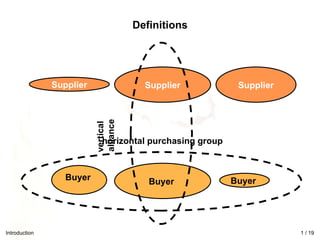
Definitions Buyer  Buyer  Buyer  Supplier vertical  alliance horizontal purchasing group Supplier Supplier Introduction 1 / 19
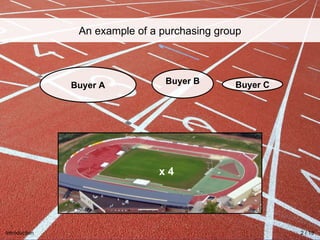
An example of a purchasing group Buyer B Buyer C Buyer A x 4 Introduction 2 / 19
Sounds nice, but problems may occur (‘bears on the road’) Small and intensive groups do not always flourish It’d help if we know what factors influence success  Introduction 3 / 19
Earlier work General A lot of literature on (forming) alliances No comprehensive theory exists Some study success factors, but hardly any study a broad set  (Hoffmann & Schlosser, 2001) Specifically 1 study deals with quite a broad set for purchasing groups  (Hendrick, 1997) Not fully consistent with the general literature Introduction 4 / 19
Identify success factors for managing purchasing groups Contributes by a broad empirical investigation into success factors for  purchasing groups Objective & contribution Agenda   Introduction 5 / 19
Several theories explain cooperation We build on  TCE  (general rationale) Social exchange theory  (individual fair rationale) 19 success factors categorized by Trust Formality  Member uniformity Common goals Communication Allocation of savings  Member influence Enforcement of cooperation Member cooperation Commitment & support Potential success factors Literature review 6 / 19
Perhaps the most discussed success factor  (e.g., Bakker et al., 2006; Polychronakis and Syntetos, 2007;Vangen and Huxham, 2003) Several empirical studies confirm its importance Reasoning from TCE costs are lower when there is trust as less monitoring & agreements are necessary  Potential success factors Members are honest and loyal Members like each other personally Members meet one's commitments Category: Interorganizational trust Literature review 7 / 19
Perceived importance  of factors  (Hendrick, 1997) Compare differences between (un)successful groups  (Hoffmann & Schlosser, 2001) Method 2 Not yet used for studying purchasing groups Need to define ‘success’ (no consensus in the literature) We measure it as the  perceived success  of the group Two methods Literature review 8 / 19
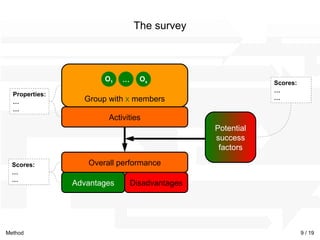
Activities Group with  x  members O 1 … Properties: … … Overall performance Advantages Disadvantages Scores: … … Potential success factors Scores: … … O x Method The survey 9 / 19
The numbers 16%  ‘worst case’ response rate 224  respondents 115  groups  74  small and intensive groups ( 81%  successful) Early & late response almost the same  ( p  < .05) We knew most responding groups  Data seems to be representative NEVI newsletter ( 797  org.) Ovia newsletter ( 620  org.) a c t i v e not active  (low response) Sampling Method 10 / 19
T-tests to identify potential success factors Discriminant analysis to the factors identified in step 1 All assumptions are met Assumptions tested with QQ-plots for normality Levene’s (1960) test  ( p  ≤ .05)  and the variance ratio for equality of variances  (< 2.5)   Box’s (1950) test  ( p  ≤ .05)  for equality of covariance matrices Data analysis  (based on  Hoffmann & Schlosser; 2001) Method 11 / 19
Enforcement of cooperation No enforced participation Member cooperation Members contribute unique knowledge Sufficient total contribution of efforts Commitment and support Members rarely change representatives Members have internal support 12 / 19 Identified potential success factors  (t-tests;  p  ≤ .05;  discriminant analysis; 89.3% classified correctly) Findings and discussion Communication  Communication (current projects) Communication (new projects) Member influence  Members have similar influence Common objectives Members have similar objectives Allocation of savings Fair allocation of savings
Categories  without  success factors  Findings and discussion Trust and formality  (consistent with Hoffmann & Schlosser, 2001) Inconsistent with a.o. Schotanus (2005) Important when establishing, but prerequisites for managing a group Explanation by awareness and the methods used Member uniformity Inconsistent with a.o. Hendrick (1997) Groups with member with (dis)similar cultures and procedures can be (un)successful  Similar explanations as for trust plus the specific context 13 / 19
Categories  with  success factors (1/3) Findings and discussion Enforcement of cooperation  (consistent with Brockhoff, 1992) Participation should bring savings and attract without enforcement Still,  if  a member cooperates, it needs to commit Enforcement & influence problems are typical for BU groups Member cooperation  (consistent with Hoffmann & Schlosser (2001)  and communication  (consistent with Laing & Cotton, 1997) Factors such as sufficient total contribution of efforts show that success doesn’t occur as a matter of course Some knowledge and efforts are necessary to coordinate, communicate, etc. 14 / 19
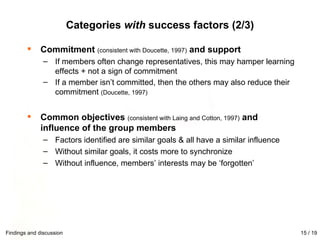
Categories  with  success factors (2/3) Findings and discussion Commitment  (consistent with Doucette, 1997)  and support If members often change representatives, this may hamper learning effects + not a sign of commitment If a member isn’t committed, then the others may also reduce their commitment  (Doucette, 1997) Common objectives  (consistent with Laing and Cotton, 1997)  and influence of the group members Factors identified are similar goals & all have a similar influence  Without similar goals, it costs more to synchronize  Without influence, members’ interests may be ‘forgotten’ 15 / 19
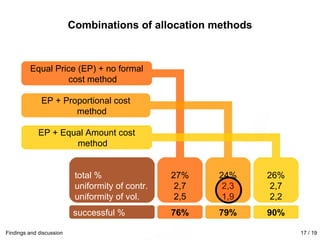
Categories  with  success factors (3/3) Findings and discussion Allocation of savings Fair allocation is important, but difficult for purchasing groups It may prevent conflicts and members leaving the group Allocation of gains 87% uses Equal Price  13% uses methods that are more beneficial to large members Allocation of costs 30% uses no formal method 29% uses a proportional method 29% uses Equal Amount or a fixed membership fee What’s a fair and successful combination? 16 / 19
Combinations of allocation methods EP + Equal Amount cost method Findings and discussion 17 / 19 Equal Price (EP) + no formal cost method EP + Proportional cost method total % uniformity of contr. uniformity of vol. successful % 27% 2,7 2,5 76% 24% 2,3 1,9 79% 26% 2,7 2,2 90%
Limitations and further research Focus on small and intensive groups Difficult to assess ‘success’ Low response rate No distinction between (very) successful  Not enough data for method combinations 18 / 19
Quantitative empirical evidence using TCE and SET Found no success factors related to trust, formality, and uniformity Inconsistencies explained by method or context differences Main success factors are No enforcement Sufficient total contribution of efforts All contribute unique knowledge All rarely change representatives  Fair allocation of savings Communication (No large differences in motives & efforts) Prediction value of the discrimination analysis is 89.3% Conclusions on managing purchasing groups Fredo Schotanus [email_address] http://www.utips.eu 19 / 19

Presentation Purchasing Groups

  • 1.
    Success factors formanaging horizontal purchasing groups: an empirical survey Presenter Fredo Schotanus Co-authors Jan Telgen Luitzen de Boer University of Twente Initiative of Purchasing Studies
  • 2.
    Definitions Buyer Buyer Buyer Supplier vertical alliance horizontal purchasing group Supplier Supplier Introduction 1 / 19
  • 3.
    An example ofa purchasing group Buyer B Buyer C Buyer A x 4 Introduction 2 / 19
  • 4.
    Sounds nice, butproblems may occur (‘bears on the road’) Small and intensive groups do not always flourish It’d help if we know what factors influence success Introduction 3 / 19
  • 5.
    Earlier work GeneralA lot of literature on (forming) alliances No comprehensive theory exists Some study success factors, but hardly any study a broad set (Hoffmann & Schlosser, 2001) Specifically 1 study deals with quite a broad set for purchasing groups (Hendrick, 1997) Not fully consistent with the general literature Introduction 4 / 19
  • 6.
    Identify success factorsfor managing purchasing groups Contributes by a broad empirical investigation into success factors for purchasing groups Objective & contribution Agenda Introduction 5 / 19
  • 7.
    Several theories explaincooperation We build on TCE (general rationale) Social exchange theory (individual fair rationale) 19 success factors categorized by Trust Formality Member uniformity Common goals Communication Allocation of savings Member influence Enforcement of cooperation Member cooperation Commitment & support Potential success factors Literature review 6 / 19
  • 8.
    Perhaps the mostdiscussed success factor (e.g., Bakker et al., 2006; Polychronakis and Syntetos, 2007;Vangen and Huxham, 2003) Several empirical studies confirm its importance Reasoning from TCE costs are lower when there is trust as less monitoring & agreements are necessary Potential success factors Members are honest and loyal Members like each other personally Members meet one's commitments Category: Interorganizational trust Literature review 7 / 19
  • 9.
    Perceived importance of factors (Hendrick, 1997) Compare differences between (un)successful groups (Hoffmann & Schlosser, 2001) Method 2 Not yet used for studying purchasing groups Need to define ‘success’ (no consensus in the literature) We measure it as the perceived success of the group Two methods Literature review 8 / 19
  • 10.
    Activities Group with x members O 1 … Properties: … … Overall performance Advantages Disadvantages Scores: … … Potential success factors Scores: … … O x Method The survey 9 / 19
  • 11.
    The numbers 16% ‘worst case’ response rate 224 respondents 115 groups 74 small and intensive groups ( 81% successful) Early & late response almost the same ( p < .05) We knew most responding groups Data seems to be representative NEVI newsletter ( 797 org.) Ovia newsletter ( 620 org.) a c t i v e not active (low response) Sampling Method 10 / 19
  • 12.
    T-tests to identifypotential success factors Discriminant analysis to the factors identified in step 1 All assumptions are met Assumptions tested with QQ-plots for normality Levene’s (1960) test ( p ≤ .05) and the variance ratio for equality of variances (< 2.5) Box’s (1950) test ( p ≤ .05) for equality of covariance matrices Data analysis (based on Hoffmann & Schlosser; 2001) Method 11 / 19
  • 13.
    Enforcement of cooperationNo enforced participation Member cooperation Members contribute unique knowledge Sufficient total contribution of efforts Commitment and support Members rarely change representatives Members have internal support 12 / 19 Identified potential success factors (t-tests; p ≤ .05; discriminant analysis; 89.3% classified correctly) Findings and discussion Communication Communication (current projects) Communication (new projects) Member influence Members have similar influence Common objectives Members have similar objectives Allocation of savings Fair allocation of savings
  • 14.
    Categories without success factors Findings and discussion Trust and formality (consistent with Hoffmann & Schlosser, 2001) Inconsistent with a.o. Schotanus (2005) Important when establishing, but prerequisites for managing a group Explanation by awareness and the methods used Member uniformity Inconsistent with a.o. Hendrick (1997) Groups with member with (dis)similar cultures and procedures can be (un)successful Similar explanations as for trust plus the specific context 13 / 19
  • 15.
    Categories with success factors (1/3) Findings and discussion Enforcement of cooperation (consistent with Brockhoff, 1992) Participation should bring savings and attract without enforcement Still, if a member cooperates, it needs to commit Enforcement & influence problems are typical for BU groups Member cooperation (consistent with Hoffmann & Schlosser (2001) and communication (consistent with Laing & Cotton, 1997) Factors such as sufficient total contribution of efforts show that success doesn’t occur as a matter of course Some knowledge and efforts are necessary to coordinate, communicate, etc. 14 / 19
  • 16.
    Categories with success factors (2/3) Findings and discussion Commitment (consistent with Doucette, 1997) and support If members often change representatives, this may hamper learning effects + not a sign of commitment If a member isn’t committed, then the others may also reduce their commitment (Doucette, 1997) Common objectives (consistent with Laing and Cotton, 1997) and influence of the group members Factors identified are similar goals & all have a similar influence Without similar goals, it costs more to synchronize Without influence, members’ interests may be ‘forgotten’ 15 / 19
  • 17.
    Categories with success factors (3/3) Findings and discussion Allocation of savings Fair allocation is important, but difficult for purchasing groups It may prevent conflicts and members leaving the group Allocation of gains 87% uses Equal Price 13% uses methods that are more beneficial to large members Allocation of costs 30% uses no formal method 29% uses a proportional method 29% uses Equal Amount or a fixed membership fee What’s a fair and successful combination? 16 / 19
  • 18.
    Combinations of allocationmethods EP + Equal Amount cost method Findings and discussion 17 / 19 Equal Price (EP) + no formal cost method EP + Proportional cost method total % uniformity of contr. uniformity of vol. successful % 27% 2,7 2,5 76% 24% 2,3 1,9 79% 26% 2,7 2,2 90%
  • 19.
    Limitations and furtherresearch Focus on small and intensive groups Difficult to assess ‘success’ Low response rate No distinction between (very) successful Not enough data for method combinations 18 / 19
  • 20.
    Quantitative empirical evidenceusing TCE and SET Found no success factors related to trust, formality, and uniformity Inconsistencies explained by method or context differences Main success factors are No enforcement Sufficient total contribution of efforts All contribute unique knowledge All rarely change representatives Fair allocation of savings Communication (No large differences in motives & efforts) Prediction value of the discrimination analysis is 89.3% Conclusions on managing purchasing groups Fredo Schotanus [email_address] http://www.utips.eu 19 / 19

Editor's Notes

  • #2 IPSERA 2008
  • #5 Practical relevance
  • #6 Academic relevance