Welcome
Sofia Arvegård
- Run my own business
- Work for the industry and different educational companies
- Studied labor relations at Stockholm University
- Passionate about group development and management

- Organisational developer
- Hyper Island


@arvegard
www.arvegard.com
sofia@arvegard.com
What are we going to do today?
First session:
- Group development
- The tailor-made leadership

Second session:
- Self Awareness, strengths and areas of development
How are we going to do this?

- We will go though the latest research regarding group development
- I wish for a dialogue whit thoughts and questions
- I will share my own experiences and hopefully so will you
- Action and consequent
- Inspiration
- Increased knowledge regarding groups and self awareness

No correct solutions, no correct answers
No one is right or wrong
Is it necessary for us to understand
groups?
- Groups influence individuals -individuals influence groups
- We need diversity to solve complex task
- We need each other to achieve collective intelligence
- Well functional groups are effective and profitable


   ”We can support groups better and we will become
 better leaders if we understand groups and learn how to
                   interpret their needs”
A little bit of history

Susan A Wheelan - psychologist, scientist and author

- studied 100 years of research
- validated model of group development from a development perspective


                                                                             source:
                                                              Create effective teams
                                     A group process from a development perspective
Have you ever belonged to a well
       functional group?
Yes, I have ...

 "... I felt involved and important, people listen to me ...
I knew what I was suppose to do and what others should
          do. I trusted my colleagues. I got support!

            After we met, I had more energy.
                It felt like I learned stuff!

                    It was really fun! "
Have you ever belonged to a dysfunctional
    group that was not as pleasant?
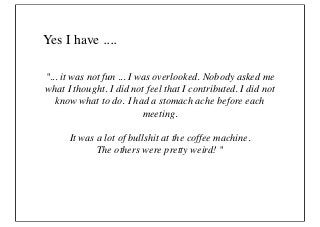
Yes I have ....

"... it was not fun ... I was overlooked. Nobody asked me
what I thought. I did not feel that I contributed. I did not
   know what to do. I had a stomach ache before each
                           meeting.

      It was a lot of bullshit at the coffee machine.
             The others were pretty weird! "
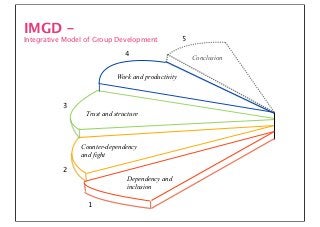
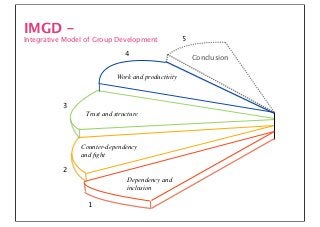
IMGD -
Integrative Model of Group Development              5

                               4
                                                        Conclusion

                            Work and productivity


           3
                 Trust and structure


                Counter-dependency
                and fight

           2
                               Dependency and
                               inclusion

                  1
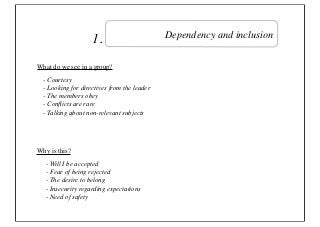
1.                       Dependency and inclusion


What do we see in a group?
  - Courtesy
  - Looking for directives from the leader
  - The members obey
  - Conflicts are rare
  - Talking about non-relevant subjects


Why is this?
   - Will I be accepted
   - Fear of being rejected
   - The desire to belong
   - Insecurity regarding expectations
   - Need of safety
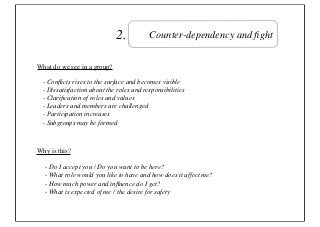
2.           Counter-dependency and fight


What do we see in a group?

  - Conflicts rises to the surface and becomes visible
  - Dissatisfaction about the roles and responsibilities
  - Clarification of roles and values
  - Leaders and members are challenged
  - Participation increases
  - Subgroups may be formed


Why is this?

  - Do I accept you / Do you want to be here?
  - What role would you like to have and how does it affect me?
  - How much power and influence do I get?
  - What is expected of me / the desire for safety
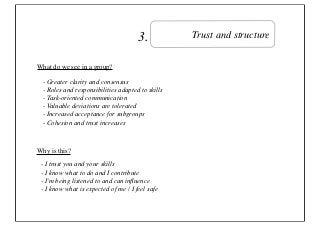
3.           Trust and structure


What do we see in a group?

  - Greater clarity and consensus
  - Roles and responsibilities adapted to skills
  - Task-oriented communication
  - Valuable deviations are tolerated
  - Increased acceptance for subgroups
  - Cohesion and trust increases


Why is this?
 - I trust you and your skills
 - I know what to do and I contribute
 - I'm being listened to and can influence
 - I know what is expected of me / I feel safe
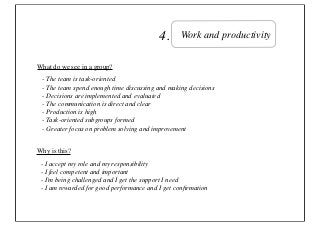
4.     Work and productivity


What do we see in a group?
 - The team is task-oriented
 - The team spend enough time discussing and making decisions
 - Decisions are implemented and evaluated
 - The communication is direct and clear
 - Production is high
 - Task-oriented subgroups formed
 - Greater focus on problem solving and improvement


Why is this?
 - I accept my role and my responsibility
 - I feel competent and important
 - I'm being challenged and I get the support I need
 - I am rewarded for good performance and I get confirmation
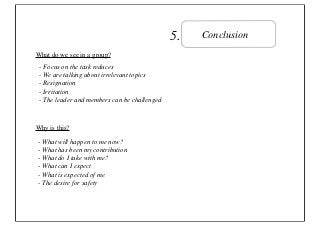
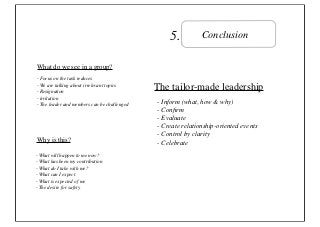
5.   Conclusion
What do we see in a group?
 - Focus on the task reduces
 - We are talking about irrelevant topics
 - Resignation
 - Irritation
 - The leader and members can be challenged


Why is this?

- What will happen to me now?
- What has been my contribution
- What do I take with me?
- What can I expect
- What is expected of me
- The desire for safety
IMGD -
Integrative Model of Group Development              5

                               4
                                                        Conclusion

                            Work and productivity


           3
                 Trust and structure


                Counter-dependency
                and fight

           2
                               Dependency and
                               inclusion

                  1
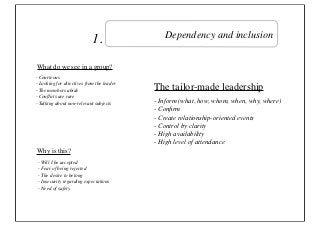
1.                Dependency and inclusion


What do we see in a group?
- Courteous
- Looking for directives from the leader
- The members abide                        The tailor-made leadership
- Conflicts are rare
- Talking about non-relevant subjects      - Inform (what, how, whom, when, why, where)
                                           - Confirm
                                           - Create relationship-oriented events
                                           - Control by clarity
                                           - High availability
                                           - High level of attendance
Why is this?
 - Will I be accepted
 - Fear of being rejected
 - The desire to belong
 - Insecurity regarding expectations
 - Need of safety
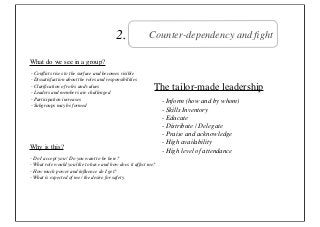
2.             Counter-dependency and fight

What do we see in a group?
- Conflicts rises to the surface and becomes visible
- Dissatisfaction about the roles and responsibilities
- Clarification of roles and values
- Leaders and members are challenged
                                                            The tailor-made leadership
- Participation increases
                                                                - Inform (how and by whom)
- Subgroups may be formed
                                                                - Skills Inventory
                                                                - Educate
                                                                - Distribute / Delegate
                                                                - Praise and acknowledge
                                                                - High availability
Why is this?
                                                                - High level of attendance
- Do I accept you / Do you want to be here?
- What role would you like to have and how does it affect me?
- How much power and influence do I get?
- What is expected of me / the desire for safety
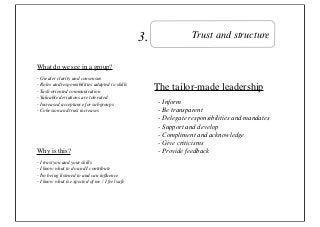
3.                Trust and structure


What do we see in a group?
- Greater clarity and consensus
- Roles and responsibilities adapted to skills
- Task-oriented communication
                                                      The tailor-made leadership
- Valuable deviations are tolerated
- Increased acceptance for subgroups                   - Inform
- Cohesion and trust increases                         - Be transparent
                                                       - Delegate responsibilities and mandates
                                                       - Support and develop
                                                       - Compliment and acknowledge
                                                       - Give criticisms
Why is this?                                           - Provide feedback
- I trust you and your skills
- I know what to do and I contribute
- I'm being listened to and can influence
- I know what is expected of me / I feel safe
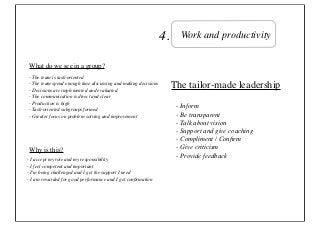
4.     Work and productivity

What do we see in a group?
- The team is task-oriented
- The team spend enough time discussing and making decisions
- Decisions are implemented and evaluated
                                                                    The tailor-made leadership
- The communication is direct and clear
- Production is high
- Task-oriented subgroups formed
                                                                     - Inform
- Greater focus on problem solving and improvement                   - Be transparent
                                                                     - Talk about vision
                                                                     - Support and give coaching
                                                                     - Compliment / Confirm
Why is this?                                                         - Give criticism
                                                                     - Provide feedback
- I accept my role and my responsibility
- I feel competent and important
- I'm being challenged and I get the support I need
- I am rewarded for good performance and I get confirmation
5.          Conclusion


What do we see in a group?
- Focus on the task reduces
- We are talking about irrelevant topics
- Resignation
                                             The tailor-made leadership
- irritation
- The leader and members can be challenged
                                             - Inform (what, how & why)
                                             - Confirm
                                             - Evaluate
                                             - Create relationship-oriented events
                                             - Control by clarity
Why is this?                                 - Celebrate
- What will happen to me now?
- What has been my contribution
- What do I take with me?
- What can I expect
- What is expected of me
- The desire for safety
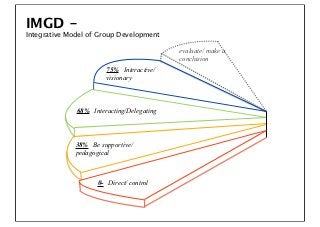
IMGD -
Integrative Model of Group Development

                                           evaluate/ make a
                                           conclusion
                       75% Interactive/
                       visionary


              68% Interacting/Delegating


              38% Be supportive/
              pedagogical


                    0- Direct/ control
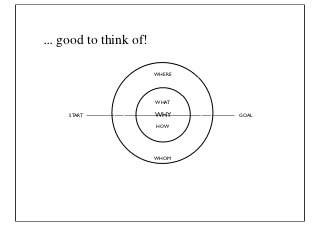
... good to think of!

                        WHERE


                        WHAT

     START              WHY     GOAL

                        HOW


                        WHOM
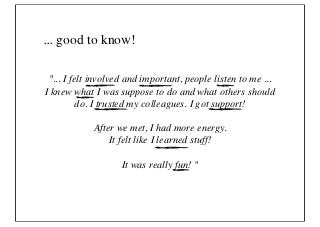
... good to know!

 "... I felt involved and important, people listen to me ...
I knew what I was suppose to do and what others should
          do. I trusted my colleagues. I got support!

            After we met, I had more energy.
                It felt like I learned stuff!

                    It was really fun! "
What we have done so far!

First session:
- Group development
- The tailor-made leadership

Second session:
- Self Awareness, strengths and areas of development
Thanks for listening to me and welcome back for the
                   second session!
Welcome
Sofia Arvegård
- Run my own business
- Work for the industry and different educational companies
- Studied labor relations at Stockholm University
- Passionate about group development and management

- Organisational developer
- Hyper Island


@arvegard
www.arvegard.com
sofia@arvegard.com
What are we going to do today?

First session:
- Group development
- The tailor-made leadership

Second session:
- Self Awareness, strengths and areas of development
How are we going to do this?

- Reflect upon your own behavior
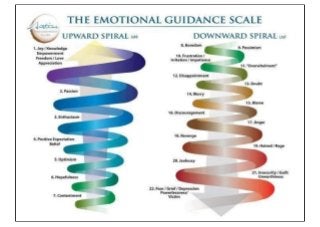
- Emotional Guidance scale
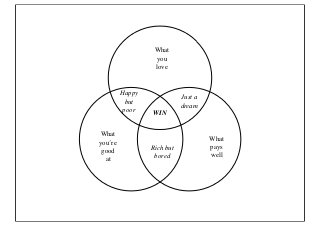
- Find your focus (love, competence and profitable)
- Find your goal 2013

Paper and a pen

- I wish for a dialogue, share your thoughts
- Action and consequent, No one is right or wrong
- Inspiration
- Increased knowledge and self awareness

No correct solutions, no correct answers
Why Self-awareness?
- My ability to manage my self and different assignments, different work relations and
different situations


- Our knowledge, theoretical and practical
- Our strengths and weaknesses
- Our strategies
- Our work capacity, our limitations
- Our passion


  You are increasing your chances of finding yourself in the right
   context, in the right environment and that will increase your
                    chances of becoming happy!
Create groups with 4 members in each group

   Make a short introduction of yourself
              - your name
      - your business / line of work
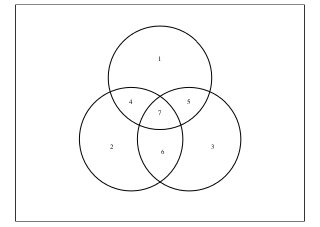
1


    4       5
        7


2               3
        6
What
                  you
                  love


         Happy
                            Just a
           but
                            dream
          poor
                 WIN


What
                                     What
you´re
                 Rich but            pays
 good
                  bored              well
  at
- network        Goal       - clients
- digital presence          - achievements
    - turnover
                     2013    - assignments


  - 5 bold concrete steps
Thank you for this day.
Good luck in the future.


sofia@arvegard.com
www.arvegard.com

BalticLab- Effecitve teams and self awareness

  • 1.
  • 2.
    Sofia Arvegård - Runmy own business - Work for the industry and different educational companies - Studied labor relations at Stockholm University - Passionate about group development and management - Organisational developer - Hyper Island @arvegard www.arvegard.com sofia@arvegard.com
  • 3.
    What are wegoing to do today? First session: - Group development - The tailor-made leadership Second session: - Self Awareness, strengths and areas of development
  • 4.
    How are wegoing to do this? - We will go though the latest research regarding group development - I wish for a dialogue whit thoughts and questions - I will share my own experiences and hopefully so will you - Action and consequent - Inspiration - Increased knowledge regarding groups and self awareness No correct solutions, no correct answers No one is right or wrong
  • 5.
    Is it necessaryfor us to understand groups? - Groups influence individuals -individuals influence groups - We need diversity to solve complex task - We need each other to achieve collective intelligence - Well functional groups are effective and profitable ”We can support groups better and we will become better leaders if we understand groups and learn how to interpret their needs”
  • 6.
    A little bitof history Susan A Wheelan - psychologist, scientist and author - studied 100 years of research - validated model of group development from a development perspective source: Create effective teams A group process from a development perspective
  • 7.
    Have you everbelonged to a well functional group?
  • 8.
    Yes, I have... "... I felt involved and important, people listen to me ... I knew what I was suppose to do and what others should do. I trusted my colleagues. I got support! After we met, I had more energy. It felt like I learned stuff! It was really fun! "
  • 9.
    Have you everbelonged to a dysfunctional group that was not as pleasant?
  • 10.
    Yes I have.... "... it was not fun ... I was overlooked. Nobody asked me what I thought. I did not feel that I contributed. I did not know what to do. I had a stomach ache before each meeting. It was a lot of bullshit at the coffee machine. The others were pretty weird! "
  • 11.
    IMGD - Integrative Modelof Group Development 5 4 Conclusion Work and productivity 3 Trust and structure Counter-dependency and fight 2 Dependency and inclusion 1
  • 12.
    1. Dependency and inclusion What do we see in a group? - Courtesy - Looking for directives from the leader - The members obey - Conflicts are rare - Talking about non-relevant subjects Why is this? - Will I be accepted - Fear of being rejected - The desire to belong - Insecurity regarding expectations - Need of safety
  • 13.
    2. Counter-dependency and fight What do we see in a group? - Conflicts rises to the surface and becomes visible - Dissatisfaction about the roles and responsibilities - Clarification of roles and values - Leaders and members are challenged - Participation increases - Subgroups may be formed Why is this? - Do I accept you / Do you want to be here? - What role would you like to have and how does it affect me? - How much power and influence do I get? - What is expected of me / the desire for safety
  • 14.
    3. Trust and structure What do we see in a group? - Greater clarity and consensus - Roles and responsibilities adapted to skills - Task-oriented communication - Valuable deviations are tolerated - Increased acceptance for subgroups - Cohesion and trust increases Why is this? - I trust you and your skills - I know what to do and I contribute - I'm being listened to and can influence - I know what is expected of me / I feel safe
  • 15.
    4. Work and productivity What do we see in a group? - The team is task-oriented - The team spend enough time discussing and making decisions - Decisions are implemented and evaluated - The communication is direct and clear - Production is high - Task-oriented subgroups formed - Greater focus on problem solving and improvement Why is this? - I accept my role and my responsibility - I feel competent and important - I'm being challenged and I get the support I need - I am rewarded for good performance and I get confirmation
  • 16.
    5. Conclusion What do we see in a group? - Focus on the task reduces - We are talking about irrelevant topics - Resignation - Irritation - The leader and members can be challenged Why is this? - What will happen to me now? - What has been my contribution - What do I take with me? - What can I expect - What is expected of me - The desire for safety
  • 17.
    IMGD - Integrative Modelof Group Development 5 4 Conclusion Work and productivity 3 Trust and structure Counter-dependency and fight 2 Dependency and inclusion 1
  • 18.
    1. Dependency and inclusion What do we see in a group? - Courteous - Looking for directives from the leader - The members abide The tailor-made leadership - Conflicts are rare - Talking about non-relevant subjects - Inform (what, how, whom, when, why, where) - Confirm - Create relationship-oriented events - Control by clarity - High availability - High level of attendance Why is this? - Will I be accepted - Fear of being rejected - The desire to belong - Insecurity regarding expectations - Need of safety
  • 19.
    2. Counter-dependency and fight What do we see in a group? - Conflicts rises to the surface and becomes visible - Dissatisfaction about the roles and responsibilities - Clarification of roles and values - Leaders and members are challenged The tailor-made leadership - Participation increases - Inform (how and by whom) - Subgroups may be formed - Skills Inventory - Educate - Distribute / Delegate - Praise and acknowledge - High availability Why is this? - High level of attendance - Do I accept you / Do you want to be here? - What role would you like to have and how does it affect me? - How much power and influence do I get? - What is expected of me / the desire for safety
  • 20.
    3. Trust and structure What do we see in a group? - Greater clarity and consensus - Roles and responsibilities adapted to skills - Task-oriented communication The tailor-made leadership - Valuable deviations are tolerated - Increased acceptance for subgroups - Inform - Cohesion and trust increases - Be transparent - Delegate responsibilities and mandates - Support and develop - Compliment and acknowledge - Give criticisms Why is this? - Provide feedback - I trust you and your skills - I know what to do and I contribute - I'm being listened to and can influence - I know what is expected of me / I feel safe
  • 21.
    4. Work and productivity What do we see in a group? - The team is task-oriented - The team spend enough time discussing and making decisions - Decisions are implemented and evaluated The tailor-made leadership - The communication is direct and clear - Production is high - Task-oriented subgroups formed - Inform - Greater focus on problem solving and improvement - Be transparent - Talk about vision - Support and give coaching - Compliment / Confirm Why is this? - Give criticism - Provide feedback - I accept my role and my responsibility - I feel competent and important - I'm being challenged and I get the support I need - I am rewarded for good performance and I get confirmation
  • 22.
    5. Conclusion What do we see in a group? - Focus on the task reduces - We are talking about irrelevant topics - Resignation The tailor-made leadership - irritation - The leader and members can be challenged - Inform (what, how & why) - Confirm - Evaluate - Create relationship-oriented events - Control by clarity Why is this? - Celebrate - What will happen to me now? - What has been my contribution - What do I take with me? - What can I expect - What is expected of me - The desire for safety
  • 23.
    IMGD - Integrative Modelof Group Development evaluate/ make a conclusion 75% Interactive/ visionary 68% Interacting/Delegating 38% Be supportive/ pedagogical 0- Direct/ control
  • 24.
    ... good tothink of! WHERE WHAT START WHY GOAL HOW WHOM
  • 25.
    ... good toknow! "... I felt involved and important, people listen to me ... I knew what I was suppose to do and what others should do. I trusted my colleagues. I got support! After we met, I had more energy. It felt like I learned stuff! It was really fun! "
  • 26.
    What we havedone so far! First session: - Group development - The tailor-made leadership Second session: - Self Awareness, strengths and areas of development
  • 27.
    Thanks for listeningto me and welcome back for the second session!
  • 28.
  • 29.
    Sofia Arvegård - Runmy own business - Work for the industry and different educational companies - Studied labor relations at Stockholm University - Passionate about group development and management - Organisational developer - Hyper Island @arvegard www.arvegard.com sofia@arvegard.com
  • 30.
    What are wegoing to do today? First session: - Group development - The tailor-made leadership Second session: - Self Awareness, strengths and areas of development
  • 31.
    How are wegoing to do this? - Reflect upon your own behavior - Emotional Guidance scale - Find your focus (love, competence and profitable) - Find your goal 2013 Paper and a pen - I wish for a dialogue, share your thoughts - Action and consequent, No one is right or wrong - Inspiration - Increased knowledge and self awareness No correct solutions, no correct answers
  • 32.
    Why Self-awareness? - Myability to manage my self and different assignments, different work relations and different situations - Our knowledge, theoretical and practical - Our strengths and weaknesses - Our strategies - Our work capacity, our limitations - Our passion You are increasing your chances of finding yourself in the right context, in the right environment and that will increase your chances of becoming happy!
  • 34.
    Create groups with4 members in each group Make a short introduction of yourself - your name - your business / line of work
  • 35.
    1 4 5 7 2 3 6
  • 36.
    What you love Happy Just a but dream poor WIN What What you´re Rich but pays good bored well at
  • 37.
    - network Goal - clients - digital presence - achievements - turnover 2013 - assignments - 5 bold concrete steps
  • 38.
    Thank you forthis day. Good luck in the future. sofia@arvegard.com www.arvegard.com