Introduction The map Course content The aim Personal mastery Close
The Map
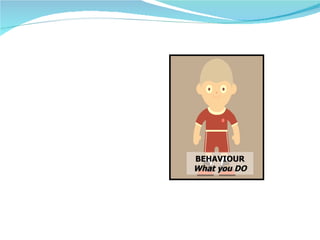
BEHAVIOUR What you DO
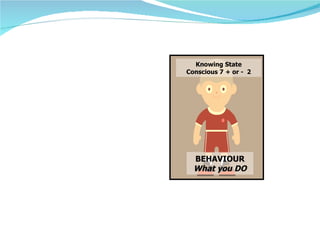
BEHAVIOUR What you DO Knowing State Conscious 7 + or -  2
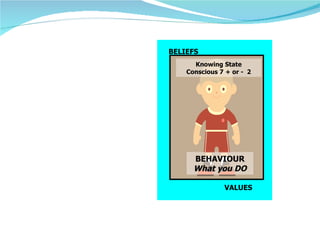
BELIEFS VALUES BEHAVIOUR What you DO Knowing State Conscious 7 + or -  2
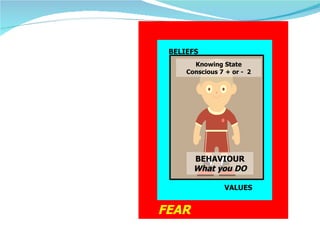
BELIEFS VALUES FEAR BEHAVIOUR What you DO Knowing State Conscious 7 + or -  2
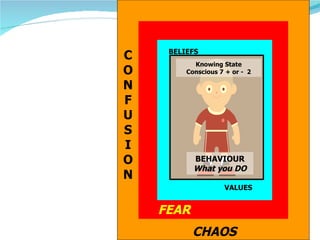
C O N F U S I O N CHAOS BELIEFS VALUES FEAR BEHAVIOUR What you DO Knowing State Conscious 7 + or -  2
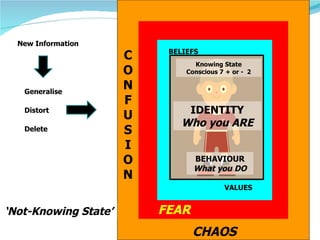
C O N F U S I O N CHAOS BELIEFS VALUES FEAR ‘ Not-Knowing State’ Generalise New Information Distort Delete IDENTITY Who you ARE BEHAVIOUR What you DO Knowing State Conscious 7 + or -  2
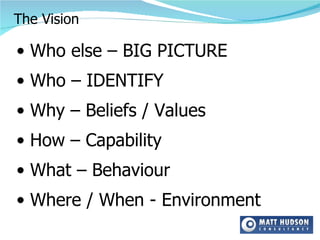
The Vision Who else – BIG PICTURE Who – IDENTIFY Why – Beliefs / Values How – Capability What – Behaviour Where / When - Environment PME
The Aim ‘ To create  one shared vision  for education’ PME
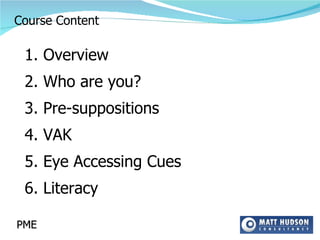
Course   Content Overview 2. Who are you? 3. Pre-suppositions 4. VAK 5. Eye Accessing Cues 6. Literacy PME
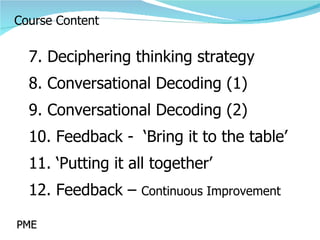
Course Content 7. Deciphering thinking strategy 8. Conversational Decoding (1) 9. Conversational Decoding (2) 10. Feedback -  ‘Bring it to the table’ 11. ‘Putting it all together’ 12. Feedback –  Continuous Improvement PME
The  Support  Network PME
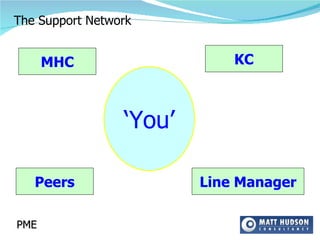
The Support Network ‘ You’ KC Line Manager Peers MHC PME
“ Personal mastery is the discipline of continually clarifying and deepening our personal vision, of focussing our energies, of developing patience, and of seeing reality objectives. As such, it is an essential cornerstone of the learning organisation – the learning organisation’s spiritual foundation.” (Senge P, The Fifth Discipline / Random House 2006) PME Personal Mastery & the Learning Organisation
”  When there is genuine vision (as opposed to the all-too-familiar ‘vision statement’, people excel and learn, not because they are told to, but because they want to” (Senge P, The Fifth Discipline  / Random House 2006) PME Personal Mastery & the Learning Organisation
Summary  &  Close PME

Presentation

  • 1.
  • 2.
    Introduction The mapCourse content The aim Personal mastery Close
  • 3.
  • 4.
  • 5.
    BEHAVIOUR What youDO Knowing State Conscious 7 + or - 2
  • 6.
    BELIEFS VALUES BEHAVIOURWhat you DO Knowing State Conscious 7 + or - 2
  • 7.
    BELIEFS VALUES FEARBEHAVIOUR What you DO Knowing State Conscious 7 + or - 2
  • 8.
    C O NF U S I O N CHAOS BELIEFS VALUES FEAR BEHAVIOUR What you DO Knowing State Conscious 7 + or - 2
  • 9.
    C O NF U S I O N CHAOS BELIEFS VALUES FEAR ‘ Not-Knowing State’ Generalise New Information Distort Delete IDENTITY Who you ARE BEHAVIOUR What you DO Knowing State Conscious 7 + or - 2
  • 10.
    The Vision Whoelse – BIG PICTURE Who – IDENTIFY Why – Beliefs / Values How – Capability What – Behaviour Where / When - Environment PME
  • 11.
    The Aim ‘To create one shared vision for education’ PME
  • 12.
    Course Content Overview 2. Who are you? 3. Pre-suppositions 4. VAK 5. Eye Accessing Cues 6. Literacy PME
  • 13.
    Course Content 7.Deciphering thinking strategy 8. Conversational Decoding (1) 9. Conversational Decoding (2) 10. Feedback - ‘Bring it to the table’ 11. ‘Putting it all together’ 12. Feedback – Continuous Improvement PME
  • 14.
    The Support Network PME
  • 15.
    The Support Network‘ You’ KC Line Manager Peers MHC PME
  • 16.
    “ Personal masteryis the discipline of continually clarifying and deepening our personal vision, of focussing our energies, of developing patience, and of seeing reality objectives. As such, it is an essential cornerstone of the learning organisation – the learning organisation’s spiritual foundation.” (Senge P, The Fifth Discipline / Random House 2006) PME Personal Mastery & the Learning Organisation
  • 17.
    ” Whenthere is genuine vision (as opposed to the all-too-familiar ‘vision statement’, people excel and learn, not because they are told to, but because they want to” (Senge P, The Fifth Discipline / Random House 2006) PME Personal Mastery & the Learning Organisation
  • 18.
    Summary & Close PME