UPDATE AND COMPLETION
MAPPING OF CIVIL SOCIETY ORGANISATIONS
IN PALESTINE
October 2014 – January 2015
BACKGROUND
• EU recognition of CSOs as a policy and governance actor
• EU engagement in supporting CSOs in the Southern Mediterranean:
the Civil Society Facility and regional interventions
• EU engagement in supporting CSOs in Palestine: the 2011 strategy
on supporting CSOs and the 2014 Roadmap for civil society
development
OBJECTIVES
The specific objective is:
"to update/upgrade the existing mapping study of 2011 by expanding its scope in
order to provide a comprehensive complete overview of the civil society state of
play in Palestine, including its capacity-building needs and recommendations for
better EU engagement with CSOs in/through cooperation and policy dialogue."
The study is expected to:
• Identify key CSOs and structures, key constraints and the main capacity
building needs.
• Identify the key policy areas with a focus on governance and policy dialogue.
• Provide an overview of donor strategies in civil society development .
• Propose recommendations for an operational strategy for effectively promoting
the engagement of civil society.
THEORETICAL AND METHODOLOGICAL FRAMEWORK
• A strategic approach to mapping
• A scope including West Bank and the Area C, East Jerusalem, Gaza Strip
• The use of a variety of information sources and consultation modalities:
• consultation of over 120 CSOs through individual meetings, focus group,
structured and semi-structured questionnaires;
• documentary analysis;
• consultation of key informants from IO, CSOs, INGOs, PA, LA, donors
MAIN STAKES AND ISSUES INVOLVING CSOS
• Uncertainty and the impediments imposed by the Israeli
occupation
• An unclear identity
• Challenging relationship with the public authorities
• Donors’ agendas and CSOs’ priorities
• The division between West Bank, Gaza strip and East Jerusalem
• Decentralisation process
• Need for innovation
• Cooperation among Palestinian CSOs and between PNGOs and
INGOs
EMERGING ISSUES AT REGIONAL AND LOCAL LEVEL
GAZA STIP:
• The reconstruction process
• The siege and the focus on emergency and relief
• The policy framework
EAST JERUSALEM:
• The sharpening of occupation practices
• Legal and funding uncertainty about East Jerusalem and about CSOs
• Absence of spaces and interlocutors
• Increased isolation
AREA C:
• Separation wall and check point control and isolation system
• Security forces influence
• Isolation and integration dynamics in PA policies and service mechanisms
CSO ENGAGEMENT IN GOVERNANCE AND POLICY DIALOGUE (A)
Emerging opportunities
• Policy setting and law formulation
• Good governance and social accountability
• Public service monitoring and improvement
• Decentralisation and local governance
• International cooperation and International advocacy
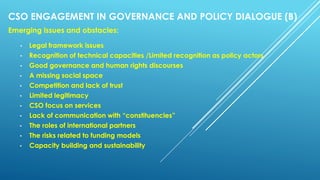
CSO ENGAGEMENT IN GOVERNANCE AND POLICY DIALOGUE (B)
Emerging issues and obstacles:
• Legal framework issues
• Recognition of technical capacities /Limited recognition as policy actors
• Good governance and human rights discourses
• A missing social space
• Competition and lack of trust
• Limited legitimacy
• CSO focus on services
• Lack of communication with “constituencies”
• The roles of international partners
• The risks related to funding models
• Capacity building and sustainability
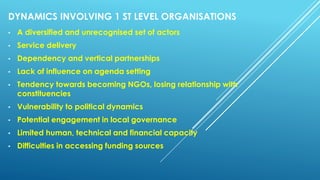
DYNAMICS INVOLVING 1 ST LEVEL ORGANISATIONS
• A diversified and unrecognised set of actors
• Service delivery
• Dependency and vertical partnerships
• Lack of influence on agenda setting
• Tendency towards becoming NGOs, losing relationship with
constituencies
• Vulnerability to political dynamics
• Potential engagement in local governance
• Limited human, technical and financial capacity
• Difficulties in accessing funding sources
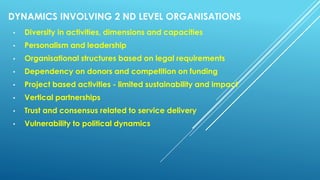
DYNAMICS INVOLVING 2 ND LEVEL ORGANISATIONS
• Diversity in activities, dimensions and capacities
• Personalism and leadership
• Organisational structures based on legal requirements
• Dependency on donors and competition on funding
• Project based activities - limited sustainability and impact
• Vertical partnerships
• Trust and consensus related to service delivery
• Vulnerability to political dynamics
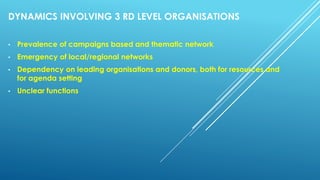
DYNAMICS INVOLVING 3 RD LEVEL ORGANISATIONS
• Prevalence of campaigns based and thematic network
• Emergency of local/regional networks
• Dependency on leading organisations and donors, both for resources and
for agenda setting
• Unclear functions
DYNAMICS INVOLVING 4TH LEVEL ORGANISATIONS
• New functions and increased vitality
• Increased coordination and cooperation
• Weak capacities, organisational consistency, and unclear
agendas
• Risk of competition with members
• Weak participation and engagement of member
• Unclear goals, missions, functions, division of responsibilities
RESOURCES FOR CSO DEVELOPMENT
 Strengthening of CSO technical and organisational
capacities
 Support to legal framework revision, sector regulation,
self-regulation and coordination
 Support to networks and platforms
 Support for human rights and governance monitoring
 Support for the establishment and functioning of local
governance and people participation mechanisms
CONCLUDING REMARKS
 Fostering bridges
 Supporting networking, knowledge management and agenda setting
 Fostering the improvement of the legal framework
 Providing Political/Diplomatic support
 Including participatory governance mechanisms in all cooperation initiatives
 Including participatory governance mechanisms in initiatives for
strengthening /supporting public services
 Shifting from training to “institutional capacity building”
 Strengthening support to long-term initiatives and core funding mechanisms,
through different mechanisms at different levels
 Balance support among the different levels of CSOs; with a special focus on
self-help groups and youth initiatives/movements, and women groups.
QUESTIONS FOR THE DISCUSSION
 Are there other elements (processes, dynamics, actors, to be
considered ?
 Are the recommendations relevant?
 Based on your experiences how the EU can better support
CSOs ? Are there specific issues to be included in next calls
for proposals and projects?

Presentation OPT_CSO Mapping_Gen_re

  • 1.
    UPDATE AND COMPLETION MAPPINGOF CIVIL SOCIETY ORGANISATIONS IN PALESTINE October 2014 – January 2015
  • 2.
    BACKGROUND • EU recognitionof CSOs as a policy and governance actor • EU engagement in supporting CSOs in the Southern Mediterranean: the Civil Society Facility and regional interventions • EU engagement in supporting CSOs in Palestine: the 2011 strategy on supporting CSOs and the 2014 Roadmap for civil society development
  • 3.
    OBJECTIVES The specific objectiveis: "to update/upgrade the existing mapping study of 2011 by expanding its scope in order to provide a comprehensive complete overview of the civil society state of play in Palestine, including its capacity-building needs and recommendations for better EU engagement with CSOs in/through cooperation and policy dialogue." The study is expected to: • Identify key CSOs and structures, key constraints and the main capacity building needs. • Identify the key policy areas with a focus on governance and policy dialogue. • Provide an overview of donor strategies in civil society development . • Propose recommendations for an operational strategy for effectively promoting the engagement of civil society.
  • 4.
    THEORETICAL AND METHODOLOGICALFRAMEWORK • A strategic approach to mapping • A scope including West Bank and the Area C, East Jerusalem, Gaza Strip • The use of a variety of information sources and consultation modalities: • consultation of over 120 CSOs through individual meetings, focus group, structured and semi-structured questionnaires; • documentary analysis; • consultation of key informants from IO, CSOs, INGOs, PA, LA, donors
  • 5.
    MAIN STAKES ANDISSUES INVOLVING CSOS • Uncertainty and the impediments imposed by the Israeli occupation • An unclear identity • Challenging relationship with the public authorities • Donors’ agendas and CSOs’ priorities • The division between West Bank, Gaza strip and East Jerusalem • Decentralisation process • Need for innovation • Cooperation among Palestinian CSOs and between PNGOs and INGOs
  • 6.
    EMERGING ISSUES ATREGIONAL AND LOCAL LEVEL GAZA STIP: • The reconstruction process • The siege and the focus on emergency and relief • The policy framework EAST JERUSALEM: • The sharpening of occupation practices • Legal and funding uncertainty about East Jerusalem and about CSOs • Absence of spaces and interlocutors • Increased isolation AREA C: • Separation wall and check point control and isolation system • Security forces influence • Isolation and integration dynamics in PA policies and service mechanisms
  • 7.
    CSO ENGAGEMENT INGOVERNANCE AND POLICY DIALOGUE (A) Emerging opportunities • Policy setting and law formulation • Good governance and social accountability • Public service monitoring and improvement • Decentralisation and local governance • International cooperation and International advocacy
  • 8.
    CSO ENGAGEMENT INGOVERNANCE AND POLICY DIALOGUE (B) Emerging issues and obstacles: • Legal framework issues • Recognition of technical capacities /Limited recognition as policy actors • Good governance and human rights discourses • A missing social space • Competition and lack of trust • Limited legitimacy • CSO focus on services • Lack of communication with “constituencies” • The roles of international partners • The risks related to funding models • Capacity building and sustainability
  • 9.
    DYNAMICS INVOLVING 1ST LEVEL ORGANISATIONS • A diversified and unrecognised set of actors • Service delivery • Dependency and vertical partnerships • Lack of influence on agenda setting • Tendency towards becoming NGOs, losing relationship with constituencies • Vulnerability to political dynamics • Potential engagement in local governance • Limited human, technical and financial capacity • Difficulties in accessing funding sources
  • 10.
    DYNAMICS INVOLVING 2ND LEVEL ORGANISATIONS • Diversity in activities, dimensions and capacities • Personalism and leadership • Organisational structures based on legal requirements • Dependency on donors and competition on funding • Project based activities - limited sustainability and impact • Vertical partnerships • Trust and consensus related to service delivery • Vulnerability to political dynamics
  • 11.
    DYNAMICS INVOLVING 3RD LEVEL ORGANISATIONS • Prevalence of campaigns based and thematic network • Emergency of local/regional networks • Dependency on leading organisations and donors, both for resources and for agenda setting • Unclear functions
  • 12.
    DYNAMICS INVOLVING 4THLEVEL ORGANISATIONS • New functions and increased vitality • Increased coordination and cooperation • Weak capacities, organisational consistency, and unclear agendas • Risk of competition with members • Weak participation and engagement of member • Unclear goals, missions, functions, division of responsibilities
  • 13.
    RESOURCES FOR CSODEVELOPMENT  Strengthening of CSO technical and organisational capacities  Support to legal framework revision, sector regulation, self-regulation and coordination  Support to networks and platforms  Support for human rights and governance monitoring  Support for the establishment and functioning of local governance and people participation mechanisms
  • 14.
    CONCLUDING REMARKS  Fosteringbridges  Supporting networking, knowledge management and agenda setting  Fostering the improvement of the legal framework  Providing Political/Diplomatic support  Including participatory governance mechanisms in all cooperation initiatives  Including participatory governance mechanisms in initiatives for strengthening /supporting public services  Shifting from training to “institutional capacity building”  Strengthening support to long-term initiatives and core funding mechanisms, through different mechanisms at different levels  Balance support among the different levels of CSOs; with a special focus on self-help groups and youth initiatives/movements, and women groups.
  • 15.
    QUESTIONS FOR THEDISCUSSION  Are there other elements (processes, dynamics, actors, to be considered ?  Are the recommendations relevant?  Based on your experiences how the EU can better support CSOs ? Are there specific issues to be included in next calls for proposals and projects?